 Скачать презентацию Chapter 3 Global Environment and Entrepreneurship Lecture outline
3612b11da511769720c346b55592d288.ppt
- Количество слайдов: 29



Chapter 3 Global Environment and Entrepreneurship Lecture outline: • The Global borderless internet environment ØEthnocentrism, The role of technology and Internet in the global village, The Economic environment, Classifying business in the global village • Taking the business global: ØGlobal sourcing, Importing and Exporting, Licensing, Contracting, Joint Venture, Direct Investment, The role of the Internet in taking the business global • Entrepreneurship ØNew venture Entrepreneurs and Intrapreneurs, Contributions of Entrepreneurs, Selecting the new venture, the business plan • Global Business practices ØPractices of large global companies, Practices of small international companies • Global diversity ØCultural Diversity, Diversity in Work-related values, Diversity in management functions
The Global Borderless Environment` • Ethnocentrism –Regarding one’s own group or culture as superior to others (e. g. , “Buy American”). • The Role of Technology and the Internet in the Global Village -The global village refers to companies conducting business worldwide without boundaries. Technological advances have made the global village possible, particularly travel and communications. The Internet and E-Commerce and wireless communications will continue to play a more important role in the global village. Commerce/E-Business –Any transaction that occurs when data are processed and transmitted over the Internet as in a business-to-business (b 2 b) approach. Wireless communication –With the Internet and wireless communication devices, such as mobile phone or the “web pocket” is rapidly becoming a compelling solution to speeding communication and business. E-business, including b 2 b and wireless, is making the virtual organization an increasingly dominant business model. 2
The Global Borderless Environment 1. Economic Development • 2. The level of economic develop varies widely globally and is commonly classified, based of wealth, as either “developed (North America, Europe, Japan) or “developing” (rest of the world) Infrastructure • Infrastructure is a country’s physical facilities, including transportation (airports, highways, railroad, public transportation etc), communication (telephone and mass media) and utilities(power plants). Developed countries have well developed infrastructure than the developing countries 3. Exchange Rates • The exchange is how many of one country’s currency you get for another company’s. A currency is considered strong when you get more in the exchange, and weak when you get less. Fluctuations in EX can have a great impact on profitability.
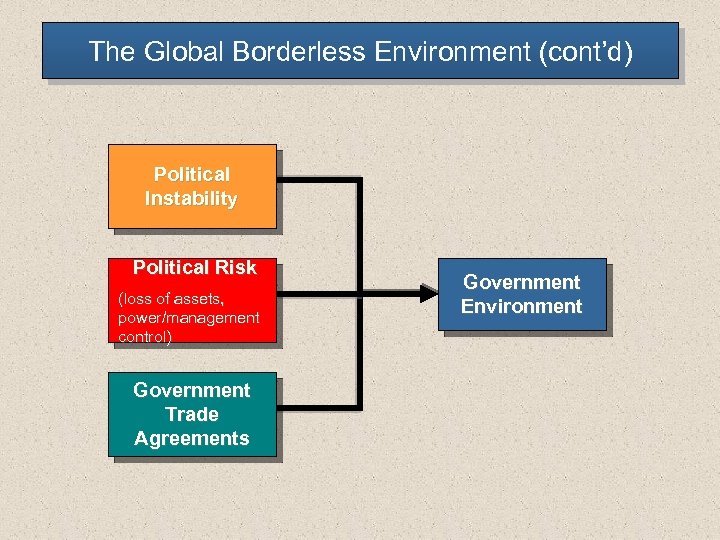
The Global Borderless Environment (cont’d) Political Instability Political Risk (loss of assets, power/management control) Government Trade Agreements Government Environment
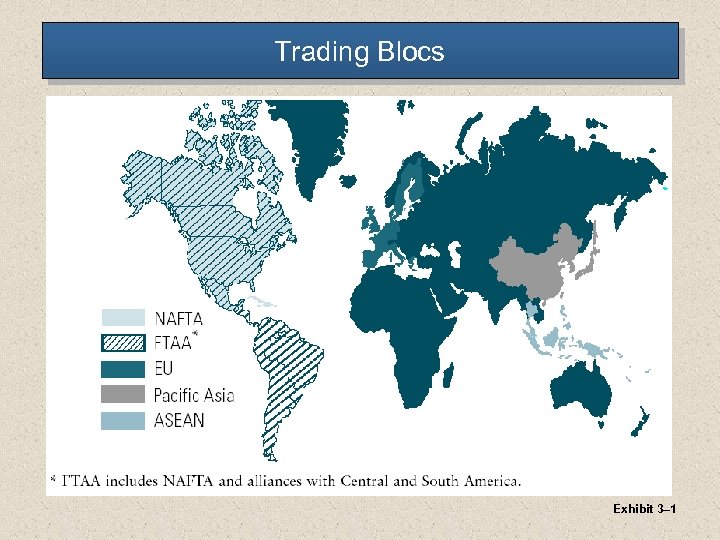
Trading Blocs Exhibit 3– 1
The Global Borderless Environment (cont’d) • Global Trade Agreements – General Agreement on Tariffs and Trade (GATT) • Free trade between more than 100 countries – North American Free Trade Agreement • United States, Canada, and Mexico – Association of Southeast Asian Nations (ASEAN) (6 members) – The Asia-Pacific Economic Cooperation (APEC) • Trade Alliances – European Union (EU) (15 countries) • A single market without national barriers to travel, employment, investment, and trade • Euro (€): single currency for the EU. 6
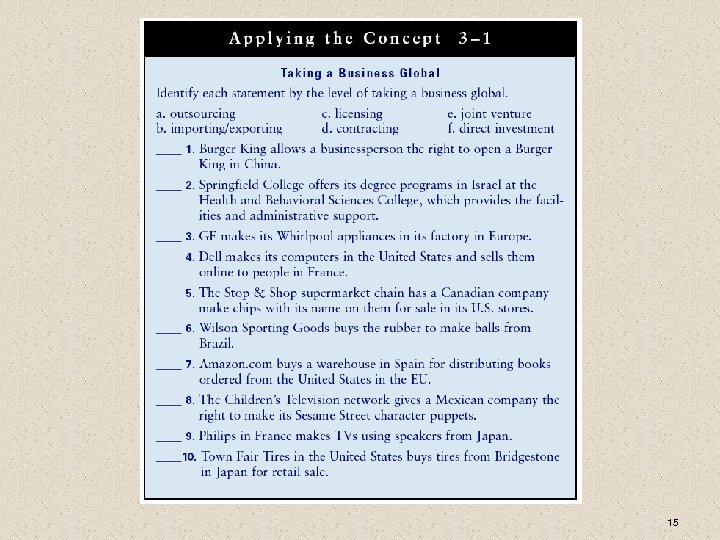
Taking the business Global • Global Sourcing – The use of worldwide resources (outsourcing). • Importing – Domestic firm buys products from foreign firms and sells them in its home market. • Exporting – Domestic firm sells its locally-made products to foreign buyers in overseas markets. 7
Classifying Global Village Businesses (cont’d) • Licensing – One company allows another company to use its assets (intellectual property) for a fee. • Brand name, trademark, technology, patent, and copyright – Franchising • For a fee, a franchiser provides the franchisee with the assets and support to conduct a business using the franchiser’s business model for its operations. 8
Classifying Global Village Businesses (cont’d) Advantages of Franchising from Franchisees’ view: 1. Avoiding the unnecessary trial and error period in starting and cooperating a new business. 2. Lower financial risk, compared to other ventures, because investment costs are lower and profit margins are higher. 3. Business Format Franchising complete packages ensure a ready to go “turn-key” franchised unit. 4. Managing a small business whilst depending on the power of the franchisor company which has a bigger organization. 5. The opportunity to learn the latest developments and changes in the local and global market from the franchisor and focus entirely on developing the sales revenues. 6. The benefit of operating under a recognized trade name/ trademark, which can have better marketing results. 8. The franchisee has access to accumulated business experience and technical know-how in managing the business. 9
Classifying Global Village Businesses (cont’d) Disadvantages of Franchising from Franchisees’ view: 1. The requirement to pay the franchise fees and royalty to the franchisor, which in some cases can be exaggerated. 2. The transfer of all goodwill built in the local market to the franchisor upon expiration or termination of the franchise contract. 3. The necessity of abiding by the franchisor’s operating systems, standards, policies and procedures. 4. Reduced corporate profit margin due to payment of royalties and levies. 10
Classifying Global Village Businesses (cont’d) • Contracting – A company has a foreign firm manufacture the goods while retaining the marketing process. • Joint Venture – A enterprise that is created when firms agree to share in its ownership. Advantages: – Sufficient Resources 1. Ability and Experience: In joint venture the different venturers may be having different skills and experience. 2. Access to improved resources like experienced technicians, experienced staff, greater capacity, etc. 3. Spreading of Cost and Risk: The co-ventures agree to share the profits and losses in a particular ratio. The implies that the cost and risk are also borne by them in that ratio. 11
Classifying Global Village Businesses (cont’d) – Disadvantages: 1. It takes time and efforts to form the right relationship. 2. The objectives of each partner may differ. The objectives needs to be clearly defined and communicated to everyone involved. 3. Imbalance in the share of capital, expertise, investment etc. , may cause conflicts between the partners. 4. Difference in the culture and style of business lead to poor co-operation or cultural conflicts. 5. Lack of assuming responsibility by the partners may lead the collapse of business. 6. Lack of communication between the partners may affect the business. 12
Classifying Global Village Businesses (cont’d) • Direct Investment – Investment that occurs when a company builds or purchases operating facilities (subsidiaries) in a foreign country. (Fed. Ex) 13
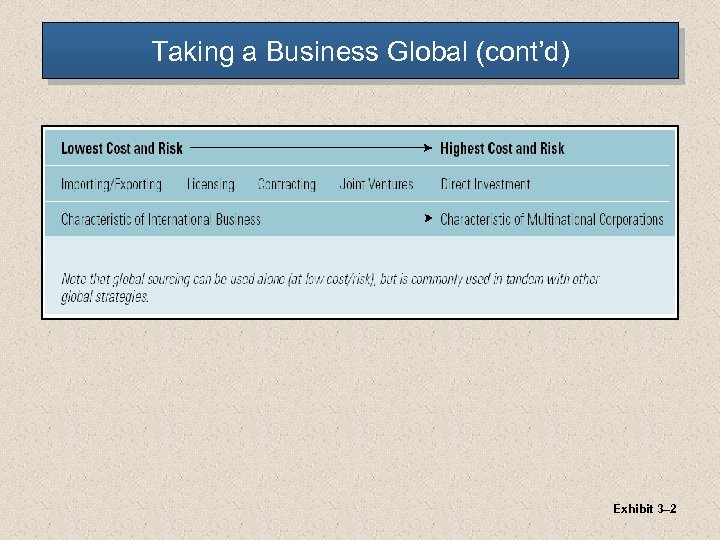
Taking a Business Global (cont’d) Exhibit 3– 2
15
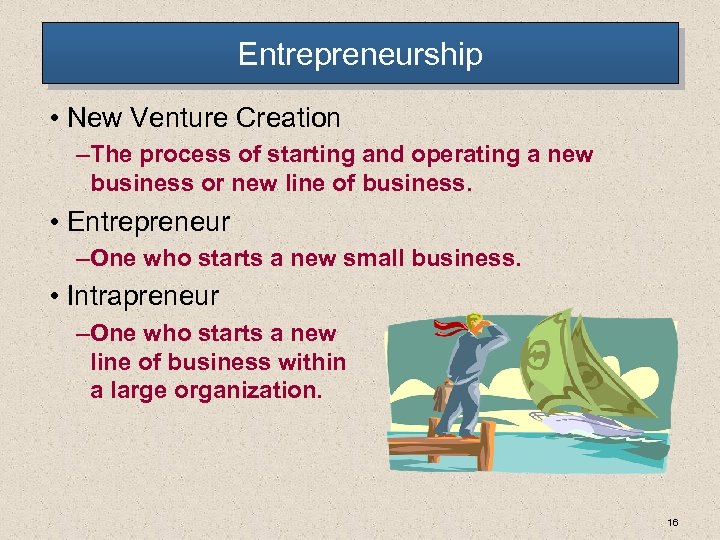
Entrepreneurship • New Venture Creation – The process of starting and operating a new business or new line of business. • Entrepreneur – One who starts a new small business. • Intrapreneur – One who starts a new line of business within a large organization. 16
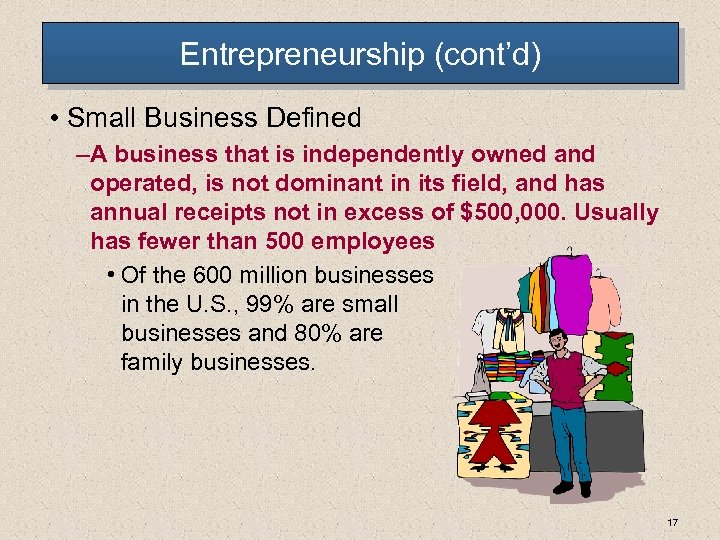
Entrepreneurship (cont’d) • Small Business Defined – A business that is independently owned and operated, is not dominant in its field, and has annual receipts not in excess of $500, 000. Usually has fewer than 500 employees • Of the 600 million businesses in the U. S. , 99% are small businesses and 80% are family businesses. 17
Contributions of Entrepreneurs provide three major contributions to society: innovation, job creation and economic growth, and contributions to large business. Innovation: Much of the creativity and innovation comes from entrepreneurs. Job Creation and Economic Growth: Small business create more new jobs than large business Contributions to Large Business: Small business are the primary supplier and distributors of products for large business. What is the difference between entrepreneurs and intrapreneurs ? -Risk taking. Entrepreneurs commonly are more risky to their personal assets as they finance part or all of their business. Intrapreneurs commonly have no risk of personal investment as the large company always provides the financing.
Selecting the New Venture • Factors in Selecting a New Venture – Good growth potential and profit opportunities – Previous work experience – Observing others’ mistakes and successes – Finding an overlooked market segment or niche – Hobby • Competitive Advantage – Specifies how the organization offers unique customer value. • First-mover advantage involves offering a unique customer value before competitors do. 19
Selecting the New Venture • Five Most Commonly Used Entrepreneurial Strategies – Create a competitive advantage. – Maintain innovation. – Lower the costs of developing/maintaining one’s venture. – Defend product/service as it is now. – Create a first-mover advantage. 20
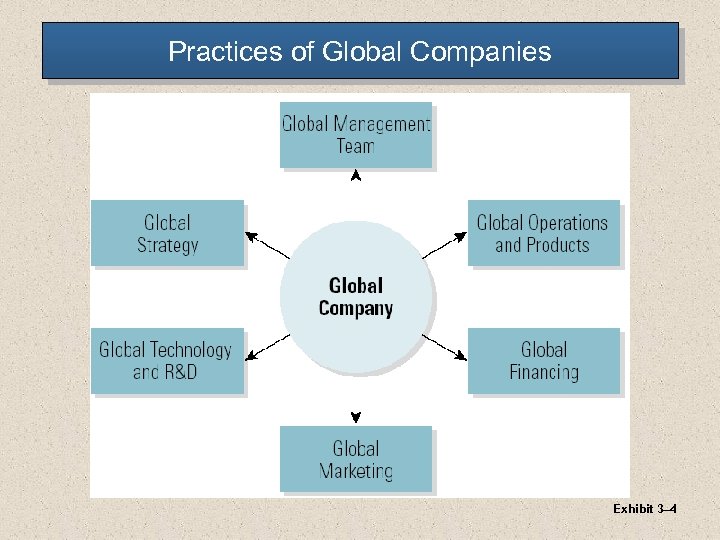
Practices of Global Companies Exhibit 3– 4
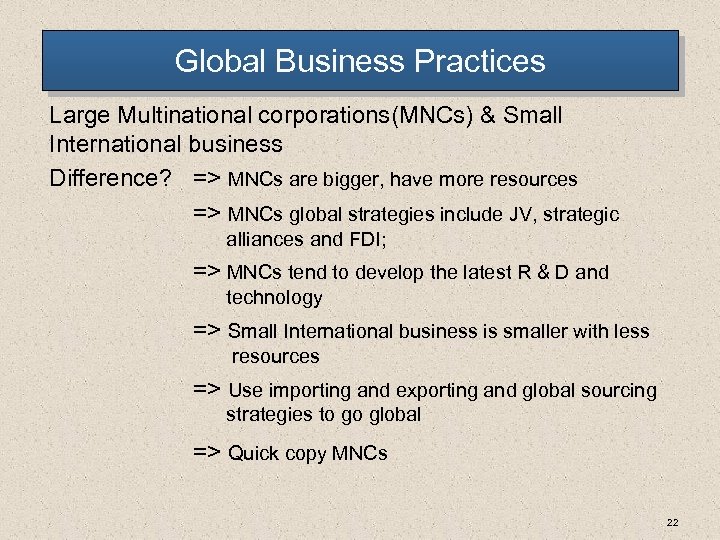
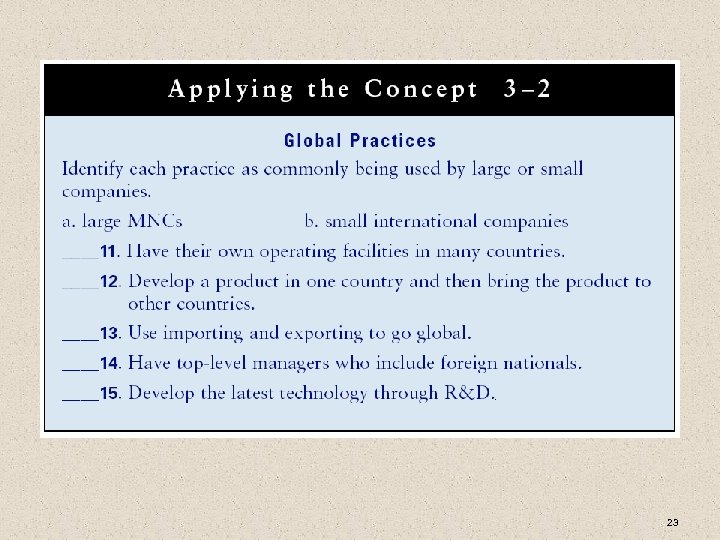
Global Business Practices Large Multinational corporations(MNCs) & Small International business Difference? => MNCs are bigger, have more resources => MNCs global strategies include JV, strategic alliances and FDI; => MNCs tend to develop the latest R & D and technology => Small International business is smaller with less resources => Use importing and exporting and global sourcing strategies to go global => Quick copy MNCs 22
23
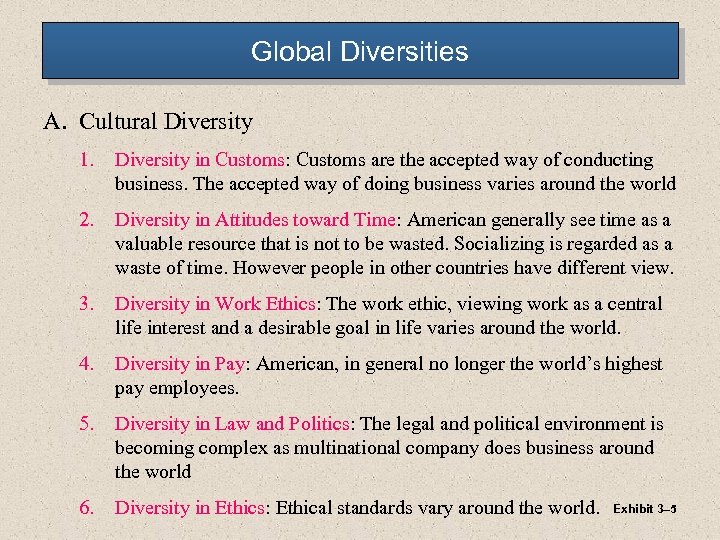
Global Diversities A. Cultural Diversity 1. Diversity in Customs: Customs are the accepted way of conducting business. The accepted way of doing business varies around the world 2. Diversity in Attitudes toward Time: American generally see time as a valuable resource that is not to be wasted. Socializing is regarded as a waste of time. However people in other countries have different view. 3. Diversity in Work Ethics: The work ethic, viewing work as a central life interest and a desirable goal in life varies around the world. 4. Diversity in Pay: American, in general no longer the world’s highest pay employees. 5. Diversity in Law and Politics: The legal and political environment is becoming complex as multinational company does business around the world 6. Diversity in Ethics: Ethical standards vary around the world. Exhibit 3– 5
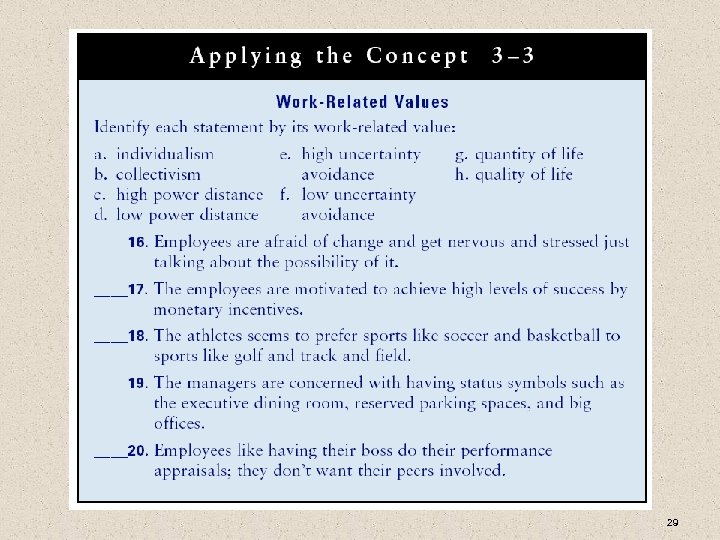
Global Diversity B. Diversity in Work-Related Values – Geert Hofstede’s Dimensions of National Value Systems • Individualism/Collectivism: Individualism reflects the value of a loosely knit social framework where people take care of themselves and immediate family. Collectivism reflect the value of a tightly knit social framework where people take care of each other and organizations take care of employees’ interest. This refers to the strength of the ties people have to others within the community. A high IDV score indicates a loose connection with people. In countries with a high IDV score there is a lack of interpersonal connection and little sharing of responsibility, beyond family and perhaps a few close friends. A society with a low IDV score would have strong group cohesion, and there would be a large amount of loyalty and respect for members of the group. The group itself is also larger and people take more responsibility for each other's well being. • High/Low Power Distance: High power distance societies accept inequality of authority in an organization where low power distance societies value equality. This refers to the degree of inequality that exists – and is accepted – among people with and without power. A high PD score indicates that society accepts an unequal distribution of power and people understand "their place" in the system. Low PD means that power is shared and well dispersed. It also means that society members view themselves as equals. 25
Global Diversity • Masculinity (MAS) – This refers to how much a society sticks with, and values, traditional male and female roles. High MAS scores are found in countries where men are expected to be tough, to be the provider, to be assertive and to be strong. If women work outside the home, they have separate professions from men. Low MAS scores do not reverse the gender roles. In a low MAS society, the roles are simply blurred. You see women and men working together equally across many professions. Men are allowed to be sensitive and women can work hard for professional success. • High/Low Uncertainty Avoidance: This relates to the degree of anxiety society members feel when in uncertain or unknown situations. High UA cultures have high level of anxiety with uncertainty and thus try to avoid ambiguous situations whenever possible. They are governed by rules and order and they seek a collective "truth". Low UA accept uncertainty and ambiguity and indicate the society enjoys novel events and values differences. There are very few rules and people are encouraged to discover their own truth. 26
Global Diversity • Long Term Orientation (LTO) / Time Orientation – • This refers to how much society values long-standing – as opposed to short term – traditions and values. This is the fifth dimension that Hofstede added in the 1990 s after finding that Asian countries with a strong link to Confucian philosophy acted differently from western cultures. In countries with a high LTO score, delivering on social obligations and avoiding "loss of face" are considered very important. • According to Hofstede's analysis, people in the United States and United Kingdom have low LTO scores. This may imply that people in the US and UK don't value tradition as much as many others, and are therefore likely to be willing to help you execute the most innovative plans as long as they get to participate fully. 27
Global Diversity • Diversity in Management Functions – Management practices that work well in one country may not work in another country. – Managers must base their actions on the characteristics and work-related values of the country in which they are operating. • The Global Learning Organizations – Successful multinational organizations value sharing knowledge to adapt to their diverse and changing environments. 28
29
Скачать презентацию Chapter 3 Global Environment and Entrepreneurship Lecture outline
3612b11da511769720c346b55592d288.ppt