 Скачать презентацию Chapter 3 Distributive Bargaining 3 -2 Distributive
daf5153b34b948590673908cc4b7be83.ppt
- Количество слайдов: 32



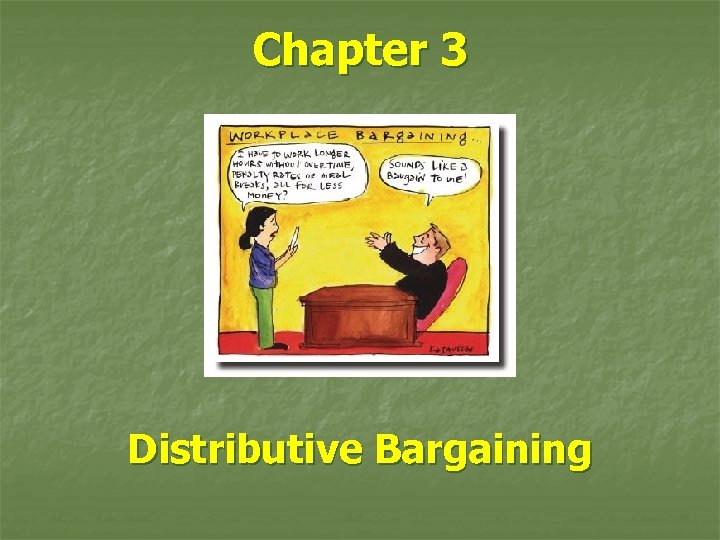
Chapter 3 Distributive Bargaining
3 -2 Distributive Bargaining Defined: “A negotiation method in which two parties strive to divide a fixed pool of resources, each trying to maximize its share of the distribution”
3 -3 Distributive Bargaining Also commonly known as: n A “fixed-sum” process n A “zero-sum” process n “Win-lose” bargaining n “Hard bargaining”
Why? n n 3 -4 Because many situations are perceived as single issue – money – and each dollar “gained” by one party is “lost” by the other party Easily identified example: the negotiated sale of a big-ticket item (house, car) between a seller and a buyer
3 -5 Three Components of a Distributive Bargaining Model 1. The parties view each other as adversaries 2. The objective of both parties is to maximize their self-interest, or share of “the pie” 3. The parties are only concerned about the content of the current negotiation and act as if they expect no future relationship
Five Negotiation Skills n n n 3 -6 Skill 3. 1: Recognize a distributive bargaining situation’s three key components Skill 3. 2: Determine a reservation price Skill 3. 3: Use bracketing of the other party’s offer Skill 3. 4: Recognize and use social norms to evaluate offers Skill 3. 5: Learn the framing of offers to influence how they are perceived
3 -7 Chapter Case: Buying a Work of Art n n n Successful California artist Chris Comte has a painting titled “Sunday” on display in her studio A vacationing couple from Texas admire the painting one day, and return the next to offer Chris $7, 500. The listed price is $12, 500 and Chris tells them it is one of her best works Why is this a distributive bargaining situation?
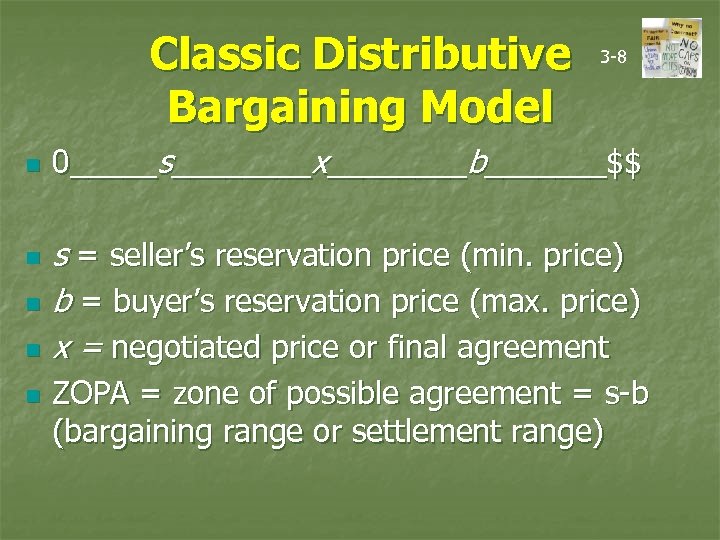
Classic Distributive Bargaining Model n n n 3 -8 0_____s____x____b_______$$ s = seller’s reservation price (min. price) b = buyer’s reservation price (max. price) x = negotiated price or final agreement ZOPA = zone of possible agreement = s-b (bargaining range or settlement range)
3 -9 “The Negotiation Dance” n Inexperienced negotiators often use the classic distributive bargaining model They start with opening offers and then “dance around” with counteroffers until one near “x” is agreed upon n Why is this often NOT a good strategy? n
3 -10 The Importance of Information (cont. ) n n Skilled negotiators utilize information to support their offers or diffuse other offers Three types of information: n Relational: Focus on relationship between the parties n Example: “How can you trust this is your best price? ”
3 -11 The Importance of Information Substantive: Use of facts, reason, and logic n Example: “Our price is based on the bank’s approval loan limit” n Procedural: Discuss the process n Example: “We will engage in discussions after we receive certain information” n
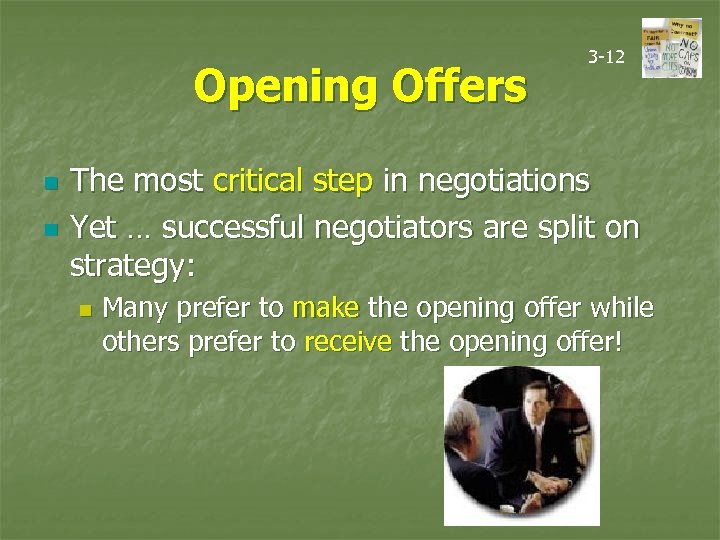
Opening Offers n n 3 -12 The most critical step in negotiations Yet … successful negotiators are split on strategy: n Many prefer to make the opening offer while others prefer to receive the opening offer!
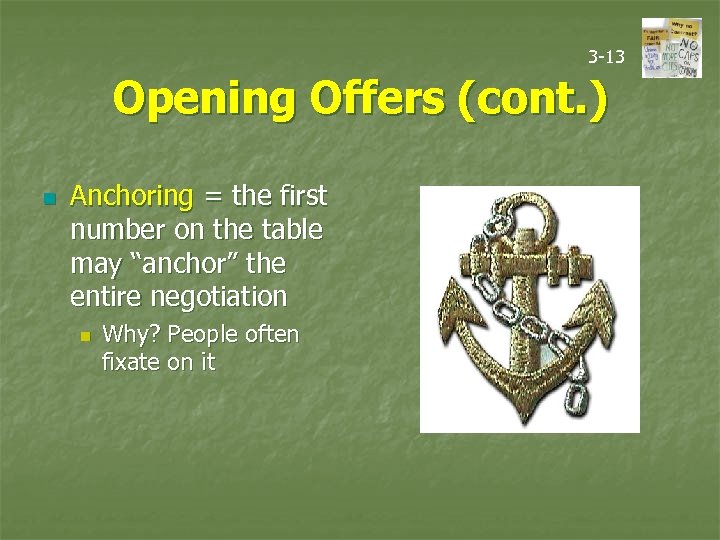
3 -13 Opening Offers (cont. ) n Anchoring = the first number on the table may “anchor” the entire negotiation n Why? People often fixate on it
3 -14 Opening Offers (cont. ) n Three types of opening offers which can anchor the negotiations Facts: “The average price paid in the past year is $350, 000” n Extreme: “This is the most valuable lot and home in the entire neighborhood!” n Precedent: “My last supervisor always gave me the highest rating” n
3 -15 Inexperienced Negotiators n May Easily Let the Opening Offer Anchor the Deal
Bracketing n Defined: The logical process of moving toward a middle point between the opening offers n n 3 -16 Example: Seller’s listed price = $15, 000; buyer desires to pay $13, 000, thus opens with $11, 000 Thus, a negotiator may “bracket” the other party’s opening offer by setting their own opening offer the same distance away from the desired value
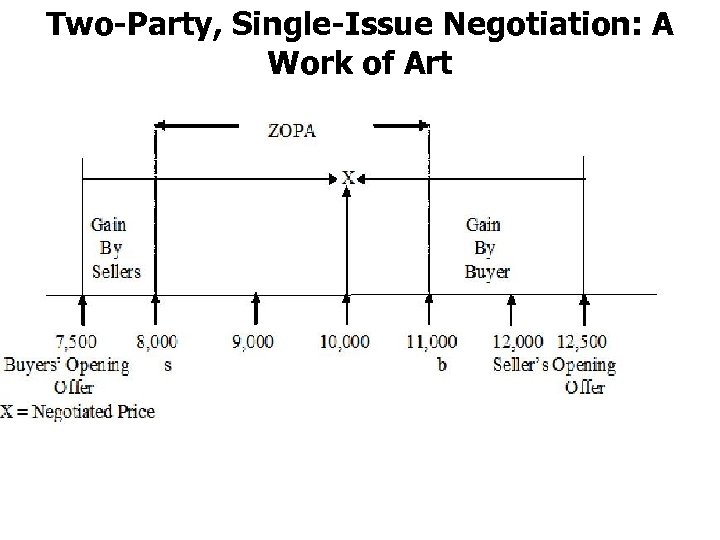
Two-Party, Single-Issue Negotiation: A Work of Art
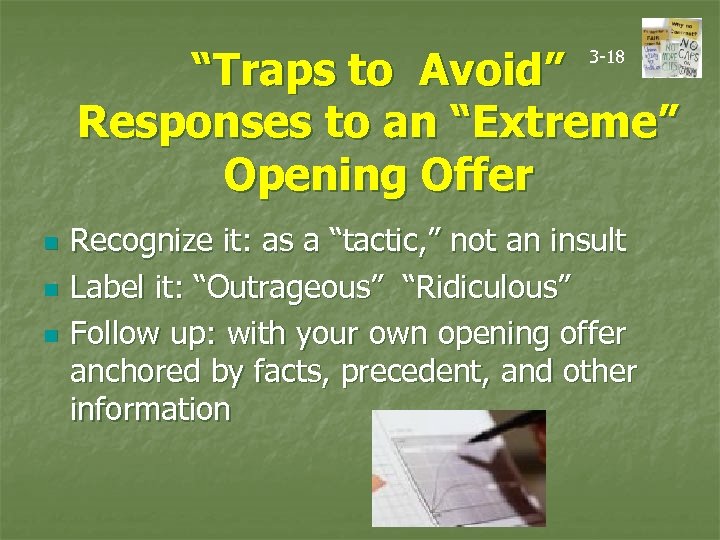
“Traps to Avoid” Responses to an “Extreme” Opening Offer 3 -18 n n n Recognize it: as a “tactic, ” not an insult Label it: “Outrageous” “Ridiculous” Follow up: with your own opening offer anchored by facts, precedent, and other information
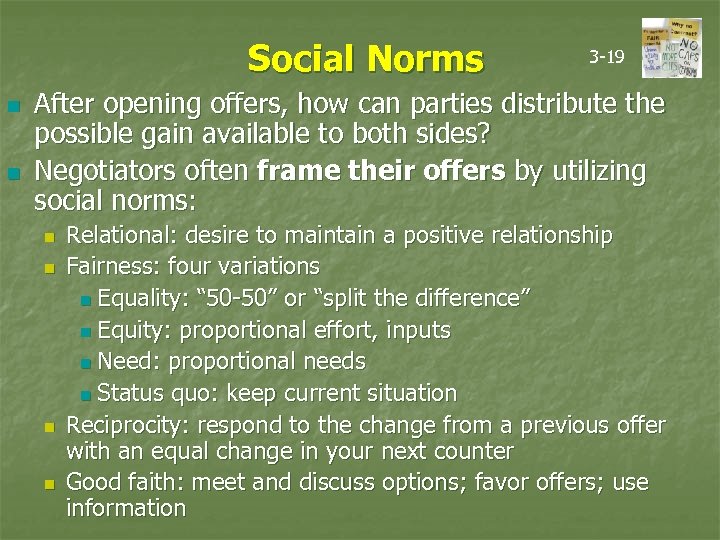
Social Norms n n 3 -19 After opening offers, how can parties distribute the possible gain available to both sides? Negotiators often frame their offers by utilizing social norms: n n Relational: desire to maintain a positive relationship Fairness: four variations n Equality: “ 50 -50” or “split the difference” n Equity: proportional effort, inputs n Need: proportional needs n Status quo: keep current situation Reciprocity: respond to the change from a previous offer with an equal change in your next counter Good faith: meet and discuss options; favor offers; use information
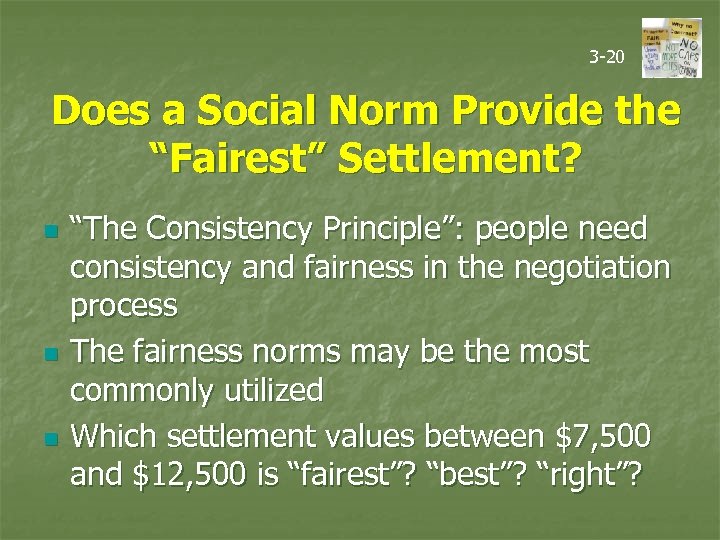
3 -20 Does a Social Norm Provide the “Fairest” Settlement? n n n “The Consistency Principle”: people need consistency and fairness in the negotiation process The fairness norms may be the most commonly utilized Which settlement values between $7, 500 and $12, 500 is “fairest”? “best”? “right”?
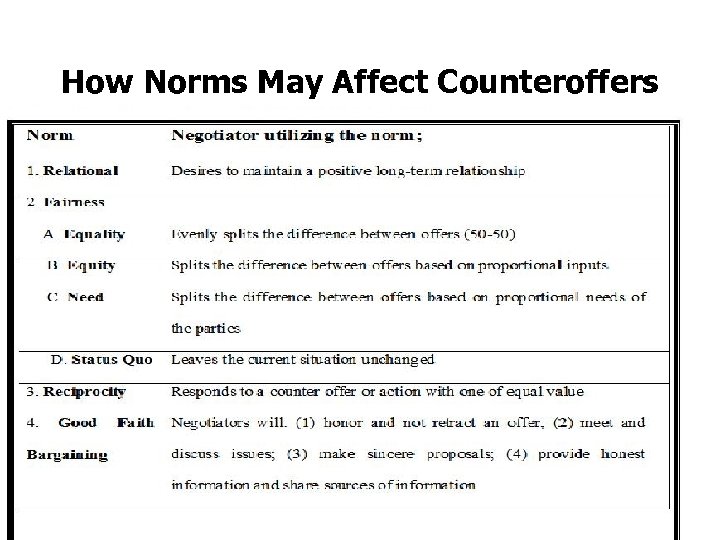
How Norms May Affect Counteroffers
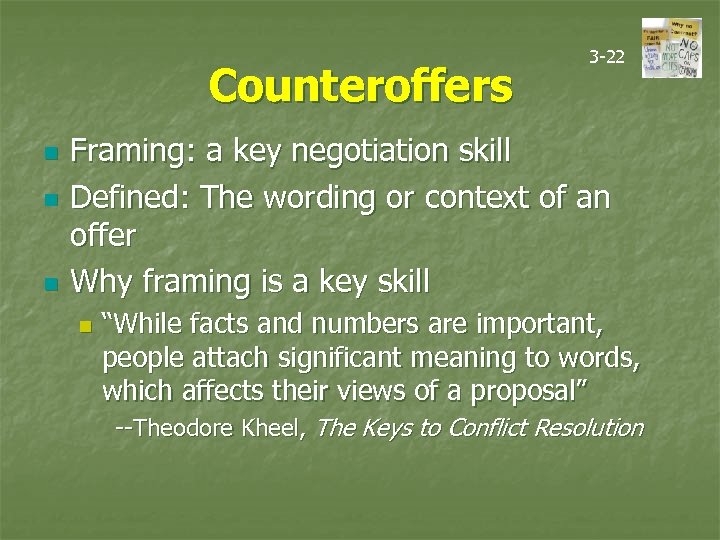
Counteroffers n n n 3 -22 Framing: a key negotiation skill Defined: The wording or context of an offer Why framing is a key skill n “While facts and numbers are important, people attach significant meaning to words, which affects their views of a proposal” --Theodore Kheel, The Keys to Conflict Resolution
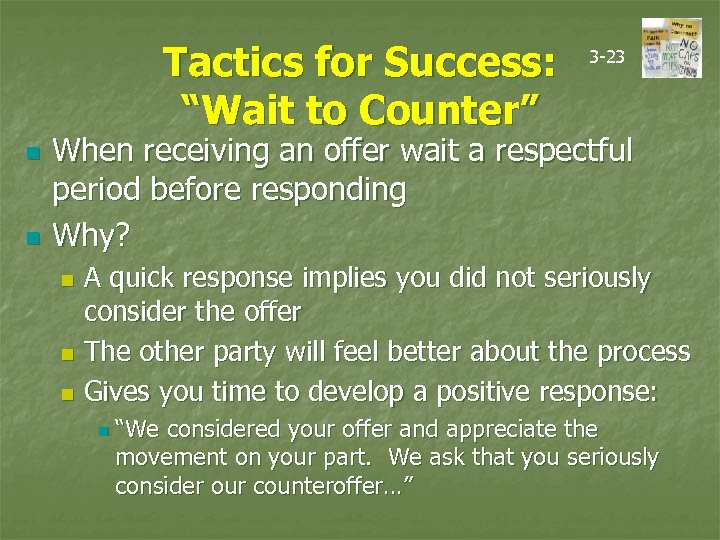
Tactics for Success: “Wait to Counter” n n 3 -23 When receiving an offer wait a respectful period before responding Why? A quick response implies you did not seriously consider the offer n The other party will feel better about the process n Gives you time to develop a positive response: n n “We considered your offer and appreciate the movement on your part. We ask that you seriously consider our counteroffer…”
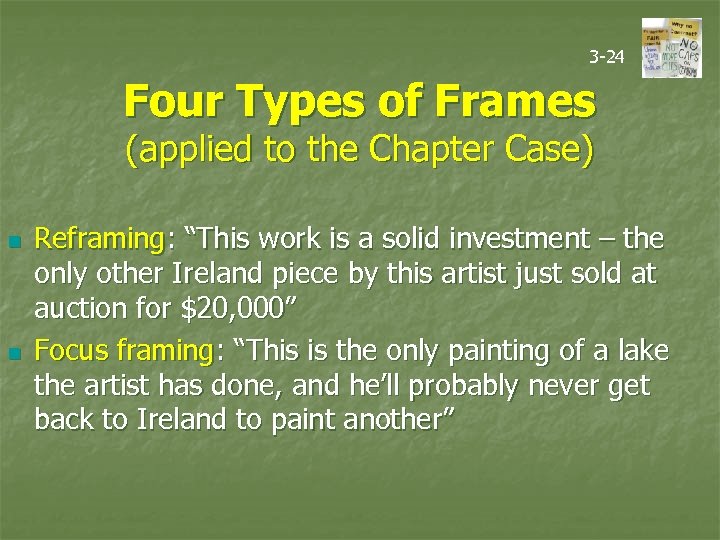
3 -24 Four Types of Frames (applied to the Chapter Case) n n Reframing: “This work is a solid investment – the only other Ireland piece by this artist just sold at auction for $20, 000” Focus framing: “This is the only painting of a lake the artist has done, and he’ll probably never get back to Ireland to paint another”
3 -25 Four Types of Frames (applied to the Chapter Case) n n Contrast framing: “If you pay for it over 24 months, the cost per month is less than the price of four tickets to a first-run play, but you will enjoy the painting for many years” Negative framing: “You can wait to decide – but another couple looked at it earlier today and said they would be back”
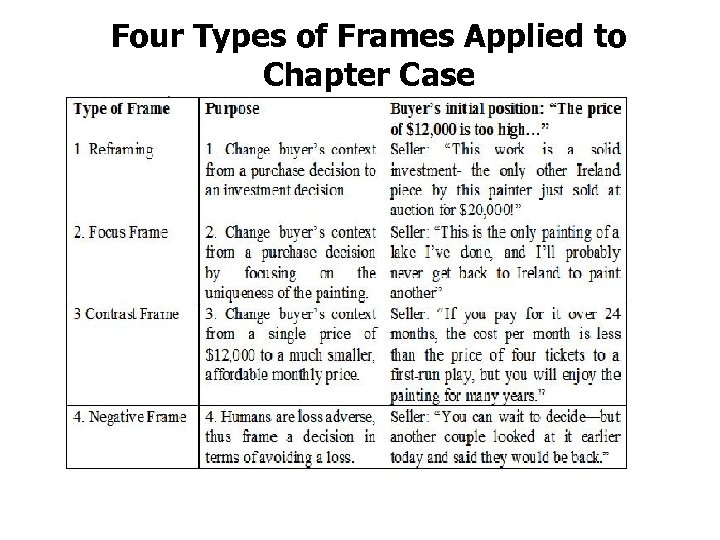
Four Types of Frames Applied to Chapter Case
Reframing Offer n 3 -27 William Ury, Getting Past No, suggests that negotiators never say no or reject an offer instead they reframe by using questions: Ask why: “Why did you select that exact number? ” n Ask why not: “Why not ask for an estimate from a professional appraiser? ” n Ask what if: “What if we agree to your price, but you paid for delivery and warranty? ” n Ask for advice: “How would you suggest I present this offer to my boss when she has rejected that price? ” n
3 -28 Reframing Personal Attacks n n Personal attacks have become a common tactic – don’t let emotions take over strategy How? n Prepare: Expect personal attacks, control your emotions n Recognize: The other party needs to “blow off steam” n Reframe: Ignore the attack on you, reframe it on the problem n Silence: Communicates your displeasure and can be a powerful tool
3 -29 Final Negotiated Price n n Shaking hands and exchanging a product for money ends many negotiations Contingency contracts should be used if future event may alter the agreement or keep it from being signed
3 -30 Negotiated Settlement Chapter Case “Buying a Work of Art” n Opening offers: Buyers = $7, 500 Seller =$12, 500 n Reservation prices: Buyers = $11, 000 Seller = $8, 000 (ZOPA) = $8, 000 - $11, 000 n Seller’s 1 st counteroffer = $11, 000 (framed by citing the number of hours invested = need norm; similar to three others sold = equity norm) n Buyer’s 1 st counteroffer = $9, 250
3 -31 Negotiated Settlement n n n Seller’s 2 nd counteroffer = $10, 000 ($1, 000 concession) Buyers accept Negotiated price = X = $10, 000 Seller’s gain = $2, 500 over buyer’s opening offer Buyers’ gain = $2, 500 less than seller’s listed price
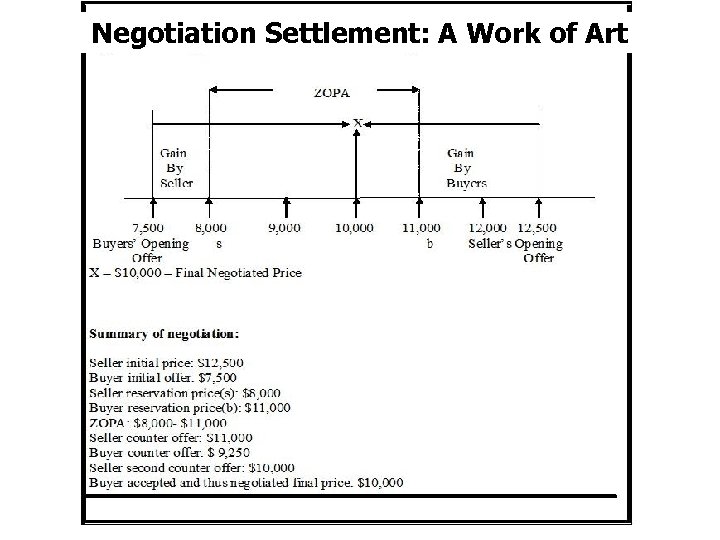
Negotiation Settlement: A Work of Art
Скачать презентацию Chapter 3 Distributive Bargaining 3 -2 Distributive
daf5153b34b948590673908cc4b7be83.ppt