


 Скачать презентацию Chapter 3 Digital Transmission Fundamentals Digital Networks
be56f270c6fa56b0b42149504c04c81c.ppt
- Количество слайдов: 86
 Chapter 3 Digital Transmission Fundamentals
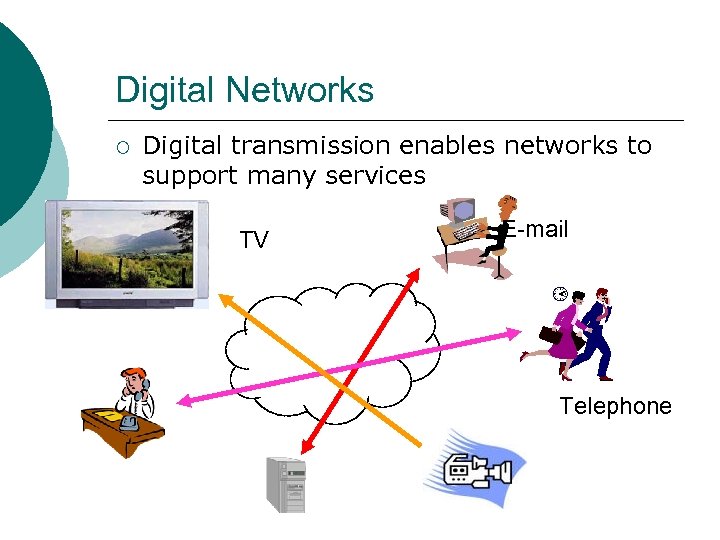 Digital Networks ¡ Digital transmission enables networks to support many services TV E-mail Telephone
 Questions of Interest ¡ How long will it take to transmit a message? ¡ Can a network/system handle a voice (video) call? ¡ How many bits/second does voice/video require? At what quality? How long will it take to transmit a message without errors? ¡ How many bits are in the message (text, image)? How fast does the network/system transfer information? How are errors introduced? How are errors detected and corrected? What transmission speed is possible over radio, copper cables, fiber, infrared, …?
 Chapter 3 Digital Transmission Fundamentals Digital Representation of Information
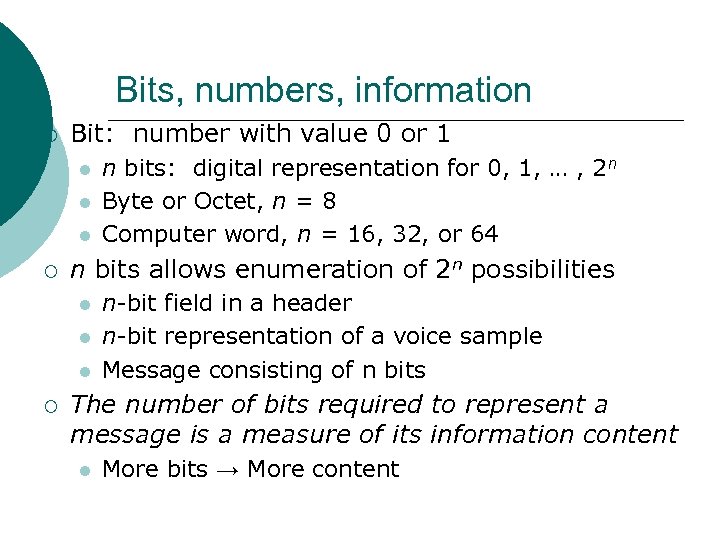 Bits, numbers, information ¡ Bit: number with value 0 or 1 ¡ n bits allows enumeration of 2 n possibilities ¡ n bits: digital representation for 0, 1, … , 2 n Byte or Octet, n = 8 Computer word, n = 16, 32, or 64 n-bit field in a header n-bit representation of a voice sample Message consisting of n bits The number of bits required to represent a message is a measure of its information content More bits → More content
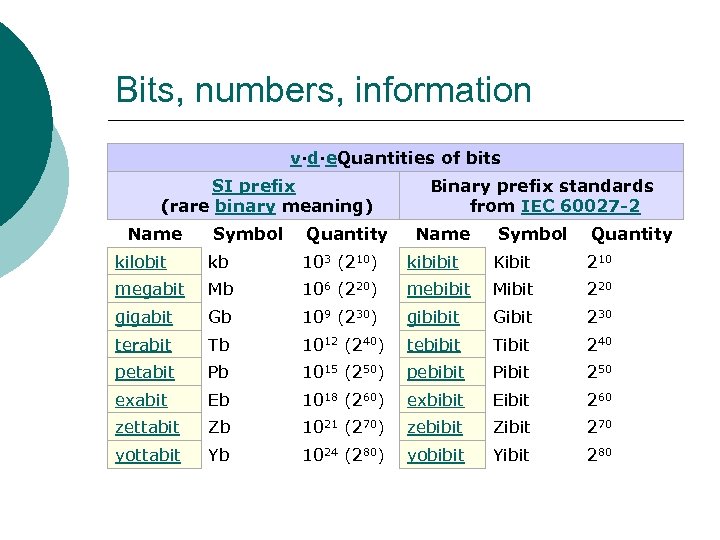 Bits, numbers, information v·d·e. Quantities of bits SI prefix (rare binary meaning) Name Symbol Quantity kilobit kb 103 (210) megabit Mb gigabit Binary prefix standards from IEC 60027 -2 Name Symbol Quantity kibibit Kibit 210 106 (220) mebibit Mibit 220 Gb 109 (230) gibibit Gibit 230 terabit Tb 1012 (240) tebibit Tibit 240 petabit Pb 1015 (250) pebibit Pibit 250 exabit Eb 1018 (260) exbibit Eibit 260 zettabit Zb 1021 (270) zebibit Zibit 270 yottabit Yb 1024 (280) yobibit Yibit 280
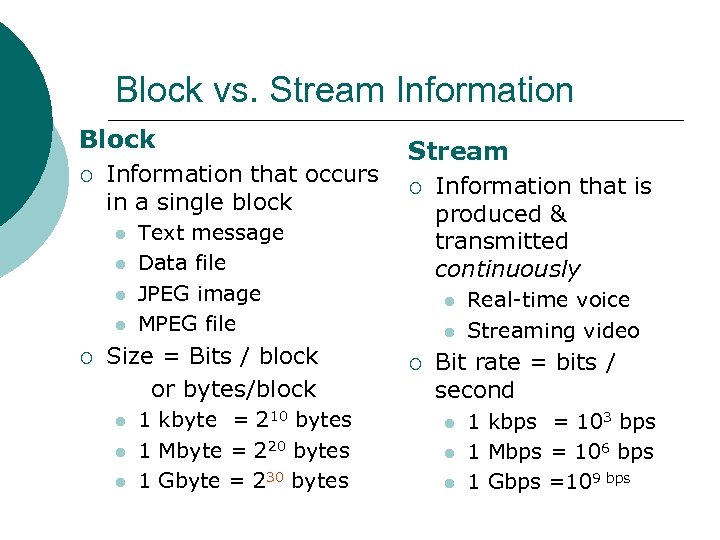 Block vs. Stream Information Block ¡ Information that occurs in a single block ¡ ¡ Text message Data file JPEG image MPEG file Size = Bits / block or bytes/block Stream 1 kbyte = 210 bytes 1 Mbyte = 220 bytes 1 Gbyte = 230 bytes Information that is produced & transmitted continuously ¡ Real-time voice Streaming video Bit rate = bits / second 1 kbps = 103 bps 1 Mbps = 106 bps 1 Gbps =109 bps
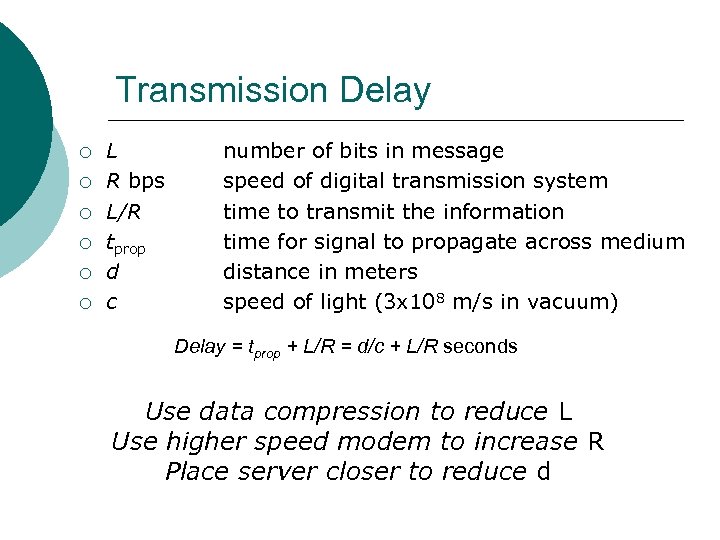 Transmission Delay ¡ ¡ ¡ L R bps L/R tprop d c number of bits in message speed of digital transmission system time to transmit the information time for signal to propagate across medium distance in meters speed of light (3 x 10⁸ m/s in vacuum) Delay = tprop + L/R = d/c + L/R seconds Use data compression to reduce L Use higher speed modem to increase R Place server closer to reduce d
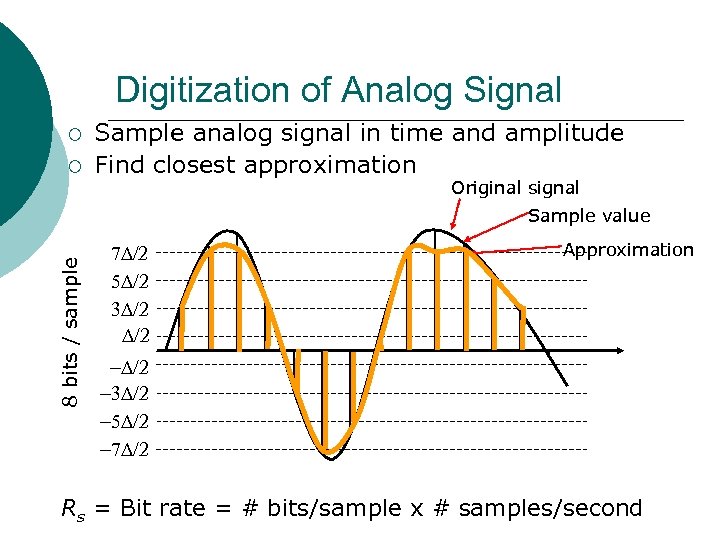 Digitization of Analog Signal ¡ ¡ Sample analog signal in time and amplitude Find closest approximation Original signal 8 bits / sample Sample value 7 D/2 5 D/2 3 D/2 Approximation -D/2 -3 D/2 -5 D/2 -7 D/2 Rs = Bit rate = # bits/sample x # samples/second
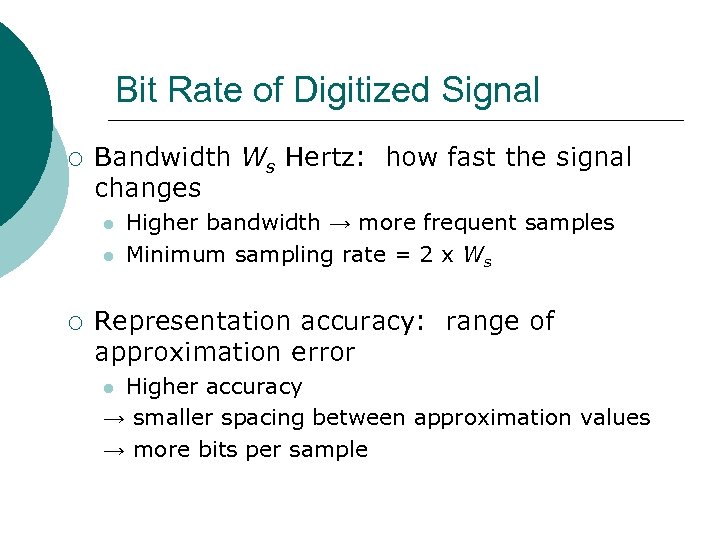 Bit Rate of Digitized Signal ¡ Bandwidth Ws Hertz: how fast the signal changes ¡ Higher bandwidth → more frequent samples Minimum sampling rate = 2 x Ws Representation accuracy: range of approximation error Higher accuracy → smaller spacing between approximation values → more bits per sample
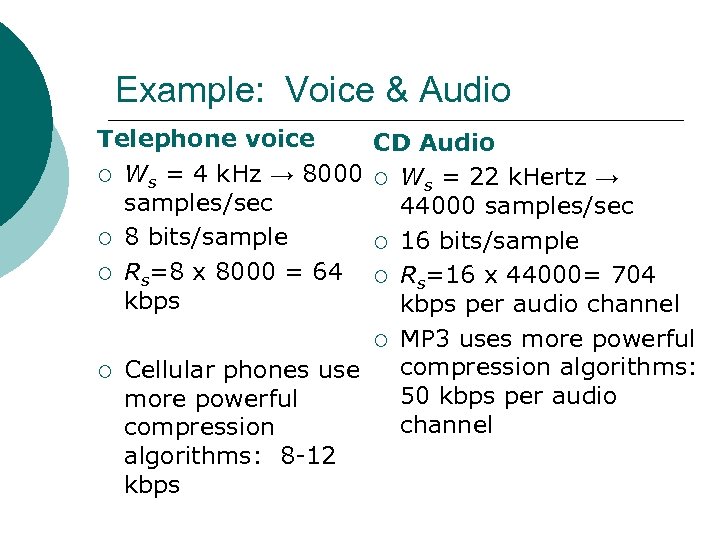 Example: Voice & Audio Telephone voice CD Audio ¡ Ws = 4 k. Hz → 8000 ¡ W = 22 k. Hertz → s samples/sec 44000 samples/sec ¡ 8 bits/sample ¡ 16 bits/sample ¡ Rs=8 x 8000 = 64 ¡ Rs=16 x 44000= 704 kbps per audio channel ¡ MP 3 uses more powerful compression algorithms: ¡ Cellular phones use 50 kbps per audio more powerful channel compression algorithms: 8 -12 kbps
 Chapter 3 Communication Networks and Services Why Digital Communications?
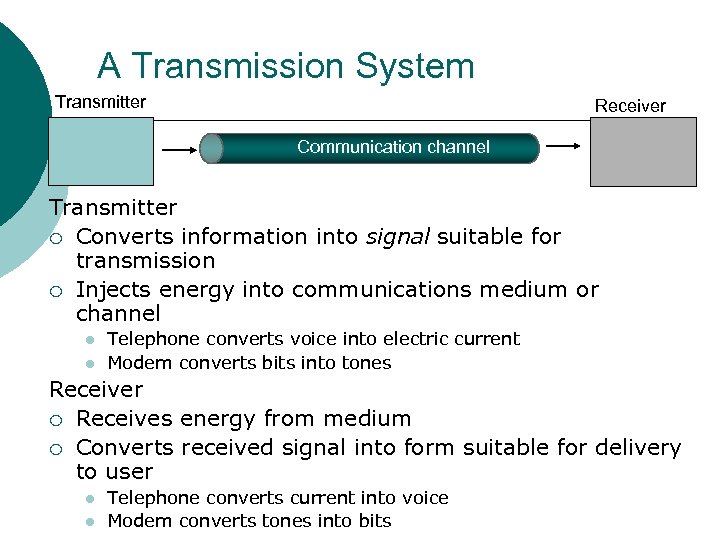 A Transmission System Transmitter Receiver Communication channel Transmitter ¡ Converts information into signal suitable for transmission ¡ Injects energy into communications medium or channel Telephone converts voice into electric current Modem converts bits into tones Receiver ¡ Receives energy from medium ¡ Converts received signal into form suitable for delivery to user Telephone converts current into voice Modem converts tones into bits
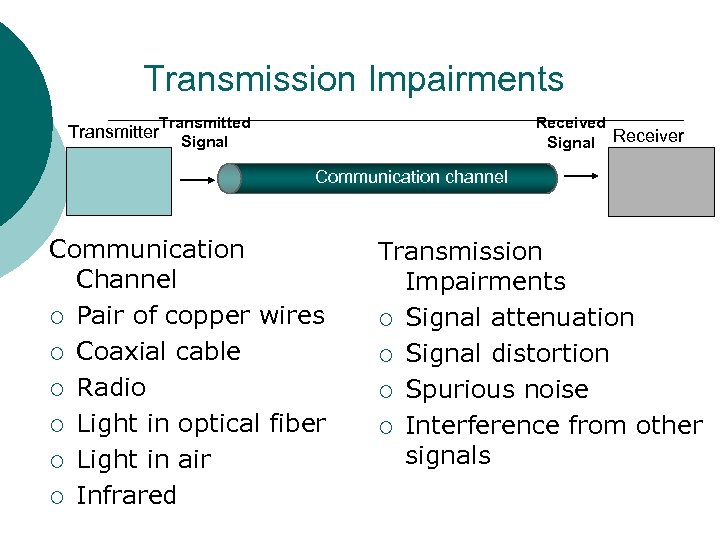 Transmission Impairments Transmitter Transmitted Signal Receiver Communication channel Communication Channel ¡ Pair of copper wires ¡ Coaxial cable ¡ Radio ¡ Light in optical fiber ¡ Light in air ¡ Infrared Transmission Impairments ¡ Signal attenuation ¡ Signal distortion ¡ Spurious noise ¡ Interference from other signals
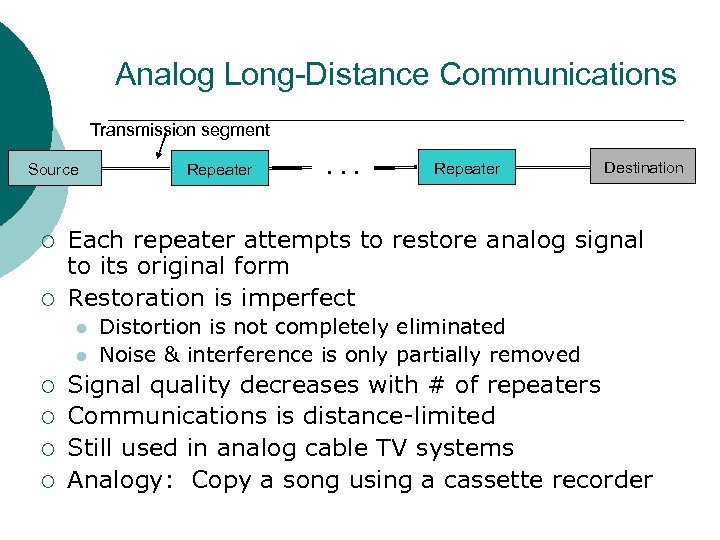 Analog Long-Distance Communications Transmission segment Source ¡ ¡ ¡ . . . Repeater Destination Each repeater attempts to restore analog signal to its original form Restoration is imperfect ¡ Repeater Distortion is not completely eliminated Noise & interference is only partially removed Signal quality decreases with # of repeaters Communications is distance-limited Still used in analog cable TV systems Analogy: Copy a song using a cassette recorder
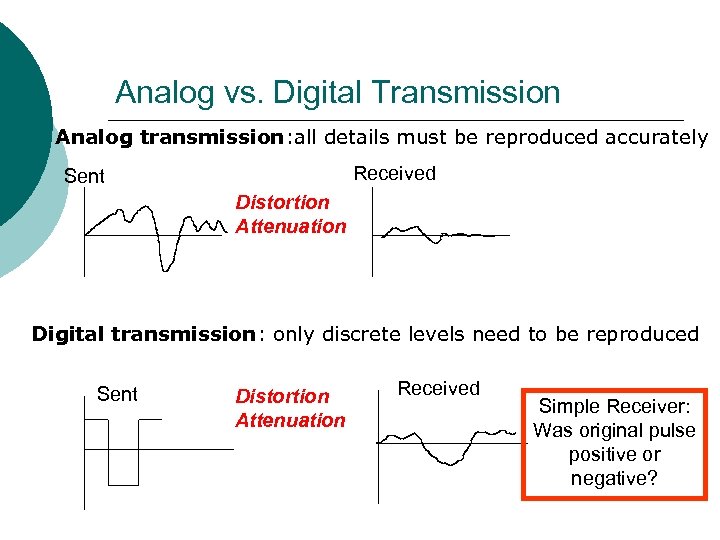 Analog vs. Digital Transmission Analog transmission: all details must be reproduced accurately Received Sent Distortion Attenuation Digital transmission: only discrete levels need to be reproduced Sent Distortion Attenuation Received Simple Receiver: Was original pulse positive or negative?
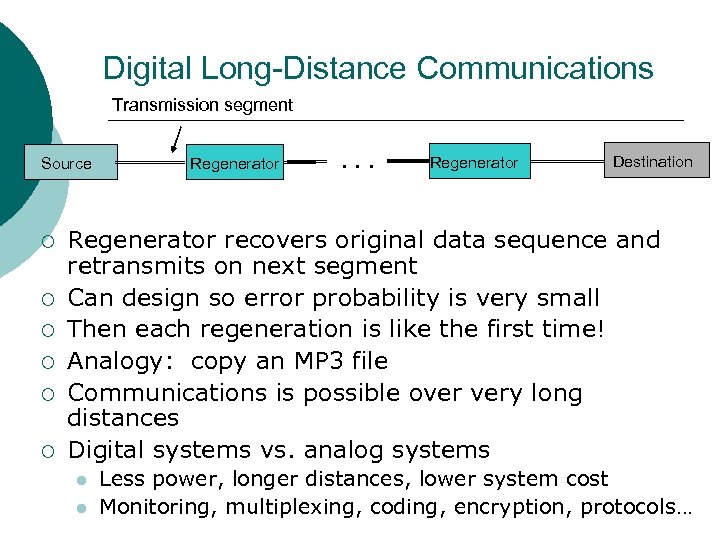 Digital Long-Distance Communications Transmission segment Source ¡ ¡ ¡ Regenerator . . . Regenerator Destination Regenerator recovers original data sequence and retransmits on next segment Can design so error probability is very small Then each regeneration is like the first time! Analogy: copy an MP 3 file Communications is possible over very long distances Digital systems vs. analog systems Less power, longer distances, lower system cost Monitoring, multiplexing, coding, encryption, protocols…
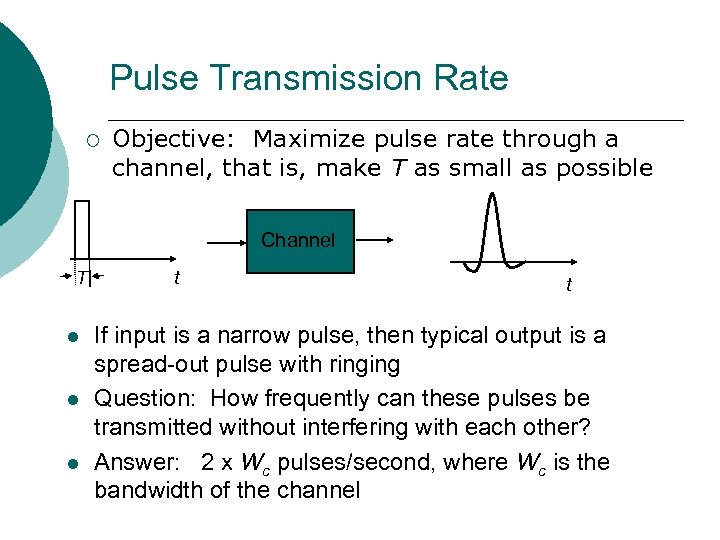 Pulse Transmission Rate ¡ Objective: Maximize pulse rate through a channel, that is, make T as small as possible Channel T t t If input is a narrow pulse, then typical output is a spread-out pulse with ringing Question: How frequently can these pulses be transmitted without interfering with each other? Answer: 2 x Wc pulses/second, where Wc is the bandwidth of the channel
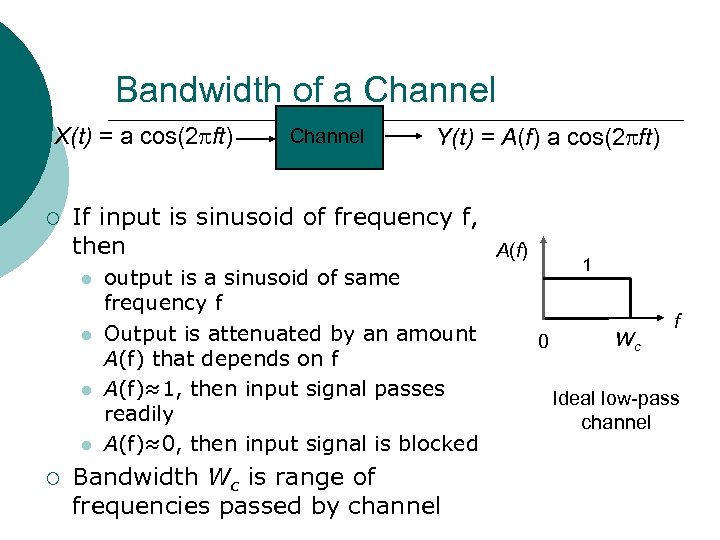 Bandwidth of a Channel X(t) = a cos(2 pft) ¡ Y(t) = A(f) a cos(2 pft) If input is sinusoid of frequency f, then A(f) ¡ Channel output is a sinusoid of same frequency f Output is attenuated by an amount A(f) that depends on f A(f)≈1, then input signal passes readily A(f)≈0, then input signal is blocked Bandwidth Wc is range of frequencies passed by channel 1 0 Wc f Ideal low-pass channel
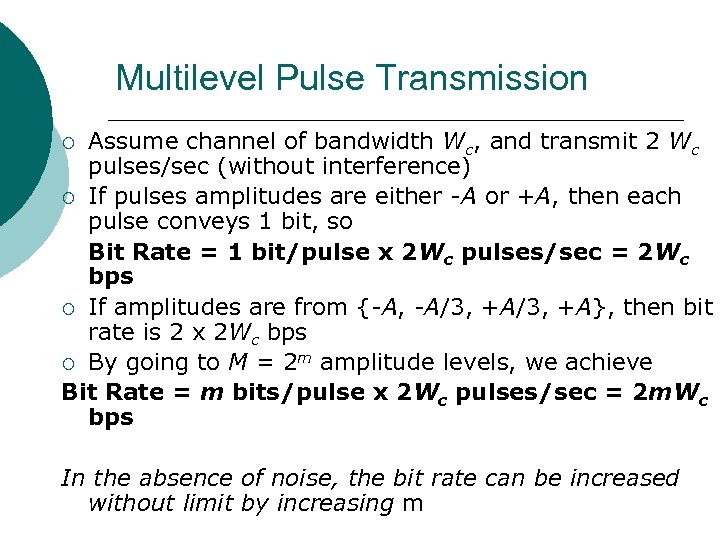 Multilevel Pulse Transmission Assume channel of bandwidth Wc, and transmit 2 Wc pulses/sec (without interference) ¡ If pulses amplitudes are either -A or +A, then each pulse conveys 1 bit, so Bit Rate = 1 bit/pulse x 2 Wc pulses/sec = 2 Wc bps ¡ If amplitudes are from {-A, -A/3, +A}, then bit rate is 2 x 2 Wc bps ¡ By going to M = 2 m amplitude levels, we achieve Bit Rate = m bits/pulse x 2 Wc pulses/sec = 2 m. Wc bps ¡ In the absence of noise, the bit rate can be increased without limit by increasing m
 Noise & Reliable Communications ¡ All physical systems have noise ¡ ¡ Electrons always vibrate at non-zero temperature Motion of electrons induces noise Presence of noise limits accuracy of measurement of received signal amplitude Errors occur if signal separation is comparable to noise level Bit Error Rate (BER) increases with decreasing signal-to-noise ratio Noise places a limit on how many amplitude levels can be used in pulse transmission
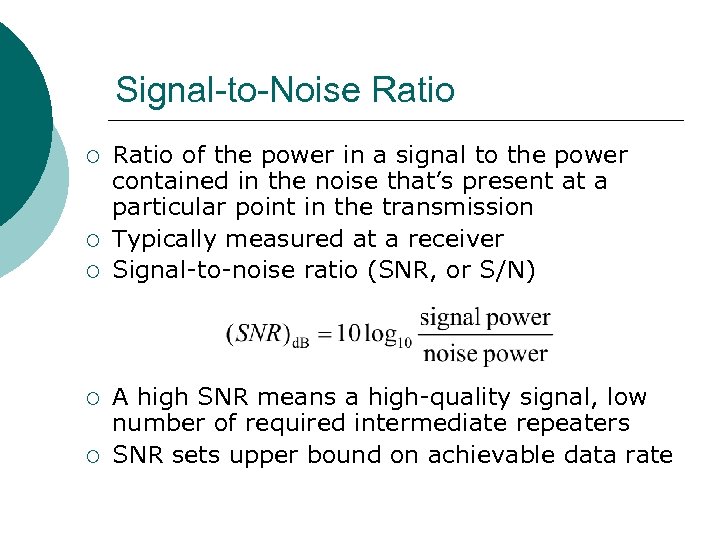 Signal-to-Noise Ratio ¡ ¡ ¡ Ratio of the power in a signal to the power contained in the noise that’s present at a particular point in the transmission Typically measured at a receiver Signal-to-noise ratio (SNR, or S/N) A high SNR means a high-quality signal, low number of required intermediate repeaters SNR sets upper bound on achievable data rate
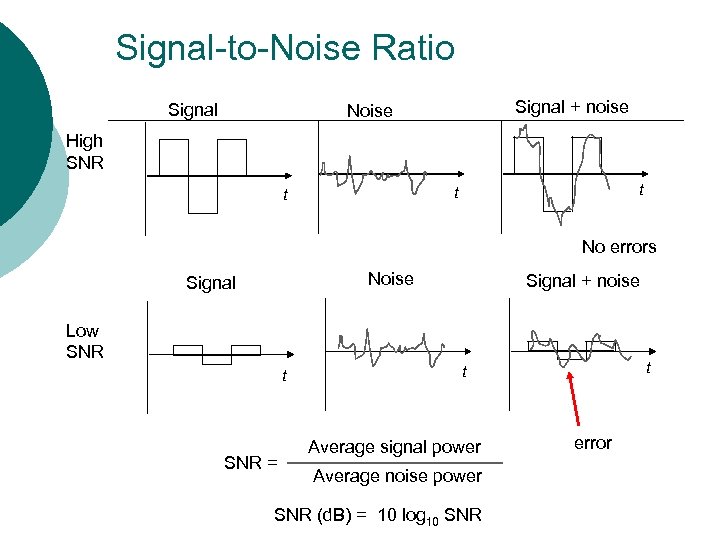 Signal-to-Noise Ratio Signal + noise Noise High SNR t t t No errors Noise Signal + noise Low SNR t SNR = t t Average signal power Average noise power SNR (d. B) = 10 log 10 SNR error
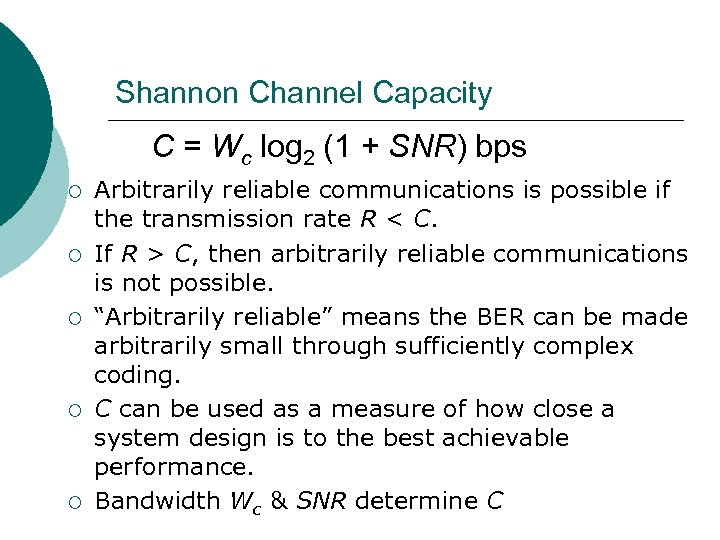 Shannon Channel Capacity C = Wc log 2 (1 + SNR) bps ¡ ¡ ¡ Arbitrarily reliable communications is possible if the transmission rate R < C. If R > C, then arbitrarily reliable communications is not possible. “Arbitrarily reliable” means the BER can be made arbitrarily small through sufficiently complex coding. C can be used as a measure of how close a system design is to the best achievable performance. Bandwidth Wc & SNR determine C
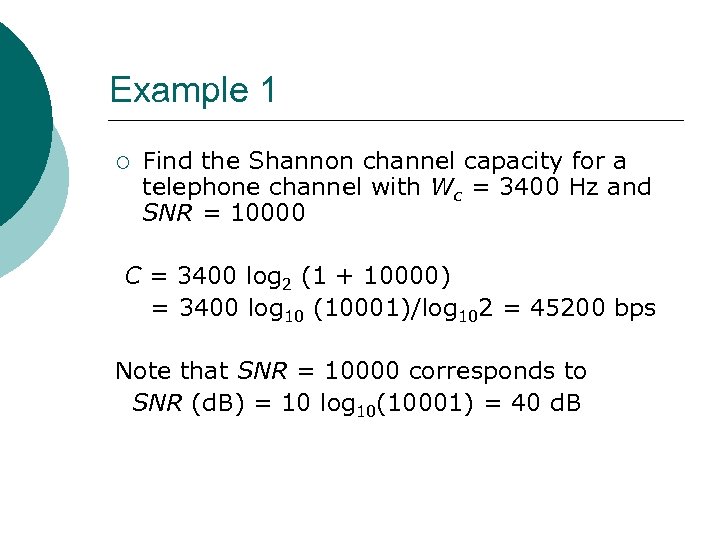 Example 1 ¡ Find the Shannon channel capacity for a telephone channel with Wc = 3400 Hz and SNR = 10000 C = 3400 log 2 (1 + 10000) = 3400 log 10 (10001)/log 102 = 45200 bps Note that SNR = 10000 corresponds to SNR (d. B) = 10 log 10(10001) = 40 d. B
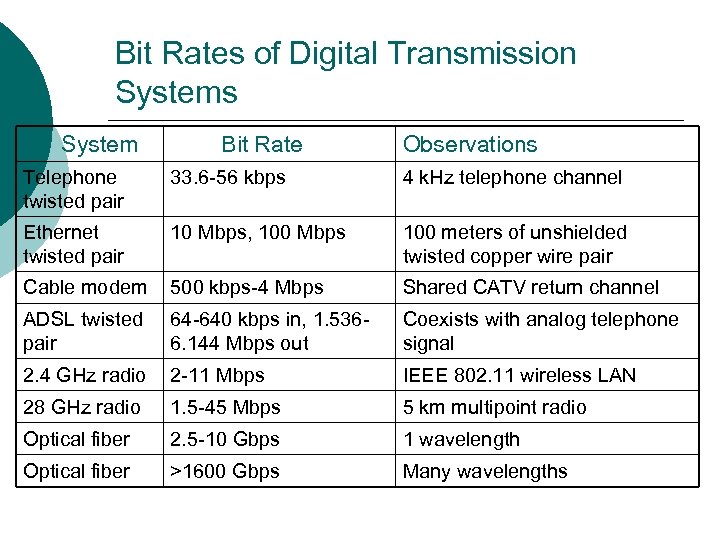 Bit Rates of Digital Transmission Systems System Bit Rate Observations Telephone twisted pair 33. 6 -56 kbps 4 k. Hz telephone channel Ethernet twisted pair 10 Mbps, 100 Mbps 100 meters of unshielded twisted copper wire pair Cable modem 500 kbps-4 Mbps Shared CATV return channel ADSL twisted pair 64 -640 kbps in, 1. 5366. 144 Mbps out Coexists with analog telephone signal 2. 4 GHz radio 2 -11 Mbps IEEE 802. 11 wireless LAN 28 GHz radio 1. 5 -45 Mbps 5 km multipoint radio Optical fiber 2. 5 -10 Gbps 1 wavelength Optical fiber >1600 Gbps Many wavelengths
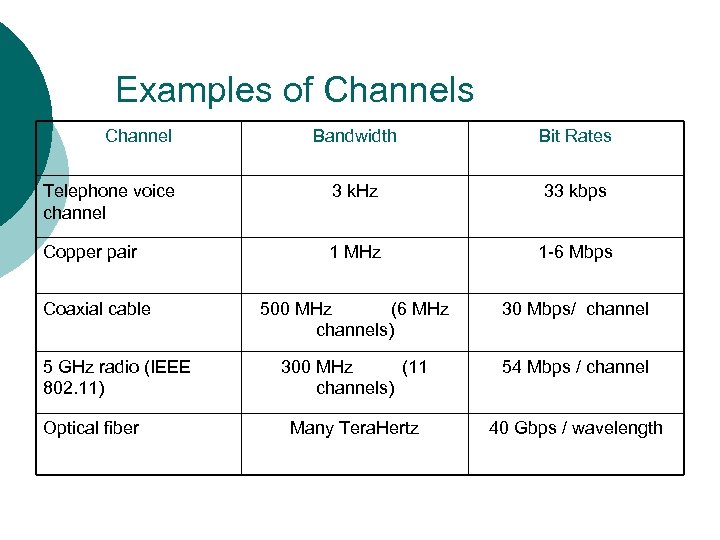 Examples of Channels Channel Bandwidth Bit Rates Telephone voice channel 3 k. Hz 33 kbps Copper pair 1 MHz 1 -6 Mbps 500 MHz (6 MHz channels) 30 Mbps/ channel 300 MHz (11 channels) 54 Mbps / channel Many Tera. Hertz 40 Gbps / wavelength Coaxial cable 5 GHz radio (IEEE 802. 11) Optical fiber
 Chapter 3 Digital Transmission Fundamentals Characterization of Communication Channels
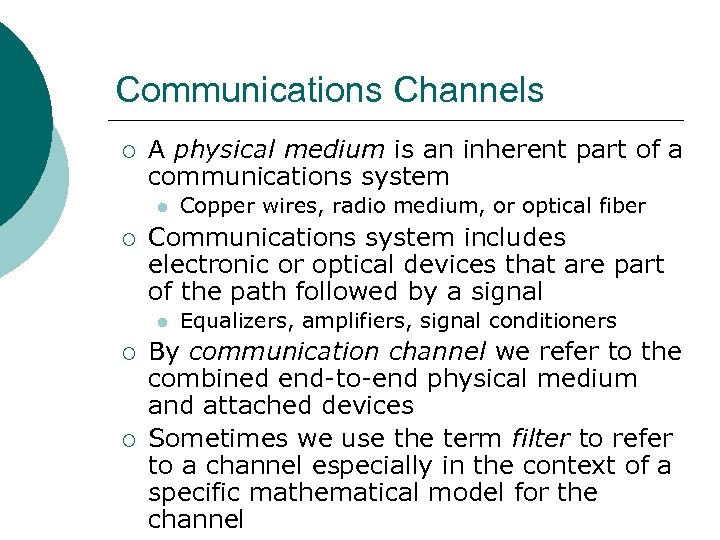 Communications Channels ¡ A physical medium is an inherent part of a communications system ¡ Communications system includes electronic or optical devices that are part of the path followed by a signal ¡ ¡ Copper wires, radio medium, or optical fiber Equalizers, amplifiers, signal conditioners By communication channel we refer to the combined end-to-end physical medium and attached devices Sometimes we use the term filter to refer to a channel especially in the context of a specific mathematical model for the channel
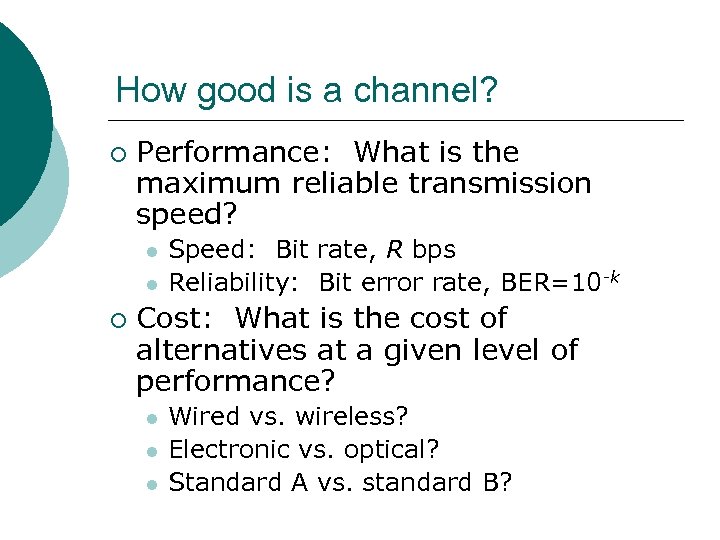 How good is a channel? ¡ Performance: What is the maximum reliable transmission speed? ¡ Speed: Bit rate, R bps Reliability: Bit error rate, BER=10 -k Cost: What is the cost of alternatives at a given level of performance? Wired vs. wireless? Electronic vs. optical? Standard A vs. standard B?
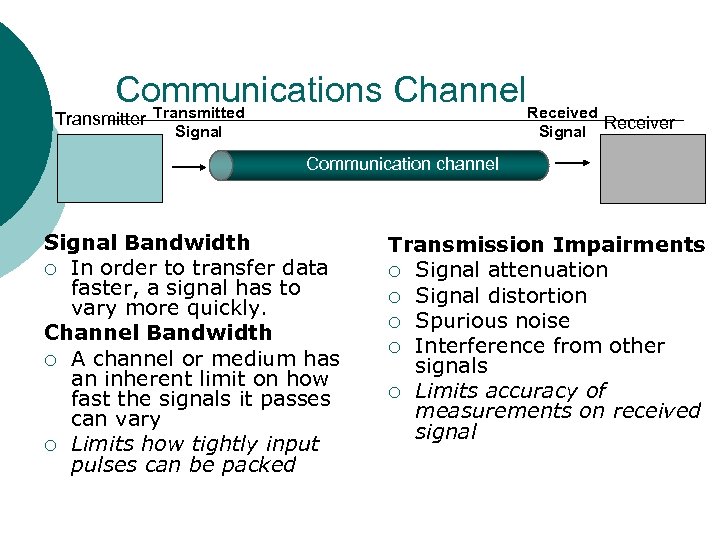 Communications Channel. Received Transmitter Signal Receiver Communication channel Signal Bandwidth ¡ In order to transfer data faster, a signal has to vary more quickly. Channel Bandwidth ¡ A channel or medium has an inherent limit on how fast the signals it passes can vary ¡ Limits how tightly input pulses can be packed Transmission Impairments ¡ Signal attenuation ¡ Signal distortion ¡ Spurious noise ¡ Interference from other signals ¡ Limits accuracy of measurements on received signal
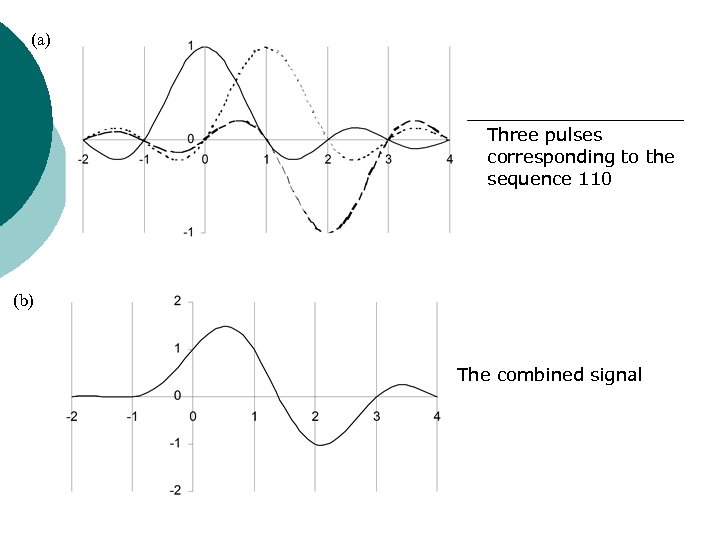 (a) Three pulses corresponding to the sequence 110 (b) The combined signal
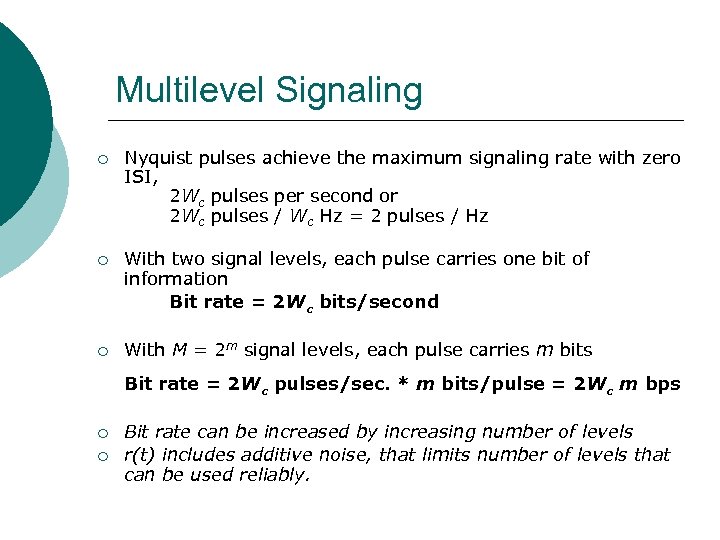 Multilevel Signaling ¡ Nyquist pulses achieve the maximum signaling rate with zero ISI, 2 Wc pulses per second or 2 Wc pulses / Wc Hz = 2 pulses / Hz ¡ With two signal levels, each pulse carries one bit of information Bit rate = 2 Wc bits/second ¡ With M = 2 m signal levels, each pulse carries m bits Bit rate = 2 Wc pulses/sec. * m bits/pulse = 2 Wc m bps ¡ ¡ Bit rate can be increased by increasing number of levels r(t) includes additive noise, that limits number of levels that can be used reliably.
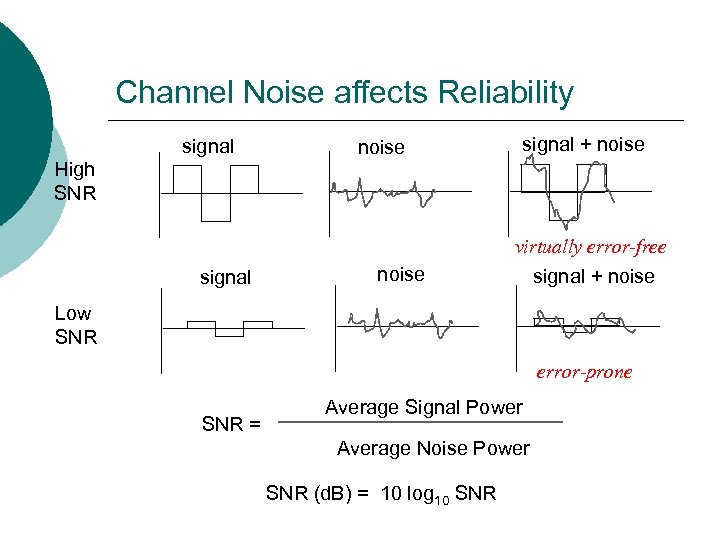 Channel Noise affects Reliability signal High SNR signal noise signal + noise virtually error-free signal + noise Low SNR error-prone SNR = Average Signal Power Average Noise Power SNR (d. B) = 10 log 10 SNR
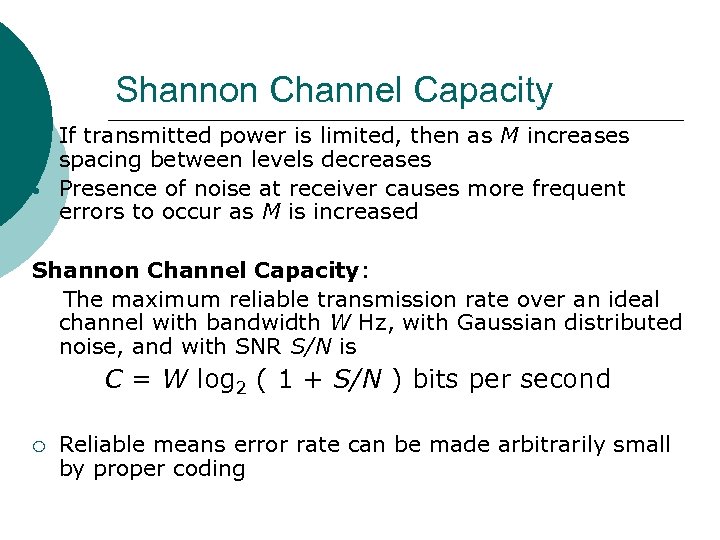 Shannon Channel Capacity • • If transmitted power is limited, then as M increases spacing between levels decreases Presence of noise at receiver causes more frequent errors to occur as M is increased Shannon Channel Capacity: The maximum reliable transmission rate over an ideal channel with bandwidth W Hz, with Gaussian distributed noise, and with SNR S/N is C = W log 2 ( 1 + S/N ) bits per second ¡ Reliable means error rate can be made arbitrarily small by proper coding
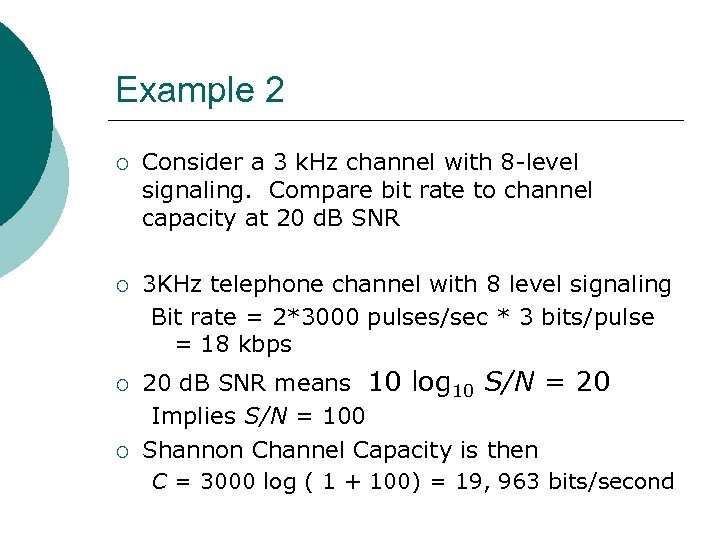 Example 2 ¡ Consider a 3 k. Hz channel with 8 -level signaling. Compare bit rate to channel capacity at 20 d. B SNR ¡ 3 KHz telephone channel with 8 level signaling Bit rate = 2*3000 pulses/sec * 3 bits/pulse = 18 kbps ¡ ¡ 20 d. B SNR means 10 log 10 S/N = 20 Implies S/N = 100 Shannon Channel Capacity is then C = 3000 log ( 1 + 100) = 19, 963 bits/second
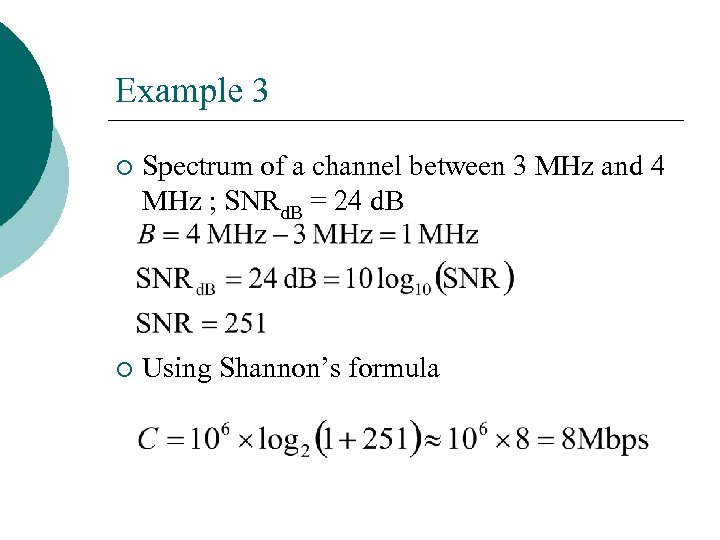 Example 3 ¡ Spectrum of a channel between 3 MHz and 4 MHz ; SNRd. B = 24 d. B ¡ Using Shannon’s formula
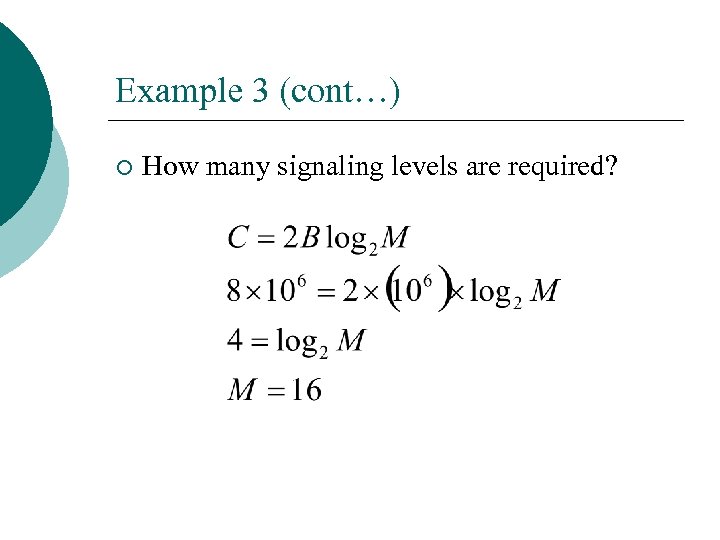 Example 3 (cont…) ¡ How many signaling levels are required?
 Chapter 3 Digital Transmission Fundamentals Properties of Media and Digital Transmission Systems
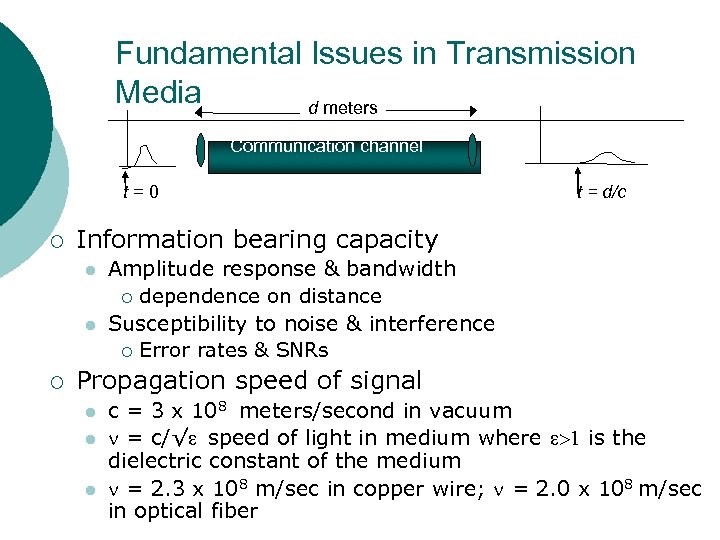 Fundamental Issues in Transmission Media d meters Communication channel t=0 ¡ Information bearing capacity ¡ t = d/c Amplitude response & bandwidth ¡ dependence on distance Susceptibility to noise & interference ¡ Error rates & SNRs Propagation speed of signal c = 3 x 10⁸ meters/second in vacuum n = c/√e speed of light in medium where e>1 is the dielectric constant of the medium n = 2. 3 x 10⁸ m/sec in copper wire; n = 2. 0 x 108 m/sec in optical fiber
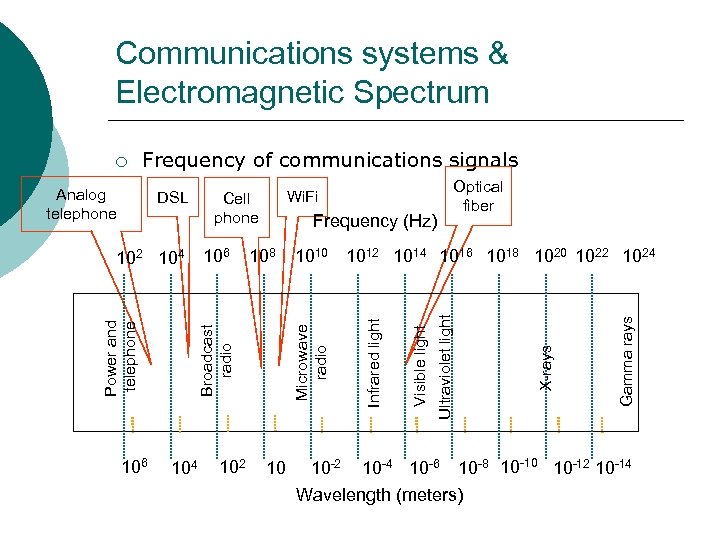 Communications systems & Electromagnetic Spectrum Frequency of communications signals 104 102 10 Gamma rays 1010 1012 1014 1016 1018 1020 1022 1024 X-rays 108 Broadcast radio Power and telephone Frequency (Hz) Optical fiber Ultraviolet light 106 102 104 106 Wi. Fi Cell phone Visible light DSL Infrared light Analog telephone Microwave radio ¡ 10 -2 10 -4 10 -6 10 -8 10 -10 10 -12 10 -14 Wavelength (meters)
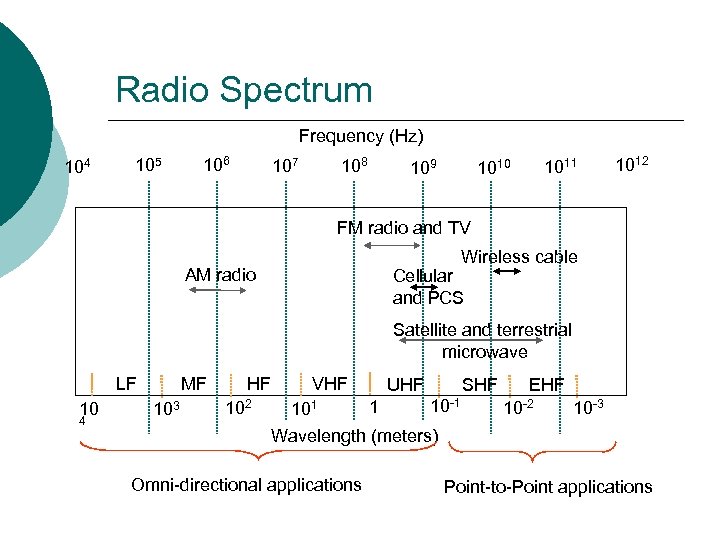
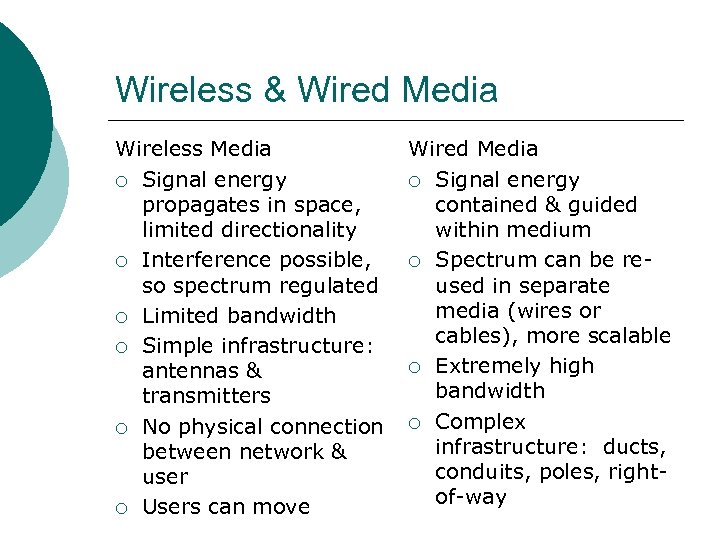 Wireless & Wired Media Wireless Media ¡ Signal energy propagates in space, limited directionality ¡ Interference possible, so spectrum regulated ¡ Limited bandwidth ¡ Simple infrastructure: antennas & transmitters ¡ No physical connection between network & user ¡ Users can move Wired Media ¡ Signal energy contained & guided within medium ¡ Spectrum can be reused in separate media (wires or cables), more scalable ¡ Extremely high bandwidth ¡ Complex infrastructure: ducts, conduits, poles, rightof-way
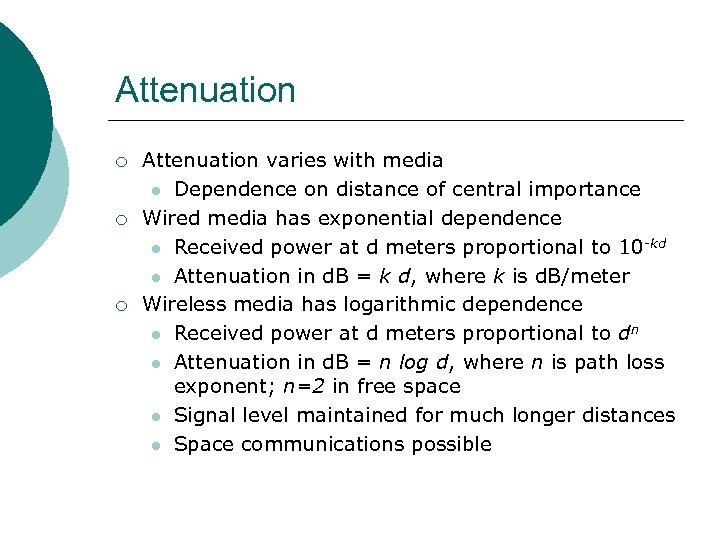 Attenuation ¡ ¡ ¡ Attenuation varies with media Dependence on distance of central importance Wired media has exponential dependence Received power at d meters proportional to 10 -kd Attenuation in d. B = k d, where k is d. B/meter Wireless media has logarithmic dependence Received power at d meters proportional to dn Attenuation in d. B = n log d, where n is path loss exponent; n=2 in free space Signal level maintained for much longer distances Space communications possible
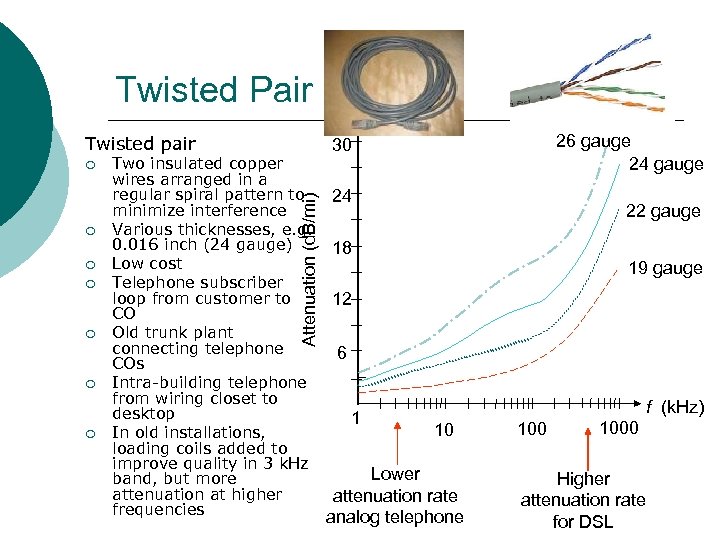 Twisted Pair Twisted pair ¡ ¡ ¡ Two insulated copper wires arranged in a regular spiral pattern to minimize interference Various thicknesses, e. g. 0. 016 inch (24 gauge) Low cost Telephone subscriber loop from customer to CO Old trunk plant connecting telephone COs Intra-building telephone from wiring closet to desktop In old installations, loading coils added to improve quality in 3 k. Hz band, but more attenuation at higher frequencies Attenuation (d. B/mi) ¡ 26 gauge 24 gauge 30 24 22 gauge 18 19 gauge 12 6 1 f (k. Hz) 10 Lower attenuation rate analog telephone 1000 Higher attenuation rate for DSL
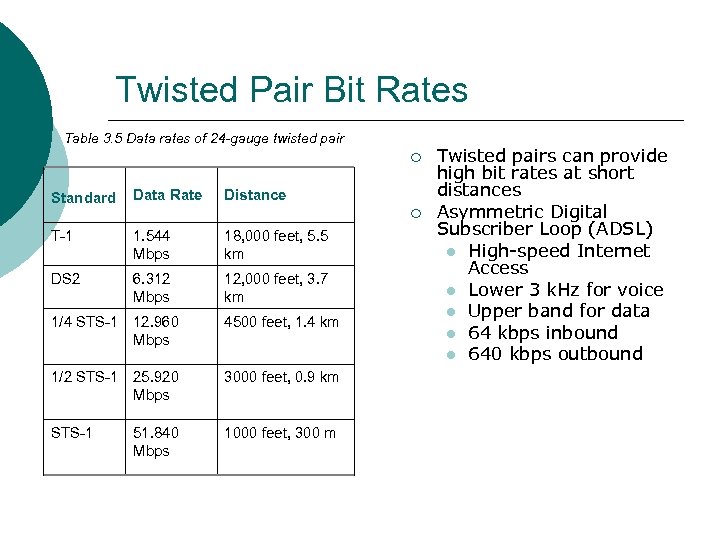 Twisted Pair Bit Rates Table 3. 5 Data rates of 24 -gauge twisted pair ¡ Standard Data Rate Distance T-1 1. 544 Mbps 18, 000 feet, 5. 5 km DS 2 6. 312 Mbps 12, 000 feet, 3. 7 km ¡ 1/4 STS-1 12. 960 Mbps 4500 feet, 1. 4 km 1/2 STS-1 25. 920 Mbps 3000 feet, 0. 9 km STS-1 1000 feet, 300 m 51. 840 Mbps Twisted pairs can provide high bit rates at short distances Asymmetric Digital Subscriber Loop (ADSL) High-speed Internet Access Lower 3 k. Hz for voice Upper band for data 64 kbps inbound 640 kbps outbound
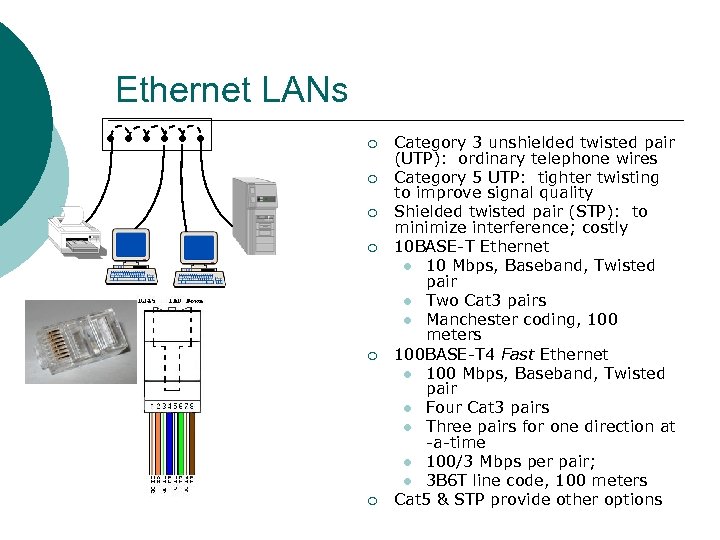 Ethernet LANs ¡ ¡ ¡ Category 3 unshielded twisted pair (UTP): ordinary telephone wires Category 5 UTP: tighter twisting to improve signal quality Shielded twisted pair (STP): to minimize interference; costly 10 BASE-T Ethernet 10 Mbps, Baseband, Twisted pair Two Cat 3 pairs Manchester coding, 100 meters 100 BASE-T 4 Fast Ethernet 100 Mbps, Baseband, Twisted pair Four Cat 3 pairs Three pairs for one direction at -a-time 100/3 Mbps per pair; 3 B 6 T line code, 100 meters Cat 5 & STP provide other options
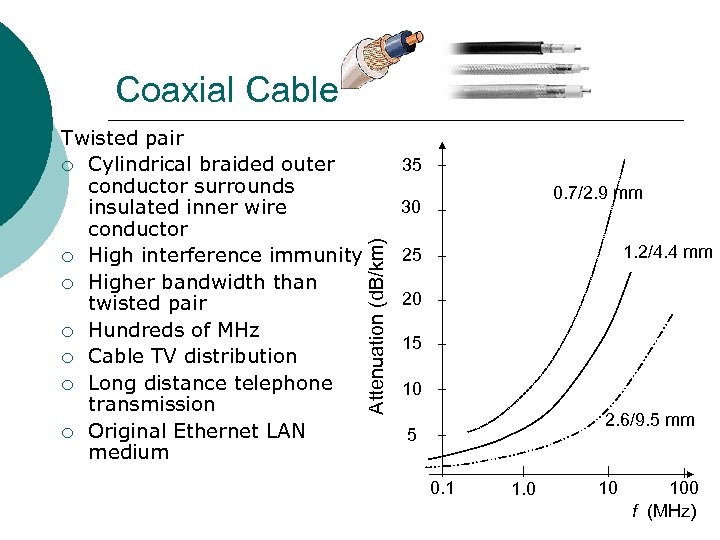 Coaxial Cable 35 0. 7/2. 9 mm 30 Attenuation (d. B/km) Twisted pair ¡ Cylindrical braided outer conductor surrounds insulated inner wire conductor ¡ High interference immunity ¡ Higher bandwidth than twisted pair ¡ Hundreds of MHz ¡ Cable TV distribution ¡ Long distance telephone transmission ¡ Original Ethernet LAN medium 1. 2/4. 4 mm 25 20 15 10 2. 6/9. 5 mm 5 0. 1 1. 0 10 100 f (MHz)
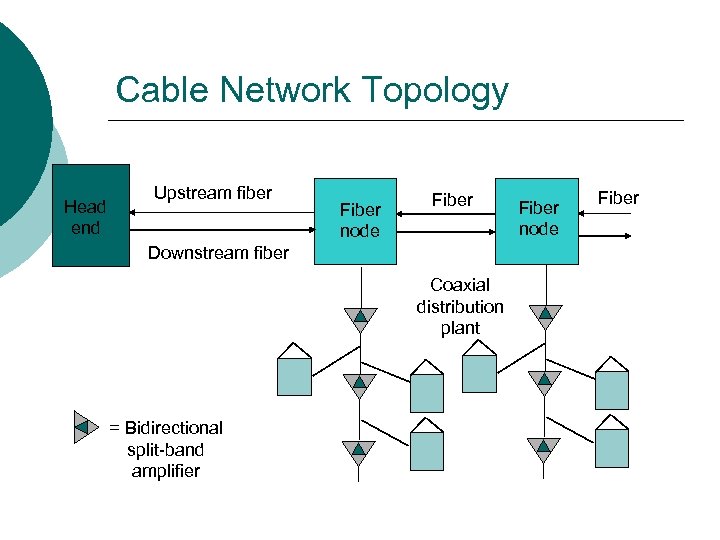 Cable Network Topology Head end Upstream fiber Fiber node Fiber Downstream fiber Coaxial distribution plant = Bidirectional split-band amplifier Fiber node Fiber
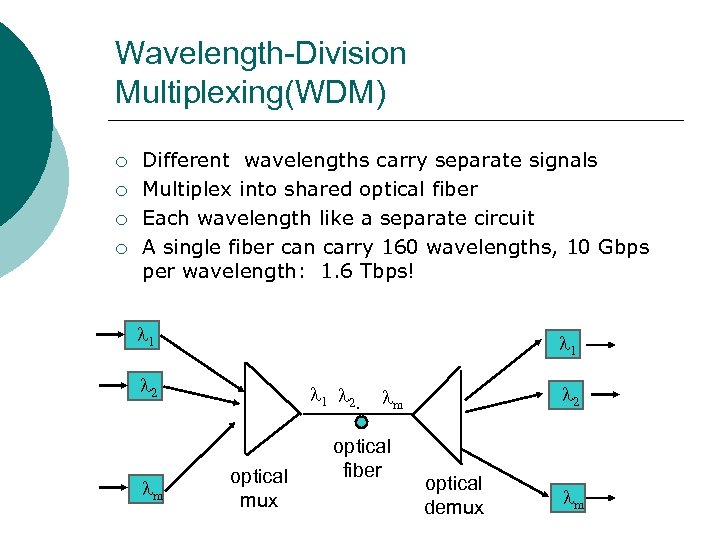
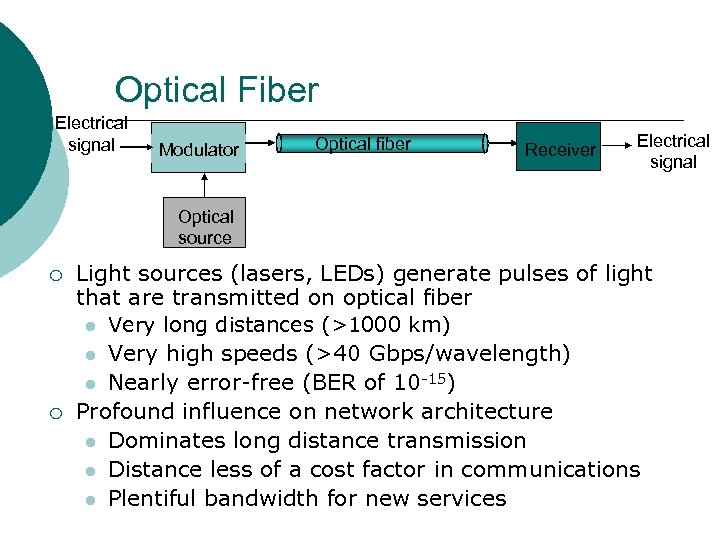 Optical Fiber Electrical signal Modulator Optical fiber Receiver Electrical signal Optical source ¡ ¡ Light sources (lasers, LEDs) generate pulses of light that are transmitted on optical fiber Very long distances (>1000 km) Very high speeds (>40 Gbps/wavelength) Nearly error-free (BER of 10 -15) Profound influence on network architecture Dominates long distance transmission Distance less of a cost factor in communications Plentiful bandwidth for new services
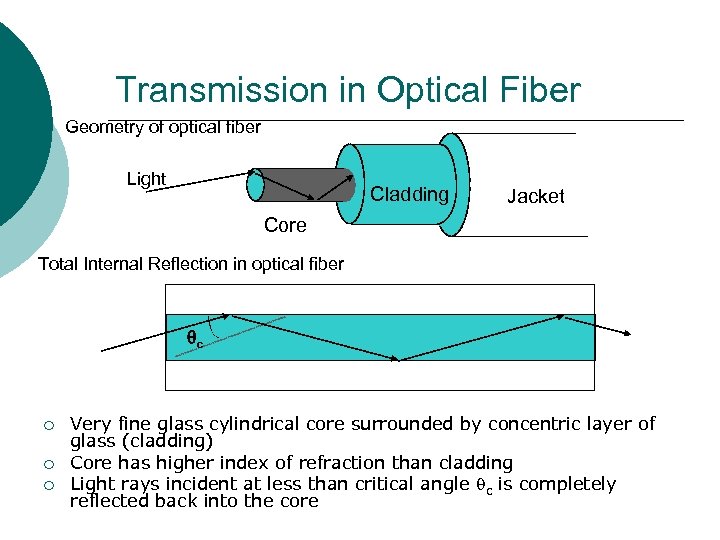 Transmission in Optical Fiber Geometry of optical fiber Light Cladding Jacket Core Total Internal Reflection in optical fiber c ¡ ¡ ¡ Very fine glass cylindrical core surrounded by concentric layer of glass (cladding) Core has higher index of refraction than cladding Light rays incident at less than critical angle qc is completely reflected back into the core
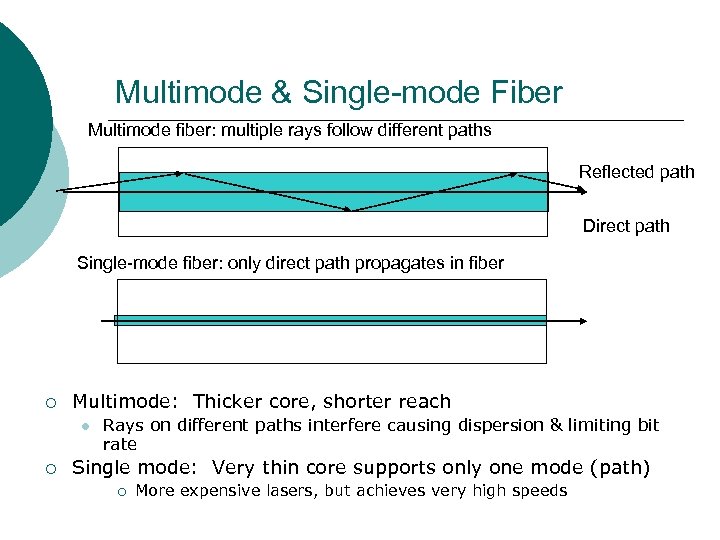 Multimode & Single-mode Fiber Multimode fiber: multiple rays follow different paths Reflected path Direct path Single-mode fiber: only direct path propagates in fiber ¡ Multimode: Thicker core, shorter reach ¡ Rays on different paths interfere causing dispersion & limiting bit rate Single mode: Very thin core supports only one mode (path) ¡ More expensive lasers, but achieves very high speeds
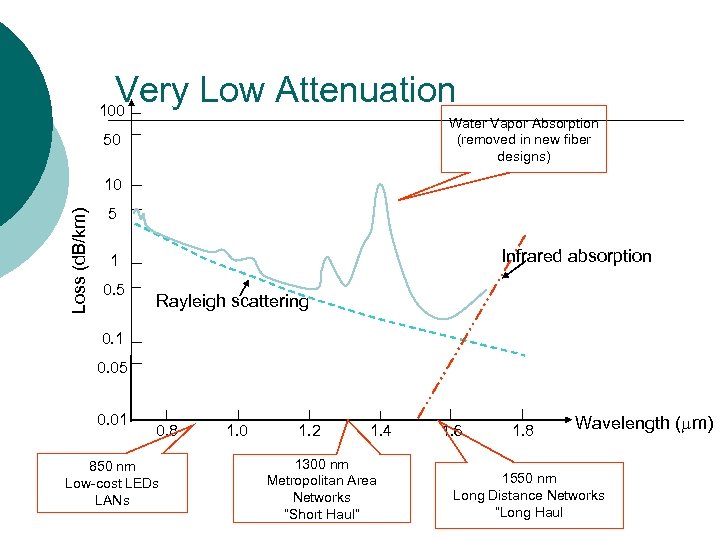
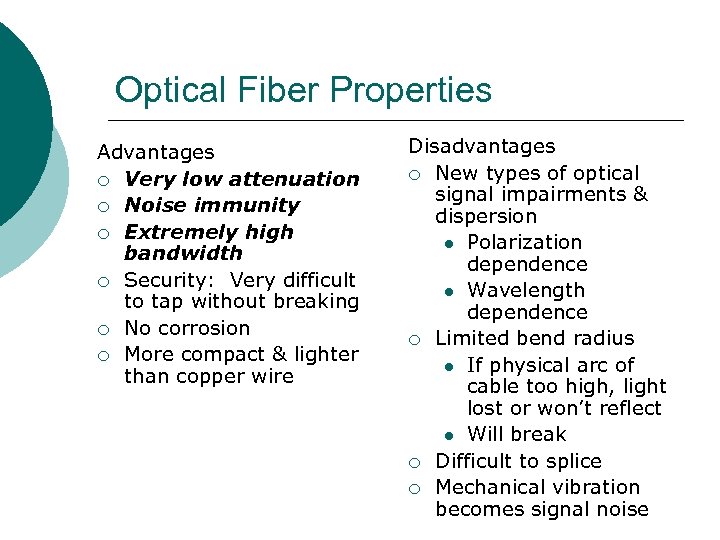 Optical Fiber Properties Advantages ¡ Very low attenuation ¡ Noise immunity ¡ Extremely high bandwidth ¡ Security: Very difficult to tap without breaking ¡ No corrosion ¡ More compact & lighter than copper wire Disadvantages ¡ New types of optical signal impairments & dispersion Polarization dependence Wavelength dependence ¡ Limited bend radius If physical arc of cable too high, light lost or won’t reflect Will break ¡ Difficult to splice ¡ Mechanical vibration becomes signal noise
 Very Low Attenuation 100 Water Vapor Absorption (removed in new fiber designs) 50 Loss (d. B/km) 10 5 Infrared absorption 1 0. 5 Rayleigh scattering 0. 1 0. 05 0. 01 0. 8 850 nm Low-cost LEDs LANs 1. 0 1. 2 1. 4 1300 nm Metropolitan Area Networks “Short Haul” 1. 6 1. 8 Wavelength ( m) 1550 nm Long Distance Networks “Long Haul
 Wavelength-Division Multiplexing(WDM) ¡ ¡ Different wavelengths carry separate signals Multiplex into shared optical fiber Each wavelength like a separate circuit A single fiber can carry 160 wavelengths, 10 Gbps per wavelength: 1. 6 Tbps! 1 1 2 m 1 2. optical mux 2 m optical fiber optical demux m
 Radio Transmission ¡ ¡ ¡ Radio signals: antenna transmits sinusoidal signal (“carrier”) that radiates in air/space Information embedded in carrier signal using modulation, e. g. QAM Multipath propagation causes fading Interference from other users Spectrum regulated by national & international regulatory organizations
 Radio Spectrum Frequency (Hz) 104 105 106 108 107 109 1011 1010 1012 FM radio and TV Wireless cable AM radio Cellular and PCS Satellite and terrestrial microwave LF 10 4 MF 103 HF 102 VHF 101 UHF 1 SHF 10 -1 EHF 10 -2 10 -3 Wavelength (meters) Omni-directional applications Point-to-Point applications
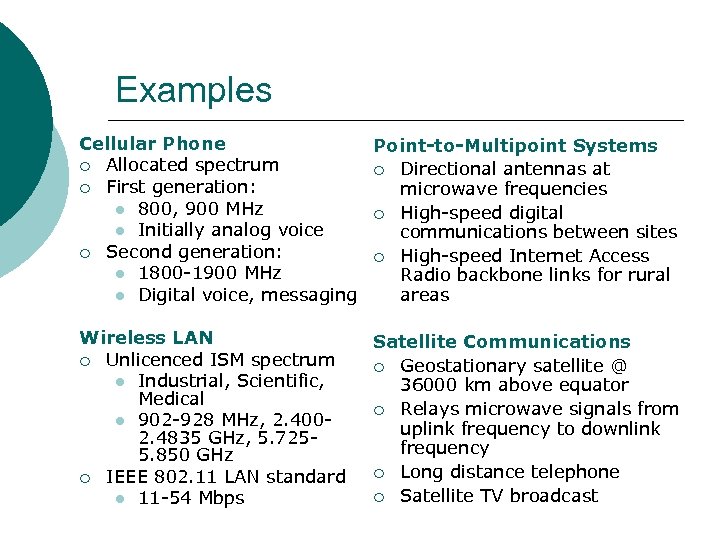 Examples Cellular Phone Point-to-Multipoint Systems ¡ Allocated spectrum ¡ Directional antennas at ¡ First generation: microwave frequencies 800, 900 MHz ¡ High-speed digital Initially analog voice communications between sites ¡ Second generation: ¡ High-speed Internet Access 1800 -1900 MHz Radio backbone links for rural areas Digital voice, messaging Wireless LAN ¡ Unlicenced ISM spectrum Industrial, Scientific, Medical 902 -928 MHz, 2. 4002. 4835 GHz, 5. 7255. 850 GHz ¡ IEEE 802. 11 LAN standard 11 -54 Mbps Satellite Communications ¡ Geostationary satellite @ 36000 km above equator ¡ Relays microwave signals from uplink frequency to downlink frequency ¡ Long distance telephone ¡ Satellite TV broadcast
 Chapter 3 Digital Transmission Fundamentals Error Detection and Correction
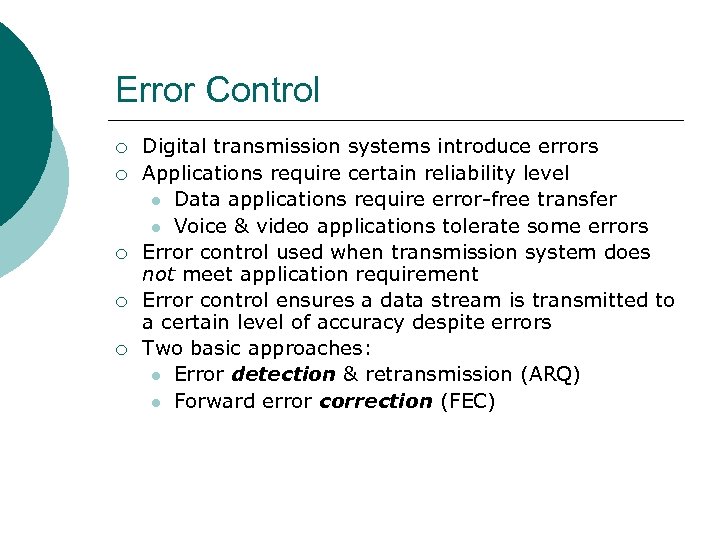 Error Control ¡ ¡ ¡ Digital transmission systems introduce errors Applications require certain reliability level Data applications require error-free transfer Voice & video applications tolerate some errors Error control used when transmission system does not meet application requirement Error control ensures a data stream is transmitted to a certain level of accuracy despite errors Two basic approaches: Error detection & retransmission (ARQ) Forward error correction (FEC)
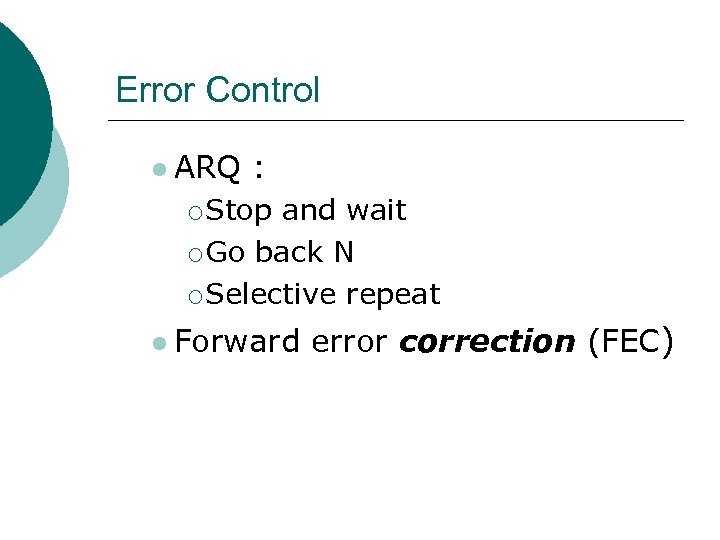 Error Control ARQ : ¡ Stop and wait ¡ Go back N ¡ Selective repeat Forward error correction (FEC)
 Stop and wait ARQ ¡ One frame at time. After sending, sender waits for ACK signal and doesn't send any further frames until it is received. ¡ If the received frame is damaged or lost, the receiver discards it and does not send an ACK. If a certain time, known as the timeout, passes without ACK, the sender sends the frame again. ¡ Problem 1 - is where the ACK sent by the receiver is damaged or lost. In this case, the sender doesn't receive the ACK, times out, and sends the frame again. Now the receiver has two copies of the same frame, and doesn't know if the second one is a duplicate frame or the next frame of the sequence carrying identical data.
 Stop and wait ARQ (cont…) ¡ Problem 2 - is when the sender's timeout runs out before the frame reaches the receiver. In this case the sender resends the same packet. Eventually the receiver gets two copies of the same frame, and sends an ACK for each one. The sender, waiting for a single ACK, receives two ACKs, which may cause problems if it assumes that the second ACK is for the next frame in the sequence. ¡ To avoid these problems, the most common solution is to define a 1 bit sequence number which is attached to the header of the frame. This sequence number alternates (from 0 to 1) in subsequent frames. When the receiver sends an ACK, it attaches the sequence number of the next packet it expects. This way, the receiver can detect duplicated frames by checking if the frame sequence numbers alternate. If two subsequent frames have the same sequence number, they are duplicates, and the second frame is discarded. Similarly, if two subsequent ACKs have the same sequence number, they are acknowledging the same frame.
 Go back N ARQ ¡ Protocol, in which the sending process continues to send a number of frames specified by a window size without receiving an ACK packet from the receiver. ¡ The receiver process keeps track of the sequence number of the next frame it expects to receive, and sends that number with every ACK it sends. ¡ If a frame from the sender does not reach the receiver, the receiver will stop acknowledging received frames. ¡ Once the sender has sent all of the frames in its window, it will detect that all of the frames since the first lost frame are outstanding, and will go back to sequence number of the last ACK it received from the receiver process and fill its window starting with that frame and continue the process over again. Demo : http: //media. pearsoncmg. com/aw/aw_kurose_network_2/applets/go-back-n. html
 Selective Repeat ARQ ¡ Protocol, in which the sending process continues to send a number of frames specified by a window size even after a frame loss. Unlike Go-Back-N ARQ, the receiving process will continue to accept and acknowledge frames sent after an initial error. ¡ The receiver process keeps track of the sequence number of the earliest frame it has not received, and sends that number with every ACK it sends. If a frame from the sender does not reach the receiver, the sender continues to send subsequent frames until it has emptied its window. ¡ The receiver continues to fill its receiving window with the subsequent frames, replying each time with an ACK containing the sequence number of the earliest missing frame. Once the sender has sent all the frames in its window, it re-sends the frame number given by the ACKs, and then continues where it left off. Demo : http: //www. eas. asu. edu/trace/eee 459_sp 02/applet/archana/gupta 5463. html
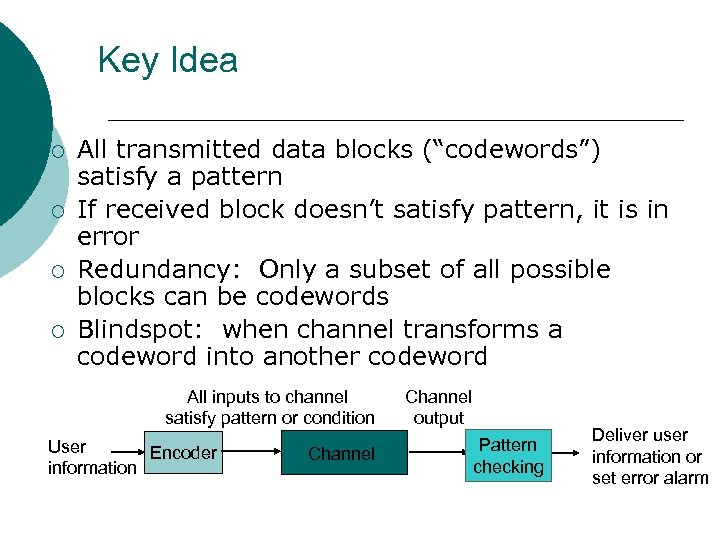 Key Idea ¡ ¡ All transmitted data blocks (“codewords”) satisfy a pattern If received block doesn’t satisfy pattern, it is in error Redundancy: Only a subset of all possible blocks can be codewords Blindspot: when channel transforms a codeword into another codeword All inputs to channel satisfy pattern or condition User Encoder information Channel output Pattern checking Deliver user information or set error alarm
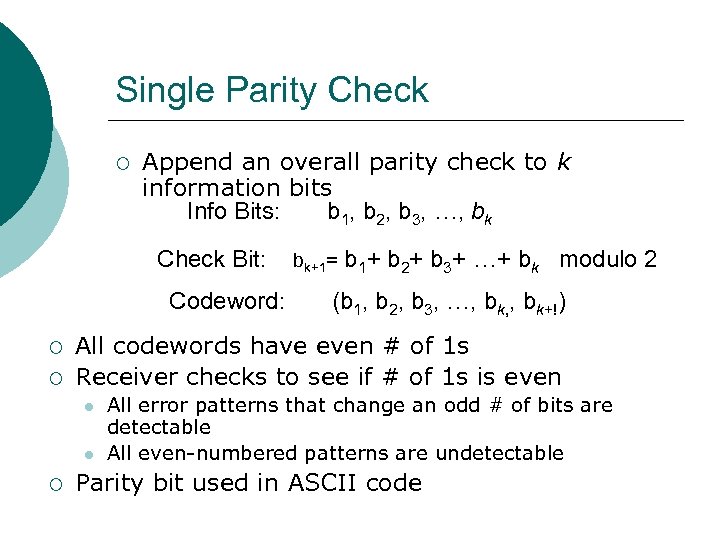 Single Parity Check ¡ Append an overall parity check to k information bits Info Bits: b 1, b 2, b 3, …, bk Check Bit: Codeword: ¡ ¡ b 1+ b 2+ b 3+ …+ bk modulo 2 (b 1, b 2, b 3, …, bk, , bk+!) All codewords have even # of 1 s Receiver checks to see if # of 1 s is even ¡ bk+1= All error patterns that change an odd # of bits are detectable All even-numbered patterns are undetectable Parity bit used in ASCII code
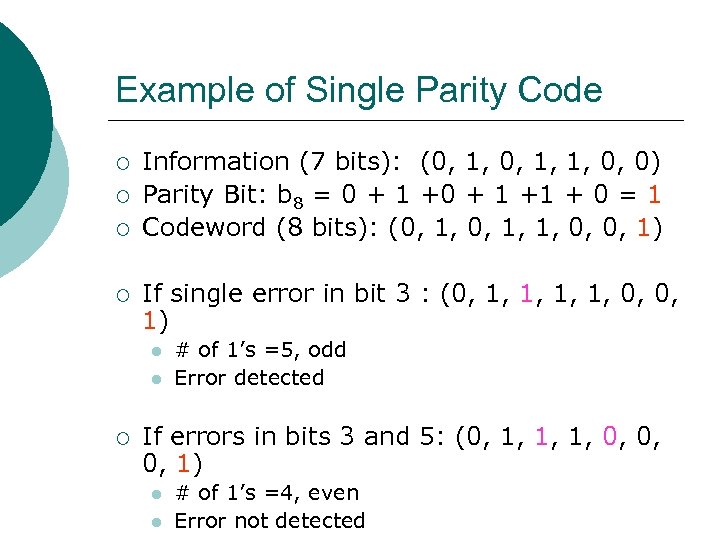 Example of Single Parity Code ¡ ¡ Information (7 bits): (0, 1, 1, 0, 0) Parity Bit: b 8 = 0 + 1 +1 + 0 = 1 Codeword (8 bits): (0, 1, 1, 0, 0, 1) If single error in bit 3 : (0, 1, 1, 0, 0, 1) ¡ # of 1’s =5, odd Error detected If errors in bits 3 and 5: (0, 1, 1, 1, 0, 0, 0, 1) # of 1’s =4, even Error not detected
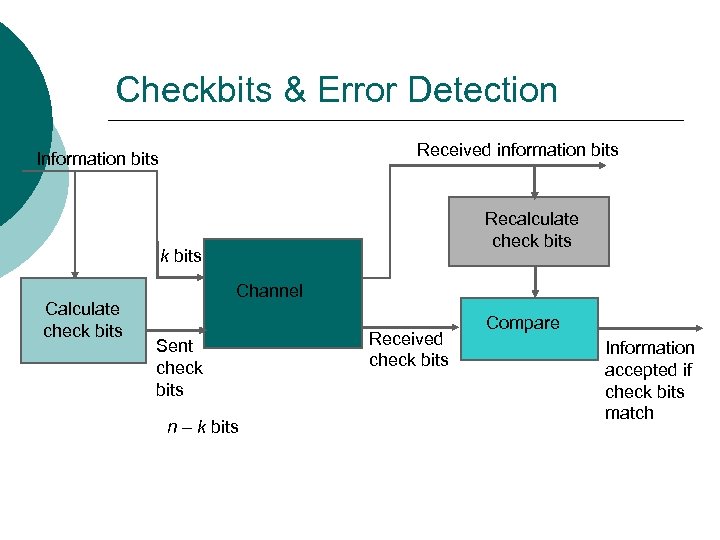 Checkbits & Error Detection Received information bits Information bits Recalculate check bits Calculate check bits Channel Sent check bits n – k bits Received check bits Compare Information accepted if check bits match
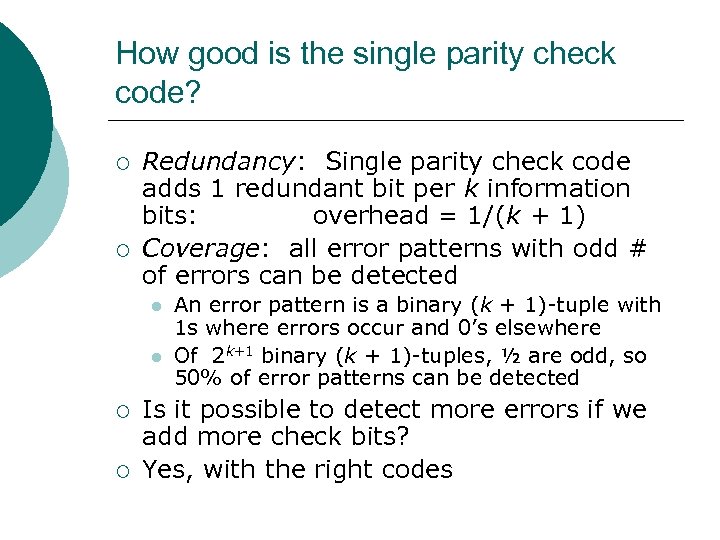 How good is the single parity check code? ¡ ¡ Redundancy: Single parity check code adds 1 redundant bit per k information bits: overhead = 1/(k + 1) Coverage: all error patterns with odd # of errors can be detected ¡ ¡ An error pattern is a binary (k + 1)-tuple with 1 s where errors occur and 0’s elsewhere Of 2 k+1 binary (k + 1)-tuples, ½ are odd, so 50% of error patterns can be detected Is it possible to detect more errors if we add more check bits? Yes, with the right codes
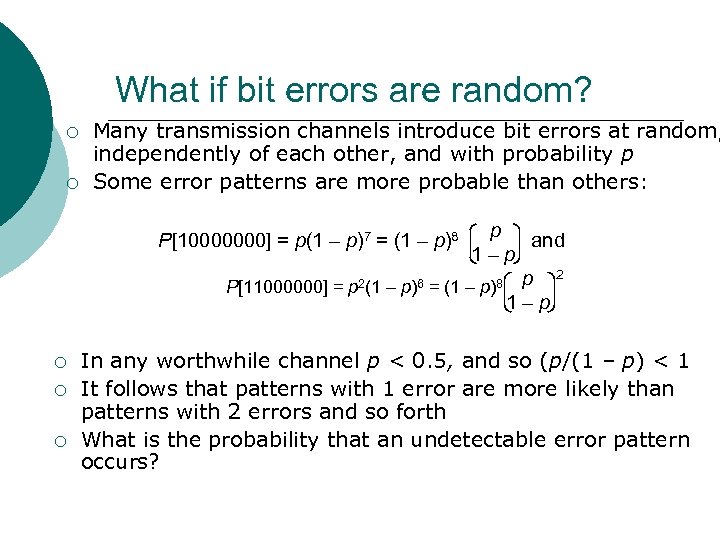 What if bit errors are random? ¡ ¡ Many transmission channels introduce bit errors at random, independently of each other, and with probability p Some error patterns are more probable than others: p and 1–p p 2 2(1 – p)6 = (1 – p)8 P[11000000] = p 1–p P[10000000] = p(1 – p)7 = (1 – p)8 ¡ ¡ ¡ In any worthwhile channel p < 0. 5, and so (p/(1 – p) < 1 It follows that patterns with 1 error are more likely than patterns with 2 errors and so forth What is the probability that an undetectable error pattern occurs?
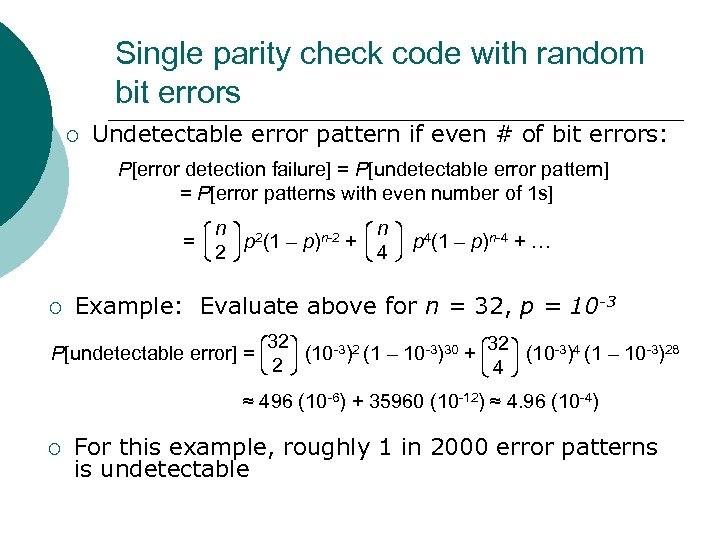 Single parity check code with random bit errors ¡ Undetectable error pattern if even # of bit errors: P[error detection failure] = P[undetectable error pattern] = P[error patterns with even number of 1 s] = ¡ n 2 p (1 – p)n-2 + 2 n 4 p 4(1 – p)n-4 + … Example: Evaluate above for n = 32, p = 10 -3 P[undetectable error] = 32 32 (10 -3)2 (1 – 10 -3)30 + (10 -3)4 (1 – 10 -3)28 2 4 ≈ 496 (10 -6) + 35960 (10 -12) ≈ 4. 96 (10 -4) ¡ For this example, roughly 1 in 2000 error patterns is undetectable
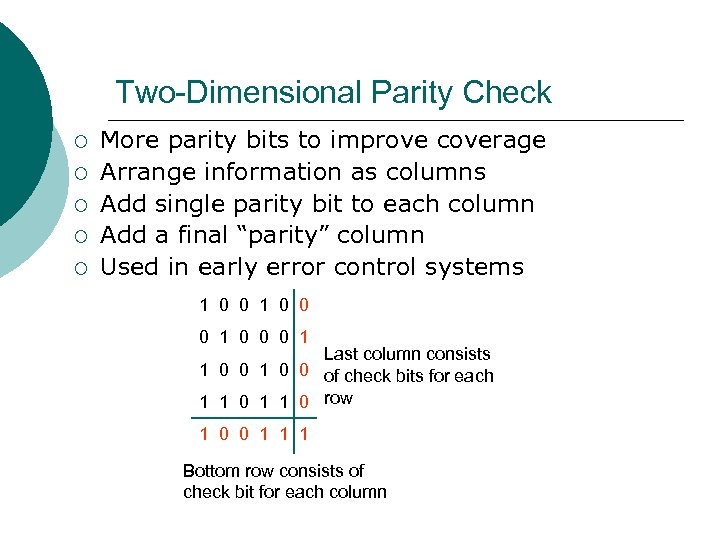 Two-Dimensional Parity Check ¡ ¡ ¡ More parity bits to improve coverage Arrange information as columns Add single parity bit to each column Add a final “parity” column Used in early error control systems 1 0 0 0 1 Last column consists 1 0 0 of check bits for each 1 1 0 row 1 0 0 1 1 1 Bottom row consists of check bit for each column
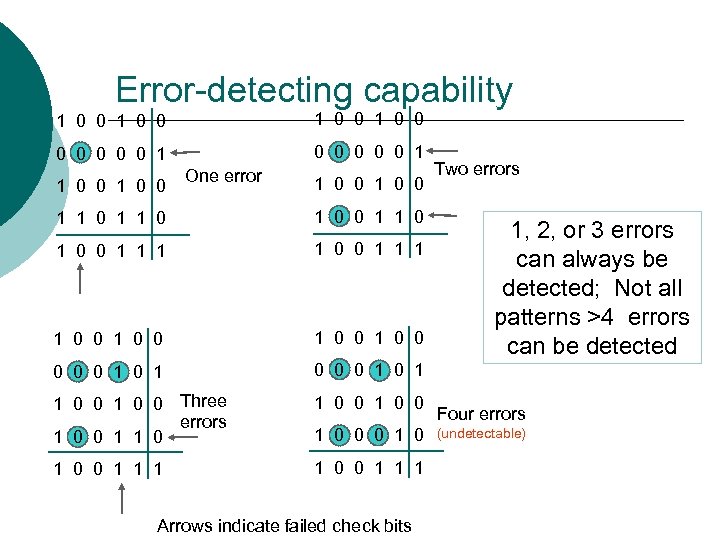 Error-detecting capability 1 0 0 0 0 0 0 0 1 1 0 0 One error 1 0 0 1 1 0 0 1 1 1 1 0 0 1 0 0 0 1 1 0 0 Three errors 1 0 0 1 1 0 0 1 1 1 Two errors 1 0 0 0 1 0 Arrows indicate failed check bits 1, 2, or 3 errors can always be detected; Not all patterns >4 errors can be detected Four errors (undetectable)
 Other Error Detection Codes ¡ ¡ ¡ Many applications require very low error rate Need codes that detect the vast majority of errors Single parity check codes do not detect enough errors Two-dimensional codes require too many check bits The following error detecting codes used in practice: Internet Check Sums CRC Polynomial Codes
 Internet Checksum ¡ ¡ ¡ Several Internet protocols (e. g. IP, TCP, UDP) use check bits to detect errors in the IP header (or in the header and data for TCP/UDP) A checksum is calculated for header contents and included in a special field. Checksum recalculated at every router, so algorithm selected for ease of implementation in software Let header consist of L, 16 -bit words, b 0, b 1, b 2, . . . , b. L-1 The algorithm appends a 16 -bit checksum b. L
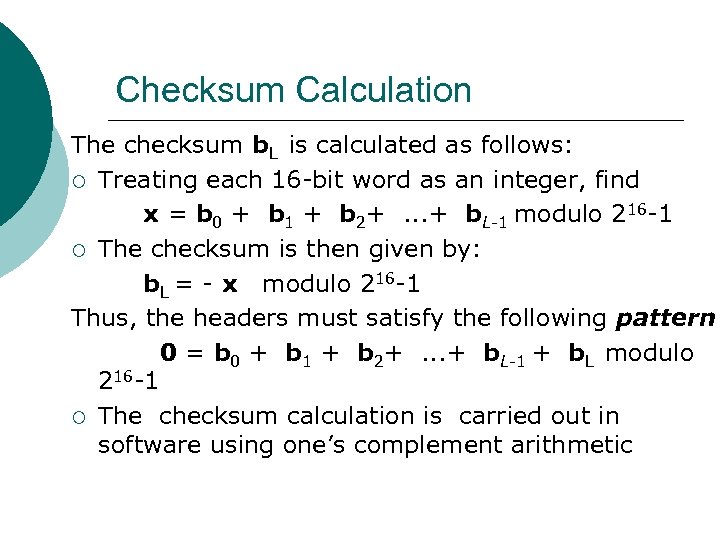 Checksum Calculation The checksum b. L is calculated as follows: ¡ Treating each 16 -bit word as an integer, find x = b 0 + b 1 + b 2+. . . + b. L-1 modulo 216 -1 ¡ The checksum is then given by: b. L = - x modulo 216 -1 Thus, the headers must satisfy the following pattern: 0 = b 0 + b 1 + b 2+. . . + b. L-1 + b. L modulo 216 -1 ¡ The checksum calculation is carried out in software using one’s complement arithmetic
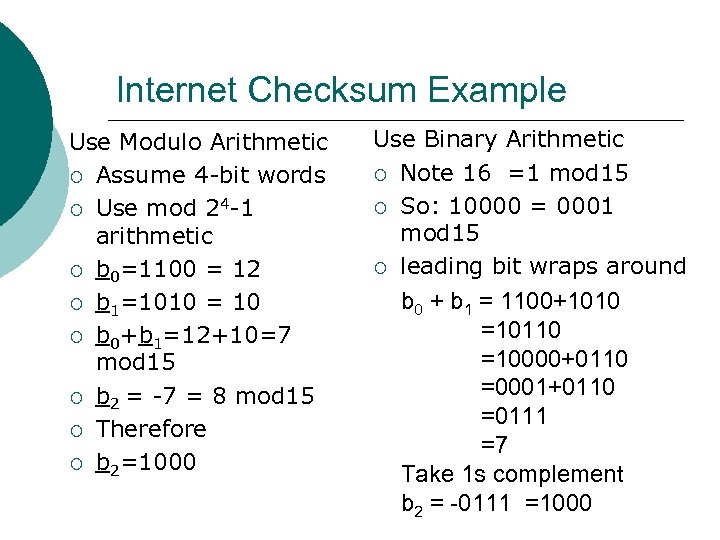 Internet Checksum Example Use Modulo Arithmetic ¡ Assume 4 -bit words ¡ Use mod 24 -1 arithmetic ¡ b 0=1100 = 12 ¡ b 1=1010 = 10 ¡ b 0+b 1=12+10=7 mod 15 ¡ b 2 = -7 = 8 mod 15 ¡ Therefore ¡ b 2=1000 Use Binary Arithmetic ¡ Note 16 =1 mod 15 ¡ So: 10000 = 0001 mod 15 ¡ leading bit wraps around b 0 + b 1 = 1100+1010 =10110 =10000+0110 =0001+0110 =0111 =7 Take 1 s complement b 2 = -0111 =1000
 Polynomial Codes ¡ ¡ ¡ Polynomials instead of vectors for codewords Polynomial arithmetic instead of check sums Implemented using shift-register circuits Also called cyclic redundancy check (CRC) codes Most data communications standards use polynomial codes for error detection Polynomial codes also basis for powerful error-correction methods
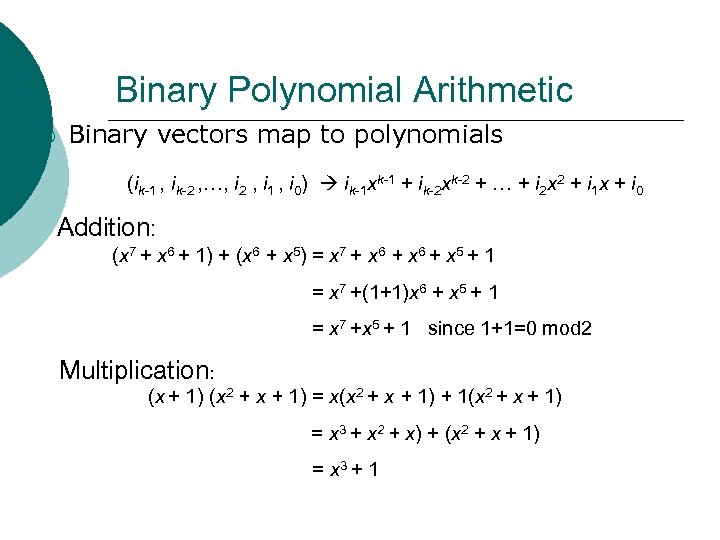 Binary Polynomial Arithmetic ¡ Binary vectors map to polynomials (ik-1 , ik-2 , …, i 2 , i 1 , i 0) ik-1 xk-1 + ik-2 xk-2 + … + i 2 x 2 + i 1 x + i 0 Addition: (x 7 + x 6 + 1) + (x 6 + x 5) = x 7 + x 6 + x 5 + 1 = x 7 +(1+1)x 6 + x 5 + 1 = x 7 +x 5 + 1 since 1+1=0 mod 2 Multiplication: (x + 1) (x 2 + x + 1) = x(x 2 + x + 1) + 1(x 2 + x + 1) = x 3 + x 2 + x) + (x 2 + x + 1) = x 3 + 1
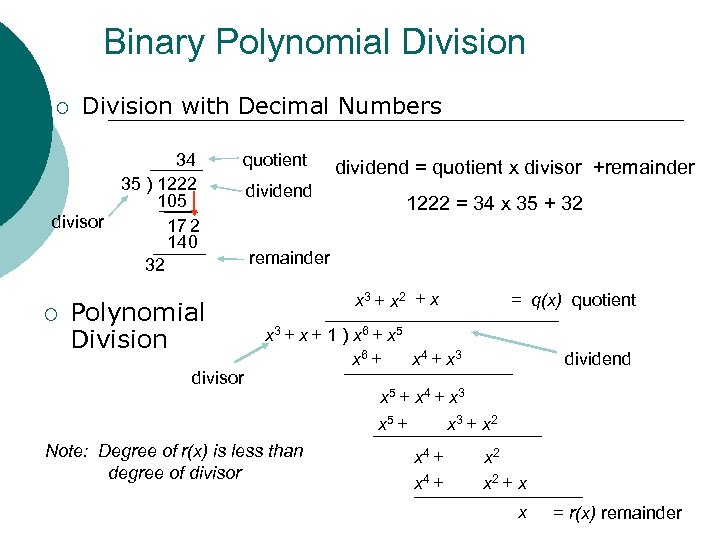 Binary Polynomial Division ¡ Division with Decimal Numbers 34 35 ) 1222 105 divisor 17 2 140 32 ¡ quotient Polynomial Division divisor dividend = quotient x divisor +remainder 1222 = 34 x 35 + 32 remainder x 3 + x 2 + x = q(x) quotient x 3 + x + 1 ) x 6 + x 5 x 6 + x 4 + x 3 Note: Degree of r(x) is less than degree of divisor dividend x 5 + x 4 + x 3 x 5 + x 3 + x 2 x 4 + x 2 + x x = r(x) remainder
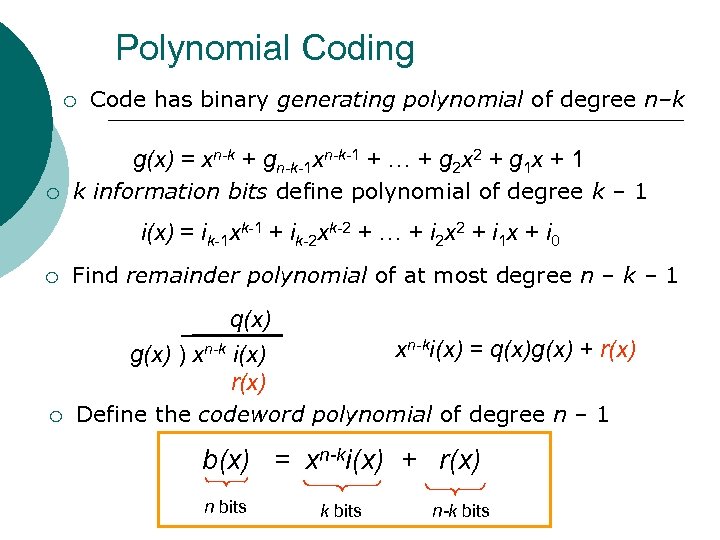 Polynomial Coding ¡ Code has binary generating polynomial of degree n–k g(x) = xn-k + gn-k-1 xn-k-1 + … + g 2 x 2 + g 1 x + 1 ¡ k information bits define polynomial of degree k – 1 i(x) = ik-1 xk-1 + ik-2 xk-2 + … + i 2 x 2 + i 1 x + i 0 ¡ Find remainder polynomial of at most degree n – k – 1 q(x) g(x) ) xn-k i(x) r(x) ¡ xn-ki(x) = q(x)g(x) + r(x) Define the codeword polynomial of degree n – 1 b(x) = xn-ki(x) + r(x) n bits k bits n-k bits
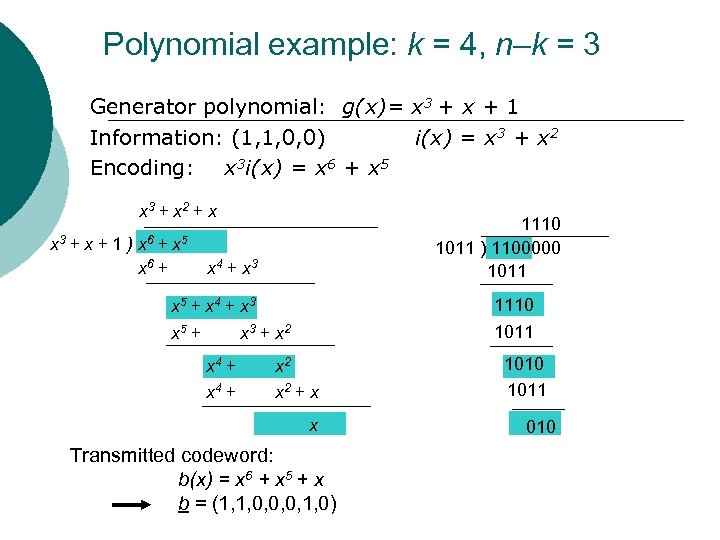 Polynomial example: k = 4, n–k = 3 Generator polynomial: g(x)= x 3 + x + 1 Information: (1, 1, 0, 0) i(x) = x 3 + x 2 Encoding: x 3 i(x) = x 6 + x 5 x 3 + x 2 + x x 3 + x + 1 ) x 6 + x 5 x 6 + 1110 1011 ) 1100000 1011 x 4 + x 3 1110 1011 x 5 + x 4 + x 3 x 5 + x 3 + x 2 x 4 + x 2 + x x Transmitted codeword: b(x) = x 6 + x 5 + x b = (1, 1, 0, 0, 0, 1, 0) 1010 1011 010
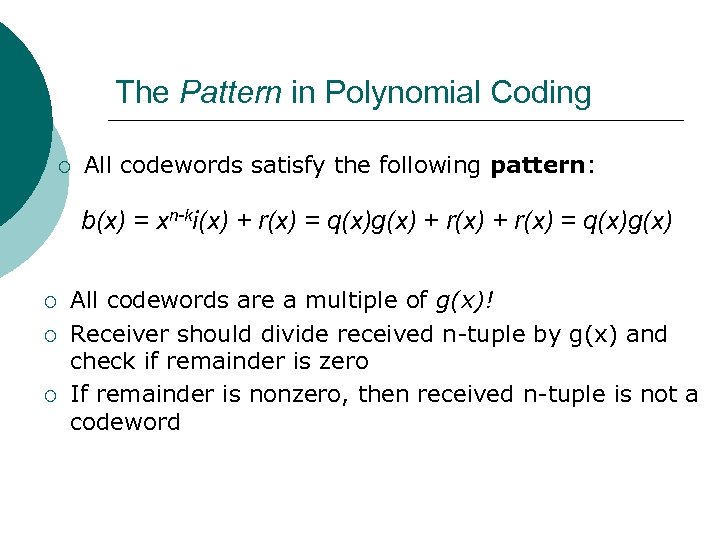 The Pattern in Polynomial Coding ¡ All codewords satisfy the following pattern: b(x) = xn-ki(x) + r(x) = q(x)g(x) ¡ ¡ ¡ All codewords are a multiple of g(x)! Receiver should divide received n-tuple by g(x) and check if remainder is zero If remainder is nonzero, then received n-tuple is not a codeword
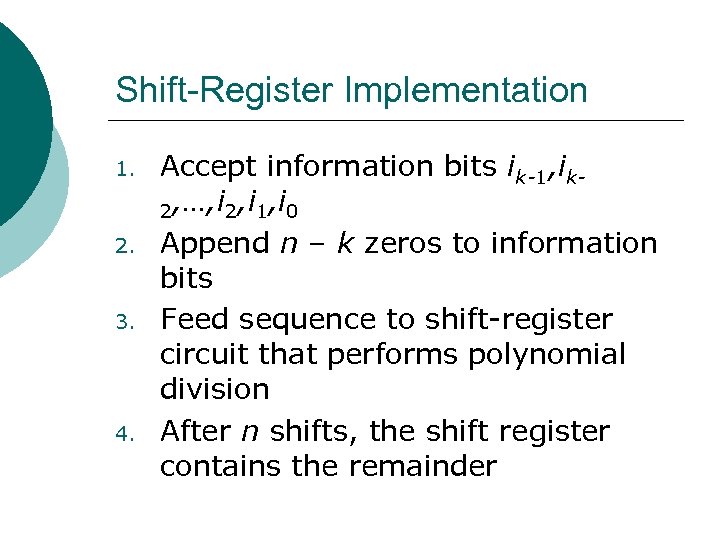 Shift-Register Implementation 1. 2. 3. 4. Accept information bits ik-1, ik 2, …, i 2, i 1, i 0 Append n – k zeros to information bits Feed sequence to shift-register circuit that performs polynomial division After n shifts, the shift register contains the remainder
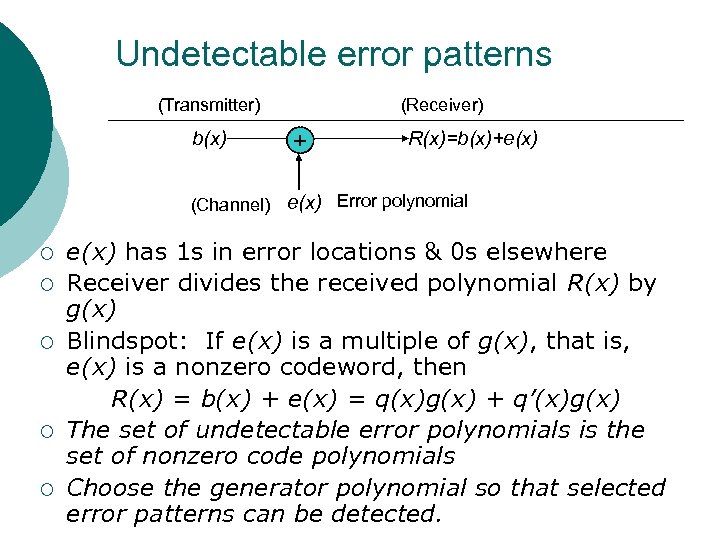 Undetectable error patterns (Transmitter) b(x) (Receiver) + R(x)=b(x)+e(x) (Channel) e(x) Error polynomial ¡ ¡ ¡ e(x) has 1 s in error locations & 0 s elsewhere Receiver divides the received polynomial R(x) by g(x) Blindspot: If e(x) is a multiple of g(x), that is, e(x) is a nonzero codeword, then R(x) = b(x) + e(x) = q(x)g(x) + q’(x)g(x) The set of undetectable error polynomials is the set of nonzero code polynomials Choose the generator polynomial so that selected error patterns can be detected.
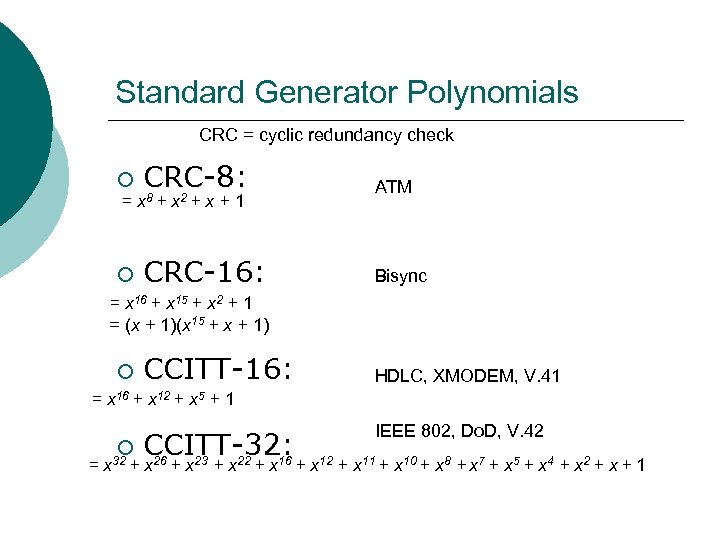 Standard Generator Polynomials CRC = cyclic redundancy check ¡ CRC-8: 8 2 ATM ¡ CRC-16: Bisync =x +x +x+1 = x 16 + x 15 + x 2 + 1 = (x + 1)(x 15 + x + 1) ¡ CCITT-16: HDLC, XMODEM, V. 41 = x 16 + x 12 + x 5 + 1 = ¡ x 32 + CCITT-32: 26 23 22 16 x +x IEEE 802, Do. D, V. 42 + x + x 12 + x 11 + x 10 + x 8 + x 7 + x 5 + x 4 + x 2 + x + 1