


 Скачать презентацию CHAPTER 3 Demand supply and the market Mc
2317a9777c55f693457e3e4ff6343bb7.ppt
- Количество слайдов: 26
 CHAPTER 3 Demand, supply and the market ©Mc. Graw-Hill Education, 2014
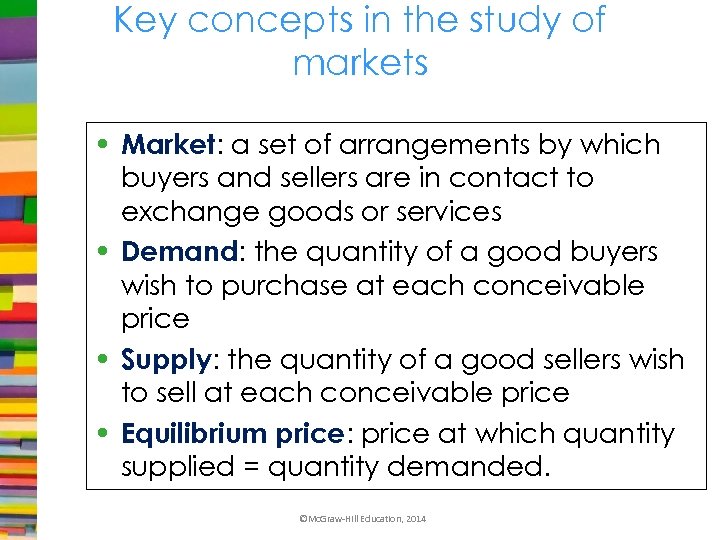 Key concepts in the study of markets • Market: a set of arrangements by which buyers and sellers are in contact to exchange goods or services • Demand: the quantity of a good buyers wish to purchase at each conceivable price • Supply: the quantity of a good sellers wish to sell at each conceivable price • Equilibrium price: price at which quantity supplied = quantity demanded. ©Mc. Graw-Hill Education, 2014
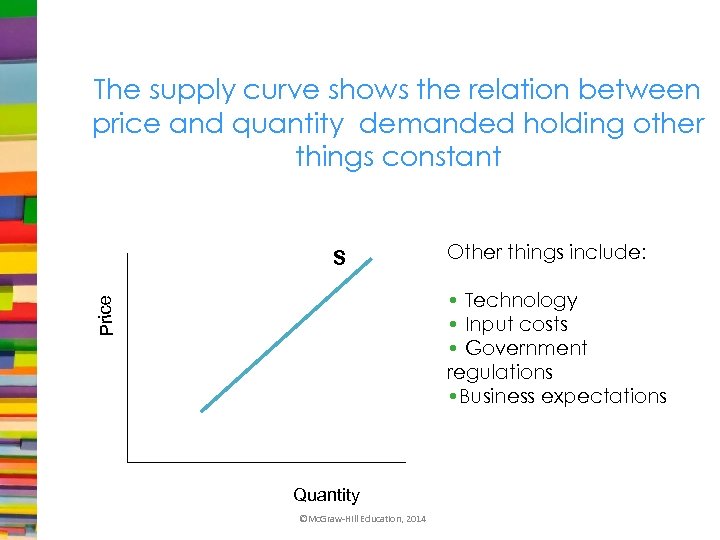 The supply curve shows the relation between price and quantity demanded holding other things constant S Other things include: Price • Technology • Input costs • Government regulations • Business expectations Quantity ©Mc. Graw-Hill Education, 2014
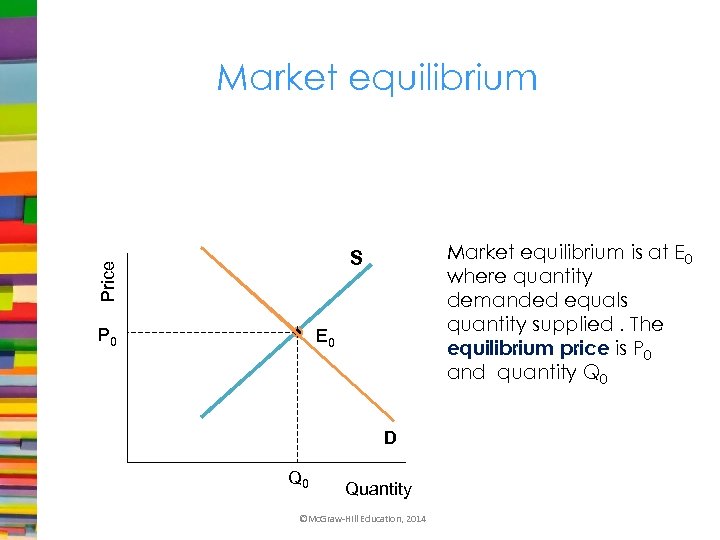 Market equilibrium is at E 0 where quantity demanded equals quantity supplied. The equilibrium price is P 0 and quantity Q 0 Price S P 0 E 0 D Q 0 Quantity ©Mc. Graw-Hill Education, 2014
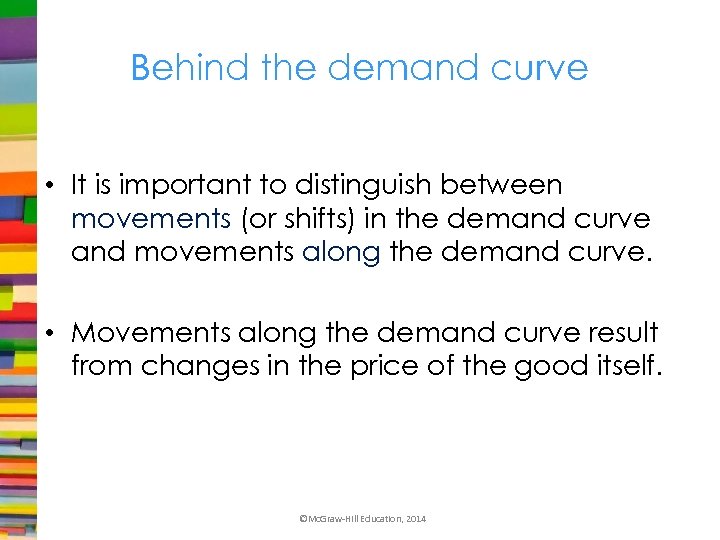 Behind the demand curve • It is important to distinguish between movements (or shifts) in the demand curve and movements along the demand curve. • Movements along the demand curve result from changes in the price of the good itself. ©Mc. Graw-Hill Education, 2014
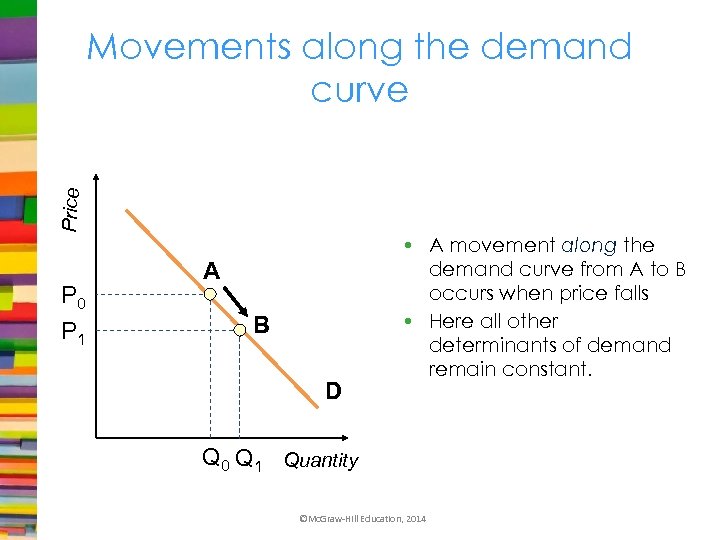 Price Movements along the demand curve P 0 P 1 A B D • A movement along the demand curve from A to B occurs when price falls • Here all other determinants of demand remain constant. Q 0 Q 1 Quantity ©Mc. Graw-Hill Education, 2014
 Behind the demand curve • Movements (or shifts) in the demand curves are caused by Ø Changes in the price of related goods – either substitutes or complements Ø Changes in consumer incomes Ø Changes in tastes Ø Expectations over future price changes. ©Mc. Graw-Hill Education, 2014
 Income changes and demand • The influence of changes in income on demand depends on whether the good is Ø a normal good or Ø an inferior good. ©Mc. Graw-Hill Education, 2014
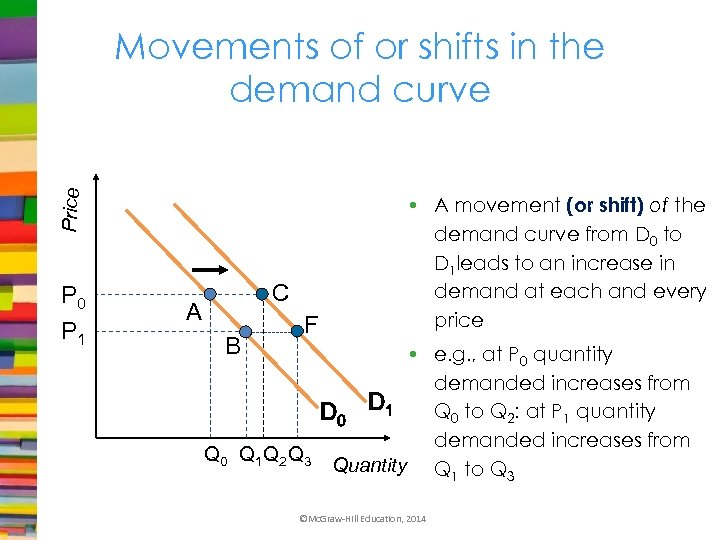 Price Movements of or shifts in the demand curve P 0 P 1 C A B F • A movement (or shift) of the demand curve from D 0 to D 1 leads to an increase in demand at each and every price • e. g. , at P 0 quantity demanded increases from Q 0 to Q 2: at P 1 quantity D 0 D 1 demanded increases from Q 0 Q 1 Q 2 Q 3 Quantity Q 1 to Q 3 ©Mc. Graw-Hill Education, 2014
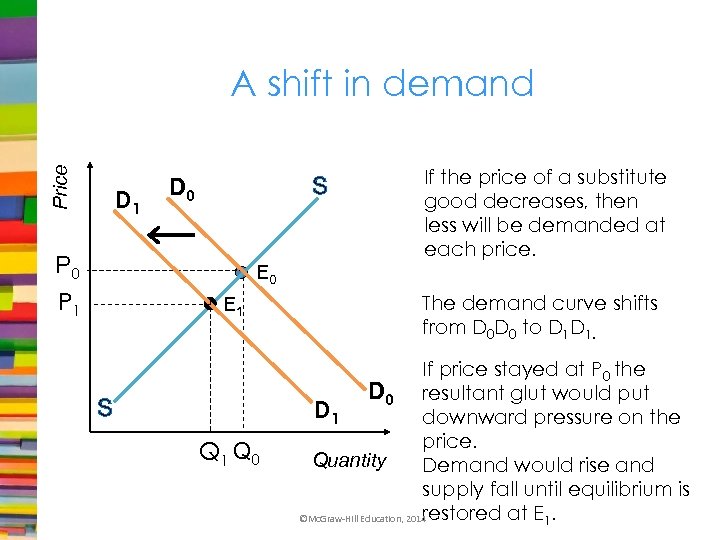 Price A shift in demand D 1 D 0 S P 0 If the price of a substitute good decreases, then less will be demanded at each price. E 0 P 1 E 1 S Q 1 Q 0 The demand curve shifts from D 0 D 0 to D 1 D 1. If price stayed at P 0 the D 0 resultant glut would put D 1 downward pressure on the price. Quantity Demand would rise and supply fall until equilibrium is restored at E 1. ©Mc. Graw-Hill Education, 2014
 Behind the supply curve (1) • It is important to distinguish between movements (or shifts) in the supply curve and movements along the supply curve. • Movements along the supply curve result from changes in the price of the good itself. ©Mc. Graw-Hill Education, 2014
 Behind the supply curve (2) • Movements (or shifts) in the supply curves are caused by Ø Changes in technology Ø Changes in input costs Ø Changes in government regulations Ø Business expectations ©Mc. Graw-Hill Education, 2014
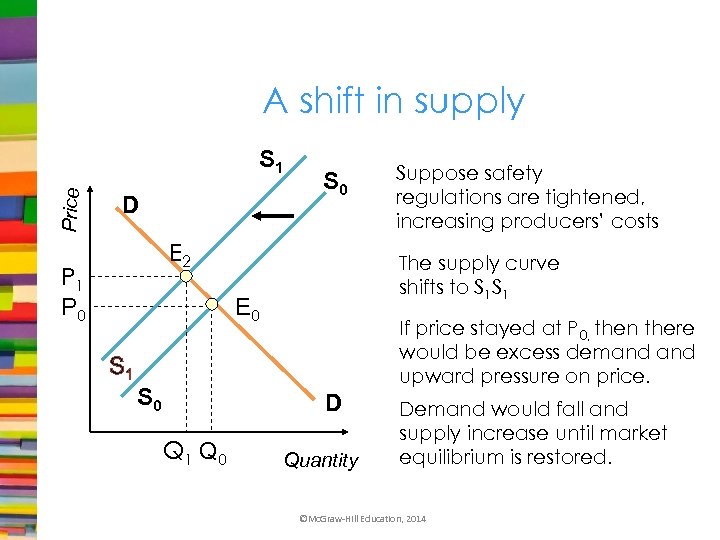 A shift in supply Price S 1 D S 0 E 2 P 1 P 0 The supply curve shifts to S 1 S 1 E 0 S 1 S 0 If price stayed at P 0, then there would be excess demand upward pressure on price. D Q 1 Q 0 Suppose safety regulations are tightened, increasing producers’ costs Quantity Demand would fall and supply increase until market equilibrium is restored. ©Mc. Graw-Hill Education, 2014
 Consumer and producer surplus(1) • The difference between what a consumer is willing to pay for a good and the price actually paid is a measure of the consumer’s surplus. • Total consumer surplus in a market is the sum of all the surpluses enjoyed by all consumers. ©Mc. Graw-Hill Education, 2014
 Consumer and producer surplus (2) • The difference between the price at which a firm would be willing to supply a good and the price actually received by the firm is a measure of its producer surplus. • Total producer surplus in a market is the sum of all the surpluses enjoyed by all producers. ©Mc. Graw-Hill Education, 2014
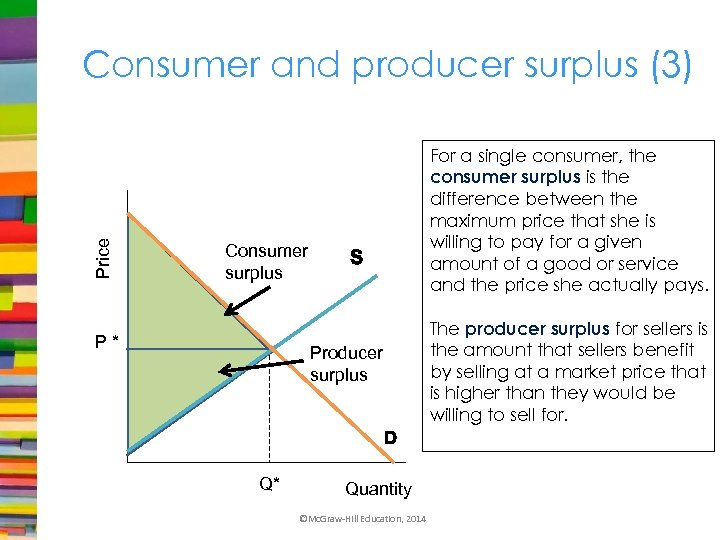 Price Consumer and producer surplus (3) Consumer surplus P* For a single consumer, the consumer surplus is the difference between the maximum price that she is willing to pay for a given amount of a good or service and the price she actually pays. S The producer surplus for sellers is the amount that sellers benefit by selling at a market price that is higher than they would be willing to sell for. Producer surplus D Q* Quantity ©Mc. Graw-Hill Education, 2014
 Consumer and producer surplus and the gains from trade • The economic surplus in a market (sum of consumer and producer surplus) is a measure of the benefits firms and consumers derive from trade. • It is maximized at the equilibrium price. • Only at this price are all the benefits from exchange exhausted. ©Mc. Graw-Hill Education, 2014
 What, how and for whom • The market: – decides how much of a good should be produced • by finding the price at which the quantity demanded equals the quantity supplied – tells us for whom the goods are produced • those consumers willing to pay the equilibrium price – determines what goods are being produced • there may be goods for which no consumer is prepared to pay a price at which firms would be willing to supply ©Mc. Graw-Hill Education, 2014
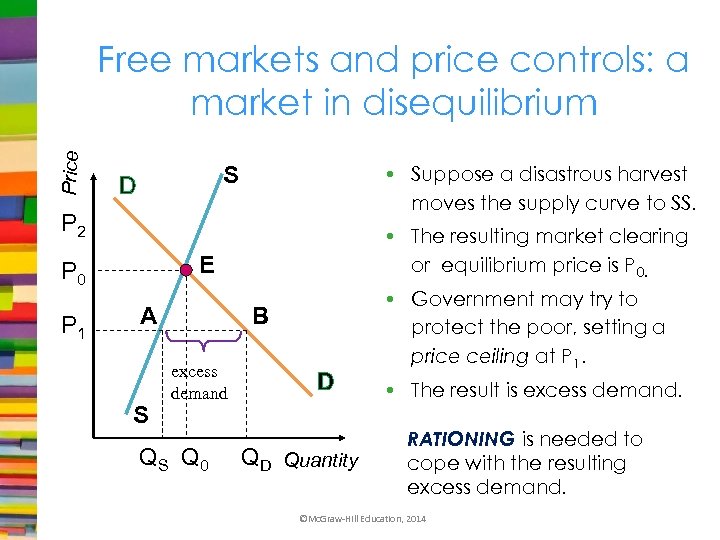 Price Free markets and price controls: a market in disequilibrium • Suppose a disastrous harvest moves the supply curve to SS. S D P 2 E P 0 P 1 • The resulting market clearing or equilibrium price is P 0. A S B excess demand QS Q 0 D QD Quantity • Government may try to protect the poor, setting a price ceiling at P 1. • The result is excess demand. RATIONING is needed to cope with the resulting excess demand. ©Mc. Graw-Hill Education, 2014
 Free markets and price controls: a market in disequilibrium • Minimum wages are an example of a price floor and can result in unemployment. • Rent caps are an example of a price ceiling and can result in shortages in rental markets. ©Mc. Graw-Hill Education, 2014
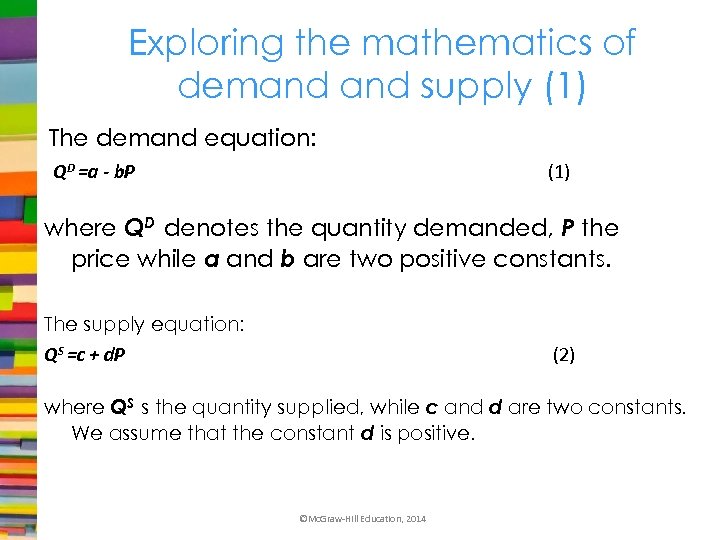 Exploring the mathematics of demand supply (1) The demand equation: QD =a - b. P (1) where QD denotes the quantity demanded, P the price while a and b are two positive constants. The supply equation: QS =c + d. P (2) where QS s the quantity supplied, while c and d are two constants. We assume that the constant d is positive. ©Mc. Graw-Hill Education, 2014
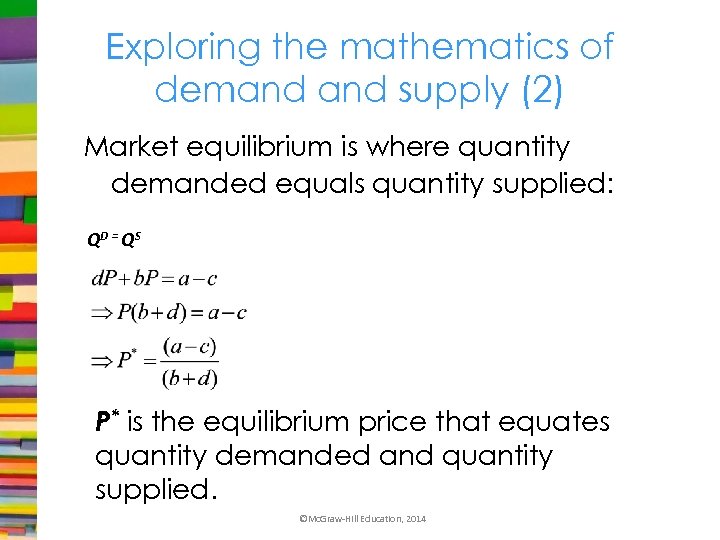 Exploring the mathematics of demand supply (2) Market equilibrium is where quantity demanded equals quantity supplied: QD = QS P* is the equilibrium price that equates quantity demanded and quantity supplied. ©Mc. Graw-Hill Education, 2014
 Uncovering demand supply curves • It is important to understand that demand supply curves are not physical objects that can be seen or touched. • Rather they are relationships revealed through the appropriate use of statistical analyses undertaken by skilled econometricians. ©Mc. Graw-Hill Education, 2014
 Uncovering supply and demand • We cannot plot ex ante demand curves and supply curves • So we use historical data and the supposition that the observed values are equilibrium ones • Since other things are often not constant, careful use of statistical techniques is required to isolate the parameters of a demand or supply curve. ©Mc. Graw-Hill Education, 2014
 Concluding comments (1) • Demand is the quantity that buyers wish to buy at each price. • Supply is the quantity of a good sellers wish to sell at each price. • The market clears, or is in equilibrium, when the price equates the quantity supplied and the quantity demanded, and there are no shortages or surpluses. • An increase in the price of a substitute good (or decrease in the price of a complementary good) will raise the quantity demanded at each price. ©Mc. Graw-Hill Education, 2014
 Concluding comments (2) • The consumer surplus is measured by the area below the market demand above the equilibrium price. • The producer surplus is measured by the area above the market supply and below the equilibrium price. • To be effective, a price ceiling must be imposed below the free market equilibrium price. • An effective price floor must be imposed above the free market equilibrium price. ©Mc. Graw-Hill Education, 2014