


 Скачать презентацию Chapter 28 Cold War and a New Western
d6e5a0787ac1ee01711f76b70beef72b.ppt
- Количество слайдов: 50
 Chapter 28 Cold War and a New Western World, 1945 - 1970
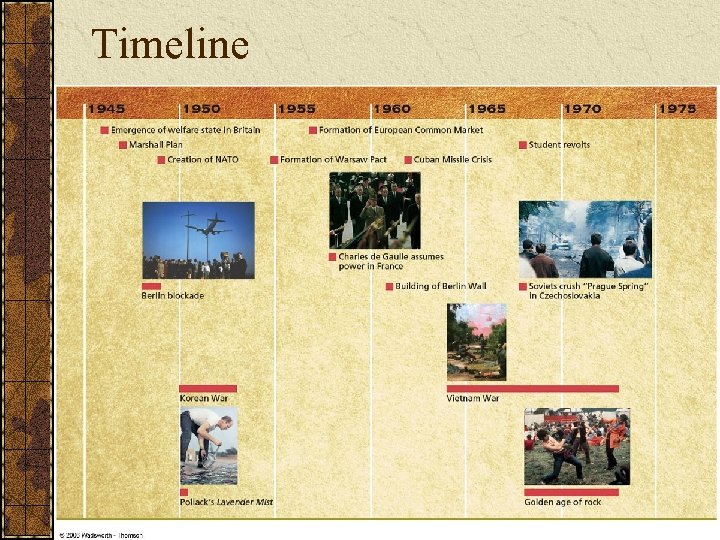 Timeline
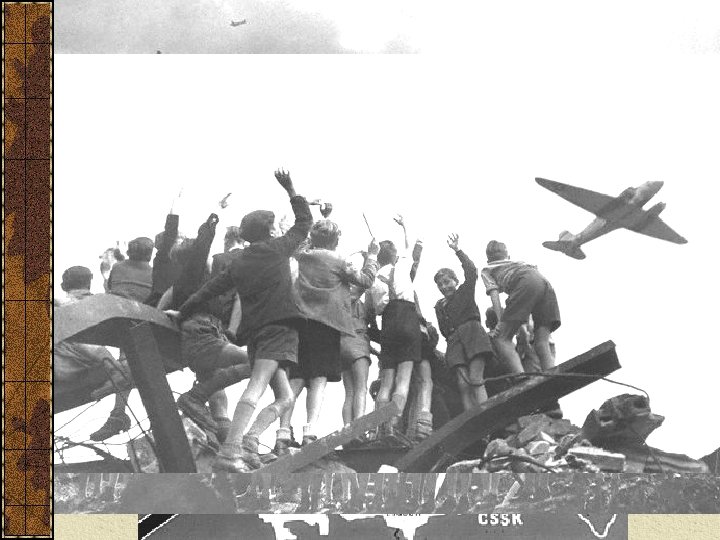
 Confrontation of the Superpowers Disagreement over Eastern Europe United States and Britain championed self-determination and democracy Soviet forces occupied all of Eastern Europe Between 1945 and 1947 Communist governments were entrenched in East Germany, Bulgaria, Romania, Poland, and Hungary Truman Doctrine, March 12, 1947 Civil war in Greece and Turkey Marshall Plan, June 1947, European Recovery Program $13 billion for the economic recovery of war-torn Europe Soviet view The American Policy of Containment Contention over Germany Soviets dismantle and remove factories Blockade of Berlin, 1948 -1949 Germany separated, 1949 • West German Federal Republic, September • German Democratic Republic, October New Military Alliances Soviet Union detonates its first atomic bomb, 1949 North Atlantic Treaty Organization, 1949 Warsaw Pact, 1955
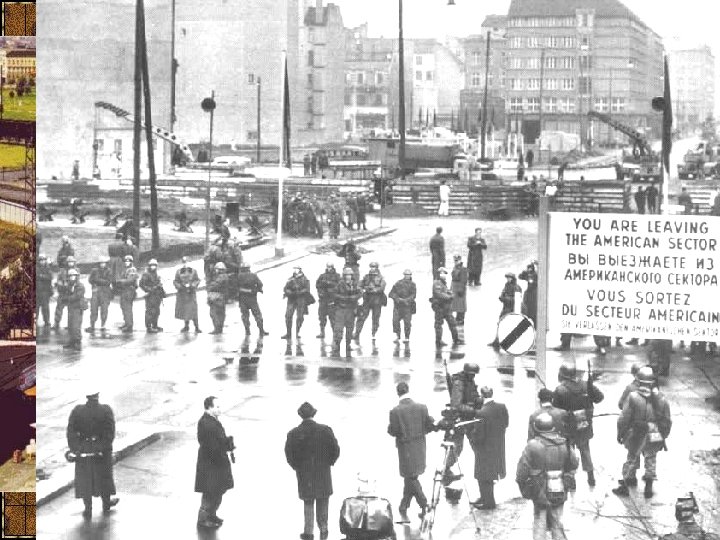
 Globalization of the Cold War The Korean War North Koreans invaded the south, 1950 Chinese intervene when UN troops approach the border Uneasy truce, 1953 Escalation of the Cold War Policy of massive retaliation Central Treaty Organization Southeast Asia Treaty Organization Another Berlin Crisis Vulnerability of Berlin ICBM missile and Sputnik I launched Summit meeting in Vienna Berlin Wall, 1961
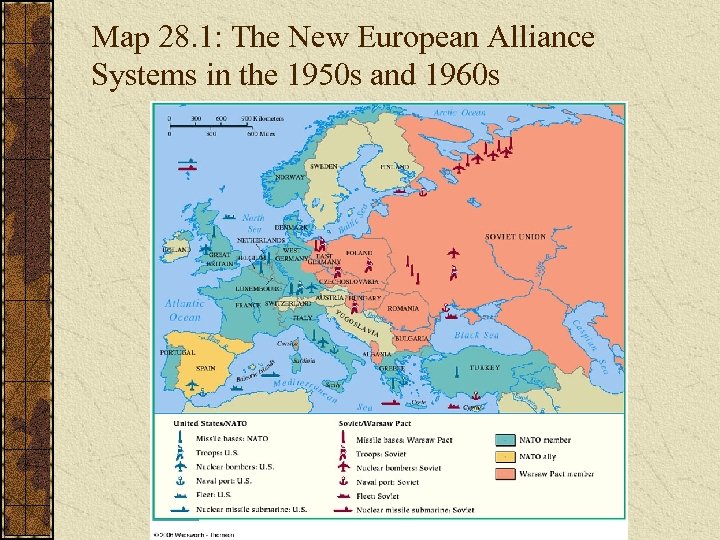 Map 28. 1: The New European Alliance Systems in the 1950 s and 1960 s
 The Cuban Missile Crisis Fidel Castro (b. 1927) Overthrows Fulgencio Batista, 1959 Established a communist regime Failed Bay of Pigs invasion, 1961 Discovery by US of missile bases being built President John F. Kennedy orders a blockade of Cuba Khrushchev agrees to turn back ships carrying missiles in return for Kennedy’s promise not to invade Cuba
 The Vietnam War President Lyndon Johnson sends larger numbers of troops to Vietnam, 1965 Domino Theory If the communists succeed in Vietnam, other nations inn Asia would fall to communism President Richard Nixon (1913 -1994) vows to bring an honorable end Begins withdrawing troops Peace treaty signed January 1973 calls for removal of all US troops
 Decolonization Africa: The Struggle for Independence Kwame Nkrumah; Convention People’s Party Jomo Kenyatta; Kenya African National Union French in North Africa • Granted full independence to Morocco and Tunisia in 1956 • Guerrilla war in Algeria South Africa • African National Congress • Apartheid • Nelson Mandela Ghana was the first to gain independence, 1957 Others followed • Portuguese gave up Angola and Mozambique, 1975
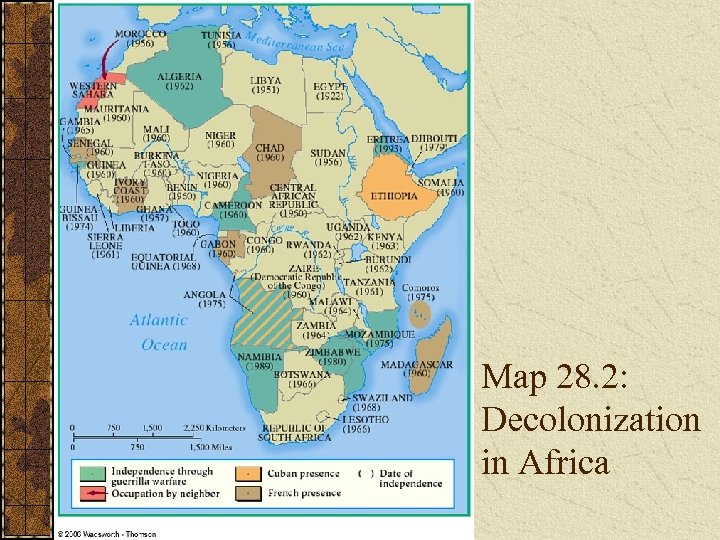 Map 28. 2: Decolonization in Africa
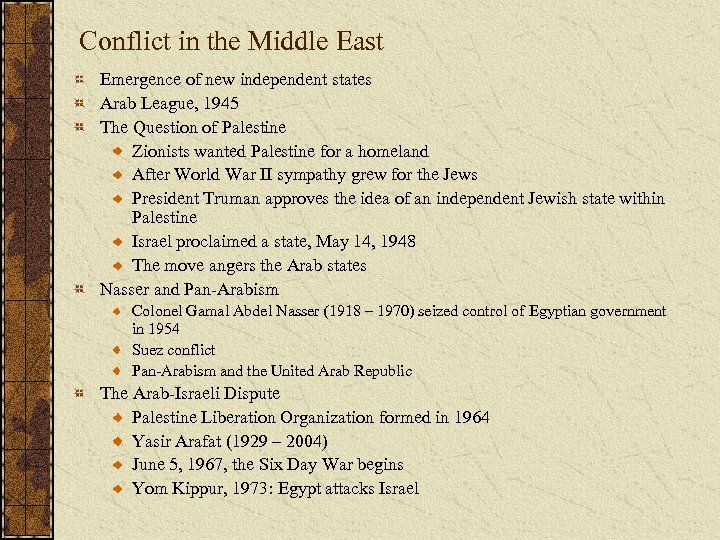 Conflict in the Middle East Emergence of new independent states Arab League, 1945 The Question of Palestine Zionists wanted Palestine for a homeland After World War II sympathy grew for the Jews President Truman approves the idea of an independent Jewish state within Palestine Israel proclaimed a state, May 14, 1948 The move angers the Arab states Nasser and Pan-Arabism Colonel Gamal Abdel Nasser (1918 – 1970) seized control of Egyptian government in 1954 Suez conflict Pan-Arabism and the United Arab Republic The Arab-Israeli Dispute Palestine Liberation Organization formed in 1964 Yasir Arafat (1929 – 2004) June 5, 1967, the Six Day War begins Yom Kippur, 1973: Egypt attacks Israel
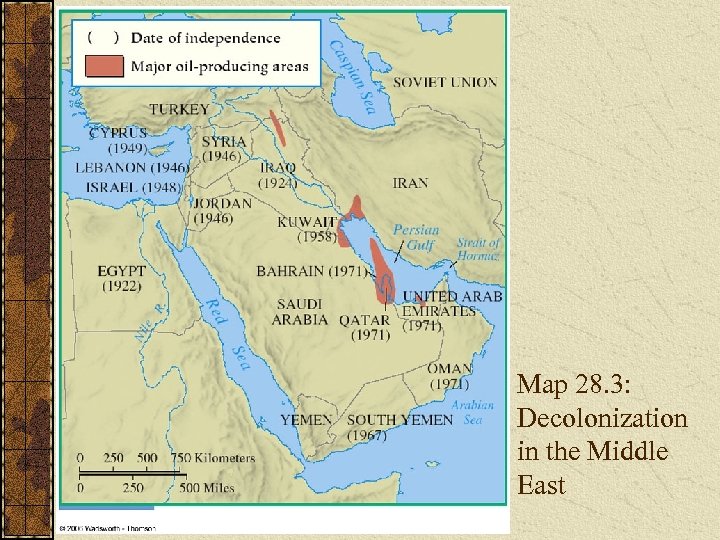 Map 28. 3: Decolonization in the Middle East
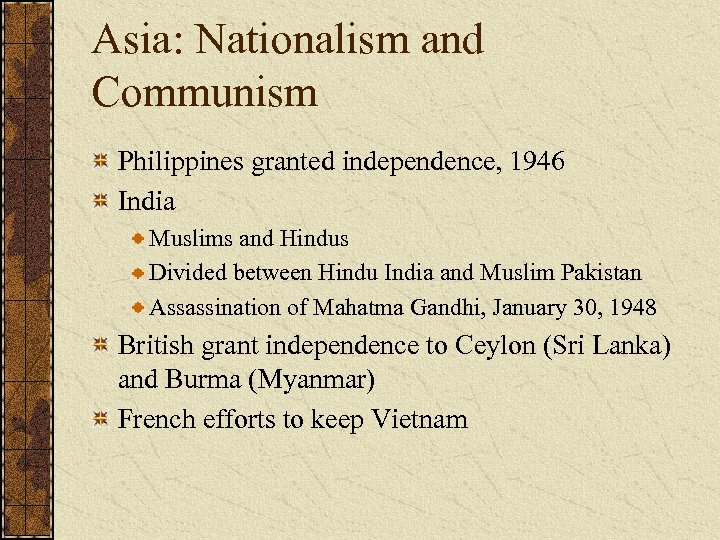 Asia: Nationalism and Communism Philippines granted independence, 1946 India Muslims and Hindus Divided between Hindu India and Muslim Pakistan Assassination of Mahatma Gandhi, January 30, 1948 British grant independence to Ceylon (Sri Lanka) and Burma (Myanmar) French efforts to keep Vietnam
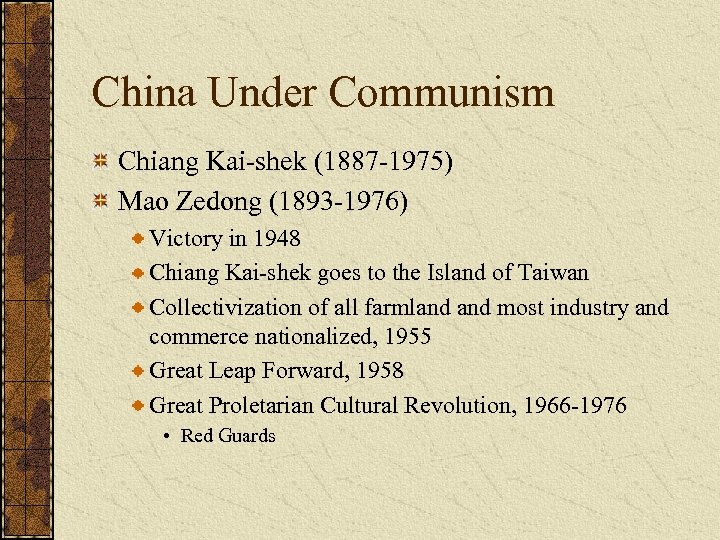 China Under Communism Chiang Kai-shek (1887 -1975) Mao Zedong (1893 -1976) Victory in 1948 Chiang Kai-shek goes to the Island of Taiwan Collectivization of all farmland most industry and commerce nationalized, 1955 Great Leap Forward, 1958 Great Proletarian Cultural Revolution, 1966 -1976 • Red Guards
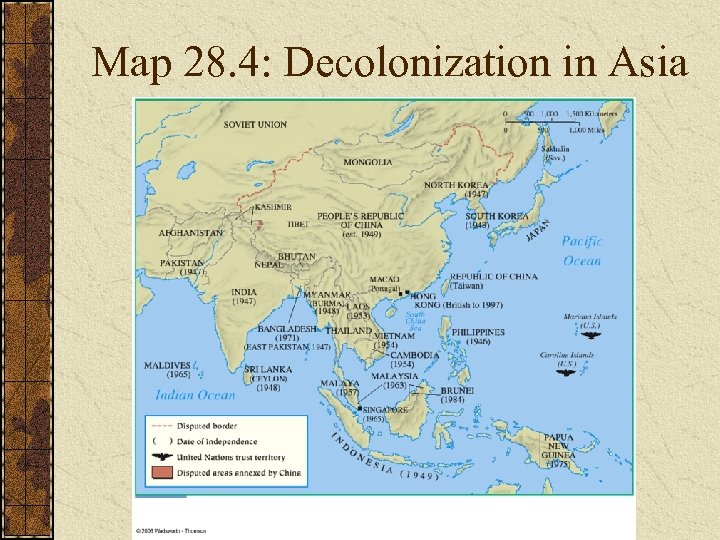 Map 28. 4: Decolonization in Asia
 Decolonization and Cold War Rivalries Newly independent nations caught in U. S. – Soviet conflict Jawaharlal Nehru and Nonalignment Indonesia Sukarno and Suharto
 The Soviet Union: From Stalin to Khrushchev Stalin’s Policies Stalin’s method for the recovery of the Soviet Union By 1947 the Soviet Union had attained pre-war levels of industrial production Very few consumer goods produced Stalin continued his iron rule until his death in 1953 Nikita Khrushchev (1894 -1971) Ends the forced labor camps Condemns Stalinist programs There seem to be a loosening of restraint Encourages rebellion in satellite nations • Rebellions will be crushed Agricultural setbacks Industrial decline
 Eastern Europe: Behind the Iron Curtain In 1945 Soviet Union occupied all of the Balkans Communist governments were under the control of the Soviet Union Albania and Yugoslavia were the exceptions Albania had a Stalinist type regime, but became more and more independent Josip Broz, Tito, took control of Yugoslavia Eastern European countries followed the Soviet pattern Five year plans Farm collectivization Upheaval in Eastern Europe Khrushchev interferes less with the satellite countries Rebellion in Poland • Wladyslaw Gomulka , 1956, elected first secretary • Poland follows its own socialist plan
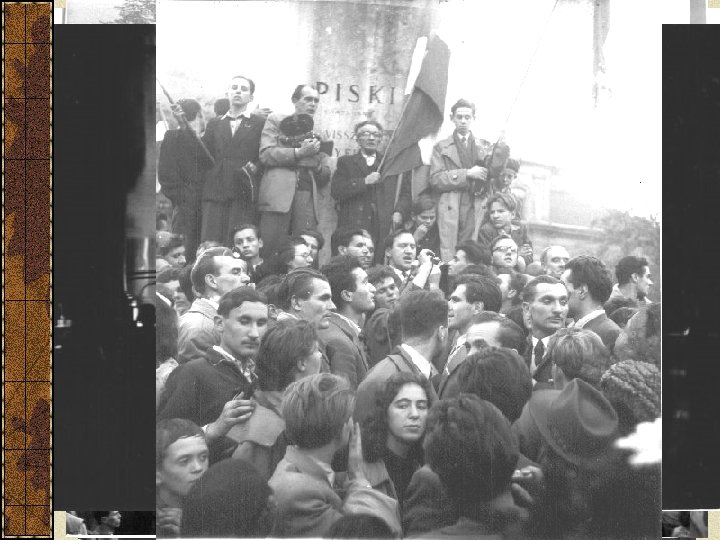
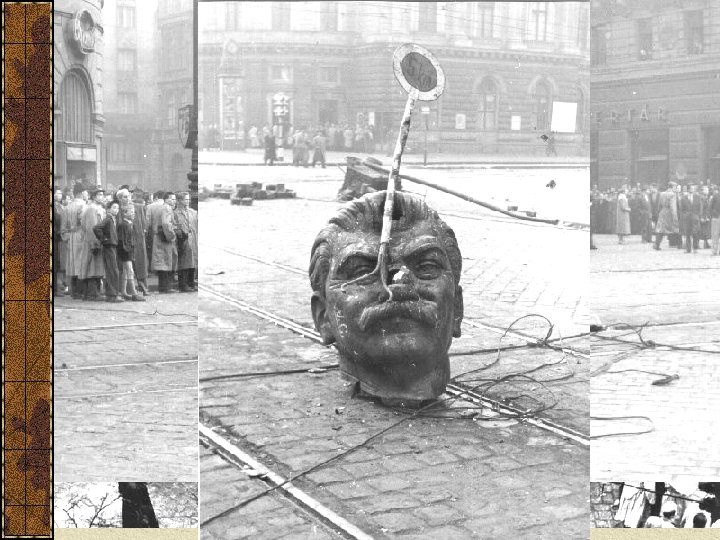
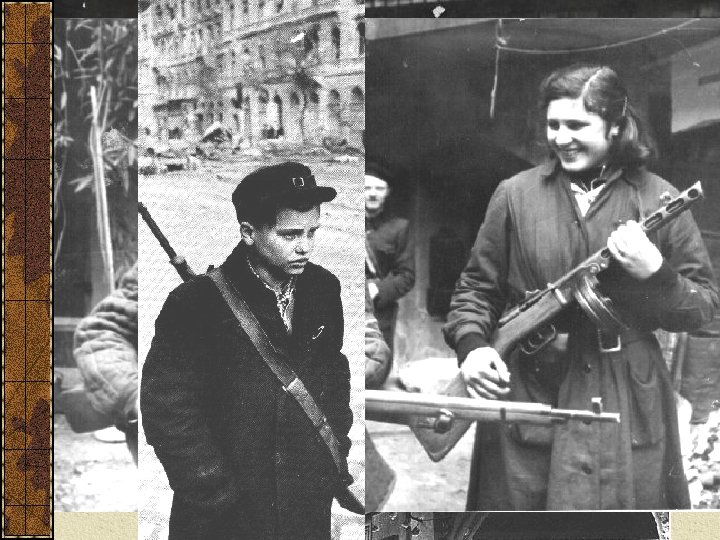
 Eastern Europe: Behind the Iron Curtain: Hungary, 1956 This time dissent was directed at communism as well Dissatisfaction and economic problems creates tense situation Imry Nagy (1896 -1958) declares Hungary free, November 1, 1956 Promises free elections Soviet Union attacks Budapest, November Janos Kadar (1912 -1989) replaced Nagy
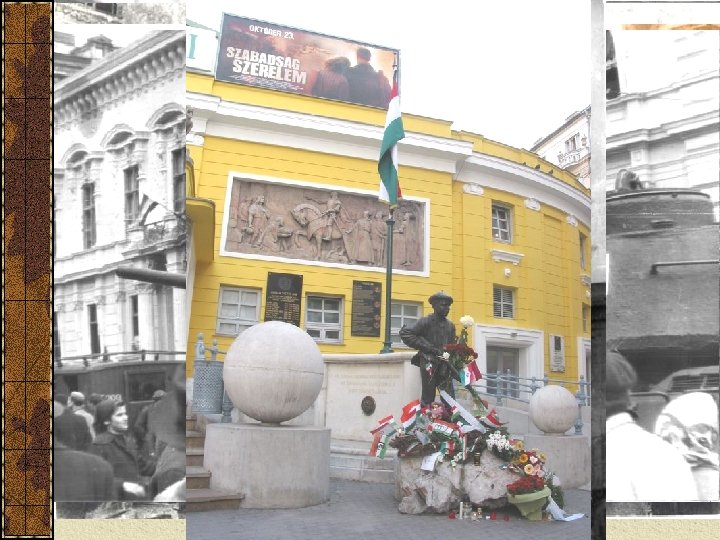
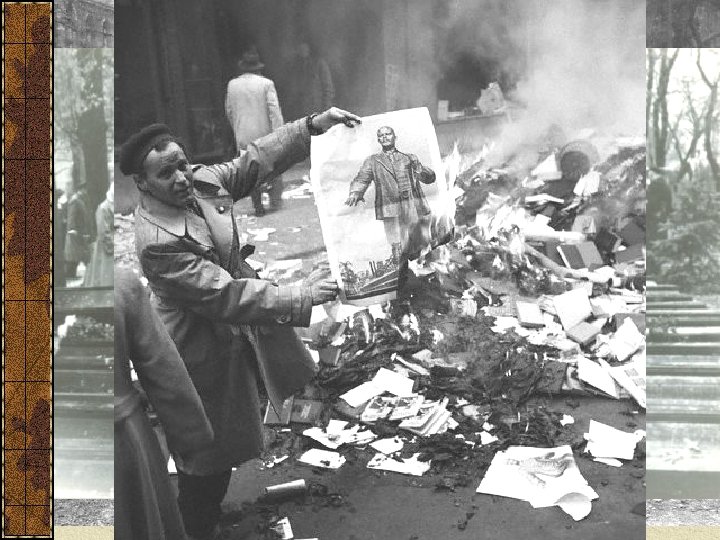
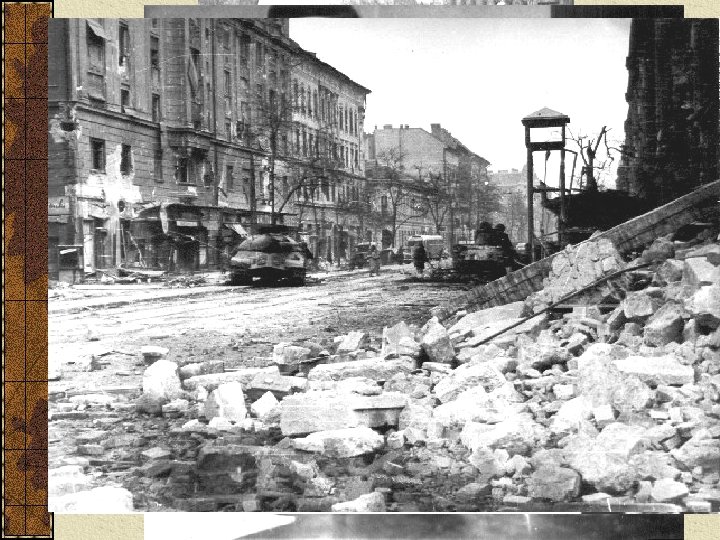
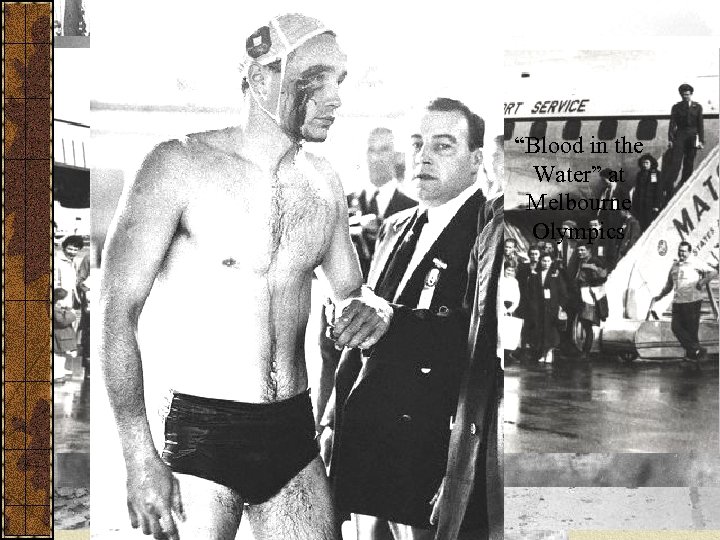 “Blood in the Water” at Melbourne Olympics
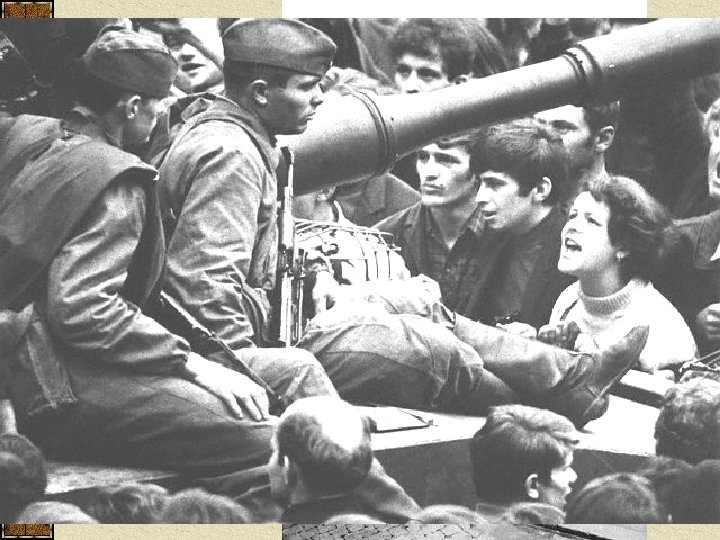
 Eastern Europe: Behind the Iron Curtain: Czechoslovakia, 1968 Antonin Novotny (1904 -1975) – “The Little Stalin” • Policies alienate comrades • Late 1967 writers’ rebellion – Vaclav Havel Alexander Dubcek (1921 -1992). Initiated reforms = “Prague Spring” • Freedom of Speech/Press/Travel; curbs Secret Police “Communism with a human face” Calls for more far-reaching reforms: neutrality, w/draw from Soviet Bloc Reform crushed by the Warsaw Pact • Albania & Romania refuse to take part – Albania pulls out of Soviet Bloc • 72 Czechs/Slovaks killed, 266 severely wounded Student Jan Palach immolates himself, Wenceslas Sq. 16 Jan 69 • 2 other students follow Feb 69, April 69 Long-term consequences: Disillusionment among remaining Western European Leftists w/ Marxism-Leninism
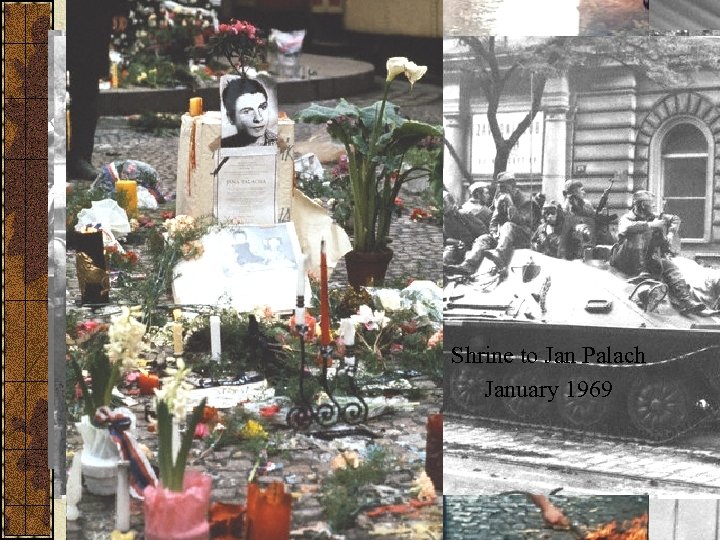 Shrine to Jan Palach January 1969 Alexander Dubcek “Communism with a Human Face”
 Western Europe: The Revival of Democracy and the Economy Europe recovered rapidly from World War II Marshall Plan money was important to the recovery France: The Domination of De Gaulle Charles de Gaulle (1890 -1970) • Feels he has mission to reestablish the greatness of France Algerian crisis -- Battle of Algiers (movie) Defeat in Indochina -- Dien Bien Phu 1954 Fifth Republic, 1958 • Powers of the President enhanced Invested heavily in the nuclear arms race -- but failure to become a major world power Economic growth Student riots, May 1968 Resignation of de Gaulle, April 1969
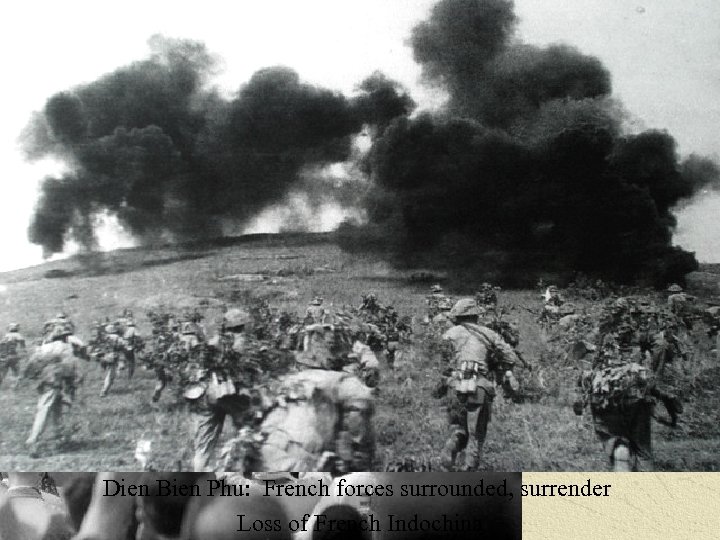 Charles De Gaulle French Equitorial Africa (1958) Dien Bien Phu: French forces surrounded, surrender Loss of French Indochina
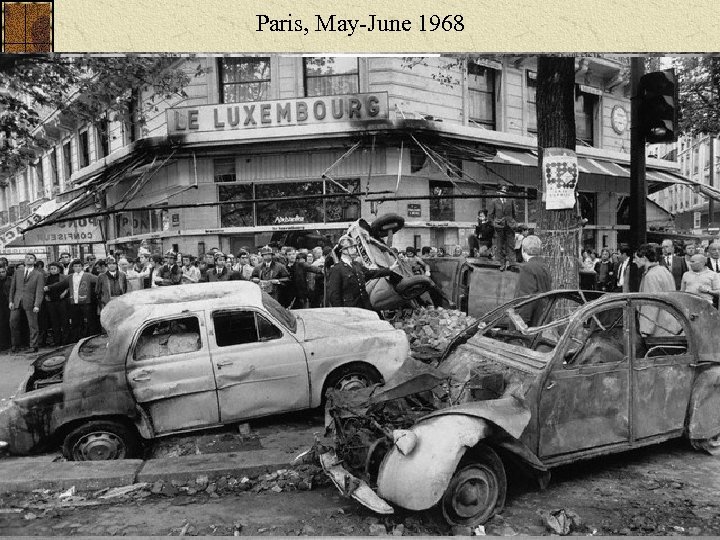 Paris, May-June 1968
 Western Europe: The Revival of Democracy and the Economy West Germany: A Reconceived Nation Konrad Adenauer (1876 -1967) Der Alte Reconciliation with France 1955 Rearmament & NATO Resurrection of the economy Adenauer succeeded by Ludwig Erhard. Great Britain: The Welfare State Clement Atlee (1883 -1967) • British Welfare State • Meant dismantling of the British Empire Continued economic problems – trade unions force wages higher than productivity allowed Italy: Weak Coalition Government Postwar reconstruction – 2 nd to Ger. in destruction Alcide de Gaspari (prime minister, 1948 – 1953) – Christian Democrats Unstable political coalitions – exclusion of Communist Party Italy’s “economic miracle” – but: South still backward
 Western Europe: The Move Toward Unity Experience of two World Wars! 1 st economic, then political European Coal and Steel Community (ECSC) – Fr. Ger. , Benelux, Italy 1957 = EURATOM peaceful atomic energy use European Economic Community (Common Market/EEC 1957) No internal customs barriers = Free Trade Common external tariff protects Eur. industry
 American Politics and Society in the 1950 s Influence of the New Deal influence continued by Truman, Kennedy, and Johnson Prosperity of the 1950’s Mc. Carthyism and the “Red Scare”
 Decade of Upheaval: America in the 1960’s Johnson and the Great Society War on Poverty Job Corps Department of Housing and Urban Development Civil Rights Movement Civil Rights Act, 1964 Voting Rights Act, 1965 Martin Luther King, Jr. (1929 -1968) • Southern Christian Leadership Conference • Assassinated, 1968 Malcolm X Summer of 1965 Antiwar Protests Kent State University, 1970
 The Development of Canada Economic Development Military Concerns Supports the United Nations NORAD
 The Emergence of a New Society The Structure of European Society Middle class joined by new group of white collar workers Further urbanization Rising income – consumer society • Automobile: 5 m 1948; 15 m 1957; 45 m 1960 s • NOT in Eastern Europe! Mass tourism & leisure • ↓ Work hours; ↑ Paid Holidays
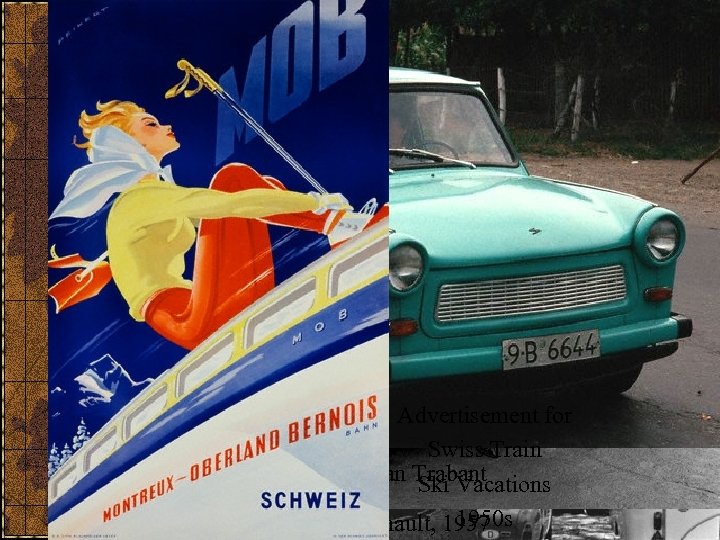 Consumer Culture: French Refrigerator 1959 Camping on the Advertisement for Adriatic coast of VW Beetles Swiss Train Italy, 1960 s East German Trabant 1954 Ski Vacations 1950 s French Renault, 1957
 Creation of the Welfare State History of Social Welfare Policies Origins: Bismark, English Reforms Extension of old benefits and creation of new ones Soc. Sec; Medical Care; Family Allowances Removal of class barriers Universities Increase in state spending on social services Gender Issues Work, motherhood, and individual rights G. B. , Ger. Discriminate against working ♀
 Women in the Postwar Western World Participation in the workforce declines until end of 1950 s “Baby Boom” Birth control (the “pill”) = smaller families Increased employment in the 1960 s Feminist Movement: The Quest for Liberation Right to vote Simone de Beauvoir (1908 -1986) • The Second Sex, 1949 Betty Friedan (b. 1921) • The Feminine Mystique • National Organization for Women (NOW)
 Social Revolutions The Permissive Society Sexual revolution – Sweden 1 st Breakdown of the traditional family – ↑ Divorce Rates Drug culture Education and Student Revolt Higher education becoming more widespread Problems • • Overcrowding Professors who paid too little attention to students Authoritative administrators Seemingly irrelevant education Student strikes in France, 1968 Protest Western society and the war in Vietnam
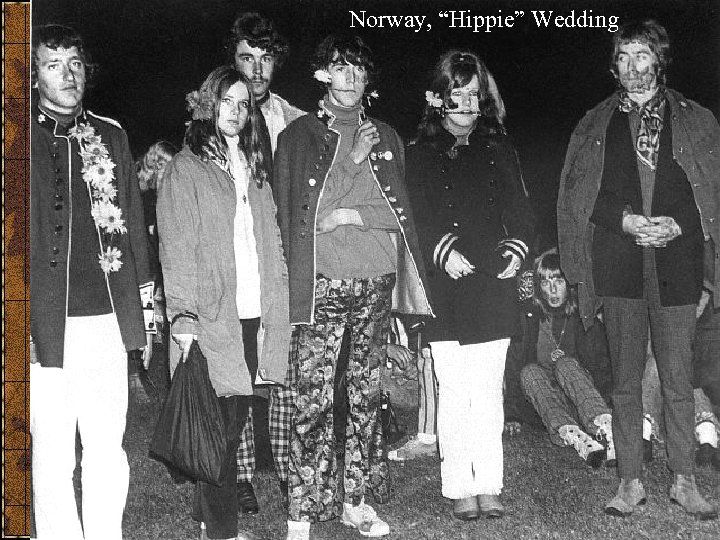 Norway, “Hippie” Wedding Rolling Stones Concert, London, 1969 London Anti-Vietnam War Demonstration, March 1968
 Postwar Art and Literature Art Jean Dubuffet Abstract Impressionism • Jackson Pollock (1912 – 1956) Pop Art • Andy Warhol (1930 – 1987) Literature Theater of the Absurd • Samuel Beckett, Waiting for Godot • Günter Grass, The Tin Drum
 The Philosophical Dilemma: Existentialism Jean-Paul Sartre (1905 – 1980) Albert Camus (1913 – 1960) The Stranger The Revival of Religion Karl Barth (1886 – 1968) Karl Rahner (1904 – 1984) Vatican II -- moves towards liberalization, modernization
 The Explosion of Popular Culture as a Consumer Commodity Link between mass culture and mass consumer society The Americanization of the World US influence on world culture Movies Television Popular music
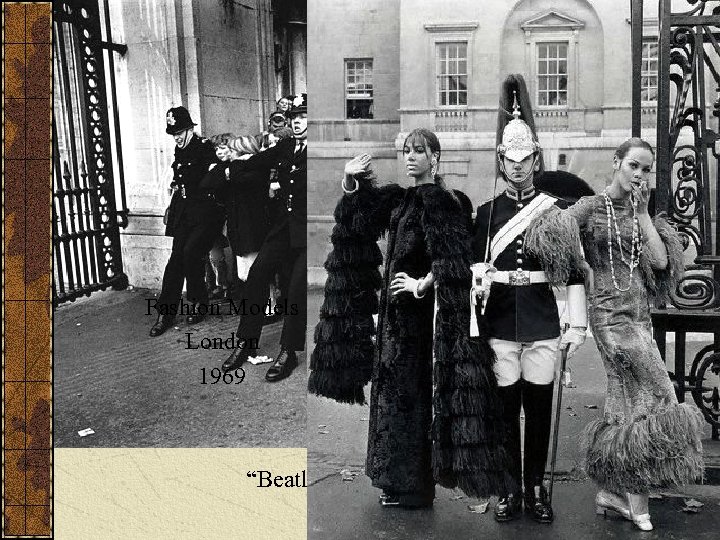 Fashion Models London 1969 “Beatle Mania” London, 1965
 Discussion Questions What factors contributed to postwar decolonization? Compare and contrast Khrushchev and Stalin’s approach to Eastern Europe. What prevented France from becoming the third super power that De Gaulle dreamed it could be? What were the most important social changes of the 1970 s?
 Web Links The Cold War Museum Vietnam Online The Women's Rights Movement, 1848 – 1998 Primary Sources: Decolonization Cuban Missile Crisis