


 Скачать презентацию CHAPTER 26 Savings Investment Spending and the Financial
53882ca78649df747ca5a02fb78ffc49.ppt
- Количество слайдов: 25
 CHAPTER 26 Savings, Investment Spending, and the Financial System
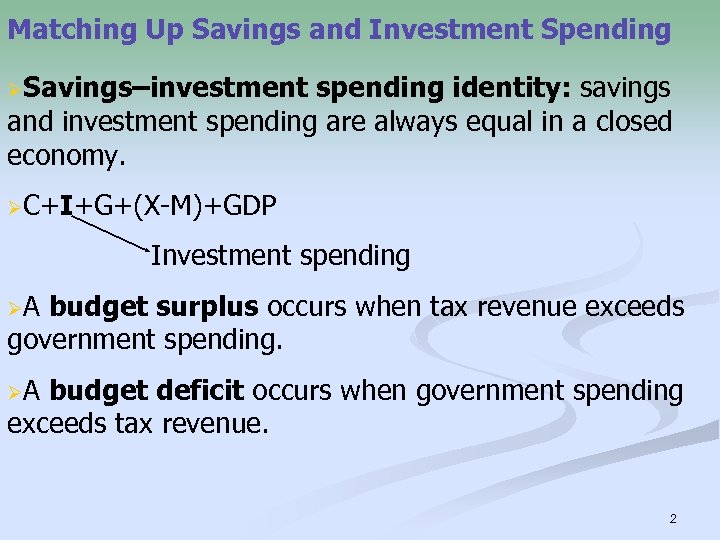 Matching Up Savings and Investment Spending ØSavings–investment spending identity: savings and investment spending are always equal in a closed economy. ØC+I+G+(X-M)+GDP Investment spending ØA budget surplus occurs when tax revenue exceeds government spending. ØA budget deficit occurs when government spending exceeds tax revenue. 2
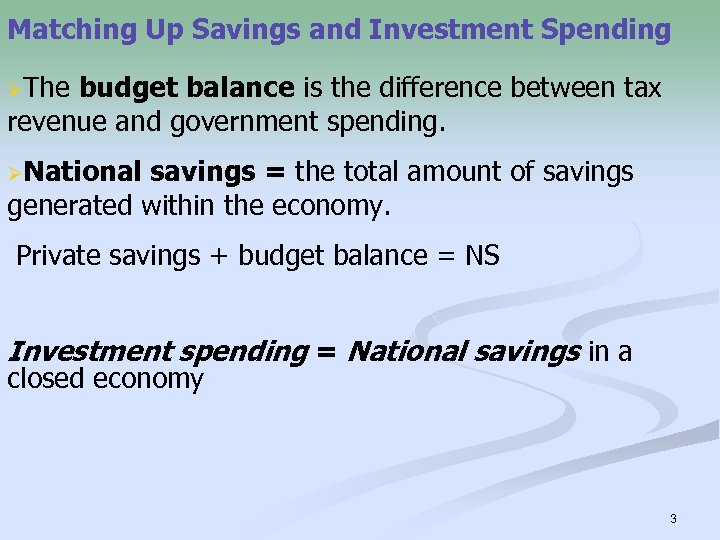 Matching Up Savings and Investment Spending ØThe budget balance is the difference between tax revenue and government spending. ØNational savings = the total amount of savings generated within the economy. Private savings + budget balance = NS Investment spending = National savings in a closed economy 3
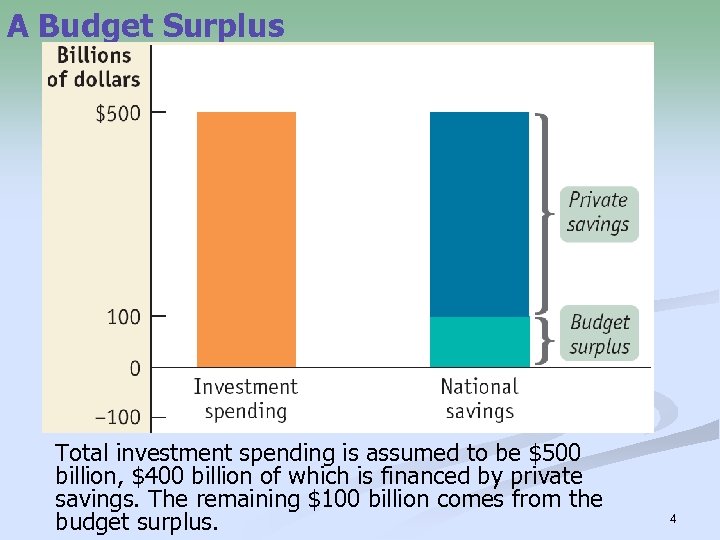 A Budget Surplus Total investment spending is assumed to be $500 billion, $400 billion of which is financed by private savings. The remaining $100 billion comes from the budget surplus. 4
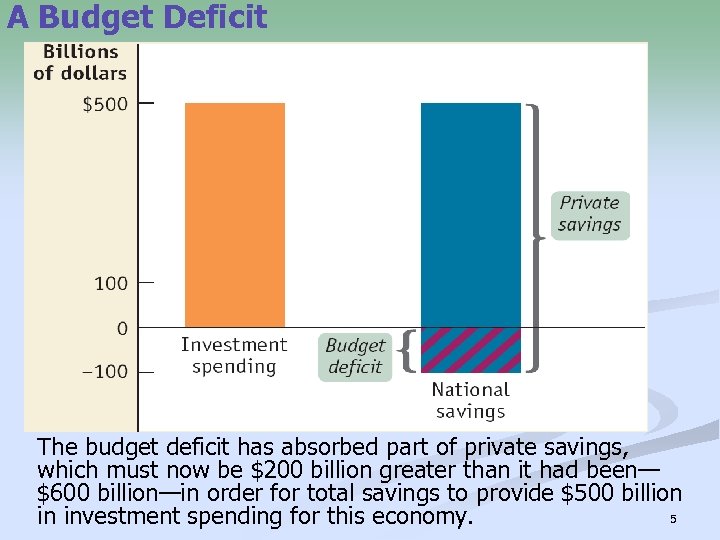 A Budget Deficit The budget deficit has absorbed part of private savings, which must now be $200 billion greater than it had been— $600 billion—in order for total savings to provide $500 billion 5 in investment spending for this economy.
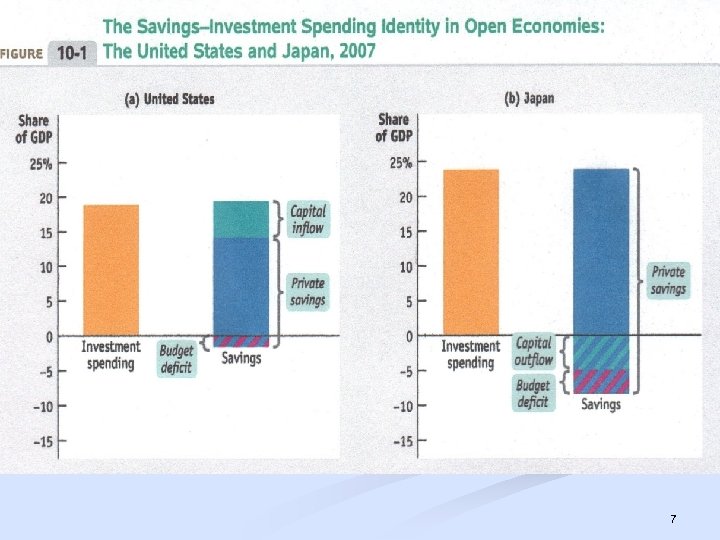
 The Savings–Investment Spending Identity in an Open Economy I = NS + KI (KI = capital inflow) Investment spending = National savings + Capital inflow in an open economy Capital inflows is investment by foreigners. Example: Chinese have purchased US Treasury debt. 6
 7
7
 The Market for Loanable Funds The loanable funds market is a hypothetical market that examines the market outcome of the demand for funds generated by borrowers and the supply of funds provided by lenders. Ø The loanable funds market does NOT actually exist. It is a simple model of a complex world of financial markets including stock, bond, bank loans, and any other market in which lending and borrowing occurs. It is the same kind of simplification that is made in other econ. models. Ø 8
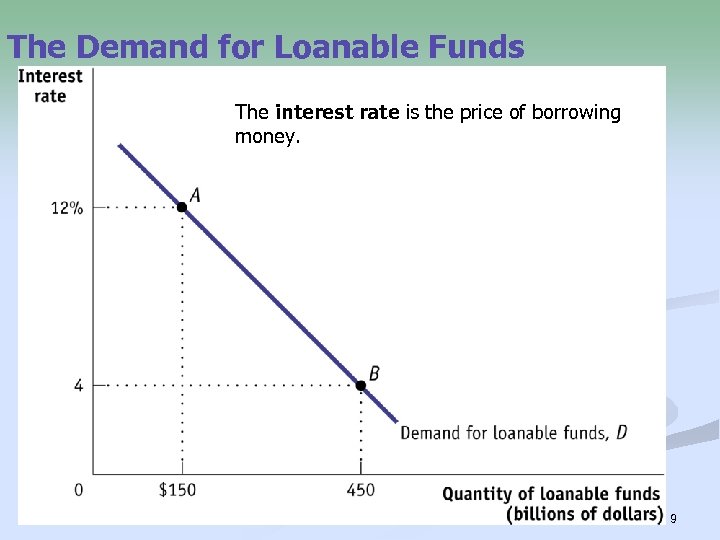 The Demand for Loanable Funds The interest rate is the price of borrowing money. 9
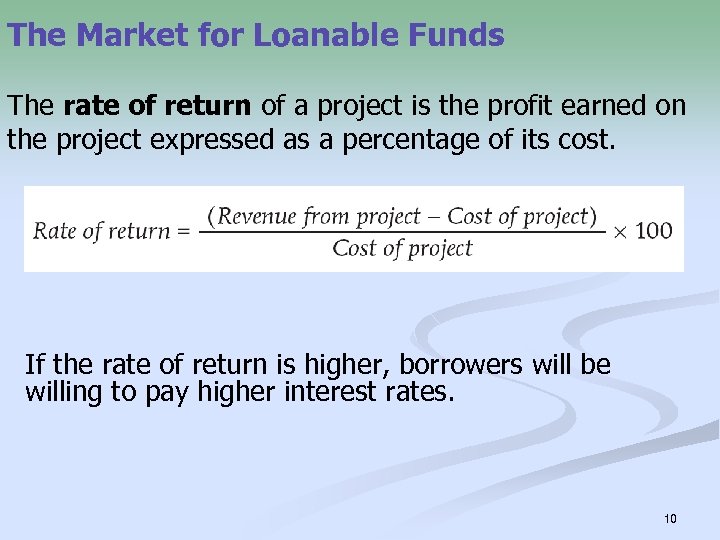 The Market for Loanable Funds The rate of return of a project is the profit earned on the project expressed as a percentage of its cost. If the rate of return is higher, borrowers will be willing to pay higher interest rates. 10
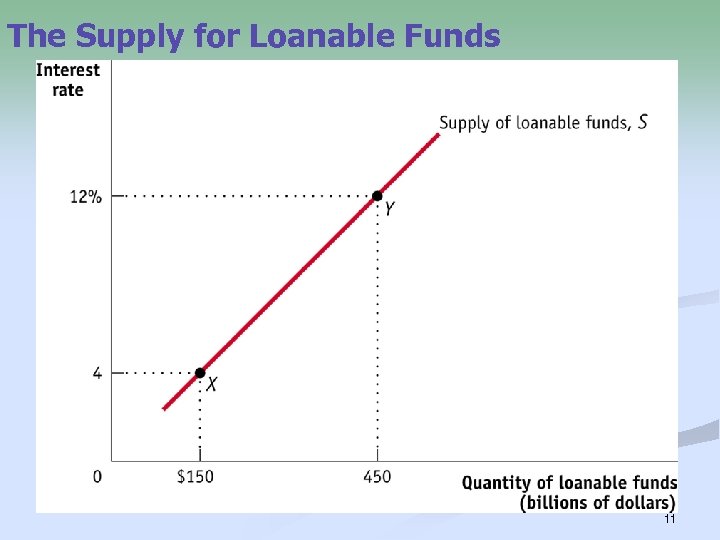 The Supply for Loanable Funds 11
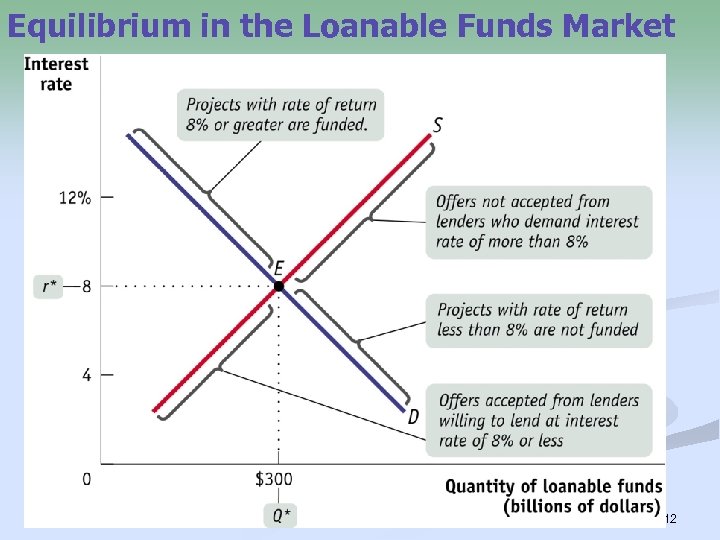 Equilibrium in the Loanable Funds Market 12
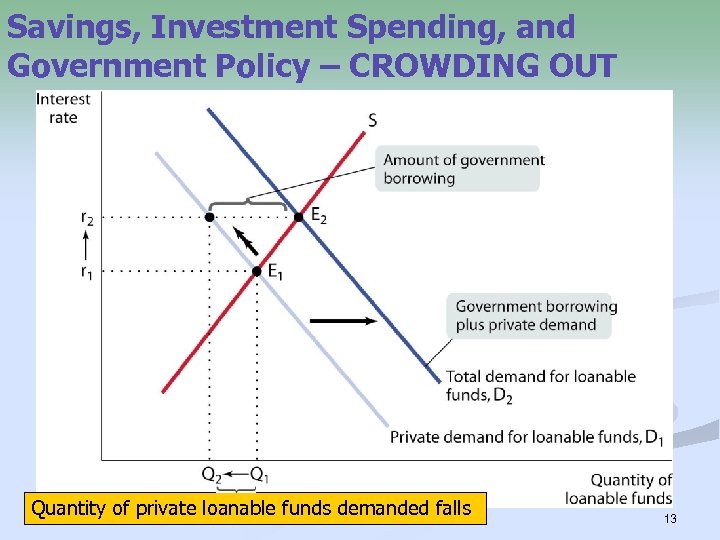 Savings, Investment Spending, and Government Policy – CROWDING OUT Quantity of private loanable funds demanded falls 13
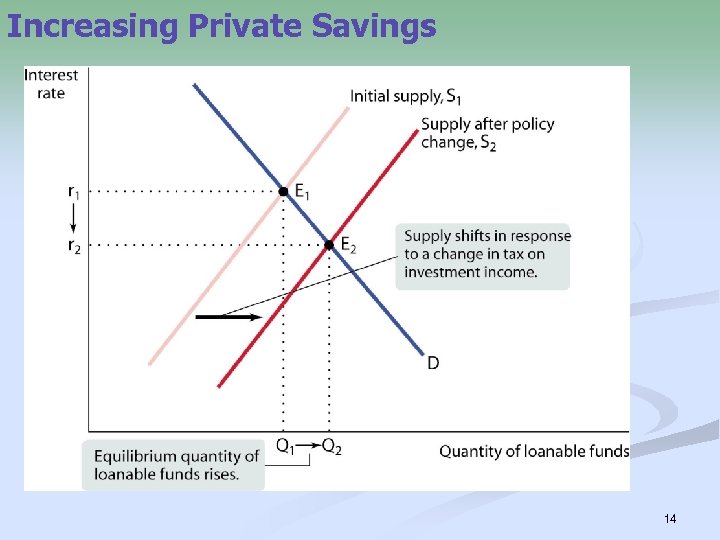 Increasing Private Savings 14
 The Financial System − Definitions ØA household’s wealth is the value of its accumulated savings. Ø Income is day-to-day earnings ØA financial asset is a paper claim that entitles the buyer to future income from the seller. ØA physical asset is a claim on a tangible object – a house for example. 15
 The Financial System − Definitions ØA liability is a requirement to pay income in the future. ØTransaction costs are the expenses of negotiating and executing a deal. ØFinancial risk is uncertainty about future outcomes that involve financial losses and gains. ØGenerally, risk. ØExample: risky? people with more money can take on more playing poker with Bill Gates – is a $100 bet 16
 The Financial System – More Definitions ØAn individual can engage in diversification by investing in several different things so that the possible losses are independent events. ØAn asset is liquid if it can be quickly converted into cash. ØAn asset is illiquid if it cannot be quickly converted into cash. 17
 The Financial System – More Definitions ØThere are four main types of financial assets: ØA loan is a lending agreement between a particular lender and a particular borrower. ØA bank deposit is a claim on a bank that obliges the bank to give the depositor his or her cash when demanded. ØA stock represents partial ownership in a business. ØA bond is a direct loan agreement (bypass banks) Bonds do not have to be held until they mature – Bonds can be bought and sold via the bond market 18
 Three Tasks of a Financial System ØReducing transaction costs─the cost of making a deal; ØReducing financial risk─uncertainty about future outcomes that involves financial gains and losses; ØProviding liquid assets─assets that can be quickly converted into cash (in contrast to illiquid assets, which can’t). 19
 Financial Intermediaries ØA financial intermediary is an institution that transforms the funds it gathers from many individuals into financial assets. ØA mutual fund is a financial intermediary that creates a stock portfolio and then resells shares of this portfolio to individual investors. ØA pension fund is a type of mutual fund that holds assets in order to provide retirement income to its members. 20
 Financial Intermediaries ØA life insurance company sells policies that guarantee a payment to a policyholder’s beneficiaries when the policyholder dies. ØA bank is a financial intermediary that provides liquid assets in the form of bank deposits to lenders and uses those funds to finance the illiquid investments or investment spending needs of borrowers. 21
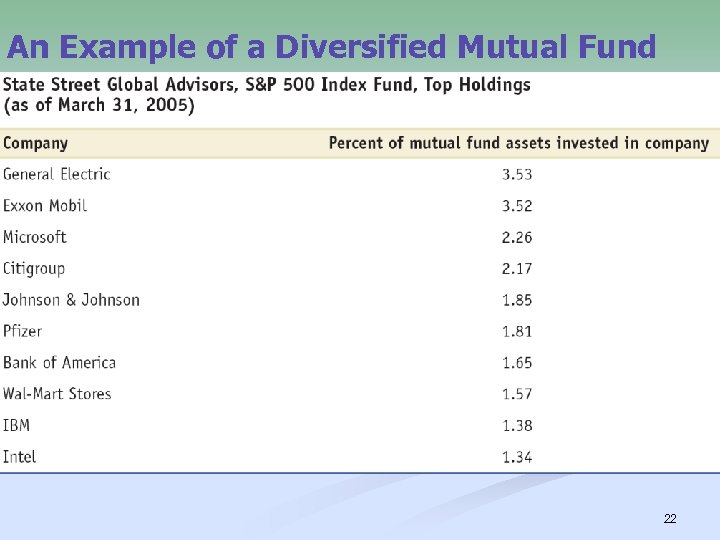 An Example of a Diversified Mutual Fund 22
 Financial Fluctuations ØStock prices are determined by supply and demand as well as the desirability of competing assets, like bonds: when the interest rate rises, stock prices generally fall and vice versa. ØExpectations drive the supply of and demand for stocks: expectations of higher future prices push today’s stock prices higher and expectations of lower future prices drive them lower. 23
 Financial Fluctuations §Efficient markets hypothesis holds that the prices of financial assets embody all publicly available information. The current price is always the fair market value price. §A random walk implies just the opposite – prices vary because investors and traders act irrationally. The current stock price doesn’t represent the actual value of the shares. §Irrational investors – actions based on fear or greed. 24
 The End of Chapter 26 25