


 Скачать презентацию Chapter 25 The Urinary System G R Pitts
5c246b8b271ab1a39b1e9fd657966245.ppt
- Количество слайдов: 95
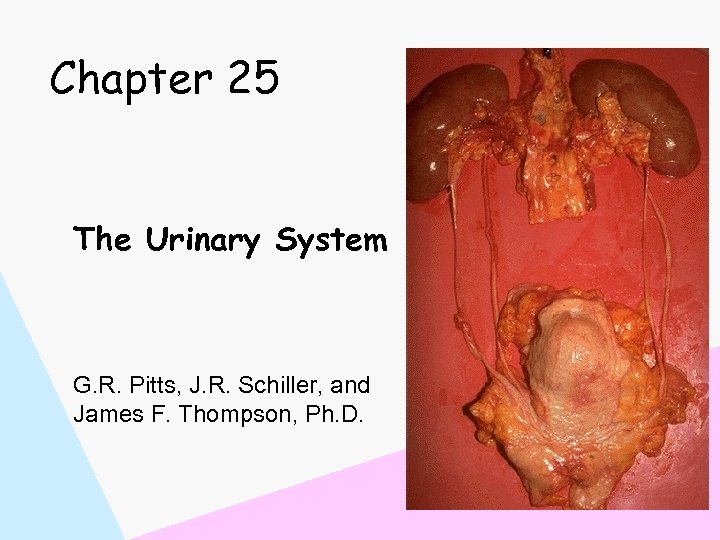 Chapter 25 The Urinary System G. R. Pitts, J. R. Schiller, and James F. Thompson, Ph. D.
 General • During metabolism cells produce wastes – waste - any substance acquired or produced in excess with no function in body – e. g. - CO 2, H 2 O, heat • All wastes must be eliminated, or at least maintained at low concentrations • Additionally, protein breakdown leaves nitrogenous wastes • Excess sodium (Na+), chloride (Cl-), potassium (K+), sulfate (SO 42 -), phosphate (PO 42 -), and hydrogen ion (H+) must be regulated
 General • Several organs transport, neutralize, store and remove wastes – – – – Body fluid and body fluid buffers Blood and blood buffers Liver Lungs Sudoriferous (sweat) glands (minor) Hair and nails (minor) GI tract and liver Kidneys
 General • Urinary system – Maintains fluid homeostasis including: • regulation of volume and composition by eliminating certain wastes while conserving needed materials • regulation of blood p. H • regulation of hydrostatic pressure of blood and, indirectly, of other body fluids – Contributions to metabolism • • helps synthesize calcitriol (active form of Vitamin D) secretes erythropoietin performs gluconeogenesis during fasting or starvation deaminates certain amino acids to eliminate ammonia
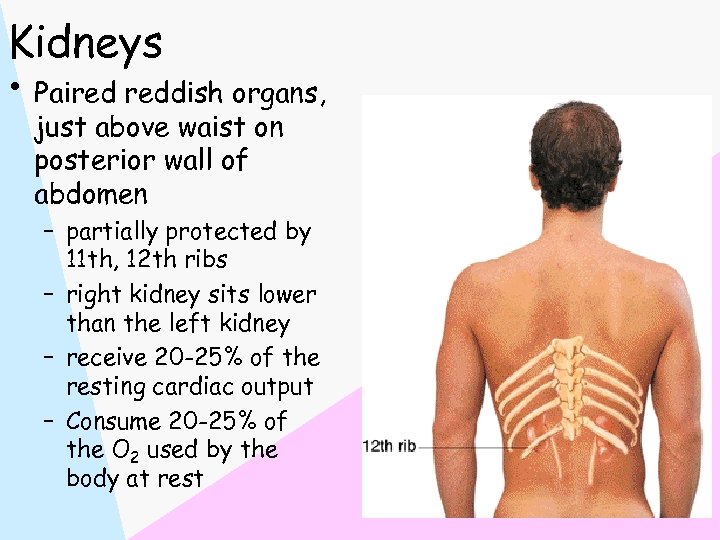 Kidneys • Paired reddish organs, just above waist on posterior wall of abdomen – partially protected by 11 th, 12 th ribs – right kidney sits lower than the left kidney – receive 20 -25% of the resting cardiac output – Consume 20 -25% of the O 2 used by the body at rest
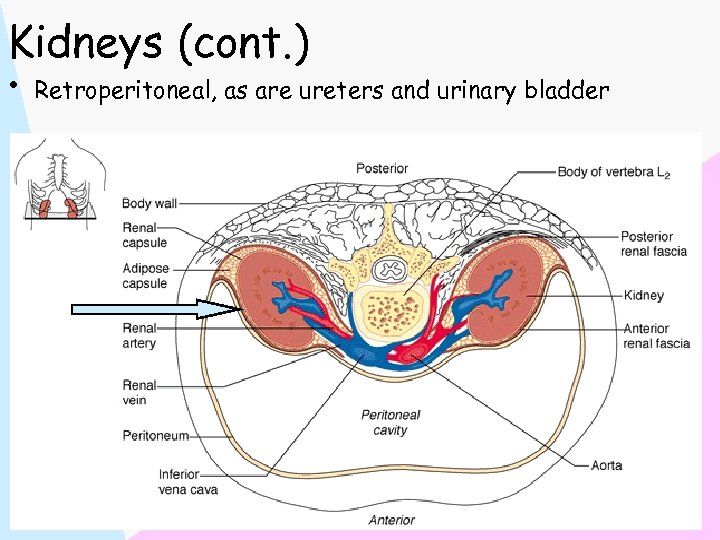 Kidneys (cont. ) • Retroperitoneal, as are ureters and urinary bladder
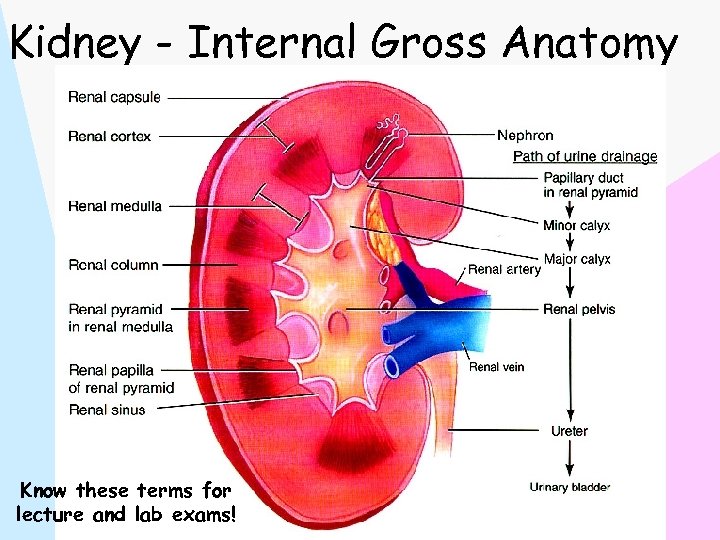 Kidney - Internal Gross Anatomy Know these terms for lecture and lab exams!
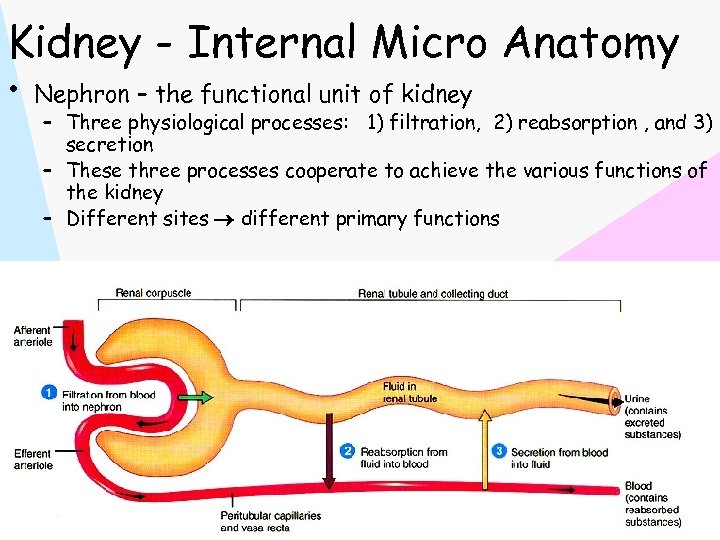 Kidney - Internal Micro Anatomy • Nephron – the functional unit of kidney – Three physiological processes: 1) filtration, 2) reabsorption , and 3) secretion – These three processes cooperate to achieve the various functions of the kidney – Different sites different primary functions
 The Functions of the Kidney • Nephron forms urine from blood plasma – 1) formation of a plasma filtrate – 2) reabsorption of useful molecules from the filtrate to prevent their loss in urine – 3) secretion of excess electrolytes and certain wastes (nitrogenous wastes, H+) in concentrations greater than their concentration in plasma – 4) regulation of water balance by concentrating or diluting the urine – 5) minor endocrine function – releasing hormone erythropoietin to stimulate RBC production – 6) releasing renin for angiotensinogen activation
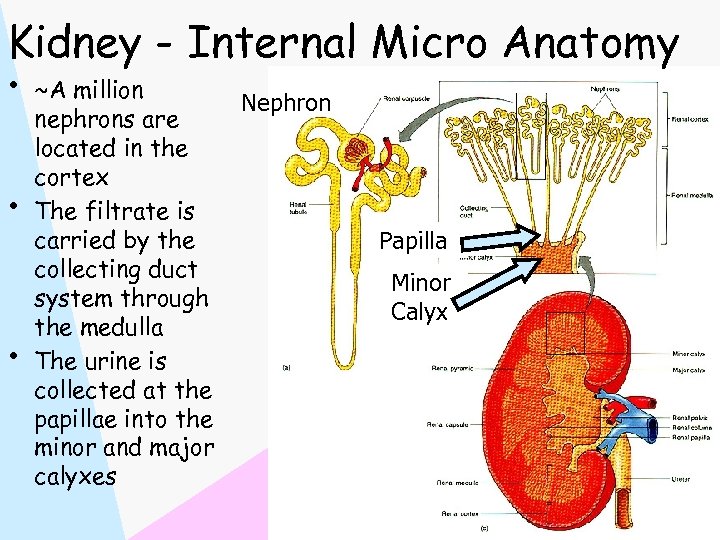 Kidney - Internal Micro Anatomy • • • ~A million nephrons are located in the cortex The filtrate is carried by the collecting duct system through the medulla The urine is collected at the papillae into the minor and major calyxes Nephron Papilla Minor Calyx
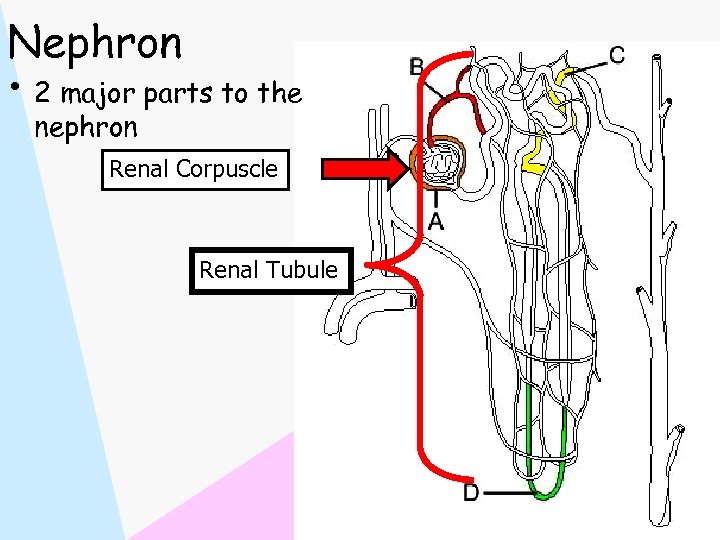 Nephron • 2 major parts to the nephron Renal Corpuscle Renal Tubule
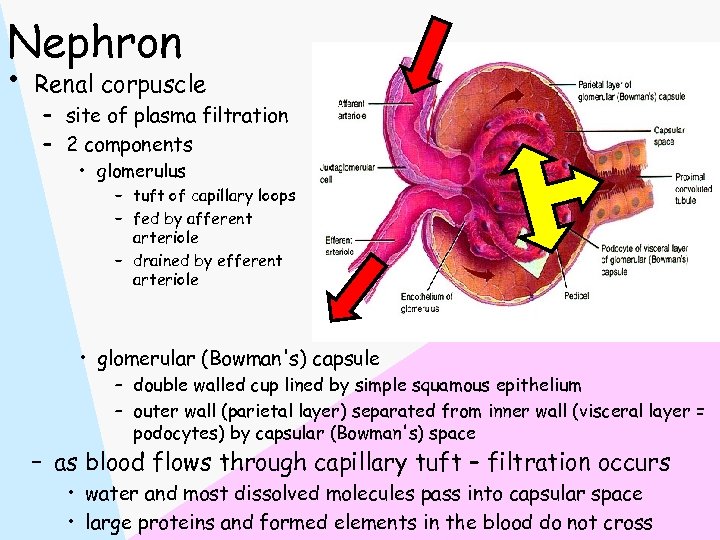 Nephron • Renal corpuscle – site of plasma filtration – 2 components • glomerulus – tuft of capillary loops – fed by afferent arteriole – drained by efferent arteriole • glomerular (Bowman's) capsule – double walled cup lined by simple squamous epithelium – outer wall (parietal layer) separated from inner wall (visceral layer = podocytes) by capsular (Bowman's) space – as blood flows through capillary tuft – filtration occurs • water and most dissolved molecules pass into capsular space • large proteins and formed elements in the blood do not cross
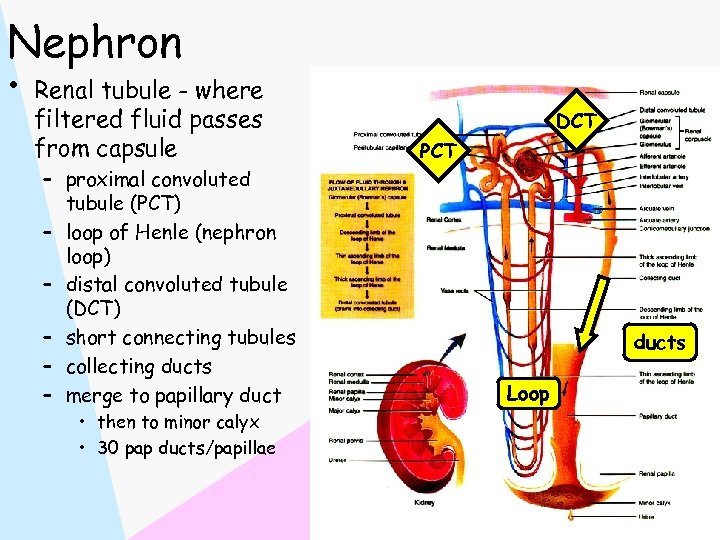 Nephron • Renal tubule - where filtered fluid passes from capsule – proximal convoluted tubule (PCT) – loop of Henle (nephron loop) – distal convoluted tubule (DCT) – short connecting tubules – collecting ducts – merge to papillary duct • then to minor calyx • 30 pap ducts/papillae DCT PCT ducts Loop
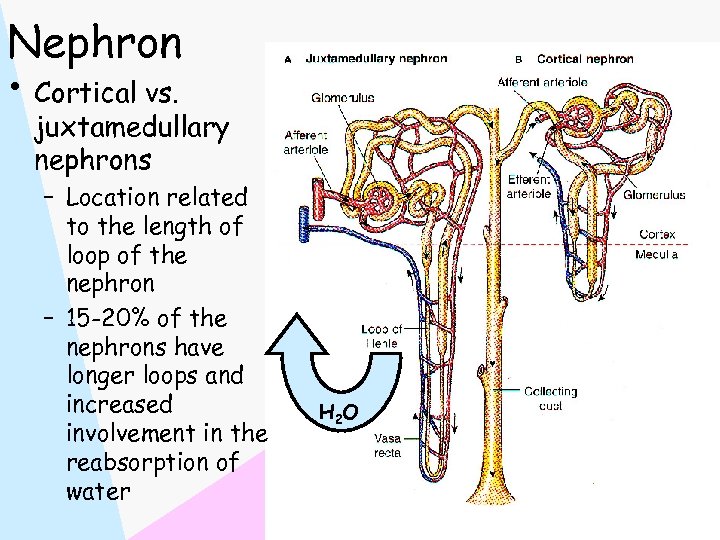 Nephron • Cortical vs. juxtamedullary nephrons – Location related to the length of loop of the nephron – 15 -20% of the nephrons have longer loops and increased involvement in the reabsorption of water H 2 O
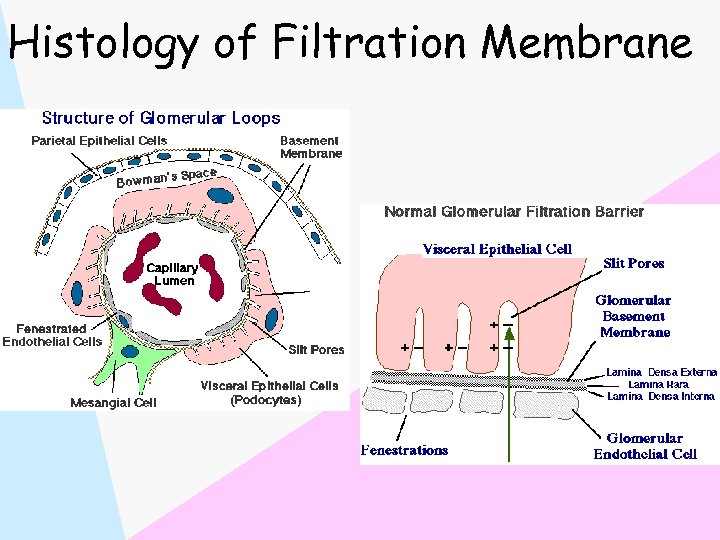
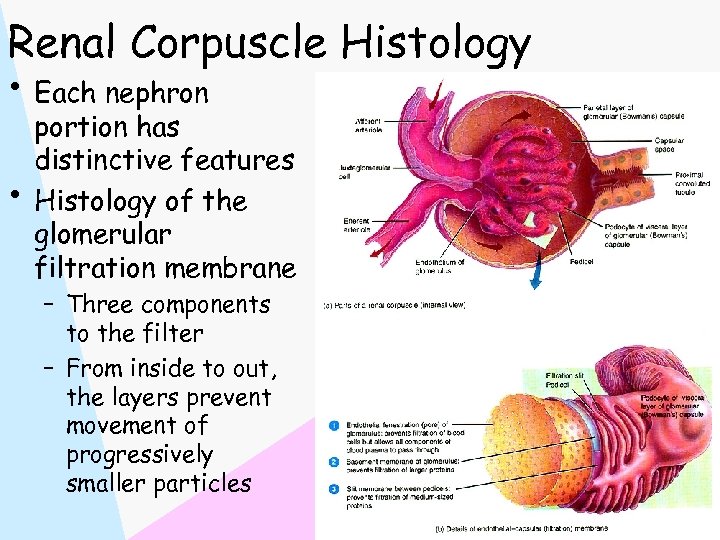 Renal Corpuscle Histology • Each nephron • portion has distinctive features Histology of the glomerular filtration membrane – Three components to the filter – From inside to out, the layers prevent movement of progressively smaller particles
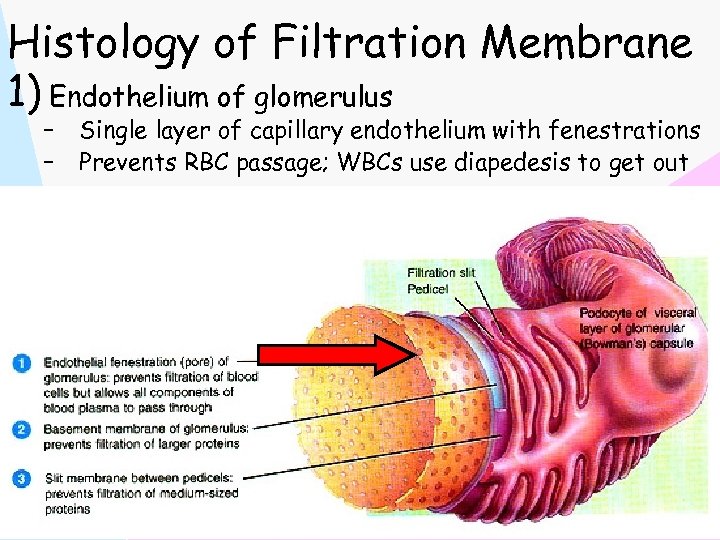 Histology of Filtration Membrane 1) Endothelium of glomerulus – – Single layer of capillary endothelium with fenestrations Prevents RBC passage; WBCs use diapedesis to get out
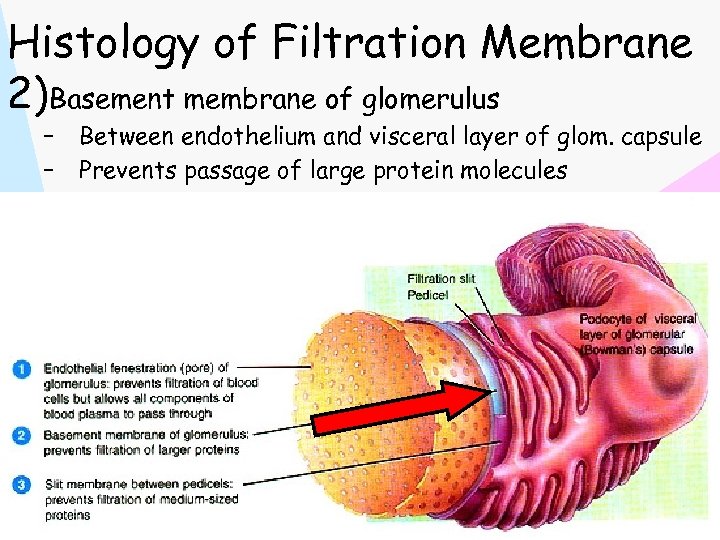 Histology of Filtration Membrane 2)Basement membrane of glomerulus – – Between endothelium and visceral layer of glom. capsule Prevents passage of large protein molecules
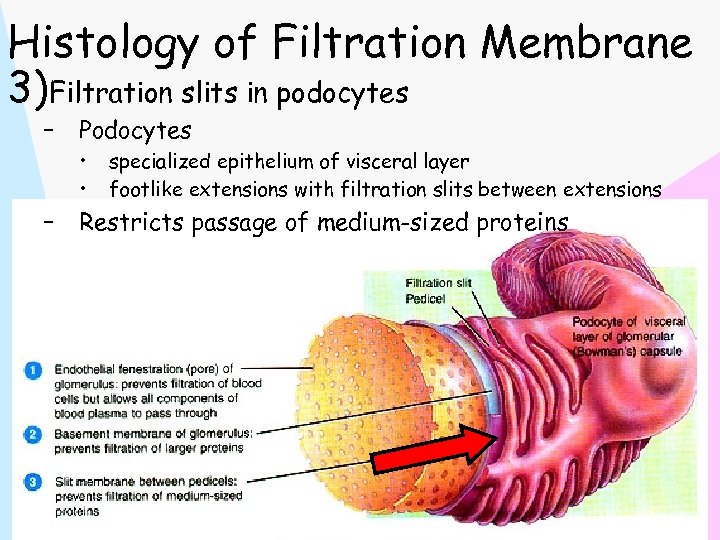 Histology of Filtration Membrane 3)Filtration slits in podocytes – Podocytes • • – specialized epithelium of visceral layer footlike extensions with filtration slits between extensions Restricts passage of medium-sized proteins
 Histology of Filtration Membrane
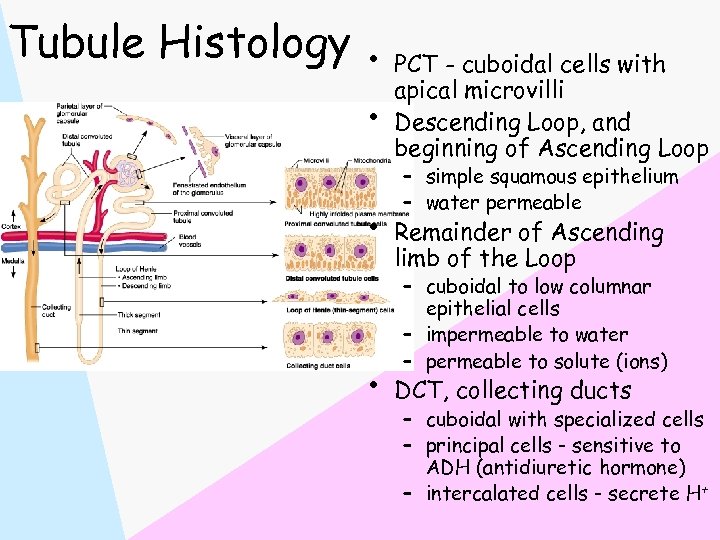 Tubule Histology • PCT - cuboidal cells with • • • apical microvilli Descending Loop, and beginning of Ascending Loop – simple squamous epithelium – water permeable Remainder of Ascending limb of the Loop – cuboidal to low columnar epithelial cells – impermeable to water – permeable to solute (ions) DCT, collecting ducts – cuboidal with specialized cells – principal cells - sensitive to ADH (antidiuretic hormone) – intercalated cells - secrete H+
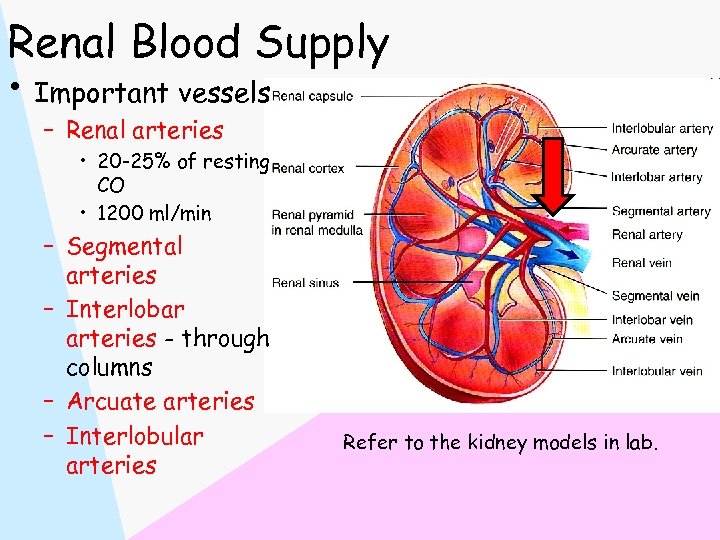 Renal Blood Supply • Important vessels – Renal arteries • 20 -25% of resting CO • 1200 ml/min – Segmental arteries – Interlobar arteries - through columns – Arcuate arteries – Interlobular arteries Refer to the kidney models in lab.
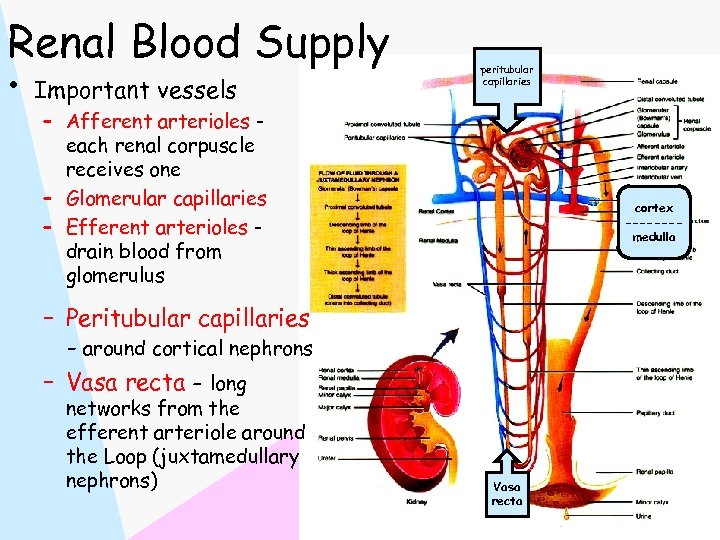 Renal Blood Supply • Important vessels peritubular capillaries – Afferent arterioles each renal corpuscle receives one – Glomerular capillaries – Efferent arterioles drain blood from glomerulus cortex -------medulla – Peritubular capillaries - around cortical nephrons – Vasa recta - long networks from the efferent arteriole around the Loop (juxtamedullary nephrons) Vasa recta
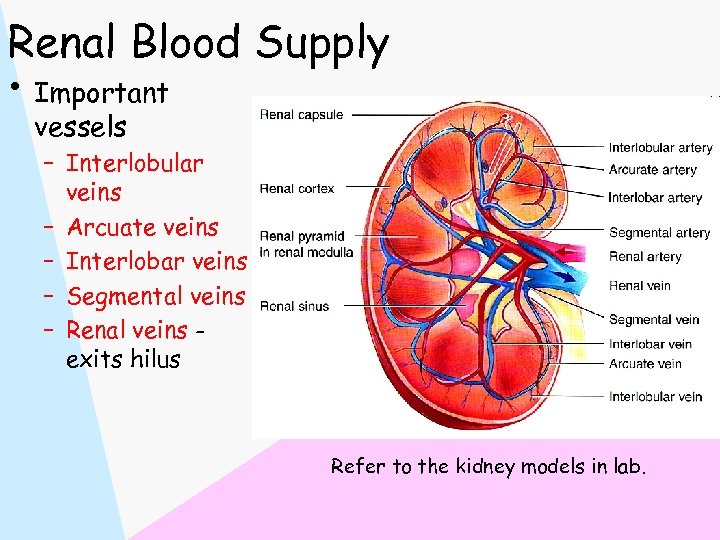 Renal Blood Supply • Important vessels – Interlobular veins – Arcuate veins – Interlobar veins – Segmental veins – Renal veins exits hilus Refer to the kidney models in lab.
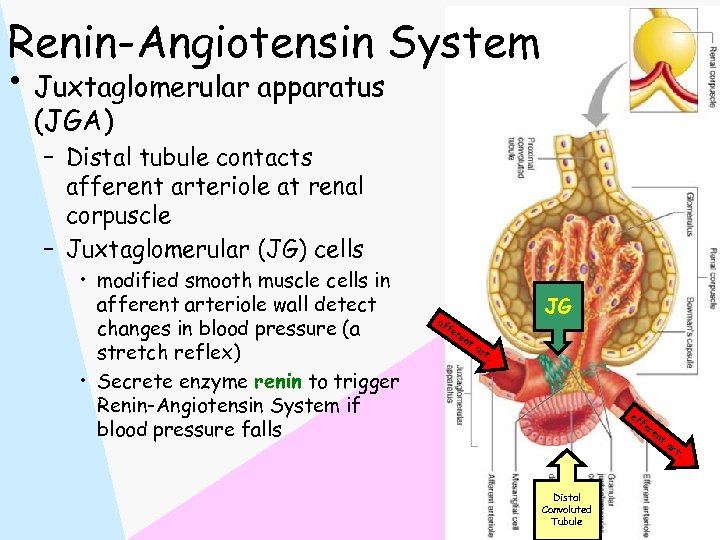 Renin-Angiotensin System • Juxtaglomerular apparatus (JGA) – Distal tubule contacts afferent arteriole at renal corpuscle – Juxtaglomerular (JG) cells • modified smooth muscle cells in afferent arteriole wall detect changes in blood pressure (a stretch reflex) • Secrete enzyme renin to trigger Renin-Angiotensin System if blood pressure falls JG af fe re nt ar t. ef fe Distal Convoluted Tubule re nt ar t.
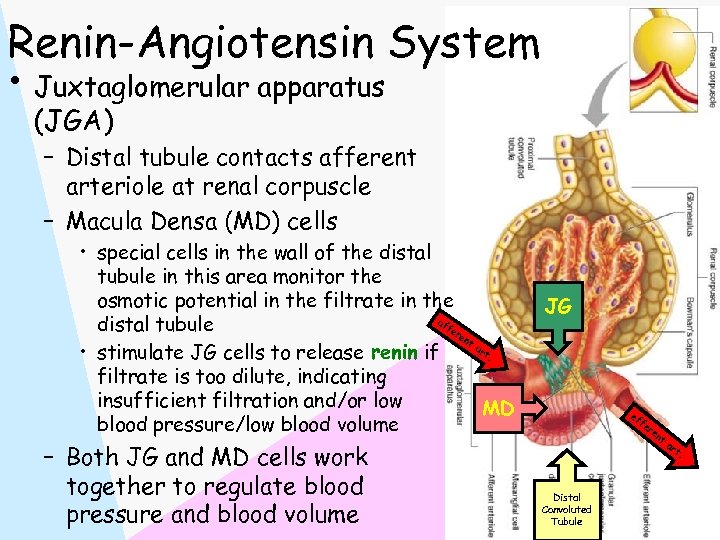 Renin-Angiotensin System • Juxtaglomerular apparatus (JGA) – Distal tubule contacts afferent arteriole at renal corpuscle – Macula Densa (MD) cells • special cells in the wall of the distal tubule in this area monitor the osmotic potential in the filtrate in the af fe distal tubule re nt ar t. • stimulate JG cells to release renin if filtrate is too dilute, indicating insufficient filtration and/or low MD blood pressure/low blood volume – Both JG and MD cells work together to regulate blood pressure and blood volume JG ef fe Distal Convoluted Tubule re nt ar t.
 Renin-Angiotensin System • Hepatocytes secrete inactive precursor Angiotensinogen into the bloodstream • Juxtaglomerular (JG) cells secrete the enzyme renin to convert Angiotensinogen to Angiotensin I in the bloodstream • Angiotensin I is transported to the lungs where Angiotensin Converting Enzyme (ACE) converts Angiotensin I to Angiotensin II • Both Angiotensin I and Angiotensin II act as circulating hormones to increase blood pressure and blood volume; AII is stronger
 Renal Nerve Supply • Nerves from renal plexus of Sympathetic Division of ANS innervate the kidney • Vasomotor nerves accompany the renal arteries and their branches – What is the role of sympathetic stimulation on renal blood flow? – In “Fight or Flight” or muscular exertion: § decrease renal arterial flow § decrease urine production § maintain blood volume § increase systemic blood pressure
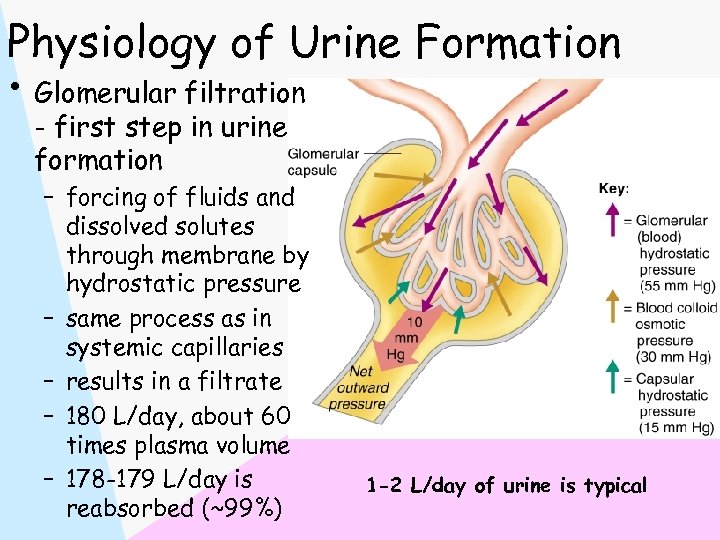 Physiology of Urine Formation • Glomerular filtration - first step in urine formation – forcing of fluids and dissolved solutes through membrane by hydrostatic pressure – same process as in systemic capillaries – results in a filtrate – 180 L/day, about 60 times plasma volume – 178 -179 L/day is reabsorbed (~99%) 1 -2 L/day of urine is typical
 Glomerular Filtration • 3 structural features of the renal corpuscles enhance their filtering capacity: 1) Glomerular capillaries are relatively long which increases their surface area for filtration 2) Filter (endothelium-capsular membrane) is thin and porous Ø Fenestrated glomerular capillaries are 50 times more permeable than regular capillaries Ø The filtration slits of the basement membrane only permit passage of small molecules 3) Glomerular Capillary blood pressure is high – the efferent arteriole diameter is less than the afferent arteriole diameter -- increasing
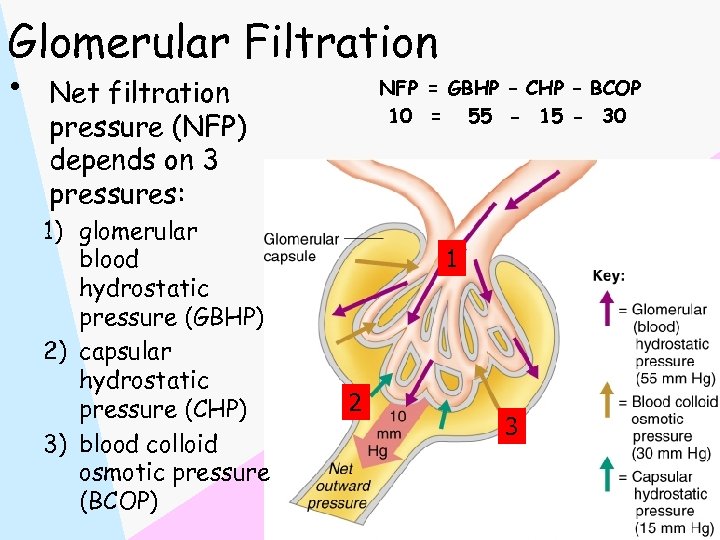 Glomerular Filtration NFP = GBHP – CHP – BCOP • Net filtration 10 = 55 - 15 - 30 pressure (NFP) depends on 3 pressures: 1) glomerular blood hydrostatic pressure (GBHP) 2) capsular hydrostatic pressure (CHP) 3) blood colloid osmotic pressure (BCOP) 1 2 3
 Glomerular Filtration Rate (GFR) • GFR – Volume of filtrate that forms in all renal corpuscles in both kidneys/min – Adult’s GFR 125 m. L/min (180 L/day) • Regulation of GFR – When more blood flows into glomerulus, GFR – GFR depends on systemic blood pressure, and the diameter of afferent & efferent arterioles – If glomerular capillary blood pressure falls much below 45 mm Hg, no filtration occurs anuria (no urine output)
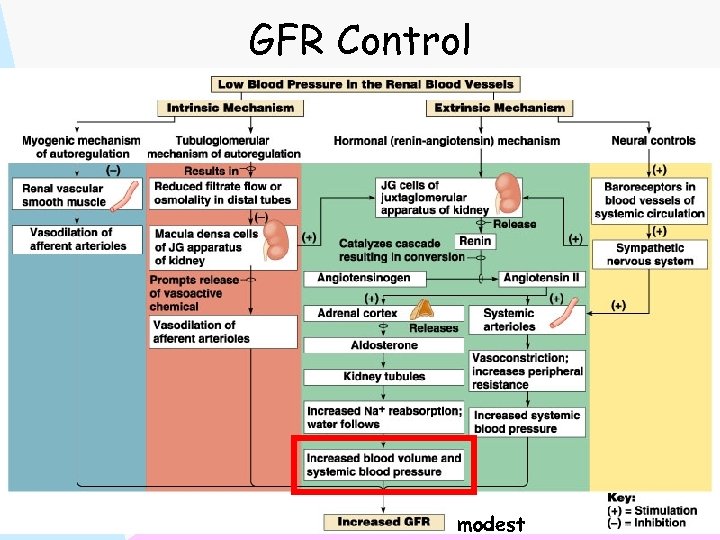
 Glomerular Filtration Rate (GFR) • 3 principal regulators of GFR: 1) Renal autoregulation of GFR • • the kidneys are able to maintain a relatively constant internal blood pressure and GFR despite changes in systemic arterial pressure there is negative feedback from the Juxta. Glomerular Apparatus adjusting blood pressure and blood volume
 Glomerular Filtration Rate (GFR) • 3 principal regulators of GFR (cont. ): 2) Hormonal regulation of GFR A. Angiotensin I & II – – – activated by renin released from JG cells and further by ACE in the lungs 5 important functions » direct vasoconstriction » aldosterone secretion » thirst generated at the hypothalamus » ADH secretion » Na+ reabsorption (H 2 O follows passively) Net Effect increased blood pressure and blood volume
 Glomerular Filtration Rate (GFR) • 3 principal regulators of GFR (cont. ): 2) Hormonal regulation of GFR A. Angiotensin I & II B. Atrial Natriuretic Peptide (ANP) – – secreted by cells in atria of heart in response to stretch GFR, promotes excretion of H 2 O, Na+, but retention of K+ suppresses output of ADH, aldosterone, and renin Net Effect decreased blood pressure and blood volume C. Aldosterone – – secreted by cells in adrenal cortex in response to angiotensin I & II (and ACTH) GFR, promotes retention of H 2 O, Na+, but excretion of K+ antagonist to Atrial Natriuretic Peptide Net Effect increased blood pressure and blood volume
 Glomerular Filtration Rate (GFR) • 3 principal regulators of GFR (cont. ): 3) Neural regulation • • kidney’s blood vessels supplied by vasoconstrictor fibers from Sympathetic Division of ANS which release Norepinephrine strong sympathetic stimulation causes JG cells to secrete renin and the adrenal medulla to secrete Epinephrine
 GFR Control modest
 Tubular Reabsorption • Movement of water and certain solutes back into bloodstream from the renal tubule – Filter 180 L/day of fluid and solutes • nutrients (Na+, K+, Glucose, etc. ) are needed by body • body will expend ATP to get them back into blood – about 99% of the filtrate volume is reabsorbed from the tubule by active transport and osmosis • Epithelial cells in PCT (microvilli) increase surface area for tubular reabsorption • DCT and collecting ducts play a lesser role in nutrient/solute reabsorption
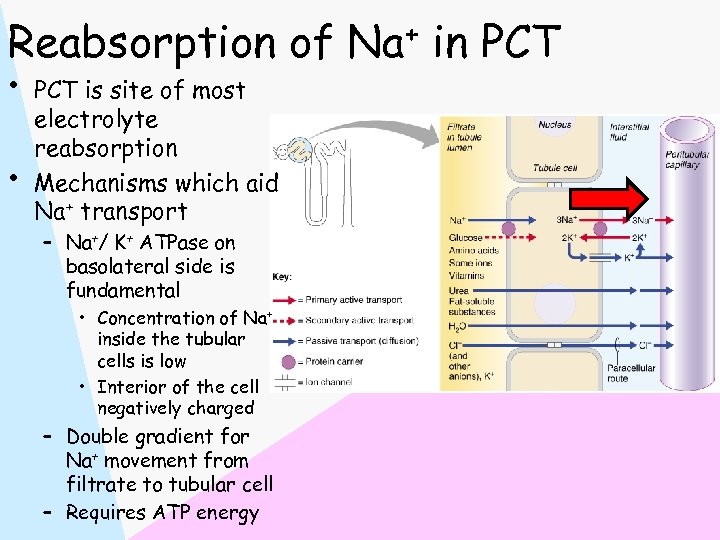 Reabsorption of Na+ in PCT • • PCT is site of most electrolyte reabsorption Mechanisms which aid Na+ transport – Na+/ K+ ATPase on basolateral side is fundamental • Concentration of Na+ inside the tubular cells is low • Interior of the cell negatively charged – Double gradient for Na+ movement from filtrate to tubular cell – Requires ATP energy
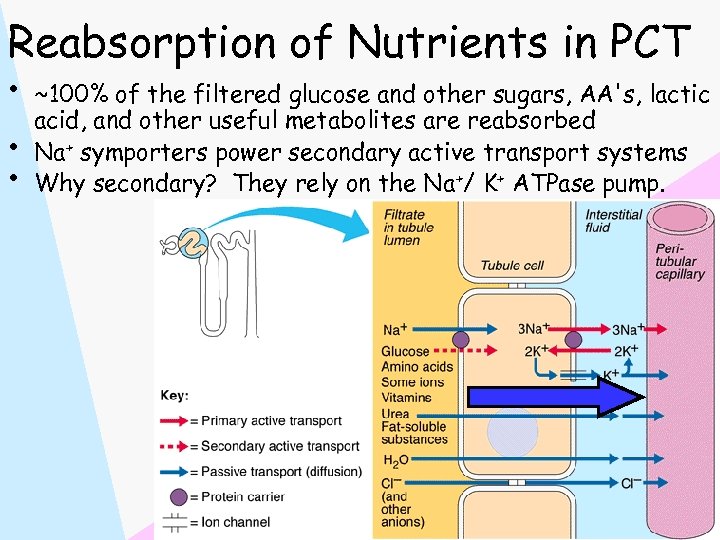 Reabsorption of Nutrients in PCT • • • ~100% of the filtered glucose and other sugars, AA's, lactic acid, and other useful metabolites are reabsorbed Na+ symporters power secondary active transport systems Why secondary? They rely on the Na+/ K+ ATPase pump.
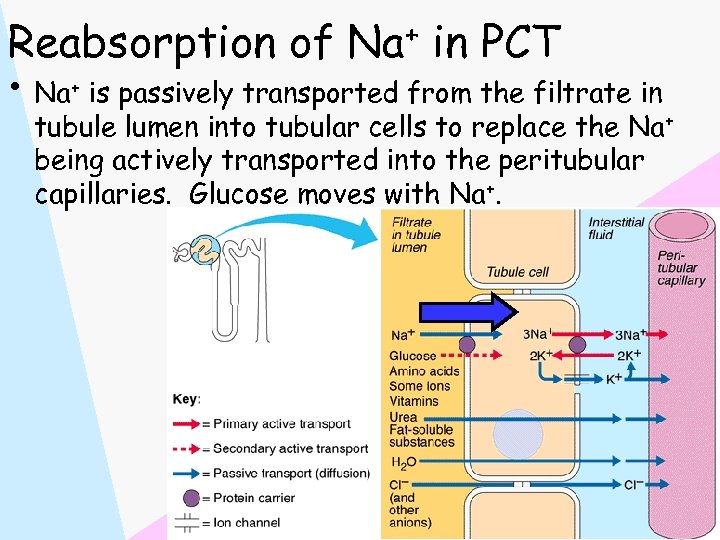 Reabsorption of Na+ in PCT • Na+ is passively transported from the filtrate in tubule lumen into tubular cells to replace the Na + being actively transported into the peritubular capillaries. Glucose moves with Na+.
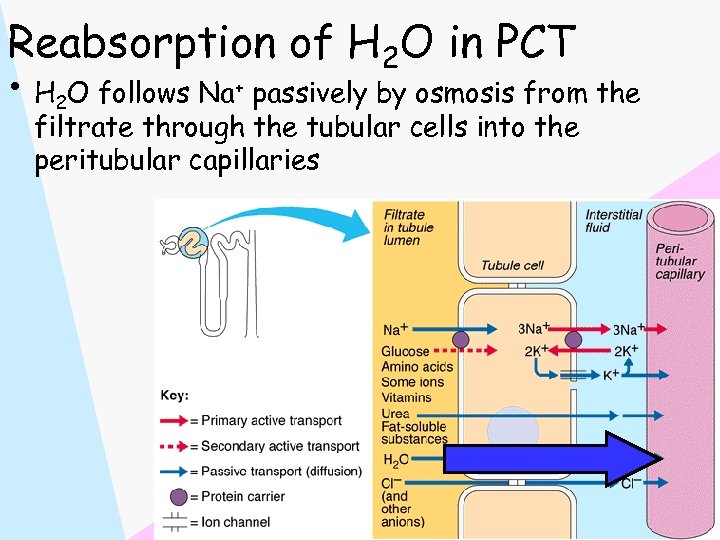 Reabsorption of H 2 O in PCT • H 2 O follows Na+ passively by osmosis from the filtrate through the tubular cells into the peritubular capillaries
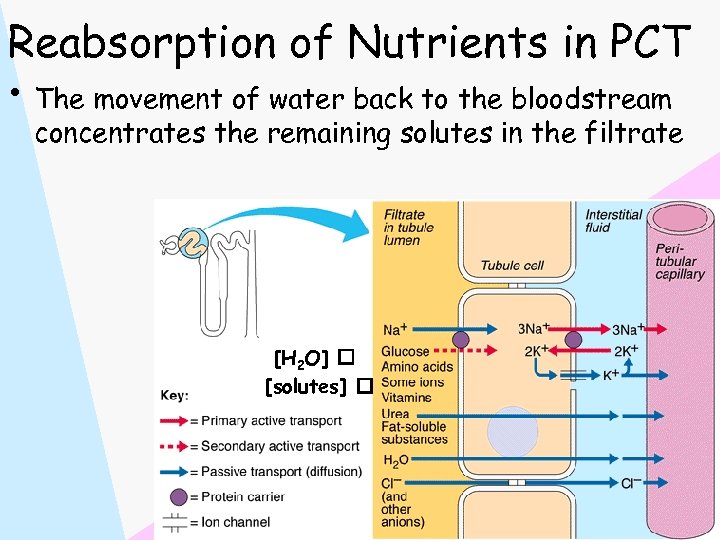 Reabsorption of Nutrients in PCT • The movement of water back to the bloodstream concentrates the remaining solutes in the filtrate [H 2 O] [solutes]
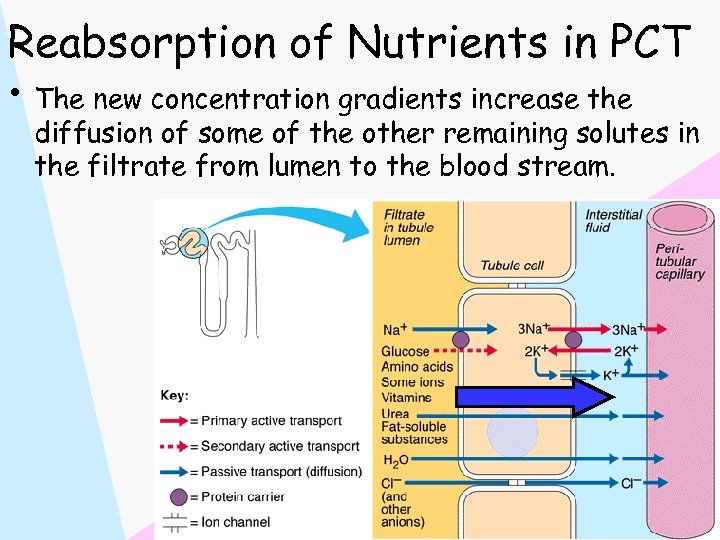 Reabsorption of Nutrients in PCT • The new concentration gradients increase the diffusion of some of the other remaining solutes in the filtrate from lumen to the blood stream.
 Transport Maximums (Tm)’s • each type of symporter has an upper limit (maximum) on how fast it can work • any time a substance is in the filtrate in an amount greater than its transport maximum, some of it will be left behind in the urine • only Na+ has no transport maximum because Na+ is being actively transported by the Na+/ K+ ATPase pump at all times.
 Renal Thresholds q The Renal Threshold is the plasma concentration at which a substance begins to spill into the urine because its Tm has been surpassed. q If the plasma filtrate concentration is too high, all of the substance cannot be reabsorbed. q For example, glucose spills into the urine in untreated diabetics. § Tm for glucose = 375 mg/min § If blood glucose > 400 mg/100 m. L, large quantities of glucose will appear in the urine
 Reabsorption in the PCT • By the end of the PCT the following reabsorption has occurred: – 100% of filtered nutrients (sugars, albumin, amino acids, vitamins, etc. ) – 80 -90% of filtered HCO 3– 65% of Na+ ions and water, – 50% of Cl- and K+ ions
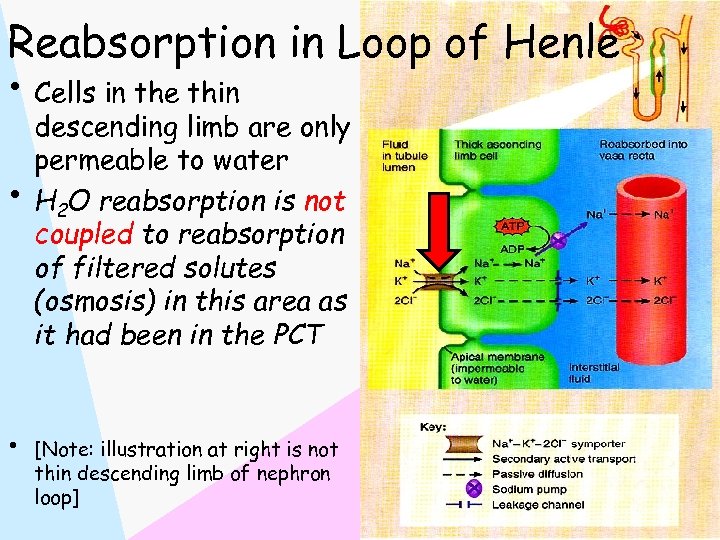 Reabsorption in Loop of Henle • Cells in the thin • • descending limb are only permeable to water H 2 O reabsorption is not coupled to reabsorption of filtered solutes (osmosis) in this area as it had been in the PCT [Note: illustration at right is not thin descending limb of nephron loop]
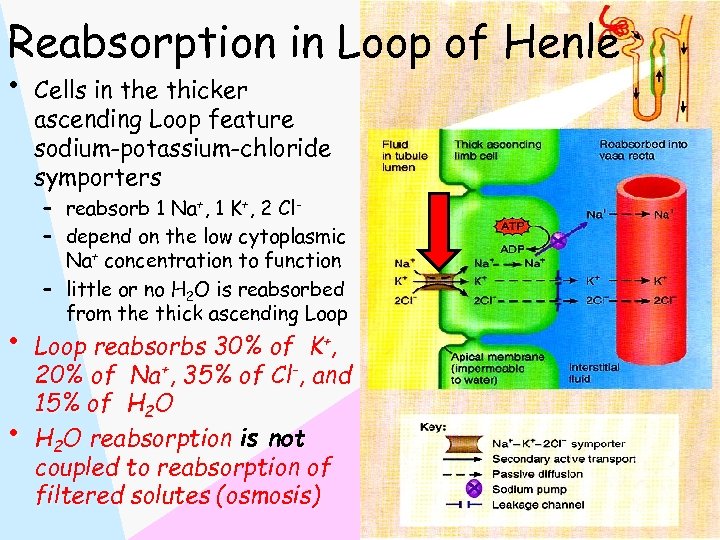 Reabsorption in Loop of Henle • • • Cells in the thicker ascending Loop feature sodium-potassium-chloride symporters – reabsorb 1 Na+, 1 K+, 2 Cl– depend on the low cytoplasmic Na+ concentration to function – little or no H 2 O is reabsorbed from the thick ascending Loop reabsorbs 30% of K+, 20% of Na+, 35% of Cl-, and 15% of H 2 O reabsorption is not coupled to reabsorption of filtered solutes (osmosis)
 Reabsorption in DCT and Collecting Ducts • Filtrate reaching the DCT has already had ~80% of the solutes and H 2 O reabsorbed • Fluid now has the characteristics of “urine” • DCT is the site of final adjustment of urine composition – less work to do, so no need for microvilli = brush border to increase surface area for tranporters – Na+/K+/Cl- symporter is a major DCT transporter – DCT reabsorbs another 10% of filtrate volume
 Reabsorption in DCT and Collecting Duct • Principal cells are present in the distal DCTs and collecting ducts • 3 hormones act on principal cells to modify ion and fluid reabsorption – [1] Anti-Diuretic Hormone (ADH) (from neurohypophysis) • H 2 O reabsorption by increasing permeability to H 2 O in the DCT and collecting duct • details discussed later on
 Reabsorption in DCT and Collecting Duct • 3 hormones act on principal cells. . . – [2] Aldosterone (from adrenal cortex) • Na+ reabsorption; Cl- and H 2 O follow passively; K+ reabsorption • numbers of basolateral Na+/K+ ATPases • activity and numbers of Na+-K+ transporters and K+ channels – [3] Atrial Natriuretic Peptide (ANP) is the antagonist to Aldosterone • K+ reabsorption; Na+ reabsorption; Cl- and H 2 O follow passively; adding “salt” and water to urine
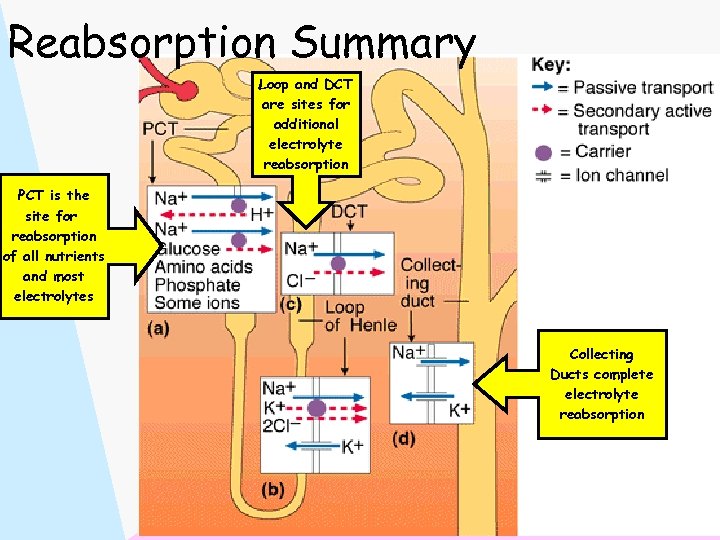 Reabsorption Summary Loop and DCT are sites for additional electrolyte reabsorption PCT is the site for reabsorption of all nutrients and most electrolytes Collecting Ducts complete electrolyte reabsorption
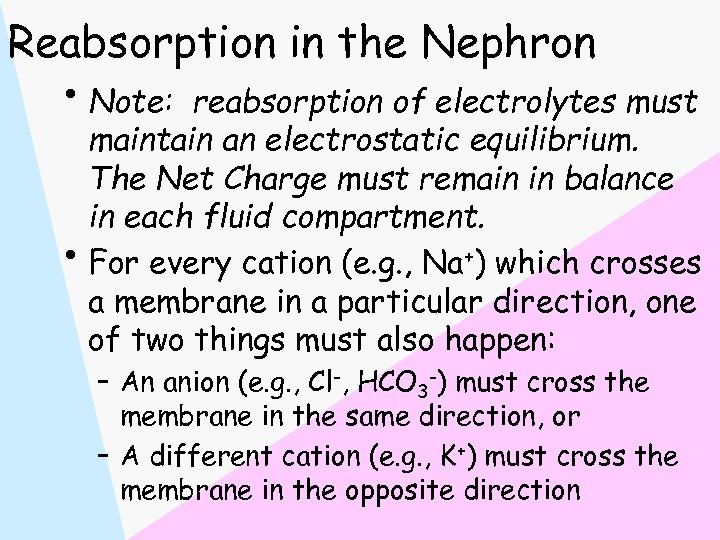 Reabsorption in the Nephron • Note: reabsorption of electrolytes must maintain an electrostatic equilibrium. The Net Charge must remain in balance in each fluid compartment. • For every cation (e. g. , Na+) which crosses a membrane in a particular direction, one of two things must also happen: – An anion (e. g. , Cl-, HCO 3 -) must cross the membrane in the same direction, or – A different cation (e. g. , K+) must cross the membrane in the opposite direction
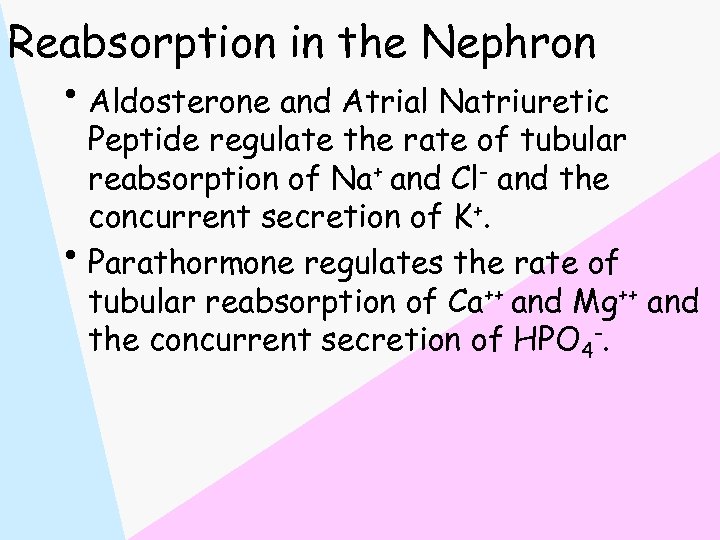 Reabsorption in the Nephron • Aldosterone and Atrial Natriuretic Peptide regulate the rate of tubular reabsorption of Na+ and Cl- and the concurrent secretion of K+. • Parathormone regulates the rate of tubular reabsorption of Ca++ and Mg++ and the concurrent secretion of HPO 4 -.
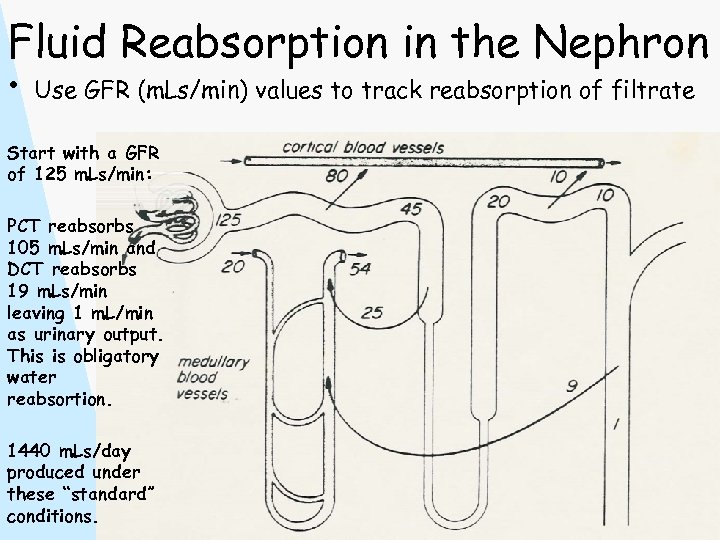 Fluid Reabsorption in the Nephron • Use GFR (m. Ls/min) values to track reabsorption of filtrate Start with a GFR of 125 m. Ls/min: PCT reabsorbs 105 m. Ls/min and DCT reabsorbs 19 m. Ls/min leaving 1 m. L/min as urinary output. This is obligatory water reabsortion. 1440 m. Ls/day produced under these “standard” conditions.
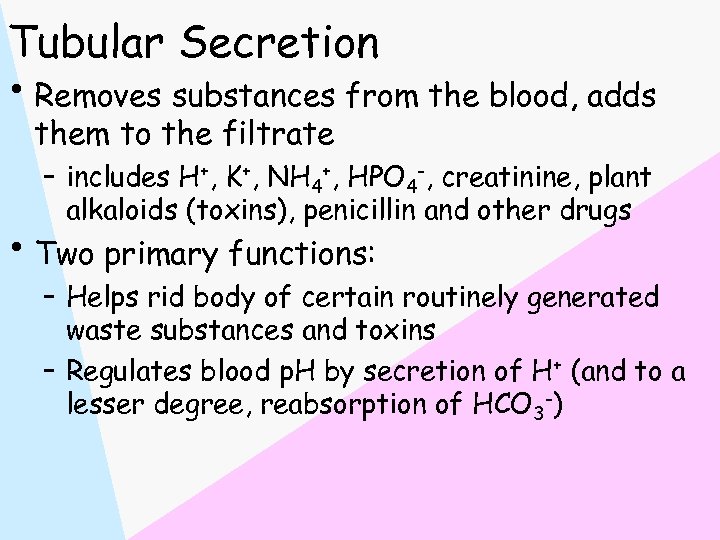 Tubular Secretion • Removes substances from the blood, adds them to the filtrate – includes H+, K+, NH 4+, HPO 4 -, creatinine, plant alkaloids (toxins), penicillin and other drugs • Two primary functions: – Helps rid body of certain routinely generated waste substances and toxins – Regulates blood p. H by secretion of H+ (and to a lesser degree, reabsorption of HCO 3 -)
 Secretion of K+ ions • Principal cells in collecting ducts secrete variable amount of K+ in exchange for reabsorbed Na+ • Most animal diets contain excess K+ but scarce Na+ • Na+/K+ ATPases are the “ion pumps” • Controlled by Aldosterone and Atrial Natriuretic Peptide • Aldosterone is released from the Adrenal Cortex in response to Angiotensin I & II • With excess K+, Aldosterone secretion predominates: Na+ (and Cl-) are reabsorbed while considerable K+ is secreted • Atrial Natriuretic Peptide is released from the Atrial walls in the heart in response to stretching when blood volume or blood pressure increase • With excess Na+, Atrial Natriuretic Peptide secretion predominates: K+ is reabsorbed while considerable Na+ (and Cl-) are secreted
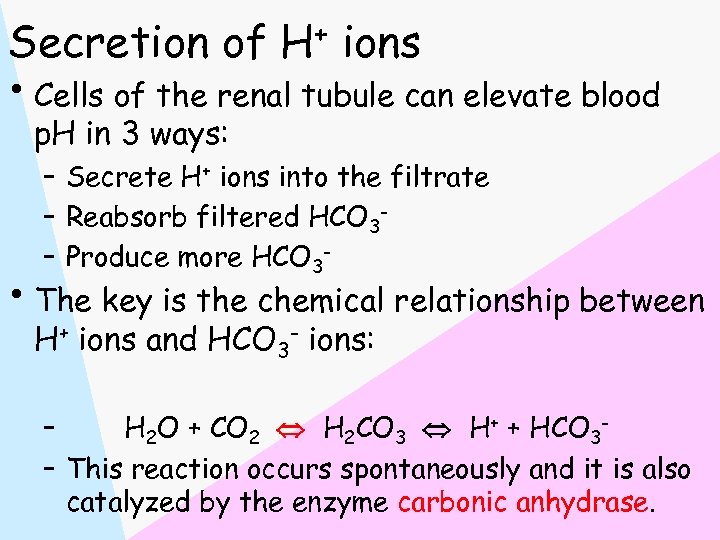 Secretion of H+ ions • Cells of the renal tubule can elevate blood p. H in 3 ways: – Secrete H+ ions into the filtrate – Reabsorb filtered HCO 3– Produce more HCO 3 - • The key is the chemical relationship between H+ ions and HCO 3 - ions: – H 2 O + CO 2 H 2 CO 3 H+ + HCO 3– This reaction occurs spontaneously and it is also catalyzed by the enzyme carbonic anhydrase.
![Secretion of H+ ions • In PCT – [1] Na+/H+ antiporter puts H+ ions](https://present5.com/presentation/5c246b8b271ab1a39b1e9fd657966245/image-59.jpg "Secretion of H+ ions • In PCT – [1] Na+/H+ antiporter puts H+ ions") Secretion of H+ ions • In PCT – [1] Na+/H+ antiporter puts H+ ions into the filtrate – H+ ions combine with HCO 3 - in lumen to form CO 2 and H 2 O 1 H+ 1 HCO 3 -
Secretion of H+ ions • In PCT – [1] Na+/H+ antiporter puts H+ ions into the filtrate – H+ ions combine with HCO 3 - in lumen to form CO 2 and H 2 O 1 H+ 1 HCO 3 -
![Secretion of H+ ions • In PCT – [2] CO 2 from the filtrate](https://present5.com/presentation/5c246b8b271ab1a39b1e9fd657966245/image-60.jpg "Secretion of H+ ions • In PCT – [2] CO 2 from the filtrate") Secretion of H+ ions • In PCT – [2] CO 2 from the filtrate or plasma enters the tubular cell where it combines with H 2 O to form H 2 CO 3 H+ HCO 3 - 2 2
Secretion of H+ ions • In PCT – [2] CO 2 from the filtrate or plasma enters the tubular cell where it combines with H 2 O to form H 2 CO 3 H+ HCO 3 - 2 2
![Secretion of H+ ions • In PCT – [3] H+ is pumped into the](https://present5.com/presentation/5c246b8b271ab1a39b1e9fd657966245/image-61.jpg "Secretion of H+ ions • In PCT – [3] H+ is pumped into the") Secretion of H+ ions • In PCT – [3] H+ is pumped into the lumen – [4] H 2 CO 3 - follows pumped Na+ back to the bloodstream H+ 3 HCO 3 - 4
Secretion of H+ ions • In PCT – [3] H+ is pumped into the lumen – [4] H 2 CO 3 - follows pumped Na+ back to the bloodstream H+ 3 HCO 3 - 4
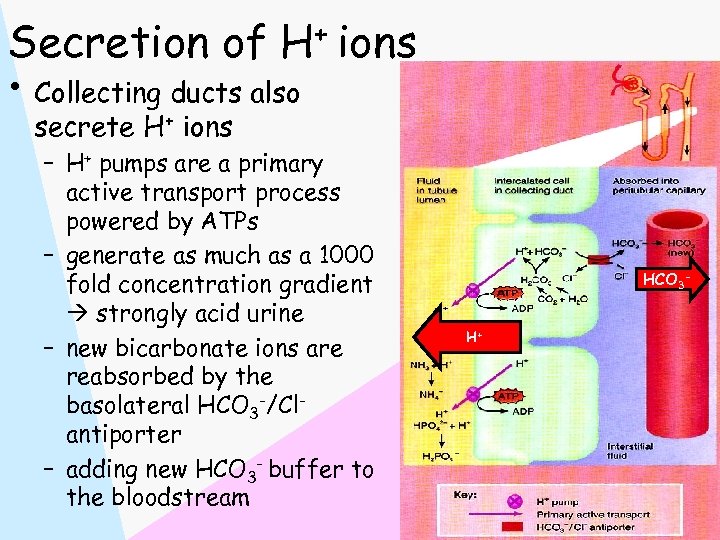 Secretion of H+ ions • Collecting ducts also secrete H+ ions – H+ pumps are a primary active transport process powered by ATPs – generate as much as a 1000 fold concentration gradient strongly acid urine – new bicarbonate ions are reabsorbed by the basolateral HCO 3 -/Clantiporter – adding new HCO 3 - buffer to the bloodstream HCO 3 H+
 Secretion of NH 3 and NH 4+ • Ammonia is a toxic waste absorbed from bacterial metabolism in the large intestine and ammonia is generated from the deamination of amino acids in the liver • Liver converts ammonia to urea, a much less toxic nitrogenous waste • PCT cells can also deaminate certain amino acids and secrete additional NH 4+ with a Na+/NH 4+ antiporter when blood p. H becomes acidic
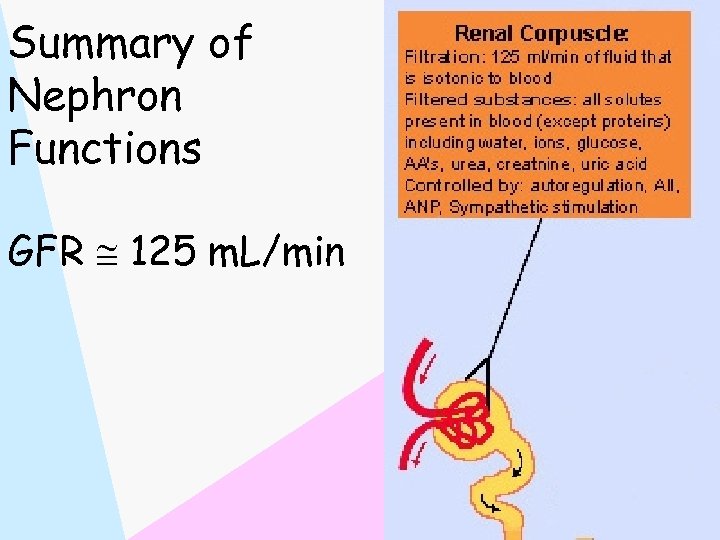 Summary of Nephron Functions GFR 125 m. L/min
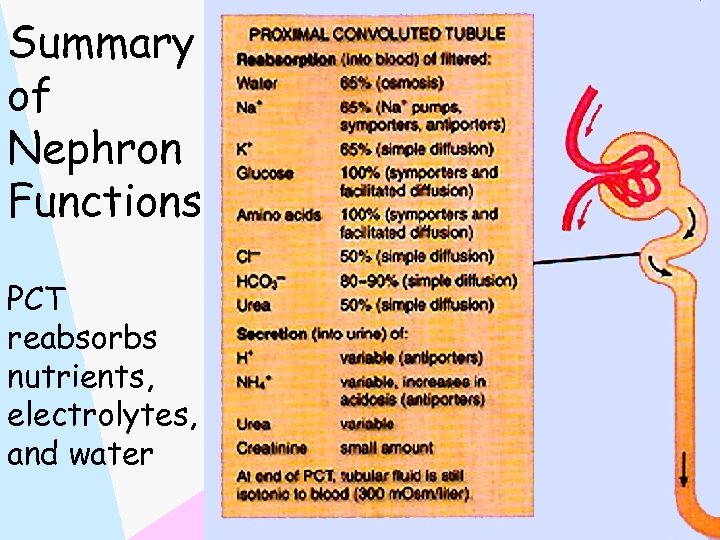 Summary of Nephron Functions PCT reabsorbs nutrients, electrolytes, and water
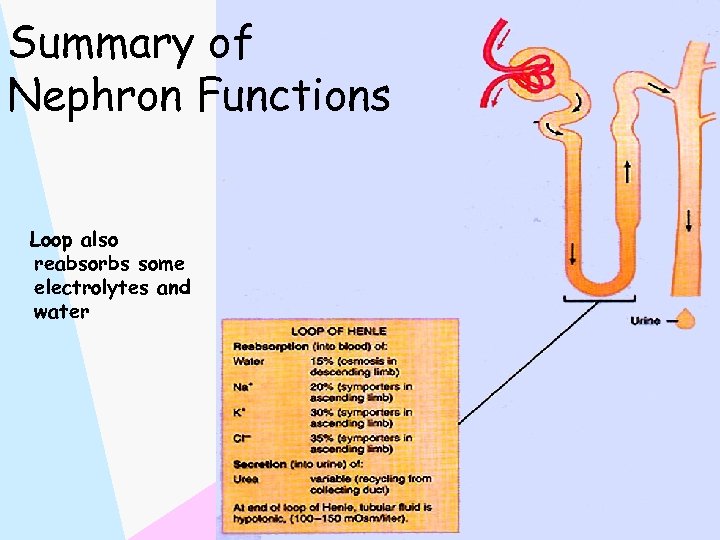 Summary of Nephron Functions Loop also reabsorbs some electrolytes and water
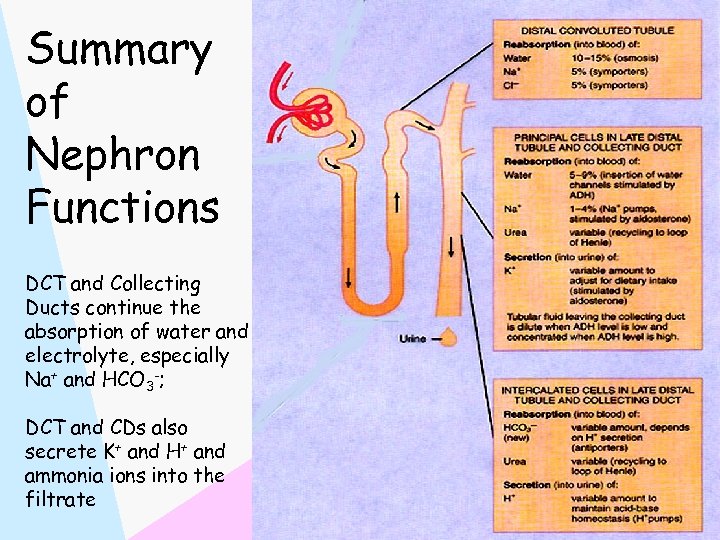 Summary of Nephron Functions DCT and Collecting Ducts continue the absorption of water and electrolyte, especially Na+ and HCO 3 -; DCT and CDs also secrete K+ and H+ and ammonia ions into the filtrate
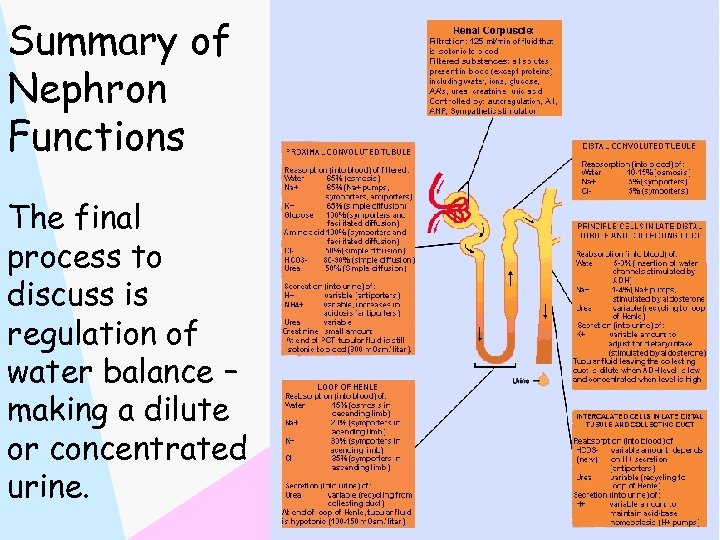 Summary of Nephron Functions The final process to discuss is regulation of water balance – making a dilute or concentrated urine.
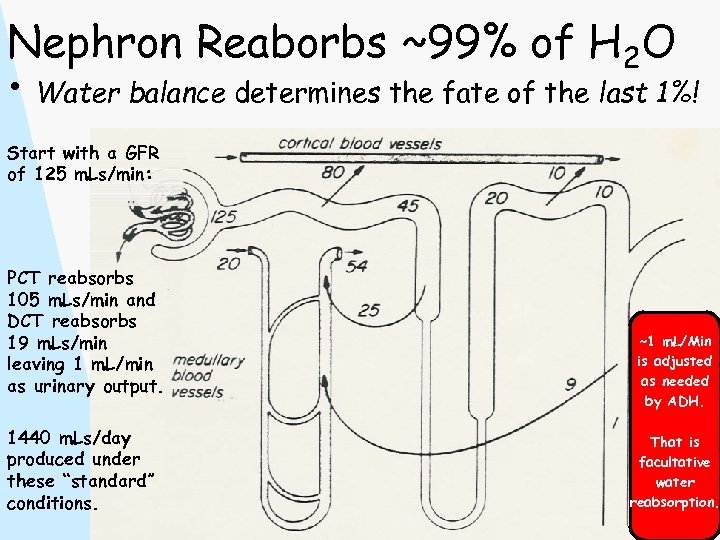 Nephron Reaborbs ~99% of H 2 O • Water balance determines the fate of the last 1%! Start with a GFR of 125 m. Ls/min: PCT reabsorbs 105 m. Ls/min and DCT reabsorbs 19 m. Ls/min leaving 1 m. L/min as urinary output. 1440 m. Ls/day produced under these “standard” conditions. ~1 m. L/Min is adjusted as needed by ADH. That is facultative water reabsorption.
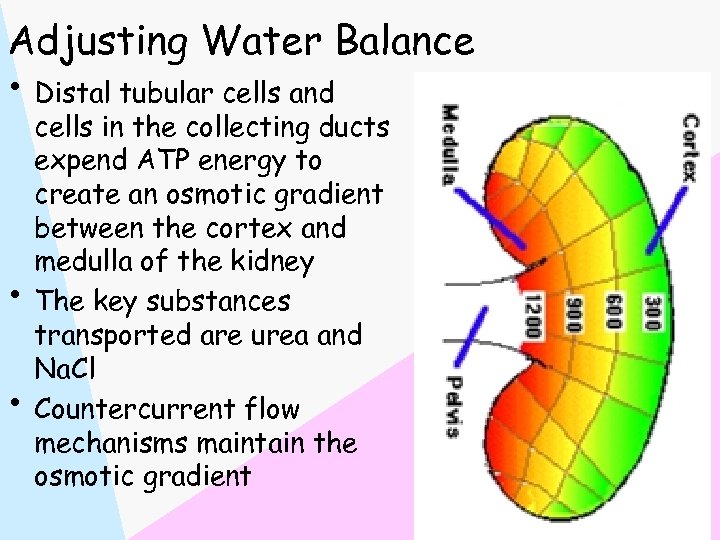 Adjusting Water Balance • Distal tubular cells and • • cells in the collecting ducts expend ATP energy to create an osmotic gradient between the cortex and medulla of the kidney The key substances transported are urea and Na. Cl Countercurrent flow mechanisms maintain the osmotic gradient
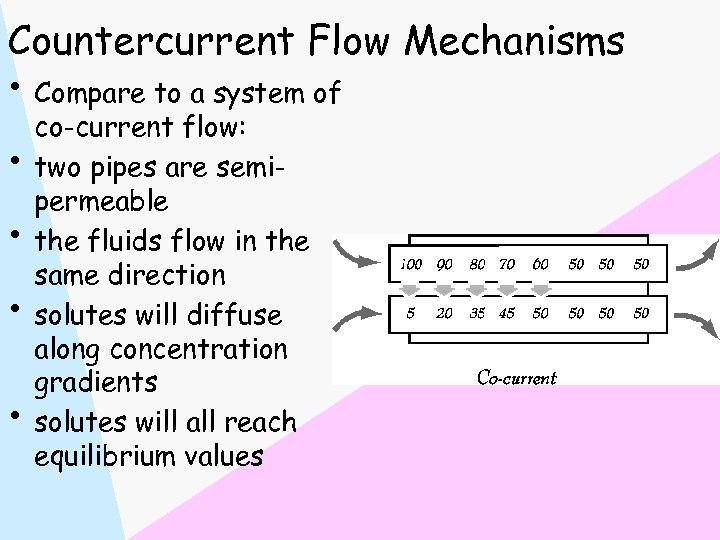 Countercurrent Flow Mechanisms • Compare to a system of • • co-current flow: two pipes are semipermeable the fluids flow in the same direction solutes will diffuse along concentration gradients solutes will all reach equilibrium values
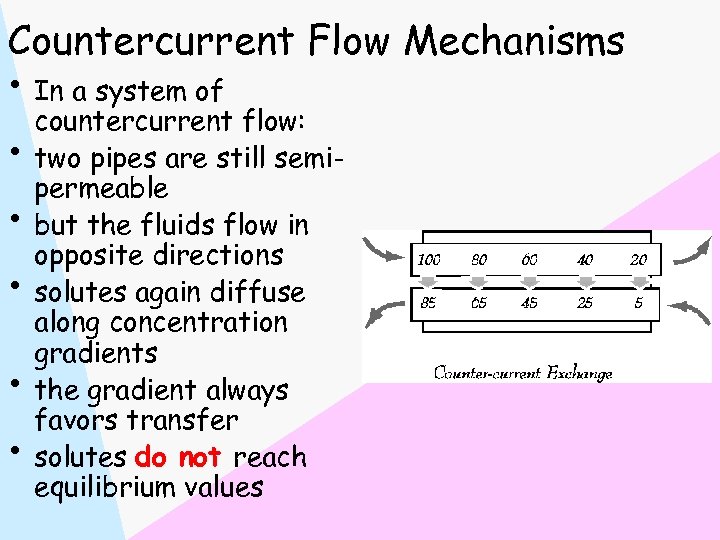 Countercurrent Flow Mechanisms • In a system of • • • countercurrent flow: two pipes are still semipermeable but the fluids flow in opposite directions solutes again diffuse along concentration gradients the gradient always favors transfer solutes do not reach equilibrium values
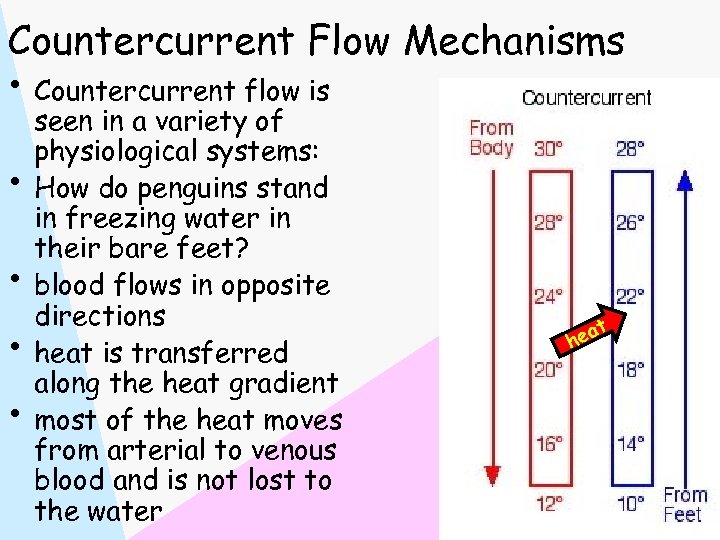 Countercurrent Flow Mechanisms • Countercurrent flow is • • seen in a variety of physiological systems: How do penguins stand in freezing water in their bare feet? blood flows in opposite directions heat is transferred along the heat gradient most of the heat moves from arterial to venous blood and is not lost to the water eat h
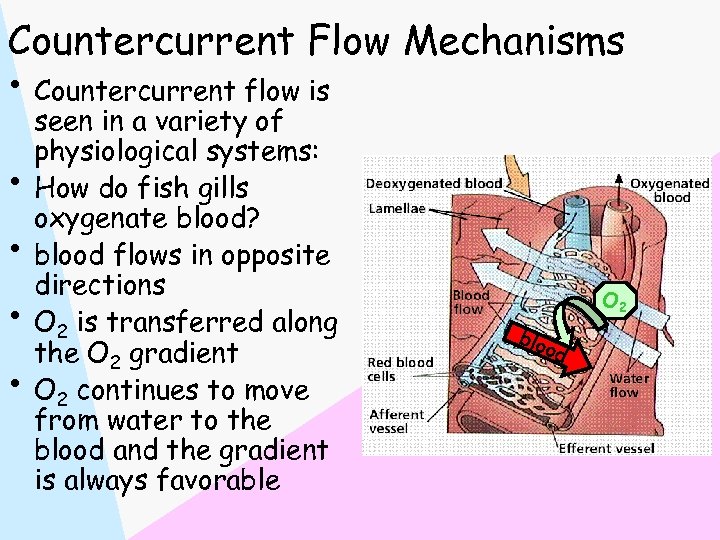 Countercurrent Flow Mechanisms • Countercurrent flow is • • seen in a variety of physiological systems: How do fish gills oxygenate blood? blood flows in opposite directions O 2 is transferred along the O 2 gradient O 2 continues to move from water to the blood and the gradient is always favorable O 2 blo od
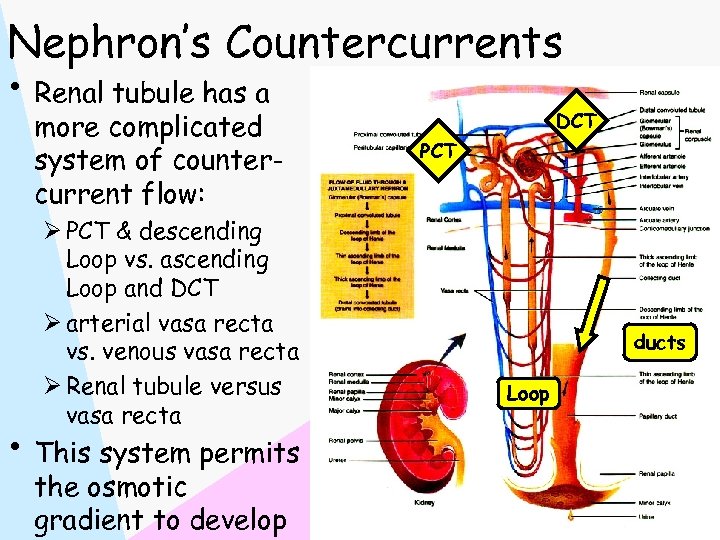 Nephron’s Countercurrents • Renal tubule has a more complicated system of countercurrent flow: Ø PCT & descending Loop vs. ascending Loop and DCT Ø arterial vasa recta vs. venous vasa recta Ø Renal tubule versus vasa recta • This system permits the osmotic gradient to develop DCT PCT ducts Loop
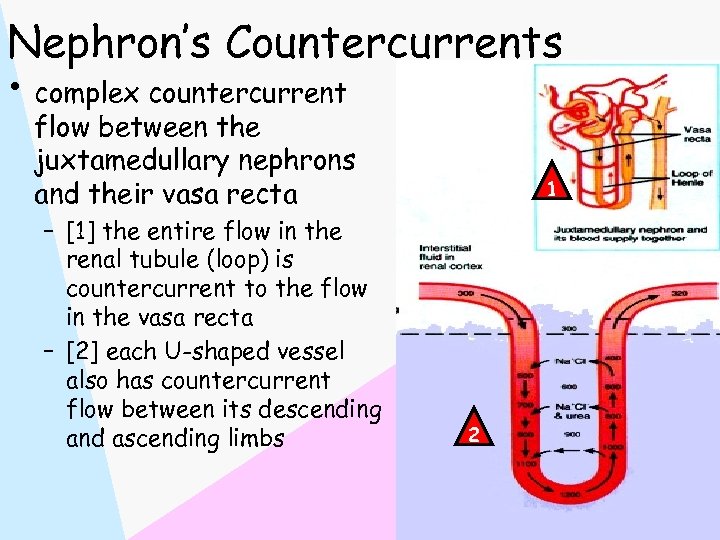 Nephron’s Countercurrents • complex countercurrent flow between the juxtamedullary nephrons and their vasa recta – [1] the entire flow in the renal tubule (loop) is countercurrent to the flow in the vasa recta – [2] each U-shaped vessel also has countercurrent flow between its descending and ascending limbs 1 2
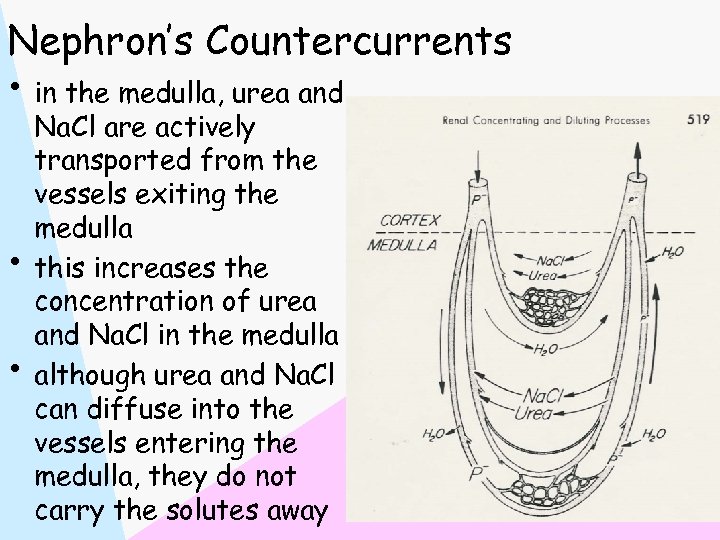 Nephron’s Countercurrents • in the medulla, urea and • • Na. Cl are actively transported from the vessels exiting the medulla this increases the concentration of urea and Na. Cl in the medulla although urea and Na. Cl can diffuse into the vessels entering the medulla, they do not carry the solutes away
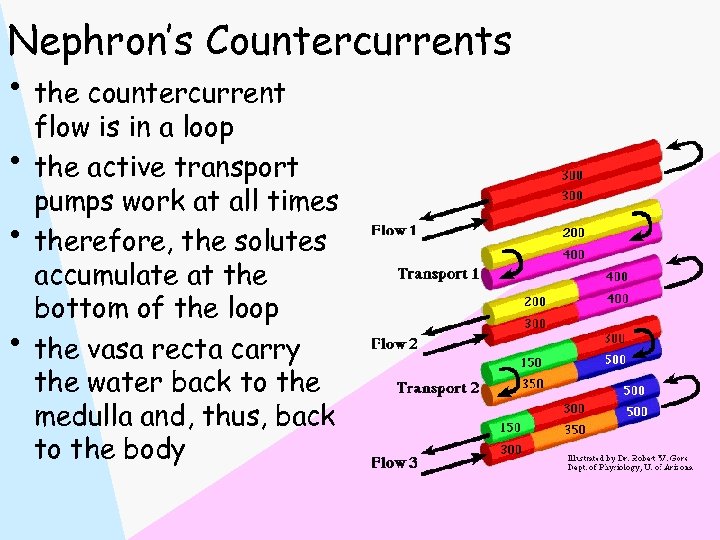 Nephron’s Countercurrents • the countercurrent • • • flow is in a loop the active transport pumps work at all times therefore, the solutes accumulate at the bottom of the loop the vasa recta carry the water back to the medulla and, thus, back to the body
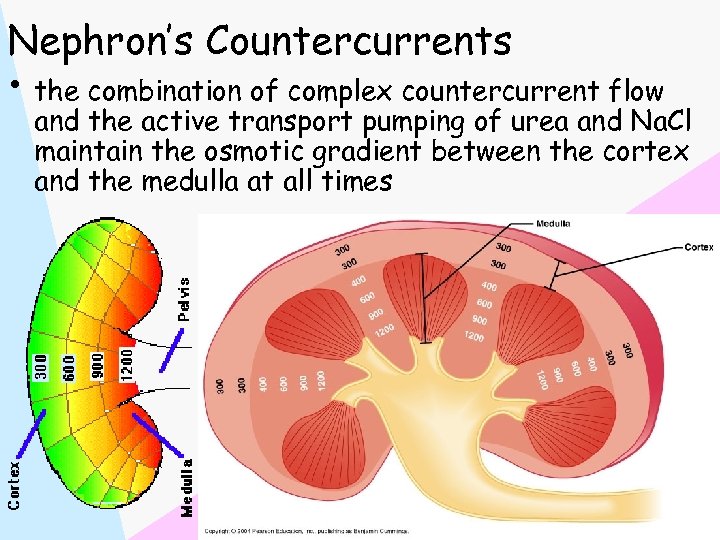 Nephron’s Countercurrents • the combination of complex countercurrent flow and the active transport pumping of urea and Na. Cl maintain the osmotic gradient between the cortex and the medulla at all times
 Adjusting Water Balance • water conservation is dependent on ADH • normal osmotic concentration in the body fluids, • • • plasma and interstitial fluids, including the kidney’s cortex, is ~300 m. Osm/L glomerular filtrate is isosmotic to plasma thick limb of the ascending Loop is impermeable to water but urea and Na+/Cl- ions are actively transported out of the filtrate DCT and collecting ducts are impermeable to water unless ADH is present
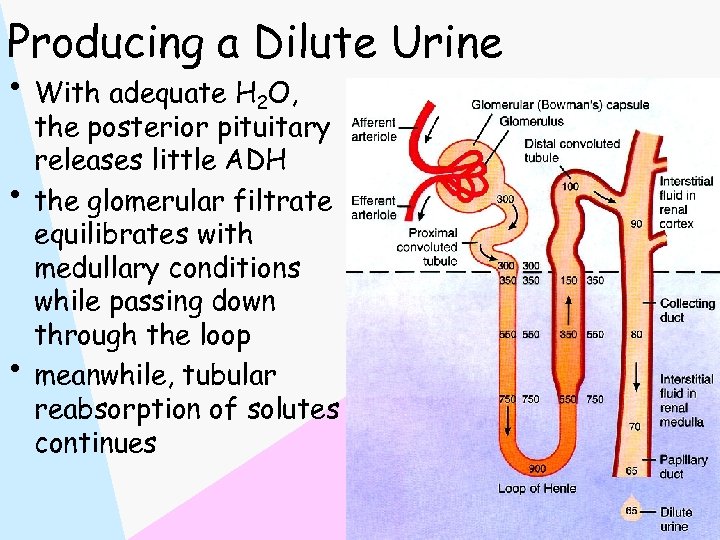 Producing a Dilute Urine • With adequate H 2 O, • • the posterior pituitary releases little ADH the glomerular filtrate equilibrates with medullary conditions while passing down through the loop meanwhile, tubular reabsorption of solutes continues
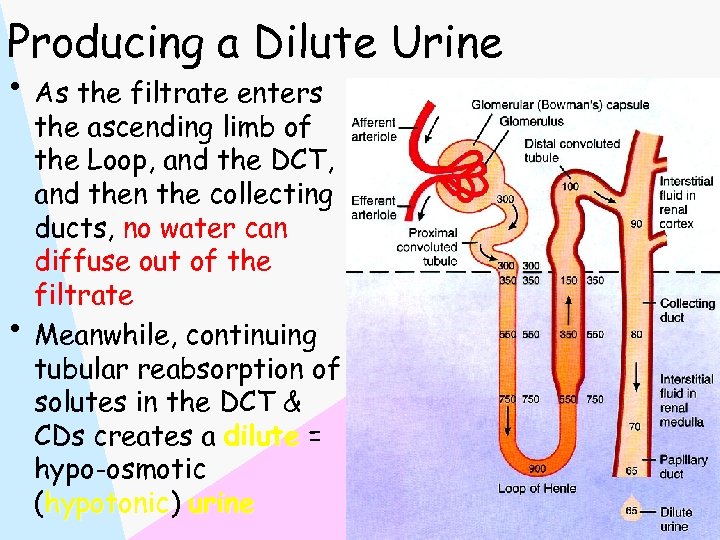 Producing a Dilute Urine • As the filtrate enters • the ascending limb of the Loop, and the DCT, and then the collecting ducts, no water can diffuse out of the filtrate Meanwhile, continuing tubular reabsorption of solutes in the DCT & CDs creates a dilute = hypo-osmotic (hypotonic) urine hypotonic
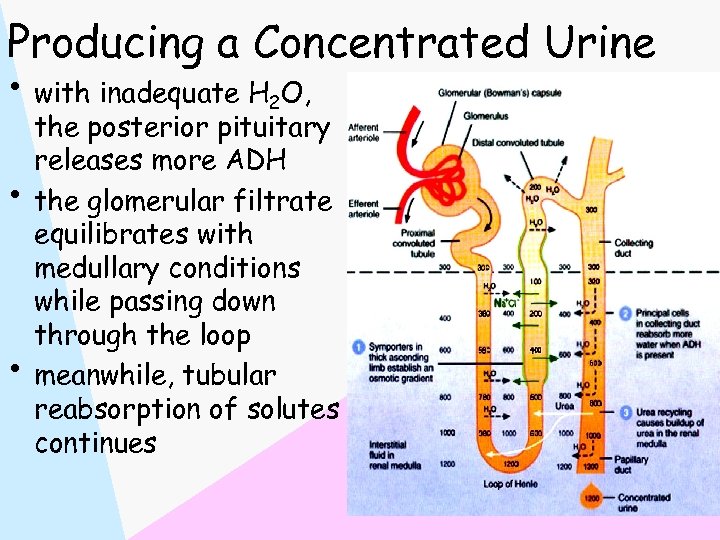 Producing a Concentrated Urine • with inadequate H 2 O, • • the posterior pituitary releases more ADH the glomerular filtrate equilibrates with medullary conditions while passing down through the loop meanwhile, tubular reabsorption of solutes continues
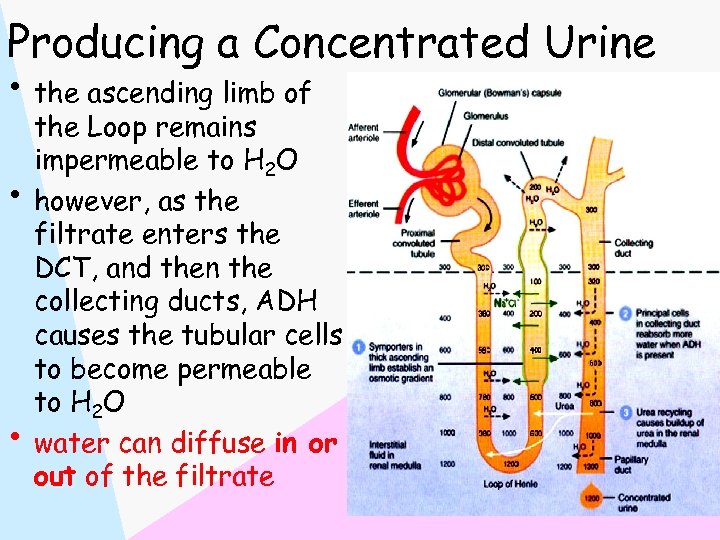 Producing a Concentrated Urine • the ascending limb of • • the Loop remains impermeable to H 2 O however, as the filtrate enters the DCT, and then the collecting ducts, ADH causes the tubular cells to become permeable to H 2 O water can diffuse in or out of the filtrate
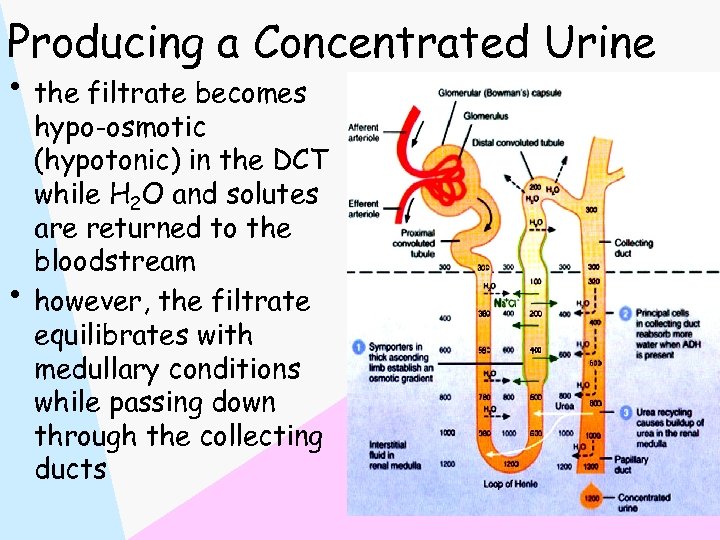 Producing a Concentrated Urine • the filtrate becomes • hypo-osmotic (hypotonic) in the DCT while H 2 O and solutes are returned to the bloodstream however, the filtrate equilibrates with medullary conditions while passing down through the collecting ducts
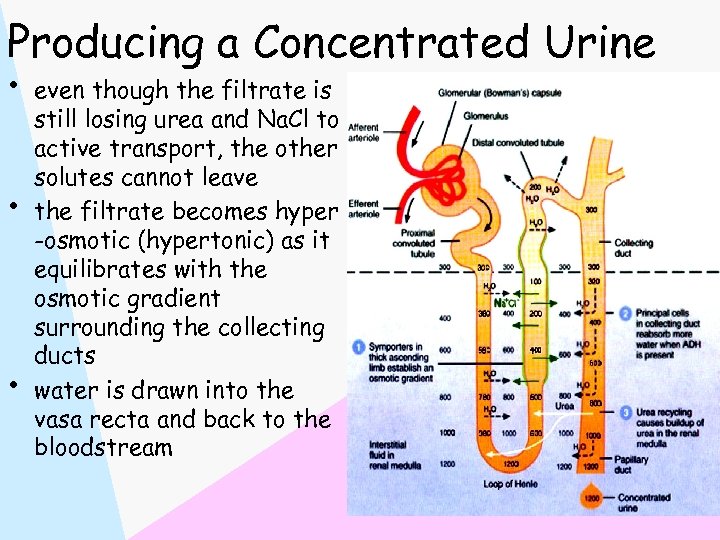 Producing a Concentrated Urine • • • even though the filtrate is still losing urea and Na. Cl to active transport, the other solutes cannot leave the filtrate becomes hyper -osmotic (hypertonic) as it equilibrates with the osmotic gradient surrounding the collecting ducts water is drawn into the vasa recta and back to the bloodstream
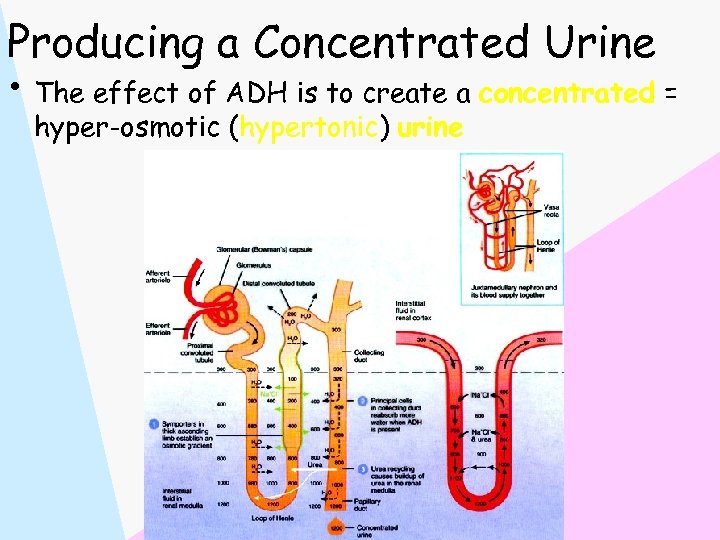 Producing a Concentrated Urine • The effect of ADH is to create a concentrated = hyper-osmotic (hypertonic) urine hypertonic
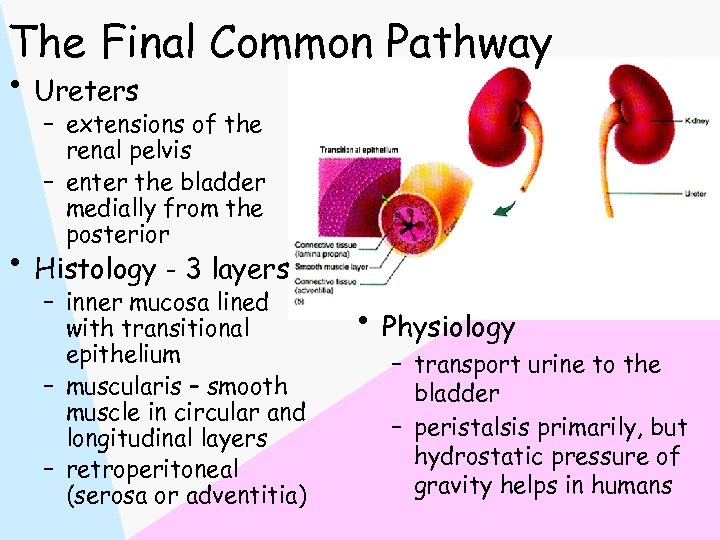 The Final Common Pathway • Ureters – extensions of the renal pelvis – enter the bladder medially from the posterior • Histology - 3 layers – inner mucosa lined with transitional epithelium – muscularis – smooth muscle in circular and longitudinal layers – retroperitoneal (serosa or adventitia) • Physiology – transport urine to the bladder – peristalsis primarily, but hydrostatic pressure of gravity helps in humans
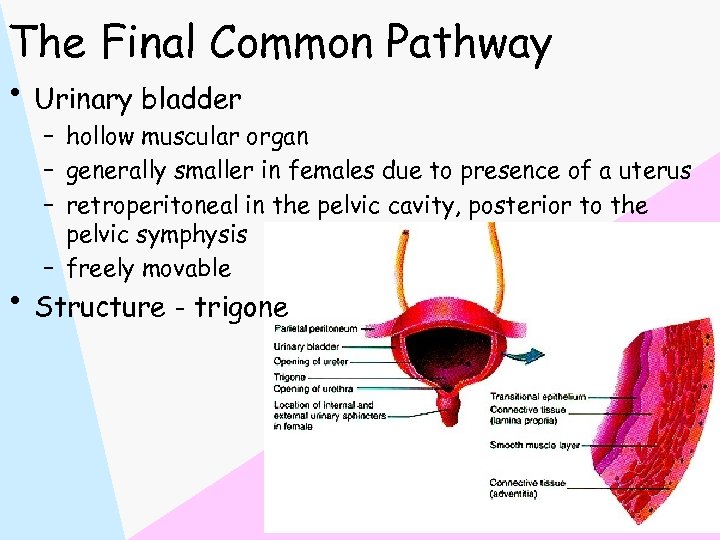 The Final Common Pathway • Urinary bladder – hollow muscular organ – generally smaller in females due to presence of a uterus – retroperitoneal in the pelvic cavity, posterior to the pelvic symphysis – freely movable • Structure - trigone
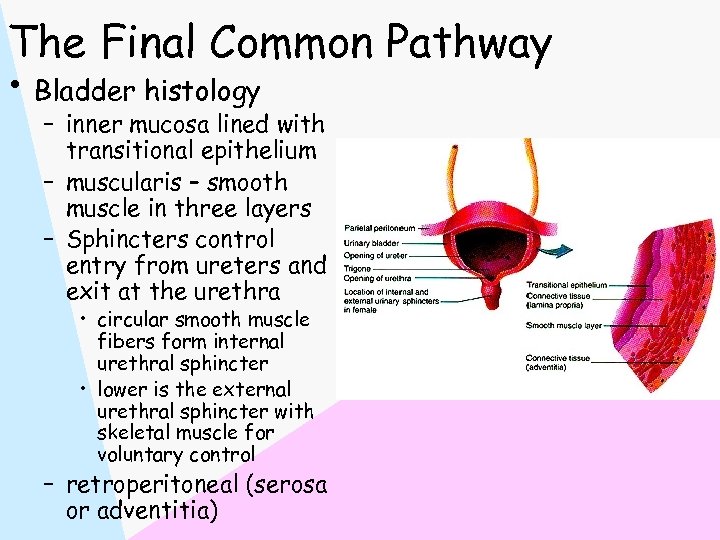 The Final Common Pathway • Bladder histology – inner mucosa lined with transitional epithelium – muscularis – smooth muscle in three layers – Sphincters control entry from ureters and exit at the urethra • circular smooth muscle fibers form internal urethral sphincter • lower is the external urethral sphincter with skeletal muscle for voluntary control – retroperitoneal (serosa or adventitia)
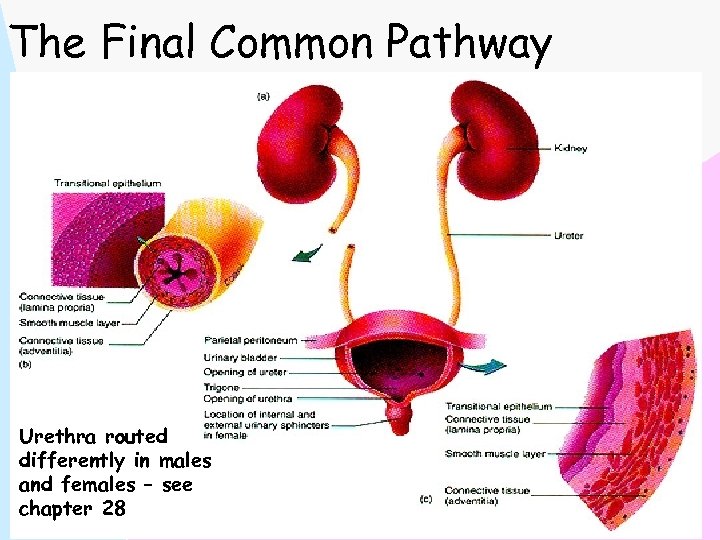 The Final Common Pathway Urethra routed differently in males and females – see chapter 28
 The Final Common Pathway • Urethra – small tube from floor of bladder to exterior of body • females -- fairly straight path exits anterior to vagina • males -- passes through the prostate gland exits through the penis – histology • female: three coats – inner mucosa, intermediate thin layer of spongy tissue with plexus of veins – outer muscular coat continuous with the bladder • male two layers – inner mucous membrane and a muscularis – outer submucosa tissue with various accessory structures which connect to it • both genders have a stratified squamous epithelial lining
 The Final Common Pathway • Urethra – Physiology - terminal portion of urinary tract, in males the urethra also serves as the duct through which semen is discharged from the body • Urine – Volume • 1000 -2000 ml/day • influenced by blood pressure, blood osmotic pressure, temperature, mental state, general health, diet, diuretics, other drugs – Chemical Composition - 95% water, 5% solutes
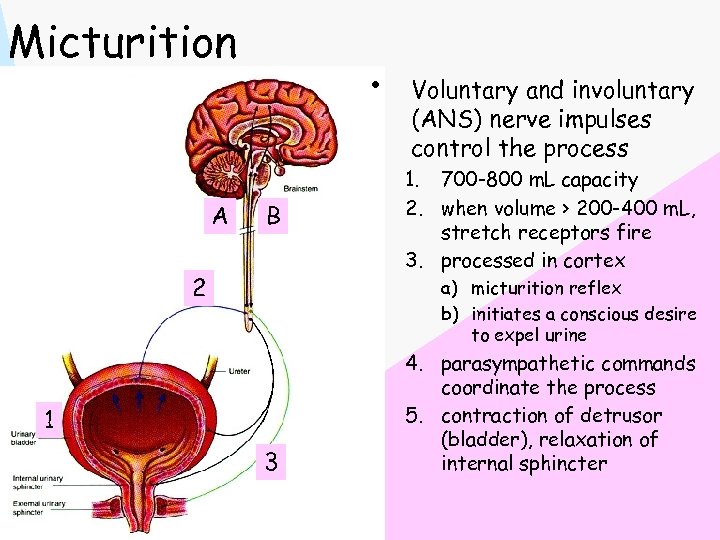 Micturition A • B 2 Voluntary and involuntary (ANS) nerve impulses control the process 1. 700 -800 m. L capacity 2. when volume > 200 -400 m. L, stretch receptors fire 3. processed in cortex a) micturition reflex b) initiates a conscious desire to expel urine 1 3 4. parasympathetic commands coordinate the process 5. contraction of detrusor (bladder), relaxation of internal sphincter
 End Chapter 25