


 Скачать презентацию Chapter 25 The Economics of Prescription Drugs Mc
612e7f1852ca9fe6ab746bd88298b6ae.ppt
- Количество слайдов: 18
 Chapter 25 The Economics of Prescription Drugs Mc. Graw-Hill/Irwin Copyright © 2012 by The Mc. Graw-Hill Companies, Inc. All rights reserved.
 Chapter Outline • Profiteers Or Benevolent Scientists • Monopoly Power As It Applies To Drugs • Important Questions 25 -2
 Profiteers or Benevolent Scientists? • Spending on drugs accounts for 10% of the more than $2 trillion health care industry • The question of advertising • Ads for particular drugs • These are not unexpected as new cures and remedies are invented. • Feel-good political ads • These ads are seen as a means to forestall price controls or regulations. 25 -3
 Patents • A patent is a right granted by government to an inventor to be the exclusive seller on an invention for a limited period of time. • Patents motivate innovation with the promise of monopoly profit for a period of time. 25 -4
 Orphan Drugs • An Orphan Drug is one that treats someone with a disease that afflicts few people. • The concern is that there is insufficient potential demand to motivate innovation. • For orphan drugs the patent life is extended by several years. 25 -5
 The Concern over High Prices • Are prescription drug prices too high? • The answer to many depends on the impact of the disease. • For “life or death” drugs price has been an ethical concern. • The AIDS “cocktail” (a mix of drugs, used to fight the disease) originally cost $14, 000 per patient per year. • For “quality of life” drugs it has been less of a concern. • Pepcid and Zantac (heartburn medications), Seldane and then Claritan (seasonal allergy medications) cost a great deal but have not raised as much ethical concern. 25 -6
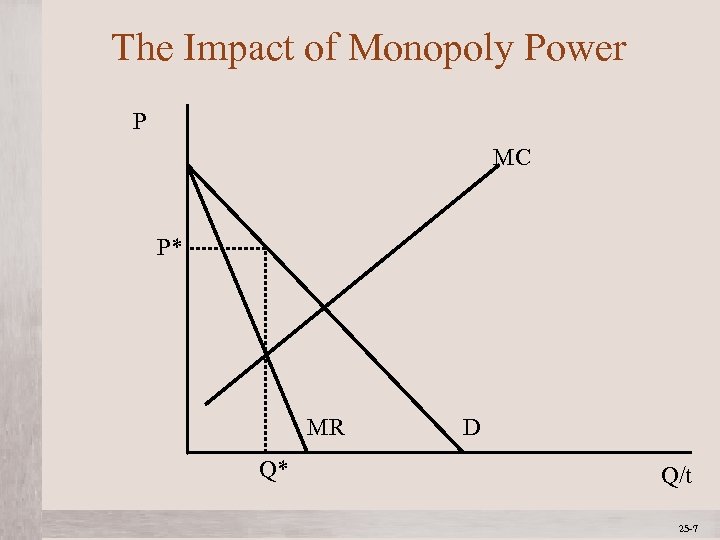 The Impact of Monopoly Power P MC P* MR Q* D Q/t 25 -7
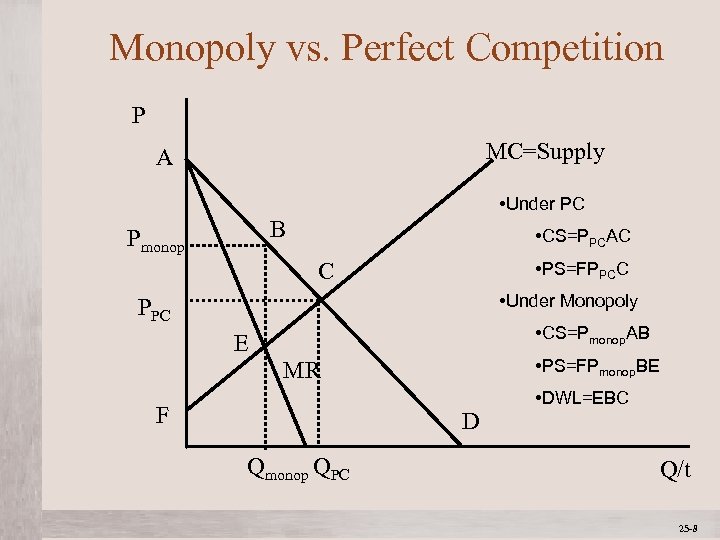 Monopoly vs. Perfect Competition P MC=Supply A • Under PC B Pmonop • CS=PPCAC C • PS=FPPCC • Under Monopoly PPC • CS=Pmonop. AB E • PS=FPmonop. BE MR F D Qmonop QPC • DWL=EBC Q/t 25 -8
 Deadweight Loss • Deadweight Loss (DWL) is the loss in social welfare associated with production being too little or too great. • In the case of monopoly, production is too little and prices are too high. 25 -9
 Important Questions • Are prescription drugs expensive necessities or relatively inexpensive godsends? • Expensive Necessities? • Prescription drug prices rose twice as fast as overall prices. • The prices are often more than ten times their marginal production costs. • Inexpensive godsends • Drug treatments are typically much less than their surgical alternatives. (Drugs that deal with blocked arteries are less than a tenth the cost of bypass surgery. ) • New quality of life drugs treat ailments for which there are no surgical alternatives. 25 -10
 Why We Should Expect Costs to be High • Innovation costs • Highly trained and highly paid personnel are required to work on therapies. • Expensive equipment is necessary to aid the invention process. • Uncertainty about success • Most new therapies that make it out of the lab do not make it through clinical testing. • Time delay and opportunity cost • Even when therapies are approved the revenue stream begins more than a decade after the invention costs have been incurred. • The opportunity cost in terms of lost interest must be counted as a cost as well. 25 -11
 The Cost Debate • Consumer advocacy groups contend that ad spending now exceeds research spending. • Drug firms contend that this ignores important “opportunity costs. ” 25 -12
 Induced Demand • Consumer advocacy groups are concerned that drug companies are inventing ailments to treat. • e. g. Restless legs syndrome & Requip • The drug treats an ailment that was not previously known to be an ailment. 25 -13
 Are Price Controls an Answer? • Price or profit controls in other countries make it such that drug prices are much higher in the U. S. than they are in other countries. • If the U. S. controlled prices or profits it would eliminate the sole high profit market for drugs thereby reducing their motivation to innovate • Economists are generally against price or profit limits for prescription drugs in the U. S. 25 -14
 Buying from Canada • It is against the law for anyone to resell drugs purchased oversees. • Canadian and Mexican drug prices are controlled by their governments • It is much cheaper to buy drugs in Canada or Mexico that it is in the U. S. 25 -15
 FDA Approval • The Process • Laboratory trials test the effectiveness of drugs “in the test-tube” and on animals. • Small scale human testing is done to determine safety. • Large scale human testing is done to determine effectiveness. This also catches some safety issues. 25 -16
 Too Lax or Too Stringent • Too Lax • If drugs are approved that are later determined to be unsafe (such as the weight loss drug Fen-Phen) the concern is that screening is too lax. • Too Stringent • If drugs that would have saved lives (or otherwise helped people) are delayed in their approval this is a loss as well. • Economists evaluate the marginal cost of increasing stringency against its marginal benefits. 25 -17
 Over-the-Counter • When a drug has been deemed to be safe and effective and does not have an adverse interaction with other drugs it can go over-the -counter (sold without a prescription. ) • It is not always in the consumer’s best interest for a drug to go over-the-counter • OTC drugs are not covered by insurance • The out of pocket expense to consumers with insurance can often be higher when a drug goes OTC. 25 -18