


 Скачать презентацию Chapter 25 Taxation of International Transactions 2012
38bc893082bb5ee0602d5071a8cbf826.ppt
- Количество слайдов: 85
 Chapter 25 Taxation of International Transactions © 2012 Cengage Learning. All Rights Reserved. May not be scanned, copied or duplicated, or posted to a publicly accessible website, in whole or in part. 1
 The Big Picture (slide 1 of 3) • Voice. Co, a domestic corporation, designs, manufactures, and sells specialty microphones for use in theaters. • All of its activities take place in Florida – But, it ships products to customers all over the United States. • When it receives some inquiries about its products from foreign customers, Voice. Co decides to test the foreign market and places ads in foreign trade journals. – Soon it is taking orders from foreign customers. 2
 The Big Picture (slide 2 of 3) • Voice. Co is concerned about its potential foreign income tax exposure. • Although it has no assets or employees in the foreign jurisdictions, it now is involved in international commerce and has many questions. – Is Voice. Co subject to income taxes in foreign countries? – Must it pay U. S. income taxes on the profits from its foreign sales? – What if Voice. Co pays taxes to other countries? • Does it receive any benefit from these payments on its U. S. tax return? 3
 The Big Picture (slide 3 of 3) • Suppose that Voice. Co establishes a manufacturing plant in Ireland. – Voice. Co incorporates the Irish operation as Voice. Co-Ireland, a foreign corporation. – Ireland imposes only a 12. 5% tax on Voice. Co-Ireland’s profits. • So long as Voice. Co-Ireland does not distribute profits to Voice. Co, will the profits escape U. S. taxation? • What are the consequences to Voice. Co of being the owner of a so-called controlled foreign corporation? • Does it have any reporting requirements with the IRS? • Read the chapter and formulate your response. 4
 Overview of International Taxation (slide 1 of 2) • The U. S. taxes U. S. taxpayers on “worldwide” income • The U. S. allows a Foreign Tax Credit to be claimed against the U. S. tax to reduce doubletaxation (U. S. and foreign) of the same income 5
 Overview of International Taxation (slide 2 of 2) • For foreign taxpayers, the U. S. generally taxes only income earned within its borders • The U. S. taxation of cross-border transactions can be organized in terms of: – Outbound taxation • Refers to the U. S. taxation of foreign-source income earned by U. S. taxpayers – Inbound taxation • Refers to the U. S. taxation of U. S. -source income earned by foreign taxpayers 6
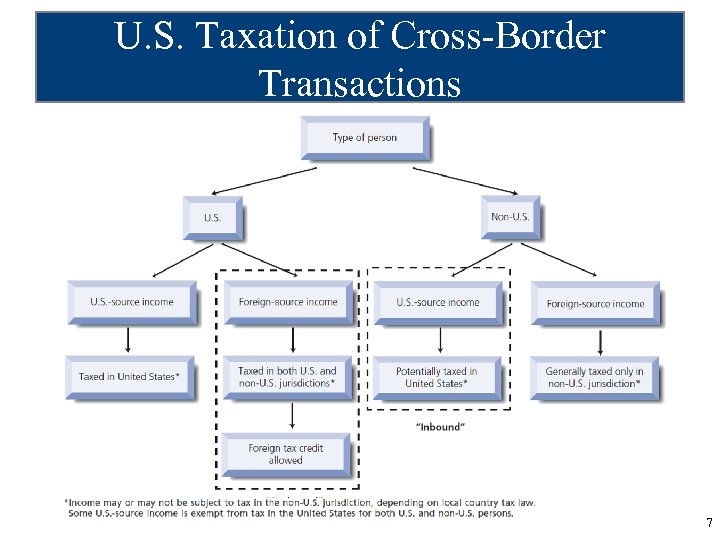 U. S. Taxation of Cross-Border Transactions 7
 The Big Picture – Example 2 Double Taxation • Return to the facts of The Big Picture on p. 25 -2. • Assume that Voice. Co operates an unincorporated manufacturing branch in Singapore. • This branch income is taxed in the U. S. as part of Voice-Co’s worldwide income and also in Singapore. – Without the foreign tax credit to mitigate this double taxation, Voice. Co would suffer an excessive tax burden and could not compete in a global environment. 8
 The Big Picture – Example 3 Inbound Taxation • Return to the facts of The Big Picture on p. 25 -2. • Voice. Co’s major competitor is a Swiss-based foreign corporation with operations in the United States. • Although not a U. S. person, the Swiss competitor is taxed in the United States on its U. S. -source business income. • If the Swiss competitor could operate free of U. S. tax, Voice. Co would face a serious competitive disadvantage. 9
 International Tax Treaties (slide 1 of 3) • Tax treaties exist between the U. S. and many other countries – Provisions generally override the treatment called for under the Internal Revenue Code or foreign tax statutes – Generally provide taxing rights for the taxable income of residents of one treaty country who have income sourced in the other treaty country 10
 International Tax Treaties (slide 2 of 3) • Tax treaties generally: – Give one country primary taxing rights, and – Require the other country to allow a credit for the taxes paid on the twice-taxed income • Which country receives primary taxing rights usually depends on – The residence of the taxpayer, or – The presence of a permanent establishment • Generally, a permanent establishment is a branch, office, factory, workshop, warehouse, or other fixed place of business 11
 International Tax Treaties (slide 3 of 3) • Most U. S. income tax treaties reduce withholding on certain items of investment income – e. g. , Treaties with France and Sweden reduce withholding on dividends to 15% and on certain interest to zero – Many new treaties (e. g. , with the United Kingdom and Australia) provide for no withholding on dividend payments to parent corporations • The U. S. has developed a Model Income Tax Convention as the starting point for negotiating income tax treaties with other countries 12
 Sourcing of Income (slide 1 of 9) • Interest income – Interest income from the U. S. government, the District of Columbia, from U. S. corp. and from noncorporate U. S. residents is treated as U. S. source income – Exceptions • Certain interest received from a U. S. corp. that earned ≥ 80% of its active business income from foreign sources over the prior 3 year period is treated as foreign-source income • Interest received on amounts deposited with a foreign branch of a U. S. corp. is treated as foreign-source income if the branch is engaged in the commercial banking business 13
 Sourcing of Income (slide 2 of 9) • Dividend income – Dividends received from domestic corps. are sourced inside the U. S. – Generally, dividends paid by a foreign corp. are foreign-source income • Exception - If ≥ 25% of foreign corp. ’s income is effectively connected with a U. S. trade or business for the 3 tax years immediately preceding dividend payment, that percentage of the dividend is treated as U. S. -source income 14
 Sourcing of Income (slide 3 of 9) • Personal services income – Sourced where the services are performed – A limited commercial traveler exception applies to non-resident aliens in the U. S. 90 days or less during the tax year • If U. S. compensation does not exceed $3, 000 and the services are performed for a non-U. S. enterprise not engaged in a U. S. trade or business, the income is not U. S. source 15
 Sourcing of Income (slide 4 of 9) • Rents and Royalties – Income received for tangible property (rents) is sourced in country in which rental property is located – Income received for intangible property (royalties) is sourced where property producing the income is used 16
 Sourcing of Income (slide 5 of 9) • Sale or exchange of property – Generally, the location of real property determines the source of any income derived from the property – Income from sale of personal property depends on several factors, including: • Whether the property was produced by the seller • The type of property sold (e. g. , inventory or a capital asset) • The residence of the seller 17
 Sourcing of Income (slide 6 of 9) • Sale or exchange of property (cont’d) – Generally, income, gain, or profit from the sale of personal property is sourced according to the residence of the seller – Income from the sale of purchased inventory is sourced based on where the sale takes place 18
 Sourcing of Income (slide 7 of 9) • Sale or exchange of property (cont’d) – When the seller has produced the inventory property • Income must be apportioned between the country of production and the country of sale • 50/50 allocation is used unless taxpayer elects to use the independent factory price or the books and records method 19
 Sourcing of Income (slide 8 of 9) • Sale or exchange of property (cont’d) • Income from the sale of personal property other than inventory is sourced at the residence of the seller unless: – Gain on the sale of depreciable personal property • Sourced according to prior depreciation deductions – Any excess gain is sourced the same as the sale of inventory – Gain on the sale of intangibles • Sourced according to prior amortization • Contingent payments are sourced as royalty income 20
 Sourcing of Income (slide 9 of 9) • Sale or exchange of property (cont’d) – Gain attributable to an office or fixed place of business maintained outside the U. S. by a U. S. resident is foreign-source income – Income or gain attributable to an office or fixed place of business maintained in the U. S. by a nonresident is U. S. -source income • Special rules apply to transportation and communication income 21
 Allocation and Apportionment of Deductions (slide 1 of 4) • Deductions and losses must be allocated and apportioned between U. S. - and foreign-source income – Deductions directly related to an activity or property are allocated to classes of income • Then, deductions are apportioned between statutory and residual groupings – A deduction not definitely related to any class of gross income is ratably allocated to all classes of gross income • Then apportioned between U. S. - and foreign-source income 22
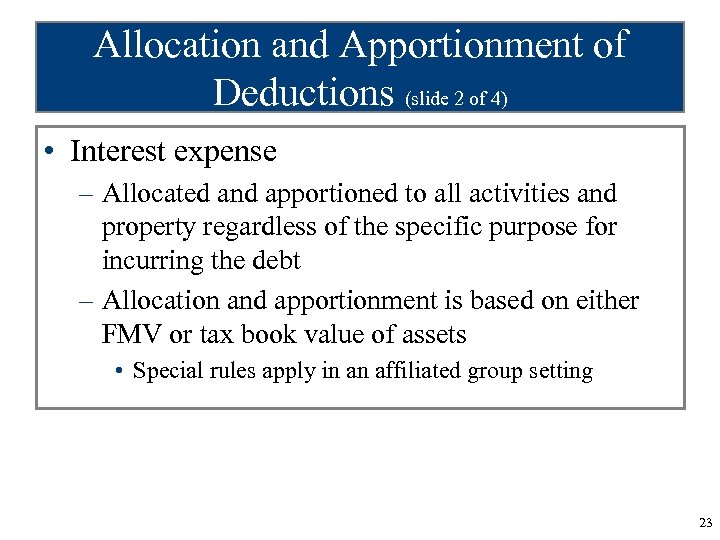 Allocation and Apportionment of Deductions (slide 2 of 4) • Interest expense – Allocated and apportioned to all activities and property regardless of the specific purpose for incurring the debt – Allocation and apportionment is based on either FMV or tax book value of assets • Special rules apply in an affiliated group setting 23
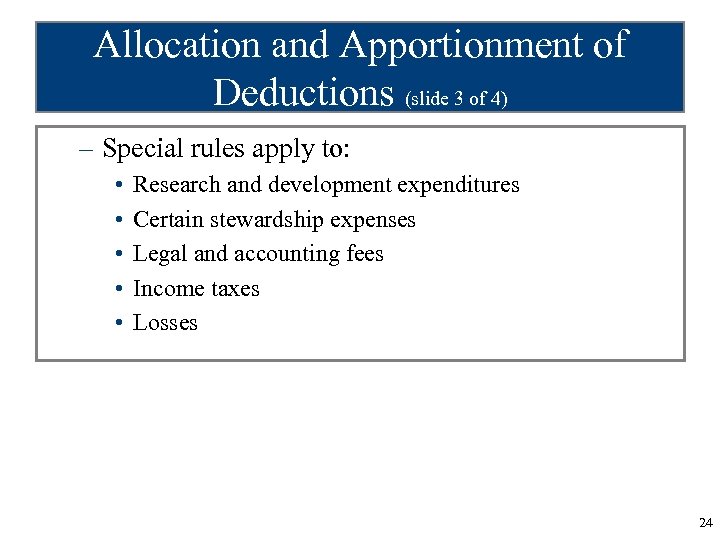 Allocation and Apportionment of Deductions (slide 3 of 4) – Special rules apply to: • • • Research and development expenditures Certain stewardship expenses Legal and accounting fees Income taxes Losses 24
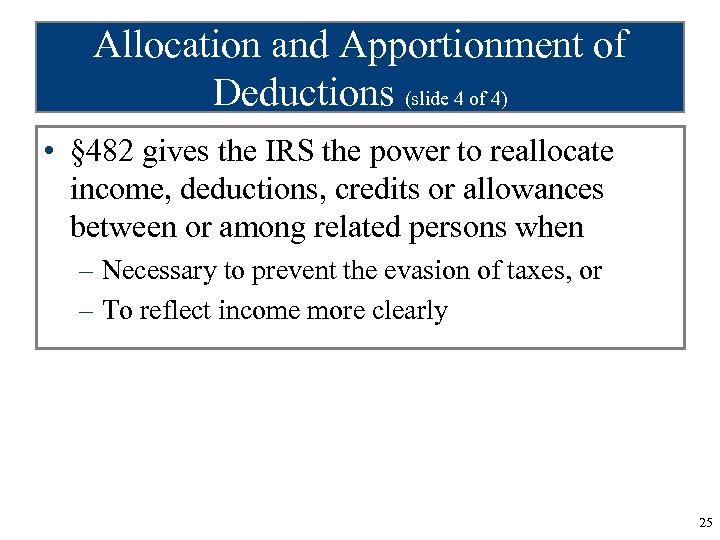 Allocation and Apportionment of Deductions (slide 4 of 4) • § 482 gives the IRS the power to reallocate income, deductions, credits or allowances between or among related persons when – Necessary to prevent the evasion of taxes, or – To reflect income more clearly 25
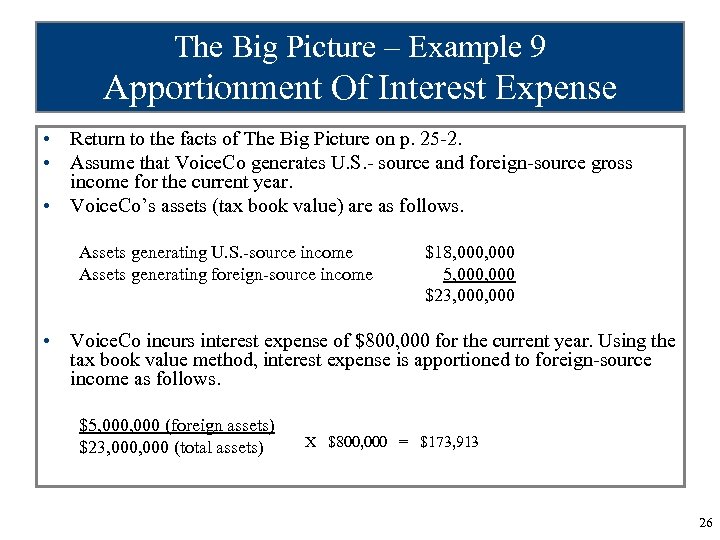 The Big Picture – Example 9 Apportionment Of Interest Expense • Return to the facts of The Big Picture on p. 25 -2. • Assume that Voice. Co generates U. S. - source and foreign-source gross income for the current year. • Voice. Co’s assets (tax book value) are as follows. Assets generating U. S. -source income Assets generating foreign-source income $18, 000 5, 000 $23, 000 • Voice. Co incurs interest expense of $800, 000 for the current year. Using the tax book value method, interest expense is apportioned to foreign-source income as follows. $5, 000 (foreign assets) $23, 000 (total assets) X $800, 000 = $173, 913 26
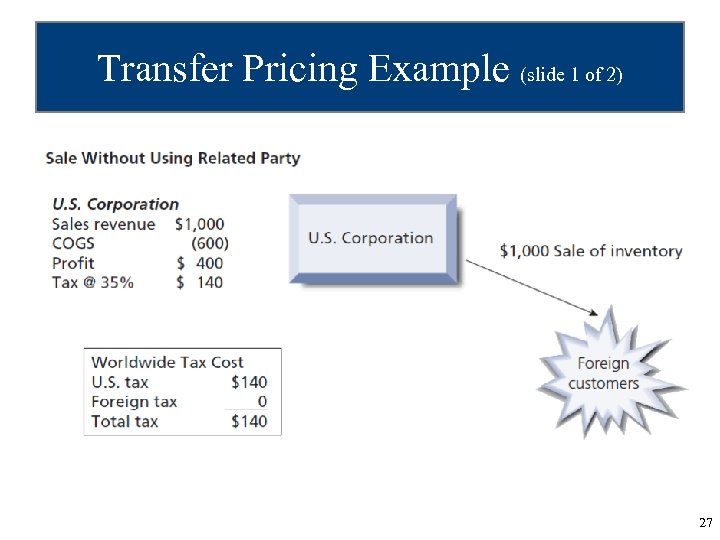 Transfer Pricing Example (slide 1 of 2) 27
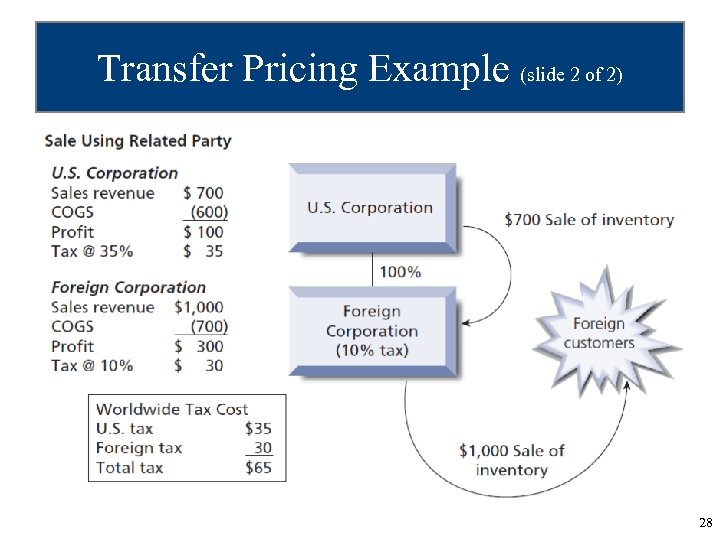 Transfer Pricing Example (slide 2 of 2) 28
 Foreign Currency Transactions (slide 1 of 4) • May be necessary to translate amounts denominated in foreign currency into U. S. dollars • Major tax issues related to foreign currency exchange include: – Character of gain/loss (capital or ordinary) – Date of recognition of gain/loss – Source of foreign currency gain/loss 29
 Foreign Currency Transactions (slide 2 of 4) • Important concepts related to tax treatment of foreign currency exchange transactions include: – Foreign currency is treated as property other than money – Gain/loss is considered separately from underlying transaction – No gain/loss is recognized until a transaction is closed 30
 Foreign Currency Transactions (slide 3 of 4) • Functional currency approach under SFAS 52 is used for tax purposes – All income tax determinations are made in taxpayer’s functional currency – Taxpayer’s default functional currency is the U. S. dollar 31
 Foreign Currency Transactions (slide 4 of 4) • A qualified business unit (QBU) operating in a foreign country uses that country’s currency as its functional currency – QBU is a separate and clearly identified unit of a taxpayer’s trade or business (e. g. , a foreign branch) – An individual is not a QBU but a trade or business conducted by a taxpayer may be a QBU 32
 Foreign Branch Currency Exchange Treatment (slide 1 of 2) • When foreign branch operations use a foreign currency as functional currency – Compute profit/loss in foreign currency – Translate into U. S. dollar using average exchange rate for the year 33
 Foreign Branch Currency Exchange Treatment (slide 2 of 2) • Exchange gains/losses are recognized on remittances from the branch – Gain/loss is ordinary – Sourced according to income to which the remittance is attributable 34
 Distributions From Foreign Corporations • Included in income at exchange rate in effect on date of distribution – No exchange gain/loss is recognized • Deemed dividend distributions under Subpart F are translated at average exchange rate for tax year – Exchange gain/loss can arise when an actual distribution of this previously taxed income is made 35
 Foreign Taxes • For purposes of the foreign tax credit, taxes accrued are translated at the average exchange rate for the tax year – An exception to this rule requires translation at the rate taxes were actually paid • If paid within 2 years of accrual and differ from accrued amount due to exchange rate fluctuations, no redetermination is required • Otherwise, where taxes paid differ from amount accrued, a redetermination is required 36
 The Big Picture – Example 13 Apportionment Of Interest Expense • Return to the facts of The Big Picture on p. 25 -2. • Assume that Voice. Co operates a foreign branch. • Foreign taxes attributable to branch income amount to 5, 000 K (a foreign currency). – The taxes are paid within two years of being accrued. – The average foreign exchange rate for the tax year to which the foreign taxes relate is. 5 K: $1. – On the date the taxes are paid, the rate is. 6 K: $1. • No redetermination is required, and Voice. Co reports foreign taxes of $10, 000 for purposes of the foreign tax credit. 37
 Tax Incentives For Exports (slide 1 of 2) • Prior tax law contained a special tax incentive for U. S. taxpayers exporting goods – Allowed U. S. taxpayers to exclude extraterritorial income (ETI) from U. S. taxation • The American Jobs Creation Act of 2004 repealed the ETI exclusion 38
 Tax Incentives For Exports (slide 2 of 2) • The American Jobs Creation Act of 2004 created a new broad-based “domestic production activities deduction” • The domestic production activities deduction is equal to 9% of the taxpayer’s qualified production activities income subject to several limitations – Unlike the earlier ETI exclusion, the DPAD does not require exporting or any other activity outside the United States 39
 Cross-Border Asset Transfers • Tax consequences of transferring assets to a foreign corporation depend on – The nature of the exchange – The assets involved – Income potential of the property – Character of the property in the hands of the transferor or transferee 40
 Outbound Transfers (slide 1 of 3) • Similar to exchanges of assets for corporate stock of a domestic corporation, realized gain/loss may be deferred on certain outbound capital changes, moving corporate business outside the U. S. – Starting a new corp outside the U. S. – Liquidating a U. S. subsidiary into an existing non. U. S. subsidiary – Others 41
 Outbound Transfers (slide 2 of 3) • Transfer of trade or business property generally qualifies for deferral of gain or loss – Transfer of “tainted” assets triggers immediate recognition of gain but not loss – In addition, depreciation and other recapture potential must be recognized to the extent of gain realized 42
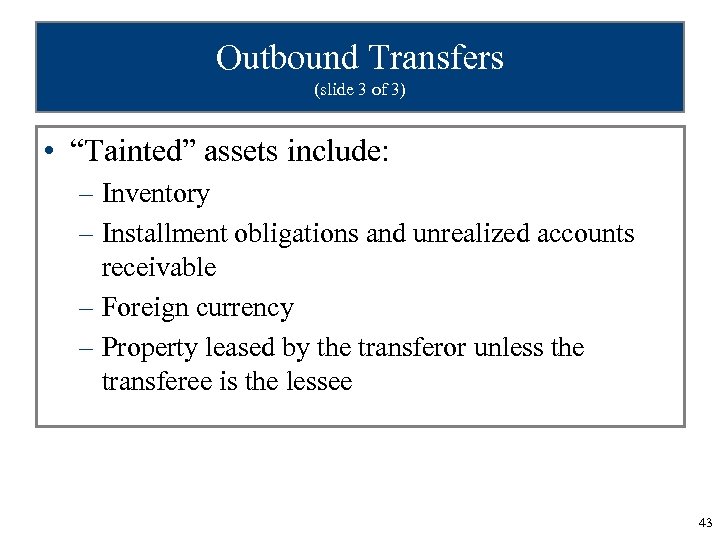 Outbound Transfers (slide 3 of 3) • “Tainted” assets include: – Inventory – Installment obligations and unrealized accounts receivable – Foreign currency – Property leased by the transferor unless the transferee is the lessee 43
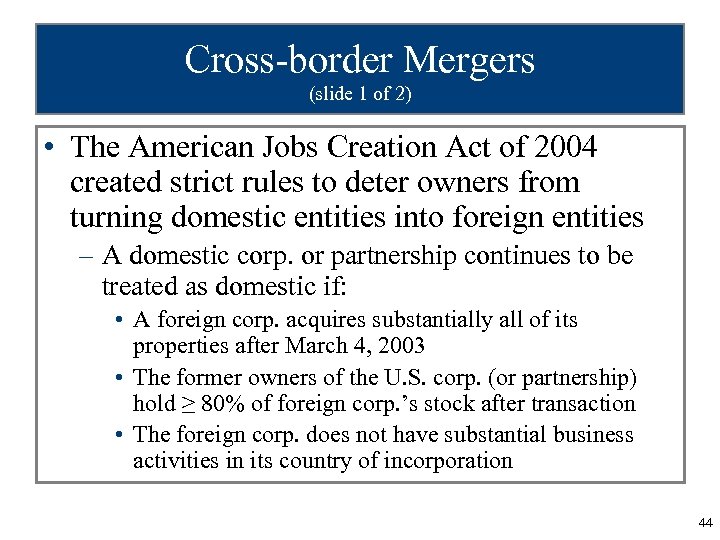 Cross-border Mergers (slide 1 of 2) • The American Jobs Creation Act of 2004 created strict rules to deter owners from turning domestic entities into foreign entities – A domestic corp. or partnership continues to be treated as domestic if: • A foreign corp. acquires substantially all of its properties after March 4, 2003 • The former owners of the U. S. corp. (or partnership) hold ≥ 80% of foreign corp. ’s stock after transaction • The foreign corp. does not have substantial business activities in its country of incorporation 44
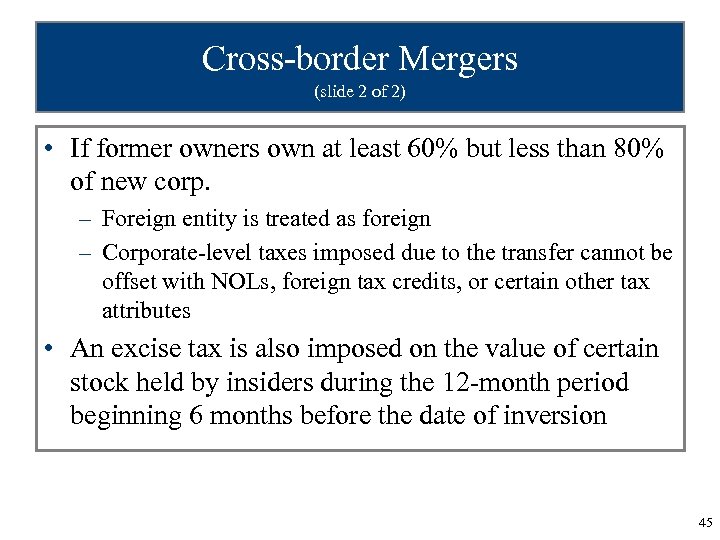 Cross-border Mergers (slide 2 of 2) • If former owners own at least 60% but less than 80% of new corp. – Foreign entity is treated as foreign – Corporate-level taxes imposed due to the transfer cannot be offset with NOLs, foreign tax credits, or certain other tax attributes • An excise tax is also imposed on the value of certain stock held by insiders during the 12 -month period beginning 6 months before the date of inversion 45
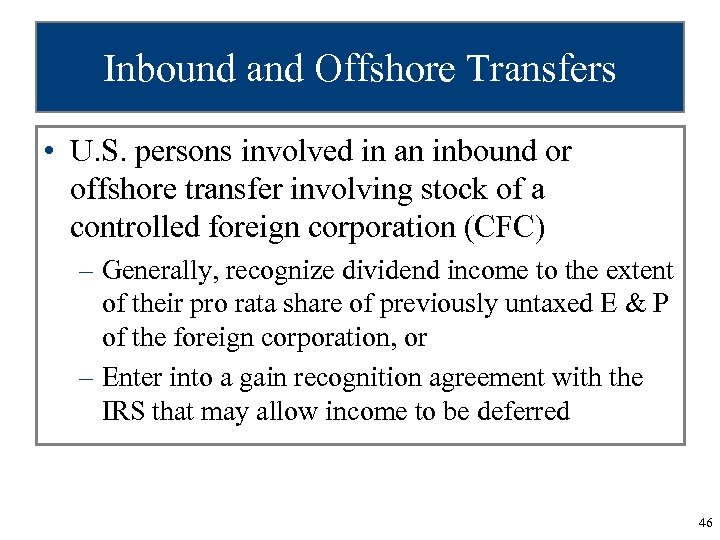 Inbound and Offshore Transfers • U. S. persons involved in an inbound or offshore transfer involving stock of a controlled foreign corporation (CFC) – Generally, recognize dividend income to the extent of their pro rata share of previously untaxed E & P of the foreign corporation, or – Enter into a gain recognition agreement with the IRS that may allow income to be deferred 46
 Controlled Foreign Corporations (slide 1 of 3) • Certain types of income generated by a controlled foreign corporation (CFC) are currently included in income by U. S. shareholders without regard to actual distributions including: – Pro rata share of Subpart F income – Increase in earnings that the CFC has invested in U. S. property 47
 Controlled Foreign Corporations (slide 2 of 3) • Subpart F Income includes the following – Insurance income (§ 953) – Foreign base company income (§ 954) – International boycott factor income (§ 999) – Illegal bribes – Income derived from a § 901(j) foreign country 48
 Controlled Foreign Corporations (slide 3 of 3) • To apply, foreign corp must have been a CFC for an uninterrupted period of 30 days or more during tax year – A CFC is any foreign corp in which > 50% of total voting power or value is owned by U. S. shareholders on any day of tax year – U. S. shareholder is a U. S. person who owns (directly or indirectly) 10% or more of voting stock of the foreign corp 49
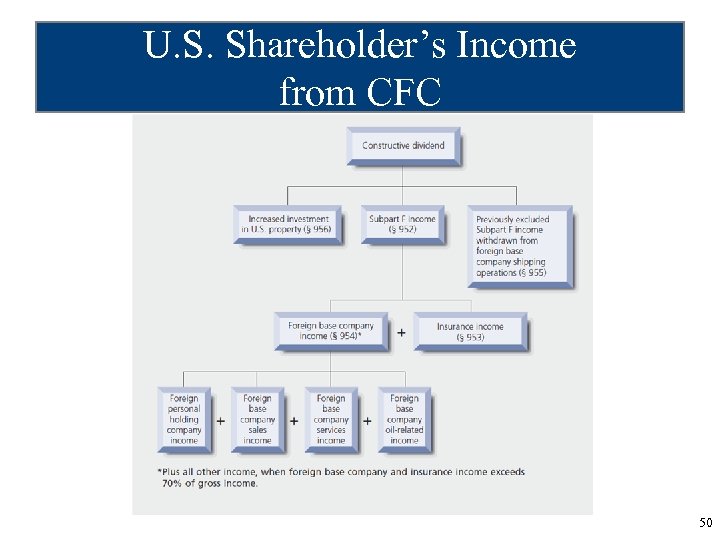 U. S. Shareholder’s Income from CFC 50
 Foreign Tax Credit • Foreign tax credit (FTC) provisions are designed to reduce the possibility of double taxation – Allows a credit foreign income taxes paid • Credit is a dollar-for-dollar reduction of U. S. income tax liability – FTC may be “direct” or “indirect” • The FTC is elective – May take a deduction foreign taxes paid or incurred rather than the FTC 51
 Direct Foreign Tax Credit • Available to taxpayers who pay or incur a foreign income tax – Only person who bears the legal burden of the foreign tax is eligible for the direct credit • Direct credit is not available to a U. S. corporation operating in a foreign country through a foreign subsidiary 52
 Indirect Foreign Tax Credit (slide 1 of 5) • The indirect credit is available to U. S. corporations for dividends received (actual or constructive) from foreign corporations – Foreign corp pays tax in foreign jurisdiction – When foreign corp remits dividends to U. S. corp, the income is subject to tax in the U. S. 53
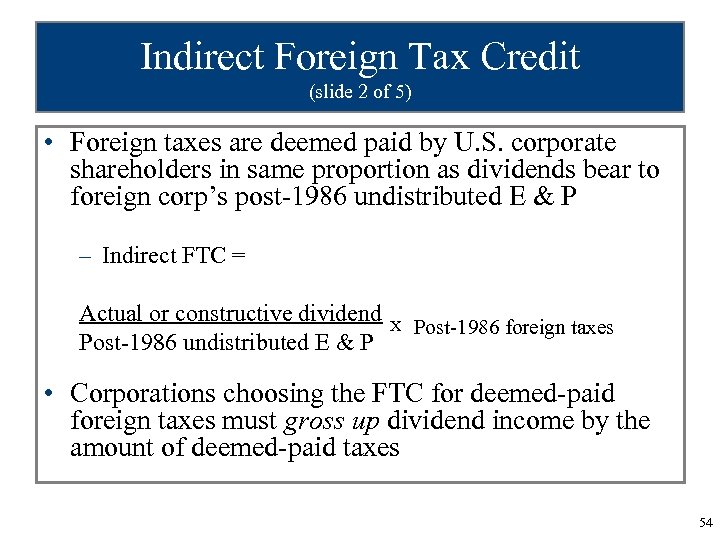 Indirect Foreign Tax Credit (slide 2 of 5) • Foreign taxes are deemed paid by U. S. corporate shareholders in same proportion as dividends bear to foreign corp’s post-1986 undistributed E & P – Indirect FTC = Actual or constructive dividend Post-1986 undistributed E & P X Post-1986 foreign taxes • Corporations choosing the FTC for deemed-paid foreign taxes must gross up dividend income by the amount of deemed-paid taxes 54
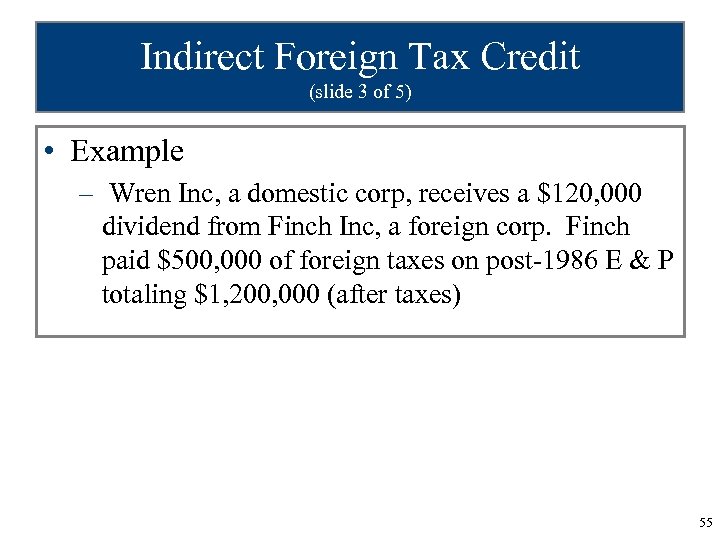 Indirect Foreign Tax Credit (slide 3 of 5) • Example – Wren Inc, a domestic corp, receives a $120, 000 dividend from Finch Inc, a foreign corp. Finch paid $500, 000 of foreign taxes on post-1986 E & P totaling $1, 200, 000 (after taxes) 55
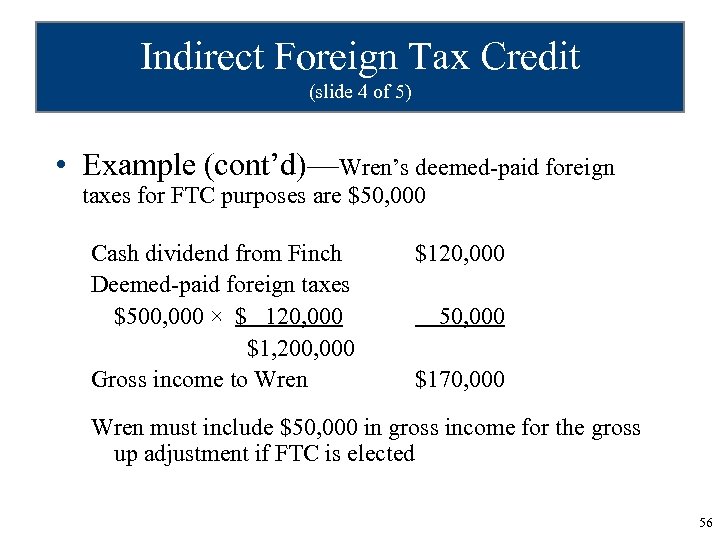 Indirect Foreign Tax Credit (slide 4 of 5) • Example (cont’d)—Wren’s deemed-paid foreign taxes for FTC purposes are $50, 000 Cash dividend from Finch Deemed-paid foreign taxes $500, 000 × $ 120, 000 $1, 200, 000 Gross income to Wren $120, 000 50, 000 $170, 000 Wren must include $50, 000 in gross income for the gross up adjustment if FTC is elected 56
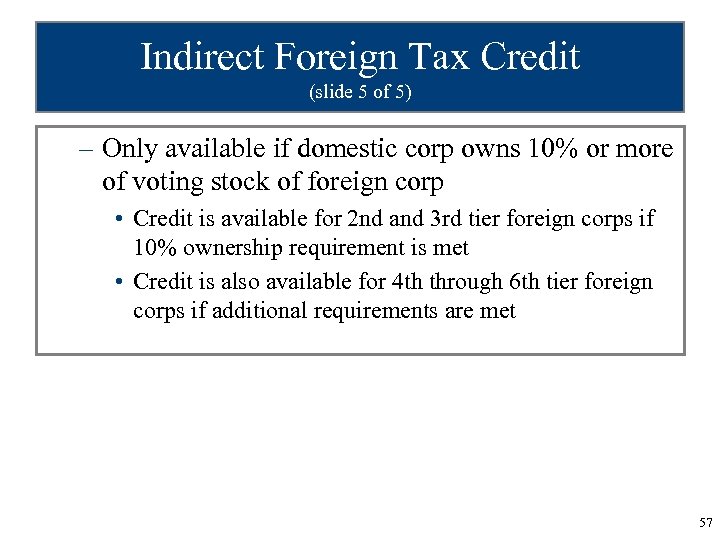 Indirect Foreign Tax Credit (slide 5 of 5) – Only available if domestic corp owns 10% or more of voting stock of foreign corp • Credit is available for 2 nd and 3 rd tier foreign corps if 10% ownership requirement is met • Credit is also available for 4 th through 6 th tier foreign corps if additional requirements are met 57
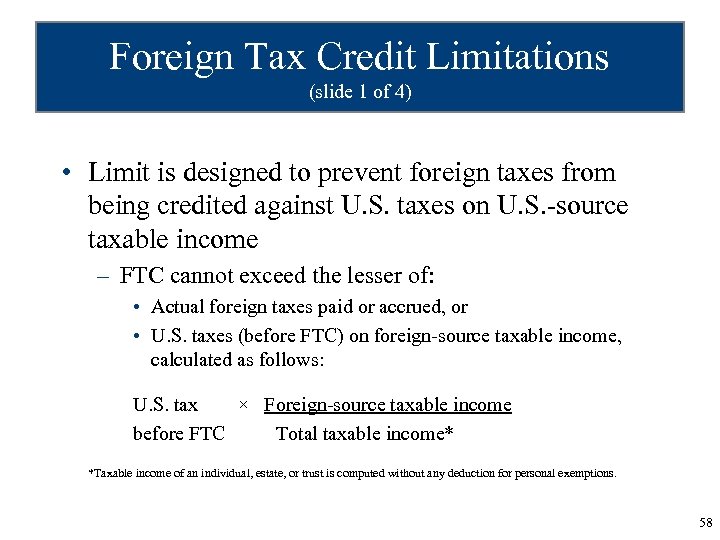 Foreign Tax Credit Limitations (slide 1 of 4) • Limit is designed to prevent foreign taxes from being credited against U. S. taxes on U. S. -source taxable income – FTC cannot exceed the lesser of: • Actual foreign taxes paid or accrued, or • U. S. taxes (before FTC) on foreign-source taxable income, calculated as follows: U. S. tax × Foreign-source taxable income before FTC Total taxable income* *Taxable income of an individual, estate, or trust is computed without any deduction for personal exemptions. 58
 Foreign Tax Credit Limitations (slide 2 of 4) • Limitation can prevent total amount of foreign taxes paid in high-tax jurisdictions from being credited – Generating additional foreign-source income in low, or no, tax jurisdictions could alleviate this problem – However, a separate limitation must be calculated for certain categories (baskets) of foreign source income 59
 Foreign Tax Credit Limitations (slide 3 of 4) • For tax years beginning after 2006, there are only two baskets: – Passive income, and – All other (general) • Any FTC carryforwards into post-2006 years are assigned to one of these two categories 60
 Foreign Tax Credit Limitations (slide 4 of 4) • The limitations can result in unused (noncredited) foreign taxes for the tax year – Carryback period is 1 year – Carryforward period is 10 years • The taxes can be credited in years when the formula limitation for that year exceeds the foreign taxes attributable to the same tax year – The carryback and carryforward provisions are available only within a specific basket 61
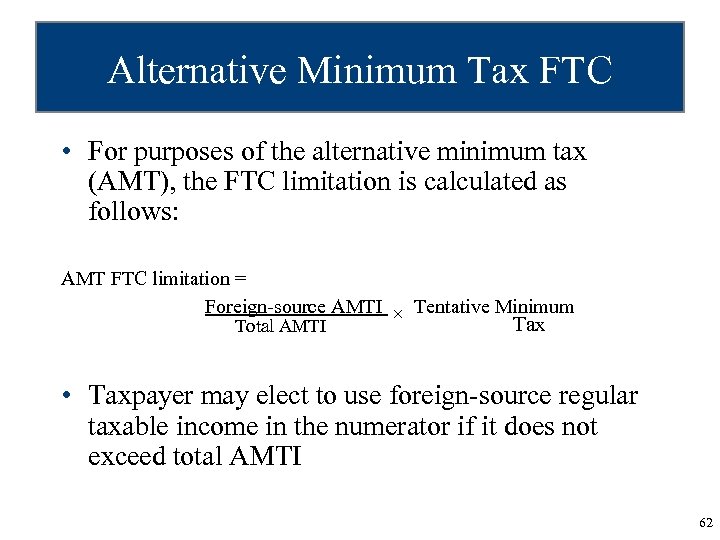 Alternative Minimum Tax FTC • For purposes of the alternative minimum tax (AMT), the FTC limitation is calculated as follows: AMT FTC limitation = Foreign-source AMTI × Tentative Minimum Total AMTI Tax • Taxpayer may elect to use foreign-source regular taxable income in the numerator if it does not exceed total AMTI 62
 U. S. Taxation of Nonresident Aliens and Foreign Corporations • Generally, nonresident alien individuals (NRAs) and foreign corps. are subject to U. S. taxation – On U. S. -source income and – Foreign-source income when that income is effectively connected with the conduct of a U. S. trade or business 63
 Nonresident Alien Individuals • Nonresident alien (NRA)—an individual who is not a citizen or resident of the U. S. – Citizenship is determined under the immigration and naturalization laws of the U. S. • The citizenship statutes are broken down into two categories: – Nationality at birth or – Through naturalization 64
 Residency Tests for Non Citizens (slide 1 of 3) • Green Card Test: – An individual is considered a resident of the U. S. on the first day of the tax year in which he or she is physically present in the U. S. after the card is issued – Residency status remains in effect until the card is revoked or the individual has abandoned permanent resident status 65
 Residency Tests for Non Citizens (slide 2 of 3) • Substantial Presence Test: – This mathematical test applies to people in the U. S. without a green card • An individual in the U. S. 183 days during the year is a resident for the year for tax purposes • Also a taxpayer in the U. S. for 183 days in the past three years (using a specified weighting formula) is taxed as a resident 66
 Residency Tests for Non Citizens (slide 3 of 3) – Exceptions apply to the substantial presence test for • Commuters from Mexico and Canada who work in the U. S. • Foreign government-related individuals (e. g. , diplomats) • Qualified teachers • Trainees and students, and • Certain professional athletes 67
 U. S. Taxation of Nonresident Aliens (slide 1 of 3) • Non-resident alien income not “effectively connected” with U. S. trade or business – Includes dividends, interest, rents, royalties, certain compensation, premiums, annuities, and other fixed, determinable, annual or periodic (FDAP) income – 30% tax generally is withheld by payors of the income • Eliminates problems of assuring payment by nonresidents, determining allowable deductions, and, in most instances, the filing of tax returns by nonresidents 68
 U. S. Taxation of Nonresident Aliens (slide 2 of 3) • Capital gains not effectively connected with the conduct of a U. S. trade or business are exempt from tax, as long as the NRA individual was not present in the United States for 183 days or more during the taxable year 69
 U. S. Taxation of Nonresident Aliens (slide 3 of 3) • Non-resident alien income effectively connected with U. S. trade or business – This income is taxed at the same rates applicable to U. S. citizens – Deductions related to the business may be claimed 70
 U. S. Taxation of Foreign Corps (slide 1 of 4) • Income not effectively connected with U. S. trade or business – Taxed at 30% as described above for individuals – The payor must withhold and remit the tax • U. S. -source capital gains - exempt from Federal income tax if not effectively connected with conduct of U. S. trade or business 71
 U. S. Taxation of Foreign Corps (slide 2 of 4) • Income effectively connected with U. S. trade or business – This income is taxed at the same rates applicable to U. S. corporations – Deductions can offset the income 72
 U. S. Taxation of Foreign Corps (slide 3 of 4) • Branch profits tax – If a foreign corporation operates through a U. S. subsidiary (a domestic corp. ) • The income of the subsidiary is taxable by the U. S. when earned • Also subject to a withholding tax when repatriated (returned as dividends to the foreign parent) 73
 U. S. Taxation of Foreign Corps (slide 4 of 4) • Branch profits tax (cont’d) – In addition to the income tax imposed under § 882 on effectively connected income of a foreign corp. , a tax equal to 30% of the dividend equivalent amount (DEA) is imposed • DEA is the foreign corp’s effectively connected earnings, adjusted for increases and decreases in the corp’s U. S. net equity (investment in U. S. operations) – The DEA is limited to current E & P and post-1986 accumulated E & P effectively connected, or treated as effectively connected, with the conduct of a U. S. trade or business 74
 Foreign Investment in Real Property Tax Act (slide 1 of 4) • Gains and losses realized by NRAs and foreign corps on U. S. real property interests (USRPI) – Treated as effectively connected with the conduct of a U. S. trade or business • NRAs must pay tax equal to at least the lesser of – 26% (or 28%) of AMTI, or – Regular U. S. rates on net real property gain for the year 75
 Foreign Investment in Real Property Tax Act (slide 2 of 4) • USRPI is any direct interest in real property situated in U. S. and any interest in a domestic corp – Applies unless taxpayer can establish that domestic corp was not a U. S. real property holding corp (USRPHC) during the shorter of: • Period taxpayer owned interest in corp, or • For 5 year period ending on date interest was disposed of 76
 Foreign Investment in Real Property Tax Act (slide 3 of 4) • USRPHC is any corp (foreign or domestic) where FMV of corp’s USRPI is 50% or more of aggregate FMV of: – USRPIs – Interests in real property located outside U. S. – Any other assets used in a trade or business • Stock regularly traded on established securities market is not a USRPI if 5% or less is owned 77
 Foreign Investment in Real Property Tax Act (slide 4 of 4) • Withholding provisions – Any purchaser or agent acquiring a USRPI from a foreign person must withhold 10% of amount realized on disposition – Higher withholding rates apply to certain entities 78
 Expatriation to Avoid U. S. Taxation (slide 1 of 2) • U. S. tax applies to U. S. -sourced income of persons who relinquished their U. S. citizenship within 10 years of deriving that income – Only applies if person gave up citizenship to avoid U. S. tax 79
 Expatriation to Avoid U. S. Taxation (slide 2 of 2) • Also applies to NRAs who lost U. S. citizenship within preceding 10 year period if principal purpose was avoidance of U. S. tax • Tax avoidance purpose is presumed if either: – Average annual net income tax for five preceding taxable years > $147, 000 (in 2011) – Net worth as of that date is $2 million or more 80
 Refocus On The Big Picture (slide 1 of 4) • Now you can address the questions about Voice. Co’s activities that were posed at the beginning of the chapter. • Simply selling into a foreign jurisdiction may not trigger any overseas income tax consequences – But, such income is taxed currently to Voice. Co in the United States. 81
 Refocus On The Big Picture (slide 2 of 4) • When Voice. Co sets up an Irish corporation, it benefits from deferral because as a manufacturer it can avoid deemed dividends under Subpart F. – However, there may be passive-basket income earned by the Irish subsidiary. – Voice. Co must file Form 5471 to report on the activities of its foreign subsidiary. – If Voice. Co receives dividends from its foreign subsidiary, it can claim § 902 foreign tax credits (so-called indirect credits). • What are the foreign tax implications if Voice. Co ‘‘checks the box’’ on its foreign subsidiary? – The U. S. tax implications? 82
 Refocus On The Big Picture (slide 3 of 4) What If? • Suppose Voice. Co decides not to create a foreign subsidiary. • Instead, Voice. Co decides to license its design and manufacturing process to a local European musical instruments company for sales in Europe. – The European company pays Voice. Co a royalty equal to 25% of the sales price on all its sales of microphones based on Voice. Co’s design. – The royalty income is foreign-source income (as the underlying intangible property is exploited outside the United States). 83
 Refocus On The Big Picture (slide 4 of 4) What If? • The European country imposes a 5% withholding tax on all royalty payments to Voice. Co. – The royalties are part of its worldwide income and so are currently taxed to Voice. Co in the United States. – Will Voice. Co receive a foreign tax credit for the withholding tax? 84
 If you have any comments or suggestions concerning this Power. Point Presentation for South-Western Federal Taxation, please contact: Dr. Donald R. Trippeer, CPA trippedr@oneonta. edu SUNY Oneonta © 2012 Cengage Learning. All Rights Reserved. May not be scanned, copied or duplicated, or posted to a publicly accessible website, in whole or in part. 85