


 Скачать презентацию Chapter 24 — Quality Management Lecture 1 Chapter
1b7973091f09a3eb93afd8ca93f90067.ppt
- Количество слайдов: 36
 Chapter 24 - Quality Management Lecture 1 Chapter 24 Quality management 1
 Topics covered ² Software quality ² Software standards ² Reviews and inspections ² Software measurement and metrics Chapter 24 Quality management 2
 Software quality management ² Concerned with ensuring that the required level of quality is achieved in a software product. ² Three principal concerns: § At the organizational level, quality management is concerned with establishing a framework of organizational processes and standards that will lead to high-quality software. § At the project level, quality management involves the application of specific quality processes and checking that these planned processes have been followed. § At the project level, quality management is also concerned with establishing a quality plan for a project. The quality plan should set out the quality goals for the project and define what processes and standards are to be used. Chapter 24 Quality management 3
 Quality management activities ² Quality management provides an independent check on the software development process. ² The quality management process checks the project deliverables to ensure that they are consistent with organizational standards and goals. ² The quality team should be independent from the development team so that they can take an objective view of the software. This allows them to report on software quality without being influenced by software development issues. Chapter 24 Quality management 4
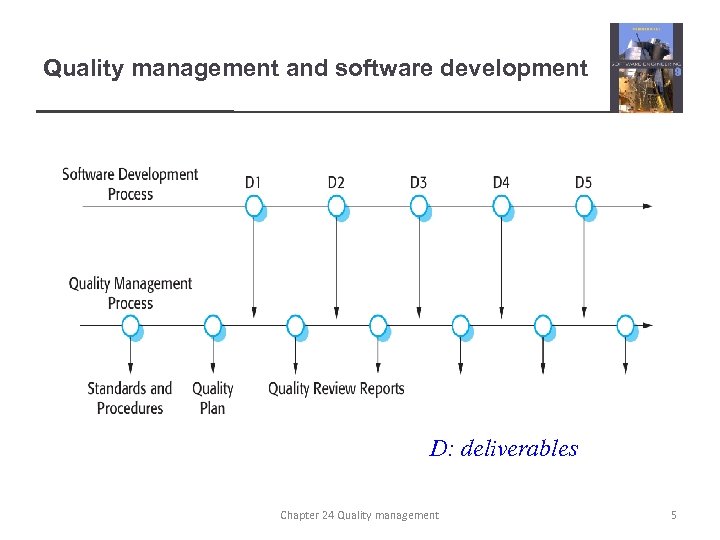 Quality management and software development D: deliverables Chapter 24 Quality management 5
 Quality planning ² A quality plan sets out the desired product qualities and how these are assessed and defines the most significant quality attributes. ² The quality plan should define the quality assessment process. ² It should set out which organisational standards should be applied and, where necessary, define new standards to be used. Chapter 24 Quality management 6
 Quality plans ² Quality plan structure § § § Product introduction; Product plans; Process descriptions; Quality goals; Risks and risk management. ² Quality plans should be short, succinct (to the point) documents § If they are too long, no-one will read them. Chapter 24 Quality management 7
 Scope of quality management ² Quality management is particularly important for large, complex systems. The quality documentation is a record of progress and supports continuity of development as the development team changes. ² For smaller systems, quality management needs less documentation and should focus on establishing a quality culture. Chapter 24 Quality management 8
 Software quality ² Quality, simplistically, means that a product should meet its specification. ² This is problematical for software systems § There is a tension between customer quality requirements (efficiency, reliability, etc. ) and developer quality requirements (maintainability, reusability, etc. ); § Some quality requirements are difficult to specify in an unambiguous way; § Software specifications are usually incomplete and often inconsistent. ² The focus may be ‘fitness for purpose’ rather than specification conformance. Chapter 24 Quality management 9
 Software fitness for purpose ² Have programming and documentation standards been followed in the development process? ² Has the software been properly tested? ² Is the software sufficiently dependable to be put into use? ² Is the performance of the software acceptable for normal use? ² Is the software usable? ² Is the software well-structured and understandable? Chapter 24 Quality management 10
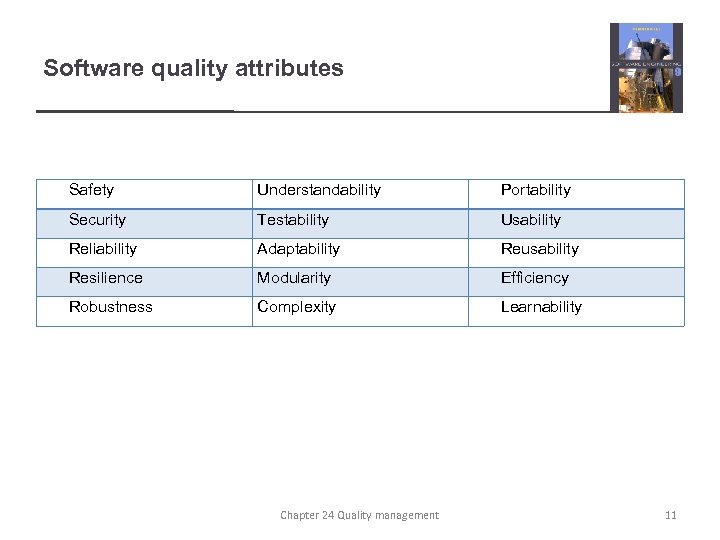 Software quality attributes Safety Understandability Portability Security Testability Usability Reliability Adaptability Reusability Resilience Modularity Efficiency Robustness Complexity Learnability Chapter 24 Quality management 11
 Software quality attributes ² These attributes relate to the software dependability, usability, efficiency, and maintainability. ² As I have discussed in Chapter 11, I believe that dependability attributes are usually the most important quality attributes of a system. ² However, the software’s performance is also very important. Users will reject software that is too slow. Chapter 24 Quality management 12
 System dependability ² For many computer-based systems, the most important system property is the dependability of the system. ² The dependability of a system reflects the user’s degree of trust in that system. It reflects the extent of the user’s confidence that it will operate as users expect and that it will not ‘fail’ in normal use. ² Dependability covers the related systems attributes of reliability, availability and security. These are all interdependent. Chapter 11 Security and Dependability 13
 Importance of dependability ² System failures may have widespread effects with large numbers of people affected by the failure. ² Systems that are not dependable and are unreliable, unsafe or insecure may be rejected by their users. ² The costs of system failure may be very high if the failure leads to economic losses or physical damage. ² Undependable systems may cause information loss with a high consequent recovery cost. Chapter 11 Security and Dependability 14
 Causes of failure ² Hardware failure § Hardware fails because of design and manufacturing errors or because components have reached the end of their natural life. ² Software failure § Software fails due to errors in its specification, design or implementation. ² Operational failure § Human operators make mistakes. Now perhaps the largest single cause of system failures in socio-technical systems. Chapter 11 Security and Dependability 15
 Principal properties ² Availability § The probability that the system will be up and running and able to deliver useful services to users. ² Reliability § The probability that the system will correctly deliver services as expected by users. ² Safety § A judgment of how likely it is that the system will cause damage to people or its environment. ² Security § A judgment of how likely it is that the system can resist accidental or deliberate intrusions. Chapter 11 Security and Dependability 16
 Other dependability properties ² Repairability § Reflects the extent to which the system can be repaired in the event of a failure ² Maintainability § Reflects the extent to which the system can be adapted to new requirements; ² Survivability § Reflects the extent to which the system can deliver services whilst under hostile attack; ² Error tolerance § Reflects the extent to which user input errors can be avoided and tolerated. Chapter 11 Security and Dependability 17
 Quality conflicts ² It is not possible for any system to be optimized for all of these attributes – for example, improving robustness may lead to loss of performance. ² The quality plan should therefore define the most important quality attributes for the software that is being developed. ² The plan should also include a definition of the quality assessment process, an agreed way of assessing whether some quality, such as maintainability or robustness, is present in the product. Chapter 24 Quality management 18
 Process and product quality ² The quality of a developed product is influenced by the quality of the production process. ² This is important in software development as some product quality attributes are hard to assess. ² However, there is a very complex and poorly understood relationship between software processes and product quality. § The application of individual skills and experience is particularly important in software development; § External factors such as the novelty of an application or the need for an accelerated development schedule may impair product quality. Chapter 24 Quality management 19
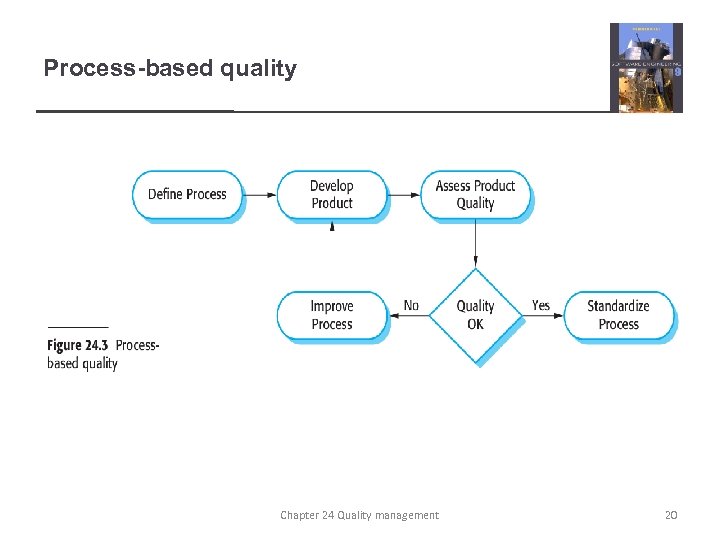 Process-based quality Chapter 24 Quality management 20
 Software standards ² Standards define the required attributes of a product or process. They play an important role in quality management. ² Standards may be international, organizational or project standards. ² Product standards define characteristics that all software components should exhibit e. g. a common programming style. ² Process standards define how the software process should be enacted/endorsed. Chapter 24 Quality management 21
 Importance of standards ² Encapsulation of best practice- avoids repetition of past mistakes. ² They are a framework for defining what quality means in a particular setting i. e. that organization’s view of quality. ² They provide continuity - new staff can understand the organisation by understanding the standards that are used. Chapter 24 Quality management 22
 Product and process standards ² There are two related types of software engineering standard that may be defined and used in software quality management: ² 1. Product standards These apply to the software product being developed. ² 2. Process standards These define the processes that should be followed during software development. § Examples of standards that could be included in such a handbook are shown in the table in the following slide. Chapter 24 Quality management 23
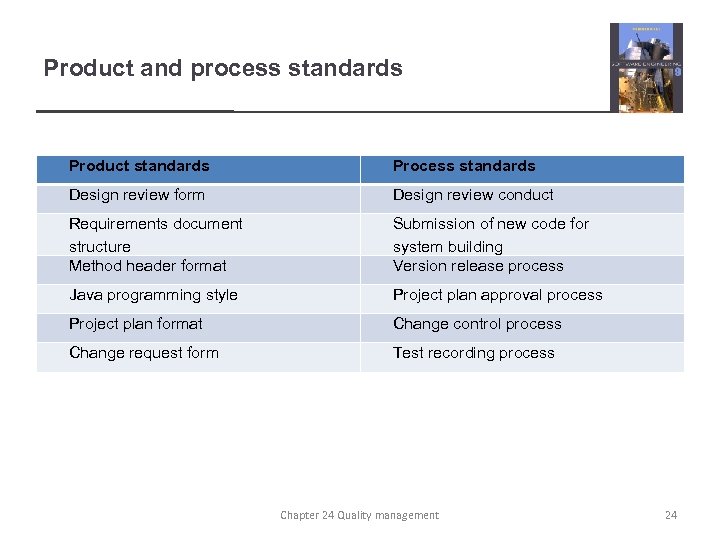 Product and process standards Product standards Process standards Design review form Design review conduct Requirements document structure Method header format Submission of new code for system building Version release process Java programming style Project plan approval process Project plan format Change control process Change request form Test recording process Chapter 24 Quality management 24
 Problems with standards ² They may not be seen as relevant and up-to-date by software engineers. ² They often involve too much bureaucratic form filling. ² If they are unsupported by software tools, tedious form filling work is often involved to maintain the documentation associated with the standards. ² To minimize dissatisfaction and to encourage buy-in to standards, quality managers who set the standards should therefore take the following steps: Chapter 24 Quality management 25
 Standards development ² Involve practitioners in development. Engineers should understand the rationale underlying a standard. ² Review standards and their usage regularly. Standards can quickly become outdated and this reduces their credibility amongst practitioners. ² Detailed standards should have specialized tool support. Excessive clerical work is the most significant complaint against standards. Chapter 24 Quality management 26
 ISO 9001 standards framework ² There is an international set of standards that can be used in the development of quality management systems in all industries, called ISO 9000. ² ISO 9000 standards can be applied to a range of organizations from manufacturing through to service industries. ² The ISO 9001 standard was originally developed in 1987, with its most recent revision in 2008. Chapter 24 Quality management 27
 ISO 9001 standards framework ² ISO 9001, the most general of these standards, applies to organizations that design, develop and maintain products, including software. ² The ISO 9001 standard is a framework for developing software standards. § It sets out general quality principles, describes quality processes in general and lays out the organizational standards and procedures that should be defined. These should be documented in an organizational quality manual. Chapter 24 Quality management 28
 ISO 9001 core processes ² If an organization is to be ISO 9001 conformant, it must document how its processes relate to these core processes. ² It must also define and maintain records that demonstrate that the defined organizational processes have been followed. ² The company quality manual should describe the relevant processes and the process data that has to be collected and maintained. Chapter 24 Quality management 29
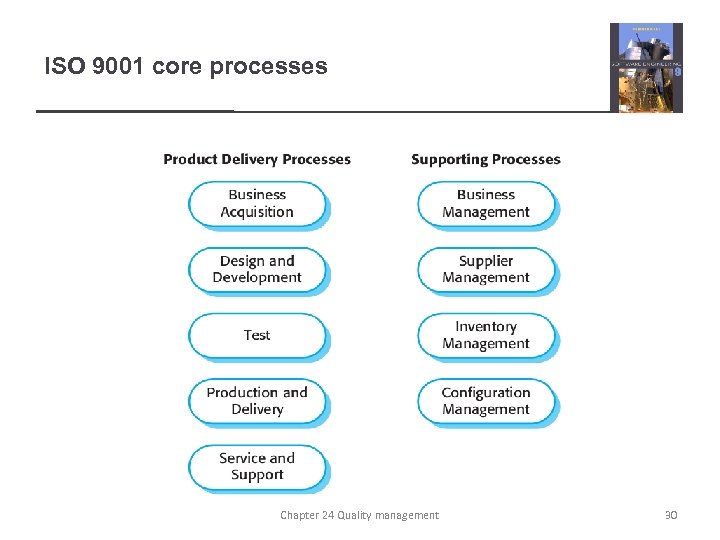 ISO 9001 core processes Chapter 24 Quality management 30
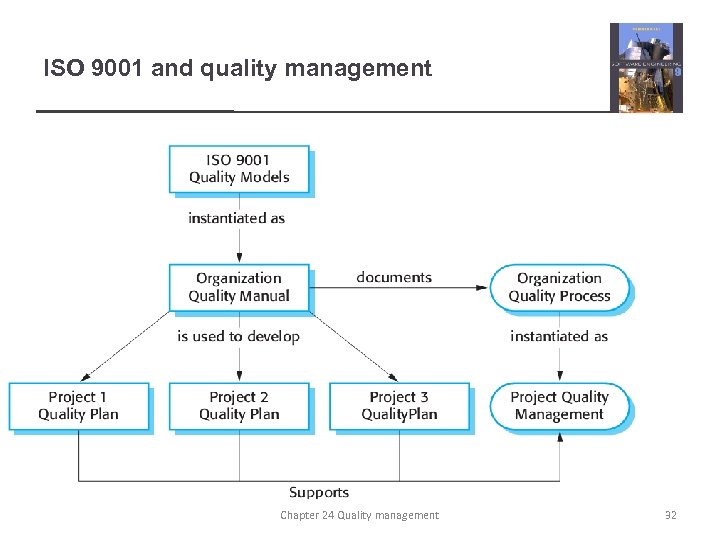
 ISO 9001 and quality management ² The relationships between ISO 9001, organizational quality manuals, and individual project quality plans are shown in Figure. It explains how the general ISO 9001 standard can be used as a basis for software quality management processes. Chapter 24 Quality management 31
 ISO 9001 and quality management Chapter 24 Quality management 32
 ISO 9001 certification ² Quality standards and procedures should be documented in an organisational quality manual. ² An external body may certify that an organisation’s quality manual conforms to ISO 9000 standards. ² Some customers require suppliers to be ISO 9000 certified although the need for flexibility here is increasingly recognised. Chapter 24 Quality management 33
 Certification Dilemma ² There is no guarantee that ISO 9001 certified companies use the best software development practices or that their processes lead to high-quality software. § For example, a company could define test coverage standards specifying that all methods in objects must be called at least once. Unfortunately, this standard can be met by incomplete software testing, which does not run tests with different method parameters. So long as the defined testing procedures were followed and records kept of the testing carried out, the company could be ISO 9001 certified. ² The ISO 9001 certification defines quality to be the conformance to standards, and takes no account of the quality as experienced by users of the software. Chapter 24 Quality management 34
 ISO 9001 certification and Agile Methods ² Agile methods, which avoid documentation and focus on the code being developed, have little in common with the formal quality processes that are discussed in ISO 9001. ² There has been some work done on reconciling these approaches (Stalhane and Hanssen, 2008), but the agile development community is fundamentally opposed to what they see as the bureaucratic overhead of standards conformance. ² For this reason, companies that use agile development methods are rarely concerned with ISO 9001 certification. Chapter 24 Quality management 35
 Key points ² Software quality management is concerned with ensuring that software has a low number of defects and that it reaches the required standards of maintainability, reliability, portability and so on. ² SQM includes defining standards for processes and products and establishing processes to check that these standards have been followed. ² Software standards are important for quality assurance as they represent an identification of ‘best practice’. ² Quality management procedures may be documented in an organizational quality manual, based on the generic model for a quality manual suggested in the ISO 9001 standard. Chapter 24 Quality management 36