 Скачать презентацию Chapter 23 Vulnerability Analysis Background
582e0543bc702d5d3ca0ce427c2ce61e.ppt
- Количество слайдов: 133



Chapter 23: Vulnerability Analysis • • • Background Penetration Studies Example Vulnerabilities Classification Frameworks Theory of Penetration Analysis June 1, 2004 Computer Security: Art and Science © 2004 Matt Bishop 1
Overview • What is a vulnerability? • Penetration studies – Flaw Hypothesis Methodology – Examples • Vulnerability examples • Classification schemes – RISOS, PA, NRL Taxonomy, Aslam’s Model • Theory of penetration analysis – Examples June 1, 2004 Computer Security: Art and Science © 2004 Matt Bishop 2
Definitions • Vulnerability, security flaw: failure of security policies, procedures, and controls that allow a subject to commit an action that violates the security policy – Subject is called an attacker – Using the failure to violate the policy is exploiting the vulnerability or breaking in June 1, 2004 Computer Security: Art and Science © 2004 Matt Bishop 3
Formal Verification • Mathematically verifying that a system satisfies certain constraints • Preconditions state assumptions about the system • Postconditions are result of applying system operations to preconditions, inputs • Required: postconditions satisfy constraints June 1, 2004 Computer Security: Art and Science © 2004 Matt Bishop 4
Penetration Testing • Testing to verify that a system satisfies certain constraints • Hypothesis stating system characteristics, environment, and state relevant to vulnerability • Result is compromised system state • Apply tests to try to move system from state in hypothesis to compromised system state June 1, 2004 Computer Security: Art and Science © 2004 Matt Bishop 5
Notes • Penetration testing is a testing technique, not a verification technique – It can prove the presence of vulnerabilities, but not the absence of vulnerabilities • For formal verification to prove absence, proof and preconditions must include all external factors – Realistically, formal verification proves absence of flaws within a particular program, design, or environment and not the absence of flaws in a computer system (think incorrect configurations, etc. ) June 1, 2004 Computer Security: Art and Science © 2004 Matt Bishop 6
Penetration Studies • Test for evaluating the strengths and effectiveness of all security controls on system – Also called tiger team attack or red team attack – Goal: violate site security policy – Not a replacement for careful design, implementation, and structured testing – Tests system in toto, once it is in place • Includes procedural, operational controls as well as technological ones June 1, 2004 Computer Security: Art and Science © 2004 Matt Bishop 7
Goals • Attempt to violate specific constraints in security and/or integrity policy – Implies metric for determining success – Must be well-defined • Example: subsystem designed to allow owner to require others to give password before accessing file (i. e. , password protect files) – Goal: test this control – Metric: did testers get access either without a password or by gaining unauthorized access to a password? June 1, 2004 Computer Security: Art and Science © 2004 Matt Bishop 8
Goals • Find some number of vulnerabilities, or vulnerabilities within a period of time – If vulnerabilities categorized and studied, can draw conclusions about care taken in design, implementation, and operation – Otherwise, list helpful in closing holes but not more • Example: vendor gets confidential documents, 30 days later publishes them on web – Goal: obtain access to such a file; you have 30 days – Alternate goal: gain access to files; no time limit (a Trojan horse would give access for over 30 days) June 1, 2004 Computer Security: Art and Science © 2004 Matt Bishop 9
Layering of Tests 1. External attacker with no knowledge of system • Locate system, learn enough to be able to access it 2. External attacker with access to system • Can log in, or access network servers • Often try to expand level of access 3. Internal attacker with access to system • Testers are authorized users with restricted accounts (like ordinary users) • Typical goal is to gain unauthorized privileges or information June 1, 2004 Computer Security: Art and Science © 2004 Matt Bishop 10
Layering of Tests (con’t) • Studies conducted from attacker’s point of view • Environment is that in which attacker would function • If information about a particular layer irrelevant, layer can be skipped – Example: penetration testing during design, development skips layer 1 – Example: penetration test on system with guest account usually skips layer 2 June 1, 2004 Computer Security: Art and Science © 2004 Matt Bishop 11
Methodology • Usefulness of penetration study comes from documentation, conclusions – Indicates whether flaws are endemic or not – It does not come from success or failure of attempted penetration • Degree of penetration’s success also a factor – In some situations, obtaining access to unprivileged account may be less successful than obtaining access to privileged account June 1, 2004 Computer Security: Art and Science © 2004 Matt Bishop 12
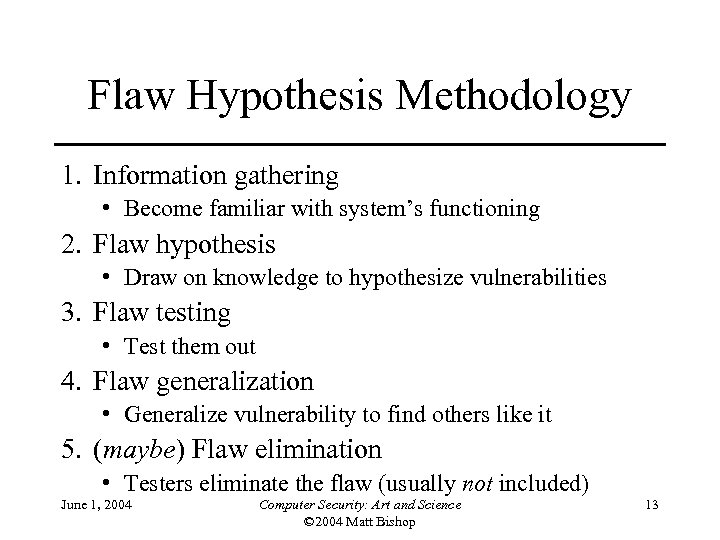
Flaw Hypothesis Methodology 1. Information gathering • Become familiar with system’s functioning 2. Flaw hypothesis • Draw on knowledge to hypothesize vulnerabilities 3. Flaw testing • Test them out 4. Flaw generalization • Generalize vulnerability to find others like it 5. (maybe) Flaw elimination • Testers eliminate the flaw (usually not included) June 1, 2004 Computer Security: Art and Science © 2004 Matt Bishop 13
Information Gathering • Devise model of system and/or components – Look for discrepancies in components – Consider interfaces among components • Need to know system well (or learn quickly!) – Design documents, manuals help • Unclear specifications often misinterpreted, or interpreted differently by different people – Look at how system manages privileged users June 1, 2004 Computer Security: Art and Science © 2004 Matt Bishop 14
Flaw Hypothesizing • Examine policies, procedures – May be inconsistencies to exploit – May be consistent, but inconsistent with design or implementation – May not be followed • Examine implementations – Use models of vulnerabilities to help locate potential problems – Use manuals; try exceeding limits and restrictions; try omitting steps in procedures June 1, 2004 Computer Security: Art and Science © 2004 Matt Bishop 15
Flaw Hypothesizing (con’t) • Identify structures, mechanisms controlling system – These are what attackers will use – Environment in which they work, and were built, may have introduced errors • Throughout, draw on knowledge of other systems with similarities – Which means they may have similar vulnerabilities • Result is list of possible flaws June 1, 2004 Computer Security: Art and Science © 2004 Matt Bishop 16
Flaw Testing • Figure out order to test potential flaws – Priority is function of goals • Example: to find major design or implementation problems, focus on potential system critical flaws • Example: to find vulnerability to outside attackers, focus on external access protocols and programs • Figure out how to test potential flaws – Best way: demonstrate from the analysis • Common when flaw arises from faulty spec, design, or operation – Otherwise, must try to exploit it June 1, 2004 Computer Security: Art and Science © 2004 Matt Bishop 17
Flaw Testing (con’t) • Design test to be least intrusive as possible – Must understand exactly why flaw might arise • Procedure – Back up system – Verify system configured to allow exploit • Take notes of requirements for detecting flaw – Verify existence of flaw • May or may not require exploiting the flaw • Make test as simple as possible, but success must be convincing – Must be able to repeat test successfully June 1, 2004 Computer Security: Art and Science © 2004 Matt Bishop 18
Flaw Generalization • As tests succeed, classes of flaws emerge – Example: programs read input into buffer on stack, leading to buffer overflow attack; others copy command line arguments into buffer on stack these are vulnerable too • Sometimes two different flaws may combine for devastating attack – Example: flaw 1 gives external attacker access to unprivileged account on system; second flaw allows any user on that system to gain full privileges any external attacker can get full privileges June 1, 2004 Computer Security: Art and Science © 2004 Matt Bishop 19
Flaw Elimination • Usually not included as testers are not best folks to fix this – Designers and implementers are • Requires understanding of context, details of flaw including environment, and possibly exploit – Design flaw uncovered during development can be corrected and parts of implementation redone • Don’t need to know how exploit works – Design flaw uncovered at production site may not be corrected fast enough to prevent exploitation • So need to know how exploit works June 1, 2004 Computer Security: Art and Science © 2004 Matt Bishop 20
Michigan Terminal System • General-purpose OS running on IBM 360, 370 systems • Class exercise: gain access to terminal control structures – Had approval and support of center staff – Began with authorized account (level 3) June 1, 2004 Computer Security: Art and Science © 2004 Matt Bishop 21
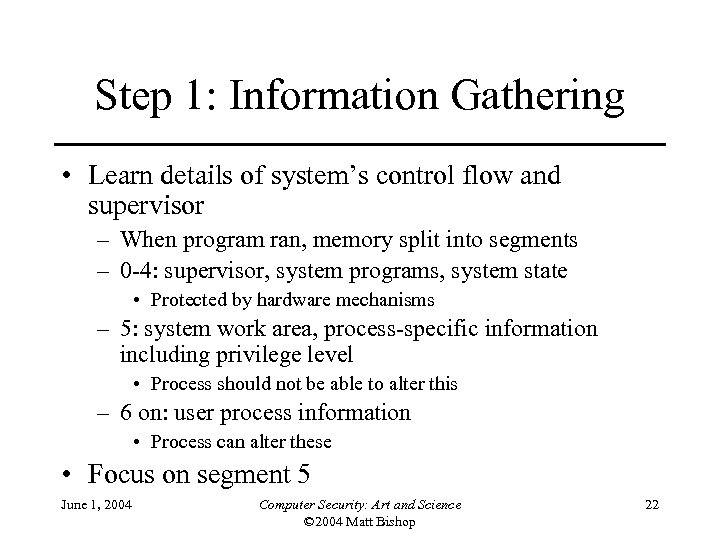
Step 1: Information Gathering • Learn details of system’s control flow and supervisor – When program ran, memory split into segments – 0 -4: supervisor, system programs, system state • Protected by hardware mechanisms – 5: system work area, process-specific information including privilege level • Process should not be able to alter this – 6 on: user process information • Process can alter these • Focus on segment 5 June 1, 2004 Computer Security: Art and Science © 2004 Matt Bishop 22
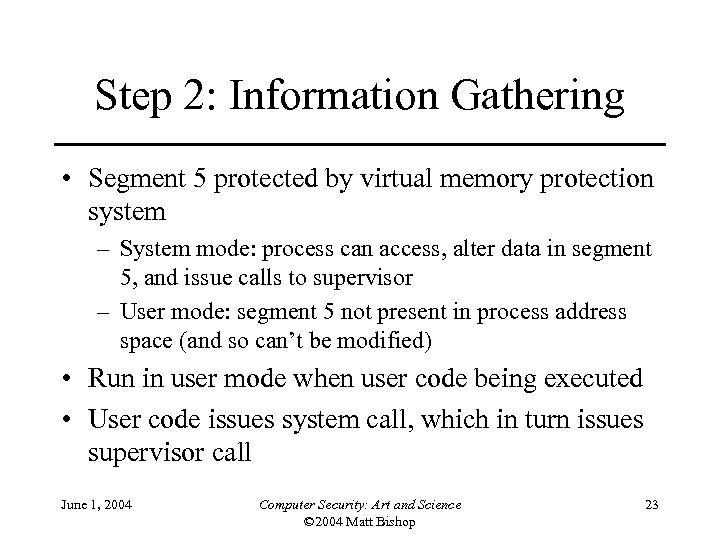
Step 2: Information Gathering • Segment 5 protected by virtual memory protection system – System mode: process can access, alter data in segment 5, and issue calls to supervisor – User mode: segment 5 not present in process address space (and so can’t be modified) • Run in user mode when user code being executed • User code issues system call, which in turn issues supervisor call June 1, 2004 Computer Security: Art and Science © 2004 Matt Bishop 23
How to Make a Supervisor Call • System code checks parameters to ensure supervisor accesses authorized locations only – Parameters passed as list of addresses (X, X+1, X+2) constructed in user segment – Address of list (X) passed via register June 1, 2004 Computer Security: Art and Science © 2004 Matt Bishop 24
Step 3: Flaw Hypothesis • Consider switch from user to system mode – System mode requires supervisor privileges • Found: a parameter could point to another element in parameter list – Below: address in location X+1 is that of parameter at X+2 – Means: system or supervisor procedure could alter parameter’s address after checking validity of old address June 1, 2004 Computer Security: Art and Science © 2004 Matt Bishop 25
Step 4: Flaw Testing • Find a system routine that: – Used this calling convention; – Took at least 2 parameters and altered 1 – Could be made to change parameter to any value (such as an address in segment 5) • Chose line input routine – Returns line number, length of line, line read • Setup: – Set address for storing line number to be address of line length June 1, 2004 Computer Security: Art and Science © 2004 Matt Bishop 26
Step 5: Execution • System routine validated all parameter addresses – All were indeed in user segment • Supervisor read input line – Line length set to value to be written into segment 5 • Line number stored in parameter list – Line number was set to be address in segment 5 • When line read, line length written into location address of which was in parameter list – So it overwrote value in segment 5 June 1, 2004 Computer Security: Art and Science © 2004 Matt Bishop 27
Step 6: Flaw Generalization • Could not overwrite anything in segments 0 -4 – Protected by hardware • Testers realized that privilege level in segment 5 controlled ability to issue supervisor calls (as opposed to system calls) – And one such call turned off hardware protection for segments 0 -4 … • Effect: this flaw allowed attackers to alter anything in memory, thereby completely controlling computer June 1, 2004 Computer Security: Art and Science © 2004 Matt Bishop 28
Burroughs B 6700 • System architecture: based on strict file typing – Entities: ordinary users, privileged programs, OS tasks • Ordinary users tightly restricted • Other 3 can access file data without restriction but constrained from compromising integrity of system – No assemblers; compilers output executable code – Data files, executable files have different types • Only compilers can produce executables • Writing to executable or its attributes changes its type to data • Class exercise: obtain status of privileged user June 1, 2004 Computer Security: Art and Science © 2004 Matt Bishop 29
Step 1: Information Gathering • System had tape drives – Writing file to tape preserved file contents – Header record indicates file attributes including type • Data could be copied from one tape to another – If you change data, it’s still data June 1, 2004 Computer Security: Art and Science © 2004 Matt Bishop 30
Step 2: Flaw Hypothesis • System cannot detect change to executable file if that file is altered off-line June 1, 2004 Computer Security: Art and Science © 2004 Matt Bishop 31
Step 3: Flaw Testing • Write small program to change type of any file from data to executable – Compiled, but could not be used yet as it would alter file attributes, making target a data file – Write this to tape • Write a small utility to copy contents of tape 1 to tape 2 – Utility also changes header record of contents to indicate file was a compiler (and so could output executables) June 1, 2004 Computer Security: Art and Science © 2004 Matt Bishop 32
Creating the Compiler • Run copy program – As header record copied, type becomes “compiler” • Reinstall program as a new compiler • Write new subroutine, compile it normally, and change machine code to give privileges to anyone calling it (this makes it data, of course) – Now use new compiler to change its type from data to executable • Write third program to call this – Now you have privileges June 1, 2004 Computer Security: Art and Science © 2004 Matt Bishop 33
Corporate Computer System • Goal: determine whether corporate security measures were effective in keeping external attackers from accessing system • Testers focused on policies and procedures – Both technical and non-technical June 1, 2004 Computer Security: Art and Science © 2004 Matt Bishop 34
Step 1: Information Gathering • Searched Internet – Got names of employees, officials – Got telephone number of local branch, and from them got copy of annual report • Constructed much of the company’s organization from this data – Including list of some projects on which individuals were working June 1, 2004 Computer Security: Art and Science © 2004 Matt Bishop 35

Step 2: Get Telephone Directory • Corporate directory would give more needed information about structure – Tester impersonated new employee • Learned two numbers needed to have something delivered offsite: employee number of person requesting shipment, and employee’s Cost Center number – Testers called secretary of executive they knew most about • One impersonated an employee, got executive’s employee number • Another impersonated auditor, got Cost Center number – Had corporate directory sent to off-site “subcontractor” June 1, 2004 Computer Security: Art and Science © 2004 Matt Bishop 36
Step 3: Flaw Hypothesis • Controls blocking people giving passwords away not fully communicated to new employees – Testers impersonated secretary of senior executive • Called appropriate office • Claimed senior executive upset he had not been given names of employees hired that week • Got the names June 1, 2004 Computer Security: Art and Science © 2004 Matt Bishop 37
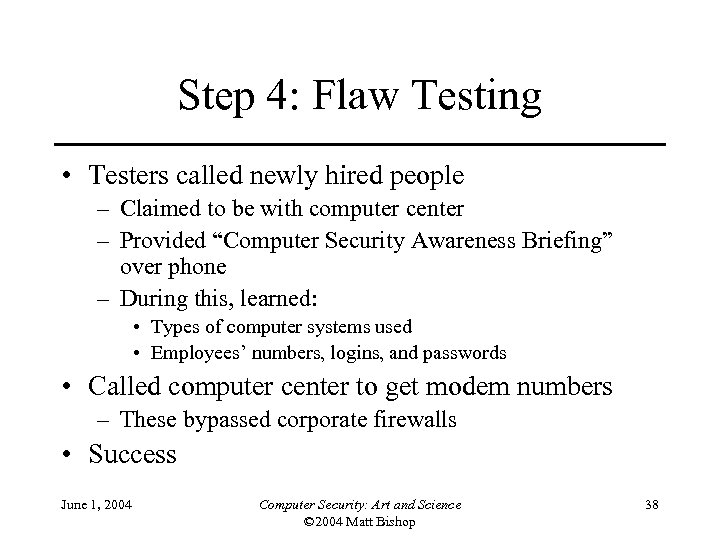
Step 4: Flaw Testing • Testers called newly hired people – Claimed to be with computer center – Provided “Computer Security Awareness Briefing” over phone – During this, learned: • Types of computer systems used • Employees’ numbers, logins, and passwords • Called computer center to get modem numbers – These bypassed corporate firewalls • Success June 1, 2004 Computer Security: Art and Science © 2004 Matt Bishop 38
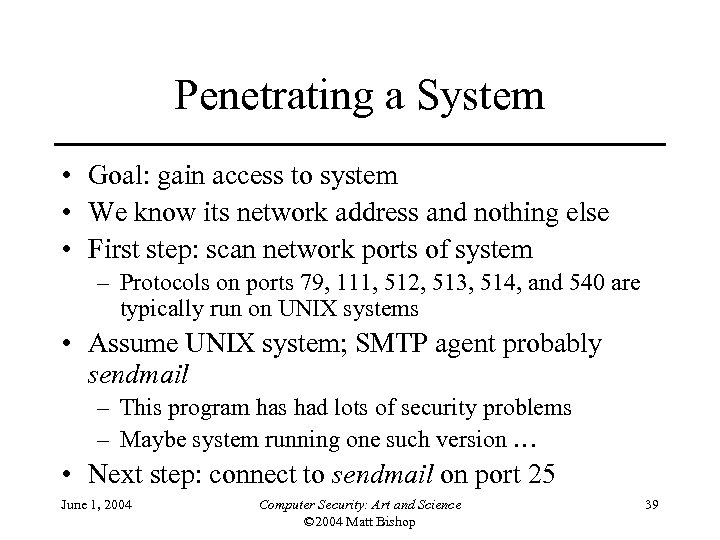
Penetrating a System • Goal: gain access to system • We know its network address and nothing else • First step: scan network ports of system – Protocols on ports 79, 111, 512, 513, 514, and 540 are typically run on UNIX systems • Assume UNIX system; SMTP agent probably sendmail – This program has had lots of security problems – Maybe system running one such version … • Next step: connect to sendmail on port 25 June 1, 2004 Computer Security: Art and Science © 2004 Matt Bishop 39
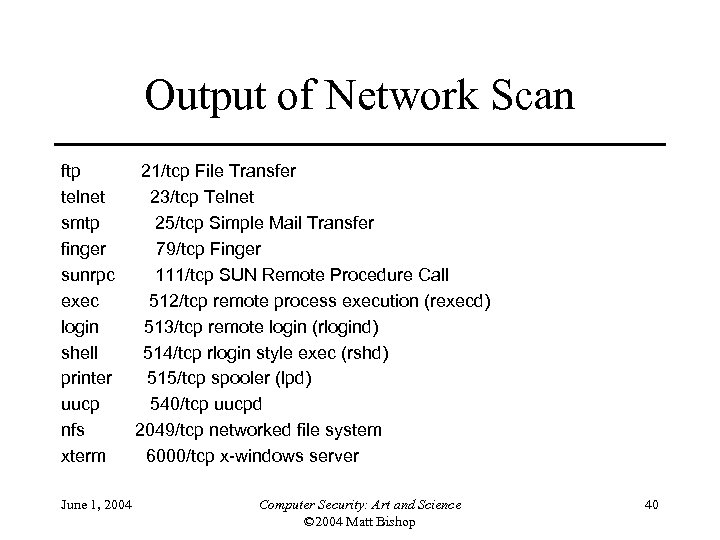
Output of Network Scan ftp telnet smtp finger sunrpc exec login shell printer uucp nfs xterm June 1, 2004 21/tcp File Transfer 23/tcp Telnet 25/tcp Simple Mail Transfer 79/tcp Finger 111/tcp SUN Remote Procedure Call 512/tcp remote process execution (rexecd) 513/tcp remote login (rlogind) 514/tcp rlogin style exec (rshd) 515/tcp spooler (lpd) 540/tcp uucpd 2049/tcp networked file system 6000/tcp x-windows server Computer Security: Art and Science © 2004 Matt Bishop 40
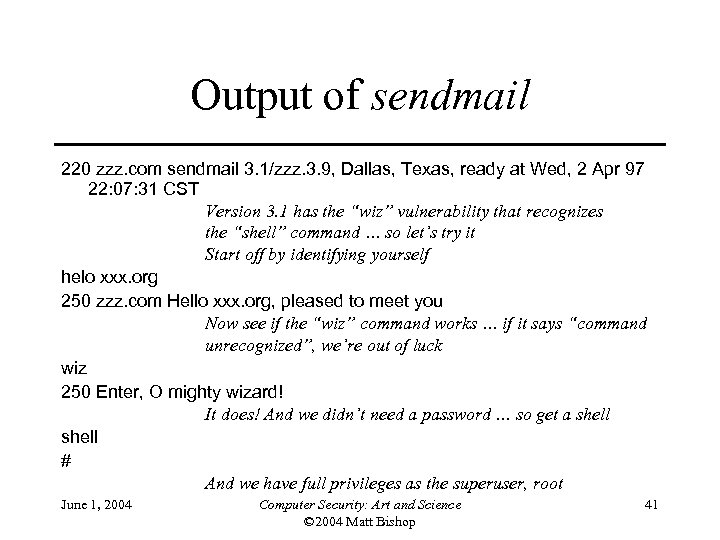
Output of sendmail 220 zzz. com sendmail 3. 1/zzz. 3. 9, Dallas, Texas, ready at Wed, 2 Apr 97 22: 07: 31 CST Version 3. 1 has the “wiz” vulnerability that recognizes the “shell” command … so let’s try it Start off by identifying yourself helo xxx. org 250 zzz. com Hello xxx. org, pleased to meet you Now see if the “wiz” command works … if it says “command unrecognized”, we’re out of luck wiz 250 Enter, O mighty wizard! It does! And we didn’t need a password … so get a shell # And we have full privileges as the superuser, root June 1, 2004 Computer Security: Art and Science © 2004 Matt Bishop 41
Penetrating a System (Revisited) • Goal: from an unprivileged account on system, gain privileged access • First step: examine system – See it has dynamically loaded kernel – Program used to add modules is loadmodule and must be privileged – So an unprivileged user can run a privileged program … this suggests an interface that controls this – Question: how does loadmodule work? June 1, 2004 Computer Security: Art and Science © 2004 Matt Bishop 42
loadmodule • Validates module ad being a dynamic load module • Invokes dynamic loader ld. so to do actual load; also calls arch to determine system architecture (chip set) – Check, but only privileged user can call ld. so • How does loadmodule execute these programs? – Easiest way: invoke them directly using system(3), which does not reset environment when it spawns subprogram June 1, 2004 Computer Security: Art and Science © 2004 Matt Bishop 43
First Try • Set environment to look in local directory, write own version of ld. so, and put it in local directory – This version will print effective UID, to demonstrate we succeeded • Set search path to look in current working directory before system directories • Then run loadmodule – Nothing is printed—darn! – Somehow changing environment did not affect execution of subprograms—why not? June 1, 2004 Computer Security: Art and Science © 2004 Matt Bishop 44
What Happened • Look in executable to see how ld. so, arch invoked – Invocations are “/bin/ld. so”, “/bin/arch” – Changing search path didn’t matter as never used • Reread system(3) manual page – It invokes command interpreter sh to run subcommands • Read sh(1) manual page – Uses IFS environment variable to separate words – These are by default blanks … can we make it include a “/”? • If so, sh would see “/bin/ld. so” as “bin” followed by “ld. so”, so it would look for command “bin” June 1, 2004 Computer Security: Art and Science © 2004 Matt Bishop 45
Second Try • Change value of IFS to include “/” • Change name of our version of ld. so to bin – Search path still has current directory as first place to look for commands • Run loadmodule – Prints that its effective UID is 0 (root) • Success! June 1, 2004 Computer Security: Art and Science © 2004 Matt Bishop 46
Generalization • Process did not clean out environment before invoking subprocess, which inherited environment – So, trusted program working with untrusted environment (input) … result should be untrusted, but is trusted! • Look for other privileged programs that spawn subcommands – Especially if they do so by calling system(3) … June 1, 2004 Computer Security: Art and Science © 2004 Matt Bishop 47
Penetrating a System redux • Goal: gain access to system • We know its network address and nothing else • First step: scan network ports of system – Protocols on ports 17, 135, and 139 are typically run on Windows NT server systems June 1, 2004 Computer Security: Art and Science © 2004 Matt Bishop 48
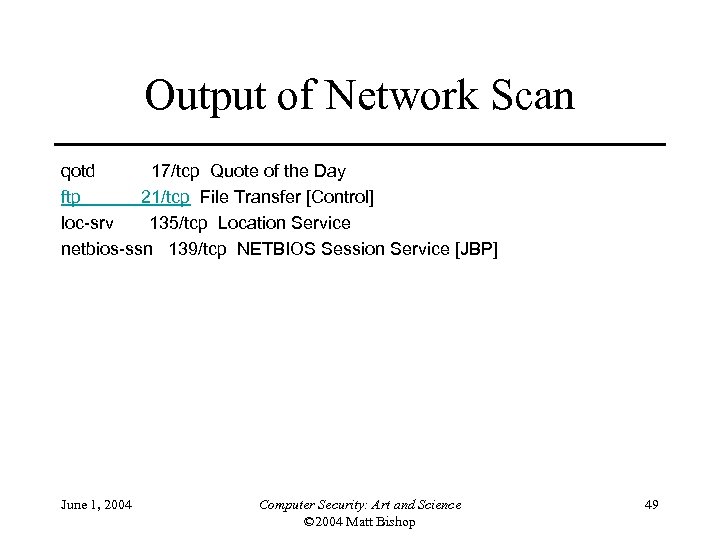
Output of Network Scan qotd 17/tcp Quote of the Day ftp 21/tcp File Transfer [Control] loc-srv 135/tcp Location Service netbios-ssn 139/tcp NETBIOS Session Service [JBP] June 1, 2004 Computer Security: Art and Science © 2004 Matt Bishop 49
First Try • Probe for easy-to-guess passwords – Find system administrator has password “Admin” – Now have administrator (full) privileges on local system • Now, go for rights to other systems in domain June 1, 2004 Computer Security: Art and Science © 2004 Matt Bishop 50
Next Step • Domain administrator installed service running with domain admin privileges on local system • Get program that dumps local security authority database – This gives us service account password – We use it to get domain admin privileges, and can access any system in domain June 1, 2004 Computer Security: Art and Science © 2004 Matt Bishop 51
Generalization • Sensitive account had an easy-to-guess password – Possible procedural problem • Look for weak passwords on other systems, accounts • Review company security policies, as well as education of system administrators and mechanisms for publicizing the policies June 1, 2004 Computer Security: Art and Science © 2004 Matt Bishop 52
Debate • How valid are these tests? – Not a substitute for good, thorough specification, rigorous design, careful and correct implementation, meticulous testing – Very valuable a posteriori testing technique • Ideally unnecessary, but in practice very necessary • Finds errors introduced due to interactions with users, environment – Especially errors from incorrect maintenance and operation – Examines system, site through eyes of attacker June 1, 2004 Computer Security: Art and Science © 2004 Matt Bishop 53
Problems • Flaw Hypothesis Methodology depends on caliber of testers to hypothesize and generalize flaws • Flaw Hypothesis Methodology does not provide a way to examine systematically – Vulnerability classification schemes help here June 1, 2004 Computer Security: Art and Science © 2004 Matt Bishop 54
Vulnerability Classification • Describe flaws from differing perspectives – Exploit-oriented – Hardware, software, interface-oriented • Goals vary; common ones are: – Specify, design, implement computer system without vulnerabilities – Analyze computer system to detect vulnerabilities – Address any vulnerabilities introduced during system operation – Detect attempted exploitations of vulnerabilities June 1, 2004 Computer Security: Art and Science © 2004 Matt Bishop 55
Example Flaws • Use these to compare classification schemes • First one: race condition (xterm) • Second one: buffer overflow on stack leading to execution of injected code (fingerd) • Both are very well known, and fixes available! – And should be installed everywhere … June 1, 2004 Computer Security: Art and Science © 2004 Matt Bishop 56
Flaw #1: xterm • xterm emulates terminal under X 11 window system – Must run as root user on UNIX systems • No longer universally true; reason irrelevant here • Log feature: user can log all input, output to file – User names file – If file does not exist, xterm creates it, makes owner the user – If file exists, xterm checks user can write to it, and if so opens file to append log to it June 1, 2004 Computer Security: Art and Science © 2004 Matt Bishop 57
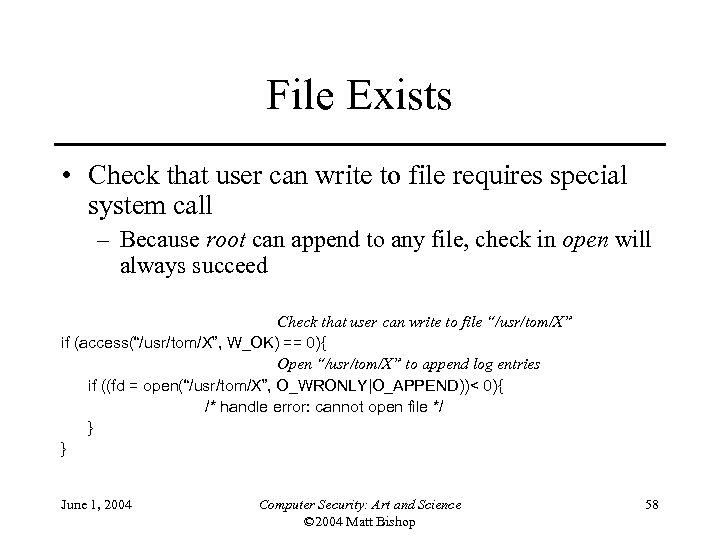
File Exists • Check that user can write to file requires special system call – Because root can append to any file, check in open will always succeed Check that user can write to file “/usr/tom/X” if (access(“/usr/tom/X”, W_OK) == 0){ Open “/usr/tom/X” to append log entries if ((fd = open(“/usr/tom/X”, O_WRONLY|O_APPEND))< 0){ /* handle error: cannot open file */ } } June 1, 2004 Computer Security: Art and Science © 2004 Matt Bishop 58
Problem • Binding of file name “/usr/tom/X” to file object can change between first and second lines – (a) is at access; (b) is at open – Note file opened is not file checked June 1, 2004 Computer Security: Art and Science © 2004 Matt Bishop 59
Flaw #2: fingerd • Exploited by Internet Worm of 1988 – Recurs in many places, even now • finger client send request for information to server fingerd (finger daemon) – Request is name of at most 512 chars – What happens if you send more? June 1, 2004 Computer Security: Art and Science © 2004 Matt Bishop 60
Buffer Overflow • Extra chars overwrite rest of stack, as shown • Can make those chars change return address to point to beginning of buffer • If buffer contains small program to spawn shell, attacker gets shell on target system June 1, 2004 Computer Security: Art and Science © 2004 Matt Bishop 61
Frameworks • Goals dictate structure of classification scheme – Guide development of attack tool focus is on steps needed to exploit vulnerability – Aid software development process focus is on design and programming errors causing vulnerabilities • Following schemes classify vulnerability as ntuple, each element of n-tuple being classes into which vulnerability falls – Some have 1 axis; others have multiple axes June 1, 2004 Computer Security: Art and Science © 2004 Matt Bishop 62
Research Into Secure Operating Systems (RISOS) • Goal: aid computer, system managers in understanding security issues in OSes, and help determine how much effort required to enhance system security • Attempted to develop methodologies and software for detecting some problems, and techniques for avoiding and ameliorating other problems • Examined Multics, TENEX, TOPS-10, GECOS, OS/MVT, SDS-940, EXEC-8 June 1, 2004 Computer Security: Art and Science © 2004 Matt Bishop 63
Classification Scheme • • • Incomplete parameter validation Inconsistent parameter validation Implicit sharing of privileged/confidential data Asynchronous validation/inadequate serialization Inadequate identification/authentication/authorization • Violable prohibition/limit • Exploitable logic error June 1, 2004 Computer Security: Art and Science © 2004 Matt Bishop 64
Incomplete Parameter Validation • Parameter not checked before use • Example: emulating integer division in kernel (RISC chip involved) – Caller provided addresses for quotient, remainder – Quotient address checked to be sure it was in user’s protection domain – Remainder address not checked • Set remainder address to address of process’ level of privilege • Compute 25/5 and you have level 0 (kernel) privileges • Check for type, format, range of values, access rights, presence (or absence) June 1, 2004 Computer Security: Art and Science © 2004 Matt Bishop 65
Inconsistent Parameter Validation • Each routine checks parameter is in proper format for that routine but the routines require different formats • Example: each database record 1 line, colons separating fields – One program accepts colons, newlines as pat of data within fields – Another program reads them as field and record separators – This allows bogus records to be entered June 1, 2004 Computer Security: Art and Science © 2004 Matt Bishop 66
Implicit Sharing of Privileged / Confidential Data • OS does not isolate users, processes properly • Example: file password protection – OS allows user to determine when paging occurs – Files protected by passwords • Passwords checked char by char; stops at first incorrect char – Position guess for password so page fault occurred between 1 st, 2 nd char • If no page fault, 1 st char was wrong; if page fault, it was right – Continue until password discovered June 1, 2004 Computer Security: Art and Science © 2004 Matt Bishop 67
Asynchronous Validation / Inadequate Serialization • Time of check to time of use flaws, intermixing reads and writes to create inconsistencies • Example: xterm flaw discussed earlier June 1, 2004 Computer Security: Art and Science © 2004 Matt Bishop 68
Inadequate Identification / Authorization / Authentication • Erroneously identifying user, assuming another’s privilege, or tricking someone into executing program without authorization • Example: OS on which access to file named “SYS$*DLOC$” meant process privileged – Check: can process access any file with qualifier name beginning with “SYS” and file name beginning with “DLO”? – If your process can access file “SYSA*DLOC$”, which is ordinary file, your process is privileged June 1, 2004 Computer Security: Art and Science © 2004 Matt Bishop 69
Violable Prohibition / Limit • Boundary conditions not handled properly • Example: OS kept in low memory, user process in high memory – Boundary was highest address of OS – All memory accesses checked against this – Memory accesses not checked beyond end of high memory • Such addresses reduced modulo memory size – So, process could access (memory size)+1, or word 1, which is part of OS … June 1, 2004 Computer Security: Art and Science © 2004 Matt Bishop 70
Exploitable Logic Error • Problems not falling into other classes – Incorrect error handling, unexpected side effects, incorrect resource allocation, etc. • Example: unchecked return from monitor – Monitor adds 1 to address in user’s PC, returns • Index bit (indicating indirection) is a bit in word • Attack: set address to be – 1; adding 1 overflows, changes index bit, so return is to location stored in register 1 – Arrange for this to point to bootstrap program stored in other registers • On return, program executes with system privileges June 1, 2004 Computer Security: Art and Science © 2004 Matt Bishop 71
Legacy of RISOS • First funded project examining vulnerabilities • Valuable insight into nature of flaws – Security is a function of site requirements and threats – Small number of fundamental flaws recurring in many contexts – OS security not critical factor in design of OSes • Spurred additional research efforts into detection, repair of vulnerabilities June 1, 2004 Computer Security: Art and Science © 2004 Matt Bishop 72
Program Analysis (PA) • Goal: develop techniques to find vulnerabilities • Tried to break problem into smaller, more manageable pieces • Developed general strategy, applied it to several OSes – Found previously unknown vulnerabilities June 1, 2004 Computer Security: Art and Science © 2004 Matt Bishop 73
Classification Scheme • Improper protection domain initialization and enforcement – – – Improper choice of initial protection domain Improper isolation of implementation detail Improper change Improper naming Improper deallocation or deletion • Improper validation • Improper synchronization – Improper indivisibility – Improper sequencing • Improper choice of operand or operation June 1, 2004 Computer Security: Art and Science © 2004 Matt Bishop 74
Improper Choice of Initial Protection Domain • Initial incorrect assignment of privileges, security and integrity classes • Example: on boot, protection mode of file containing identifiers of all users can be altered by any user – Under most policies, should not be allowed June 1, 2004 Computer Security: Art and Science © 2004 Matt Bishop 75
Improper Isolation of Implementation Detail • Mapping an abstraction into an implementation in such a way that the abstraction can be bypassed • Example: virtual machines modulate length of time CPU is used by each to send bits to each other • Example: Having raw disk accessible to system as ordinary file, enabling users to bypass file system abstraction and write directly to raw disk blocks June 1, 2004 Computer Security: Art and Science © 2004 Matt Bishop 76
Improper Change • Data is inconsistent over a period of time • Example: xterm flaw – Meaning of “/usr/tom/X” changes between access and open • Example: parameter is validated, then accessed; but parameter is changed between validation and access – Burroughs B 6700 allowed this June 1, 2004 Computer Security: Art and Science © 2004 Matt Bishop 77
Improper Naming • Multiple objects with same name • Example: Trojan horse – loadmodule attack discussed earlier; “bin” could be a directory or a program • Example: multiple hosts with same IP address – Messages may be erroneously routed June 1, 2004 Computer Security: Art and Science © 2004 Matt Bishop 78
Improper Deallocation or Deletion • Failing to clear memory or disk blocks (or other storage) after it is freed for use by others • Example: program that contains passwords that a user typed dumps core – Passwords plainly visible in core dump June 1, 2004 Computer Security: Art and Science © 2004 Matt Bishop 79
Improper Validation • Inadequate checking of bounds, type, or other attributes or values • Example: fingerd’s failure to check input length June 1, 2004 Computer Security: Art and Science © 2004 Matt Bishop 80
Improper Indivisibility • Interrupting operations that should be uninterruptable – Often: “interrupting atomic operations” • Example: mkdir flaw (UNIX Version 7) – Created directories by executing privileged operation to create file node of type directory, then changed ownership to user – On loaded system, could change binding of name of directory to be that of password file after directory created but before change of ownership – Attacker can change administrator’s password June 1, 2004 Computer Security: Art and Science © 2004 Matt Bishop 81
Improper Sequencing • Required order of operations not enforced • Example: one-time password scheme – System runs multiple copies of its server – Two users try to access same account • • • Server 1 reads password from file Server 2 reads password from file Both validate typed password, allow user to log in Server 1 writes new password to file Server 2 writes new password to file – Should have every read to file followed by a write, and vice versa; not two reads or two writes to file in a row June 1, 2004 Computer Security: Art and Science © 2004 Matt Bishop 82
Improper Choice of Operand or Operation • Calling inappropriate or erroneous instructions • Example: cryptographic key generation software calling pseudorandom number generators that produce predictable sequences of numbers June 1, 2004 Computer Security: Art and Science © 2004 Matt Bishop 83
Legacy • First to explore automatic detection of security flaws in programs and systems • Methods developed but not widely used – Parts of procedure could not be automated – Complexity – Procedures for obtaining system-independent patterns describing flaws not complete June 1, 2004 Computer Security: Art and Science © 2004 Matt Bishop 84
NRL Taxonomy • Goals: – Determine how flaws entered system – Determine when flaws entered system – Determine where flaws are manifested in system • 3 different schemes used: – Genesis of flaws – Time of flaws – Location of flaws June 1, 2004 Computer Security: Art and Science © 2004 Matt Bishop 85
Genesis of Flaws • Inadvertent (unintentional) flaws classified using RISOS categories; not shown above – If most inadvertent, better design/coding reviews needed – If most intentional, need to hire more trustworthy developers and do more security-related testing June 1, 2004 Computer Security: Art and Science © 2004 Matt Bishop 86
Time of Flaws • Development phase: all activities up to release of initial version of software • Maintenance phase: all activities leading to changes in software performed under configuration control • Operation phase: all activities involving patching and not under configuration control June 1, 2004 Computer Security: Art and Science © 2004 Matt Bishop 87
Location of Flaw • Focus effort on locations where most flaws occur, or where most serious flaws occur June 1, 2004 Computer Security: Art and Science © 2004 Matt Bishop 88
Legacy • Analyzed 50 flaws • Concluded that, with a large enough sample size, an analyst could study relationships between pairs of classes – This would help developers focus on most likely places, times, and causes of flaws • Focused on social processes as well as technical details – But much information required for classification not available for the 50 flaws June 1, 2004 Computer Security: Art and Science © 2004 Matt Bishop 89
Aslam’s Model • Goal: treat vulnerabilities as faults and develop scheme based on fault trees • Focuses specifically on UNIX flaws • Classifications unique and unambiguous – Organized as a binary tree, with a question at each node. Answer determines branch you take – Leaf node gives you classification • Suited for organizing flaws in a database June 1, 2004 Computer Security: Art and Science © 2004 Matt Bishop 90
Top Level • Coding faults: introduced during software development – Example: fingerd’s failure to check length of input string before storing it in buffer • Emergent faults: result from incorrect initialization, use, or application – Example: allowing message transfer agent to forward mail to arbitrary file on system (it performs according to specification, but results create a vulnerability) June 1, 2004 Computer Security: Art and Science © 2004 Matt Bishop 91
Coding Faults • Synchronization errors: improper serialization of operations, timing window between two operations creates flaw – Example: xterm flaw • Condition validation errors: bounds not checked, access rights ignored, input not validated, authentication and identification fails – Example: fingerd flaw June 1, 2004 Computer Security: Art and Science © 2004 Matt Bishop 92
Emergent Faults • Configuration errors: program installed incorrectly – Example: tftp daemon installed so it can access any file; then anyone can copy any file • Environmental faults: faults introduced by environment – Example: on some UNIX systems, any shell with “-” as first char of name is interactive, so find a setuid shell script, create a link to name “-gotcha”, run it, and you has a privileged interactive shell June 1, 2004 Computer Security: Art and Science © 2004 Matt Bishop 93
Legacy • Tied security flaws to software faults • Introduced a precise classification scheme – Each vulnerability belongs to exactly 1 class of security flaws – Decision procedure well-defined, unambiguous June 1, 2004 Computer Security: Art and Science © 2004 Matt Bishop 94
Comparison and Analysis • Point of view – If multiple processes involved in exploiting the flaw, how does that affect classification? • xterm, fingerd flaws depend on interaction of two processes (xterm and process to switch file objects; fingerd and its client) • Levels of abstraction – How does flaw appear at different levels? • Levels are abstract, design, implementation, etc. June 1, 2004 Computer Security: Art and Science © 2004 Matt Bishop 95
xterm and PA Classification • Implementation level – xterm: improper change – attacker’s program: improper deallocation or deletion – operating system: improper indivisibility June 1, 2004 Computer Security: Art and Science © 2004 Matt Bishop 96
xterm and PA Classification • Consider higher level of abstraction, where directory is simply an object – create, delete files maps to writing; read file status, open file maps to reading – operating system: improper sequencing • During read, a write occurs, violating Bernstein conditions • Consider even higher level of abstraction – attacker’s process: improper choice of initial protection domain • Should not be able to write to directory containing log file • Semantics of UNIX users require this at lower levels June 1, 2004 Computer Security: Art and Science © 2004 Matt Bishop 97
xterm and RISOS Classification • Implementation level – xterm: asynchronous validation/inadequate serialization – attacker’s process: exploitable logic error and violable prohibition/limit – operating system: inconsistent parameter validation June 1, 2004 Computer Security: Art and Science © 2004 Matt Bishop 98
xterm and RISOS Classification • Consider higher level of abstraction, where directory is simply an object (as before) – all: asynchronous validation/inadequate serialization • Consider even higher level of abstraction – attacker’s process: inadequate identification/authentication/authorization • Directory with log file not protected adequately • Semantics of UNIX require this at lower levels June 1, 2004 Computer Security: Art and Science © 2004 Matt Bishop 99
xterm and NRL Classification • Time, location unambiguous – Time: during development – Location: Support: privileged utilities • Genesis: ambiguous – If intentional: • Lowest level: inadvertent flaw of serialization/aliasing – If unintentional: • Lowest level: nonmalicious: other – At higher levels, parallels that of RISOS June 1, 2004 Computer Security: Art and Science © 2004 Matt Bishop 100
xterm and Aslam’s Classification • Implementation level – attacker’s process: object installed with incorrect permissions • attacker’s process can delete file – xterm: access rights validation error • xterm doesn’t properly validate file at time of access – operating system: improper or inadequate serialization error • deletion, creation should not have been interspersed with access, open – Note: in absence of explicit decision procedure, all could go into class race condition June 1, 2004 Computer Security: Art and Science © 2004 Matt Bishop 101
The Point • The schemes lead to ambiguity – Different researchers may classify the same vulnerability differently for the same classification scheme • Not true for Aslam’s, but that misses connections between different classifications – xterm is race condition as well as others; Aslam does not show this June 1, 2004 Computer Security: Art and Science © 2004 Matt Bishop 102
fingerd and PA Classification • Implementation level – fingerd: improper validation – attacker’s process: improper choice of operand or operation – operating system: improper isolation of implementation detail June 1, 2004 Computer Security: Art and Science © 2004 Matt Bishop 103
fingerd and PA Classification • Consider higher level of abstraction, where storage space of return address is object – operating system: improper change – fingerd: improper validation • Because it doesn’t validate the type of instructions to be executed, mistaking data for valid ones • Consider even higher level of abstraction, where security-related value in memory is changing and data executed that should not be executable – operating system: improper choice of initial protection domain June 1, 2004 Computer Security: Art and Science © 2004 Matt Bishop 104
fingerd and RISOS Classification • Implementation level – fingerd: incomplete parameter validation – attacker’s process: violable prohibition/limit – operating system: inadequate identification/authentication/authorization June 1, 2004 Computer Security: Art and Science © 2004 Matt Bishop 105
fingerd and RISOS Classification • Consider higher level of abstraction, where storage space of return address is object – operating system: asynchronous validation/inadequate serialization – fingerd: inadequate identification/authentication/authorization • Consider even higher level of abstraction, where security-related value in memory is changing and data executed that should not be executable – operating system: inadequate identification/authentication/authorization June 1, 2004 Computer Security: Art and Science © 2004 Matt Bishop 106
fingerd and NRL Classification • Time, location unambiguous – Time: during development – Location: support: privileged utilities • Genesis: ambiguous – Known to be inadvertent flaw – Parallels that of RISOS June 1, 2004 Computer Security: Art and Science © 2004 Matt Bishop 107
fingerd and Aslam Classification • Implementation level – fingerd: boundary condition error – attacker’s process: boundary condition error • operating system: environmental fault – If decision procedure not present, could also have been access rights validation errors June 1, 2004 Computer Security: Art and Science © 2004 Matt Bishop 108
Theory of Penetration • Goal: detect previously undetected flaws • Based on two hypotheses: – Hypothesis of Penetration Patterns – Hypothesis of Penetration-Resistent Systems • Idea: formulate principles consistent with these hypotheses and check system for inconsistencies June 1, 2004 Computer Security: Art and Science © 2004 Matt Bishop 109
Hypothesis of Penetration Patterns System flaws that cause a large class of penetration patterns can be identified in system (i. e. , TCB) source code as incorrect/absent condition checks or integrated flows that violate the intentions of the system designers. – Meaning: an appropriate set of design, implementation principles will prevent vulnerabilities June 1, 2004 Computer Security: Art and Science © 2004 Matt Bishop 110
Hypothesis of Penetration. Resistent Systems A system (i. e. , TCB) is largely resistant to penetration if it adheres to a specific set of design properties. Example properties: – Users must not be able to tamper with system – System must check all references to objects – Global objects belonging to the system must be consistent with respect to both timing and storage – Undesirable system and user dependencies must be eliminated June 1, 2004 Computer Security: Art and Science © 2004 Matt Bishop 111
Flow-Based Model • Focus on flow of control during parameter validation • Consider rmdir(fname) – Allocates space for copy of parameter on stack – Copies parameter into allocated storage • Control flows through 3 steps: – Allocation of storage – Binding of parameter with formal argument – Copying formal argument (parameter) to storage • Problem: length of parameter not checked June 1, 2004 Computer Security: Art and Science © 2004 Matt Bishop 112
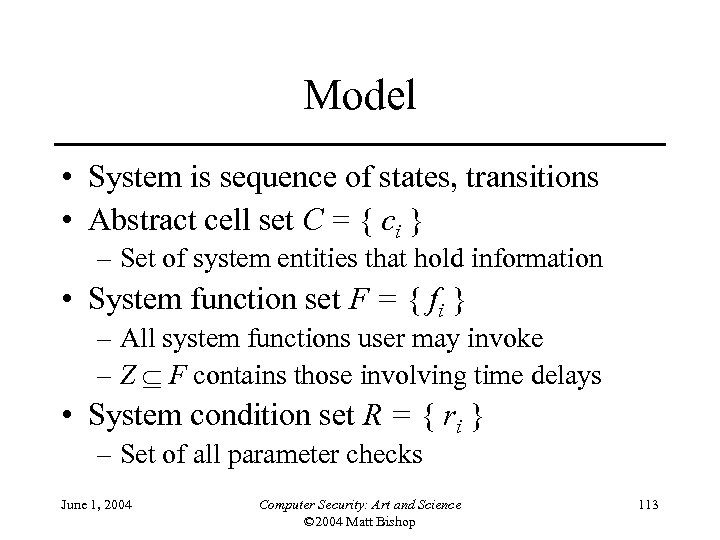
Model • System is sequence of states, transitions • Abstract cell set C = { ci } – Set of system entities that hold information • System function set F = { fi } – All system functions user may invoke – Z F contains those involving time delays • System condition set R = { ri } – Set of all parameter checks June 1, 2004 Computer Security: Art and Science © 2004 Matt Bishop 113
More Model • Information flow set IF = C C – Set of all possible information flows between pairs of abstract cells – (ci, cj) means information flows from ci to cj • Call relationship set SF = F F – Set of all possible information flows between pairs of system functions – (fi, fj) means fi calls fj or fi returns to fj • These capture flow of information, control throughout system June 1, 2004 Computer Security: Art and Science © 2004 Matt Bishop 114
System-Critical Functions • Functions that analysts deem critical with respect to penetration – Functions that cause time delays, because they may allow window during which checked parameters are changed – Functions that can cause system crash • System-critical function set K • System entry points E – Gates through which user processes invoke system functions June 1, 2004 Computer Security: Art and Science © 2004 Matt Bishop 115
rmdir June 1, 2004 Computer Security: Art and Science © 2004 Matt Bishop 116
rmdir and Model • fname C – Points to global entity • rmdir F, rmdir E – System function and also entry point • fname cannot be illegal address – islegal(fname) R • length of fname less than that of buf – length(fname) < spacefor(buf) R June 1, 2004 Computer Security: Art and Science © 2004 Matt Bishop 117
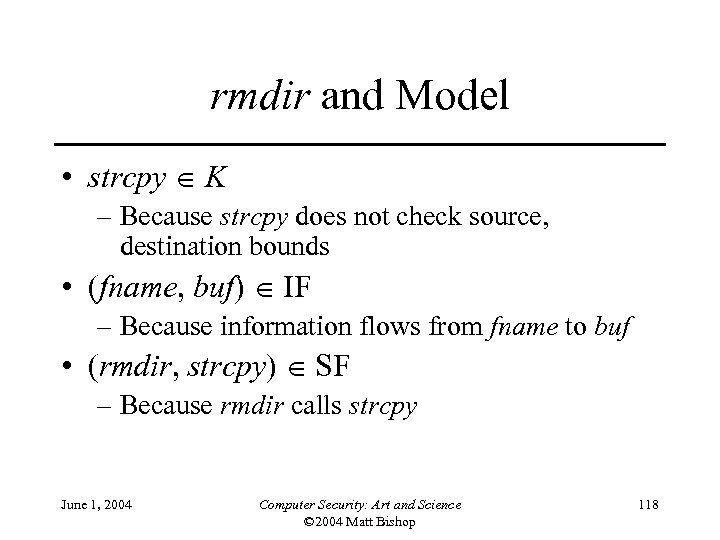
rmdir and Model • strcpy K – Because strcpy does not check source, destination bounds • (fname, buf) IF – Because information flows from fname to buf • (rmdir, strcpy) SF – Because rmdir calls strcpy June 1, 2004 Computer Security: Art and Science © 2004 Matt Bishop 118
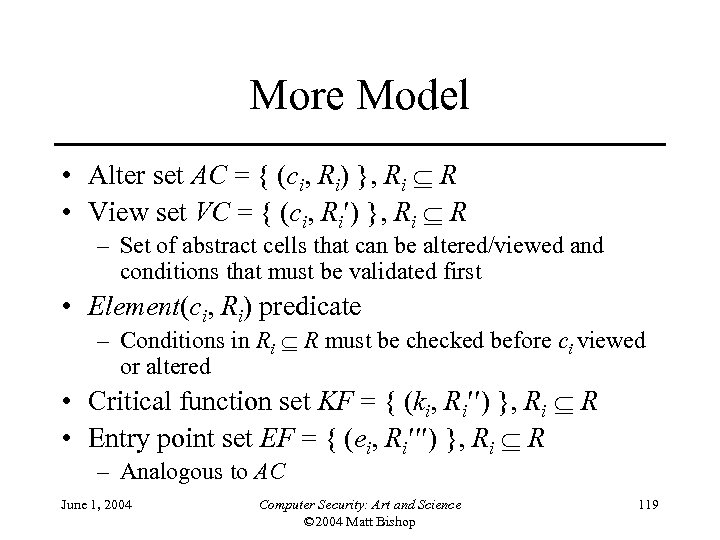
More Model • Alter set AC = { (ci, Ri) }, Ri R • View set VC = { (ci, Ri ) }, Ri R – Set of abstract cells that can be altered/viewed and conditions that must be validated first • Element(ci, Ri) predicate – Conditions in Ri R must be checked before ci viewed or altered • Critical function set KF = { (ki, Ri ) }, Ri R • Entry point set EF = { (ei, Ri ) }, Ri R – Analogous to AC June 1, 2004 Computer Security: Art and Science © 2004 Matt Bishop 119
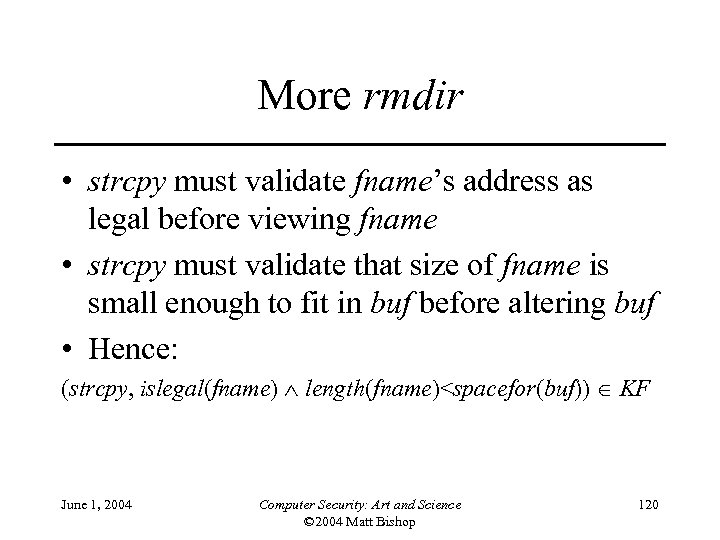
More rmdir • strcpy must validate fname’s address as legal before viewing fname • strcpy must validate that size of fname is small enough to fit in buf before altering buf • Hence: (strcpy, islegal(fname) length(fname)<spacefor(buf)) KF June 1, 2004 Computer Security: Art and Science © 2004 Matt Bishop 120
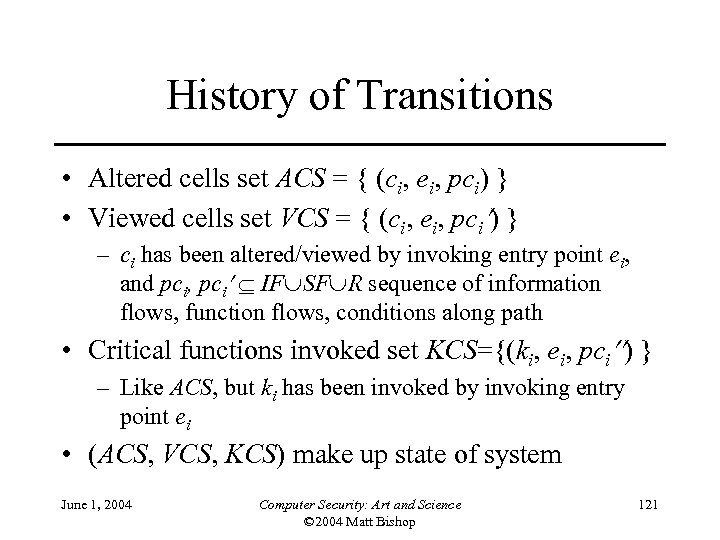
History of Transitions • Altered cells set ACS = { (ci, ei, pci) } • Viewed cells set VCS = { (ci, ei, pci ) } – ci has been altered/viewed by invoking entry point ei, and pci, pci IF SF R sequence of information flows, function flows, conditions along path • Critical functions invoked set KCS={(ki, ei, pci ) } – Like ACS, but ki has been invoked by invoking entry point ei • (ACS, VCS, KCS) make up state of system June 1, 2004 Computer Security: Art and Science © 2004 Matt Bishop 121
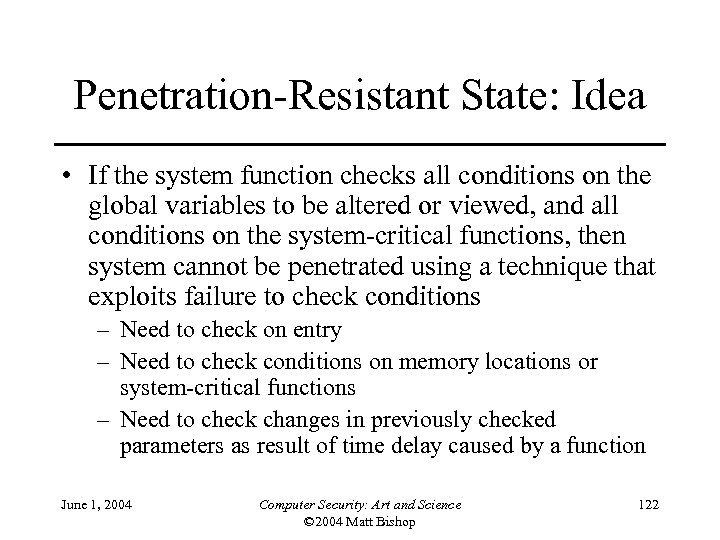
Penetration-Resistant State: Idea • If the system function checks all conditions on the global variables to be altered or viewed, and all conditions on the system-critical functions, then system cannot be penetrated using a technique that exploits failure to check conditions – Need to check on entry – Need to check conditions on memory locations or system-critical functions – Need to check changes in previously checked parameters as result of time delay caused by a function June 1, 2004 Computer Security: Art and Science © 2004 Matt Bishop 122
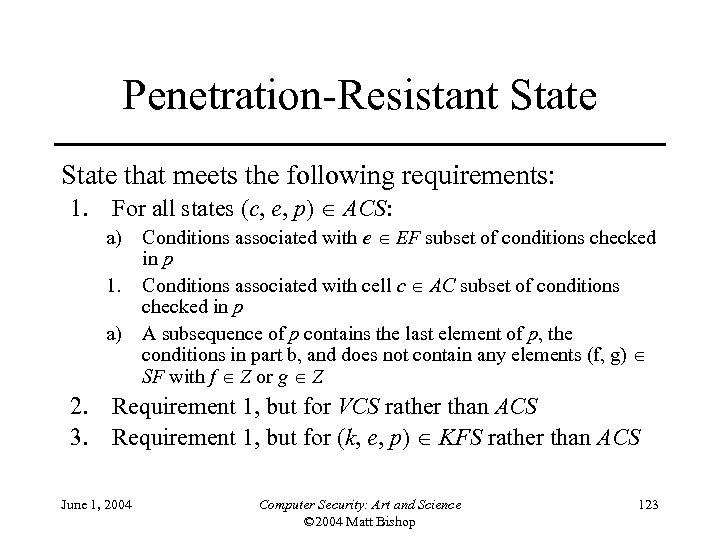
Penetration-Resistant State that meets the following requirements: 1. For all states (c, e, p) ACS: a) Conditions associated with e EF subset of conditions checked in p 1. Conditions associated with cell c AC subset of conditions checked in p a) A subsequence of p contains the last element of p, the conditions in part b, and does not contain any elements (f, g) SF with f Z or g Z 2. Requirement 1, but for VCS rather than ACS 3. Requirement 1, but for (k, e, p) KFS rather than ACS June 1, 2004 Computer Security: Art and Science © 2004 Matt Bishop 123
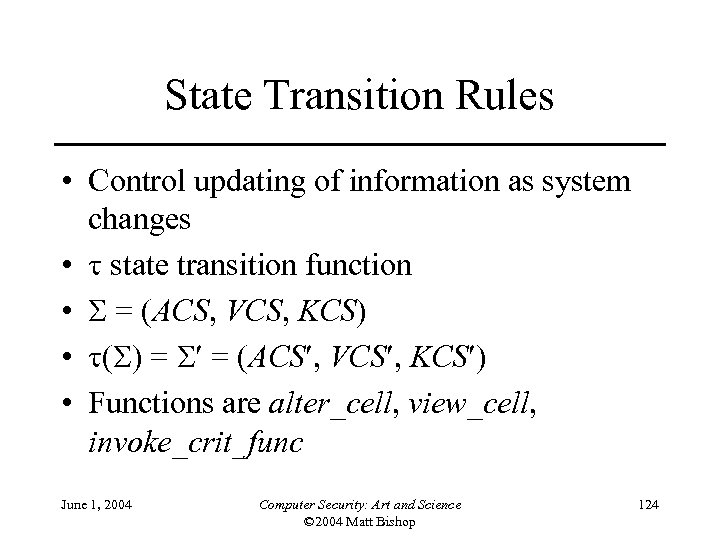
State Transition Rules • Control updating of information as system changes • state transition function • = (ACS, VCS, KCS) • ( ) = = (ACS , VCS , KCS ) • Functions are alter_cell, view_cell, invoke_crit_func June 1, 2004 Computer Security: Art and Science © 2004 Matt Bishop 124
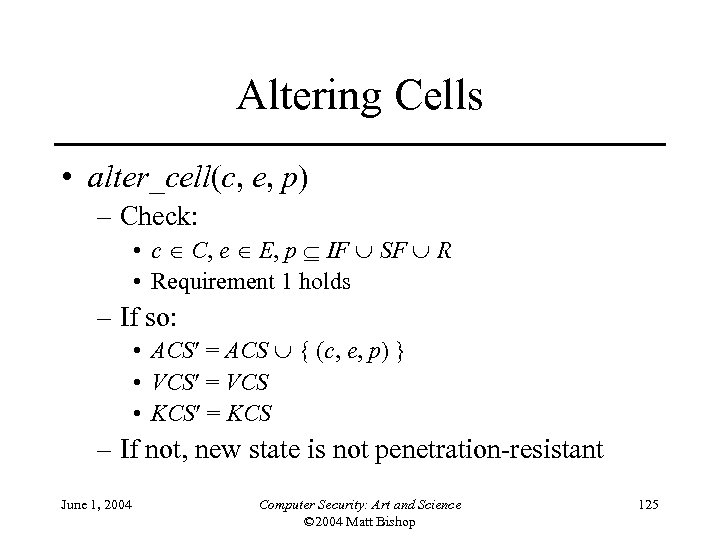
Altering Cells • alter_cell(c, e, p) – Check: • c C, e E, p IF SF R • Requirement 1 holds – If so: • ACS = ACS { (c, e, p) } • VCS = VCS • KCS = KCS – If not, new state is not penetration-resistant June 1, 2004 Computer Security: Art and Science © 2004 Matt Bishop 125
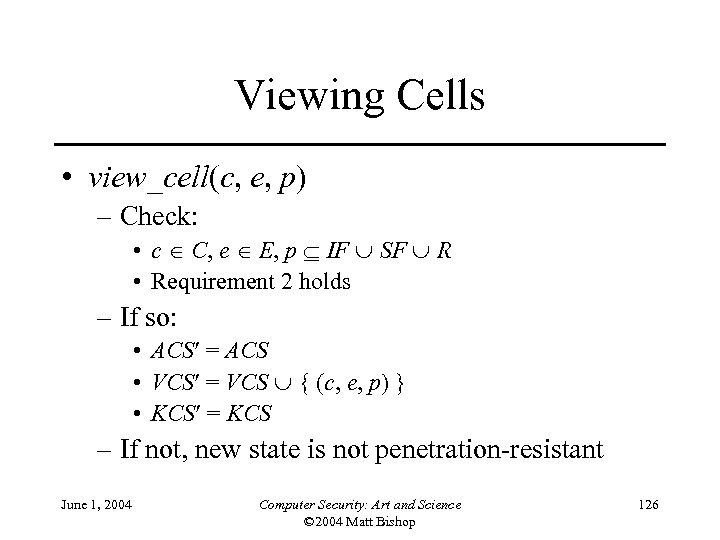
Viewing Cells • view_cell(c, e, p) – Check: • c C, e E, p IF SF R • Requirement 2 holds – If so: • ACS = ACS • VCS = VCS { (c, e, p) } • KCS = KCS – If not, new state is not penetration-resistant June 1, 2004 Computer Security: Art and Science © 2004 Matt Bishop 126
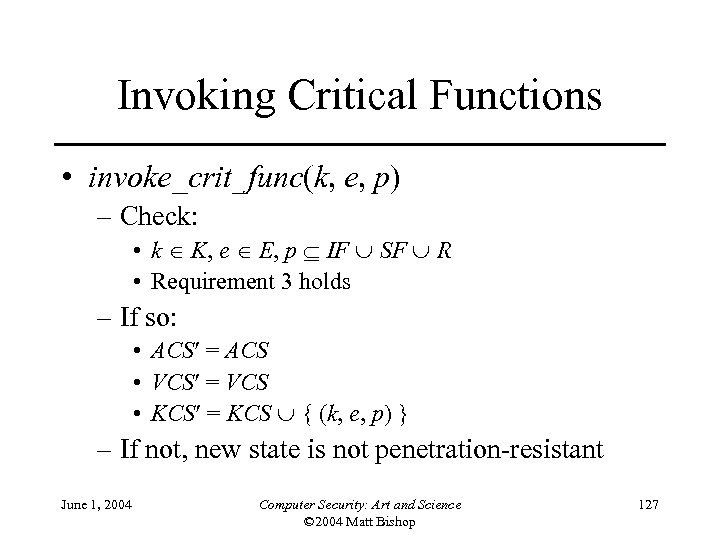
Invoking Critical Functions • invoke_crit_func(k, e, p) – Check: • k K, e E, p IF SF R • Requirement 3 holds – If so: • ACS = ACS • VCS = VCS • KCS = KCS { (k, e, p) } – If not, new state is not penetration-resistant June 1, 2004 Computer Security: Art and Science © 2004 Matt Bishop 127
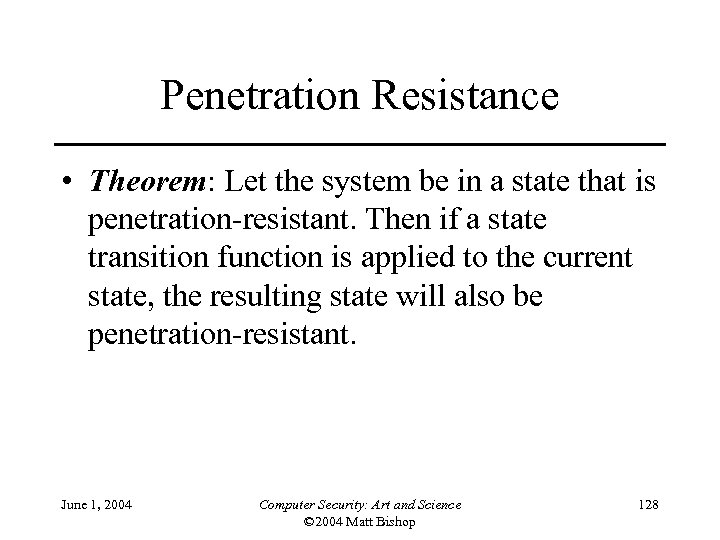
Penetration Resistance • Theorem: Let the system be in a state that is penetration-resistant. Then if a state transition function is applied to the current state, the resulting state will also be penetration-resistant. June 1, 2004 Computer Security: Art and Science © 2004 Matt Bishop 128
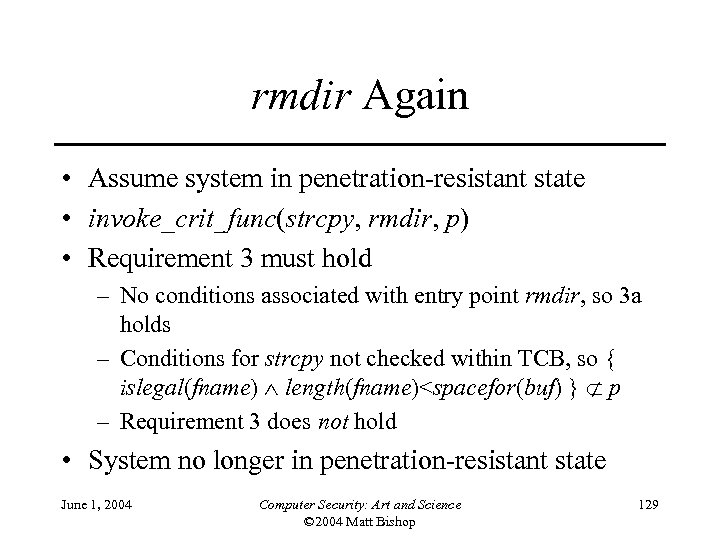
rmdir Again • Assume system in penetration-resistant state • invoke_crit_func(strcpy, rmdir, p) • Requirement 3 must hold – No conditions associated with entry point rmdir, so 3 a holds – Conditions for strcpy not checked within TCB, so { islegal(fname) length(fname)<spacefor(buf) } p – Requirement 3 does not hold • System no longer in penetration-resistant state June 1, 2004 Computer Security: Art and Science © 2004 Matt Bishop 129
Automated Penetration Analysis Tool • APA performed this testing automatically – Primitive flow generator reduces statements to Prolog facts recording needed information – Information flow integrator, function flow integrator integrate execution path derived from primitive flow statements – Condition set consistency prover analyzes conditions along execution path, reports inconsistencies – Flaw decision module determines whether conditions for each entry point correspond to penetration-resistant specs (applies Hypothesis of Penetration Patterns) June 1, 2004 Computer Security: Art and Science © 2004 Matt Bishop 130
Questions • Can this technique be generalized to types of flaws other than consistency checking? • Can this theory be generalized to classify vulnerabilities? June 1, 2004 Computer Security: Art and Science © 2004 Matt Bishop 131
Summary • Classification schemes requirements – Decision procedure for classifying vulnerability – Each vulnerability should have unique classification • Above schemes do not meet these criteria – Inconsistent among different levels of abstraction – Point of view affects classification June 1, 2004 Computer Security: Art and Science © 2004 Matt Bishop 132
Key Points • Given large numbers of non-secure systems in use now, unrealistic to expect less vulnerable systems to replace them • Penetration studies are effective tests of systems provided the test goals are known and tests are structured well • Vulnerability classification schemes aid in flaw generalization and hypothesis June 1, 2004 Computer Security: Art and Science © 2004 Matt Bishop 133
Скачать презентацию Chapter 23 Vulnerability Analysis Background
582e0543bc702d5d3ca0ce427c2ce61e.ppt