 Скачать презентацию Chapter 23 Price Adjustments and Balance-of Payments Disequilibrium
6f7551f85cde10b6592c18b9ee16477c.ppt
- Количество слайдов: 33



Chapter 23 Price Adjustments and Balance-of. Payments Disequilibrium Mc. Graw-Hill/Irwin Copyright © 2010 by The Mc. Graw-Hill Companies, Inc. All rights reserved. 23 -1
Learning Objectives • Explain how changes in the exchange rate affect the movement of goods and services and the trade balances of countries. • Discuss how price elasticity of demand relates to the stability of foreign exchange markets. • Summarize how the price adjustment mechanism functions under a system of fixed or pegged exchange rates. 23 -2
The Price Adjustment Process and the Current Account Under A Flexible Rate System § A depreciation of the home currency causes foreign goods to become more expensive, reducing consumption of imports relative to domestic alternatives. § A depreciation makes the home country’s exports seem cheaper, so the trading partner switches expenditure towards home products. § This process is expenditure switching. 23 -3
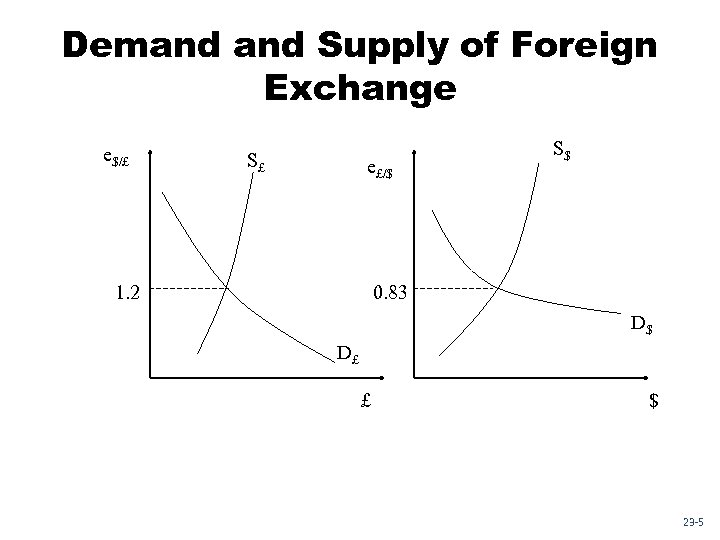
Demand for Foreign Goods and Services and the Foreign Exchange Market § Demand foreign exchange is derived from demand for goods and services. § Demand for imports depends on price of foreign goods or services, tariffs or subsidies, prices of domestic substitutes and complements, domestic income, and tastes. § Demand foreign currency by home country is also supply of foreign currency to the foreign country. 23 -4
Demand Supply of Foreign Exchange e$/£ S£ e£/$ 1. 2 S$ 0. 83 D$ D£ £ $ 23 -5
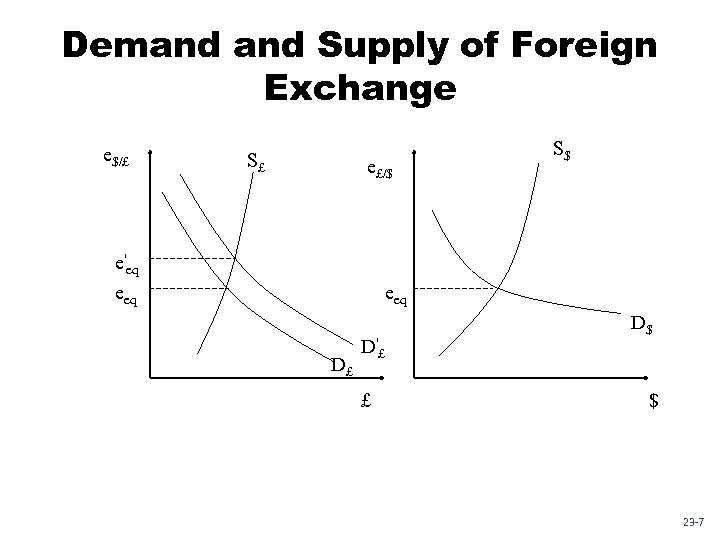
Demand Supply of Foreign Exchange § With normally shaped supply and demand curves, the market foreign exchange is stable. § If U. S. income rises, demand for imports rises and so does demand foreign exchange. § The rightward shift of the demand foreign exchange creates a current account deficit and an increase in the price of pounds (a depreciation of the dollar). 23 -6
Demand Supply of Foreign Exchange e$/£ S£ e£/$ S$ e'eq eeq D£ D'£ £ D$ $ 23 -7
Demand Supply of Foreign Exchange § If U. S. prices increase relative to British prices: § U. S. consumers demand more British products, increasing demand for pounds. § British consumers demand fewer U. S. products, decreasing the supply of pounds. § The overall effect is an increase in the dollar price of pounds. 23 -8
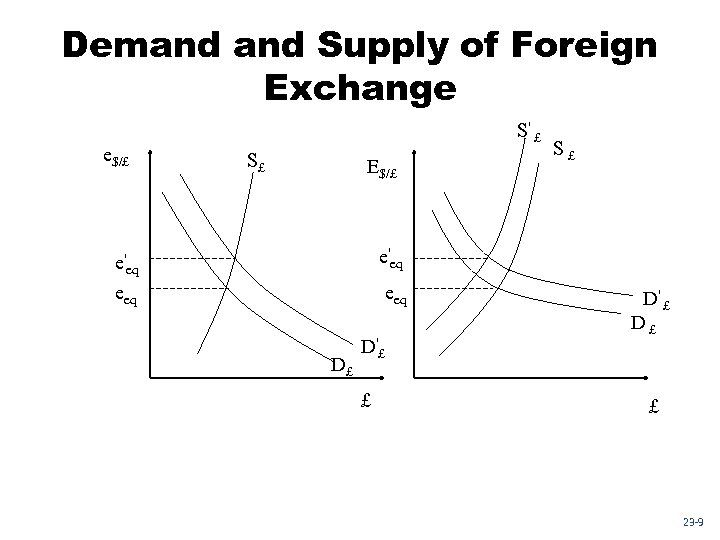
Demand Supply of Foreign Exchange e$/£ S' £ S£ E$/£ e'eq eeq S£ D£ D'£ £ D' £ D£ £ 23 -9
Market Stability and the Price Adjustment Mechanism § This price adjustment depends on the slope of the supply and demand curves foreign exchange. § Supply curves can be backwardsloping. § If supply curve is steeper than demand curve, the market is still stable. § If supply curve is flatter than demand curve, the market is unstable. 23 -10
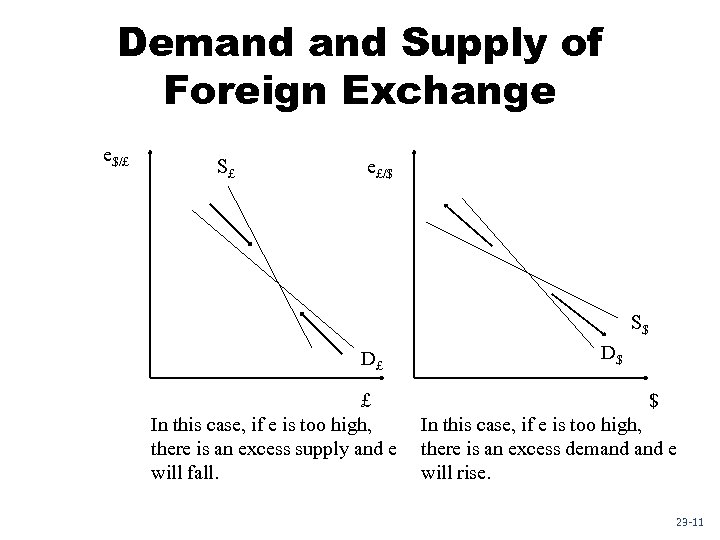
Demand Supply of Foreign Exchange e$/£ S£ e£/$ S$ D£ £ In this case, if e is too high, there is an excess supply and e will fall. D$ $ In this case, if e is too high, there is an excess demand e will rise. 23 -11
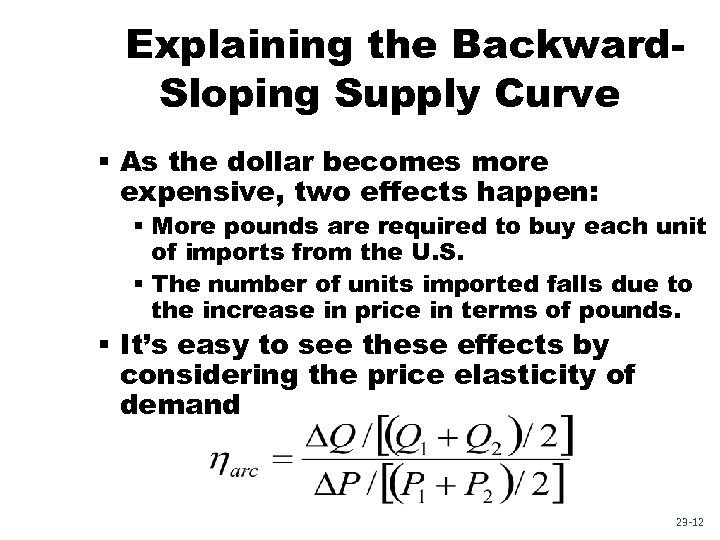
Explaining the Backward. Sloping Supply Curve § As the dollar becomes more expensive, two effects happen: § More pounds are required to buy each unit of imports from the U. S. § The number of units imported falls due to the increase in price in terms of pounds. § It’s easy to see these effects by considering the price elasticity of demand 23 -12
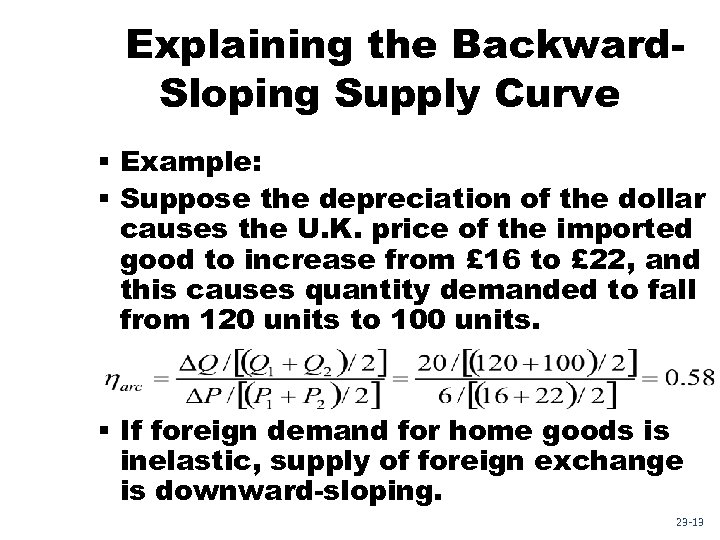
Explaining the Backward. Sloping Supply Curve § Example: § Suppose the depreciation of the dollar causes the U. K. price of the imported good to increase from £ 16 to £ 22, and this causes quantity demanded to fall from 120 units to 100 units. § If foreign demand for home goods is inelastic, supply of foreign exchange is downward-sloping. 23 -13
Exchange Market Stability: The Marshall-Lerner Condition § If home-country demand is elastic, a depreciation will improve the current account balance. § The increased price of imports reduces total expenditures on imports and the reduced price of exports to foreigners causes an increase in their expenditures. § If home-country demand is inelastic, a depreciation will have an ambiguous effect on the current account balance. § The increased price of imports will increase total expenditures on imports, possibly offsetting the foreign country’s increased expenditures on exports. 23 -14
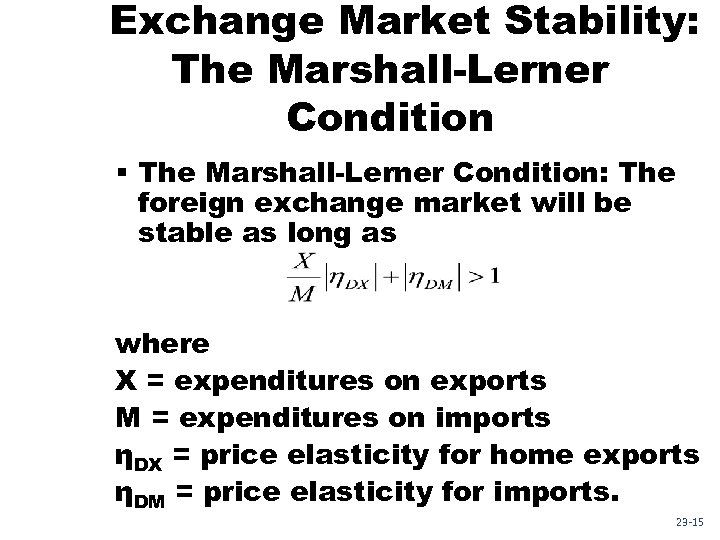
Exchange Market Stability: The Marshall-Lerner Condition § The Marshall-Lerner Condition: The foreign exchange market will be stable as long as where X = expenditures on exports M = expenditures on imports ηDX = price elasticity for home exports ηDM = price elasticity for imports. 23 -15
Exchange Market Stability: The Marshall-Lerner Condition § Some empirical studies suggest these demand elasticities may be low. § However, the general consensus is that these elasticities are large enough that the foreign exchange market is stable. 23 -16
Price Adjustment Process: Short Run vs. Long Run § When the Marshall-Lerner condition holds, changes in the exchange rate bring about appropriate switches in expenditures between domestic and foreign goods. § A home currency depreciation leads to a substitution of domestic goods for imports. § A home currency depreciation causes foreigners to switch to home country exports. 23 -17
Price Adjustment Process: Short Run vs. Long Run § Short-run elasticities of supply and demand tend to be smaller in absolute value than long-run elasticities. § Consumers don’t adjust immediately to relative price changes; it’s not unusual for the quantity demanded of imports and the amount of foreign exchange needed to not respond to changes in the exchange rate. § The supply of exports may not adjust immediately in response to changes in exchange rates due to lags in recognition, decision-making, production, and delivery. 23 -18
Price Adjustment Process: The J-Curve § If the short-run elasticities are low, the market foreign exchange may be unstable. § A depreciation may initially lead to a further depreciation, since demand for the foreign currency outstrips supply. § Therefore the current account deficit worsens. § Eventually, the current account deficit shrinks and a new equilibrium is attained. 23 -19
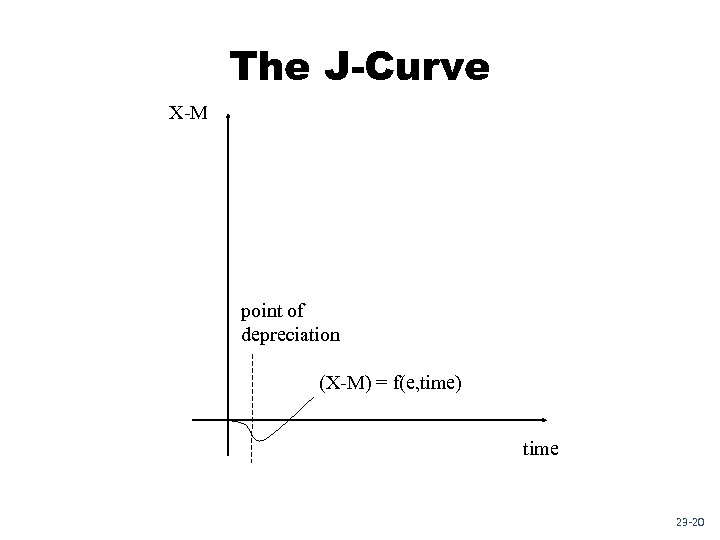
The J-Curve X-M point of depreciation (X-M) = f(e, time) time 23 -20
Price Adjustment Mechanism in a Fixed Exchange Rate System § Rather than allowing the foreign exchange market to determine the value of foreign exchange, countries sometimes fix or “peg” the value of their currencies. 23 -21
Price Adjustment Mechanism with the Gold Standard § From 1880 to 1914, countries pegged their currencies to gold. § This fixes countries’ exchange rates with each other. § For example, if the dollar is fixed at $100 per ounce and the pound is fixed at £ 50 per ounce, the “mint par” exchange rate is $2/£. § Governments must be prepared to maintain the gold price by buying and selling gold at the set price. 23 -22
Price Adjustment Mechanism with the Gold Standard § Since the exchange rate is fixed, some other mechanism must be in force to balance demand for and supply of foreign exchange. § These “rules of the game” are assumed to hold: § no restraints on buying/selling gold within countries; gold can move freely between countries, § money supply is allowed to change if a country’s gold holdings change, and § prices/wages are flexible. 23 -23
Price Adjustment Mechanism with the Gold Standard § Suppose an increase in U. S. income causes an increased demand for pounds. § There will be upward pressure on the exchange rate to eliminate the excess demand for pounds. § Buyers/sellers know that governments stand ready to buy/sell pounds at mint par, using gold as medium of exchange. § Since it is costly to ship gold, the exchange rate can vary slightly from mint par. 23 -24
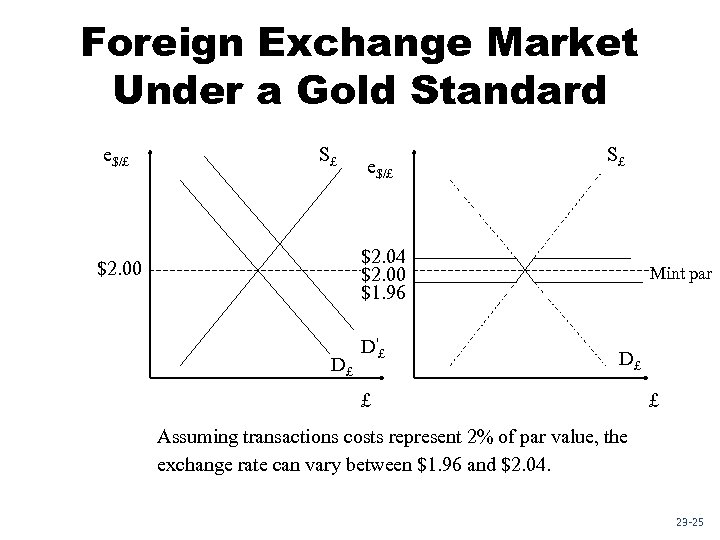
Foreign Exchange Market Under a Gold Standard e$/£ S£ $2. 04 $2. 00 $1. 96 $2. 00 D£ D'£ Mint par D£ £ £ Assuming transactions costs represent 2% of par value, the exchange rate can vary between $1. 96 and $2. 04. 23 -25
Price Adjustment Mechanism with the Gold Standard § Americans never need to pay more than $2. 04/£, since an unlimited supply of pounds can be obtained at this price. § This price is called the gold export point. § The British never need to receive fewer than $1. 96/£, since at that point gold will begin to move to the U. S. to be exchanged for dollars. § This price is called the gold import point. 23 -26
Price Adjustment Mechanism with the Gold Standard § The exchange rate can vary in between these narrow bands. § Prices cannot adjust through exchange rate changes. § Instead, prices adjust through changes in the money supply. 23 -27
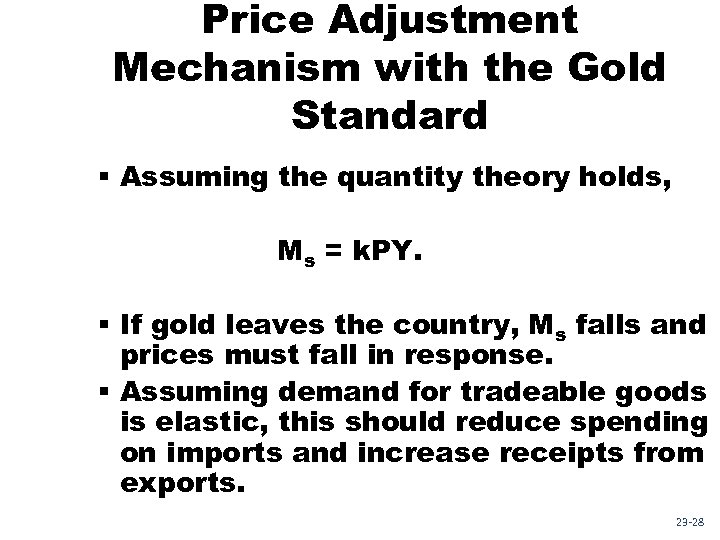
Price Adjustment Mechanism with the Gold Standard § Assuming the quantity theory holds, Ms = k. PY. § If gold leaves the country, Ms falls and prices must fall in response. § Assuming demand for tradeable goods is elastic, this should reduce spending on imports and increase receipts from exports. 23 -28
Price Adjustment Mechanism with the Gold Standard § The price adjustment mechanism under the gold standard is triggered by changes in the money supply related to flows of gold. § This adjustment depends on flexible wages and prices – any rigidities will hinder adjustment. § Other adjustment may occur due the effects of changes in the money supply on interest rates and income. § The gold standard works to keep inflation in check. 23 -29
Price Adjustment Mechanism with a Pegged Rate System § A country can also fix its exchange rate without reference to the value of gold. § The central bank must be ready to buy foreign currency when the domestic currency is strong, and sell foreign currency when the domestic currency is weak. § Central banks must hold a sufficient supply of foreign currencies. 23 -30
Price Adjustment Mechanism with a Pegged Rate System § The adjustment effects of such a system are similar to a gold standard. § Upward pressure on the exchange rate caused by an increase in demand foreign exchange will cause the central bank to sell foreign exchange. § This reduces the money supply, thereby triggering adjustments to interest rates, income, and prices. 23 -31
Price Adjustment Mechanism with a Pegged Rate System § Similarly, downward pressure on the exchange rate caused by an increase in the supply of foreign exchange will cause the central bank to buy foreign exchange. § This increases the money supply, thereby triggering adjustments to interest rates, income, and prices. 23 -32
Price Adjustment Mechanism with a Pegged Rate System § For these adjustments to occur, the central bank must allow the actions taken in the foreign exchange markets to affect the domestic money supply. § Bottom line: when a country adopts a fixed exchange rate system, its central bank loses effective control over the money supply as a policy tool. 23 -33
Скачать презентацию Chapter 23 Price Adjustments and Balance-of Payments Disequilibrium
6f7551f85cde10b6592c18b9ee16477c.ppt