 Скачать презентацию Chapter 23 Minimum Spanning Trees Problem
ff39009276f6f3ece216fa09a732a79e.ppt
- Количество слайдов: 24



Chapter 23. Minimum Spanning Trees
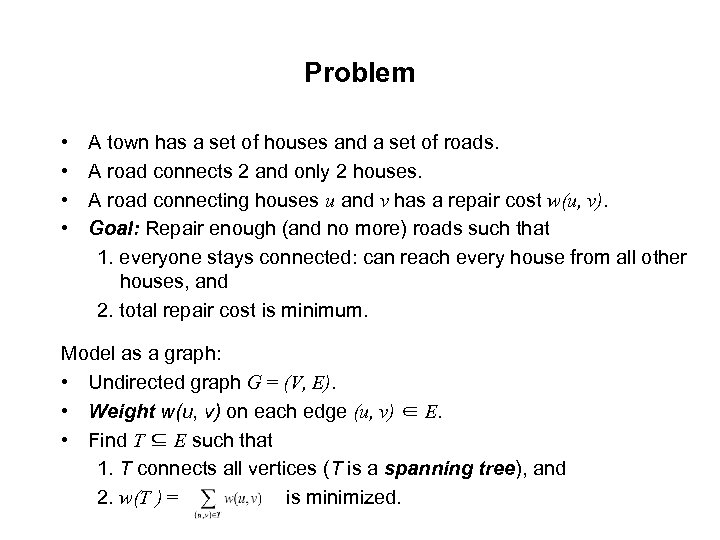
Problem • • A town has a set of houses and a set of roads. A road connects 2 and only 2 houses. A road connecting houses u and v has a repair cost w(u, v). Goal: Repair enough (and no more) roads such that 1. everyone stays connected: can reach every house from all other houses, and 2. total repair cost is minimum. Model as a graph: • Undirected graph G = (V, E). • Weight w(u, v) on each edge (u, v) ∈ E. • Find T ⊆ E such that 1. T connects all vertices (T is a spanning tree), and 2. w(T ) = is minimized.
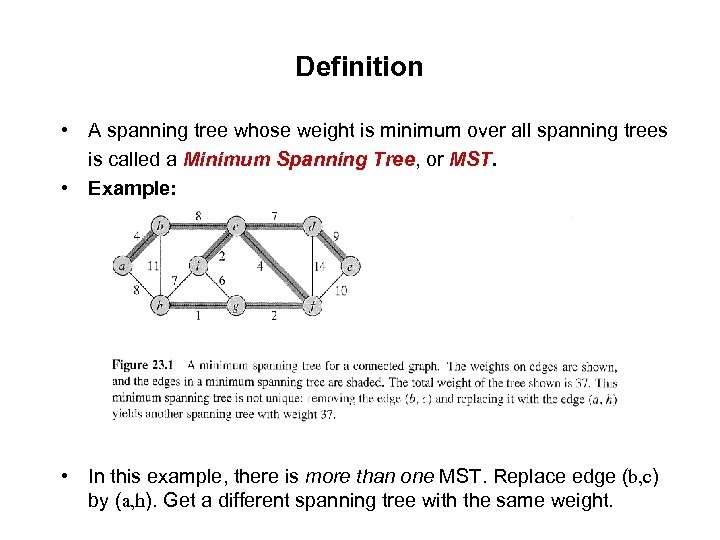
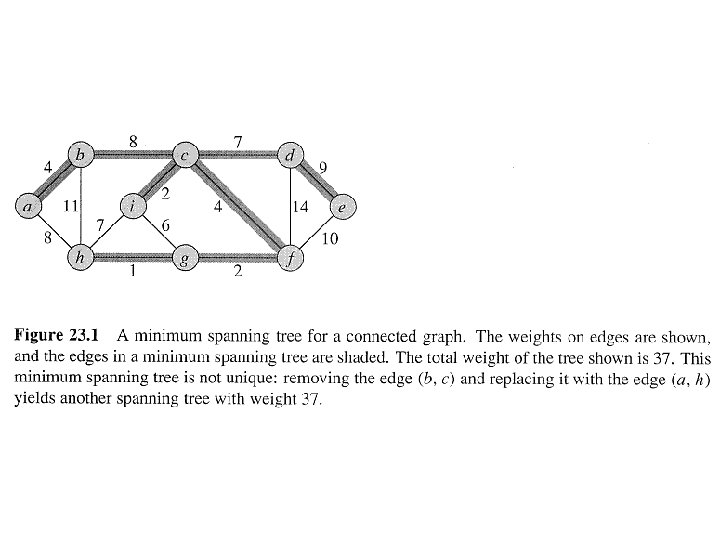
Definition • A spanning tree whose weight is minimum over all spanning trees is called a Minimum Spanning Tree, or MST. • Example: • In this example, there is more than one MST. Replace edge (b, c) by (a, h). Get a different spanning tree with the same weight.
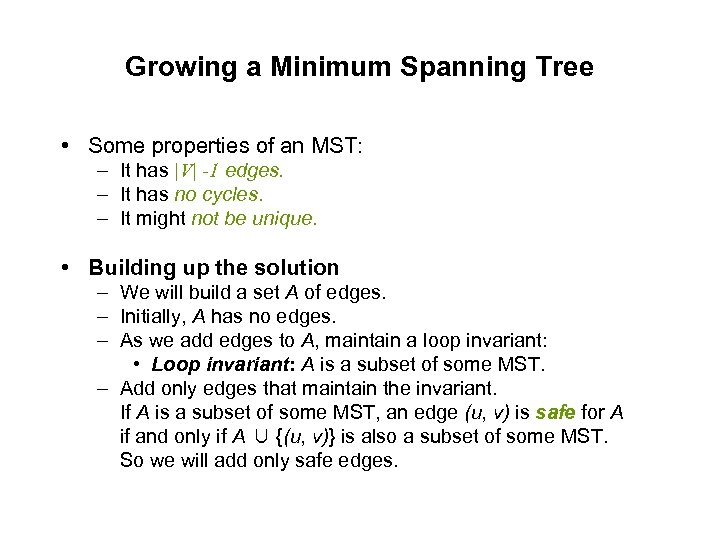
Growing a Minimum Spanning Tree • Some properties of an MST: – It has |V| -1 edges. – It has no cycles. – It might not be unique. • Building up the solution – We will build a set A of edges. – Initially, A has no edges. – As we add edges to A, maintain a loop invariant: • Loop invariant: A is a subset of some MST. – Add only edges that maintain the invariant. If A is a subset of some MST, an edge (u, v) is safe for A if and only if A ∪ {(u, v)} is also a subset of some MST. So we will add only safe edges.
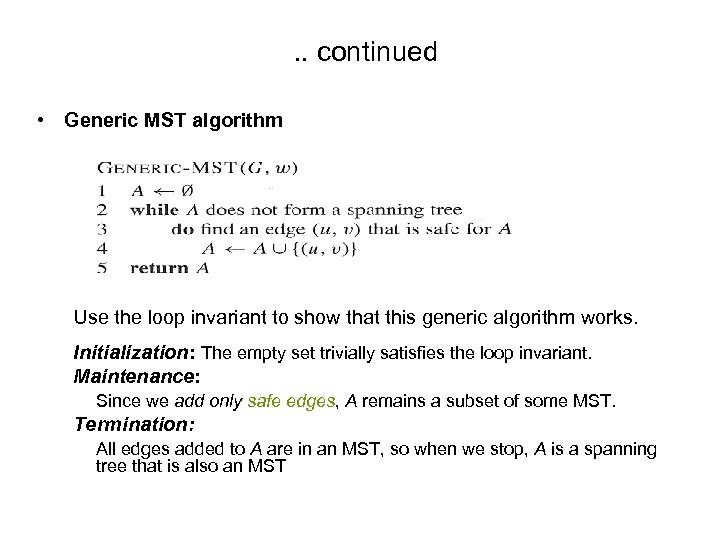
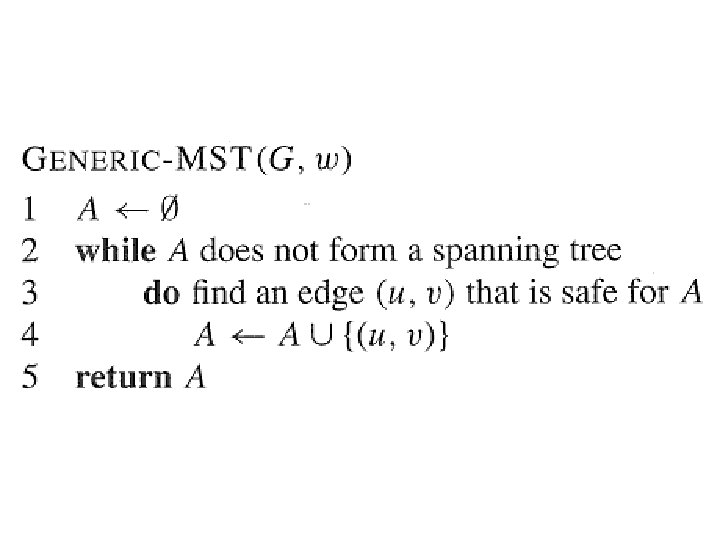
. . continued • Generic MST algorithm Use the loop invariant to show that this generic algorithm works. Initialization: The empty set trivially satisfies the loop invariant. Maintenance: Since we add only safe edges, A remains a subset of some MST. Termination: All edges added to A are in an MST, so when we stop, A is a spanning tree that is also an MST
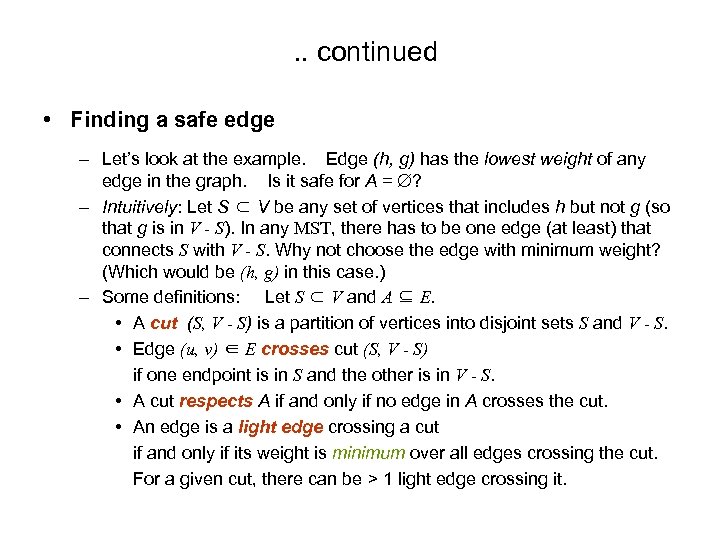
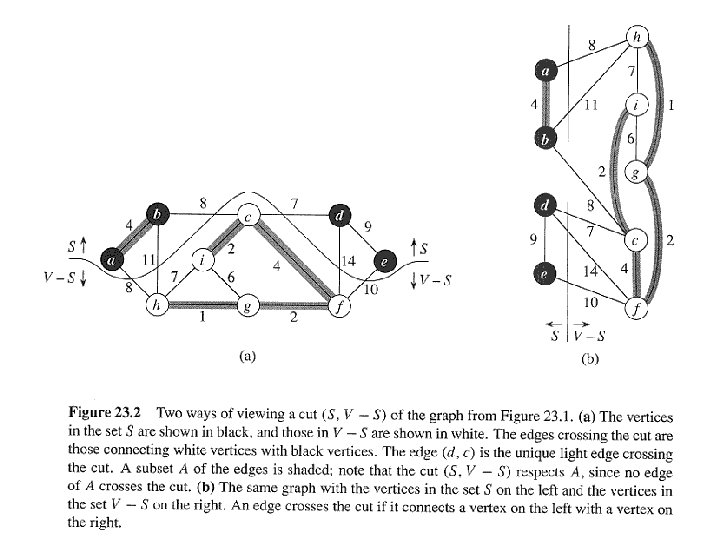
. . continued • Finding a safe edge – Let’s look at the example. Edge (h, g) has the lowest weight of any edge in the graph. Is it safe for A = ? – Intuitively: Let S ⊂ V be any set of vertices that includes h but not g (so that g is in V S). In any MST, there has to be one edge (at least) that connects S with V S. Why not choose the edge with minimum weight? (Which would be (h, g) in this case. ) – Some definitions: Let S ⊂ V and A ⊆ E. • A cut (S, V S) is a partition of vertices into disjoint sets S and V - S. • Edge (u, v) ∈ E crosses cut (S, V S) if one endpoint is in S and the other is in V S. • A cut respects A if and only if no edge in A crosses the cut. • An edge is a light edge crossing a cut if and only if its weight is minimum over all edges crossing the cut. For a given cut, there can be > 1 light edge crossing it.
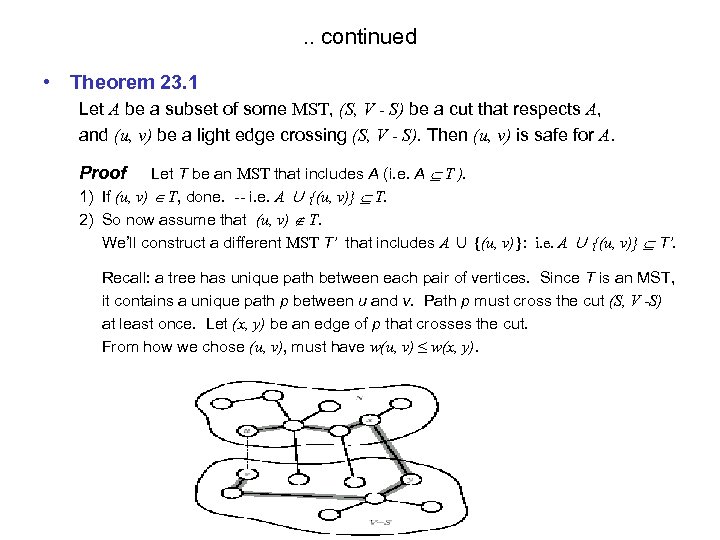
. . continued • Theorem 23. 1 Let A be a subset of some MST, (S, V - S) be a cut that respects A, and (u, v) be a light edge crossing (S, V S). Then (u, v) is safe for A. Let T be an MST that includes A (i. e. A T ). 1) If (u, v) T, done. -- i. e. A ∪ {(u, v)} T. 2) So now assume that (u, v) T. We’ll construct a different MST T’ that includes A ∪ {(u, v)}: i. e. A ∪ {(u, v)} T’. Proof Recall: a tree has unique path between each pair of vertices. Since T is an MST, it contains a unique path p between u and v. Path p must cross the cut (S, V S) at least once. Let (x, y) be an edge of p that crosses the cut. From how we chose (u, v), must have w(u, v) ≤ w(x, y).
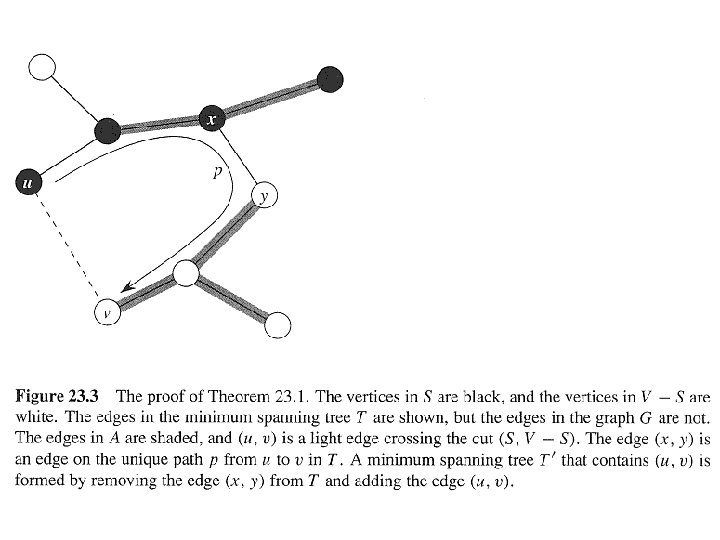
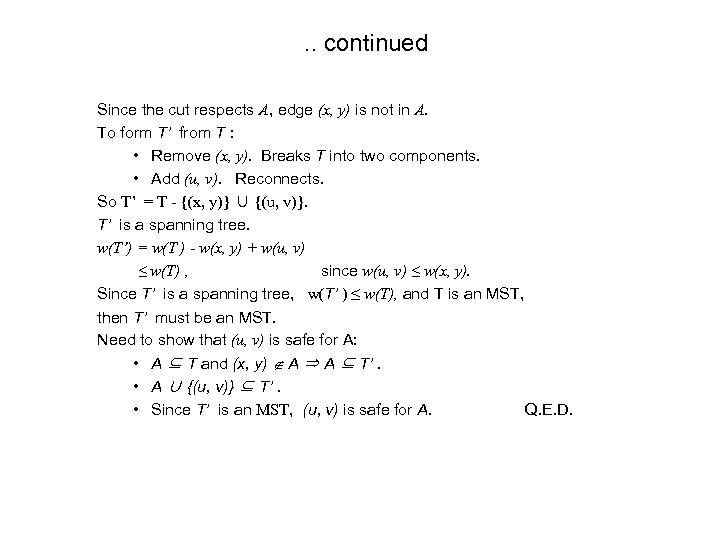
. . continued Since the cut respects A, edge (x, y) is not in A. To form T’ from T : • Remove (x, y). Breaks T into two components. • Add (u, v). Reconnects. So T’ = T {(x, y)} ∪ {(u, v)}. T’ is a spanning tree. w(T’) = w(T ) - w(x, y) + w(u, v) ≤ w(T) , since w(u, v) ≤ w(x, y). Since T’ is a spanning tree, w(T’ ) ≤ w(T), and T is an MST, then T’ must be an MST. Need to show that (u, v) is safe for A: • A ⊆ T and (x, y) A ⇒ A ⊆ T’. • A ∪ {(u, v)} ⊆ T’. • Since T’ is an MST, (u, v) is safe for A. Q. E. D.
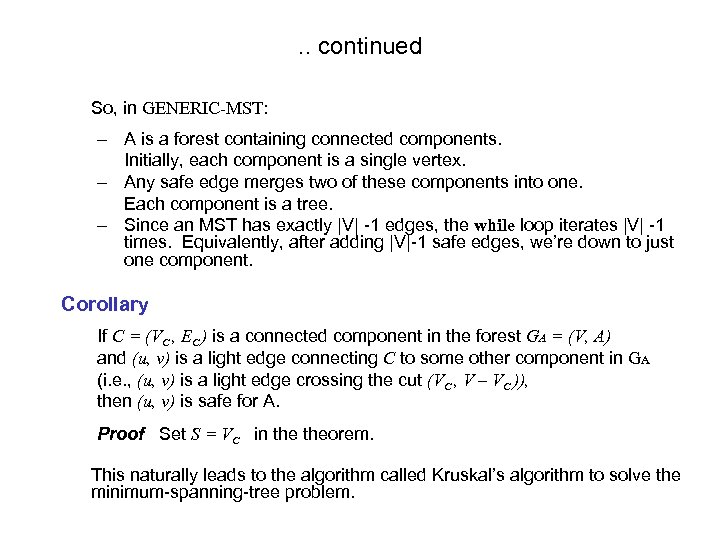
. . continued So, in GENERIC MST: – A is a forest containing connected components. Initially, each component is a single vertex. – Any safe edge merges two of these components into one. Each component is a tree. – Since an MST has exactly |V| -1 edges, the while loop iterates |V| -1 times. Equivalently, after adding |V|-1 safe edges, we’re down to just one component. Corollary If C = (VC , EC ) is a connected component in the forest GA = (V, A) and (u, v) is a light edge connecting C to some other component in GA (i. e. , (u, v) is a light edge crossing the cut (VC , V – VC )), then (u, v) is safe for A. Proof Set S = VC in theorem. This naturally leads to the algorithm called Kruskal’s algorithm to solve the minimum-spanning-tree problem.
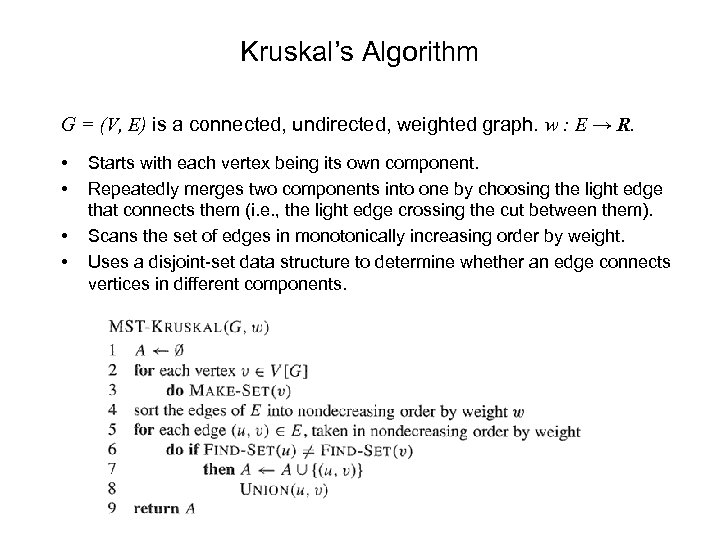
Kruskal’s Algorithm G = (V, E) is a connected, undirected, weighted graph. w : E → R. • • Starts with each vertex being its own component. Repeatedly merges two components into one by choosing the light edge that connects them (i. e. , the light edge crossing the cut between them). Scans the set of edges in monotonically increasing order by weight. Uses a disjoint-set data structure to determine whether an edge connects vertices in different components.
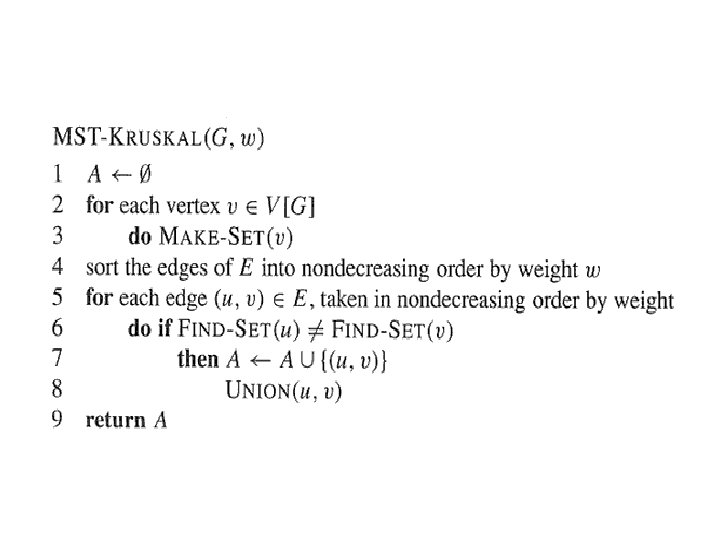
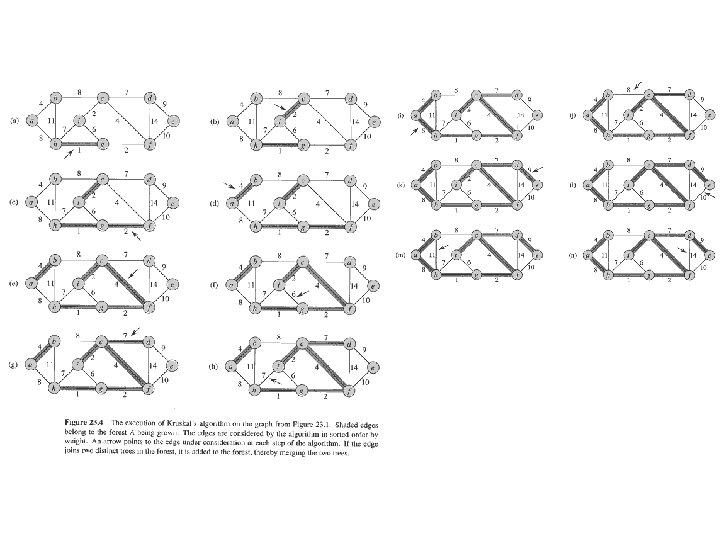
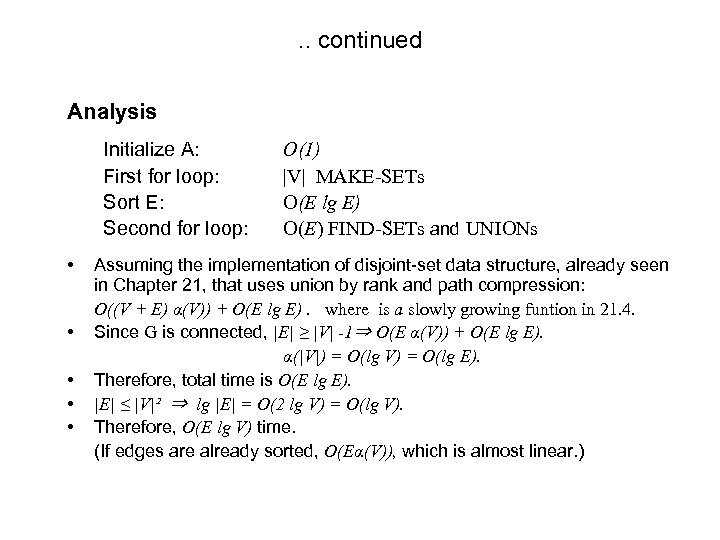
. . continued Analysis Initialize A: First for loop: Sort E: Second for loop: • • • O(1) |V| MAKE SETs O(E lg E) O(E) FIND SETs and UNIONs Assuming the implementation of disjoint-set data structure, already seen in Chapter 21, that uses union by rank and path compression: O((V + E) α(V)) + O(E lg E). where is a slowly growing funtion in 21. 4. Since G is connected, |E| ≥ |V| -1⇒ O(E α(V)) + O(E lg E). α(|V|) = O(lg V) = O(lg E). Therefore, total time is O(E lg E). |E| ≤ |V|² ⇒ lg |E| = O(2 lg V) = O(lg V). Therefore, O(E lg V) time. (If edges are already sorted, O(Eα(V)), which is almost linear. )
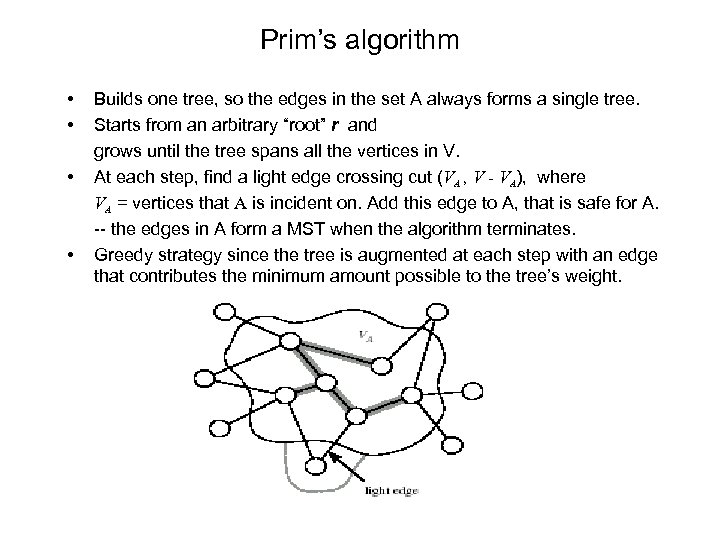
Prim’s algorithm • • Builds one tree, so the edges in the set A always forms a single tree. Starts from an arbitrary “root” r and grows until the tree spans all the vertices in V. At each step, find a light edge crossing cut (VA , V - VA), where VA = vertices that A is incident on. Add this edge to A, that is safe for A. -- the edges in A form a MST when the algorithm terminates. Greedy strategy since the tree is augmented at each step with an edge that contributes the minimum amount possible to the tree’s weight.
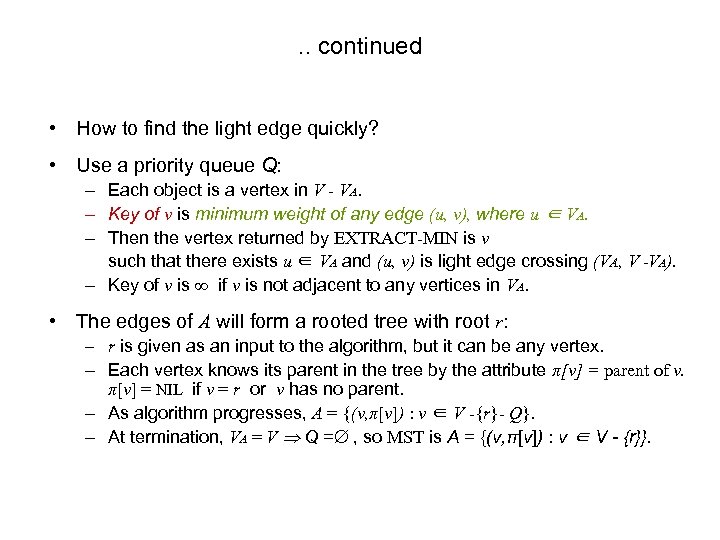
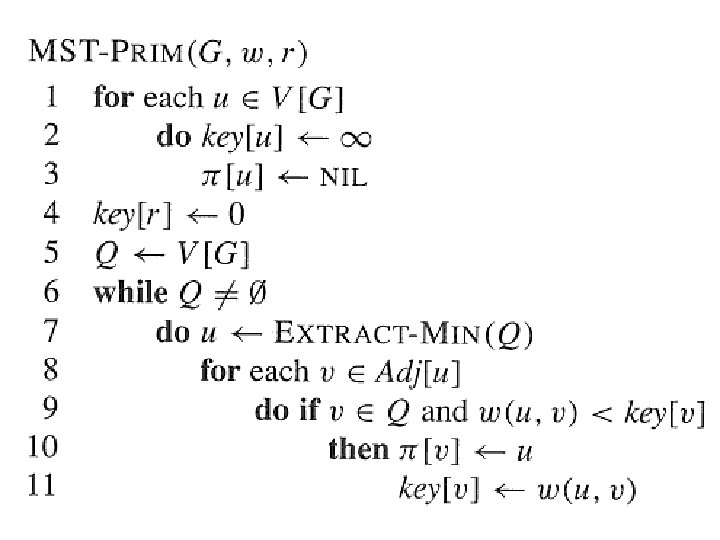
. . continued • How to find the light edge quickly? • Use a priority queue Q: – Each object is a vertex in V VA. – Key of v is minimum weight of any edge (u, v), where u ∈ VA. – Then the vertex returned by EXTRACT MIN is v such that there exists u ∈ VA and (u, v) is light edge crossing (VA, V VA). – Key of v is if v is not adjacent to any vertices in VA. • The edges of A will form a rooted tree with root r: – r is given as an input to the algorithm, but it can be any vertex. – Each vertex knows its parent in the tree by the attribute π[v] = parent of v. π[v] = NIL if v = r or v has no parent. – As algorithm progresses, A = {(v, π[v]) : v ∈ V -{r} Q}. – At termination, VA = V Q = , so MST is A = {(v, π[v]) : v ∈ V - {r}}.
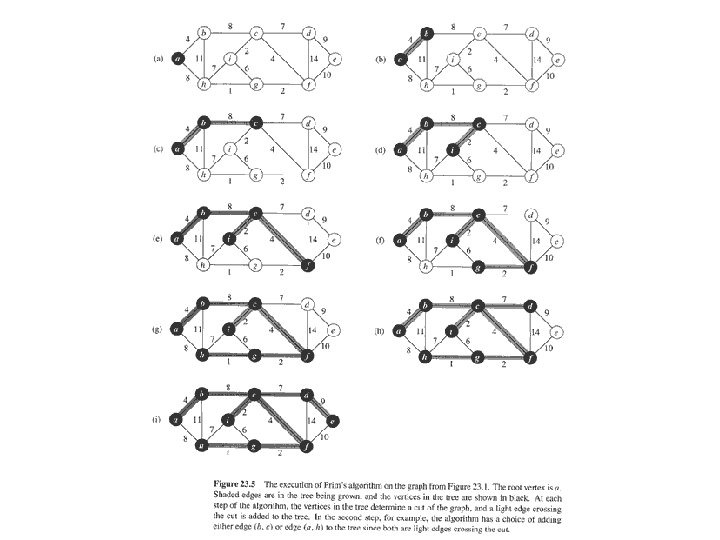
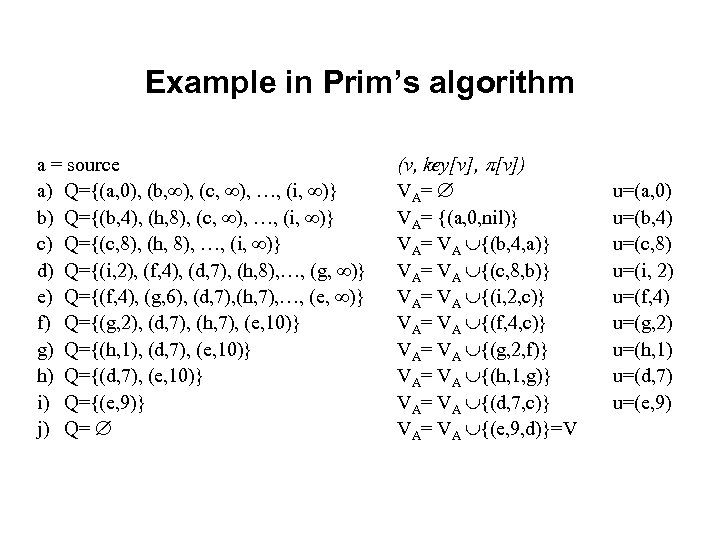
Example in Prim’s algorithm a = source a) Q={(a, 0), (b, ∞), (c, ∞), …, (i, ∞)} b) Q={(b, 4), (h, 8), (c, ∞), …, (i, ∞)} c) Q={(c, 8), (h, 8), …, (i, ∞)} d) Q={(i, 2), (f, 4), (d, 7), (h, 8), …, (g, ∞)} e) Q={(f, 4), (g, 6), (d, 7), (h, 7), …, (e, ∞)} f) Q={(g, 2), (d, 7), (h, 7), (e, 10)} g) Q={(h, 1), (d, 7), (e, 10)} h) Q={(d, 7), (e, 10)} i) Q={(e, 9)} j) Q= (v, key[v], [v]) VA= {(a, 0, nil)} VA= VA {(b, 4, a)} VA= VA {(c, 8, b)} VA= VA {(i, 2, c)} VA= VA {(f, 4, c)} VA= VA {(g, 2, f)} VA= VA {(h, 1, g)} VA= VA {(d, 7, c)} VA= VA {(e, 9, d)}=V u=(a, 0) u=(b, 4) u=(c, 8) u=(i, 2) u=(f, 4) u=(g, 2) u=(h, 1) u=(d, 7) u=(e, 9)
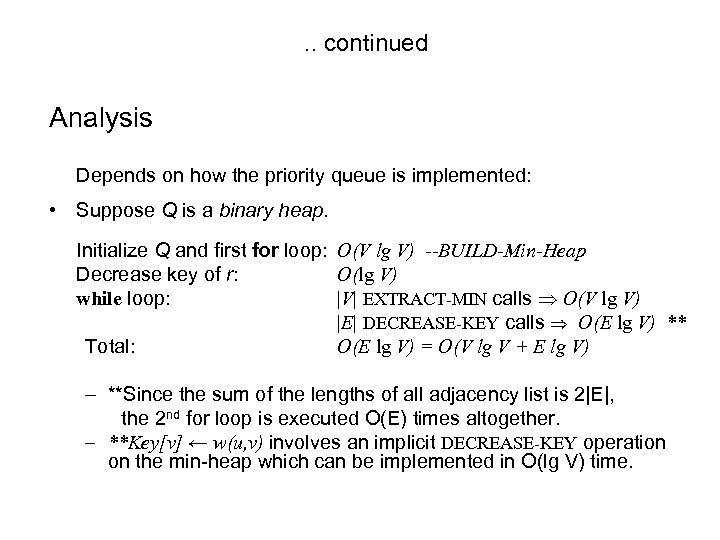
. . continued Analysis Depends on how the priority queue is implemented: • Suppose Q is a binary heap. Initialize Q and first for loop: O(V lg V) --BUILD-Min-Heap Decrease key of r: O(lg V) while loop: |V| EXTRACT MIN calls O(V lg V) |E| DECREASE KEY calls O(E lg V) ** Total: O(E lg V) = O(V lg V + E lg V) – **Since the sum of the lengths of all adjacency list is 2|E|, the 2 nd for loop is executed O(E) times altogether. – **Key[v] ← w(u, v) involves an implicit DECREASE KEY operation on the min-heap which can be implemented in O(lg V) time.
 Скачать презентацию Chapter 23 Minimum Spanning Trees Problem
ff39009276f6f3ece216fa09a732a79e.ppt