


 Скачать презентацию Chapter 21 Term Loans and Leases 21 1
b17b6109d264af17909d0234d674a4ce.ppt
- Количество слайдов: 38
 Chapter 21 Term Loans and Leases 21. 1 Van Horne and Wachowicz, Fundamentals of Financial Management, 13 th edition. © Pearson Education Limited 2009. Created by Gregory Kuhlemeyer.
 After Studying Chapter 21, you should be able to: 1. 2. 3. 4. 5. 21. 2 Describe various types of term loans and discuss the costs and benefits of each. Discuss the nature and the content of loan agreements, including protective (restrictive) covenants. Discuss the sources and types of equipment financing. Understand explain lease financing in its various forms. Compare lease financing with debt financing via a numerical evaluation of the present value of cash outflows. Van Horne and Wachowicz, Fundamentals of Financial Management, 13 th edition. © Pearson Education Limited 2009. Created by Gregory Kuhlemeyer.
 Term Loans and Leases • • • 21. 3 Term Loans Provisions of Loan Agreements Equipment Financing Lease Financing Evaluating Lease Financing in Relation to Debt Financing Van Horne and Wachowicz, Fundamentals of Financial Management, 13 th edition. © Pearson Education Limited 2009. Created by Gregory Kuhlemeyer.
 Term Loans Term Loan – Debt originally scheduled for repayment in more than 1 year, but generally in less than 10 years. • • Usually payments that cover both interest and principal are made quarterly, semiannually, or annually. • 21. 4 Credit is extended under a formal loan arrangement. The repayment schedule is geared to the borrower’s cash-flow ability and may be amortized or have a balloon payment. Van Horne and Wachowicz, Fundamentals of Financial Management, 13 th edition. © Pearson Education Limited 2009. Created by Gregory Kuhlemeyer.
 Costs of a Term Loan • • • 21. 5 The interest rate is higher than on a shortterm loan to the same borrower (25 to 50 basis points on a low risk borrower). Interest rates are either (1) fixed or (2) variable depending on changing market conditions – possibly with a floor or ceiling. Borrower is also required to pay legal expenses (loan agreement) and a commitment fee (25 to 75 basis points) may be imposed on the unused portion. Van Horne and Wachowicz, Fundamentals of Financial Management, 13 th edition. © Pearson Education Limited 2009. Created by Gregory Kuhlemeyer.
 Benefits of a Term Loan • • • 21. 6 The borrower can tailor a loan to their specific needs through direct negotiation with the lender. Flexibility in terms of changing needs allows the borrower to revise the loan more quickly and more easily. Term loan financing is more readily available over time making it a more dependable source of financing than, say, the capital markets. Van Horne and Wachowicz, Fundamentals of Financial Management, 13 th edition. © Pearson Education Limited 2009. Created by Gregory Kuhlemeyer.
 Revolving Credit Agreements Revolving Credit Agreement – A formal, legal commitment to extend credit up to some maximum amount over a stated period of time. • • The actual notes are usually 90 days, but the company can renew them per the agreement. • Most useful when funding needs are uncertain. • 21. 7 Agreements are frequently for three years. Many are set up so at maturity the borrower has the option of converting into a term loan. Van Horne and Wachowicz, Fundamentals of Financial Management, 13 th edition. © Pearson Education Limited 2009. Created by Gregory Kuhlemeyer.
 Insurance Company Term Loans • • These companies do not have compensating balances to generate additional revenue and usually have a prepayment penalty. • Loans must yield a return commensurate with the risks and costs involved in making the loan. • 21. 8 These term loans usually have final maturities in excess of seven years. As such, the rate is typically higher than what a bank would charge, but the term is longer. Van Horne and Wachowicz, Fundamentals of Financial Management, 13 th edition. © Pearson Education Limited 2009. Created by Gregory Kuhlemeyer.
 Medium-Term Note (MTN) – A corporate or government debt instrument that is offered to investors on a continuous basis. • Maturities range from 9 months to 30 years (or more). • Shelf registration makes it practical for corporate issuers to offer small amounts of MTNs to the public. • Issuers include finance companies, banks or bank holding companies, and industrial companies. Euro MTN – An MTN issue sold internationally outside the country in whose currency the MTN is denominated. 21. 9 Van Horne and Wachowicz, Fundamentals of Financial Management, 13 th edition. © Pearson Education Limited 2009. Created by Gregory Kuhlemeyer.
 Provisions of Loan Agreements Loan Agreement – A legal agreement specifying the terms of a loan and the obligations of the borrower. • • 21. 10 Covenant – A restriction on a borrower imposed by a lender; for example, the borrower must maintain a minimum amount of working capital. This allows the lender to act (or be “warned” early) when adverse developments are occurring that will affect the borrowing firm. Van Horne and Wachowicz, Fundamentals of Financial Management, 13 th edition. © Pearson Education Limited 2009. Created by Gregory Kuhlemeyer.
 Formulation of Provisions The important protective covenants* fall into covenants three different categories. • General provisions are used in most loan agreements, which are usually variable to fit the situation. • Routine provisions used in most loan agreements, which are usually not variable. • Specific provisions that are used according to the situation. * Restrictions are negotiated between the borrower and lender 21. 11 Van Horne and Wachowicz, Fundamentals of Financial Management, 13 th edition. © Pearson Education Limited 2009. Created by Gregory Kuhlemeyer.
 Frequent General Provisions • • Cash dividend and repurchase of common stock restriction • Capital expenditures limitation • 21. 12 Working capital requirement Limitation on other indebtedness Van Horne and Wachowicz, Fundamentals of Financial Management, 13 th edition. © Pearson Education Limited 2009. Created by Gregory Kuhlemeyer.
 Frequent Routine Provisions • • • 21. 13 Furnish financial statements and maintain adequate insurance to the lender Must not sell a significant portion of its assets and pay all liabilities as required Negative pledge clause Cannot sell or discount accounts receivable Prohibited from entering into any leasing arrangement of property Restrictions on other contingent liabilities Van Horne and Wachowicz, Fundamentals of Financial Management, 13 th edition. © Pearson Education Limited 2009. Created by Gregory Kuhlemeyer.
 Equipment Financing • • 21. 14 Loans are usually extended for more than 1 year. The lender evaluates the marketability and quality of equipment to determine the loanable percentage. Repayment schedules are designed by the lender so that the market value is expected to exceed the loan balance by a given safety margin. Trucking equipment is highly marketable, and the lender may advance as much as 80% of market value, while a limited use lathe might provide only a 40% advance or a specific use item cannot be used as collateral. Van Horne and Wachowicz, Fundamentals of Financial Management, 13 th edition. © Pearson Education Limited 2009. Created by Gregory Kuhlemeyer.
 Sources and Types of Equipment Financing Sources of financing are commercial banks, finance companies, and sellers of equipment. Types of financing 1. Chattel Mortgage – A lien on specifically identified personal property (assets other than real estate) backing a loan. • 21. 15 To perfect (make legally valid) the lien, the lender files a copy of the security agreement or a financing statement with a public office of the state in which the equipment is located. Van Horne and Wachowicz, Fundamentals of Financial Management, 13 th edition. © Pearson Education Limited 2009. Created by Gregory Kuhlemeyer.
 Sources and Types of Equipment Financing 2. Conditional Sales Contract – A means of financing provided by the seller of equipment, who holds title to it until the financing is paid off. • • • 21. 16 The buyer signs a conditional sales contract security agreement to make installment payments (usually monthly or quarterly) over time. The seller has the authority to repossess the equipment if the buyer does not meet all of the terms of the contract. The seller can sell the contract without the buyer’s consent – usually to a finance company or bank. Van Horne and Wachowicz, Fundamentals of Financial Management, 13 th edition. © Pearson Education Limited 2009. Created by Gregory Kuhlemeyer.
 Lease Financing Lease – A contract under which one party, the lessor (owner) of an asset, agrees to grant the use of that asset to another, the lessee, in exchange for periodic rental payments. Examples of familiar leases Apartments Offices 21. 17 Houses Automobiles Van Horne and Wachowicz, Fundamentals of Financial Management, 13 th edition. © Pearson Education Limited 2009. Created by Gregory Kuhlemeyer.
 Issues in Lease Financing • • • Advantage: Use of an asset without Advantage purchasing the asset Obligation: Make periodic lease payments Obligation Contract specifies who maintains the asset • • • Cancelable or noncancelable lease? • • 21. 18 Full-service lease – lessor pays maintenance Net lease – lessee pays maintenance costs Operating lease (short-term, cancellable) vs. financial lease (longer-term, noncancelable) Options at expiration to lessee Van Horne and Wachowicz, Fundamentals of Financial Management, 13 th edition. © Pearson Education Limited 2009. Created by Gregory Kuhlemeyer.
 Types of Leasing Sale and Leaseback – The sale of an asset with the agreement to immediately lease it back for an extended period of time. • • There may be a tax advantage as land is not depreciable, but the entire lease payment is a deductible expense. • 21. 19 The lessor realizes any residual value. Lessors: insurance companies, institutional Lessors investors, finance companies, and independent companies. Van Horne and Wachowicz, Fundamentals of Financial Management, 13 th edition. © Pearson Education Limited 2009. Created by Gregory Kuhlemeyer.
 Types of Leasing Direct Leasing – Under direct leasing a firm acquires the use of an asset it did not previously own. • • 21. 20 The firm often leases an asset directly from a manufacturer (e. g. , IBM leases computers and Xerox leases copiers). Lessors: manufacturers, finance companies, Lessors banks, independent leasing companies, special -purpose leasing companies, and partnerships. Van Horne and Wachowicz, Fundamentals of Financial Management, 13 th edition. © Pearson Education Limited 2009. Created by Gregory Kuhlemeyer.
 Types of Leasing Leverage Leasing – A lease arrangement in which the lessor provides an equity portion (usually 20 to 40 percent) of the leased asset’s cost and third-party lenders provide the balance of the financing. • Popular for big-ticket assets such as aircraft, oil rigs, and railway equipment. • The role of the lessor changes as the lessor is borrowing funds itself to finance the lease for the lessee (hence, leveraged lease). lease • Any residual value belongs to the lessor as well as any net cash inflows during the lease. 21 Van Horne and Wachowicz, Fundamentals of Financial Management, 13 th edition. © Pearson Education Limited 2009. Created by Gregory Kuhlemeyer.
 Accounting and Tax Treatment of Leases • • 21. 22 In the past, leases were “off-balance-sheet” items and hid the true obligations of some firms. The lessee can deduct the full lease payment in a properly structured lease. To be a “true lease” the IRS requires: 1. Lessor must have a minimum “at-risk” (inception and throughout lease) of 20% or more of the acquisition cost. 2. The remaining life of the asset at the end of the lease period must be the longer of 1 year or 20% of original estimated asset life. 3. An expected profit to the lessor from the lease contract apart from any tax benefits. Van Horne and Wachowicz, Fundamentals of Financial Management, 13 th edition. © Pearson Education Limited 2009. Created by Gregory Kuhlemeyer.
 Economic Rationale for Leasing • • Thus, leases provide a means of shifting tax benefits to companies that can fully utilize those benefits. • 21. 23 Leasing allows higher-income taxable companies to own equipment (lessor) and take accelerated depreciation, while a marginally profitable company (lessee) would prefer the advantages afforded by leases. Other non-tax issues: economies of scale in the issues purchase of assets; different estimates of asset life, salvage value, or the opportunity cost of funds; and the lessor’s expertise in equipment selection and maintenance. Van Horne and Wachowicz, Fundamentals of Financial Management, 13 th edition. © Pearson Education Limited 2009. Created by Gregory Kuhlemeyer.
 “Should I Lease or Should I Buy? ” Analyze cash flows and determine which alternative has the lowest (present value) cost to the firm. Example: • • 21. 24 Basket Wonders (BW) is deciding between leasing a new machine or purchasing the machine outright. The equipment, which manufactures Easter baskets, costs $74, 000 and can be leased over seven years with payments being made at the beginning of each year. Van Horne and Wachowicz, Fundamentals of Financial Management, 13 th edition. © Pearson Education Limited 2009. Created by Gregory Kuhlemeyer.
 “Should I Lease or Should I Buy? ” • • The lease is a net lease • The firm is in the 40% marginal tax bracket. • 21. 25 The lessor calculates the lease payments based on an expected return of 11% over the seven years. (Ignore possible residual value of equipment to lessor. ) If bought, the equipment is expected to have a final salvage value of $7, 500. Van Horne and Wachowicz, Fundamentals of Financial Management, 13 th edition. © Pearson Education Limited 2009. Created by Gregory Kuhlemeyer.
 “Should I Lease or Should I Buy? ” • • 21. 26 The purchase of the equipment will result in a depreciation schedule of 20%, 32%, 19. 2%, 11. 52%, and 5. 76% for the first six years (5 -year property class) based on a $74, 000 depreciable base. Loan payments are based on a 12% loan with payments occurring at the beginning of each period. Van Horne and Wachowicz, Fundamentals of Financial Management, 13 th edition. © Pearson Education Limited 2009. Created by Gregory Kuhlemeyer.
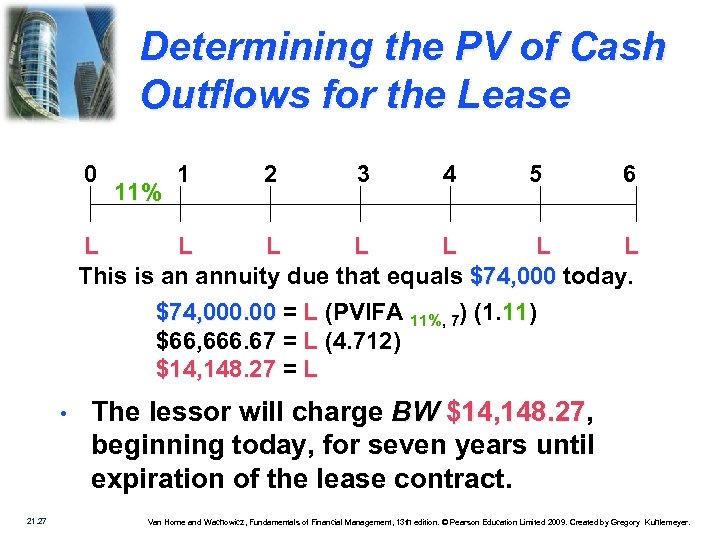 Determining the PV of Cash Outflows for the Lease 0 11% 1 2 3 4 5 6 L L L L This is an annuity due that equals $74, 000 today. $74, 000. 00 = L (PVIFA 11%, 7) (1. 11) 11 11% $66, 666. 67 = L (4. 712) $14, 148. 27 = L • 21. 27 The lessor will charge BW $14, 148. 27, $14, 148. 27 beginning today, for seven years until expiration of the lease contract. Van Horne and Wachowicz, Fundamentals of Financial Management, 13 th edition. © Pearson Education Limited 2009. Created by Gregory Kuhlemeyer.
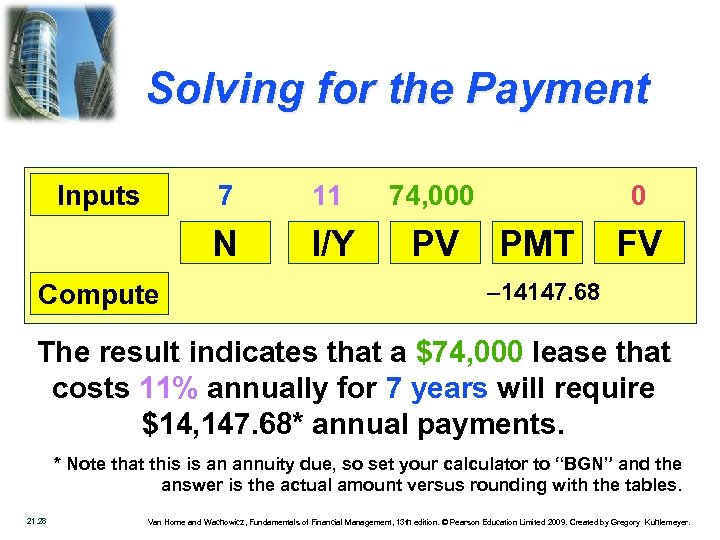 Solving for the Payment Inputs 7 74, 000 N Compute 11 I/Y PV 0 PMT FV – 14147. 68 The result indicates that a $74, 000 lease that costs 11% annually for 7 years will require $14, 147. 68* annual payments. * Note that this is an annuity due, so set your calculator to “BGN” and the answer is the actual amount versus rounding with the tables. 21. 28 Van Horne and Wachowicz, Fundamentals of Financial Management, 13 th edition. © Pearson Education Limited 2009. Created by Gregory Kuhlemeyer.
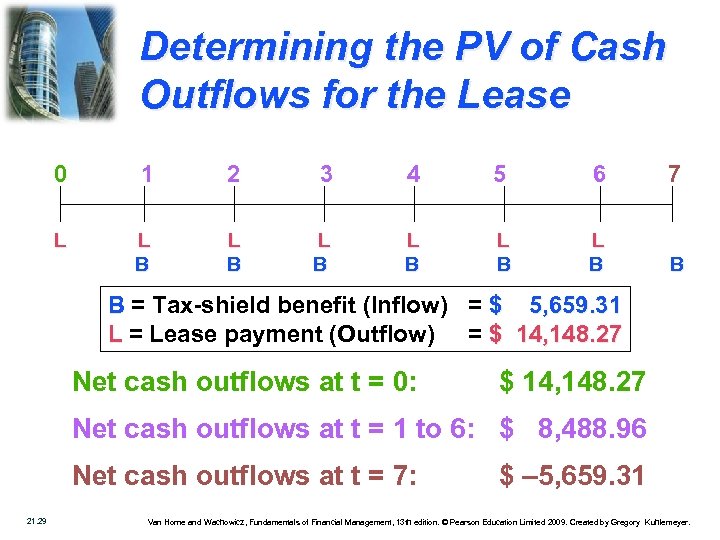 Determining the PV of Cash Outflows for the Lease 0 1 2 3 4 5 6 7 L L B L B L B B B = Tax-shield benefit (Inflow) = $ 5, 659. 31 L = Lease payment (Outflow) = $ 14, 148. 27 Net cash outflows at t = 0: $ 14, 148. 27 Net cash outflows at t = 1 to 6: $ 8, 488. 96 Net cash outflows at t = 7: 21. 29 $ – 5, 659. 31 Van Horne and Wachowicz, Fundamentals of Financial Management, 13 th edition. © Pearson Education Limited 2009. Created by Gregory Kuhlemeyer.
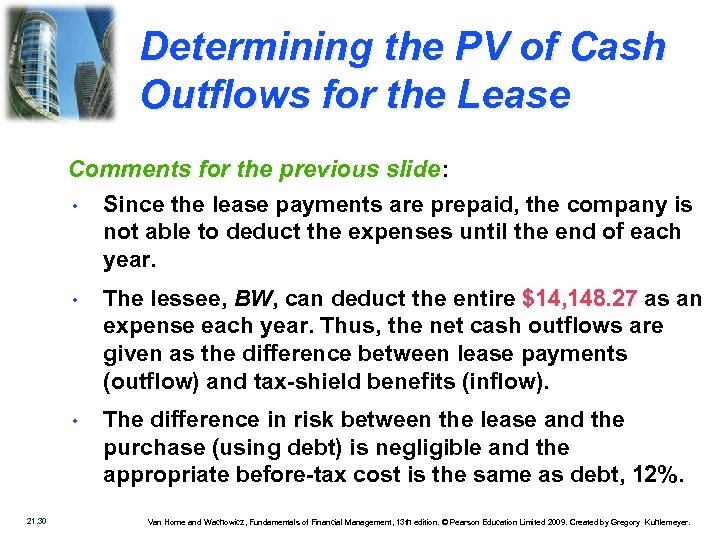 Determining the PV of Cash Outflows for the Lease Comments for the previous slide: slide • Since the lease payments are prepaid, the company is not able to deduct the expenses until the end of each year. • • 21. 30 The lessee, BW, can deduct the entire $14, 148. 27 as an BW expense each year. Thus, the net cash outflows are given as the difference between lease payments (outflow) and tax-shield benefits (inflow). The difference in risk between the lease and the purchase (using debt) is negligible and the appropriate before-tax cost is the same as debt, 12%. Van Horne and Wachowicz, Fundamentals of Financial Management, 13 th edition. © Pearson Education Limited 2009. Created by Gregory Kuhlemeyer.
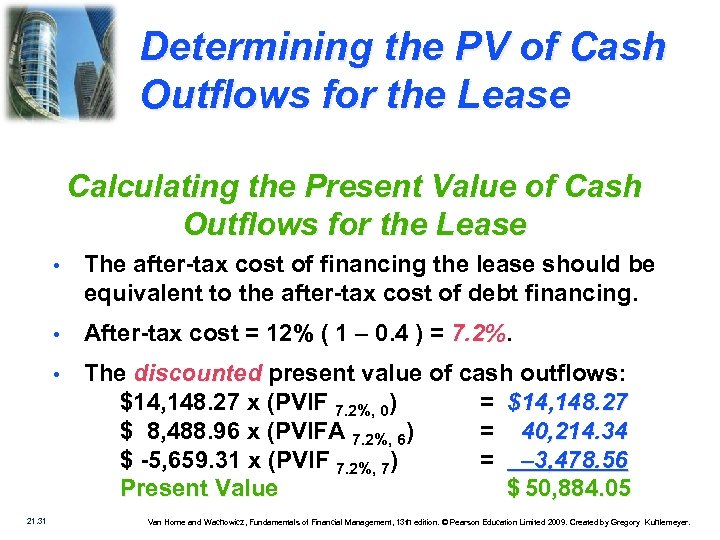 Determining the PV of Cash Outflows for the Lease Calculating the Present Value of Cash Outflows for the Lease • • After-tax cost = 12% ( 1 – 0. 4 ) = 7. 2% • 21. 31 The after-tax cost of financing the lease should be equivalent to the after-tax cost of debt financing. The discounted present value of cash outflows: $14, 148. 27 x (PVIF 7. 2%, 0) = $14, 148. 27 $ 8, 488. 96 x (PVIFA 7. 2%, 6) = 40, 214. 34 $ -5, 659. 31 x (PVIF 7. 2%, 7) = – 3, 478. 56 Present Value $ 50, 884. 05 Van Horne and Wachowicz, Fundamentals of Financial Management, 13 th edition. © Pearson Education Limited 2009. Created by Gregory Kuhlemeyer.
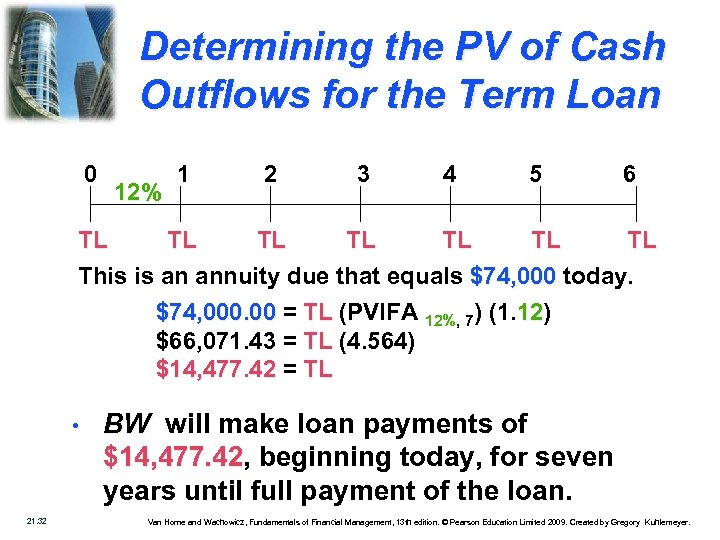 Determining the PV of Cash Outflows for the Term Loan 0 12% 1 2 3 4 5 6 TL TL This is an annuity due that equals $74, 000 today. $74, 000. 00 = TL (PVIFA 12%, 7) (1. 12) 12 12% $66, 071. 43 = TL (4. 564) $14, 477. 42 = TL • 21. 32 BW will make loan payments of $14, 477. 42, beginning today, for seven $14, 477. 42 years until full payment of the loan. Van Horne and Wachowicz, Fundamentals of Financial Management, 13 th edition. © Pearson Education Limited 2009. Created by Gregory Kuhlemeyer.
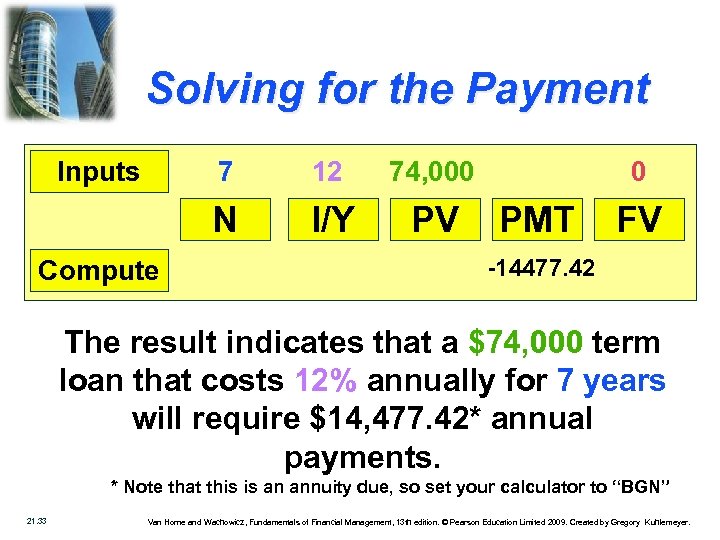 Solving for the Payment Inputs 7 74, 000 N Compute 12 I/Y PV 0 PMT FV -14477. 42 The result indicates that a $74, 000 term loan that costs 12% annually for 7 years will require $14, 477. 42* annual payments. * Note that this is an annuity due, so set your calculator to “BGN” 21. 33 Van Horne and Wachowicz, Fundamentals of Financial Management, 13 th edition. © Pearson Education Limited 2009. Created by Gregory Kuhlemeyer.
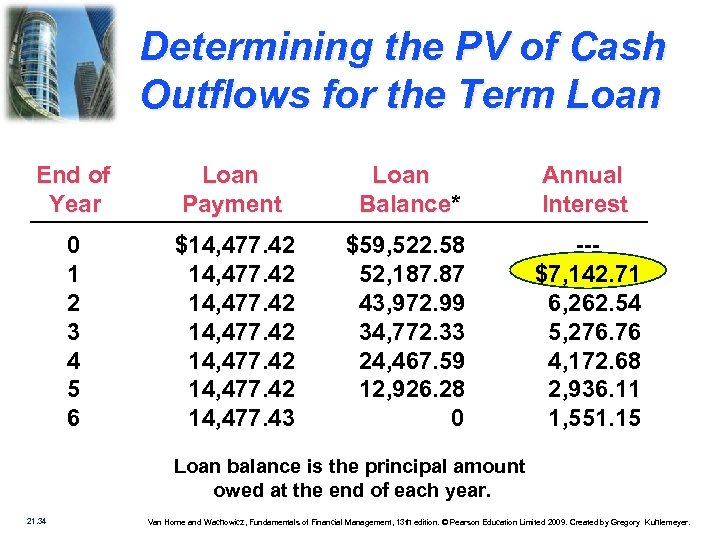 Determining the PV of Cash Outflows for the Term Loan End of Year Loan Payment Loan Balance* Balance Annual Interest 0 1 2 3 4 5 6 $14, 477. 42 14, 477. 43 $59, 522. 58 52, 187. 87 43, 972. 99 34, 772. 33 24, 467. 59 12, 926. 28 0 --$7, 142. 71 6, 262. 54 5, 276. 76 4, 172. 68 2, 936. 11 1, 551. 15 Loan balance is the principal amount owed at the end of each year. 21. 34 Van Horne and Wachowicz, Fundamentals of Financial Management, 13 th edition. © Pearson Education Limited 2009. Created by Gregory Kuhlemeyer.
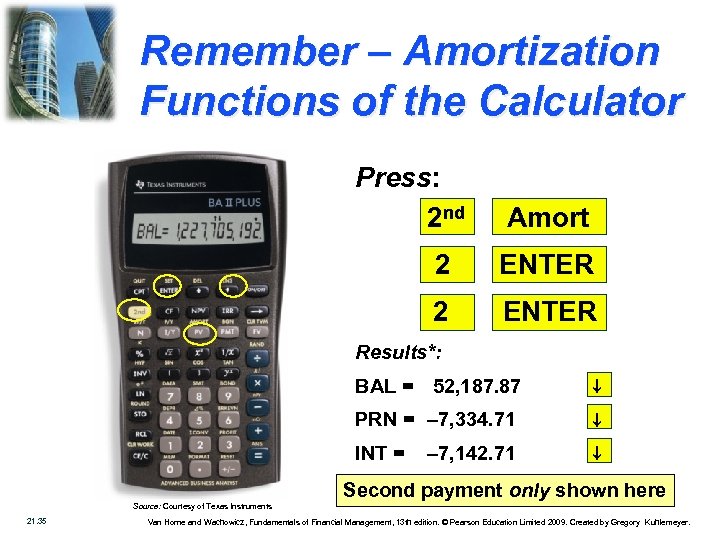 Remember – Amortization Functions of the Calculator Press: 2 nd Amort 2 ENTER Results*: BAL = 52, 187. 87 PRN = – 7, 334. 71 INT = – 7, 142. 71 Second payment only shown here Source: Courtesy of Texas Instruments 21. 35 Van Horne and Wachowicz, Fundamentals of Financial Management, 13 th edition. © Pearson Education Limited 2009. Created by Gregory Kuhlemeyer.
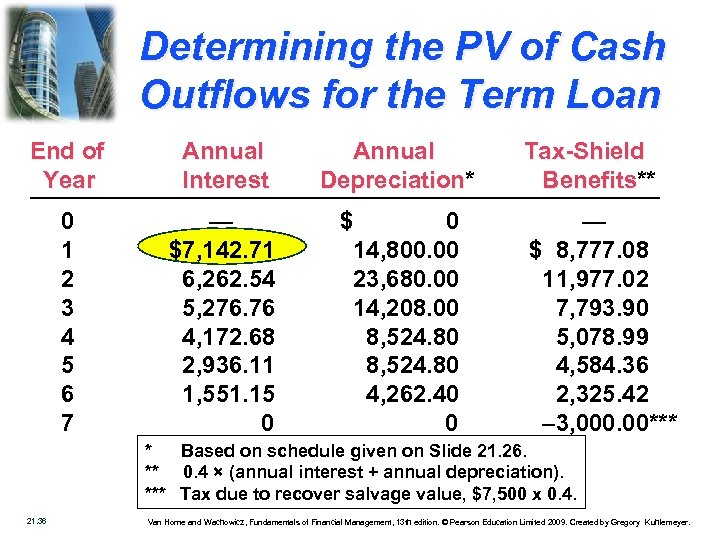 Determining the PV of Cash Outflows for the Term Loan End of Year Annual Interest Annual Depreciation* Depreciation 0 1 2 3 4 5 6 7 — $7, 142. 71 6, 262. 54 5, 276. 76 4, 172. 68 2, 936. 11 1, 551. 15 0 $ 0 14, 800. 00 23, 680. 00 14, 208. 00 8, 524. 80 4, 262. 40 0 Tax-Shield Benefits** Benefits — $ 8, 777. 08 11, 977. 02 7, 793. 90 5, 078. 99 4, 584. 36 2, 325. 42 – 3, 000. 00*** * Based on schedule given on Slide 21. 26. ** 0. 4 × (annual interest + annual depreciation). *** Tax due to recover salvage value, $7, 500 x 0. 4. 21. 36 Van Horne and Wachowicz, Fundamentals of Financial Management, 13 th edition. © Pearson Education Limited 2009. Created by Gregory Kuhlemeyer.
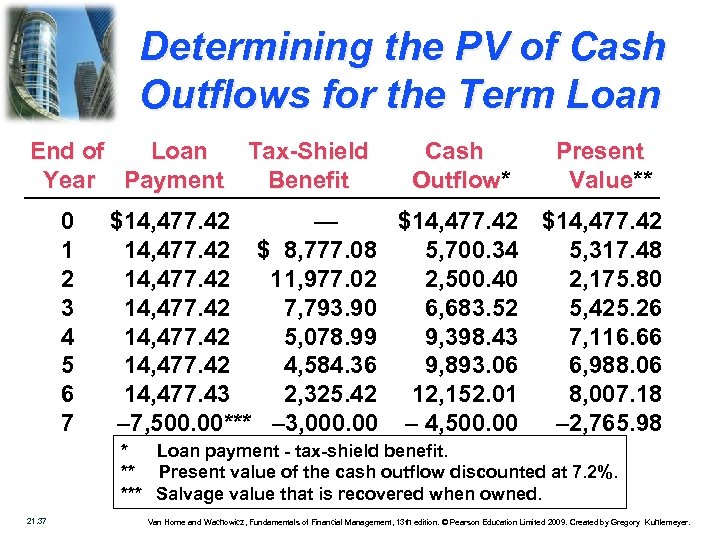 Determining the PV of Cash Outflows for the Term Loan End of Loan Tax-Shield Year Payment Benefit 0 1 2 3 4 5 6 7 Cash Outflow* Outflow Present Value** Value $14, 477. 42 — $14, 477. 42 $ 8, 777. 08 5, 700. 34 5, 317. 48 14, 477. 42 11, 977. 02 2, 500. 40 2, 175. 80 14, 477. 42 7, 793. 90 6, 683. 52 5, 425. 26 14, 477. 42 5, 078. 99 9, 398. 43 7, 116. 66 14, 477. 42 4, 584. 36 9, 893. 06 6, 988. 06 14, 477. 43 2, 325. 42 12, 152. 01 8, 007. 18 – 7, 500. 00*** – 3, 000. 00 – 4, 500. 00 – 2, 765. 98 * Loan payment - tax-shield benefit. ** Present value of the cash outflow discounted at 7. 2%. *** Salvage value that is recovered when owned. 21. 37 Van Horne and Wachowicz, Fundamentals of Financial Management, 13 th edition. © Pearson Education Limited 2009. Created by Gregory Kuhlemeyer.
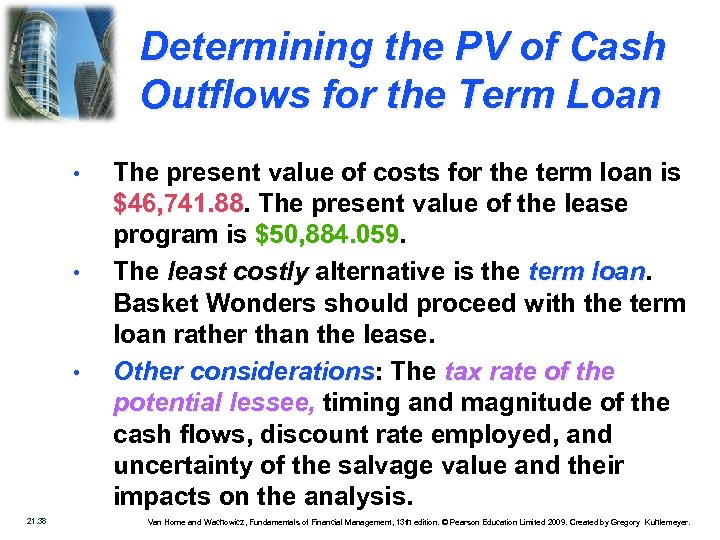 Determining the PV of Cash Outflows for the Term Loan • • • 21. 38 The present value of costs for the term loan is $46, 741. 88. The present value of the lease $46, 741. 88 program is $50, 884. 059 The least costly alternative is the term loan Basket Wonders should proceed with the term loan rather than the lease. Other considerations: The tax rate of the considerations potential lessee, timing and magnitude of the cash flows, discount rate employed, and uncertainty of the salvage value and their impacts on the analysis. Van Horne and Wachowicz, Fundamentals of Financial Management, 13 th edition. © Pearson Education Limited 2009. Created by Gregory Kuhlemeyer.