


 Скачать презентацию Chapter 20 Unemployment and Inflation Chapter 22 Long-Run
7eab49a0d096a8e62c0af76ff5e33147.ppt
- Количество слайдов: 47
 Chapter 20: Unemployment and Inflation Chapter 22: Long-Run Economic Growth: Sources and Policies Chapter 23: Output and Expenditure in the Short Run Chapter 24 - Aggregate Expenditure and Aggregate Demand
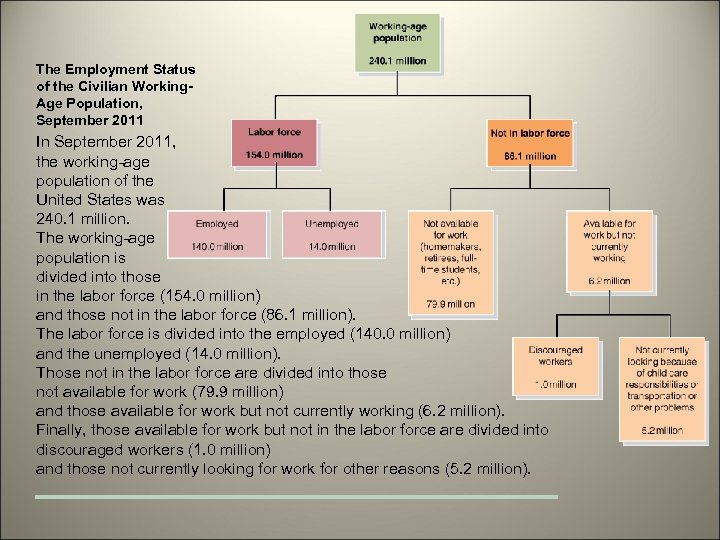 The Employment Status of the Civilian Working. Age Population, September 2011 In September 2011, the working-age population of the United States was 240. 1 million. The working-age population is divided into those in the labor force (154. 0 million) and those not in the labor force (86. 1 million). The labor force is divided into the employed (140. 0 million) and the unemployed (14. 0 million). Those not in the labor force are divided into those not available for work (79. 9 million) and those available for work but not currently working (6. 2 million). Finally, those available for work but not in the labor force are divided into discouraged workers (1. 0 million) and those not currently looking for work for other reasons (5. 2 million).
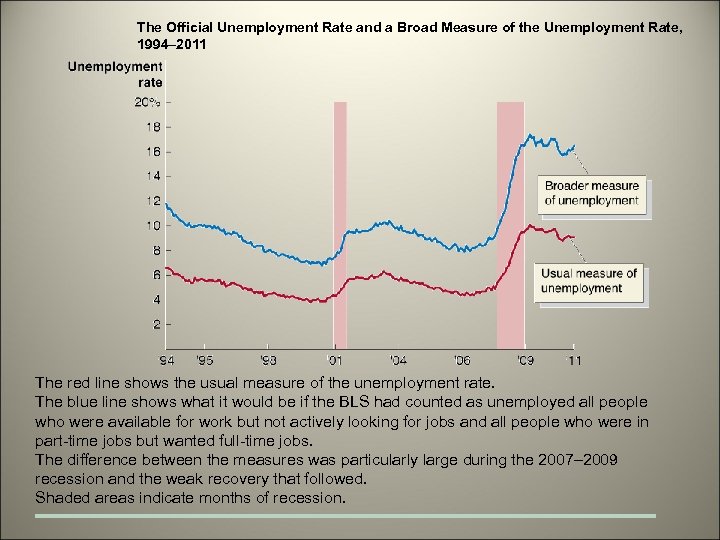 The Official Unemployment Rate and a Broad Measure of the Unemployment Rate, 1994– 2011 The red line shows the usual measure of the unemployment rate. The blue line shows what it would be if the BLS had counted as unemployed all people who were available for work but not actively looking for jobs and all people who were in part-time jobs but wanted full-time jobs. The difference between the measures was particularly large during the 2007– 2009 recession and the weak recovery that followed. Shaded areas indicate months of recession.
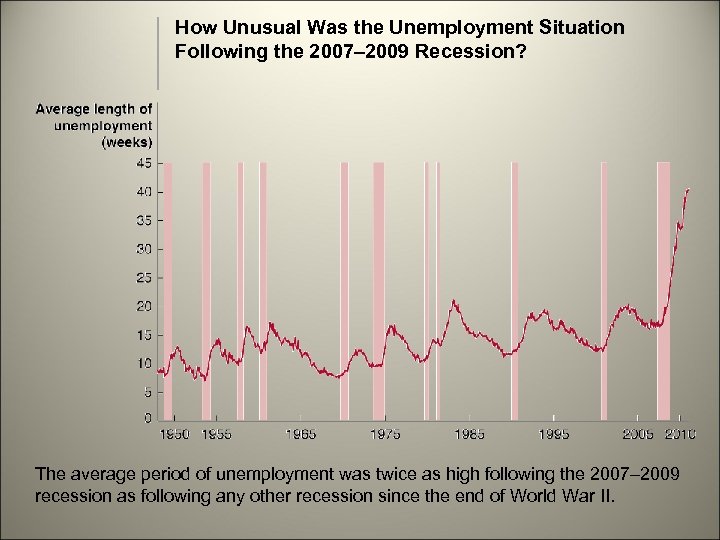 How Unusual Was the Unemployment Situation Following the 2007– 2009 Recession? The average period of unemployment was twice as high following the 2007– 2009 recession as following any other recession since the end of World War II.
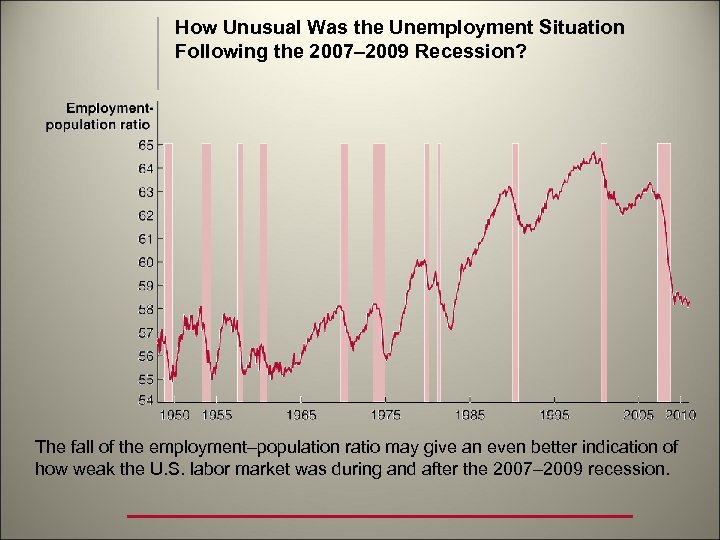 How Unusual Was the Unemployment Situation Following the 2007– 2009 Recession? The fall of the employment–population ratio may give an even better indication of how weak the U. S. labor market was during and after the 2007– 2009 recession.
 Types of Unemployment Identify the three types of unemployment. 1. Frictional unemployment 2. Structural unemployment 3. Cyclical unemployment
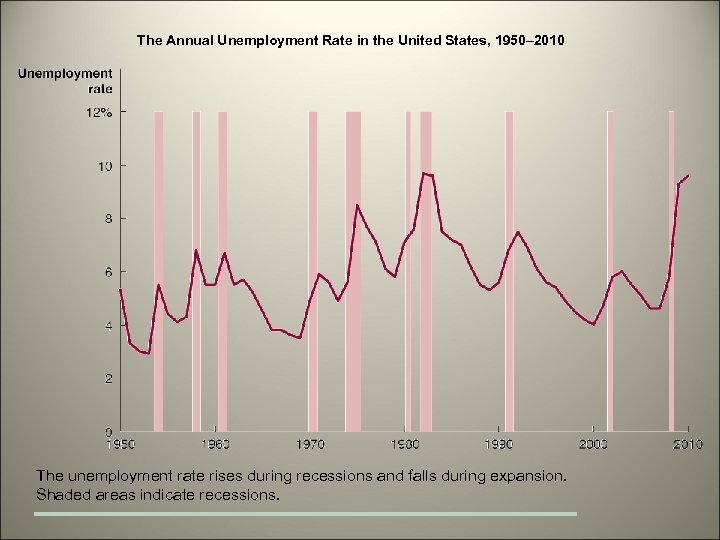 The Annual Unemployment Rate in the United States, 1950– 2010 The unemployment rate rises during recessions and falls during expansion. Shaded areas indicate recessions.
 Cyclical unemployment Unemployment caused by a business cycle recession. Structural unemployment Unemployment that arises from a persistent mismatch between the skills and attributes of workers and the requirements of jobs. Frictional unemployment Short-term unemployment that arises from the process of matching workers with jobs. Seasonal unemployment refers to unemployment due to factors such as weather, variations in tourism, and other calendar-related events.
 Full Employment When the only remaining unemployment is structural and frictional unemployment, the economy is said to be at full employment. Natural rate of unemployment The normal rate of unemployment, consisting of frictional unemployment plus structural unemployment.
 Price level A measure of the average prices of goods and services in the economy. Inflation rate The percentage increase in the price level from one year to the next.
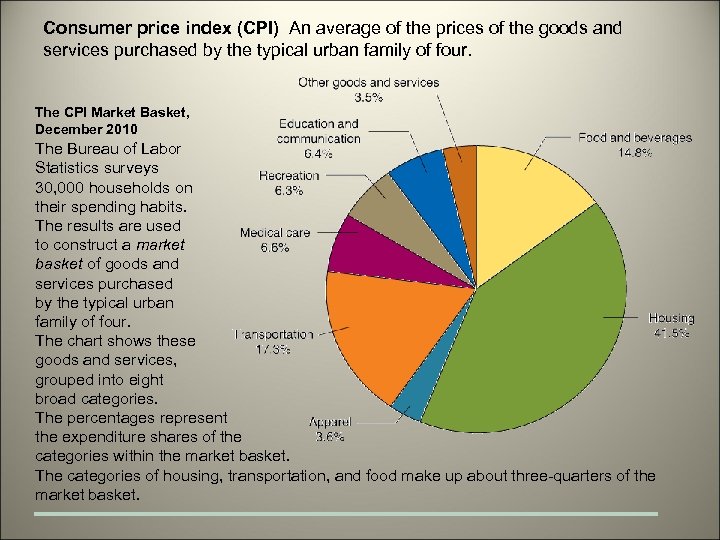 Consumer price index (CPI) An average of the prices of the goods and services purchased by the typical urban family of four. The CPI Market Basket, December 2010 The Bureau of Labor Statistics surveys 30, 000 households on their spending habits. The results are used to construct a market basket of goods and services purchased by the typical urban family of four. The chart shows these goods and services, grouped into eight broad categories. The percentages represent the expenditure shares of the categories within the market basket. The categories of housing, transportation, and food make up about three-quarters of the market basket.
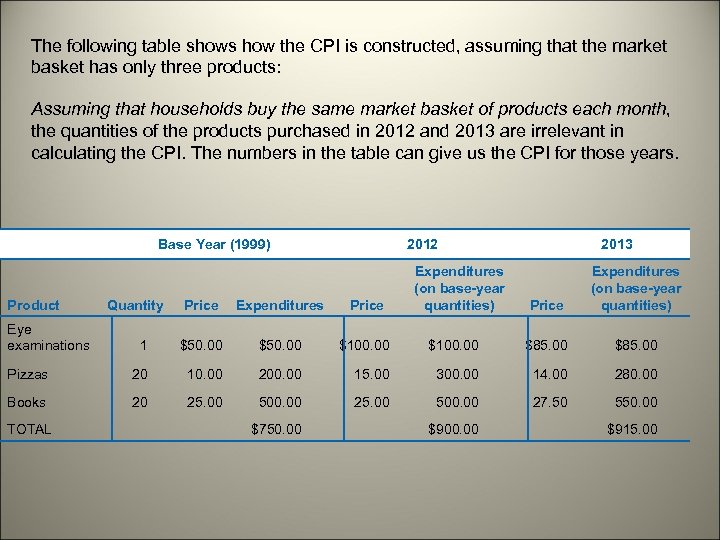 The following table shows how the CPI is constructed, assuming that the market basket has only three products: Assuming that households buy the same market basket of products each month, the quantities of the products purchased in 2012 and 2013 are irrelevant in calculating the CPI. The numbers in the table can give us the CPI for those years. Base Year (1999) Product Price $100. 00 $85. 00 15. 00 300. 00 14. 00 280. 00 25. 00 500. 00 27. 50 550. 00 Expenditures Price 1 $50. 00 $100. 00 Pizzas 20 10. 00 200. 00 Books 20 25. 00 500. 00 TOTAL $750. 00 Expenditures (on base-year quantities) 2013 Expenditures (on base-year quantities) Price Eye examinations Quantity 2012 $900. 00 $915. 00
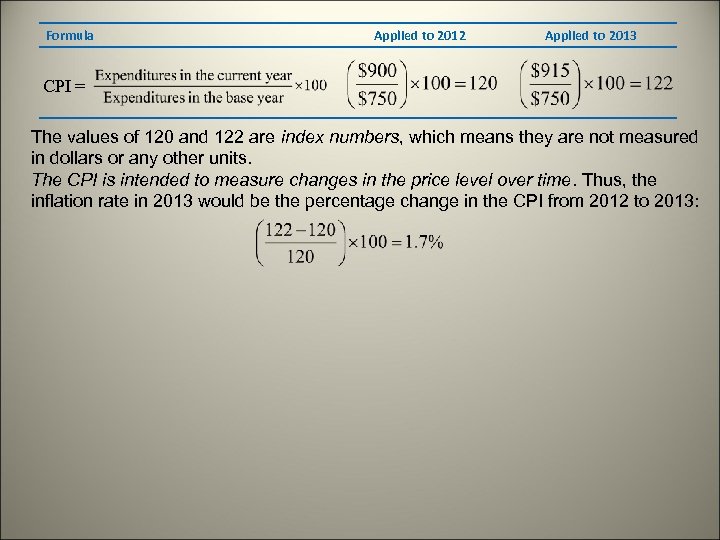 Formula Applied to 2012 Applied to 2013 CPI = The values of 120 and 122 are index numbers, which means they are not measured in dollars or any other units. The CPI is intended to measure changes in the price level over time. Thus, the inflation rate in 2013 would be the percentage change in the CPI from 2012 to 2013:
 Is the CPI Accurate? There are four biases that cause changes in the CPI to overstate the true inflation rate by 0. 5 percentage point to 1 percentage point, according to most economists, which the BLS continues to take steps to reduce: • Substitution bias. . • Increase in quality bias. . • New product bias. • Outlet bias.
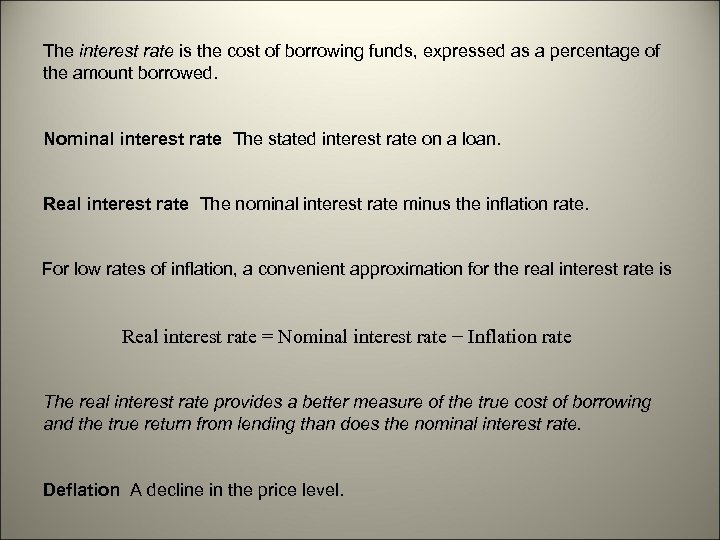 The interest rate is the cost of borrowing funds, expressed as a percentage of the amount borrowed. Nominal interest rate The stated interest rate on a loan. Real interest rate The nominal interest rate minus the inflation rate. For low rates of inflation, a convenient approximation for the real interest rate is Real interest rate = Nominal interest rate − Inflation rate The real interest rate provides a better measure of the true cost of borrowing and the true return from lending than does the nominal interest rate. Deflation A decline in the price level.
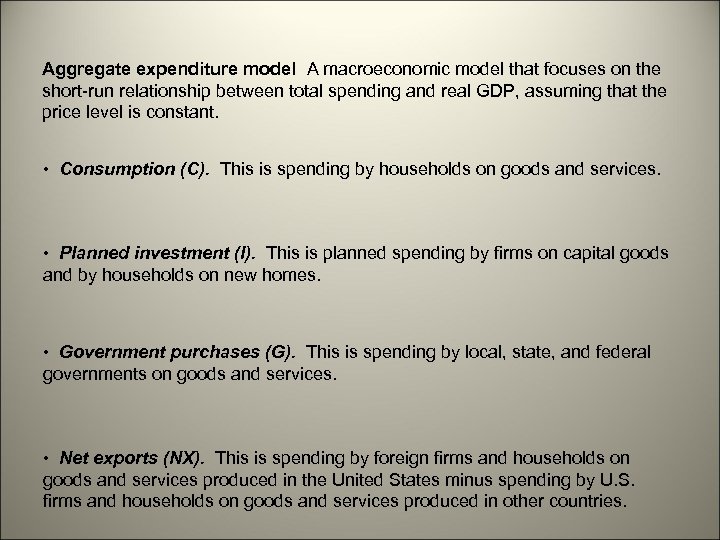 Aggregate expenditure model A macroeconomic model that focuses on the short-run relationship between total spending and real GDP, assuming that the price level is constant. • Consumption (C). This is spending by households on goods and services. • Planned investment (I). This is planned spending by firms on capital goods and by households on new homes. • Government purchases (G). This is spending by local, state, and federal governments on goods and services. • Net exports (NX). This is spending by foreign firms and households on goods and services produced in the United States minus spending by U. S. firms and households on goods and services produced in other countries.
 So, we can write Aggregate expenditure = Consumption + Planned investment + Government purchases + Net exports or AE = C + I + G + NX The Difference between Planned Investment and Actual Investment Inventories Goods that have been produced but not yet sold. Actual investment will equal planned investment only when there is no unplanned change in inventories. In this chapter, we will use I to represent planned investment. 17
 Macroeconomic Equilibrium For the economy as a whole, macroeconomic equilibrium occurs where total spending, or aggregate expenditure, equals total production, or GDP: Aggregate expenditure = GDP Adjustments to Macroeconomic Equilibrium When aggregate expenditure is greater than GDP, inventories will decline, and GDP and total employment will increase. When aggregate expenditure is less than GDP, inventories will increase, and GDP and total employment will decrease. Only when aggregate expenditure equals GDP will the economy be in macroeconomic equilibrium. 18
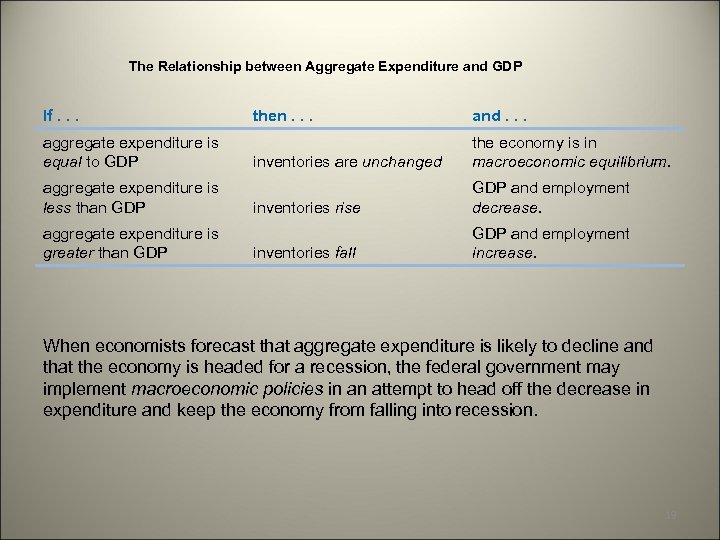 The Relationship between Aggregate Expenditure and GDP If. . . aggregate expenditure is equal to GDP aggregate expenditure is less than GDP aggregate expenditure is greater than GDP then. . . and. . . inventories are unchanged the economy is in macroeconomic equilibrium. inventories rise GDP and employment decrease. inventories fall GDP and employment increase. When economists forecast that aggregate expenditure is likely to decline and that the economy is headed for a recession, the federal government may implement macroeconomic policies in an attempt to head off the decrease in expenditure and keep the economy from falling into recession. 19
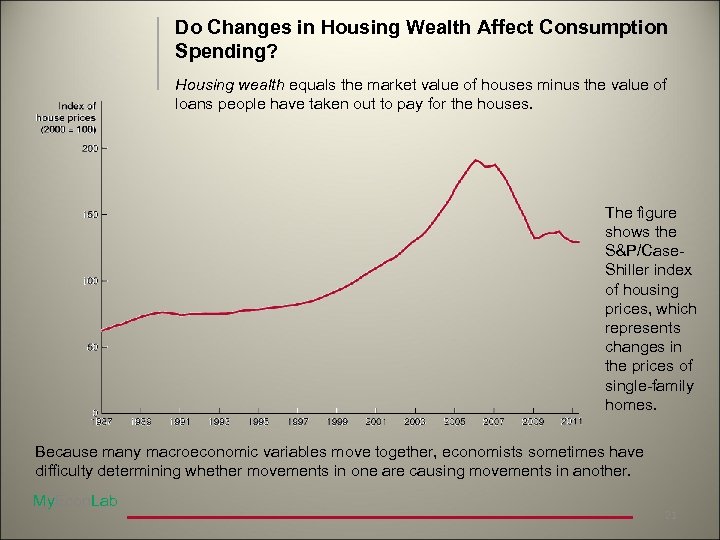 Do Changes in Housing Wealth Affect Consumption Spending? Housing wealth equals the market value of houses minus the value of loans people have taken out to pay for the houses. The figure shows the S&P/Case. Shiller index of housing prices, which represents changes in the prices of single-family homes. Because many macroeconomic variables move together, economists sometimes have difficulty determining whether movements in one are causing movements in another. My. Econ. Lab 21
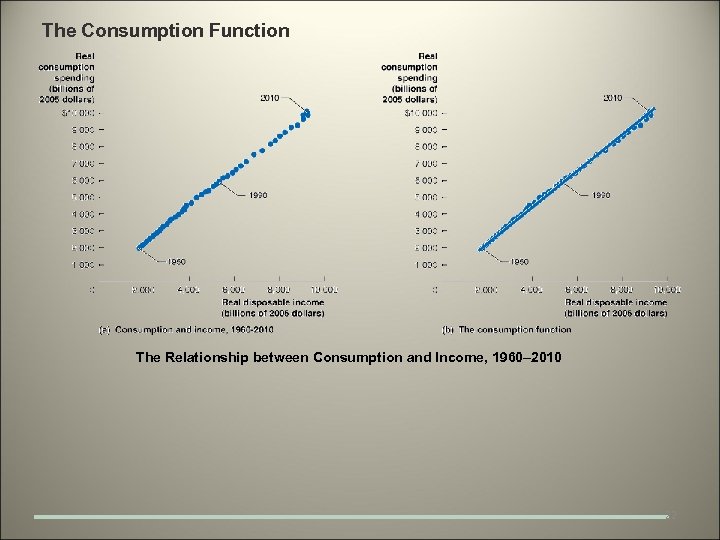 The Consumption Function The Relationship between Consumption and Income, 1960– 2010 22
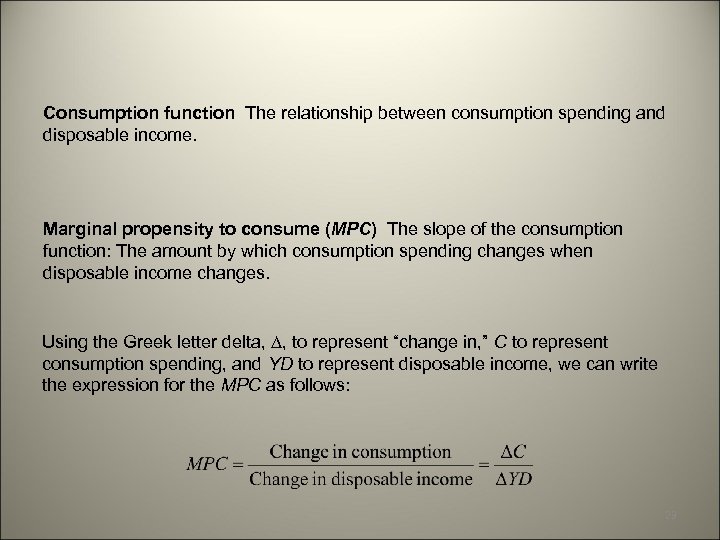 Consumption function The relationship between consumption spending and disposable income. Marginal propensity to consume (MPC) The slope of the consumption function: The amount by which consumption spending changes when disposable income changes. Using the Greek letter delta, ∆, to represent “change in, ” C to represent consumption spending, and YD to represent disposable income, we can write the expression for the MPC as follows: 23
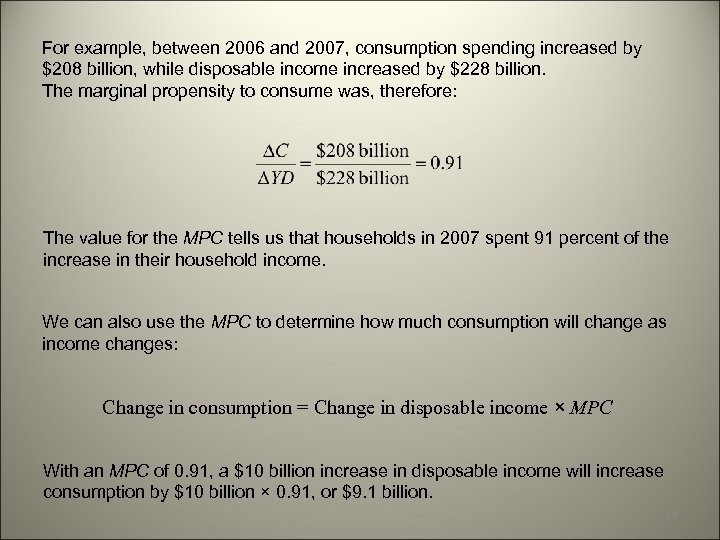 For example, between 2006 and 2007, consumption spending increased by $208 billion, while disposable income increased by $228 billion. The marginal propensity to consume was, therefore: The value for the MPC tells us that households in 2007 spent 91 percent of the increase in their household income. We can also use the MPC to determine how much consumption will change as income changes: Change in consumption = Change in disposable income × MPC With an MPC of 0. 91, a $10 billion increase in disposable income will increase consumption by $10 billion × 0. 91, or $9. 1 billion. 24
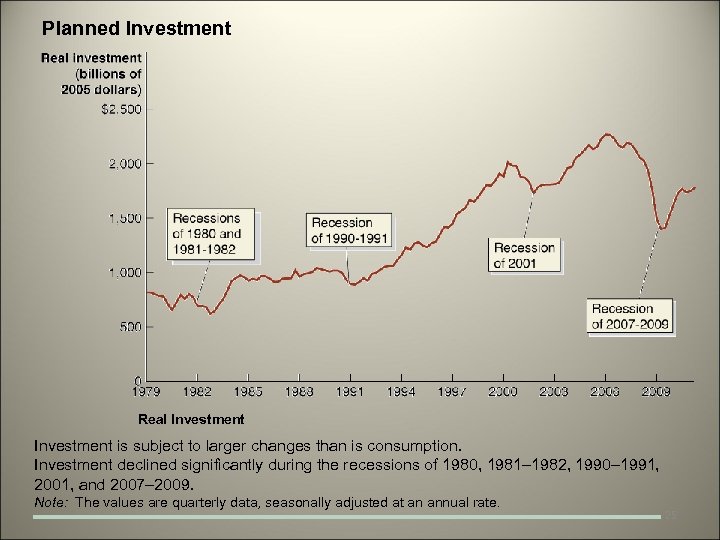 Planned Investment Real Investment is subject to larger changes than is consumption. Investment declined significantly during the recessions of 1980, 1981– 1982, 1990– 1991, 2001, and 2007– 2009. Note: The values are quarterly data, seasonally adjusted at an annual rate. 25
 The four most important variables that determine the level of investment are: • Expectations of future profitability • Interest rate • Taxes • Cash flow 26
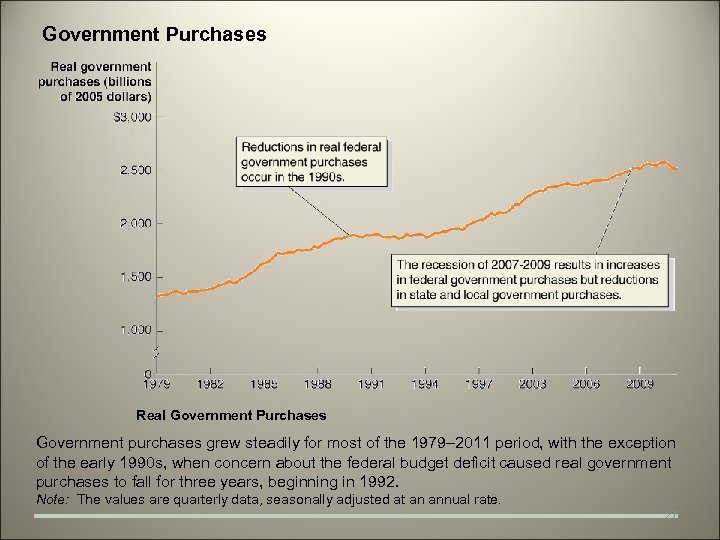 Government Purchases Real Government Purchases Government purchases grew steadily for most of the 1979– 2011 period, with the exception of the early 1990 s, when concern about the federal budget deficit caused real government purchases to fall for three years, beginning in 1992. Note: The values are quarterly data, seasonally adjusted at an annual rate. 27
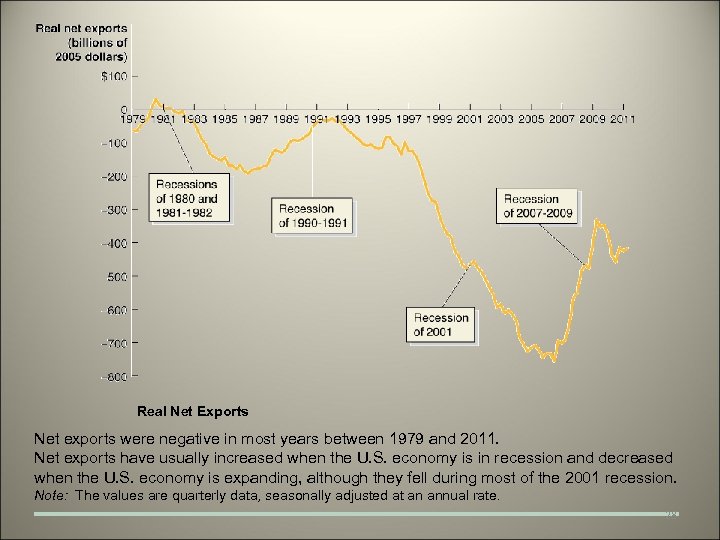 Real Net Exports Net exports were negative in most years between 1979 and 2011. Net exports have usually increased when the U. S. economy is in recession and decreased when the U. S. economy is expanding, although they fell during most of the 2001 recession. Note: The values are quarterly data, seasonally adjusted at an annual rate. 28
 The following are three most important variables that determine the level of net exports: • The price level in the United States relative to the price levels in other countries • The growth rate of GDP in the United States relative to the growth rates of GDP in other countries • The exchange rate between the dollar and other currencies 29
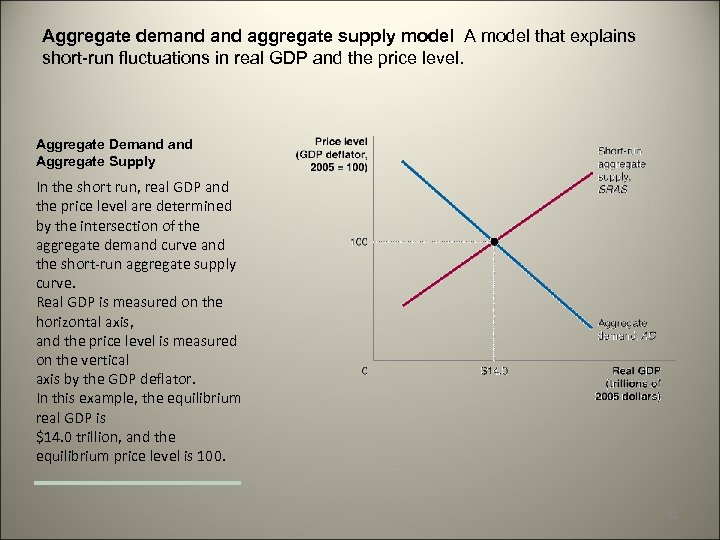 Aggregate demand aggregate supply model A model that explains short-run fluctuations in real GDP and the price level. Aggregate Demand Aggregate Supply In the short run, real GDP and the price level are determined by the intersection of the aggregate demand curve and the short-run aggregate supply curve. Real GDP is measured on the horizontal axis, and the price level is measured on the vertical axis by the GDP deflator. In this example, the equilibrium real GDP is $14. 0 trillion, and the equilibrium price level is 100. 30
 Aggregate demand (AD) curve A curve that shows the relationship between the price level and the quantity of real GDP demanded by households, firms, and the government. Short-run aggregate supply (SRAS) curve A curve that shows the relationship in the short run between the price level and the quantity of real GDP supplied by firms. Because we are dealing with the economy as a whole, we need macroeconomic explanations of why the aggregate demand curve is downward sloping, why the short-run aggregate supply curve is upward sloping, and why the curves shift. 31
 Why Is the Aggregate Demand Curve Downward Sloping? Recall the four components of GDP: consumption (C), investment (I), government purchases (G), and net exports (NX). If we let Y stand for GDP, we have the following relationship: Y = C + I + G + NX The aggregate demand curve is downward sloping because a fall in the price level increases the quantity of real GDP demanded. To see why, we next look at how changes in the price level affect each component of aggregate demand, assuming government purchases are not affected. The Wealth Effect: How a Change in the Price Level Affects Consumption The Interest-Rate Effect: How a Change in the Price Level Affects Investment The International-Trade Effect: How a Change in the Price Level Affects Net Exports 32
 Shifts of the Aggregate Demand Curve versus Movements along It The aggregate demand curve tells us the relationship between the price level and the quantity of real GDP demanded, holding everything else constant. If the price level changes but other variables that affect the willingness of households, firms, and the government to spend are unchanged, the economy will move up or down a stationary aggregate demand curve. If any variable other than the price level changes, the aggregate demand curve will shift. 33
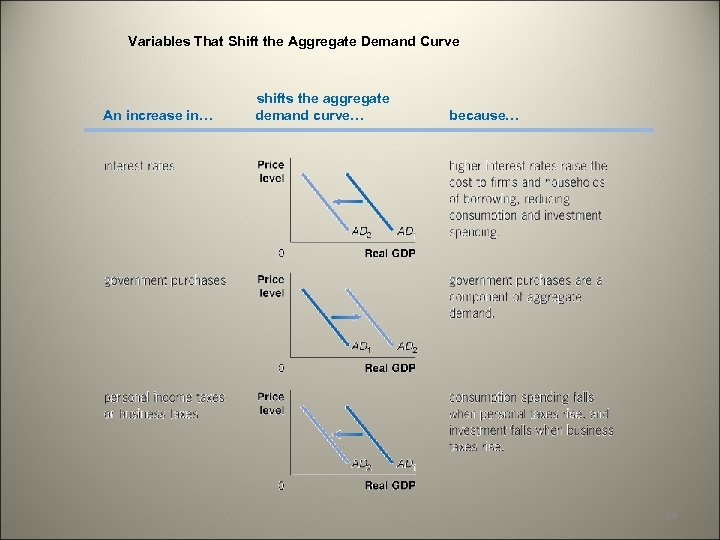 Variables That Shift the Aggregate Demand Curve An increase in… shifts the aggregate demand curve… because… 34
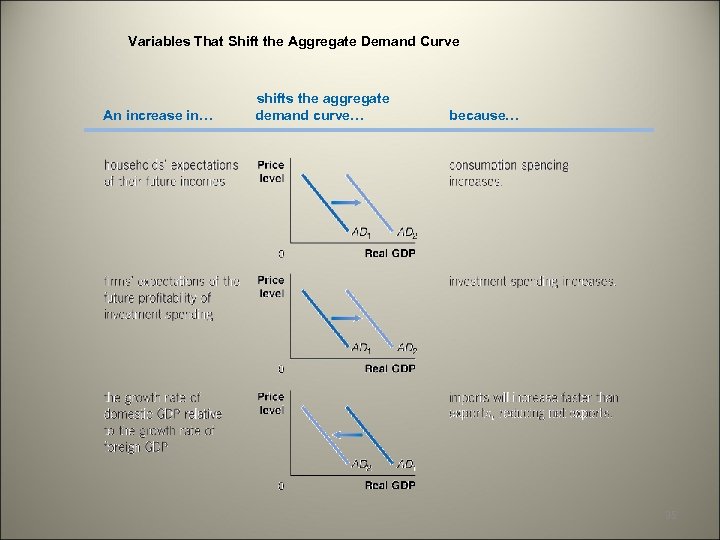 Variables That Shift the Aggregate Demand Curve An increase in… shifts the aggregate demand curve… because… 35
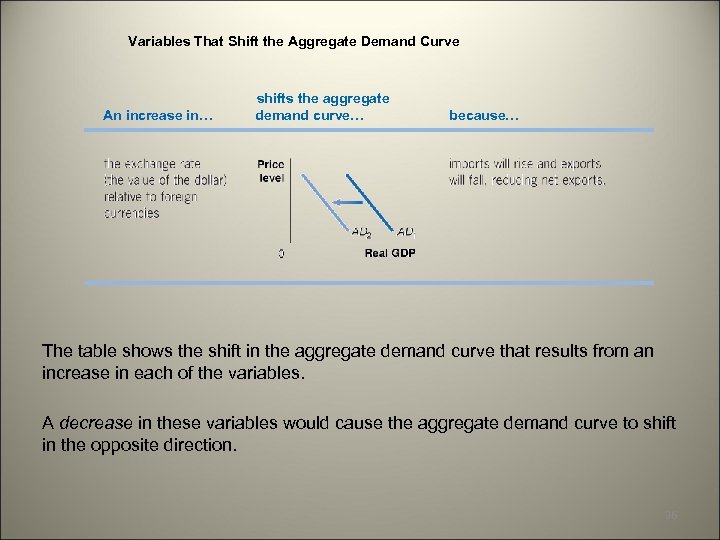 Variables That Shift the Aggregate Demand Curve An increase in… shifts the aggregate demand curve… because… The table shows the shift in the aggregate demand curve that results from an increase in each of the variables. A decrease in these variables would cause the aggregate demand curve to shift in the opposite direction. 36
 Because the effect of changes in the price level on aggregate supply is very different in the short run from what it is in the long run, we use two aggregate supply curves: one for the short run and one for the long run. The Long-Run Aggregate Supply Curve In the long run, the level of real GDP is determined by the number of workers, the capital stock, and the available technology, none of which are affected by changes in the price level. So, in the long run, changes in the price level do not affect the level of real GDP. Remember that the level of real GDP in the long run is called potential GDP, or full-employment GDP. Long-run aggregate supply (LRAS) curve A curve that shows the relationship in the long run between the price level and the quantity of real GDP supplied. 37
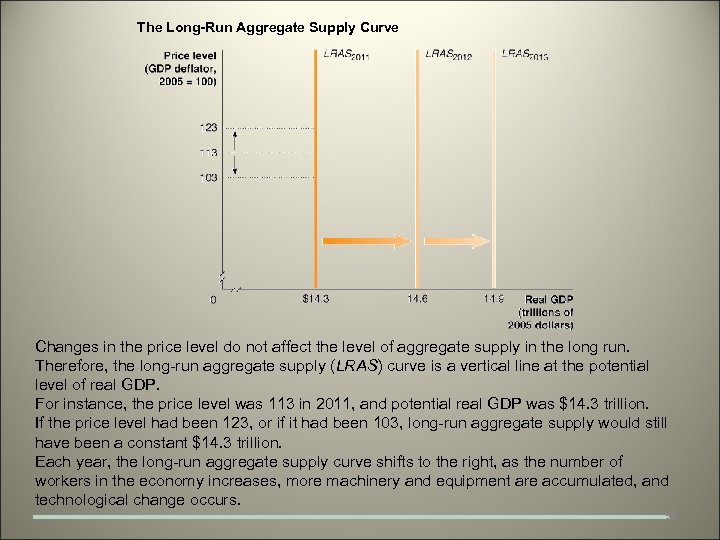 The Long-Run Aggregate Supply Curve Changes in the price level do not affect the level of aggregate supply in the long run. Therefore, the long-run aggregate supply (LRAS) curve is a vertical line at the potential level of real GDP. For instance, the price level was 113 in 2011, and potential real GDP was $14. 3 trillion. If the price level had been 123, or if it had been 103, long-run aggregate supply would still have been a constant $14. 3 trillion. Each year, the long-run aggregate supply curve shifts to the right, as the number of workers in the economy increases, more machinery and equipment are accumulated, and technological change occurs. 38
 The Short-Run Aggregate Supply Curve As prices of final goods and services rise, prices of inputs—such as the wages of workers or the price of natural resources—rise more slowly. The reason for this is that some firms and workers fail to accurately predict changes in the price level. There are three common explanations for an upward-sloping SRAS curve when workers and firms fail to accurately predict the price level: 1. Contracts make some wages and prices “sticky. ” 2. Firms are often slow to adjust wages. 3. Menu costs make some prices sticky. 39
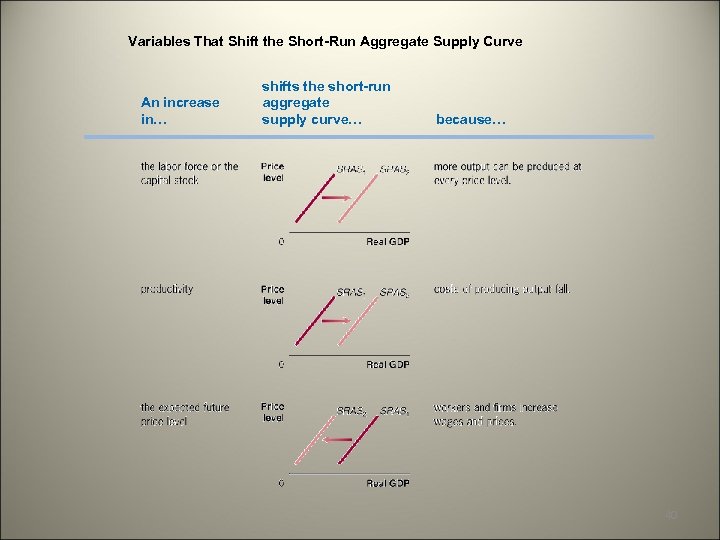 Variables That Shift the Short-Run Aggregate Supply Curve An increase in… shifts the short-run aggregate supply curve… because… 40
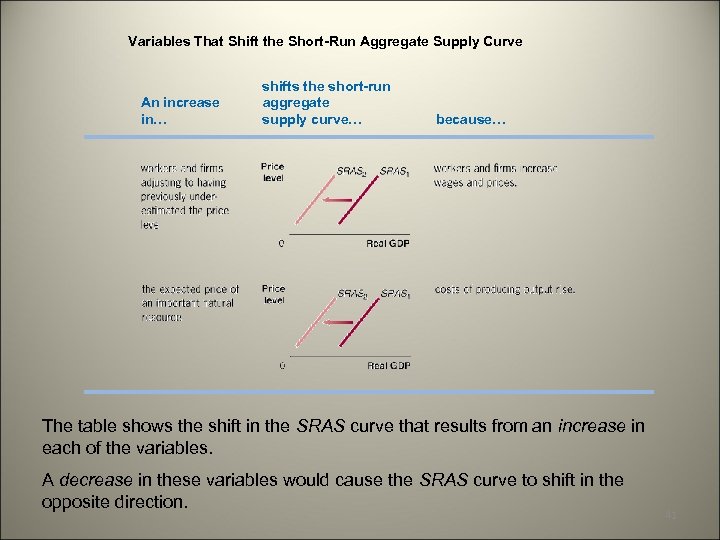 Variables That Shift the Short-Run Aggregate Supply Curve An increase in… shifts the short-run aggregate supply curve… because… The table shows the shift in the SRAS curve that results from an increase in each of the variables. A decrease in these variables would cause the SRAS curve to shift in the opposite direction. 41
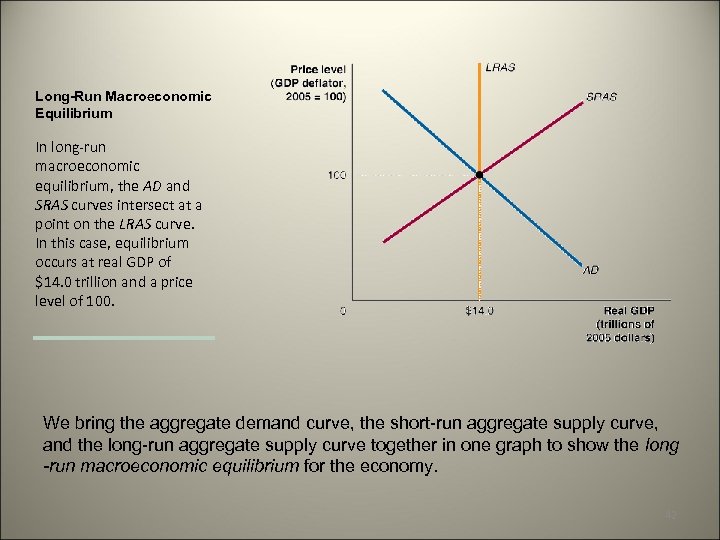 Long-Run Macroeconomic Equilibrium In long-run macroeconomic equilibrium, the AD and SRAS curves intersect at a point on the LRAS curve. In this case, equilibrium occurs at real GDP of $14. 0 trillion and a price level of 100. We bring the aggregate demand curve, the short-run aggregate supply curve, and the long-run aggregate supply curve together in one graph to show the long -run macroeconomic equilibrium for the economy. 42
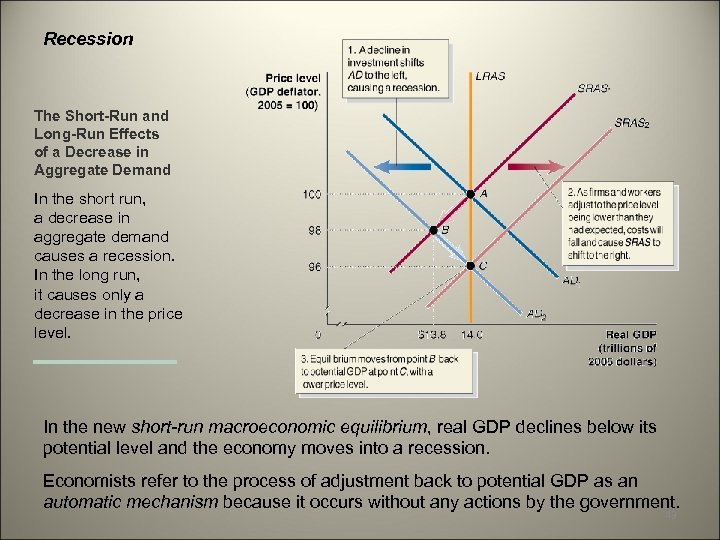 Recession The Short-Run and Long-Run Effects of a Decrease in Aggregate Demand In the short run, a decrease in aggregate demand causes a recession. In the long run, it causes only a decrease in the price level. In the new short-run macroeconomic equilibrium, real GDP declines below its potential level and the economy moves into a recession. Economists refer to the process of adjustment back to potential GDP as an automatic mechanism because it occurs without any actions by the government. 43
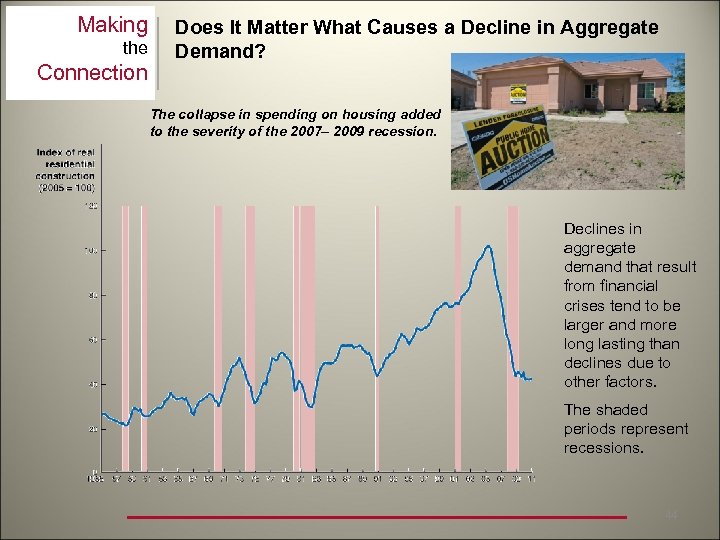 Making the Connection Does It Matter What Causes a Decline in Aggregate Demand? The collapse in spending on housing added to the severity of the 2007– 2009 recession. Declines in aggregate demand that result from financial crises tend to be larger and more long lasting than declines due to other factors. The shaded periods represent recessions. 44
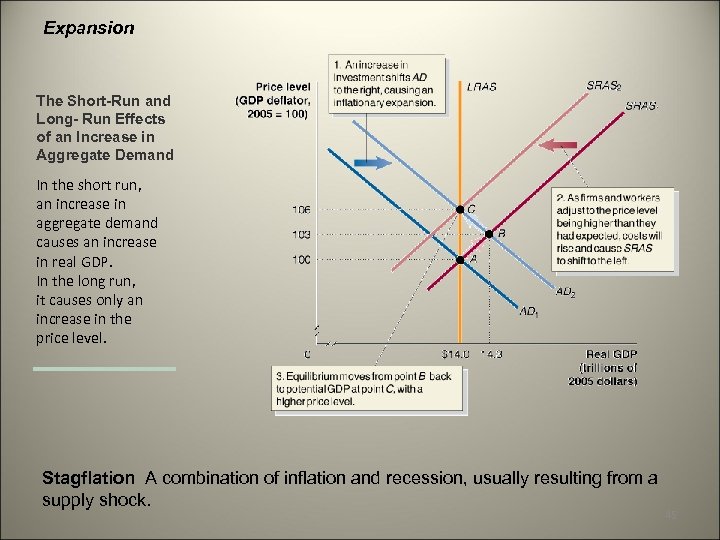 Expansion The Short-Run and Long- Run Effects of an Increase in Aggregate Demand In the short run, an increase in aggregate demand causes an increase in real GDP. In the long run, it causes only an increase in the price level. Stagflation A combination of inflation and recession, usually resulting from a supply shock. 45
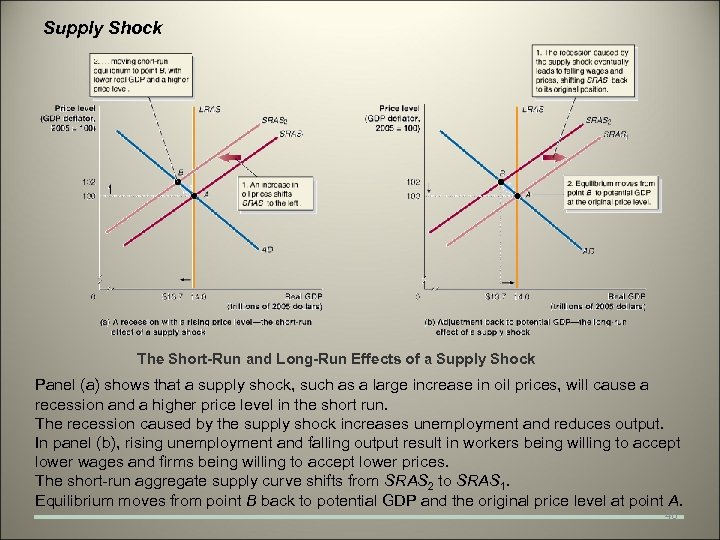 Supply Shock The Short-Run and Long-Run Effects of a Supply Shock Panel (a) shows that a supply shock, such as a large increase in oil prices, will cause a recession and a higher price level in the short run. The recession caused by the supply shock increases unemployment and reduces output. In panel (b), rising unemployment and falling output result in workers being willing to accept lower wages and firms being willing to accept lower prices. The short-run aggregate supply curve shifts from SRAS 2 to SRAS 1. Equilibrium moves from point B back to potential GDP and the original price level at point A. 46
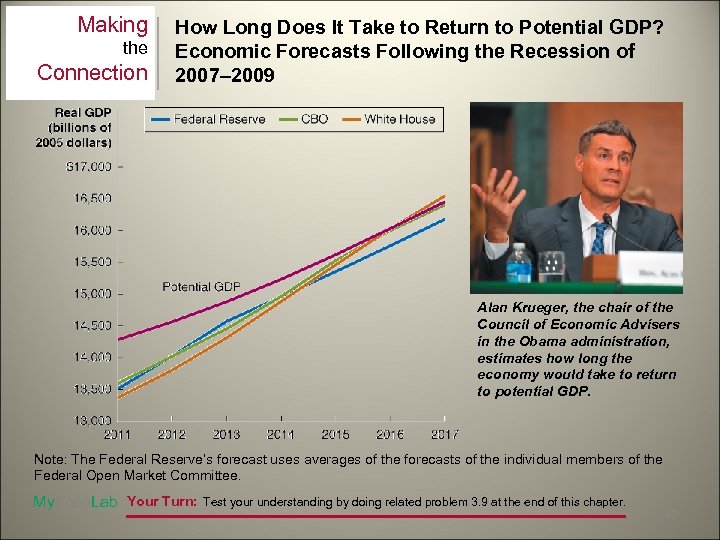 Making the Connection How Long Does It Take to Return to Potential GDP? Economic Forecasts Following the Recession of 2007– 2009 Alan Krueger, the chair of the Council of Economic Advisers in the Obama administration, estimates how long the economy would take to return to potential GDP. Note: The Federal Reserve’s forecast uses averages of the forecasts of the individual members of the Federal Open Market Committee. My. Econ. Lab Your Turn: Test your understanding by doing related problem 3. 9 at the end of this chapter. 47