


 Скачать презентацию Chapter 20 Current Topics in Risk Management
3cecdd916f12d01653b316907c88e002.ppt
- Количество слайдов: 62
 Chapter 20 Current Topics in Risk Management • Value at Risk (Va. R) • Credit Derivatives • Exotic Options 1
 Value at Risk (VAR) (http: //www. gloriamundi. org) • Value At Risk (Va. R): A risk management concept wherein senior management can be informed, via a single number, of the firm’s shortterm price risk. • Va. R is an estimated dollar decline with a stated probability during a stated period of time. • The dollar loss may be estimated for the firm’s cash flows or for the value of its assets and/or liabilities. • Note Bene: No finance theory exists to show that Va. R is the appropriate measure upon which to build optimal decision rules. 2
 Background • One goal of active risk management: Reduce the variability of uncertain cash flows. • Usually, risk management cannot eliminate cash flow variability. • The modern corporation could have hundreds, or thousands, of sources of uncertain cash flows that are being hedged (or not being hedged). • Thus, there exists a portfolio of risks. 3
 Va. R Origins • Va. R stems from the request by J. P Morgan’s Chairman, Dennis Weatherstone. • Mr. Weatherstone requested a simple report be made available to him every day concerning the firm’s risk exposure. • Since then, Va. R has become pervasive. • Va. R has become the financial industry’s standard for measuring exposure to financial price risks. • Most financial firms make Va. R part of their daily reporting to senior management. 4
 Sources of Va. R Pervasiveness • Effective 1/1/1998, The Bank for International Settlements (BIS), required major banks to determine their capital adequacy using Va. R. • The U. S. Federal Reserve and the International Swaps and Derivatives Association (ISDA) have endorsed the BIS’s recommendations about Va. R. • In December 1995, the U. S. Securities and Exchange Commission (SEC) proposed rules that would require corporations to disclose information concerning their use of derivatives. 5
 Sources of Va. R Pervasiveness, Cont. • Risk Standards Working Group (1996) self-imposed charge: “Create a set of risk standards for institutional investment managers and institutional investors. ” • Risk Standard 12 states that money managers “should regularly measure relevant risks and quantify the key drivers of risk and return. ” • Risk Standard 12 proceeds to suggest Va. R as one possible method for measurement of risk. • For a voluminous source of regulatory and other documents concerning risk management, see http: //riskinstitute. ch. 6
 The Va. R Concept • Va. R is an attempt to encapsulate an estimate of the price risk possessed by a portfolio of derivatives and other financial assets. • The statistic that Va. R provides is the dollar amount by which the value of a portfolio might change with a stated probability during a stated time horizon, say one day, one week, or longer. • For example, a financial institution might estimate that there is a 1% chance that its portfolio will decline by $15 million during the next week. 7
 Va. R Concept, Cont. • Most likely, the decline in value will be caused by changes in the prices of fundamental risk factors. • Examples of these are changes in foreign exchange rates, interest rate changes, commodity price fluctuations, changes in stock prices, and/or increases in volatility. 8
 Important! • The price risk number obtained from a Va. R model summarizes risk exposure into one dollar figure. • This dollar figure purportedly represents the estimated maximum loss over an interval of time. • So, a dollar loss greater than the Va. R estimate can occur, but with a smaller probability than the VAR estimate. 9
 Computing Va. R • As yet, there is no standard method to compute Va. R. • However, several accepted methods for computing Va. R have emerged: – The variance-covariance approach – The historical simulation method – The Monte Carlo simulation method • The Va. R estimate is sensitive to the assumptions made and to the method used. 10
 The Variance-Covariance Approach • Also know as the “Delta-Normal Method. ” • The variance-covariance approach is used by JP Morgan’s Risk. Metrics model. • www. riskmetrics. com • The important assumption of this approach: The returns for each of the institution’s assets are normally distributed. 11
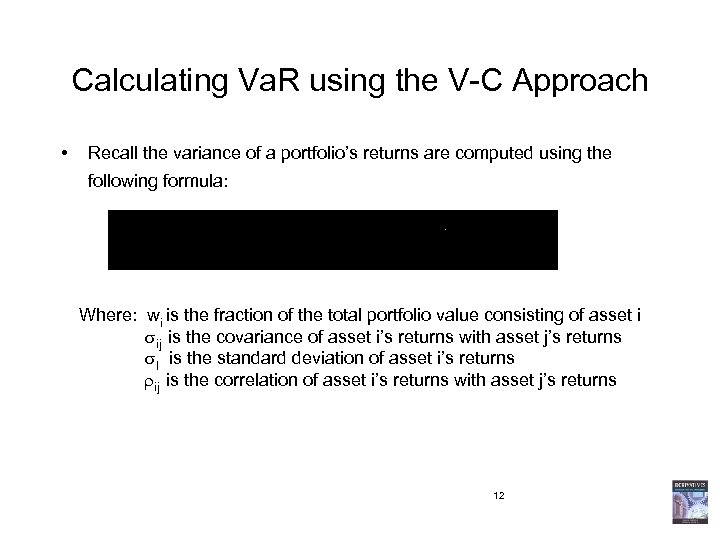 Calculating Va. R using the V-C Approach • Recall the variance of a portfolio’s returns are computed using the following formula: Where: wi is the fraction of the total portfolio value consisting of asset i ij is the covariance of asset i’s returns with asset j’s returns I is the standard deviation of asset i’s returns ij is the correlation of asset i’s returns with asset j’s returns 12
 Shortcomings of the V-C Approach • Return distributions may not be normal. • The returns distribution might be skewed, or it may possess “fat tails. ” • A “fat-tailed” distribution has leptokurtosis. – Characterized by “too many” observations in the tails. – So, “unusual” events occur more frequently than a normal distribution would predict. – There is considerable evidence that the returns distributions of many risk factors are leptokurtic. – Options, and assets with option-like characteristics, possess nonnormal return distributions. 13
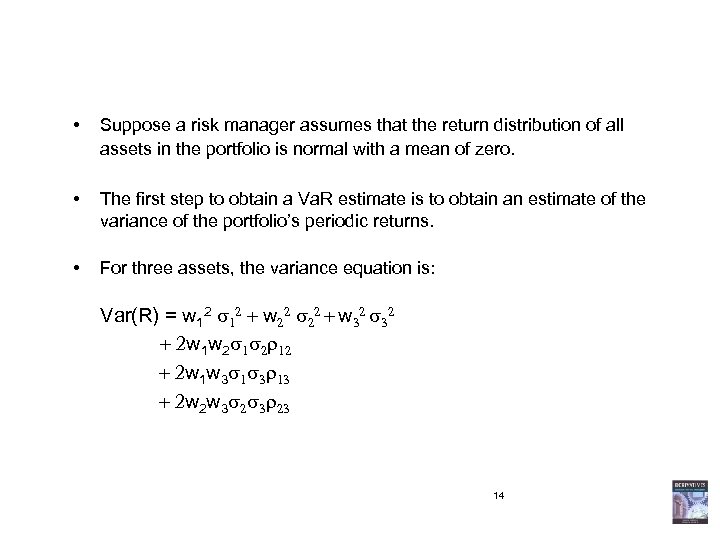 • Suppose a risk manager assumes that the return distribution of all assets in the portfolio is normal with a mean of zero. • The first step to obtain a Va. R estimate is to obtain an estimate of the variance of the portfolio’s periodic returns. • For three assets, the variance equation is: Var(R) = w 12 12 + w 22 22 + w 32 32 + 2 w 1 w 2 12 + 2 w 1 w 3 13 + 2 w 2 w 3 23 14
 After obtaining a portfolio’s mean return and return variance: • A simple statistical procedure is used to estimate what the loss in value of the portfolio will be during that period. • Further note that this estimate can be calculated with any desired probability. – For example, the value at risk, Va. R, will equal 1. 645 times the portfolio’s standard deviation with a probability of 5%. – The maximum loss with a 1% probability will equal 2. 327 times the portfolio’s standard deviation. 15
 Using V-C to Calculate Va. R: Example • Consider a portfolio consists of these three assets: – A currency swap. Because of changes in the exchange rate since the swap was first entered into, the swap now has a value of $2 million, or 8. 7% of the portfolio’s total value. – A bond. The market value of the bond is $17 million, which is 73. 9% of the portfolio’s total value. – 10, 000 shares of a stock that are worth $4 million, or 17. 4% of the portfolio’s total value. 16
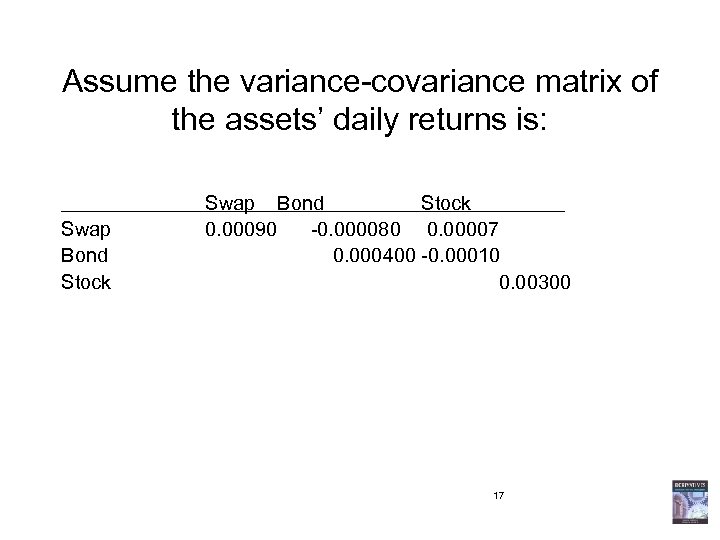 Assume the variance-covariance matrix of the assets’ daily returns is: Swap Bond Stock Swap Bond Stock 0. 00090 -0. 000080 0. 00007 0. 000400 -0. 00010 0. 00300 17
 The variance of this portfolio’s daily returns distribution is: 18
 • The standard deviation of the daily returns distribution is (0. 0002822)1/2 = 0. 0168, or 1. 68%. • One standard deviation of dollar loss from the portfolio value of $23, 000 is $386, 375 (1. 68% of $23 million is $386, 375). To calculate the Va. R, multiply the number of standard deviations for a stated probability level by one standard deviation of dollar loss. • • Thus, there is a 5% probability that a one day loss of (1. 645)($386, 375) = $635, 587 will be realized. • There is a 1% probability that a one day loss of (2. 327)($386, 375) = $899, 095 will be realized. 19
 Caveats: • Va. R calculated using historical data will differ, depending on the time period chosen. • If one year of daily historical data were gathered on January 1, 1989, then that data would not include the very unusual financial events of October, 1987. • Example: Consider a $23, 000 portfolio that mimics the S&P 500 index. 20
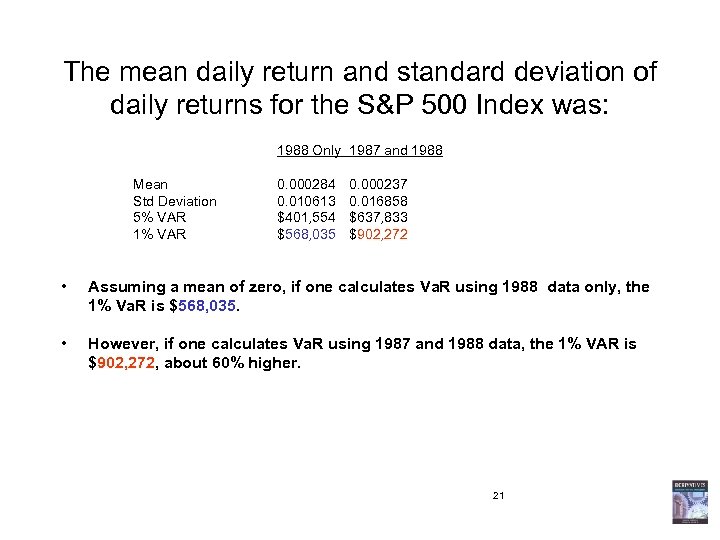 The mean daily return and standard deviation of daily returns for the S&P 500 Index was: 1988 Only 1987 and 1988 Mean Std Deviation 5% VAR 1% VAR 0. 000284 0. 010613 $401, 554 $568, 035 0. 000237 0. 016858 $637, 833 $902, 272 • Assuming a mean of zero, if one calculates Va. R using 1988 data only, the 1% Va. R is $568, 035. • However, if one calculates Va. R using 1987 and 1988 data, the 1% VAR is $902, 272, about 60% higher. 21
 Using the Historical Simulation Approach to Calculate Va. R • Here, the risk manager determines how each relevant price has changed during each of the past ‘N’ time periods. • For example, the relevant prices might be the dollar price of the Japanese yen and Deutsche mark, short-term U. S. interest rates, and the dollar price of oil. • Using a historical database, it is possible to find the price changes for each of these four variables on each of the last 300 days. 22
 • The risk manager then estimates how each of the 300 sets of price changes would affect the value of the current portfolio of spot assets and derivatives. • Assuming that each of these outcomes is equally likely, rank the resulting estimated value changes from most positive to most negative. • If the risk manager is interested in the VAR at the 95% confidence level, then use the 15 th worst outcome out of the 300. Why? • The VAR at the 99% confidence level is the 3 rd worst outcome. These are the losses that will be exceeded only 5% of the time and 1% of the time, respectively. • 23
 Using the Monte Carlo Simulation Approach to Calculate Va. R, I. • Here, returns are not assumed to be equally likely. • Instead, the risk manager specifies probability distributions or stochastic processes for prices in the future, based on economic scenarios. • A different probability distribution can be assumed for each fundamental economic factor. For example: – changes in interest rates might be skewed right – changes in oil prices might be drawn from a uniform distribution – changes in the price of some particular currency might be normally distributed. 24
 Using the Monte Carlo Simulation Approach to Calculate Va. R, II. • After the distributions or processes are defined, random realizations of outcomes can be simulated. • Each randomly chosen outcome is a set of prices. Correlations are explicitly incorporated in the simulation. • The change in value of each asset in the portfolio is estimated for each randomly selected set of prices, thereby producing a probability distribution of future value changes of the portfolio. • The risk manager can then determine what the worst outcome will be with a desired confidence level. 25
 Stress Testing • Stress testing attempts to answer this question: How well would the portfolio have performed under extreme market moves? – Suppose all equities in the portfolio fall 15% at once. – Suppose all interest rates change by 200 bp at once. • Stress testing takes into account extreme events (i. e. , jumps) that cannot be accounted for by probability distributions. • It is important to run stress tests on your portfolio. 26
 Back Testing • Regardless of the Va. R method employed, it is important to back test the Va. R estimates. • That is, how well would the Va. R estimate have performed in the past? • Suppose you are interested in the 5% Va. R. – How often did the portfolio lose more than the number predicted by the 5% Va. R? – Was it about 5% of the time? – Or, was it, say, 12% of the time? – If so, then it is important to adjust the Va. R method. • Remember, there is no finance theory that suggests Va. R should be used for decision making. 27
 What are Credit Derivatives? • A derivative is a contract whose value is derived from some underlying asset or variable. • Credit risk is the underlying variable of a credit derivative. • Credit risk is an asset class unto itself. • A credit derivative permits institutions to trade credit risk (credit (yield) spreads, rating downgrades, defaults, any credit event). Credit risk is traded in isolation from all other attributes that define the reference asset. The reference asset itself is not transferred. 28
 Credit Risk Management • 1971: Municipal bond insurance • Letters of credit • Collateralization • Marking to market • Netting • Early termination or assignment 29
 History • 1991: birth of the OTC credit derivatives market. • 1992: ISDA coins the term “credit derivatives. ” • By May 1996, the size of the market was $39 billion (CIBC Wood Gundy survey). • Recent surveys: – BBA, July 2000: $893 billion – Risk, Feb. 2001: $810 billion – OCC: June 2001: $351 billion – ISDA: June 2001: $631 billion 30
 Types of Credit Derivatives • Forward contracts • Swaps – Total return swap • Options – Default puts (credit default swaps) – Credit spread options 31
 Credit Forward Contracts • The buyer commits to buy a specified bond (reference asset) on a specified date at a contractually agreed upon price. • Buyer is buying credit risk. If the credit worthiness of the bond issuer deteriorates, the buyer loses. • Payoff can also be based on the change in the bond’s yield spread, say, relative to a Treasury security – E. g. , pay (spread at maturity – contract spread) X duration X notional principal 32
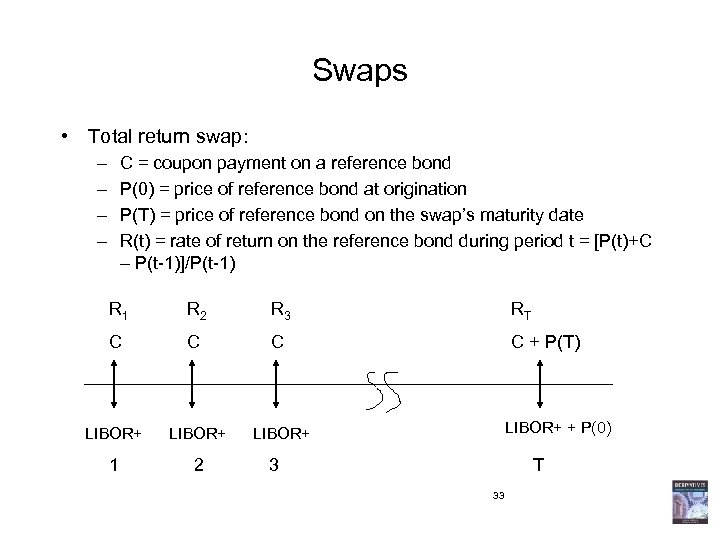 Swaps • Total return swap: – – C = coupon payment on a reference bond P(0) = price of reference bond at origination P(T) = price of reference bond on the swap’s maturity date R(t) = rate of return on the reference bond during period t = [P(t)+C – P(t-1)]/P(t-1) R 1 R 2 R 3 RT C C + P(T) LIBOR+ + P(0) 1 2 3 T 33
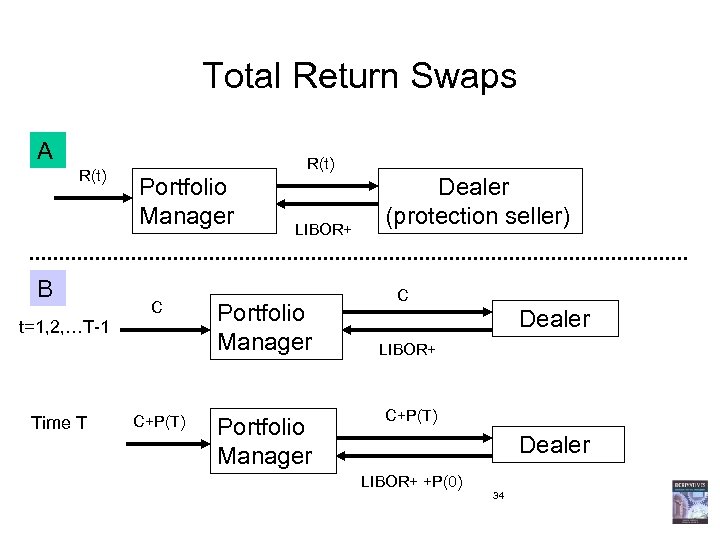 Total Return Swaps A R(t) B R(t) Portfolio Manager C t=1, 2, …T-1 Time T C+P(T) LIBOR+ Portfolio Manager Dealer (protection seller) C Dealer LIBOR+ C+P(T) Dealer LIBOR+ +P(0) 34
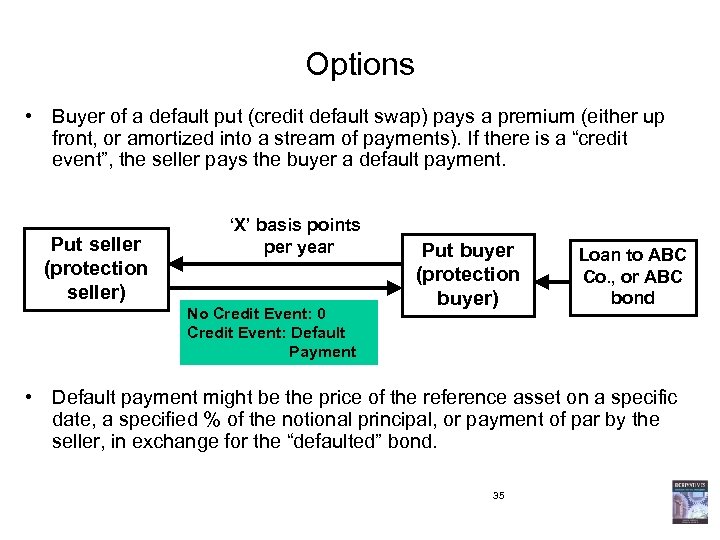 Options • Buyer of a default put (credit default swap) pays a premium (either up front, or amortized into a stream of payments). If there is a “credit event”, the seller pays the buyer a default payment. Put seller (protection seller) ‘X’ basis points per year No Credit Event: 0 Credit Event: Default Payment Put buyer (protection buyer) Loan to ABC Co. , or ABC bond • Default payment might be the price of the reference asset on a specific date, a specified % of the notional principal, or payment of par by the seller, in exchange for the “defaulted” bond. 35
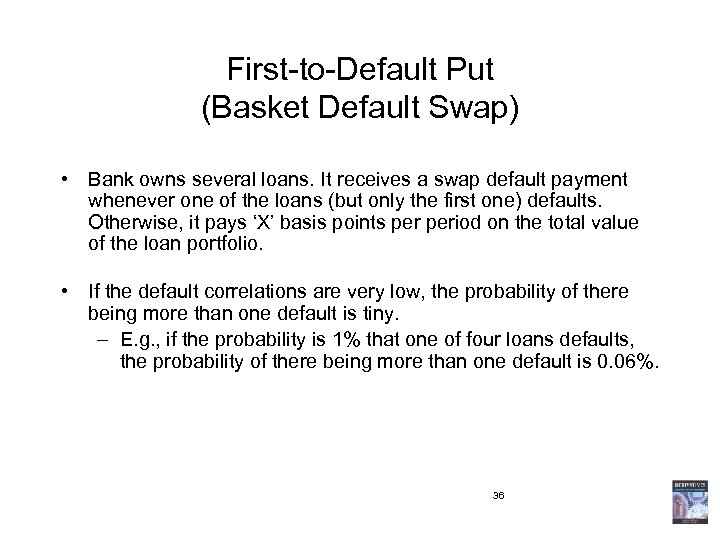 First-to-Default Put (Basket Default Swap) • Bank owns several loans. It receives a swap default payment whenever one of the loans (but only the first one) defaults. Otherwise, it pays ‘X’ basis points period on the total value of the loan portfolio. • If the default correlations are very low, the probability of there being more than one default is tiny. – E. g. , if the probability is 1% that one of four loans defaults, the probability of there being more than one default is 0. 06%. 36
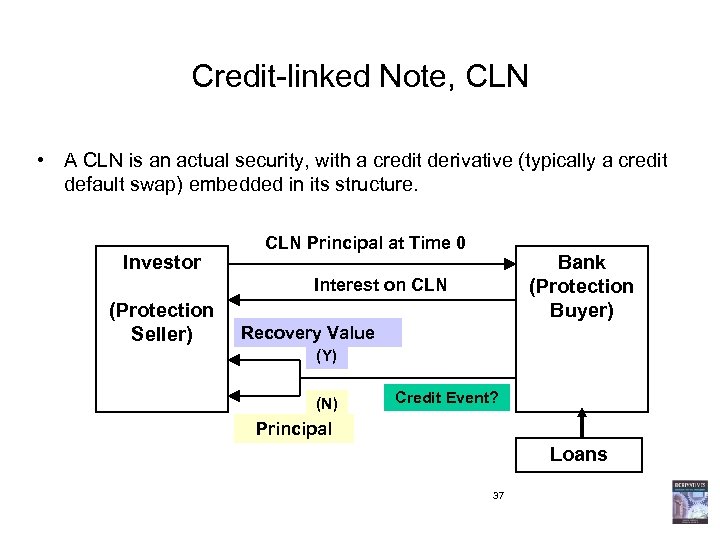 Credit-linked Note, CLN • A CLN is an actual security, with a credit derivative (typically a credit default swap) embedded in its structure. Investor CLN Principal at Time 0 Bank (Protection Buyer) Interest on CLN (Protection Seller) Recovery Value (Y) (N) Credit Event? Principal Loans 37
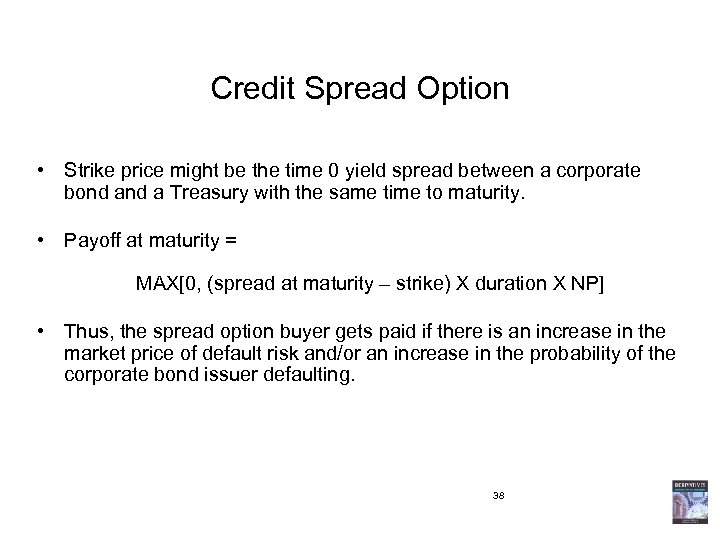 Credit Spread Option • Strike price might be the time 0 yield spread between a corporate bond a Treasury with the same time to maturity. • Payoff at maturity = MAX[0, (spread at maturity – strike) X duration X NP] • Thus, the spread option buyer gets paid if there is an increase in the market price of default risk and/or an increase in the probability of the corporate bond issuer defaulting. 38
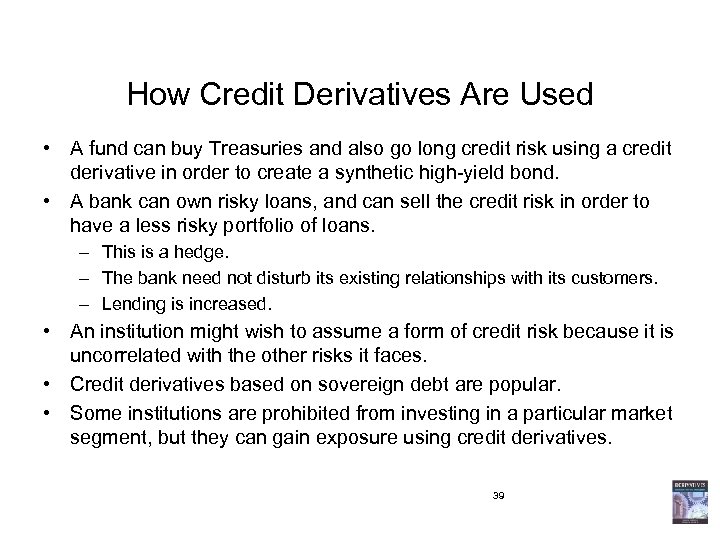 How Credit Derivatives Are Used • A fund can buy Treasuries and also go long credit risk using a credit derivative in order to create a synthetic high-yield bond. • A bank can own risky loans, and can sell the credit risk in order to have a less risky portfolio of loans. – This is a hedge. – The bank need not disturb its existing relationships with its customers. – Lending is increased. • An institution might wish to assume a form of credit risk because it is uncorrelated with the other risks it faces. • Credit derivatives based on sovereign debt are popular. • Some institutions are prohibited from investing in a particular market segment, but they can gain exposure using credit derivatives. 39
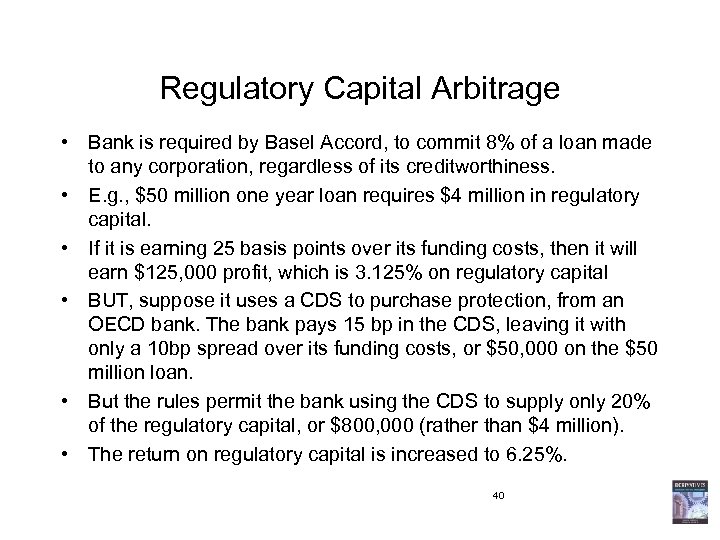 Regulatory Capital Arbitrage • Bank is required by Basel Accord, to commit 8% of a loan made to any corporation, regardless of its creditworthiness. • E. g. , $50 million one year loan requires $4 million in regulatory capital. • If it is earning 25 basis points over its funding costs, then it will earn $125, 000 profit, which is 3. 125% on regulatory capital • BUT, suppose it uses a CDS to purchase protection, from an OECD bank. The bank pays 15 bp in the CDS, leaving it with only a 10 bp spread over its funding costs, or $50, 000 on the $50 million loan. • But the rules permit the bank using the CDS to supply only 20% of the regulatory capital, or $800, 000 (rather than $4 million). • The return on regulatory capital is increased to 6. 25%. 40
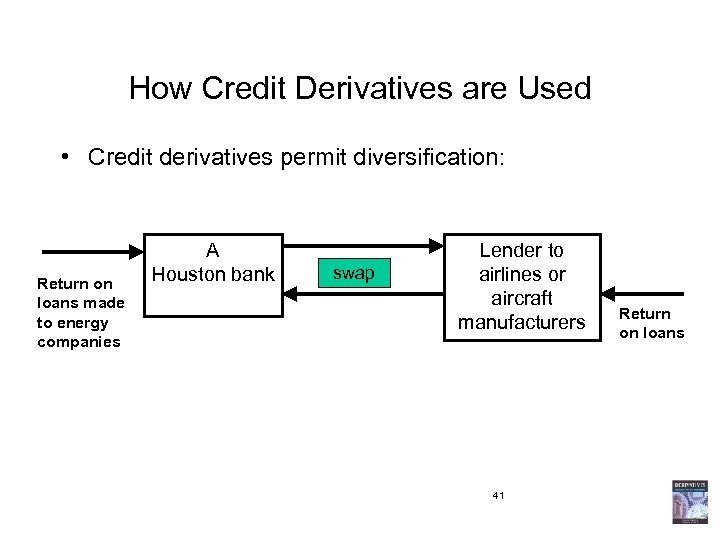 How Credit Derivatives are Used • Credit derivatives permit diversification: Return on loans made to energy companies A Houston bank swap Lender to airlines or aircraft manufacturers 41 Return on loans
 Product Structuring • Suppose an investor wants to invest in a Brazilian government bond, denominated in euros, but no such instrument exists. The investor can – Buy a German bond denominated in euros, – Sell default protection on the government of Brazil, in exchange for Euribor+ • Result: Investor gets coupon payments on the German bond in euros, and also receives a periodic payment from the sale of default protection. Effectively, she owns a Brazilian government bond denominated in euros. She is receiving a premium over the German interest rate, paid in euros, and is exposed to Brazilian default risk. 42
 Corporations can use Credit Derivatives • Corporations can hedge their receivables. • They can hedge sovereign credit-related project risk. • They can use a credit derivative as an alternative to buying back their own bonds. (There may be adverse tax consequences to a bond repurchase. ) 43
 Pricing Credit Derivatives • In theory, a credit derivative should be priced like any other derivative. The underlying asset is a variable (just like a stock price), which changes according to an assumed process (e. g. , Geometric Brownian Motion). • But, credit risk typically does not follow normal probability distribution processes – Many credit events are “jumps” – Many credit processes are unobservable (what is the probability of default? ) – Credit markets are often illiquid and have high transactions costs 44
 Other Issues with Pricing Credit Derivatives • One also needs to estimate recovery rates on defaulted securities. • How do dealers hedge their own unwanted credit risk exposure? – Could trade the issuer’s bonds (but, they often trade in illiquid markets) – Could trade the issuer’s stock • Does something cause the default, or is it random? 45
 The Elements of Credit Risk Models • Asset Credit Risk Model – What is the credit risk of an asset today? – How might that credit risk change over time? • Migration models (prob. of moving from one credit quality to another, within a given period of time) are often based on historic data. – Should you assume the migration follows a random Markov process, based on historical probabilities, or – Should you use macroeconomic data to drive the model? • Historic default data. • Stock price can be an indicator of default risk. • Must assume that interest rates can change; higher interest rates mean higher default probability. 46
 The Elements of Credit Risk Models • A credit risk model must also model how credit risk is priced. • Yield spreads over Treasuries. • Credit risk term structures. • Account for correlations among assets and over time. • Measure the credit risk for the portfolio over different holding periods. • Produce risk/return profiles. What is the expected return of the portfolio? What is the portfolio’s risk? Is the portfolio optimal? 47
 Exotic Options • The recent proliferation of option products has lead to a new class of options called “exotics. ” • Where to ordinary options end and exotics begin? • It is “common” to refer to almost any option not traded on an exchange as an exotic. 48
 There are Two Basic Types of Exotic Options • Path Dependent • Path Independent (AKA “Free Range”) • We will start our investigation with Free Range Options. 49
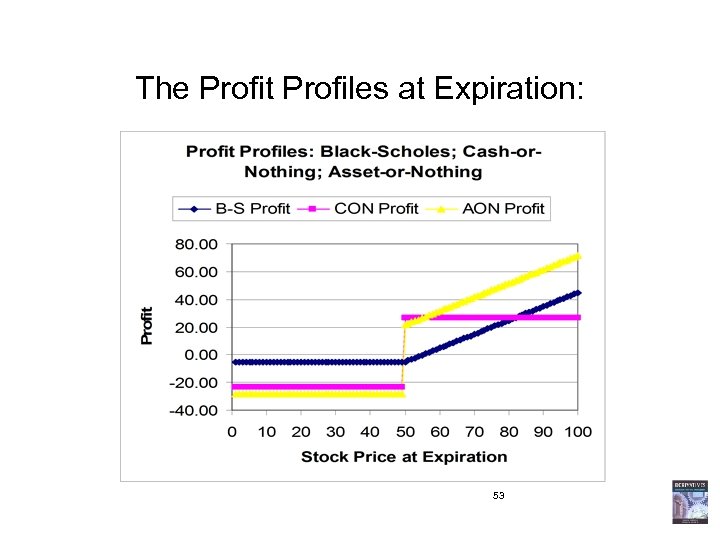
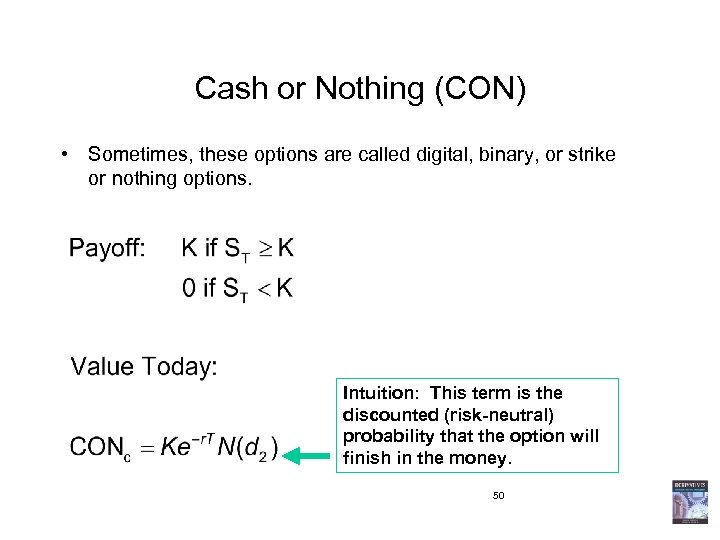 Cash or Nothing (CON) • Sometimes, these options are called digital, binary, or strike or nothing options. Intuition: This term is the discounted (risk-neutral) probability that the option will finish in the money. 50
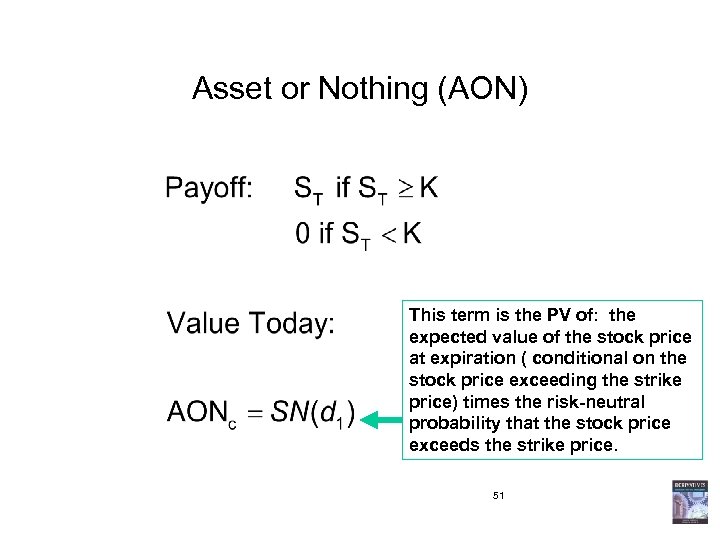 Asset or Nothing (AON) This term is the PV of: the expected value of the stock price at expiration ( conditional on the stock price exceeding the strike price) times the risk-neutral probability that the stock price exceeds the strike price. 51
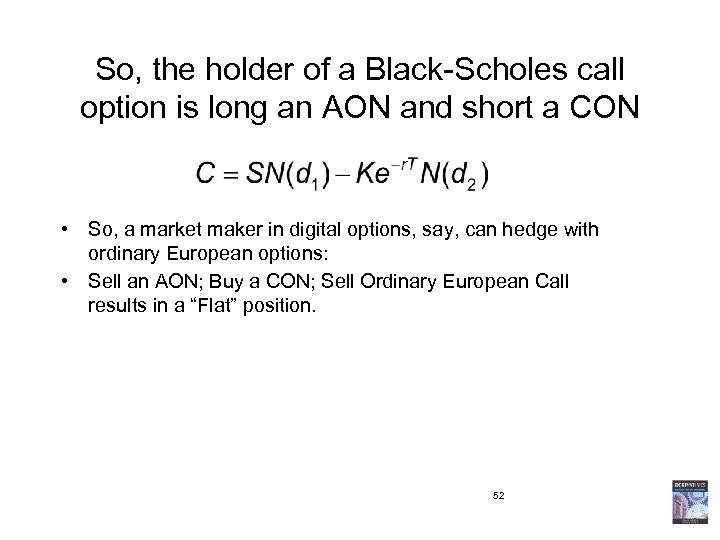 So, the holder of a Black-Scholes call option is long an AON and short a CON • So, a market maker in digital options, say, can hedge with ordinary European options: • Sell an AON; Buy a CON; Sell Ordinary European Call results in a “Flat” position. 52
 The Profit Profiles at Expiration: 53
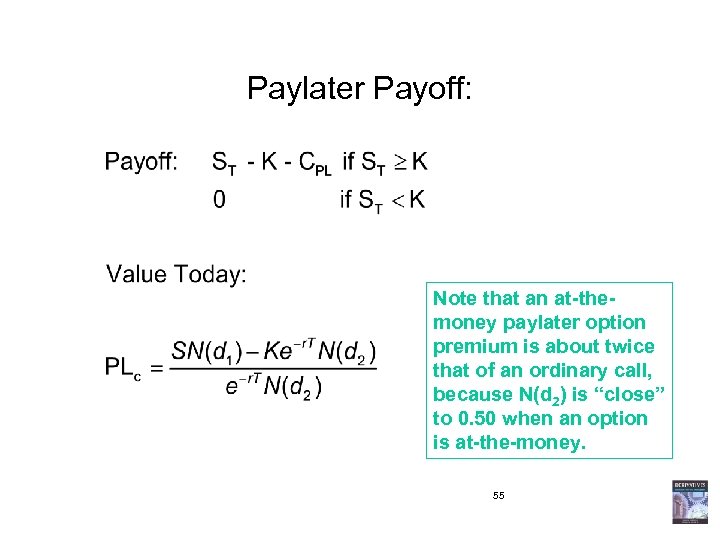
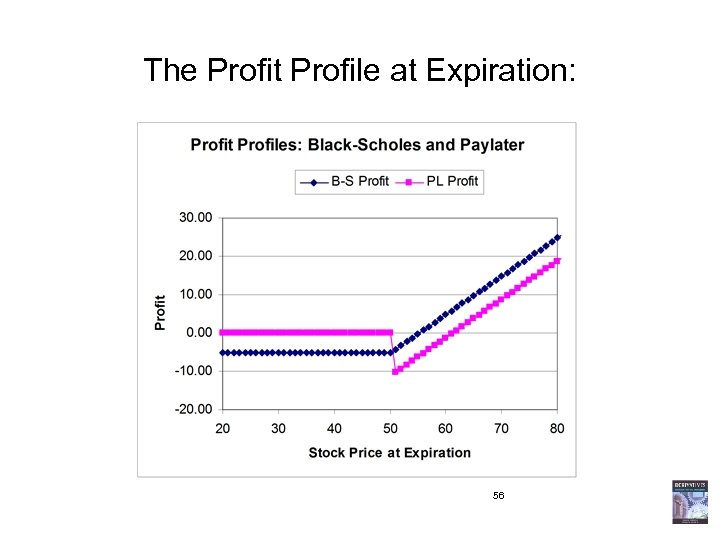
 Paylater Option • These are contingent options: The option premium is paid at exercise, if the option is in-the-money at expiration. – NB: The buyer must exercise the option if it is in-the-money at expiration, regardless whether it is “sufficiently” deep in the money to pay the premium and make a profit. – These options insure against a large adverse move, at zero initial cost. 54
 Paylater Payoff: Note that an at-themoney paylater option premium is about twice that of an ordinary call, because N(d 2) is “close” to 0. 50 when an option is at-the-money. 55
 The Profit Profile at Expiration: 56
 Chooser, AKA, “As You Like It” (Or, Options for the Undecided) • The holder of a chooser option gets to decide, at a designated future point before expiration (t), whether this option becomes a call option, or a put option. • Why buy Choosers? (What else could we do? ) – Straddle Cost: C + P (both with expiration T and strike K. ) – Chooser Cost: Replication Portfolio: Call with expiration T, strike K; Put with expiration t and strike Ke-r(T-t) – So, the Chooser is cheaper than the straddle (the put in the replication portfolio is cheaper. ) 57
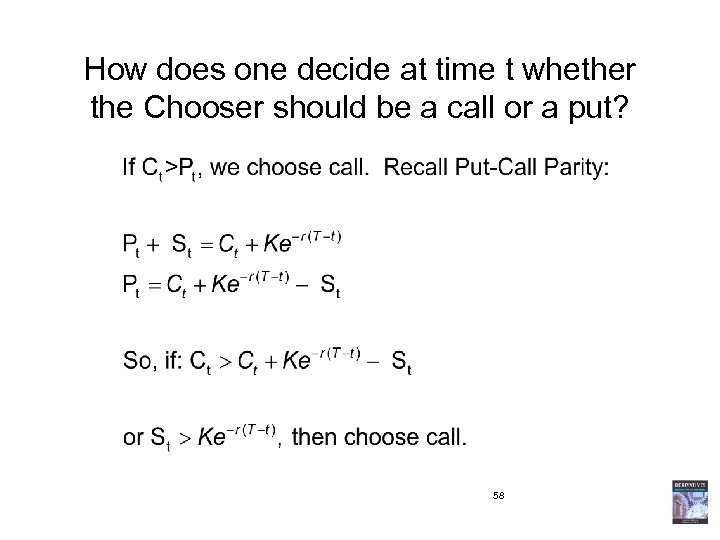 How does one decide at time t whether the Chooser should be a call or a put? 58
 Path Dependent Exotic Options • Closed-formulas are generally not available. • Must use computer algorithms, in general, to solve for these prices. 59
 Barrier Options, AKA Knocks: Cheaper than Ordinary Options • Down-and-Out (Knock Out) • Down-and-In (behaves as an ordinary option once it is ‘in’) • Up-and-Out (Knock Out) • Up-and-In (behaves as an ordinary option once it is ‘in’) • Parisian 60
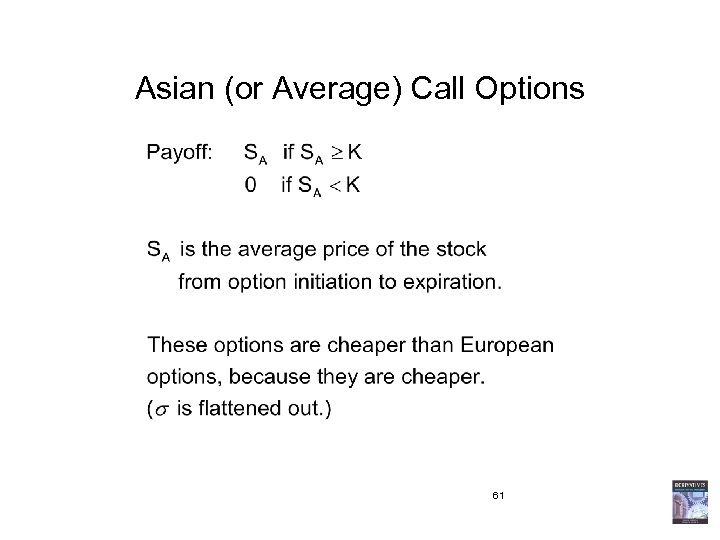 Asian (or Average) Call Options 61
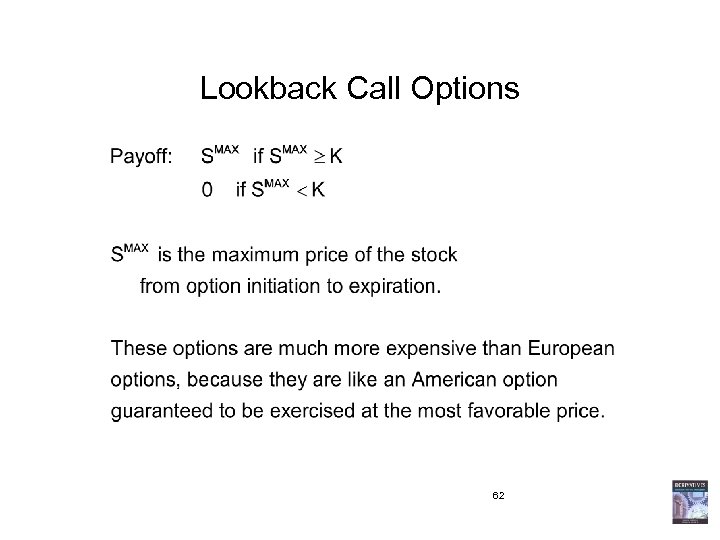 Lookback Call Options 62