


 Скачать презентацию Chapter 2 Tools for Healthy Eating 2010
cbbfac9d7f68715a358fc7b7e51a72fc.ppt
- Количество слайдов: 47
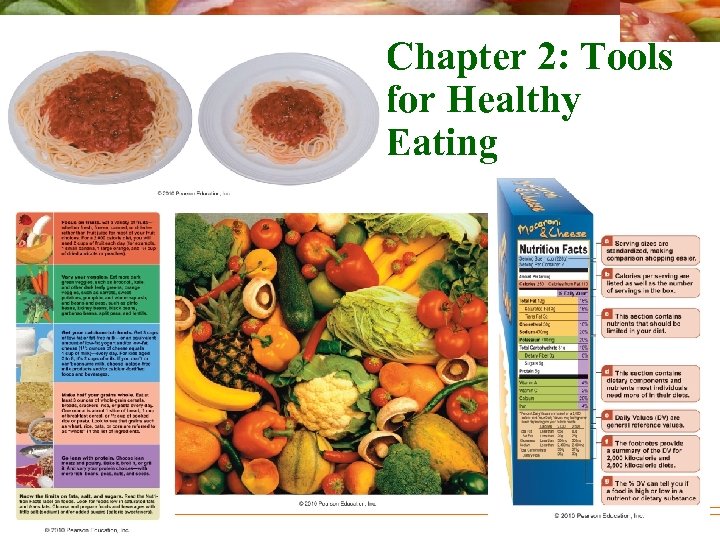 Chapter 2: Tools for Healthy Eating © 2010 Pearson Education, Inc.
 What Is Healthy Eating? Ø Eating to maintain health and prevent disease Ø Involves the key principles of • Adequacy • Balance • Variety • Moderation © 2010 Pearson Education, Inc.
 Healthy Eating Principles Ø Adequacy and Balance: • Diet provides all the essential nutrients, fiber, and energy • Diet provides the correct proportion of nutrients • Inadequacy Undernutrition Malnutrition • Overnutrition Overweight and Obesity © 2010 Pearson Education, Inc.
 Healthy Eating Principles Ø Variety • Diet contains a mixture of different food groups and foods within each group Ø Moderation • Diet provides reasonable but not excessive amounts or foods and nutrients • Be aware of portion size and number of servings © 2010 Pearson Education, Inc.
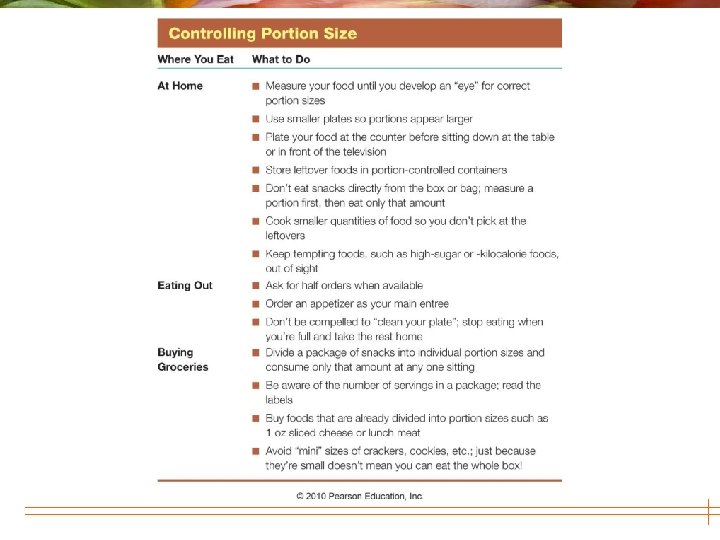
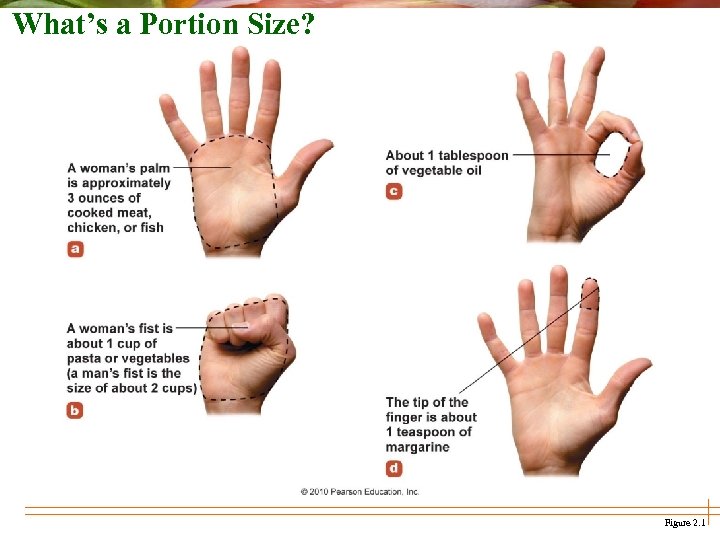 What’s a Portion Size? Figure 2. 1
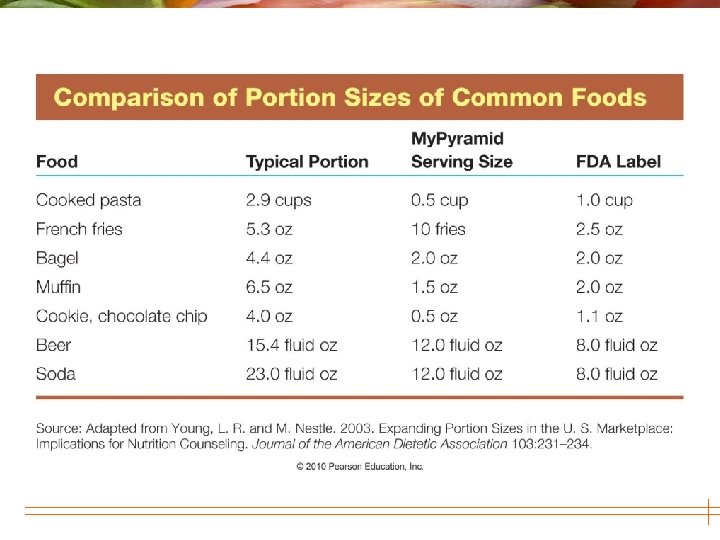
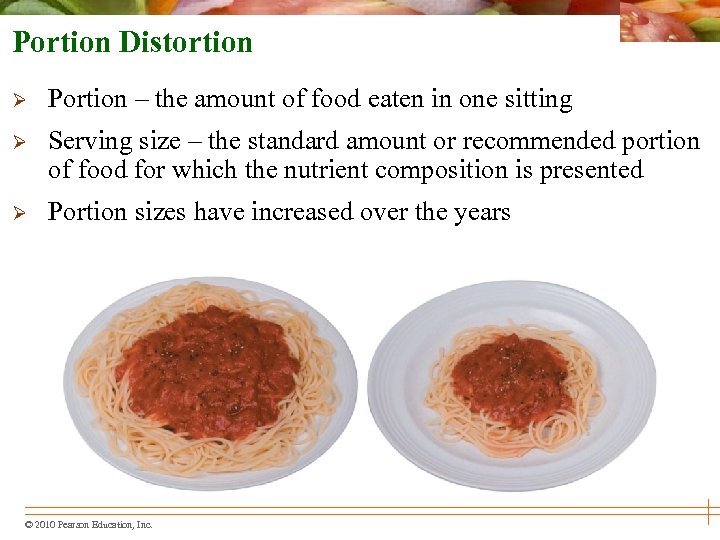 Portion Distortion Ø Portion – the amount of food eaten in one sitting Ø Serving size – the standard amount or recommended portion of food for which the nutrient composition is presented Ø Portion sizes have increased over the years © 2010 Pearson Education, Inc.
 Portion Distortion Ø Increased portion sizes have contributed to • Increased kcal intake • Increased weight • Increased risk of developing - Cardiovascular disease - Diabetes - Joint problems - Cancers © 2010 Pearson Education, Inc.
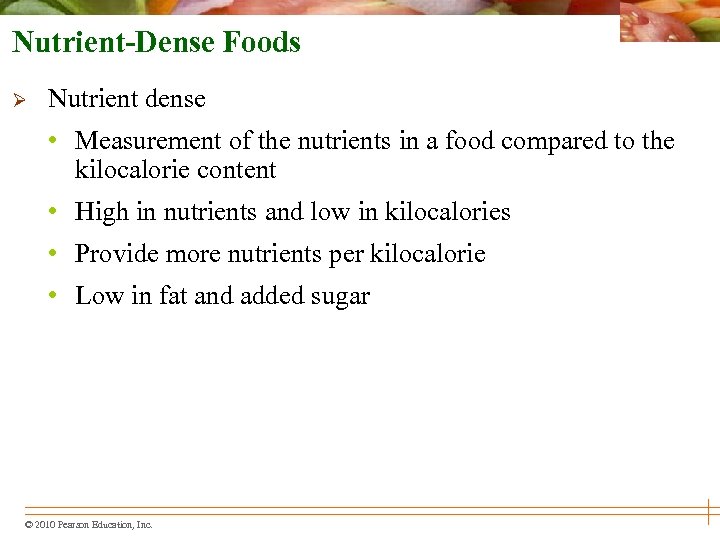 Nutrient-Dense Foods Ø Nutrient dense • Measurement of the nutrients in a food compared to the kilocalorie content • High in nutrients and low in kilocalories • Provide more nutrients per kilocalorie • Low in fat and added sugar © 2010 Pearson Education, Inc.
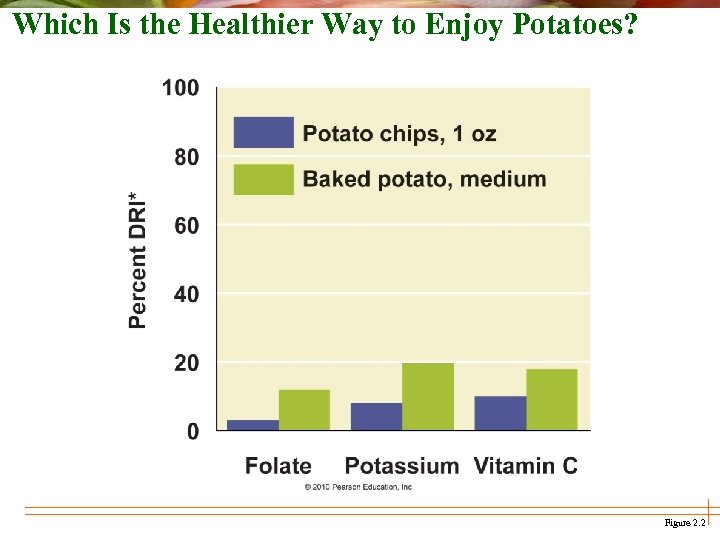 Which Is the Healthier Way to Enjoy Potatoes? Figure 2. 2
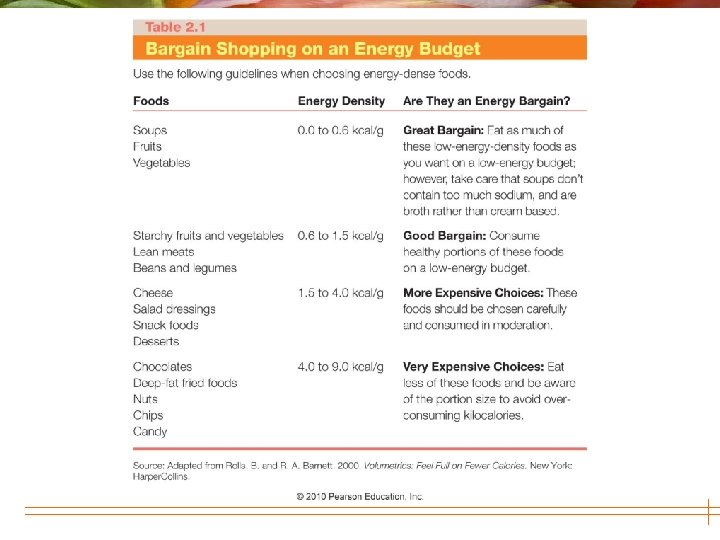
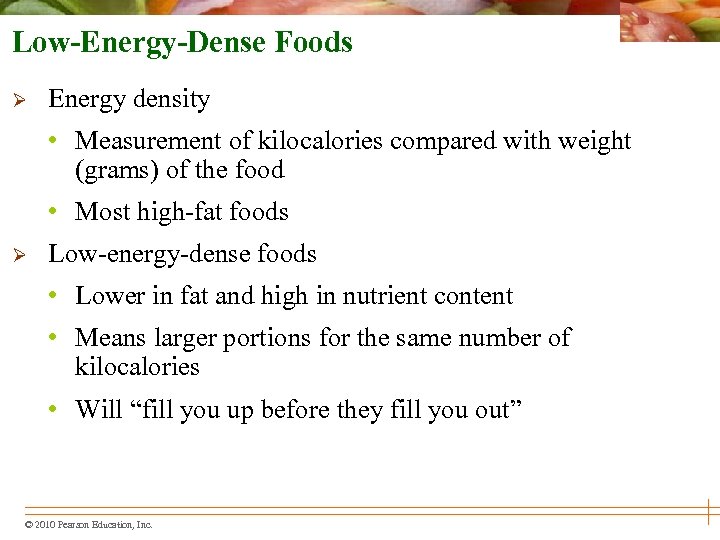 Low-Energy-Dense Foods Ø Energy density • Measurement of kilocalories compared with weight (grams) of the food • Most high-fat foods Ø Low-energy-dense foods • Lower in fat and high in nutrient content • Means larger portions for the same number of kilocalories • Will “fill you up before they fill you out” © 2010 Pearson Education, Inc.
 Resources for Planning a Healthy Diet Ø Dietary Reference Intakes (DRIs) • Reference values for nutrients developed by the Food and Nutrition Board (FNB) of the Institute of Medicine • Used to plan and evaluate the diets of healthy people in the United States and Canada © 2010 Pearson Education, Inc.
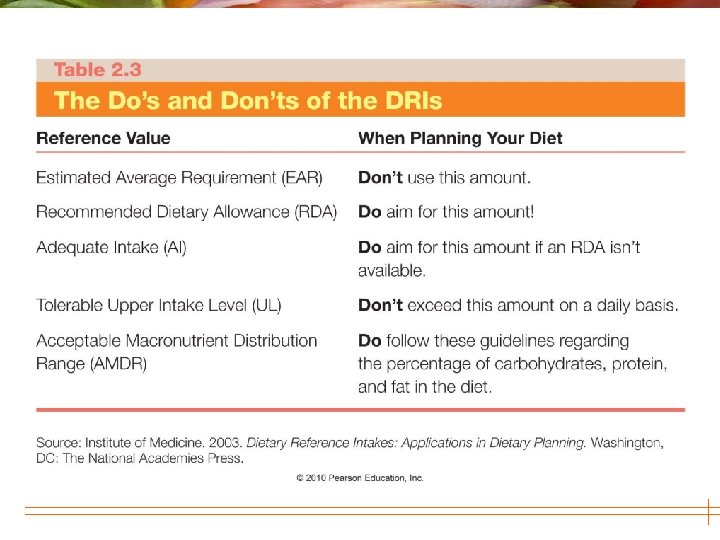
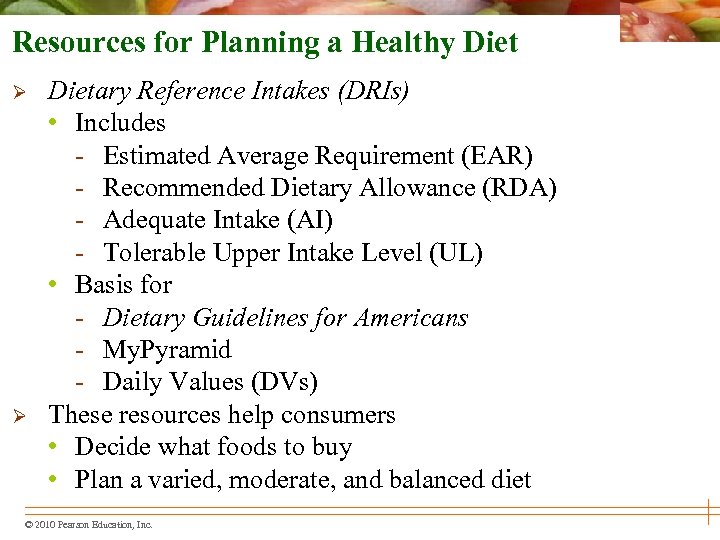 Resources for Planning a Healthy Diet Ø Ø Dietary Reference Intakes (DRIs) • Includes - Estimated Average Requirement (EAR) - Recommended Dietary Allowance (RDA) - Adequate Intake (AI) - Tolerable Upper Intake Level (UL) • Basis for - Dietary Guidelines for Americans - My. Pyramid - Daily Values (DVs) These resources help consumers • Decide what foods to buy • Plan a varied, moderate, and balanced diet © 2010 Pearson Education, Inc.
 Dietary Reference Intakes (DRIs) Ø Focus on • Maintaining good health • Reducing the risk of developing chronic disease • Avoiding unhealthy excess (toxic amounts of nutrients) Ø Nutrient requirements for different life stages • Pregnant versus non-pregnant status • Age • Gender Ø Periodically updated © 2010 Pearson Education, Inc.
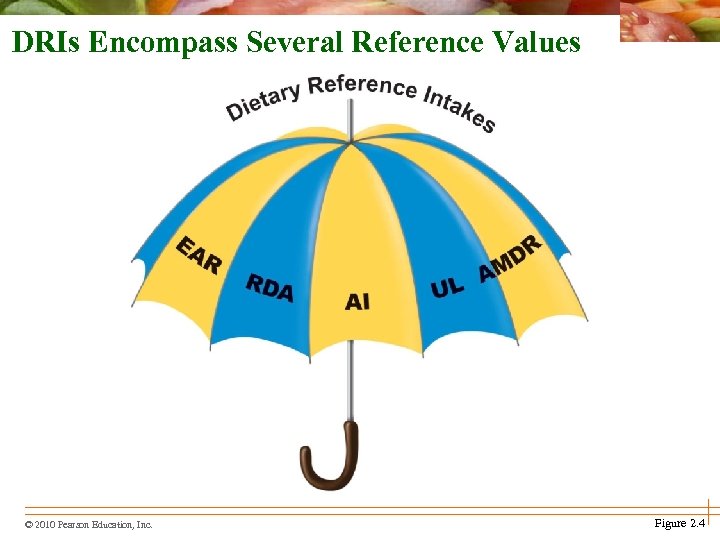 DRIs Encompass Several Reference Values © 2010 Pearson Education, Inc. Figure 2. 4
 DRI Reference Values Ø Estimated Average Requirements (EAR) • Starting point for determining other values • Amount of a nutrient projected to meet the needs of 50% of healthy Americans by age and gender • Requirements are based on a measurement that indicates whether the individual is at risk of a deficiency - Measurement differs from nutrient to nutrient • If there isn’t enough research to develop an appropriate measurement for a nutrient, EAR is not established • Used to calculate RDAs © 2010 Pearson Education, Inc.
 DRI Reference Values Ø Recommended Dietary Allowance (RDA) • Recommendation for each nutrient that should meet the needs of nearly all (97 to 98%) of the individuals in a specific gender and age group • Higher than the EARs • Not available for all nutrients © 2010 Pearson Education, Inc.
 DRI Reference Values Ø Adequate Intakes (AI) • Estimate based on the judgment of the FNB members • Next best scientific estimate of the amount of a nutrient that groups of similar individuals should consume to maintain good health • Set without having established RDAs • Only estimation for nutrients’ adequacy in infants © 2010 Pearson Education, Inc.
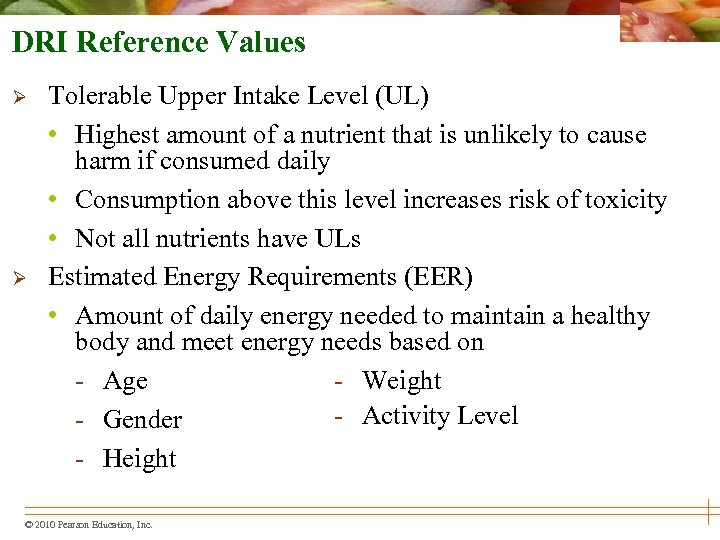 DRI Reference Values Ø Ø Tolerable Upper Intake Level (UL) • Highest amount of a nutrient that is unlikely to cause harm if consumed daily • Consumption above this level increases risk of toxicity • Not all nutrients have ULs Estimated Energy Requirements (EER) • Amount of daily energy needed to maintain a healthy body and meet energy needs based on - Age - Weight - Activity Level - Gender - Height © 2010 Pearson Education, Inc.
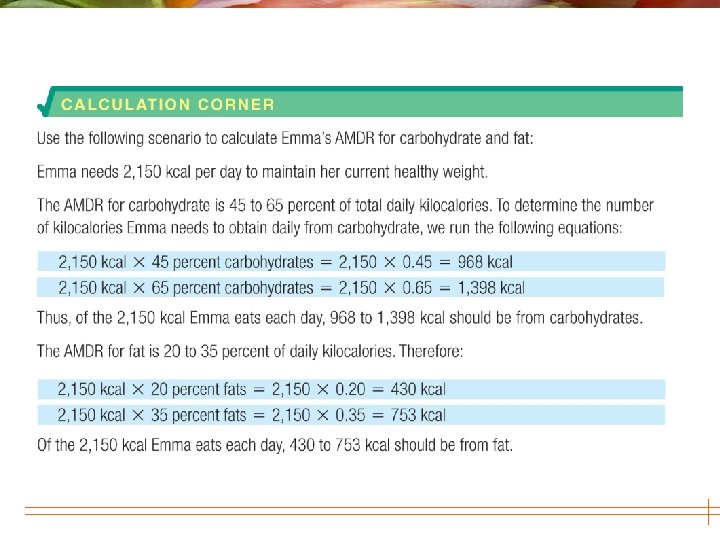
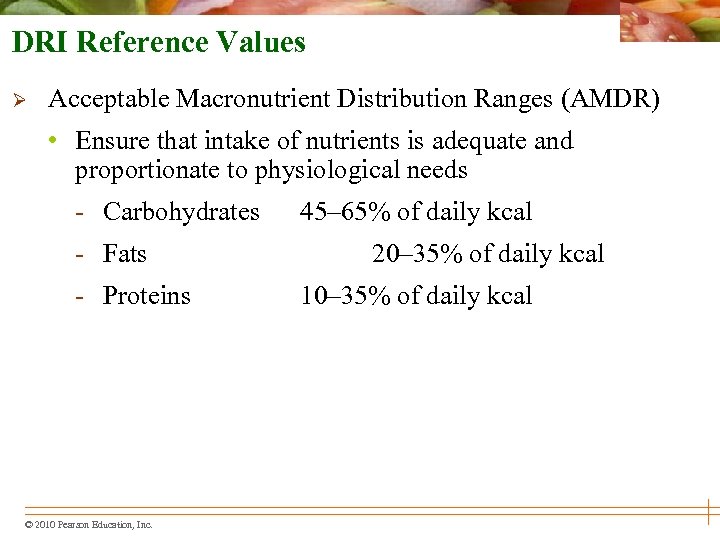 DRI Reference Values Ø Acceptable Macronutrient Distribution Ranges (AMDR) • Ensure that intake of nutrients is adequate and proportionate to physiological needs - Carbohydrates - Fats - Proteins © 2010 Pearson Education, Inc. 45– 65% of daily kcal 20– 35% of daily kcal 10– 35% of daily kcal
 Dietary Guidelines for Americans Ø Nutritional goals for Americans established by scientists Ø Updated every five years by the U. S. Department of Agriculture (USDA) and the Department of Health and Human Services (DHHS) Ø Shapes all federally funded nutritional programs in areas of research and labeling Ø Educates and guides consumers concerning healthy diet and lifestyle choices © 2010 Pearson Education, Inc.
 Dietary Guidelines for Americans 2010 Ø The most current nutrition and physical activity recommendations for good health Ø Designed to help individuals aged 2 and over • Improve the quality of diet • Lower the risk of chronic disease and unhealthy conditions © 2010 Pearson Education, Inc.
 Dietary Guidelines for Americans 2010 Ø Divided into four current, major goals: • Balance kilocalories to manage weight - Prevent overweight/obesity- Control total kilocalorie intake, increase physical activity • Food groups to encourage - Variety of vegetables and fruits - Whole grains - Variety of protein, specifically seafood - Lower fat food, oils vs. solid fat • Food choices to discourage - Reduce sodium intake and cholesterol consumption - Less saturated fats, added sugars, refined grains, alcohol • Building Healthy Eating Patterns © 2010 Pearson Education, Inc.
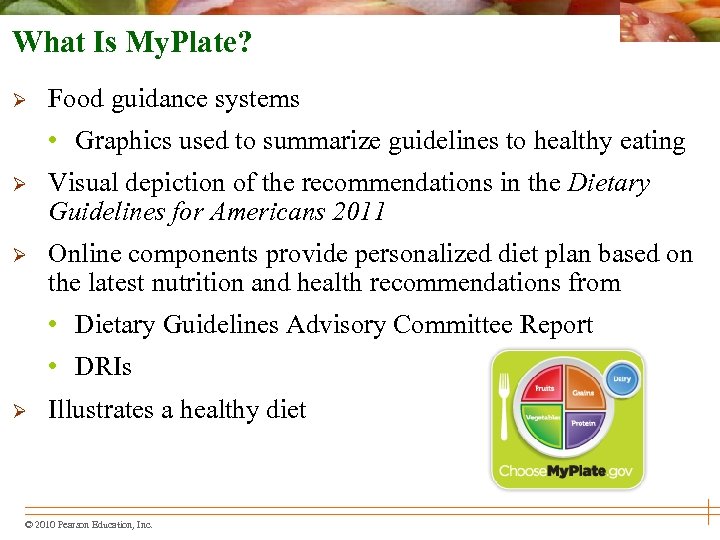 What Is My. Plate? Ø Food guidance systems • Graphics used to summarize guidelines to healthy eating Ø Visual depiction of the recommendations in the Dietary Guidelines for Americans 2011 Ø Online components provide personalized diet plan based on the latest nutrition and health recommendations from • Dietary Guidelines Advisory Committee Report • DRIs Ø Illustrates a healthy diet © 2010 Pearson Education, Inc.
 How to Use My. Plate Ø Personalize your eating plan at www. choosemyplate. gov/index. html Ø For a moderately active female who needs 2, 000 kcal daily, a healthy daily diet would consist of the following: • 6 servings from the grains group • 21⁄2 cups of dark green, orange, starchy and other vegetables • 2 cups of fruits • 3 cups of fat-free or low fat milk and yogurt • 51⁄2 oz lean meat, poultry and fish, or equivalent in meat alternatives such as beans • 6 tsp of vegetable oils MIX UP CHOICES WITHIN EACH FOOD GROUP © 2010 Pearson Education, Inc.
 My. Plate Recommendations "Make half your plate fruits and vegetables” "Switch to 1% or skim milk" "Make at least half your grains whole" "Vary your protein food choices. ” The guidelines also recommend portion control while still enjoying food, as well as reductions in sodium and sugar intakes. http: //en. wikipedia. org/wiki/My. Plate © 2010 Pearson Education, Inc.
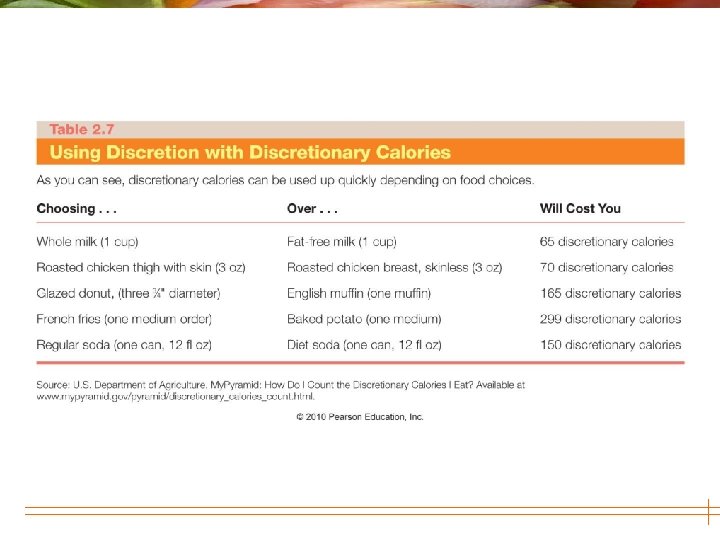
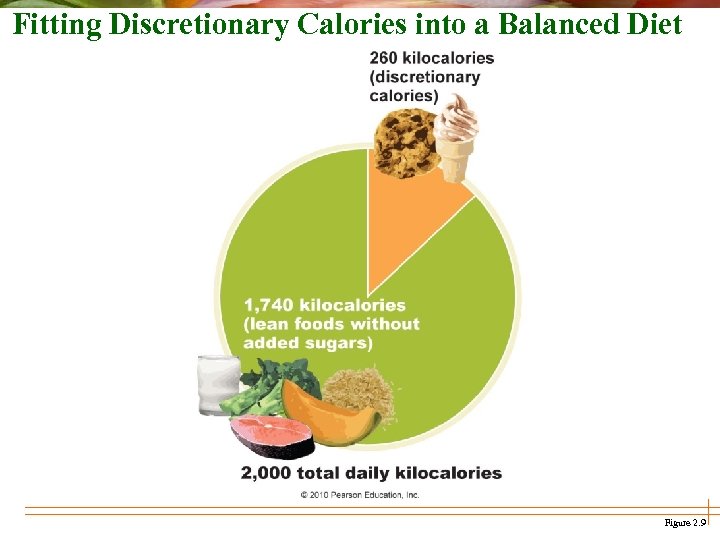 Fitting Discretionary Calories into a Balanced Diet Figure 2. 9
 Time of Day and Eating: Does It Impact Your Health? Ø Eat breakfast may decreases the total number of kilocalories you eat in a day • Increased satiety with breakfast foods • May be a good strategy for weight control Ø Eating later in the day may increase kilocalorie intake Ø Eating more fat and consuming more alcohol on the weekends can result in weight gain © 2010 Pearson Education, Inc.
 Time of Day and Eating: Does It Impact Your Health? Ø Start your day with a nutrient-dense breakfast Ø Choose breakfast foods that are more satisfying Ø Control kilocalorie intake on nights and weekends © 2010 Pearson Education, Inc.
 Food Labels Strictly Regulated by the FDA Ø Every packaged food must be labeled with • Name of food • Net weight, the weight of the food in the package, excluding weight of the package or packing material • Name and address of the manufacturer or distributor • List of ingredients in descending order by weight Ø Nutrition Labeling and Education Act mandated in 1990 • Uniform nutritional information • Serving sizes • Specific criteria for health claims © 2010 Pearson Education, Inc.
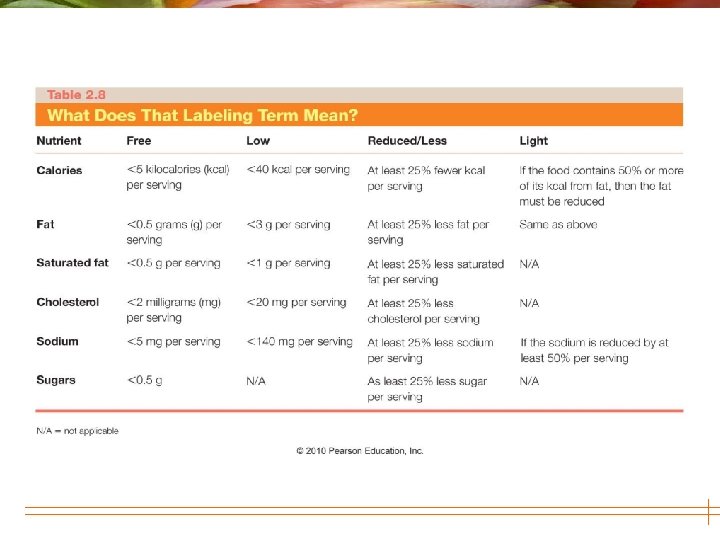
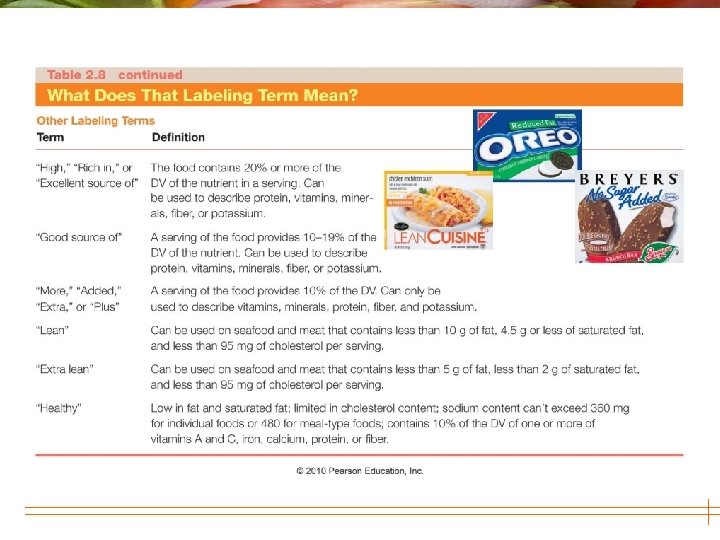
 Food Labels Strictly Regulated by the FDA Ø Ø Ø Additional requirements since 1990 Nutrition information: total kilocalories, kilocalories from fat, total fat, saturated fat, trans fats, cholesterol, sodium, total carbohydrate, dietary fiber, sugars, vitamin A, vitamin C, calcium, and iron Uniform serving sizes among similar products Indication of how a serving of the food fits into an overall daily diet Uniform definitions for descriptive label terms such as “light” and “fat free” Health claims that are accurate and science based, if made about the food or one of its nutrients © 2010 Pearson Education, Inc.
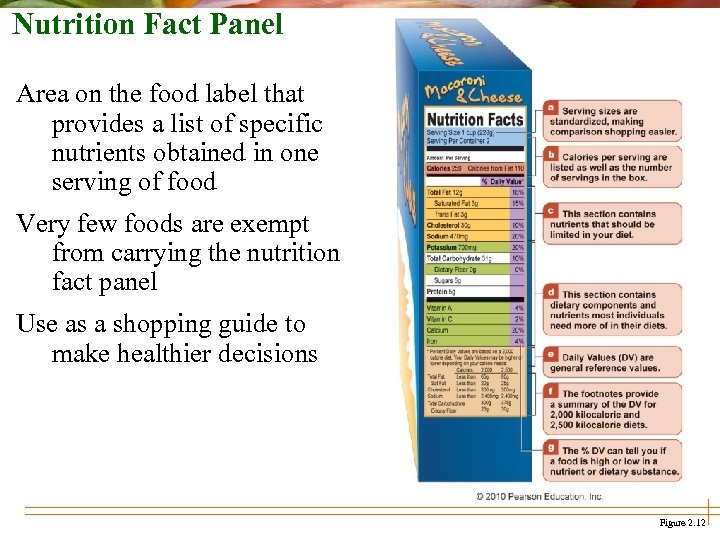 Nutrition Fact Panel Area on the food label that provides a list of specific nutrients obtained in one serving of food Very few foods are exempt from carrying the nutrition fact panel Use as a shopping guide to make healthier decisions Figure 2. 12
 Daily Values (DVs) Ø General idea of how the nutrients in the food fit into the overall diet Ø Based on a 2, 000 kilocalorie diet Ø Food is considered high in nutrient if DV is > 20% Ø Food is considered low in nutrient if DV is < 5% Ø There is no DV for trans fat, sugars, and protein Ø Some Nutrient Facts Panels have a footnote at the bottom that provides a summary of DVs for 2, 000 and 2, 500 kilocalorie diets © 2010 Pearson Education, Inc.
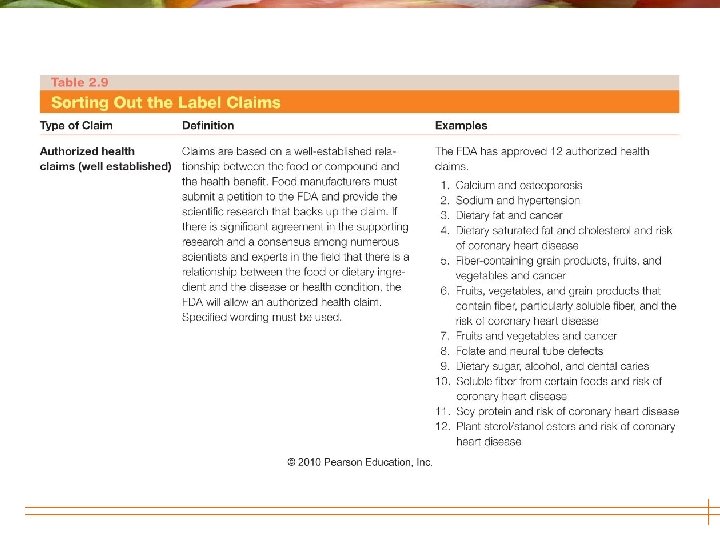
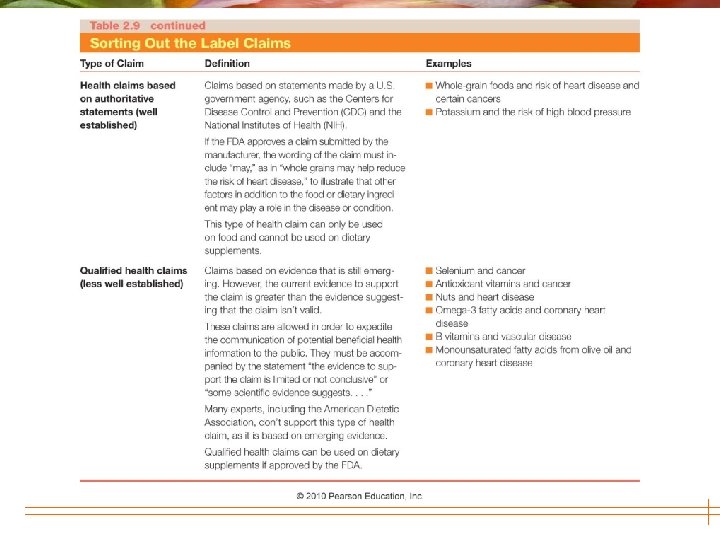
 Label Claims Can Reveal Potential Health Benefits Ø FDA mandates that all claims on labels follow strict guidelines Ø Currently three types of health claims are allowed • Nutrient content claims • Health claims • Structure/function claims © 2010 Pearson Education, Inc.
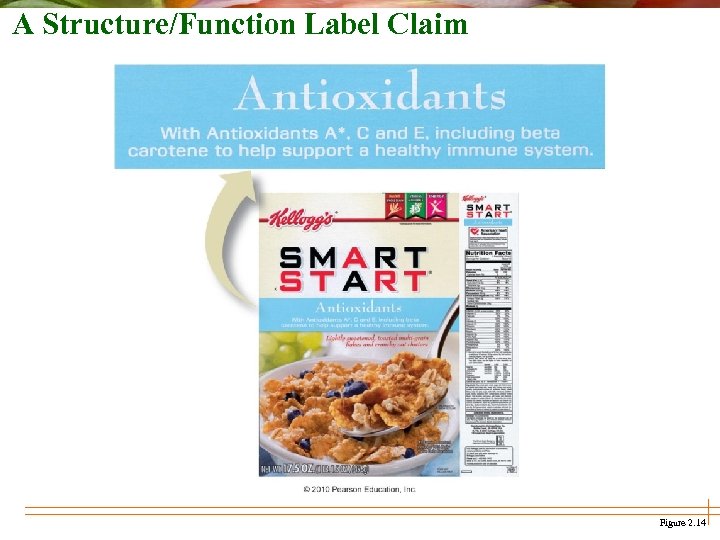 A Structure/Function Label Claim Figure 2. 14
 Quick Review Ø Ø Ø FDA regulates the labeling on all packaged foods Every food label must contain the name of the food, net weight, name and address of the manufacturer or distributor, a list of ingredients, and standardized nutrition information FDA allows and regulates the use of • Nutrient content claims • Health claims • Structure/function claims • Foods or dietary supplements displaying these - Must meet specified criteria - Claims must be truthful © 2010 Pearson Education, Inc.
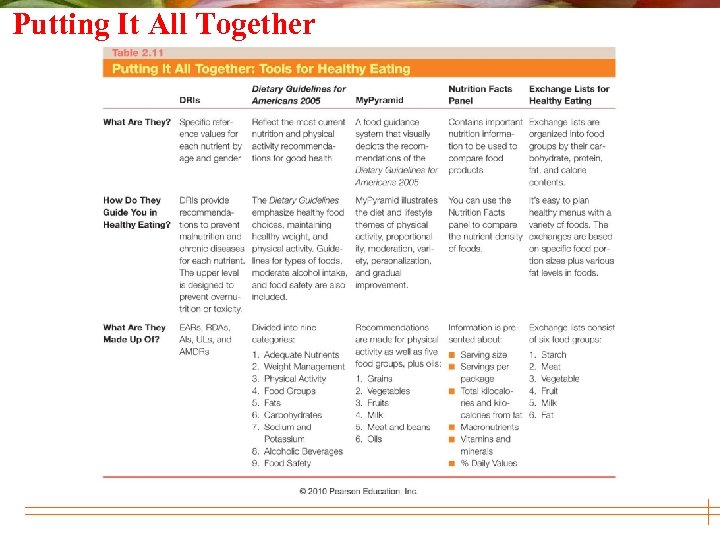 Putting It All Together