


 Скачать презентацию CHAPTER 2 THE THREE STRATEGY-MAKING TASKS Screen graphics
3462ff6ed633005b4f273b81d8863da0.ppt
- Количество слайдов: 88
 CHAPTER 2 THE THREE STRATEGY-MAKING TASKS Screen graphics created by: Jana F. Kuzmicki, Ph. D, Mississippi University for Women Mc. Graw-Hill/Irwin © 2003 The Mc. Graw-Hill Companies, Inc. , All Rights Reserved. 1
 “Management’s job is not to see the company as it is…. but as it can become. ” John W. Teets “A strategy is a commitment to undertake one set of actions rather than another. ” “Quote” Sharon M. Oster Mc. Graw-Hill/Irwin © 2003 The Mc. Graw-Hill Companies, Inc. , All Rights Reserved. 2
 Chapter Outline u Developing a Strategic Vision / Mission u Establishing Financial and Strategic Objectives u Crafting a Strategy u Factors Shaping a Company's Strategy u Linking Strategy With Ethics Mc. Graw-Hill/Irwin © 2003 The Mc. Graw-Hill Companies, Inc. , All Rights Reserved. 3
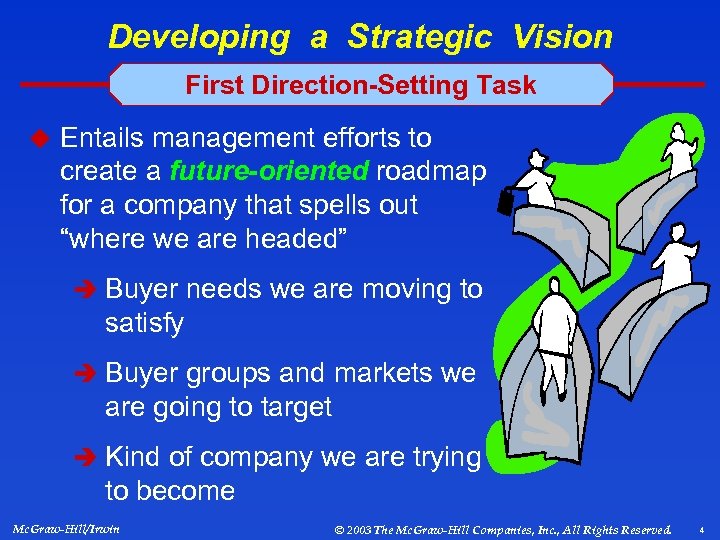 Developing a Strategic Vision First Direction-Setting Task u Entails management efforts to create a future-oriented roadmap for a company that spells out “where we are headed” è Buyer needs we are moving to satisfy è Buyer groups and markets we are going to target è Kind of company we are trying to become Mc. Graw-Hill/Irwin © 2003 The Mc. Graw-Hill Companies, Inc. , All Rights Reserved. 4
 Strategic Management Principle Effective strategy-making begins with a vision of where the organization needs to head! Mc. Graw-Hill/Irwin © 2003 The Mc. Graw-Hill Companies, Inc. , All Rights Reserved. 5
 Example: John Deere’s Strategic Vision Who Are We? John Deere has grown and prospered through a long-standing partnership with the world’s most productive farmers. Today, John Deere is a global company with several equipment operations and complementary service businesses. These businesses are closely interrelated, providing the company with significant growth opportunities and other synergistic benefits. Mc. Graw-Hill/Irwin © 2003 The Mc. Graw-Hill Companies, Inc. , All Rights Reserved. 6
 Example: John Deere’s Strategic Vision Where Are We Going? u Deere is committed to providing genuine value to the company’s stakeholders. In support of that commitment, Deere aspires to: è Grow and pursue leadership positions in each of our businesses. è Extend our preeminent leadership position in the agricultural equipment market worldwide. è Create new opportunities to leverage the John Deere brand globally. Mc. Graw-Hill/Irwin © 2003 The Mc. Graw-Hill Companies, Inc. , All Rights Reserved. 7
 Example: John Deere’s Strategic Vision How Will We Get There? u By pursuing the broader corporate goals of profitable growth and continuous improvement, each of the company’s businesses is expected to: è Achieve world-class performance by attaining a strong competitive position in target markets. è Exceed customer expectations for quality and value. è Earn in excess of the cost of capital over a business cycle. Mc. Graw-Hill/Irwin © 2003 The Mc. Graw-Hill Companies, Inc. , All Rights Reserved. 8
 Example: John Deere’s Strategic Vision How Will We Get There? u By growing profitably and continuously improving, each of the company’s businesses will benefit from and contribute to Deere’s unique intangible assets: è Our distinguished brand. è Our heritage of integrity and teamwork. è Our advanced skills. è The special relationships that have long existed between the company and our employees, customers, dealers and other business partners around the world. Mc. Graw-Hill/Irwin © 2003 The Mc. Graw-Hill Companies, Inc. , All Rights Reserved. 9
 Example: John Deere’s Strategic Vision How Will We Measure Our Performance? u Each business will make a positive contribution to the corporation’s objectives in the pursuit of creating genuine value for our stakeholders. Our “scorecard” includes: è Human Resources--employee satisfaction, training è Customer Focus--loyalty, market leadership è Business Processes--productivity, quality, cost, environment è Business Results--return on assets, sales growth Mc. Graw-Hill/Irwin © 2003 The Mc. Graw-Hill Companies, Inc. , All Rights Reserved. 10
 Example: Delta Airline’s Strategic Vision DELTA AIRLINES . . . we want Delta to be the WORLDWIDE AIRLINE OF CHOICE. Mc. Graw-Hill/Irwin © 2003 The Mc. Graw-Hill Companies, Inc. , All Rights Reserved. 11
 Example: Delta Airline’s Strategic Vision DELTA AIRLINES WORLDWIDE, because we are and intend to remain an innovative, aggressive, ethical, and successful competitor that offers access to the world at the highest standards of customer service. We will continue to look for opportunities to extend our reach through new routes and creative global alliances. Mc. Graw-Hill/Irwin © 2003 The Mc. Graw-Hill Companies, Inc. , All Rights Reserved. 12
 Example: Delta Airline’s Strategic Vision DELTA AIRLINES AIRLINE, because we intend to stay in the business we know best -- air transportation and related services. We won’t stray from our roots. We believe in the long-term prospects for profitable growth in the airline industry, and we will continue to focus time, attention, and investment on enhancing our place in that business environment. Mc. Graw-Hill/Irwin © 2003 The Mc. Graw-Hill Companies, Inc. , All Rights Reserved. 13
 Example: Delta Airline’s Strategic Vision DELTA AIRLINES OF CHOICE, because we value the loyalty of our customers, employees, and investors. For passengers and shippers, we will continue to provide the best service and value. For our personnel, we will continue to offer an ever more challenging, rewarding, and result-oriented workplace that recognizes and appreciates their contributions. For our shareholders, we will earn a consistent, superior financial return. Mc. Graw-Hill/Irwin © 2003 The Mc. Graw-Hill Companies, Inc. , All Rights Reserved. 14
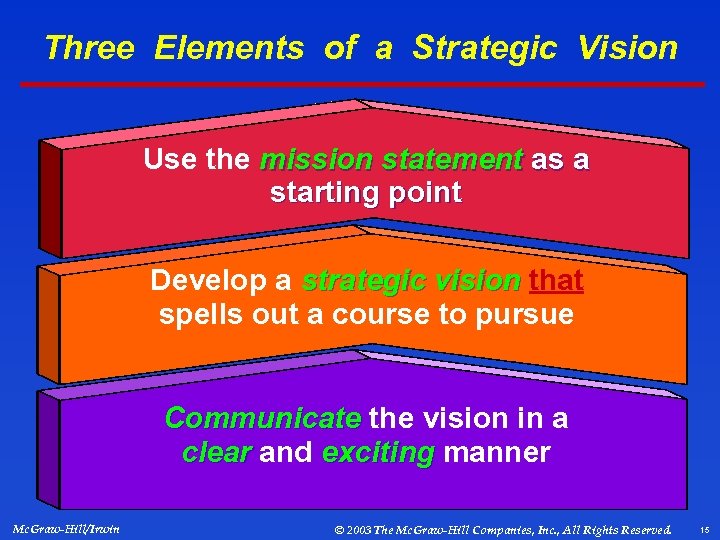 Three Elements of a Strategic Vision Use the mission statement as a starting point Develop a strategic vision that spells out a course to pursue Communicate the vision in a clear and exciting manner Mc. Graw-Hill/Irwin © 2003 The Mc. Graw-Hill Companies, Inc. , All Rights Reserved. 15
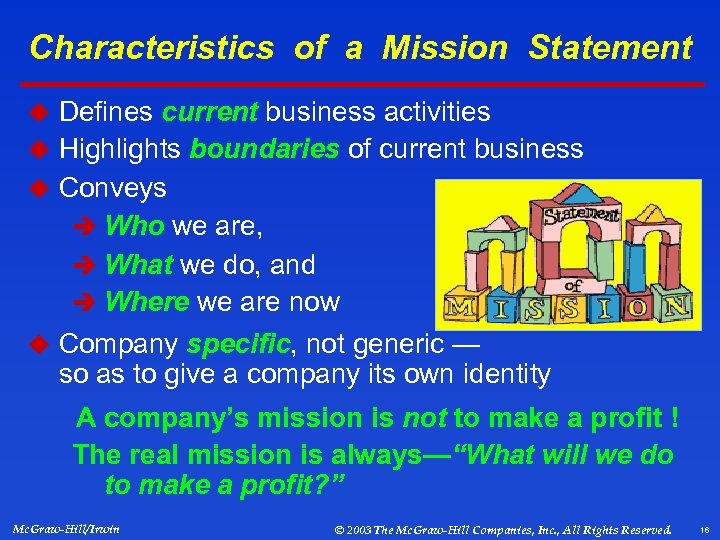 Characteristics of a Mission Statement u Defines current business activities u Highlights boundaries of current business u Conveys è Who we are, è What we do, and è Where we are now u Company specific, not generic — so as to give a company its own identity A company’s mission is not to make a profit ! The real mission is always—“What will we do to make a profit? ” Mc. Graw-Hill/Irwin © 2003 The Mc. Graw-Hill Companies, Inc. , All Rights Reserved. 16
 Defining a Company’s Business u A good business definition incorporates three factors è Customer needs -- What is being satisfied è Customer groups -- Who is being satisfied è Technologies and competencies employed -- How value is delivered to customers to satisfy their needs Mc. Graw-Hill/Irwin © 2003 The Mc. Graw-Hill Companies, Inc. , All Rights Reserved. 17
 Business Mission: Cardinal Health u Cardinal Health is a leading provider of services supporting health care worldwide. u The company offers a broad array services for health-care providers manufacturers to help them improve efficiency and quality of health care. of and the u These services include pharmaceutical distribution, health-care product manufacturing and distribution, drug delivery systems development, . . . , retail pharmacy franchising, and health-care information systems development. Mc. Graw-Hill/Irwin © 2003 The Mc. Graw-Hill Companies, Inc. , All Rights Reserved. 18
 Business Mission: u JDS Uniphase is the leading provider of advanced fiber optic components and modules. u These products are sold to the world’s leading telecommunications and cable television system providers. . . u Our products perform both optical-only functions and optoelectronic functions within fiber option networks. u Our products include semiconductor lasers, . . . , and isolators for fiber optic applications. u In addition, we design, manufacture, and market laser subsystems for a broad range of OEM applications, which include. . . Mc. Graw-Hill/Irwin © 2003 The Mc. Graw-Hill Companies, Inc. , All Rights Reserved. 19
 Business Mission: Russell Corp. u Russell Corporation is a vertically integrated international designer, manufacturer, and marketer of athletic uniforms, . . . , and a comprehensive line of lightweight, yarn-dyed woven fabrics. u The Company’s manufacturing operations include the entire process of converting raw fibers into finished apparel and fabrics. u Products are marketed to sporting goods dealers, department and specialty stores, mass merchandisers, . . . , and other apparel manufacturers. Mc. Graw-Hill/Irwin © 2003 The Mc. Graw-Hill Companies, Inc. , All Rights Reserved. 20
 Broad or Narrow Mission Statements? u Narrow enough to specify real arena of interest u Serve as è Boundary for what to do and not do è Beacon of where top management intends to take firm u Diversified companies have broader business definitions than single-business enterprises Mc. Graw-Hill/Irwin © 2003 The Mc. Graw-Hill Companies, Inc. , All Rights Reserved. 21
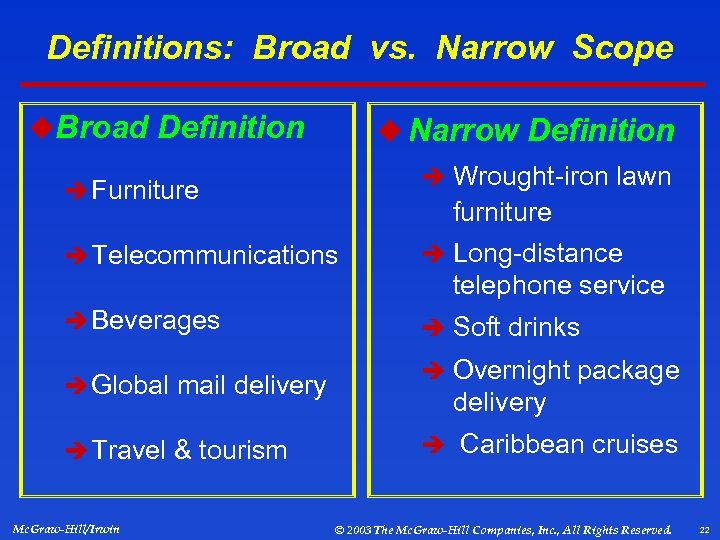 Definitions: Broad vs. Narrow Scope u. Broad Definition u Narrow Definition è Wrought-iron lawn è Furniture furniture è Telecommunications è Long-distance telephone service è Beverages è Global mail delivery è Travel & tourism Mc. Graw-Hill/Irwin è Soft drinks è Overnight package delivery è Caribbean cruises © 2003 The Mc. Graw-Hill Companies, Inc. , All Rights Reserved. 22
 Business Mission: The Mc. Graw Hill Companies (a diversified firm) u The Mc. Graw-Hill Companies is a global publishing, financial, information and media services company with such renowned brands as Standard & Poor’s, Business Week, and Mc. Graw-Hill educational and professional materials. u The Company provides information via various media platforms: books, magazines and newsletters; on-line; via television, satellite and FM sideband broadcast; and software, videotape, facsimile and CD-ROM products. u The Company now creates more than 90 % of its information on digital platforms and its business units are represented on more than 75 Web sites. Mc. Graw-Hill/Irwin © 2003 The Mc. Graw-Hill Companies, Inc. , All Rights Reserved. 23
 Business Mission: FDX Corporation (a diversified firm) u FDX is composed of a powerful family of companies: Fed. Ex, RPS, Viking Freight, FDX Global Logistics and Roberts Express. u These companies offer logistics and distribution solutions on a regional, national and global scale: fast, reliable, time-definite express delivery; . . . expedited same-day delivery; . . . ; and integrated information and logistics solutions u With all this expertise under one umbrella, the FDX companies can provide businesses with the competitive advantage they need by providing streamlined solutions that are on the cutting edge of technology. Mc. Graw-Hill/Irwin © 2003 The Mc. Graw-Hill Companies, Inc. , All Rights Reserved. 24
 Example: Mission Statement Pfizer Inc. Pfizer is a research-based, global pharmaceutical company. We discover and develop innovative, value-added products that improve the quality of life of people around the world and help them enjoy longer, healthier, and more productive lives. The company has three business segments: health care, animal health and consumer health care. Our products are available in more than 150 countries. Mc. Graw-Hill/Irwin © 2003 The Mc. Graw-Hill Companies, Inc. , All Rights Reserved. 25
 Example: Mission Statement Ritz-Carlton Hotels The Ritz-Carlton Hotel is a place where the genuine care and comfort of our guests is our highest mission. We pledge to provide the finest personal service and facilities for our guests who will always enjoy a warm, relaxed yet refined ambiance. The Ritz-Carlton experiences enlivens the senses, instills well-being, and fulfills even the unexpressed wishes and needs of our guests. Mc. Graw-Hill/Irwin © 2003 The Mc. Graw-Hill Companies, Inc. , All Rights Reserved. 26
 Example: Mission Statement Apple Computer, Inc. , ignited the personal computer revolution in the 1970 s with the Apple II, and reinvented the personal computer in the 1980 s with the Macintosh. Apple is now committed to its original mission--to bring the best personal computing products and support to students, educators, designers, scientists, engineers, business persons and consumers in over 140 countries around the world. Mc. Graw-Hill/Irwin © 2003 The Mc. Graw-Hill Companies, Inc. , All Rights Reserved. 27
 Example: Mission Statement The Gillette Company is a globally focused consumer products company that seeks competitive advantage in quality, value-added personal care and personal use products. We compete in four large, worldwide businesses: personal grooming products, consumer portable power products, stationery products and small electrical appliances. As a company, we share skills and resources among business units to optimize performance. We are committed to a plan of sustained sales and profit growth that recognizes and balances both short- and long-term objectives. Mc. Graw-Hill/Irwin © 2003 The Mc. Graw-Hill Companies, Inc. , All Rights Reserved. 28
 Example: Mission Statement The Gillette Company Our mission is to achieve or enhance clear leadership, worldwide, in the existing or new core consumer product categories in which we choose to compete. Current core categories are: ¿ Male grooming products - blades and razors, electric shavers, shaving preparations and deodorants. . . ¿ Female grooming products - wet shaving products, hair removal and hair care appliances and deodorants. . . ¿ Alkaline and specialty batteries and cells. ¿ Writing instruments and correction products. ¿ Certain areas of the oral care market - toothbrushes. . . ¿ Selected areas of the high-quality small household appliance business - coffeemakers. . . Mc. Graw-Hill/Irwin © 2003 The Mc. Graw-Hill Companies, Inc. , All Rights Reserved. 29
 Mission Statements for Functional Departments u Spotlights department’s è Role and scope of activities è Direction which department needs to pursue è Contribution to firm’s overall mission Mc. Graw-Hill/Irwin © 2003 The Mc. Graw-Hill Companies, Inc. , All Rights Reserved. 30
 Mission Statements of Functional Departments HUMAN RESOURCES To contribute to organizational success by developing effective leaders, creating high performance teams, and maximizing the potential of individuals. CORPORATE SECURITY To provide services for the protection of corporate personnel and assets through preventive measures and investigations. Mc. Graw-Hill/Irwin © 2003 The Mc. Graw-Hill Companies, Inc. , All Rights Reserved. 31
 Characteristics of a Strategic Vision u Charts a company’s future strategic course u Defines the business makeup for 5 years (or more) u Specifies future technology- product-customer focus u Indicates capabilities to be developed u Requires managers to exercise foresight Mc. Graw-Hill/Irwin © 2003 The Mc. Graw-Hill Companies, Inc. , All Rights Reserved. 32
 Questions to Address in Developing a Strategic Vision 1. What changes are occurring in the market arena(s) where we operate and what implications do these changes have for our future direction? 2. What new or different customer needs should we be moving to satisfy? 3. What new or different buyer segments should we be concentrating on? 4. What new geographic or product markets should we be pursuing? 5. What should the company’s business makeup look like in 5 years? 6. What kind of company should we be trying to become? Mc. Graw-Hill/Irwin © 2003 The Mc. Graw-Hill Companies, Inc. , All Rights Reserved. 33
 Entrepreneurial Challenges in Forming a Strategic Vision u How to creatively prepare a company for the future u How to keep the company responsive to è Evolving customer needs è Competitive pressures è New technologies è New market opportunities è Growing or shrinking opportunities Mc. Graw-Hill/Irwin © 2003 The Mc. Graw-Hill Companies, Inc. , All Rights Reserved. 34
 Intel’s “Strategic Inflection Points” u Prior to mid-1980 s è Focus on memory chips u Starting in mid-1980 s è Abandon memory chip business and l Become preeminent supplier of microprocessors to PC industry l Make PC central appliance in workplace and home l Be undisputed leader in driving PC technology forward u 1998 è Shift focus from PC technology to becoming the preeminent building block supplier to the Internet economy Mc. Graw-Hill/Irwin © 2003 The Mc. Graw-Hill Companies, Inc. , All Rights Reserved. 35
 Communicating the Vision u An exciting, inspirational vision è Challenges and motivates workforce è Arouses strong sense of organizational purpose è Induces employee buy-in è Galvanizes people to live the business Mc. Graw-Hill/Irwin © 2003 The Mc. Graw-Hill Companies, Inc. , All Rights Reserved. 36
 Managerial Value of a Well-Conceived Strategic Vision and Mission u Crystallizes long-term direction u Reduces risk of rudderless decision- making u Conveys organizational purpose and identity u Keeps direction-related actions of lower -level managers on common path u Helps organization prepare for the future Mc. Graw-Hill/Irwin © 2003 The Mc. Graw-Hill Companies, Inc. , All Rights Reserved. 37
 Establishing Objectives Second Direction-Setting Task u Represent commitment to achieve specific performance targets by a certain time u Should be stated in quantifiable terms and contain a deadline for achievement u Spell-out how much of what kind of performance by when Mc. Graw-Hill/Irwin © 2003 The Mc. Graw-Hill Companies, Inc. , All Rights Reserved. 38
 Purpose of Objective-Setting u Substitutes results-oriented decision-making for aimlessness over what to accomplish u Provides a set of benchmarks for judging organizational performance Mc. Graw-Hill/Irwin © 2003 The Mc. Graw-Hill Companies, Inc. , All Rights Reserved. 39
 Two Types of Objectives Are Required Financial Objectives Strategic Objectives Outcomes that improve a firm’s financial performance Outcomes that strengthen a firm’s competitiveness and long-term market position $ Mc. Graw-Hill/Irwin © 2003 The Mc. Graw-Hill Companies, Inc. , All Rights Reserved. 40
 Strategic Management Principle Every company needs both strategic and financial objectives! Mc. Graw-Hill/Irwin © 2003 The Mc. Graw-Hill Companies, Inc. , All Rights Reserved. 41
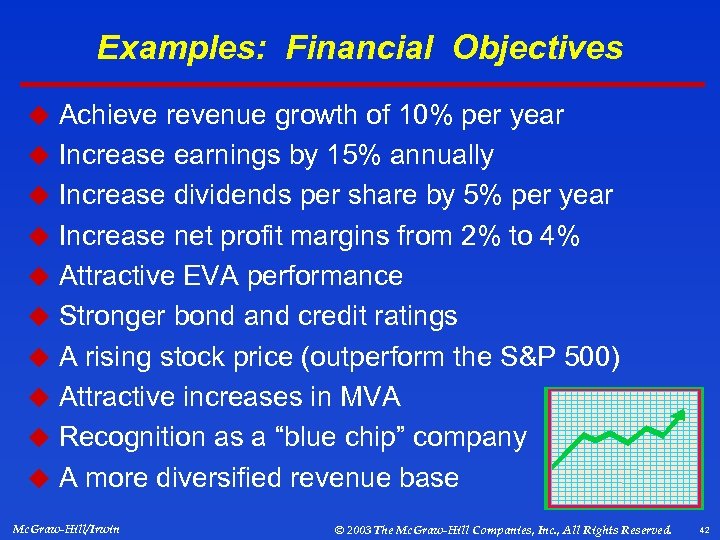 Examples: Financial Objectives u Achieve revenue growth of 10% per year u Increase earnings by 15% annually u Increase dividends per share by 5% per year u Increase net profit margins from 2% to 4% u Attractive EVA performance u Stronger bond and credit ratings u A rising stock price (outperform the S&P 500) u Attractive increases in MVA u Recognition as a “blue chip” company u A more diversified revenue base Mc. Graw-Hill/Irwin © 2003 The Mc. Graw-Hill Companies, Inc. , All Rights Reserved. 42
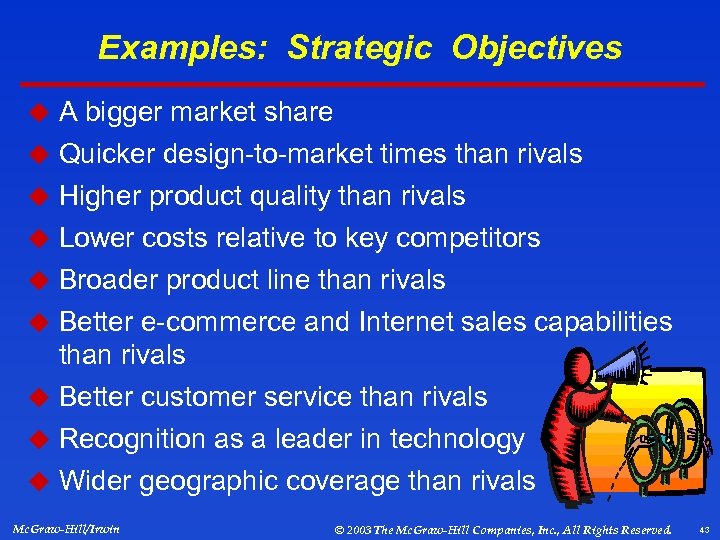 Examples: Strategic Objectives u A bigger market share u Quicker design-to-market times than rivals u Higher product quality than rivals u Lower costs relative to key competitors u Broader product line than rivals u Better e-commerce and Internet sales capabilities than rivals u Better customer service than rivals u Recognition as a leader in technology u Wider geographic coverage than rivals Mc. Graw-Hill/Irwin © 2003 The Mc. Graw-Hill Companies, Inc. , All Rights Reserved. 43
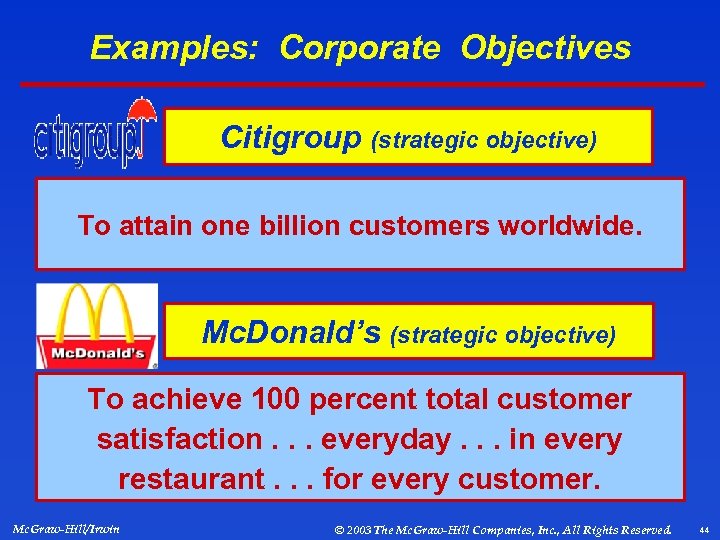 Examples: Corporate Objectives Citigroup (strategic objective) To attain one billion customers worldwide. Mc. Donald’s (strategic objective) To achieve 100 percent total customer satisfaction. . . everyday. . . in every restaurant. . . for every customer. Mc. Graw-Hill/Irwin © 2003 The Mc. Graw-Hill Companies, Inc. , All Rights Reserved. 44
 Example: Corporate Objectives General Electric (strategic objectives) ¿ Become the most competitive enterprise in the world. ¿ Be number one or number two in each business we are in. ¿ Globalize every activity in the company. ¿ Embrace the Internet and become a global e-business. Mc. Graw-Hill/Irwin © 2003 The Mc. Graw-Hill Companies, Inc. , All Rights Reserved. 45
 Example: Corporate Objectives Anheuser-Busch (strategic & financial objectives) ¿ To make all our companies leaders in their industries in ¿ ¿ quality while exceeding customer expectations. To achieve a 50% share of the U. S. beer market. To establish and maintain a dominant leadership position in the international beer market. To provide all our employees with challenging and rewarding work, . . . , and opportunities for personal development, advancement, and competitive compensation. To provide our shareholders with superior returns by achieving double-digit annual earnings per share growth, . . . Mc. Graw-Hill/Irwin © 2003 The Mc. Graw-Hill Companies, Inc. , All Rights Reserved. 46
 Example: Corporate Objectives Exodus Communications (strategic objectives) ¿ Extend our market leadership and position Exodus as the leading brand name in the category. ¿ Enhance our systems and network management and Internet technology services. ¿ Accelerate our domestic and international growth. ¿ Leverage our technical expertise to address new market opportunities in e-commerce. Mc. Graw-Hill/Irwin © 2003 The Mc. Graw-Hill Companies, Inc. , All Rights Reserved. 47
 Example: Corporate Objectives Motorola (financial objectives) ¿ Self-funding revenue growth of 15% annually. ¿ An average return on assets of 13 to 15%. ¿ An average return on shareholders’ equity investment of 16 to 18%. ¿ A strong balance sheet. Mc. Graw-Hill/Irwin © 2003 The Mc. Graw-Hill Companies, Inc. , All Rights Reserved. 48
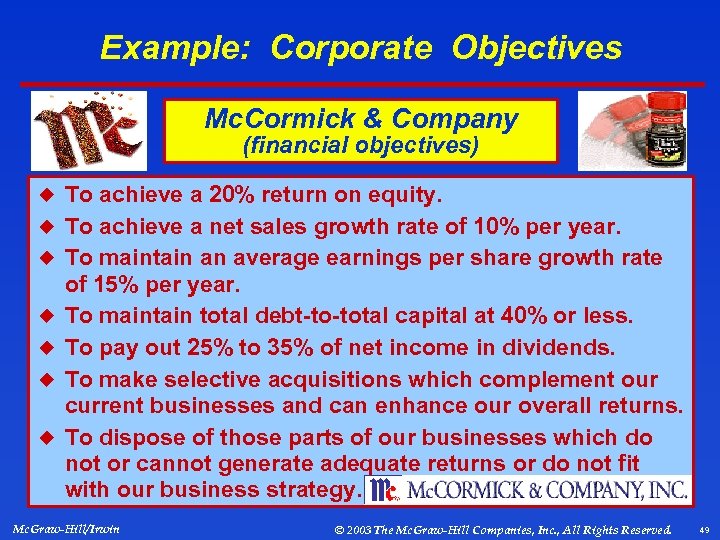 Example: Corporate Objectives Mc. Cormick & Company (financial objectives) ¿ To achieve a 20% return on equity. ¿ To achieve a net sales growth rate of 10% per year. ¿ To maintain an average earnings per share growth rate ¿ ¿ of 15% per year. To maintain total debt-to-total capital at 40% or less. To pay out 25% to 35% of net income in dividends. To make selective acquisitions which complement our current businesses and can enhance our overall returns. To dispose of those parts of our businesses which do not or cannot generate adequate returns or do not fit with our business strategy. Mc. Graw-Hill/Irwin © 2003 The Mc. Graw-Hill Companies, Inc. , All Rights Reserved. 49
 Strategic or Financial Objectives -Which Take Precedence? u Pressures for better short-term financial performance become pronounced when è Firm is struggling financially è Resource commitments for new strategic initiatives may hurt bottom-line for several years è Proposed strategic moves are risky u Otherwise strategic objectives merit top priority—a firm that consistently passes up opportunities to strengthen its long-term competitive position è Risks diluting its competitiveness è Risks losing momentum in its markets è Hurts its ability to fend off rivals’ challenges Mc. Graw-Hill/Irwin © 2003 The Mc. Graw-Hill Companies, Inc. , All Rights Reserved. 50
 Strategic Management Principle Building a stronger long-term competitive position benefits shareholders more lastingly than improving short-term profitability! Mc. Graw-Hill/Irwin © 2003 The Mc. Graw-Hill Companies, Inc. , All Rights Reserved. 51
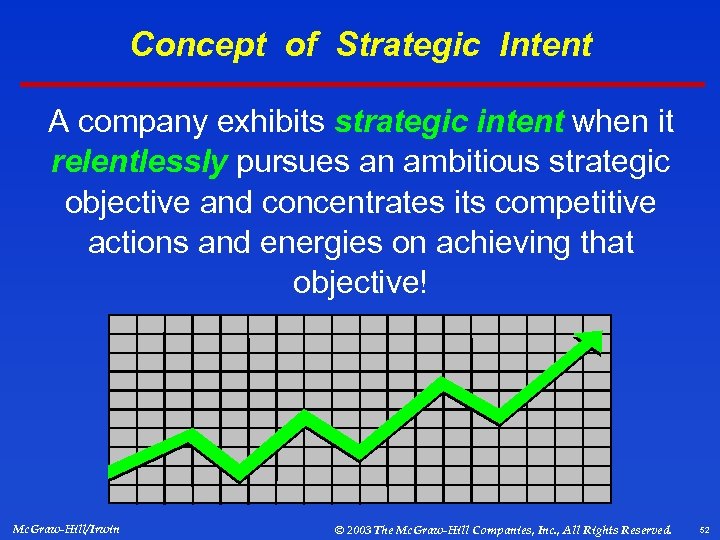 Concept of Strategic Intent A company exhibits strategic intent when it relentlessly pursues an ambitious strategic objective and concentrates its competitive actions and energies on achieving that objective! Mc. Graw-Hill/Irwin © 2003 The Mc. Graw-Hill Companies, Inc. , All Rights Reserved. 52
 Characteristics of Strategic Intent u Indicates firm’s intent to stake out a particular position over the long-term u Involves establishing a BHAG - ”big, hairy, audacious goal” u Signals relentless commitment to winning Mc. Graw-Hill/Irwin © 2003 The Mc. Graw-Hill Companies, Inc. , All Rights Reserved. 53
 Short-Range Versus Long-Range Objectives u Short-Range objectives è Targets to be achieved soon è Serve as stair steps for reaching long-range performance u Long-Range objectives è Targets to be achieved within 3 to 5 years è Prompt actions now that will permit reaching targeted -range performance later Mc. Graw-Hill/Irwin long © 2003 The Mc. Graw-Hill Companies, Inc. , All Rights Reserved. 54
 Objectives Are Needed at All Levels Objective-setting process is top-down, not bottom-up! 1. First, establish organization-wide objectives and performance targets 2. Next, set business and product line objectives 3. Then, establish functional and departmental objectives 4. Individual objectives are established last Mc. Graw-Hill/Irwin © 2003 The Mc. Graw-Hill Companies, Inc. , All Rights Reserved. 55
 Strategic Management Principle Objective-setting needs to be more of a top-down than a bottom-up process in order to guide lower-level managers and organizational units toward outcomes that support the achievement of overall business and company objectives. Mc. Graw-Hill/Irwin © 2003 The Mc. Graw-Hill Companies, Inc. , All Rights Reserved. 56
 Crafting a Strategy Third Direction-Setting Task u An organization’s strategy deals with è How to make the strategic vision a reality and achieve target objectives è The game plan for l Pleasing customers l Conducting operations l Building a sustainable competitive advantage u Strategy constitutes management’s business model for producing good profitability Mc. Graw-Hill/Irwin © 2003 The Mc. Graw-Hill Companies, Inc. , All Rights Reserved. 57
 Strategizing Involves HOW To. . . u Achieve performance targets u Out-compete rivals and achieve a sustainable competitive advantage Our game plan for running the company will be. . . u Respond to changing market conditions and new customer requirements u Make the strategic vision a reality Mc. Graw-Hill/Irwin © 2003 The Mc. Graw-Hill Companies, Inc. , All Rights Reserved. 58
 Characteristics of Strategy-Making u Strategy is action- oriented u Strategy evolves over time u Strategy-making is a never-ending, ongoing task Mc. Graw-Hill/Irwin © 2003 The Mc. Graw-Hill Companies, Inc. , All Rights Reserved. 59
 Rule-Breaking Strategies u Challenge fundamental conventions by è Reconceiving a product or service (Creating a single-use disposable camera) è Redefining the marketplace (Detouring retailers by selling online at the company’s website) è Redrawing industry boundaries (Getting credit cards from Shell Oil or General Motors or AOL) Mc. Graw-Hill/Irwin © 2003 The Mc. Graw-Hill Companies, Inc. , All Rights Reserved. 60
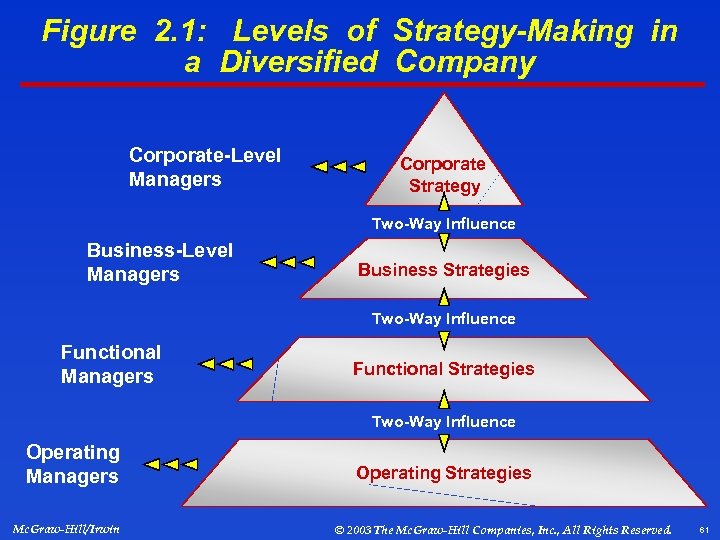 Figure 2. 1: Levels of Strategy-Making in a Diversified Company Corporate-Level Managers Corporate Strategy Two-Way Influence Business-Level Managers Business Strategies Two-Way Influence Functional Managers Functional Strategies Two-Way Influence Operating Managers Mc. Graw-Hill/Irwin Operating Strategies © 2003 The Mc. Graw-Hill Companies, Inc. , All Rights Reserved. 61
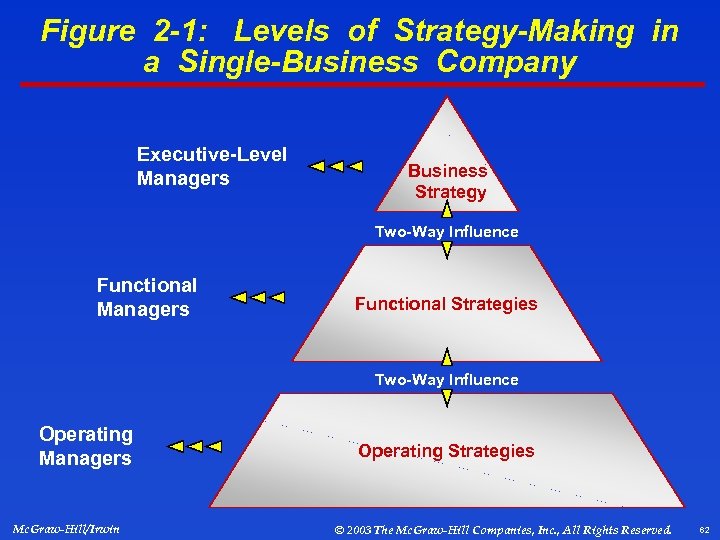 Figure 2 -1: Levels of Strategy-Making in a Single-Business Company Executive-Level Managers Business Strategy Two-Way Influence Functional Managers Functional Strategies Two-Way Influence Operating Managers Mc. Graw-Hill/Irwin Operating Strategies © 2003 The Mc. Graw-Hill Companies, Inc. , All Rights Reserved. 62
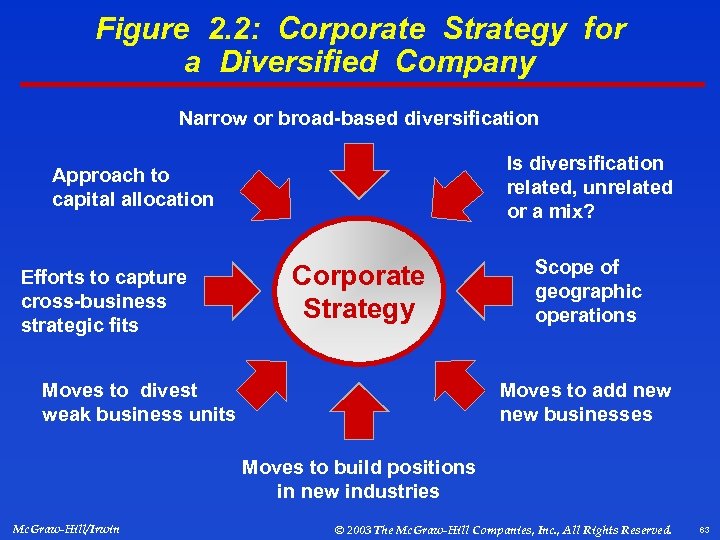 Figure 2. 2: Corporate Strategy for a Diversified Company Narrow or broad-based diversification Is diversification related, unrelated or a mix? Approach to capital allocation Efforts to capture cross-business strategic fits Corporate Strategy Moves to divest weak business units Scope of geographic operations Moves to add new businesses Moves to build positions in new industries Mc. Graw-Hill/Irwin © 2003 The Mc. Graw-Hill Companies, Inc. , All Rights Reserved. 63
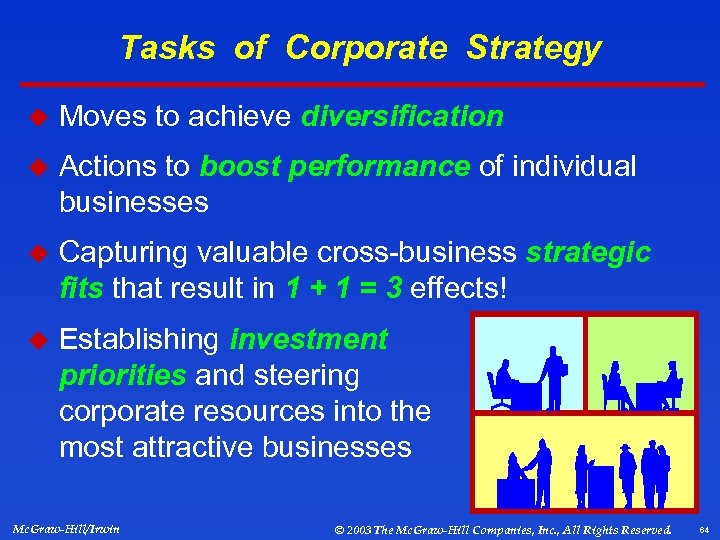 Tasks of Corporate Strategy u Moves to achieve diversification u Actions to boost performance of individual businesses u Capturing valuable cross-business strategic fits that result in 1 + 1 = 3 effects! u Establishing investment priorities and steering corporate resources into the most attractive businesses Mc. Graw-Hill/Irwin © 2003 The Mc. Graw-Hill Companies, Inc. , All Rights Reserved. 64
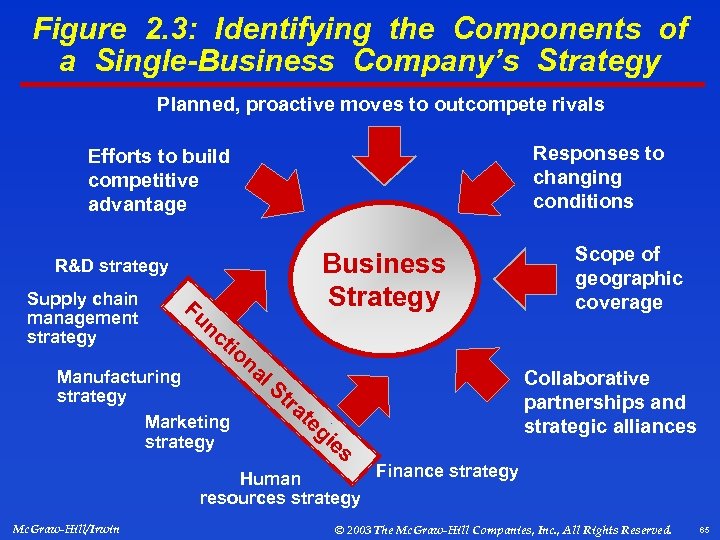 Figure 2. 3: Identifying the Components of a Single-Business Company’s Strategy Planned, proactive moves to outcompete rivals Responses to changing conditions Efforts to build competitive advantage Business Strategy R&D strategy Supply chain management strategy Fu n ct Scope of geographic coverage io Manufacturing strategy Marketing strategy na l. S tra te gi es Collaborative partnerships and strategic alliances Finance strategy Human resources strategy Mc. Graw-Hill/Irwin © 2003 The Mc. Graw-Hill Companies, Inc. , All Rights Reserved. 65
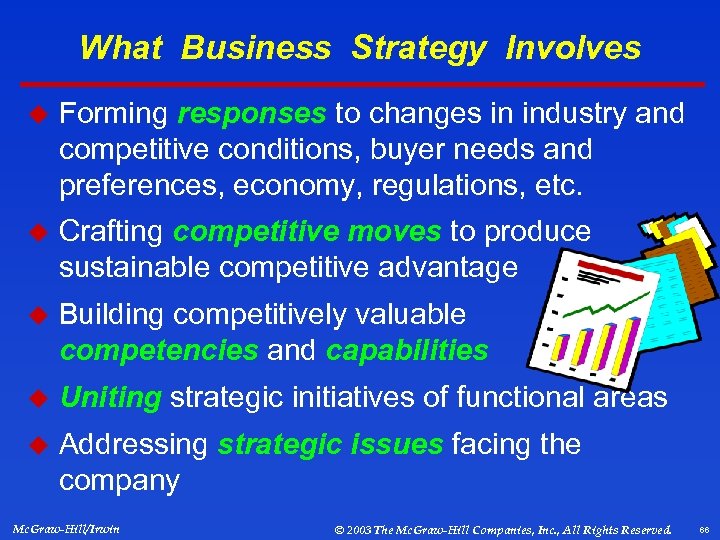 What Business Strategy Involves u Forming responses to changes in industry and competitive conditions, buyer needs and preferences, economy, regulations, etc. u Crafting competitive moves to produce sustainable competitive advantage u Building competitively valuable competencies and capabilities u Uniting strategic initiatives of functional areas u Addressing strategic issues facing the company Mc. Graw-Hill/Irwin © 2003 The Mc. Graw-Hill Companies, Inc. , All Rights Reserved. 66
 Functional Strategies u Game plan for a strategically-relevant function, activity, or business process u Details how key activities will be managed u Provide support for business strategy u Specify how functional objectives are to be achieved Mc. Graw-Hill/Irwin © 2003 The Mc. Graw-Hill Companies, Inc. , All Rights Reserved. 67
 Operating Strategies u Concern narrower strategies for managing grassroots activities and strategically-relevant operating units u Add detail to business and functional strategies Mc. Graw-Hill/Irwin © 2003 The Mc. Graw-Hill Companies, Inc. , All Rights Reserved. 68
 Example: Operating Strategy Improving Delivery & Order-Filling Manufacturer of plumbing equipment emphasizes quick delivery and accurate order-filling as keystones of its customer service approach. Warehouse manager took following approaches: è Inventory stocking strategy allowing 99% of all orders to be completely filled without backordering any item è Staffing strategy of maintaining workforce capability to ship any order within 24 hours Mc. Graw-Hill/Irwin © 2003 The Mc. Graw-Hill Companies, Inc. , All Rights Reserved. 69
 Example: Operating Strategy Boosting Worker Productivity To boost productivity by 10%, managers of firm with low-price, high-volume strategy take following actions: è Recruitment manager develops selection process designed to weed out all but best-qualified candidates è Information systems manager devises way to use technology to boost productivity of office workers è Compensation manager devises improved incentive compensation plan è Purchasing manager obtains new efficiency-increasing tools and equipment Mc. Graw-Hill/Irwin © 2003 The Mc. Graw-Hill Companies, Inc. , All Rights Reserved. 70
 Uniting the Company’s Strategy-Making Effort u A company’s strategy is a collection of strategies and initiatives being acted on by managers at various organizational levels u Separate levels of strategy must be unified into a cohesive, companywide action plan u Pieces of strategy should fit together like the pieces of a puzzle Mc. Graw-Hill/Irwin © 2003 The Mc. Graw-Hill Companies, Inc. , All Rights Reserved. 71
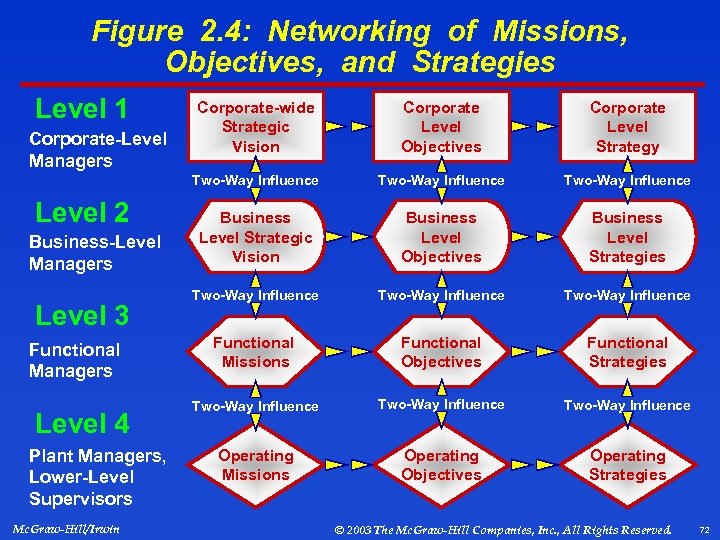 Figure 2. 4: Networking of Missions, Objectives, and Strategies Level 1 Level 2 Business-Level Managers Level 3 Functional Managers Level 4 Plant Managers, Lower-Level Supervisors Mc. Graw-Hill/Irwin Corporate Level Objectives Corporate Level Strategy Two-Way Influence Corporate-Level Managers Corporate-wide Strategic Vision Two-Way Influence Business Level Strategic Vision Business Level Objectives Business Level Strategies Two-Way Influence Functional Missions Functional Objectives Functional Strategies Two-Way Influence Operating Missions Operating Objectives Operating Strategies © 2003 The Mc. Graw-Hill Companies, Inc. , All Rights Reserved. 72
 Strategic Management Principle Objectives and strategies that are unified from top to bottom of the strategy-making managerial hierarchy require a team effort! Mc. Graw-Hill/Irwin © 2003 The Mc. Graw-Hill Companies, Inc. , All Rights Reserved. 73
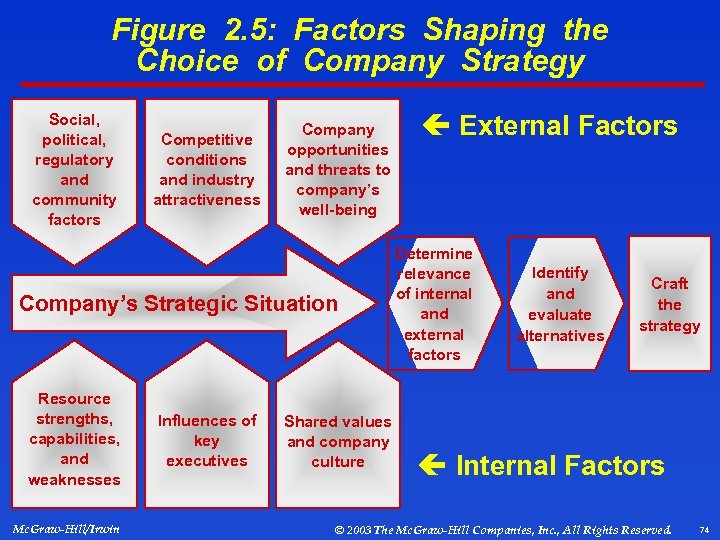 Figure 2. 5: Factors Shaping the Choice of Company Strategy Social, political, regulatory and community factors Competitive conditions and industry attractiveness Company opportunities and threats to company’s well-being Company’s Strategic Situation Resource strengths, capabilities, and weaknesses Mc. Graw-Hill/Irwin Influences of key executives Shared values and company culture External Factors Determine relevance of internal and external factors Identify and evaluate alternatives Craft the strategy Internal Factors © 2003 The Mc. Graw-Hill Companies, Inc. , All Rights Reserved. 74
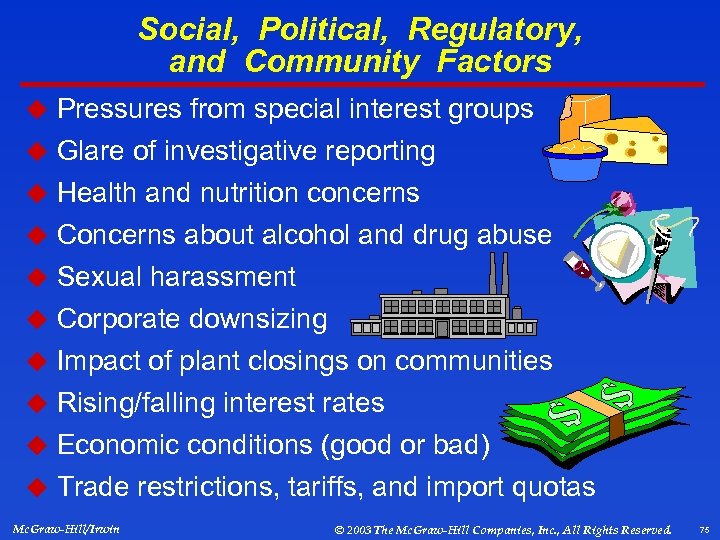 Social, Political, Regulatory, and Community Factors u Pressures from special interest groups u Glare of investigative reporting u Health and nutrition concerns u Concerns about alcohol and drug abuse u Sexual harassment u Corporate downsizing u Impact of plant closings on communities u Rising/falling interest rates u Economic conditions (good or bad) u Trade restrictions, tariffs, and import quotas Mc. Graw-Hill/Irwin © 2003 The Mc. Graw-Hill Companies, Inc. , All Rights Reserved. 75
 What Do We Mean by “Corporate Social Responsibility? ” u Conducting company activities within bounds of what is considered ethical and in public interest u Responding positively to emerging societal priorities and expectations u Demonstrating willingness to take needed action ahead of regulatory confrontation u Balancing stockholder interests against larger interest of society as a whole u Being a “good citizen” in community Mc. Graw-Hill/Irwin © 2003 The Mc. Graw-Hill Companies, Inc. , All Rights Reserved. 76
 Competitive Conditions and Industry Attractiveness u A company’s strategy has to be responsive to è Fresh moves of rival competitors è Changes in industry’s price-cost-profit economics è Shifting buyer needs and expectations è New technological developments è Pace of market growth Mc. Graw-Hill/Irwin © 2003 The Mc. Graw-Hill Companies, Inc. , All Rights Reserved. 77
 Strategic Management Principle A company’s strategy can’t produce real market success unless it is well-matched to industry and competitive conditions! Mc. Graw-Hill/Irwin © 2003 The Mc. Graw-Hill Companies, Inc. , All Rights Reserved. 78
 Company Opportunities and Threats u For strategy to be successful, it has to è Be well matched to capturing a company’s best opportunities è And help counteract threats to the company’s well-being Mc. Graw-Hill/Irwin © 2003 The Mc. Graw-Hill Companies, Inc. , All Rights Reserved. 79
 Company Strengths, Competencies, and Competitive Capabilities u A company must have or be able to acquire the resources, competencies, and competitive capabilities needed to execute the chosen strategy u Resource deficiencies, gaps in skills, and weaknesses in competitive position make pursuit of certain strategies risky or altogether unwise Mc. Graw-Hill/Irwin © 2003 The Mc. Graw-Hill Companies, Inc. , All Rights Reserved. 80
 Strategic Management Principle A company’s strategy ought to be grounded in its resource strengths and in what it is good at doing (its competencies and competitive capabilities); it is perilous to discount the competitive liabilities of company’s resource deficiencies and skills gaps! Mc. Graw-Hill/Irwin © 2003 The Mc. Graw-Hill Companies, Inc. , All Rights Reserved. 81
 Ambitions, Philosophies, and Ethics of Key Executives u Managers generally stamp strategies they craft with their own personal èAmbitions èValues I believe we should be #1! èBusiness philosophies èAttitudes toward risk èEthical beliefs Mc. Graw-Hill/Irwin © 2003 The Mc. Graw-Hill Companies, Inc. , All Rights Reserved. 82
 Shared Values and Company Culture u Values and culture often shape the strategic moves a company will è Consider è Reject u It is generally unwise for a company to undertake strategic moves which conflict with è Its culture è Values widely shared by managers and employees Mc. Graw-Hill/Irwin © 2003 The Mc. Graw-Hill Companies, Inc. , All Rights Reserved. 83
 Hewlett-Packard’s Basic Values: “The HP Way” u Sharing firm’s success with employees u Showing trust and respect for employees u Providing customers with products or services of the greatest value u Being genuinely interested in providing customers with effective solutions to their problems u Making profit a high stockholder priority u Avoiding use of long-term debt to finance growth u Individual initiative, creativity, & teamwork u Being a good corporate citizen Mc. Graw-Hill/Irwin © 2003 The Mc. Graw-Hill Companies, Inc. , All Rights Reserved. 84
 Linking Strategy With Ethics u Ethical and moral standards go beyond èProhibitions of law and èLanguage of “thou shalt not” u Ethical and moral standards involve è Issues of duty and èLanguage of “should and should not do” Mc. Graw-Hill/Irwin © 2003 The Mc. Graw-Hill Companies, Inc. , All Rights Reserved. 85
 A Firm’s Ethical Responsibilities to Its Stakeholders Owners/shareholders – Rightfully expect some form of return on their investment Employees - Rightfully expect respect for their worth and devoting their energies to firm Customers - Rightfully expect a seller to provide them with a reliable, safe product or service Suppliers - Rightfully expect to have an equitable relationship with firms they supply Community - Rightfully expect businesses to be good citizens in their community Mc. Graw-Hill/Irwin © 2003 The Mc. Graw-Hill Companies, Inc. , All Rights Reserved. 86
 Tests of a Winning Strategy u GOODNESS OF FIT TEST è How well is strategy matched to firm’s situation? u COMPETITIVE ADVANTAGE TEST è Does strategy lead to sustainable competitive advantage? u PERFORMANCE TEST è Does strategy boost firm performance? Mc. Graw-Hill/Irwin © 2003 The Mc. Graw-Hill Companies, Inc. , All Rights Reserved. 87
 Strategic Management Principle To be a real winner, a strategy must 1. Fit the enterprise’s internal and external situation 2. Build sustainable competitive advantage 3. Improve company performance Mc. Graw-Hill/Irwin © 2003 The Mc. Graw-Hill Companies, Inc. , All Rights Reserved. 88