


 Скачать презентацию Chapter 2 The Organizational Context of the New
aeef343870f9296a9777048f4c58fc58.ppt
- Количество слайдов: 69
 Chapter 2 The Organizational Context of the New Millennium Diversity, Quality, Technology, International
 Learning Goals • Understand why the U. S. Workforce will increase in diversity well into the next century • Describe the direction in which many organizations are headed in managing for quality
 Learning Goals (Cont. ) • Explain how technological changes will affect modern organizations and their management • Discuss some issues and implications of managing organizations in an increasingly global environment
 Chapter Overview • Workforce Diversity • Quality Management • Technology, Organizations, and Management • The Global Environment of Organizations
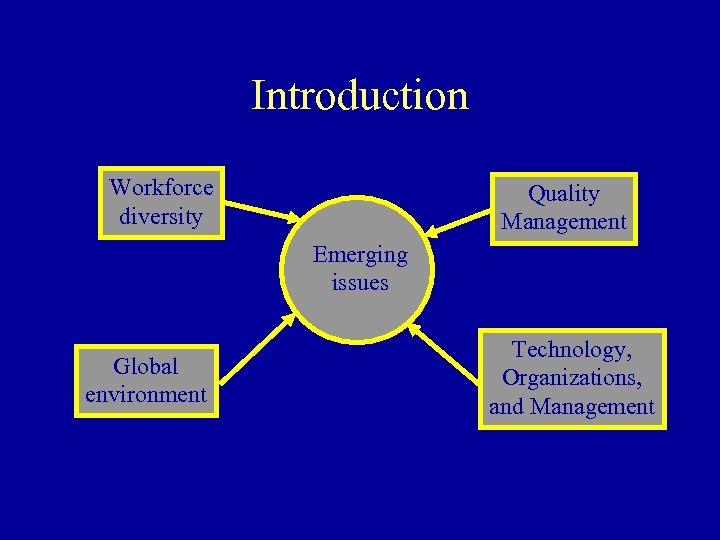 Introduction Workforce diversity Quality Management Emerging issues Global environment Technology, Organizations, and Management
 Workforce Diversity • Differences in workforce composition based on personal and background factors of people • Some dimensions of workforce diversity – Age – Race – Physical ability – Family status See text book Figure 2. 1 for a more complete listing
 Workforce Diversity (Cont. ) • Projections show more women, more minorities, and older workers in the work force • Expect strong regional differences • For example, California's population in 2005 will have 50 percent white and 50 percent people of color, speaking 80 languages
 Workforce Diversity (Cont. ) • Differences in people also present different worldviews to an organization • They see the world through different perceptual lenses • Issue: harnessing these differences as opportunities to pursue the organization’s mission
 Workforce Diversity (Cont. ) • Challenges to personnel and work policies – Working parents: work schedules and on-site day care – Single parent: time off to tend to sick child – Native Americans: work schedules and their culture’s celebration periods – Disabled: special access to building and work area design – Part-time: job sharing
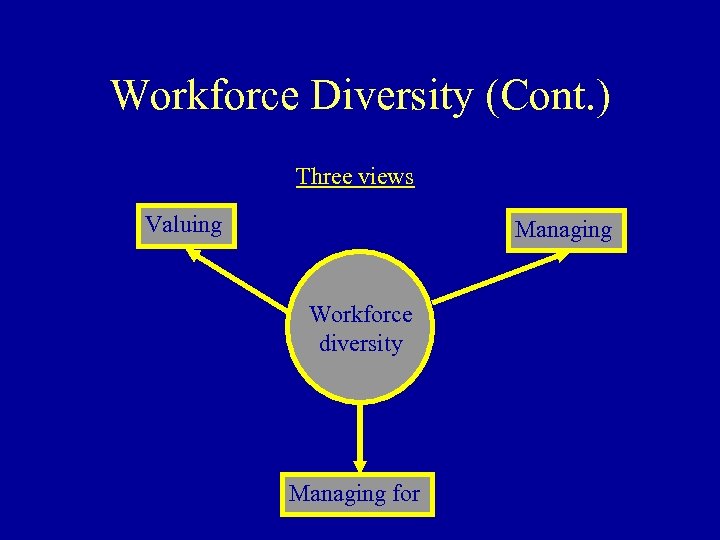 Workforce Diversity (Cont. ) Three views Valuing Managing Workforce diversity Managing for
 Workforce Diversity (Cont. ) • Valuing diversity – Aggressively embrace diversity – Goes beyond managing existing diversity – Recognizes the essential character of a diverse workforce – Actively builds a diverse workforce
 Workforce Diversity (Cont. ) • Managing diversity – Harness the potential of all sources of difference within an organization's workforce – Tap diverse perspectives and rethink approaches to tasks and markets – Example: after hiring its first Hispanic female attorney, a small northeastern law firm discovered a new market: pursue English-only employment policies in cases involving immigrants. Previously all-white legal staff never thought of that market
 Workforce Diversity (Cont. ) • Managing diversity (cont. ) – Not affirmative action in disguise – Get the greatest contributions from increasingly diverse people – A variety of views enriches organizational life – Does not ask people to give up their individuality
 Workforce Diversity (Cont. ) • Managing diversity (cont. ) – Honors differences among people, but asks everyone to accept the core values of the organization – Core values come from organization's mission: "An unending pursuit of excellence in customer service. ” – People reach the goal in many different ways because of their diversity
 Workforce Diversity (Cont. ) • Managing diversity (cont. ) – No choice about managing for diversity • Note the labor force statistics discussed earlier • Likely have a diverse labor force in the future, especially as an organization pursues scarce skilled labor • Organizations that have followed affirmative action and Equal Employment Opportunity (EEO) guidelines now have diverse workforces
 Workforce Diversity (Cont. ) • Managing diversity (cont. ) – Good business strategy • Increasingly diverse customer base • Think and compete globally to remain competitive • A diverse workforce helps managers attract customers from diverse backgrounds • Example: Pizza Hut has found that the presence of Muslim workers attracts more Muslim customers
 Workforce Diversity (Cont. ) • Managing diversity (cont. ) – Global environment adds another layer of complexity – Many U. S. organizations sell in foreign markets, operate in foreign countries, or have joint ventures with foreign organizations – Need to understand local customs to meet customer expectations in foreign markets – Diverse workforce helps U. S. organizations meet these global challenges
 Workforce Diversity (Cont. ) • Managing for diversity – Aggressively recruit and hire people of diverse backgrounds – Challenges • • • Unleash the potential of a diverse workforce Channel it toward organizational goals Provide vision so everyone understands the goals Preserve a diversity of viewpoints Help employees get the satisfaction they want from their work experiences
 Workforce Diversity (Cont. ) • Managing for diversity (cont. ) – Policy changes • • Work schedules Personal leave Language training in English or other languages Other basic skills – Fairness in policies: day-care policy applies to all employees
 Workforce Diversity (Cont. ) • Managing for diversity (cont. ) – Managers will need to learn new skills • Accepting differences • Appreciating language differences • Learning new languages. Includes sign language to communicate with hearing-impaired employees
 Workforce Diversity (Cont. ) • Managing for diversity (cont. ) – Other changes touch the heart of an organization's culture – Values suitable to a homogeneous white-male culture need to yield to the heterogeneous values of diverse groups – Social activities • Rituals in male cultures will need to change to allow ready access by females • Rotate activities to meet the desires of both groups • Example: if social gatherings include only maleoriented sports, add other activities
 Quality Management • Managing all parts of an organization to ensure quality products or services • Can trace its roots to the 1920 s • Ignored by American managers until forced to focus on it by competitive forces • Many names: Total Quality Control, Leadership through Quality, Total Quality Management, Robust Design, six-sigma quality • Quality Management (QM) covers them all
 Quality Management (Cont. ) • Quality Management – A philosophy and system of management – Philosophy: values of quality, continuous improvement, and “getting it right the first time” – System of management: tools and techniques that help manage for quality and continuous improvement – Has its roots in manufacturing but applies to all organizations
 Quality Management (Cont. ) • History – An American invention, not Japanese – Some significant contributors: W. Edwards Deming, Walter A. Shewhart, Armand V. Feigenbaum, Joseph M. Juran, and Philip B. Crosby – Taught to the Japanese after WW II. They understood what it meant from the beginning
 Quality Management (Cont. ) • Requires a total system's view of the organization. Reaches beyond its boundaries • Interdependence of outside people, outside organizations, and groups within the organization to manage for quality – Employees – Suppliers – Clients, customers
 Quality Management (Cont. ) • Interdependence (cont. ) – Community – Coalitions to which the organization belongs – Professional or trade associations – Competitors
 Quality Management (Cont. ) • View organizations as a system of processes, not as a vertical chain-ofcommand view – Emphasizes processes, customers, interdependence with suppliers, and the role of feedback in continuous quality improvement – Ask customers and suppliers: discover shifts in expectations and quality requirements
 Quality Management (Cont. ) • Supporting tools and techniques – Let people watch work processes to ensure a quality product or service – Train employees in the use of the tools – Most QM tools and techniques let organizations analyze processes
 Quality Management (Cont. ) • Supporting tools and techniques (cont. ) – Typically done by teams of people drawn from all parts of the organization affected by the process – Deliberately diverse teams bring different views to the analysis and improvement of a work process – Example: analysis team examining an organization's hiring process includes members from the Human Resources Department, hiring departments, newly hired employees, labor union representatives
 Quality Management (Cont. ) • Benefits – Increased employee commitment to continuous quality improvement – Cost of providing a service or manufacturing a product drops – More dependable service processes. More reliable products
 Quality Management (Cont. ) • QM differs from other ways of managing – Emphasizes a long-term commitment to continuous quality improvement – Quality is everyone's job, not the job of a quality-control department – Intensely customer focused: demands that all organization members share that focus – Emphasizes high involvement in the work process
 Quality Management (Cont. ) • QM differs from other ways of managing (cont. ) – Communication in all directions--top-down, bottom-up, laterally – A long-term orientation: commitment to the future – Decisions made with a view of the future – Continuous improvement lets people do more with the same resources
 Quality Management (Cont. ) • QM differs from other ways of managing (cont. ) – Involving everyone in continuous improvement can add challenge to employees' jobs – Long-run result: a committed corps of people with an impassioned focus on mission, customers, and continuous quality improvement
 Quality Management (Cont. ) • Moving toward QM presents massive change to an organization • Requires people to reframe the way they think about their organization • Difficult transformations might account for some QM failures
 Quality Management (Cont. ) • Results – Continuous improvement increases process efficiency and reduces costs – Quality can attract new customers and increase the retention of old ones. Costs five times more to get new customers than to keep present ones – High quality can make a product or service so attractive that an organization can charge higher prices than competitors
 Quality Management (Cont. ) • Results (cont. ) – QM efforts produced poor results when managers did not target improvements to areas that had the greatest long-term positive effect on profits – Some significant positive financial effects – Some major failures: The Wallace Co. and Florida Power and Light
 Technology, Organizations, and Management • Computing power and computer features – Desktop computers with CD-Rom drives, highspeed processors, and large memory capacity: create business presentations using threedimensional animated technology – Laptop and palmtop computers: Internet connections using ports in airport telephones, aircraft telephones, or cybercafés – Tracking appointments and staying connected will continue to get easier in the future
 Technology, Organizations, and Management (Cont. ) • Communications technology – Note: the first transatlantic telephone cable carried only 89 simultaneous calls! – Digital satellite systems: allows handheld digital cellular communication anywhere in the world
 Technology, Organizations, and Management (Cont. ) • Communications technology (cont. ) – Lucent Technology's Bell Labs' wave division multiplexing • Splits a single beam of light into multiple colors • Each color is a separate communication channel within an optical fiber – Handheld communicators: send and receive e-mail, talk to a person by telephone, and surf the Web--from anywhere
 Technology, Organizations, and Management (Cont. ) • Other technologies – Electronically based measurement systems: monitor manufacturing processes and collect sales data at store checkout stands – Future computer technologies: digitize information from voice interaction and handwriting on a digital tablet – Handheld computers: track inventories and send orders electronically
 Technology, Organizations, and Management (Cont. ) • Other technologies (cont. ) – Navigation satellites: track truck and ship fleets – Communication satellites: managers can talk to drivers and ship captains anywhere in the world – E-mail, voice mail, videoconferencing, teleconferencing – Widely used now and will increase in use in the future
 Technology, Organizations, and Management (Cont. ) • Other technologies (cont. ) – Videoconferencing adds a two-way video connection to the now common teleconference – Replace or supplement e-mail systems with voice-mail systems. Oral messages, not written ones, appear in a person's electronic mailbox – Widespread use of intranets (internal networks) and the Internet
 Technology, Organizations, and Management (Cont. ) • Materials technology and engineering – Commonly used: carbon fiber composites and optical fibers – New: superpolymers, amorphous metal alloys, and superconductors – Innovations in product ideas and technological solutions no longer will depend on naturally existing materials
 Technology, Organizations, and Management (Cont. ) • Materials technology and engineering (cont. ) – New materials: lighter cars and trucks that can carry heavier loads – New ceramics technology allows designing jet engines with more thrust. Larger planes going longer distances with more people and cargo
 Technology, Organizations, and Management (Cont. ) • Manufacturing – Agile manufacturing processes with almost no inventory. Direct computer links with customers or end-users – Cost-effective and competitive processes to produce both custom-made items and large production runs in the same plant – Products moving through these processes can differ from item to item
 Technology, Organizations, and Management (Cont. ) • Manufacturing (cont. ) – Computer-assisted manufacturing (CAM) – Computer-integrated manufacturing (CIM) – Modern materials – Robotics
 Technology, Organizations, and Management (Cont. ) • Manufacturing (cont. ) – Laser cutting – Bonding methods – Internet technology: suppliers receive orders as manufacturer updates its manufacturing schedule in real time
 Technology, Organizations, and Management (Cont. ) • Managerial role changes – People in scattered places – Networks will act as coordinating mechanisms, replacing face-to-face interaction • Increase in telecommuting
 Technology, Organizations, and Management (Cont. ) • New strategies – Flexibility: key feature that will permeate the design and response of manufacturing and service operations – Includes thorough understanding of customer needs and variations among markets – Latter will be especially true for multinationals
 Technology, Organizations, and Management (Cont. ) • New strategies (cont. ) – Markets in different countries have high diversity even between nearby countries – Treat customers of different countries in the way they expect. Example: insurance giant AIG • Local agents collect monthly premiums at each insured's home in Taiwan • Electronic bank transfers in Hong Kong
 Technology, Organizations, and Management (Cont. ) • Organizational design – New strategies require decentralized organizations – Fast responses to meet shifting market and customer needs – Cross-functional teams to tightly integrate the total business process
 Technology, Organizations, and Management (Cont. ) • Organizational design (cont. ) – Local teams with broad decision-making and problem-solving authority will help large organizations decentralize – Modern information technologies will help globally dispersed organizations decentralize
 Technology, Organizations, and Management (Cont. ) • Organizational design (cont. ) – Organization-wide self-managing teams • Form teams around a specific customer base, product, or service • Makes all decisions in response to customer needs • Conceives, designs, builds, markets
 Technology, Organizations, and Management (Cont. ) • Organizational design (cont. ) – Self-managing teams (cont. ) • Involved in all parts of the business process affecting a customer • Will do much of the selection and socialization of new employees – Virtual organizations: link to various partners over the Internet
 Technology, Organizations, and Management (Cont. ) • Organizational design (cont. ) – Virtual organizations (cont. ) • Example: Aditi Inc. – Customer support to software users with a twist – Seattle and Bangalore, India based – After American workers go home, messages transfer over the Internet to Bangalore – Reverse happens at the end of the Indian work day – Almost immediate customer response, no matter what their time zone More detail in Chapter 17: Organizational Design
 Technology, Organizations, and Management (Cont. ) • Internet commerce – Forecast: $1. 3 trillion in sales by 2002 – Biggest growth areas: computers, software, books, music, videos – Example: Amazon. com offers three million book titles, outstripping Barnes & Noble's 175, 000 titles – Simple to set up commercial Web sites – Observers predict a flood of upstarts: new generation of competitors
 The Global Environment of Organizations • Our increasingly interconnected world requires managers to have a global perspective • Range of perspective – Finding new markets outside the home country – Multinational organization: operations in many countries – Transnational organization: sees no country boundary limits
 The Global Environment of Organizations (Cont. ) • Modern managers must think of the entire world as a source of labor, materials, markets, and the like • Highly interconnected economies around the world
 The Global Environment of Organizations (Cont. ) • Technology effects – International travel: common and fast with modern aircraft – Telecommunication-satellites: information in all forms moves quickly from country to country – Includes international videoconferences – Easy Internet communication
 The Global Environment of Organizations (Cont. ) • Free trade effects – Regional trade agreements: opening vast new markets; increasing a firm’s competition – North American Free Trade Agreement opened the borders of Mexico, Canada, and the United States: easy movement of goods, capital, and services – Europe and the Euro: 11 European countries moving to a single currency – Many Latin American countries are moving toward freer trade
 The Global Environment of Organizations (Cont. ) • Issues for managers – Language differences among countries – Form partnerships with local business people or learning the language oneself can help solve the language problem – Cultural differences among countries • Affects how a company enters markets, the way it markets goods or services, how it deals with labor laws, and how it builds a loyal customer base • Orientations to space and time. See text book for examples
 The Global Environment of Organizations (Cont. ) • Issues for managers (cont. ) – Values desired for globally dispersed operations • Values of home country? • Values of local culture? – Values of home country: place people from the home country in charge of units
 The Global Environment of Organizations (Cont. ) • Issues for managers (cont. ) – Organizations that hire local people for management positions often first socialize them to its major home country values – Hewlett-Packard: managers know the "HP Way" whatever their national origins or the country in which they work
 The Global Environment of Organizations (Cont. ) • Country culture dimensions that imply acceptable management behavior and organizational forms • Five dimensions – Power distance – Uncertainty avoidance – Individualism – Masculinity – Long-term orientation
 The Global Environment of Organizations (Cont. ) • Country culture dimensions (cont. ) – Power distance: degree of inequality among people a culture considers normal • Low: people treated as equals despite social status • High: people accept authority relations – Uncertainty avoidance: value placed on predictability, structure, stability • Low: prefer few formal rules • High: want clear behavioral guides
 The Global Environment of Organizations (Cont. ) • Country culture dimensions (cont. ) – Individualism: value placed on acting alone and not as part of a group • Low: group behavior important • High: individual behavior important – Masculinity: value placed on decisiveness and assertiveness • Low: caring for others; warm interpersonal relationships • High: assertive, ambitious, tough
 The Global Environment of Organizations (Cont. ) • Country culture dimensions (cont. ) – Long-term orientation: value placed on persistence, status, thrift • Low: respect for tradition, personal stability, focused on the past • High: perseverance, thrift, focused on the future
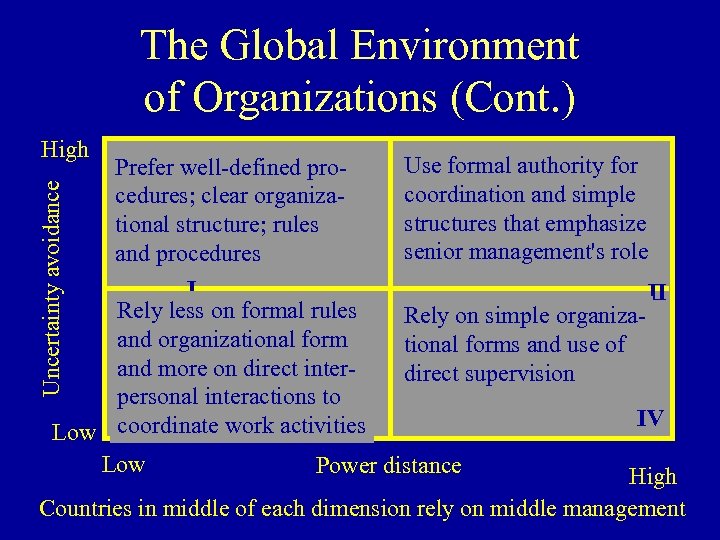 The Global Environment of Organizations (Cont. ) High Uncertainty avoidance Use formal authority for Prefer well-defined procoordination and simple cedures; clear organizastructures that emphasize tional structure; rules senior management's role and procedures I II Rely less on formal rules Rely on simple organizaand organizational forms and use of and more on direct interdirect supervision personal interactions to III IV coordinate work activities Low Power distance High Countries in middle of each dimension rely on middle management
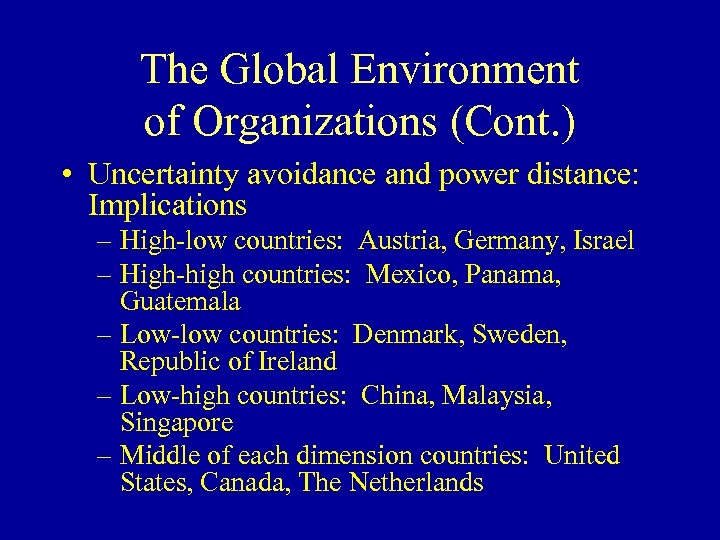 The Global Environment of Organizations (Cont. ) • Uncertainty avoidance and power distance: Implications – High-low countries: Austria, Germany, Israel – High-high countries: Mexico, Panama, Guatemala – Low-low countries: Denmark, Sweden, Republic of Ireland – Low-high countries: China, Malaysia, Singapore – Middle of each dimension countries: United States, Canada, The Netherlands