 Скачать презентацию Chapter 2 The Global Economic Environment 1
527f2e3c968bcd15bd7f518d59223050.ppt
- Количество слайдов: 35



Chapter 2 The Global Economic Environment 1
Introduction to Chapter • Market definition – People or organizations with needs and wants; both have the willingness and ability to buy or sell • The global economic environment plays a large role in the development of new markets for organizations 2
The World Economy – An Overview • The new realities: – Capital movements have replaced trade as the driving force of the world economy – Production has become uncoupled from employment – The world economy, not individual countries, is the dominating factor 3
The World Economy – An Overview • The new realities continued: – 75 -year struggle between capitalism and socialism has almost ended – E-Commerce diminishes the importance of national barriers and forces companies to reevaluate business models 4
Economic Systems • 4 main types of economic systems – Market Capitalism – Centrally planned socialism – Centrally planned capitalism – Market socialism 5
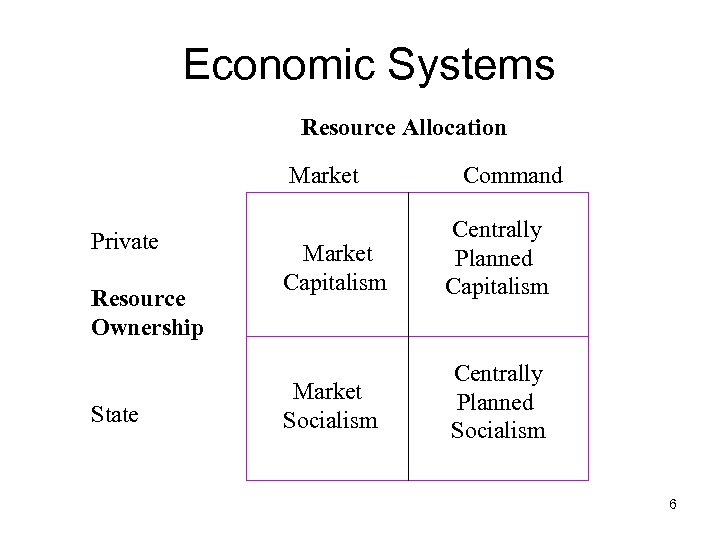
Economic Systems Resource Allocation Market Private Resource Ownership State Command Market Capitalism Centrally Planned Capitalism Market Socialism Centrally Planned Socialism 6
Economic Freedom • Rankings of economic freedom among countries – Ranges from “free” to “repressed” • Variables considered include such things as: – Trade policy – Taxation policy – Banking policy – Wage and price controls – Property rights 7
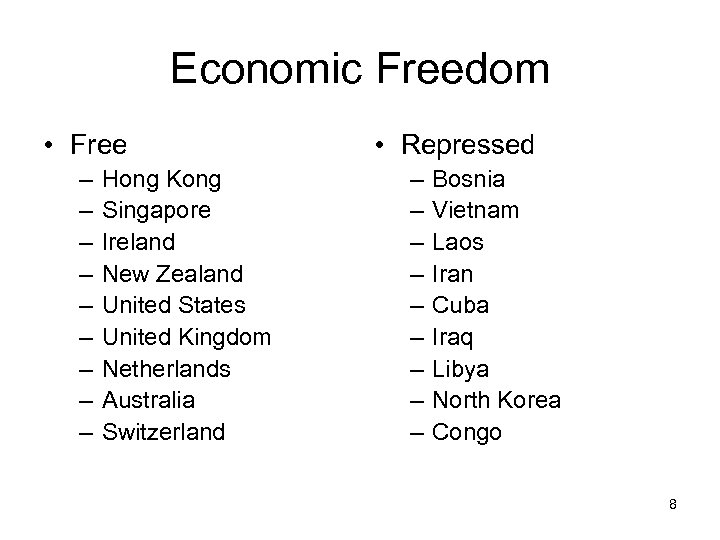
Economic Freedom • Free – – – – – Hong Kong Singapore Ireland New Zealand United States United Kingdom Netherlands Australia Switzerland • Repressed – – – – – Bosnia Vietnam Laos Iran Cuba Iraq Libya North Korea Congo 8
Stages of Market Development • World Bank has defined four categories of development – High-income countries – Upper-middle income countries – Low-income countries • Based upon Gross National Product (GNP) 9
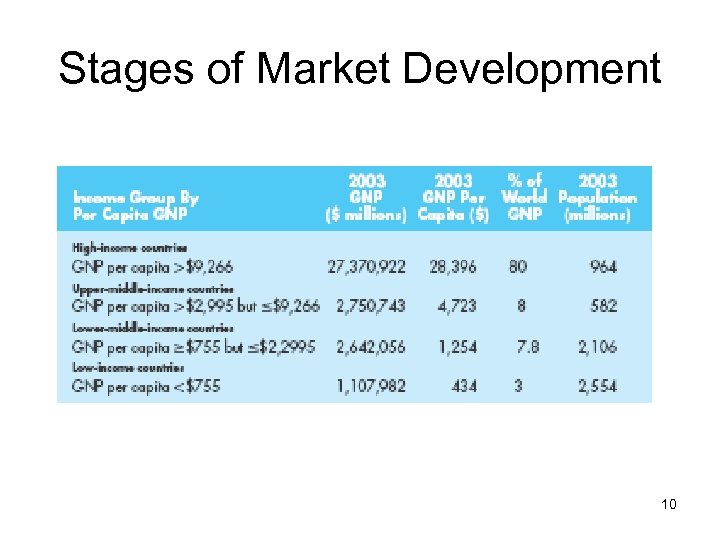
Stages of Market Development 10
Big Emerging Markets • • • China India Indonesia South Korea Brazil Mexico Argentina South Africa Poland Turkey 11
Marketing Opportunities in LDCs • Characterized by a shortage of goods and services • Long-term opportunities must be nurtured in these countries – Look beyond per capita GNP – Consider the LDCs collectively rather than individually – Consider first mover advantage – Set realistic Deadlines 12
Influencing the World Economy • Group of Seven (G-7) • Organization for Economic Cooperation and Development • The Triad 13
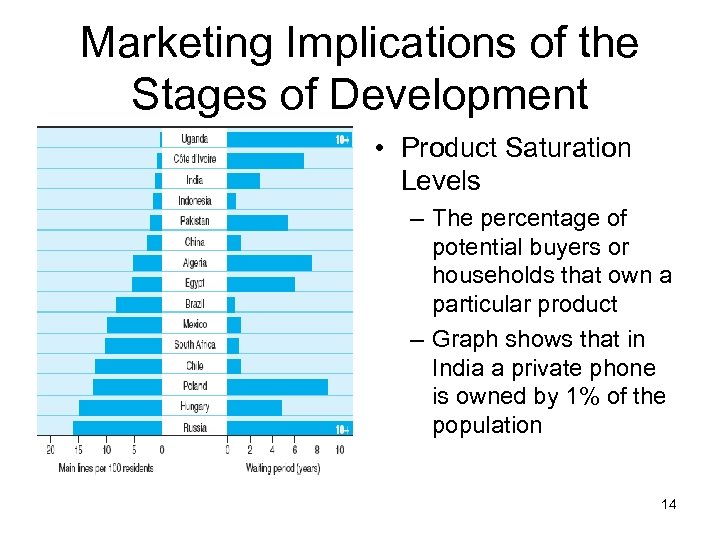
Marketing Implications of the Stages of Development • Product Saturation Levels – The percentage of potential buyers or households that own a particular product – Graph shows that in India a private phone is owned by 1% of the population 14
Balance of Payments • Record of all economic transactions between the residents of a country and the rest of the world – Current account – record of all recurring trade in merchandise and services, private gifts, and public aid between countries • trade deficit • trade surplus – Capital account – record of all long-term direct investment, portfolio investment, and capital flows 15
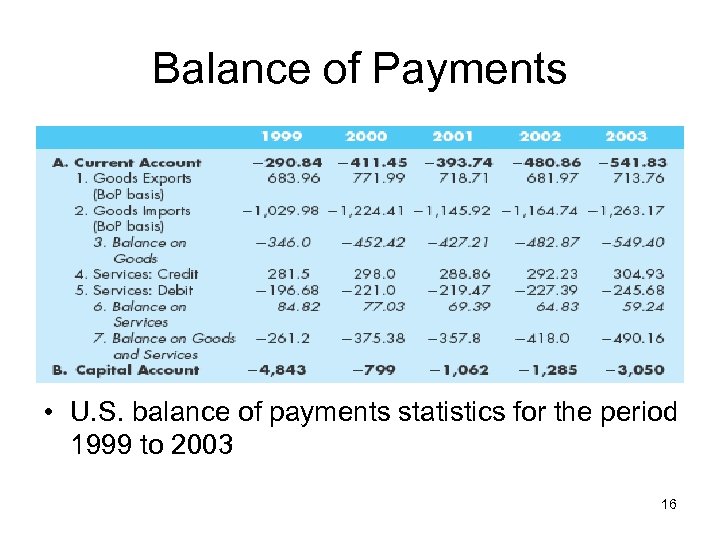
Balance of Payments • U. S. balance of payments statistics for the period 1999 to 2003 16
Overview of International Finance • Foreign exchange makes it possible to do business across the boundary of a national currency • Currency of various countries are traded for both immediate (spot) and future (forward) delivery • Increases the risk to organizations that are involved in global marketing 17
Managed Dirty Float? • Definitions – Float refers to the system of fluctuating exchange rates – Managed refers to the specific use of fiscal and monetary policy by governments to influence exchange rates • Devaluation is a reduction in the value of the local currency against other currencies 18
Managed Dirty Float? • Definitions – Dirty refers to the fact that central banks, as well as currency traders, buy and sell currency to influence exchange rates 19
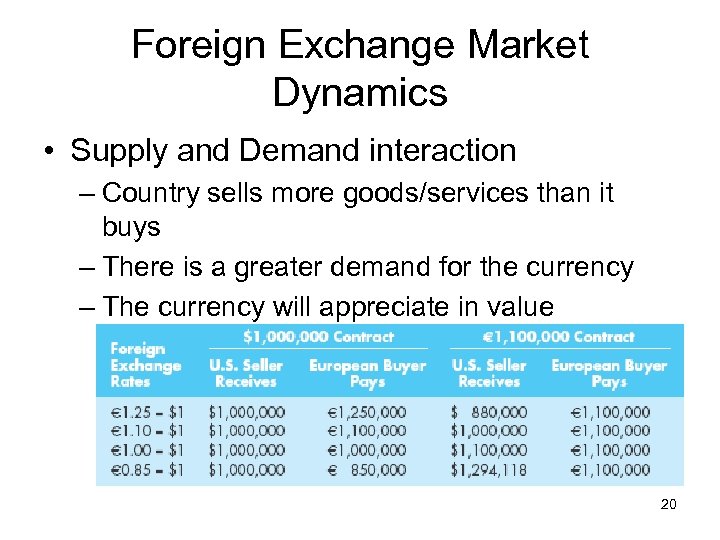
Foreign Exchange Market Dynamics • Supply and Demand interaction – Country sells more goods/services than it buys – There is a greater demand for the currency – The currency will appreciate in value 20
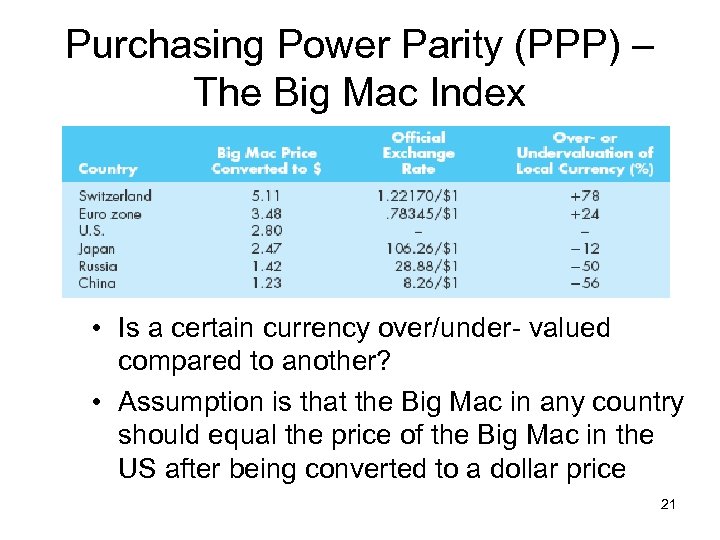
Purchasing Power Parity (PPP) – The Big Mac Index • Is a certain currency over/under- valued compared to another? • Assumption is that the Big Mac in any country should equal the price of the Big Mac in the US after being converted to a dollar price 21
Managing Economic Exposure • Economic exposure refers to the impact of currency fluctuations on the present value of the company’s future cash flows – Transaction exposure is from sales/purchases – Real operating exposure arises when currency fluctuations, together with price changes, alter a company’s future revenues and costs 22
Managing Economic Exposure • Numerous techniques and strategies have been developed to reduce exchange rate risk – Hedging involves balancing the risk of loss in one currency with a corresponding gain in another currency – Forward Contracts set the price of the exchange rate at some point in the future to eliminate some risk 23
Looking Ahead • Chapter 3 – The Global Trade Environment: Regional Market Characteristics and Preferential Trade Agreements 24
Market Capitalism • • Individuals and firms allocate resources Production resources are privately owned Driven by consumers Government should promote competition among firms and ensure consumer protection Return 25
Centrally Planned Socialism • Opposite of market capitalism • State holds broad powers to serve the public interest; decides what goods and services are produced and in what quantities • Consumers can spend on what is available • Government owns entire industries • Demand typically exceeds supply • Little reliance on product differentiation, advertising, pricing strategy Return 26
Centrally-Planned Capitalism • Economic system in which command resource allocation is used extensively in an environment of private resource ownership • Examples: – Sweden – Japan Return 27
Market Socialism • Economic system in which market allocation policies are permitted within an overall environment of state ownership • Examples: – China – India Return 28
Low-Income Countries • GNP per capita of $785 or less • Characteristics – – – Limited industrialization High percentage of population involved in farming High birth rates Low literacy rates Heavy reliance on foreign aid Political instability and unrest • Of these, only China and India are BEMs Return 29
Lower-Middle-Income Countries • GNP per capita between $786 and $3, 125 • Sometimes called less-developed countries (LDCs) • Characteristics – Early stages of industrialization – Cheap labor markets – Factories supply items such as clothing, tires, building materials, and packaged foods • 3 BEMs: Poland, Turkey, Indonesia Return 30
Upper-Middle-Income Countries • GNP per capita between $3, 126 to $9, 655 • Characteristics – Rapidly industrializing – Rising wages – High rates of literacy and advanced education – Lower wage costs than advanced countries • Sometimes called newly industrializing economies (NIEs) • 3 BEMs: Argentina, Brazil, Mexico, South Africa Return 31
High-Income Countries • GNP per capita above $9, 656 • Sometimes referred to as post-industrial countries • Characteristics – Importance of service sector, information processing and exchange, and intellectual technology – Knowledge as key strategic resource – Orientation toward the future Return 32
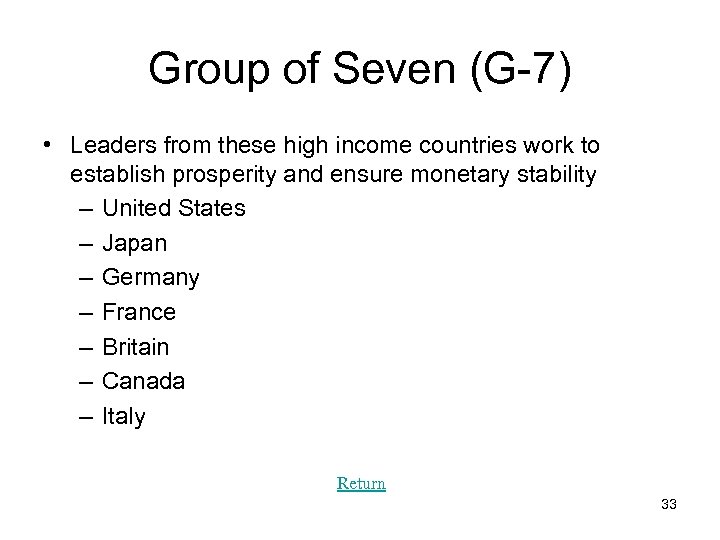
Group of Seven (G-7) • Leaders from these high income countries work to establish prosperity and ensure monetary stability – United States – Japan – Germany – France – Britain – Canada – Italy Return 33
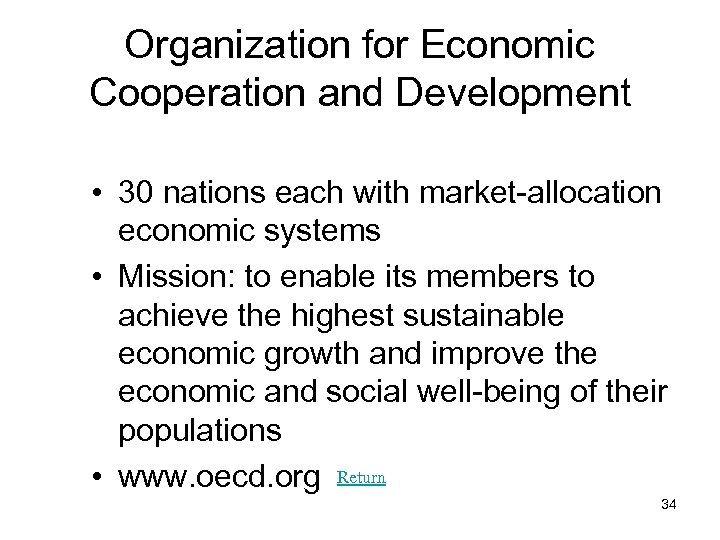
Organization for Economic Cooperation and Development • 30 nations each with market-allocation economic systems • Mission: to enable its members to achieve the highest sustainable economic growth and improve the economic and social well-being of their populations • www. oecd. org Return 34
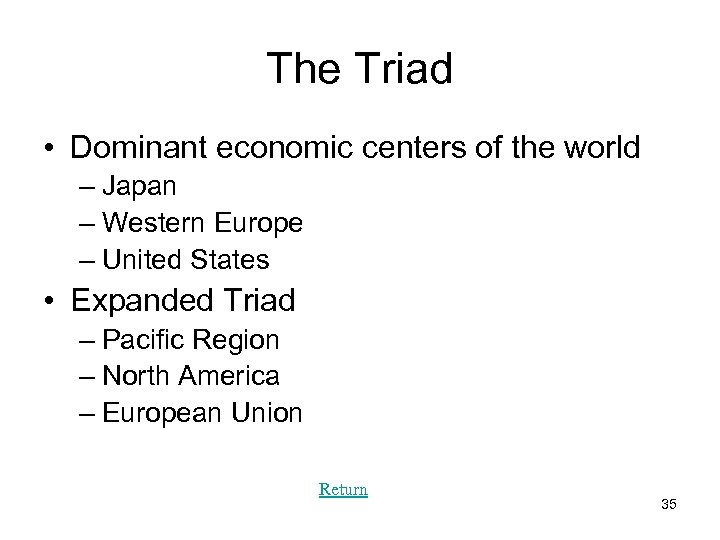
The Triad • Dominant economic centers of the world – Japan – Western Europe – United States • Expanded Triad – Pacific Region – North America – European Union Return 35
Скачать презентацию Chapter 2 The Global Economic Environment 1
527f2e3c968bcd15bd7f518d59223050.ppt