


 Скачать презентацию Chapter 2 THE CRIME SCENE CRIMINALISTICS An Introduction
d01f0e69718bc7aad981cc07f13fed79.ppt
- Количество слайдов: 57
 Chapter 2 THE CRIME SCENE CRIMINALISTICS An Introduction to Forensic Science, 9/E By Richard Saferstein PRENTICE HALL © 2007 Pearson Education, Inc. Upper Saddle River, NJ 07458 2 - 1
 CRIMINALISTICS An Introduction to Forensic Science, 9/E By Richard Saferstein PRENTICE HALL © 2007 Pearson Education, Inc. Upper Saddle River, NJ 07458 2 - 2
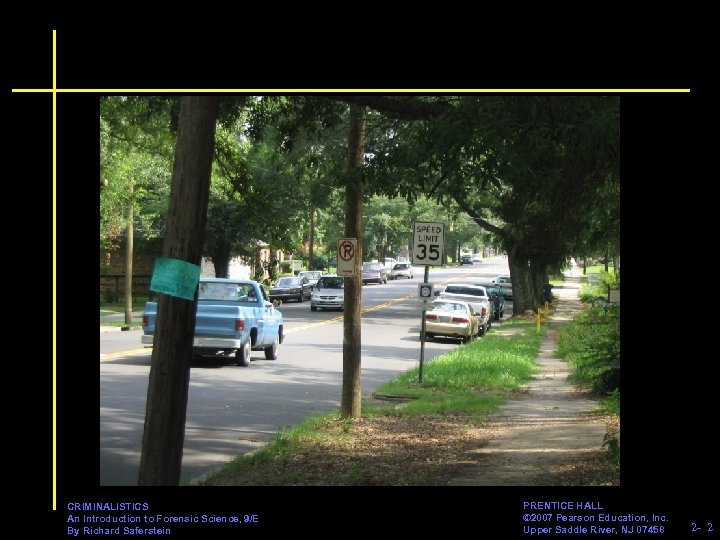
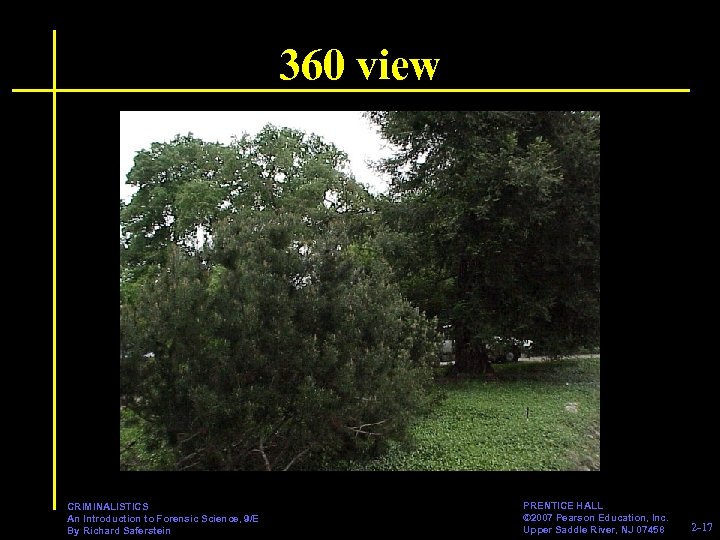
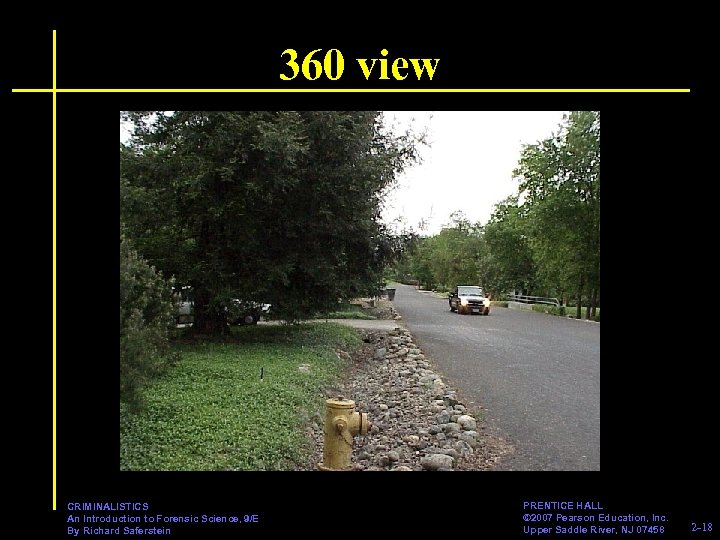
 Observation Skills • Are there cars parked on the sides of the road? • What color is the pickup truck driving in the road? • Any minivans around? • What does the blue sign say? • What’s the speed limit? • Are there any pedestrians on the road? CRIMINALISTICS An Introduction to Forensic Science, 9/E By Richard Saferstein PRENTICE HALL © 2007 Pearson Education, Inc. Upper Saddle River, NJ 07458 2 - 3
 Recording The Crime Scene • Investigators have limited amount of time to work a crime site in untouched state. • Opportunity to permanently record the scene in its original state must not be lost. • Records will prove useful during subsequent investigation & are also required for presentation at a trial to document the condition of the crime site and show location of physical evidence. • Every step of investigation should be documented thoroughly with an appropriate method. CRIMINALISTICS An Introduction to Forensic Science, 9/E By Richard Saferstein PRENTICE HALL © 2007 Pearson Education, Inc. Upper Saddle River, NJ 07458 2 - 4
 The First Steps • first officer to arrive at the scene - responsible for securing crime scene. • First priority - obtaining medical assistance for individuals in need and to arresting the perpetrator. • ASAP, extensive efforts must be made to exclude all unauthorized personnel from scene. • Once the scene is secured, preliminary exam begins. • Recording of the crime scene: critical piece to the investigation process. CRIMINALISTICS An Introduction to Forensic Science, 9/E By Richard Saferstein PRENTICE HALL © 2007 Pearson Education, Inc. Upper Saddle River, NJ 07458 2 - 5
 The Preliminary Exam • A lead investigator will start process of evaluating the area. 1. Boundaries of scene must be determined. 2. Establishment of the perpetrator’s path of entry and exit. 3. Investigator then proceeds with an initial walk-through of the scene; gains an overview of the situation & develop a strategy for examination and documentation of entire crime scene. • All done before processing the crime scene for physical evidence. CRIMINALISTICS An Introduction to Forensic Science, 9/E By Richard Saferstein PRENTICE HALL © 2007 Pearson Education, Inc. Upper Saddle River, NJ 07458 2 - 6
 The Search • The search for physical evidence at a crime scene must be thorough and systematic. • The search pattern: – depends on the size and locale of the scene – the number of collectors participating in the search. • For a factual, unbiased reconstruction of the crime, the investigator must not overlook any pertinent evidence. • Physical evidence can be anything from massive objects to microscopic traces. CRIMINALISTICS An Introduction to Forensic Science, 9/E By Richard Saferstein PRENTICE HALL © 2007 Pearson Education, Inc. Upper Saddle River, NJ 07458 2 - 7
 Survey Methods § Line or strip method—best in large, outdoor scenes § Grid method—basically a double-line search; effective, but time-consuming § Zone method—most effective in houses or buildings; teams are assigned small zones for searching § Wheel or ray method—best on small, circular crime scenes § Spiral method—may move inward or outward; best used where there are no physical barriers CRIMINALISTICS An Introduction to Forensic Science, 9/E By Richard Saferstein PRENTICE HALL © 2007 Pearson Education, Inc. Upper Saddle River, NJ 07458 2 - 8
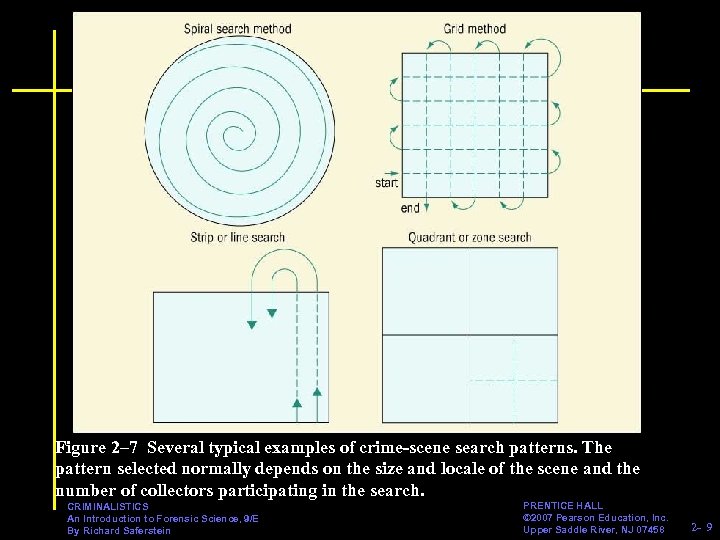 Figure 2– 7 Several typical examples of crime-scene search patterns. The pattern selected normally depends on the size and locale of the scene and the number of collectors participating in the search. CRIMINALISTICS An Introduction to Forensic Science, 9/E By Richard Saferstein PRENTICE HALL © 2007 Pearson Education, Inc. Upper Saddle River, NJ 07458 2 - 9
 The Search • Items of evidence – some clearly visible – Others detected only through examination at crime laboratory. • Important to collect possible carriers of trace evidence like: – clothing, vacuum sweepings, and fingernail scrapings, in addition to more discernible items. CRIMINALISTICS An Introduction to Forensic Science, 9/E By Richard Saferstein PRENTICE HALL © 2007 Pearson Education, Inc. Upper Saddle River, NJ 07458 2 -10
 Beyond The Crime Scene • Search for physical evidence must extend beyond the crime scene - autopsy room of a deceased victim. • Medical examiner carefully examines the victim to establish: – a cause and manner of death. • As a routine, tissues and organs retained for: – pathological and toxicological examination. • At the same time, arrangements made between the examiner & investigator : – secure items that may be obtainable from the body for laboratory examination. CRIMINALISTICS An Introduction to Forensic Science, 9/E By Richard Saferstein PRENTICE HALL © 2007 Pearson Education, Inc. Upper Saddle River, NJ 07458 2 -11
 Beyond The Crime Scene • The following are to be collected and sent to the forensic laboratory: 1. Victim’s clothing 2. Fingernail scrapings 3. Head and pubic hairs 4. Blood (for DNA typing purposes) 5. Vaginal, and oral swabs (in sex related crimes) 6. Recovered bullets from the body 7. Hand swabs from shooting victims (for gunshot residue analysis) CRIMINALISTICS An Introduction to Forensic Science, 9/E By Richard Saferstein PRENTICE HALL © 2007 Pearson Education, Inc. Upper Saddle River, NJ 07458 2 -12
 Recording Methods • Photography, sketches, and notes – three methods for crime-scene recording. • Ideally all three should be employed; however, personnel and monetary limitations may prohibit the utilization of photography at every crime site. CRIMINALISTICS An Introduction to Forensic Science, 9/E By Richard Saferstein PRENTICE HALL © 2007 Pearson Education, Inc. Upper Saddle River, NJ 07458 2 -13
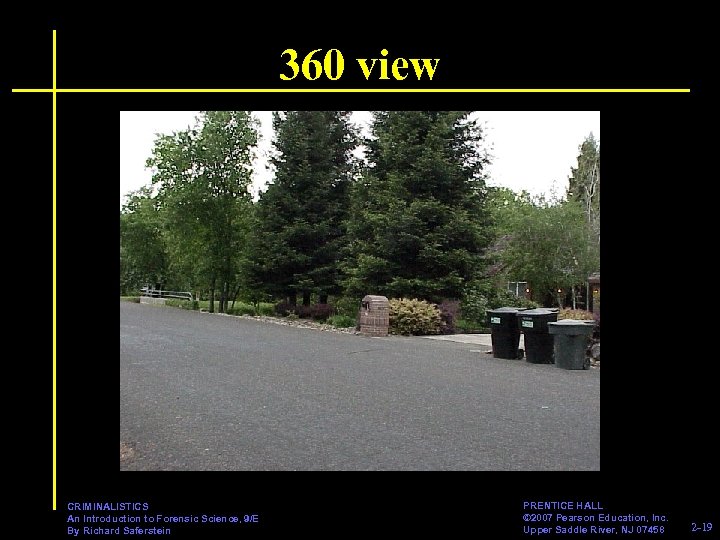
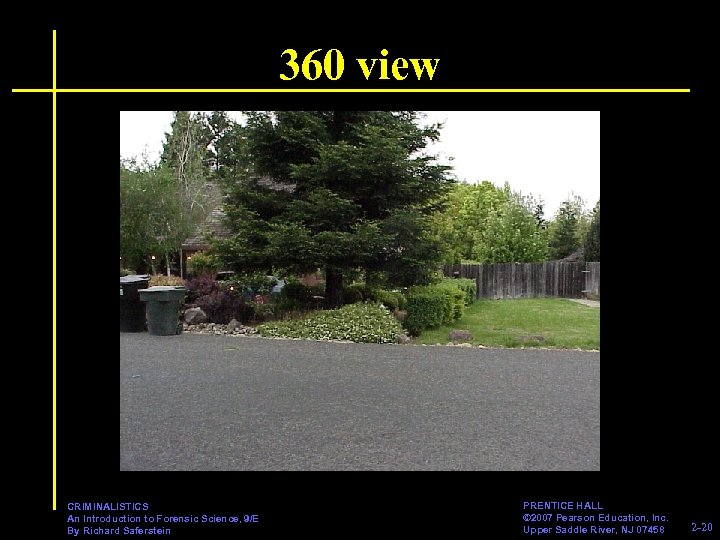
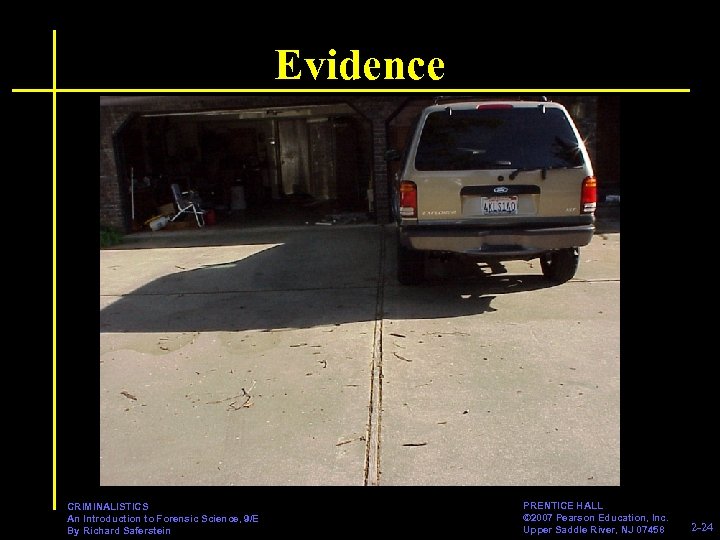
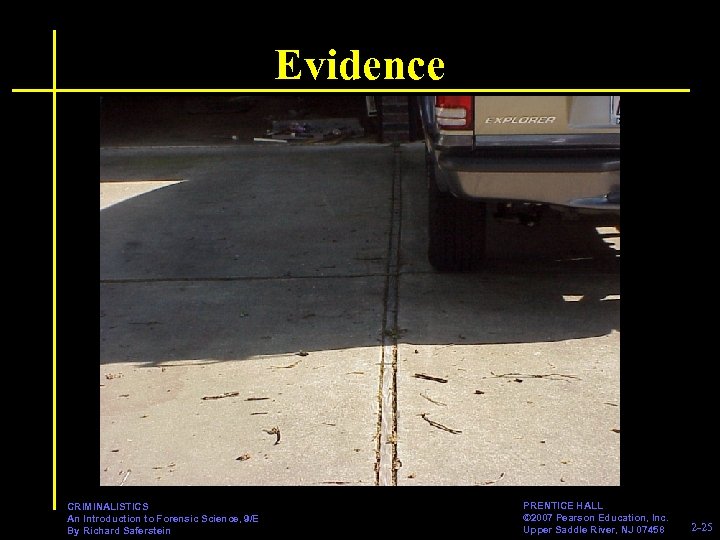
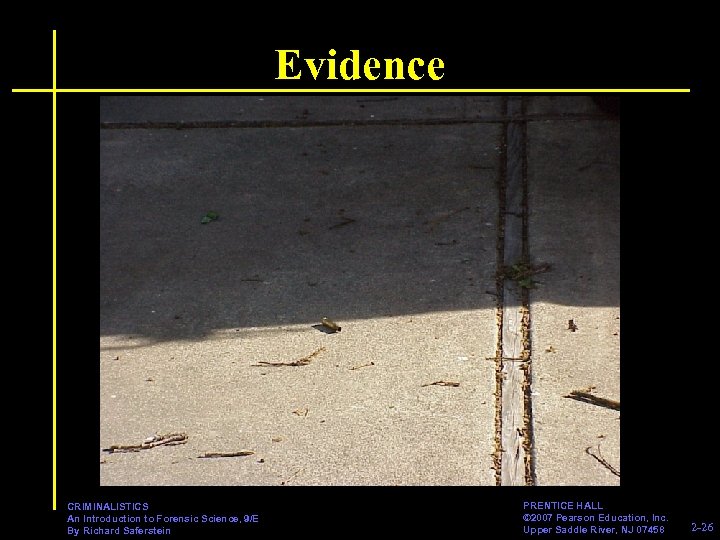
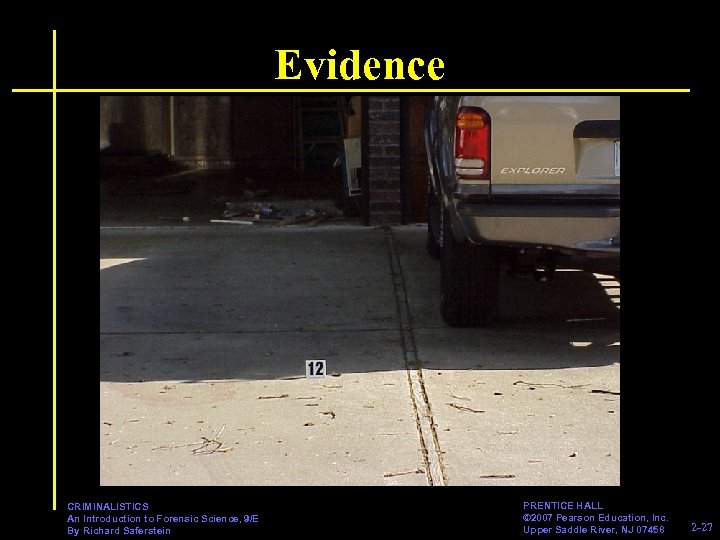
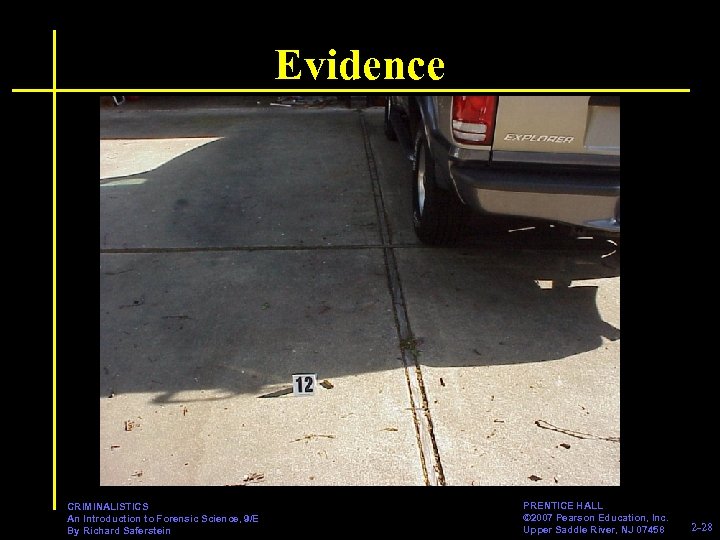
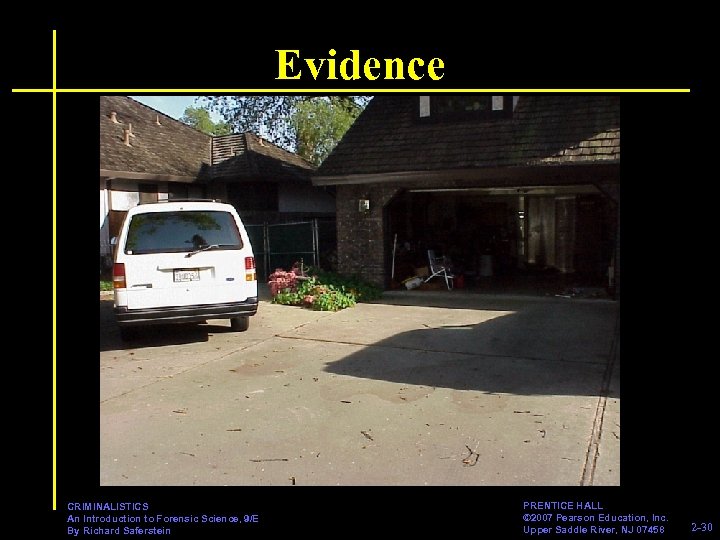
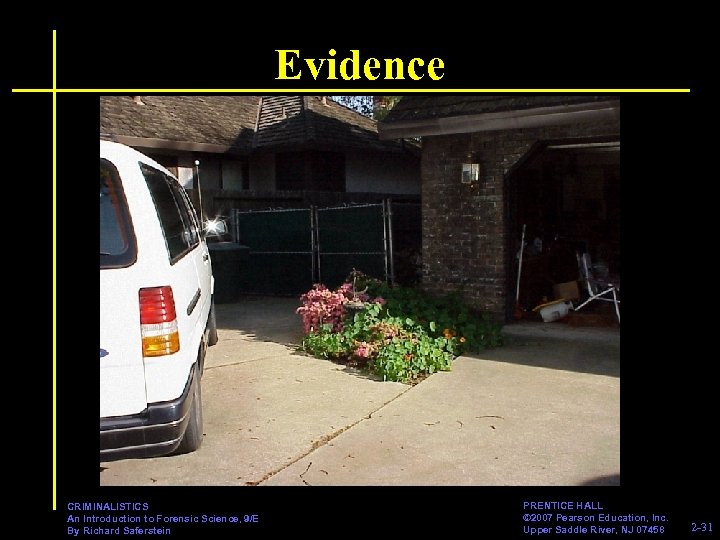
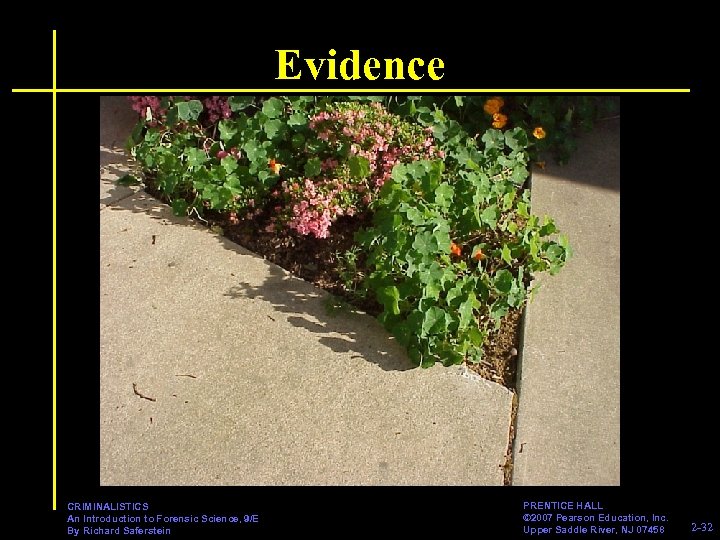
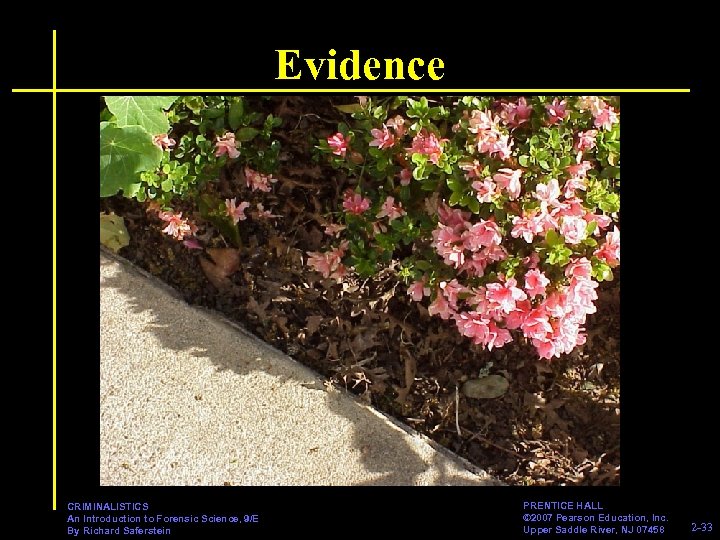
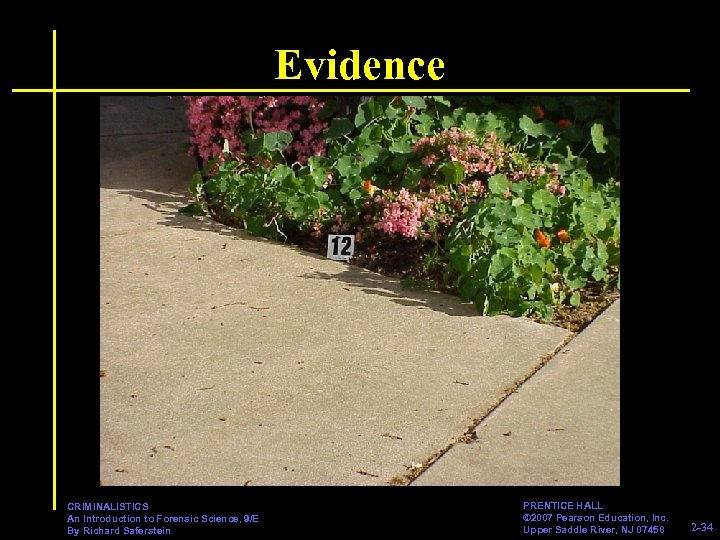
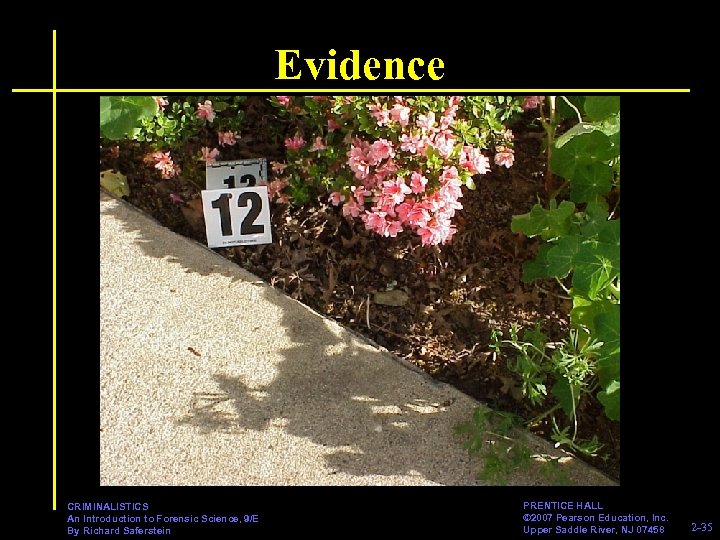
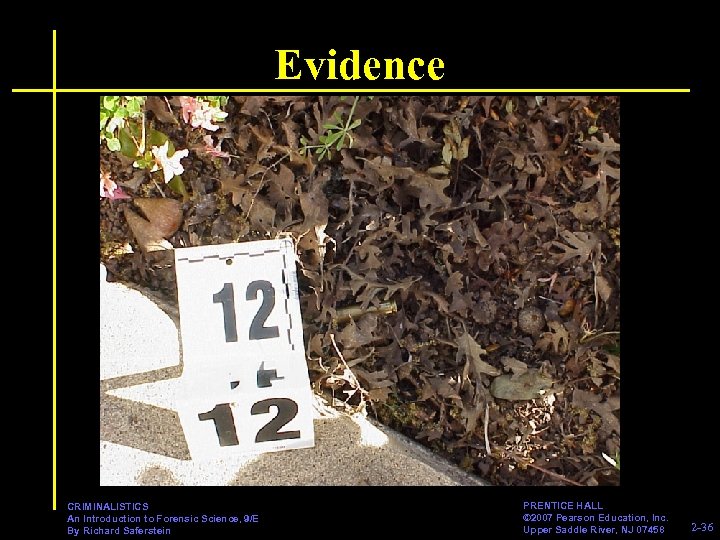
 Photography • Most important: – a crime scene needs to be in an unaltered condition. • Unless injured parties involved: – objects must not be moved until they have been photographed from all necessary angles. • As items of physical evidence discovered: – photographed to show their position and location relative to the entire scene. CRIMINALISTICS An Introduction to Forensic Science, 9/E By Richard Saferstein PRENTICE HALL © 2007 Pearson Education, Inc. Upper Saddle River, NJ 07458 2 -14
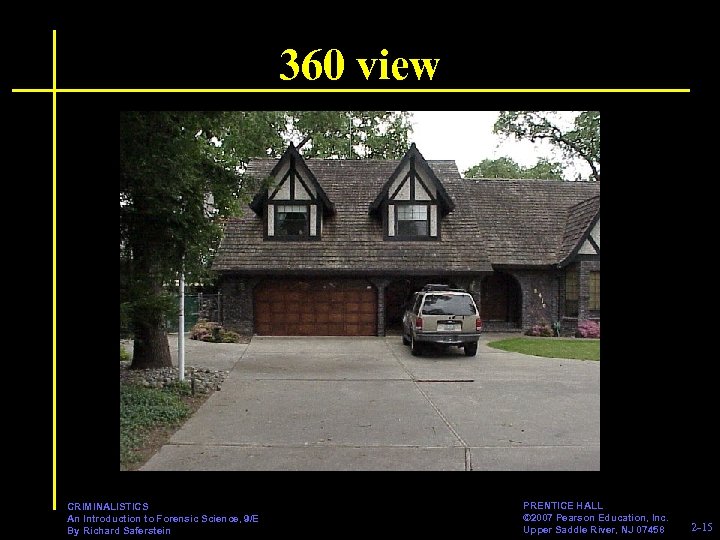 360 view CRIMINALISTICS An Introduction to Forensic Science, 9/E By Richard Saferstein PRENTICE HALL © 2007 Pearson Education, Inc. Upper Saddle River, NJ 07458 2 -15
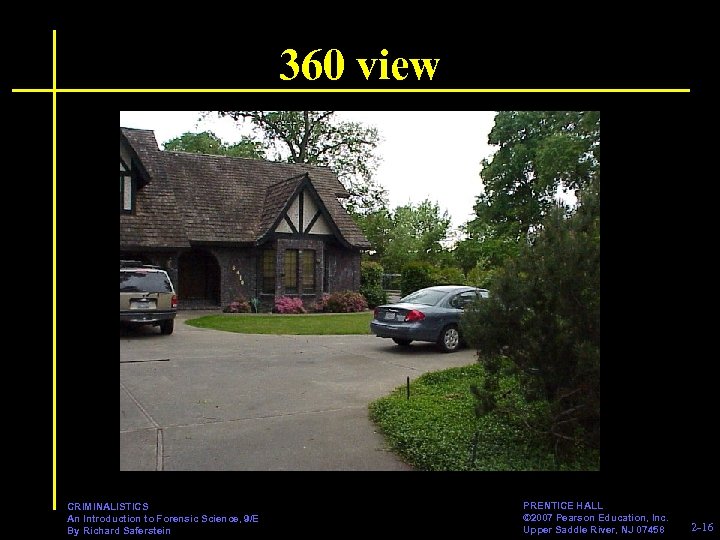 360 view CRIMINALISTICS An Introduction to Forensic Science, 9/E By Richard Saferstein PRENTICE HALL © 2007 Pearson Education, Inc. Upper Saddle River, NJ 07458 2 -16
 360 view CRIMINALISTICS An Introduction to Forensic Science, 9/E By Richard Saferstein PRENTICE HALL © 2007 Pearson Education, Inc. Upper Saddle River, NJ 07458 2 -17
 360 view CRIMINALISTICS An Introduction to Forensic Science, 9/E By Richard Saferstein PRENTICE HALL © 2007 Pearson Education, Inc. Upper Saddle River, NJ 07458 2 -18
 360 view CRIMINALISTICS An Introduction to Forensic Science, 9/E By Richard Saferstein PRENTICE HALL © 2007 Pearson Education, Inc. Upper Saddle River, NJ 07458 2 -19
 360 view CRIMINALISTICS An Introduction to Forensic Science, 9/E By Richard Saferstein PRENTICE HALL © 2007 Pearson Education, Inc. Upper Saddle River, NJ 07458 2 -20
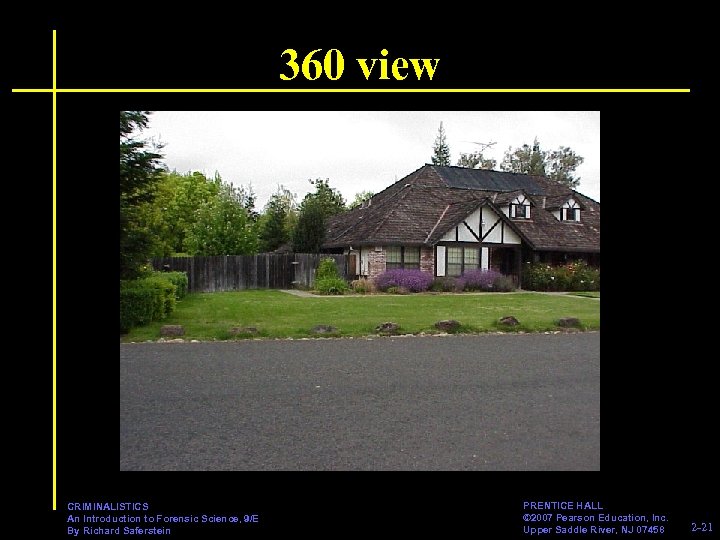 360 view CRIMINALISTICS An Introduction to Forensic Science, 9/E By Richard Saferstein PRENTICE HALL © 2007 Pearson Education, Inc. Upper Saddle River, NJ 07458 2 -21
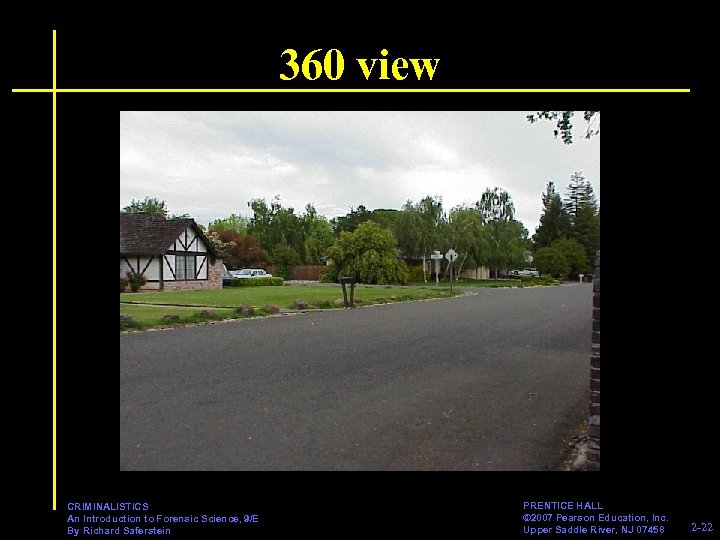 360 view CRIMINALISTICS An Introduction to Forensic Science, 9/E By Richard Saferstein PRENTICE HALL © 2007 Pearson Education, Inc. Upper Saddle River, NJ 07458 2 -22
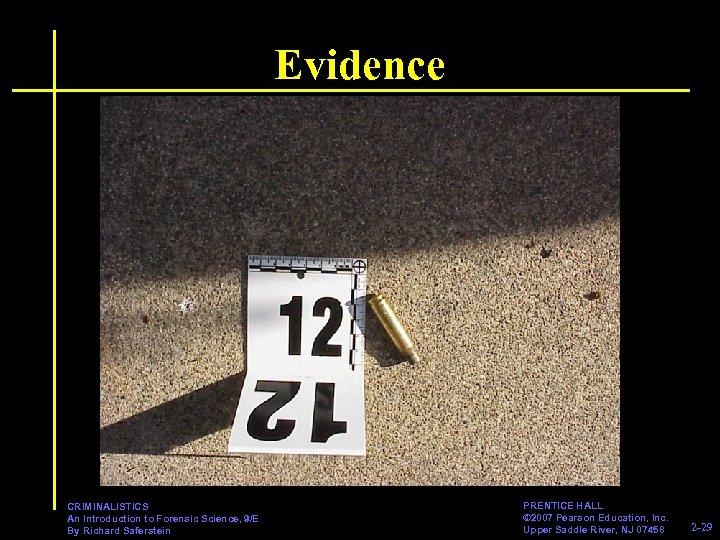
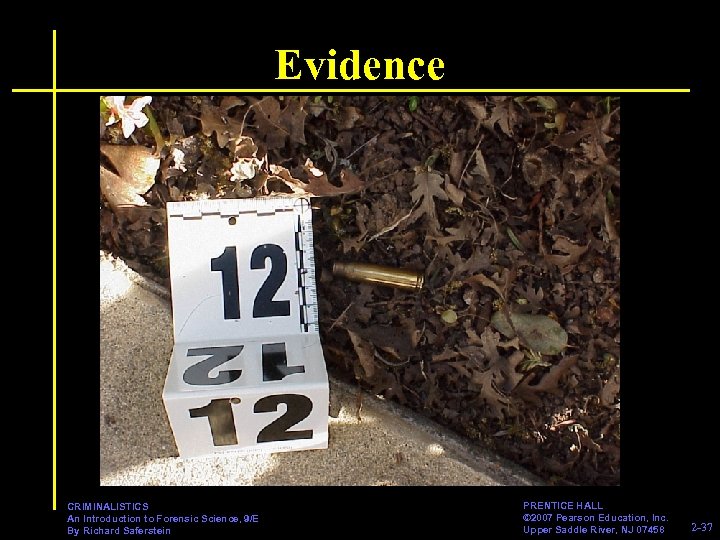
 Photography • After overviews are taken, close-ups taken to record details of the object itself. – When size is of significance, a ruler or other measuring scale may be inserted and included in the photograph as a point of reference. CRIMINALISTICS An Introduction to Forensic Science, 9/E By Richard Saferstein PRENTICE HALL © 2007 Pearson Education, Inc. Upper Saddle River, NJ 07458 2 -23
 Evidence CRIMINALISTICS An Introduction to Forensic Science, 9/E By Richard Saferstein PRENTICE HALL © 2007 Pearson Education, Inc. Upper Saddle River, NJ 07458 2 -24
 Evidence CRIMINALISTICS An Introduction to Forensic Science, 9/E By Richard Saferstein PRENTICE HALL © 2007 Pearson Education, Inc. Upper Saddle River, NJ 07458 2 -25
 Evidence CRIMINALISTICS An Introduction to Forensic Science, 9/E By Richard Saferstein PRENTICE HALL © 2007 Pearson Education, Inc. Upper Saddle River, NJ 07458 2 -26
 Evidence CRIMINALISTICS An Introduction to Forensic Science, 9/E By Richard Saferstein PRENTICE HALL © 2007 Pearson Education, Inc. Upper Saddle River, NJ 07458 2 -27
 Evidence CRIMINALISTICS An Introduction to Forensic Science, 9/E By Richard Saferstein PRENTICE HALL © 2007 Pearson Education, Inc. Upper Saddle River, NJ 07458 2 -28
 Evidence CRIMINALISTICS An Introduction to Forensic Science, 9/E By Richard Saferstein PRENTICE HALL © 2007 Pearson Education, Inc. Upper Saddle River, NJ 07458 2 -29
 Evidence CRIMINALISTICS An Introduction to Forensic Science, 9/E By Richard Saferstein PRENTICE HALL © 2007 Pearson Education, Inc. Upper Saddle River, NJ 07458 2 -30
 Evidence CRIMINALISTICS An Introduction to Forensic Science, 9/E By Richard Saferstein PRENTICE HALL © 2007 Pearson Education, Inc. Upper Saddle River, NJ 07458 2 -31
 Evidence CRIMINALISTICS An Introduction to Forensic Science, 9/E By Richard Saferstein PRENTICE HALL © 2007 Pearson Education, Inc. Upper Saddle River, NJ 07458 2 -32
 Evidence CRIMINALISTICS An Introduction to Forensic Science, 9/E By Richard Saferstein PRENTICE HALL © 2007 Pearson Education, Inc. Upper Saddle River, NJ 07458 2 -33
 Evidence CRIMINALISTICS An Introduction to Forensic Science, 9/E By Richard Saferstein PRENTICE HALL © 2007 Pearson Education, Inc. Upper Saddle River, NJ 07458 2 -34
 Evidence CRIMINALISTICS An Introduction to Forensic Science, 9/E By Richard Saferstein PRENTICE HALL © 2007 Pearson Education, Inc. Upper Saddle River, NJ 07458 2 -35
 Evidence CRIMINALISTICS An Introduction to Forensic Science, 9/E By Richard Saferstein PRENTICE HALL © 2007 Pearson Education, Inc. Upper Saddle River, NJ 07458 2 -36
 Evidence CRIMINALISTICS An Introduction to Forensic Science, 9/E By Richard Saferstein PRENTICE HALL © 2007 Pearson Education, Inc. Upper Saddle River, NJ 07458 2 -37
 Sketches • Rough Sketch- – draft representation of all essential information and measurements at a crime scene. – sketch is drawn at the crime scene. – shows all recovered items of physical evidence, as well as other important features of the crime scene. CRIMINALISTICS An Introduction to Forensic Science, 9/E By Richard Saferstein PRENTICE HALL © 2007 Pearson Education, Inc. Upper Saddle River, NJ 07458 2 -38
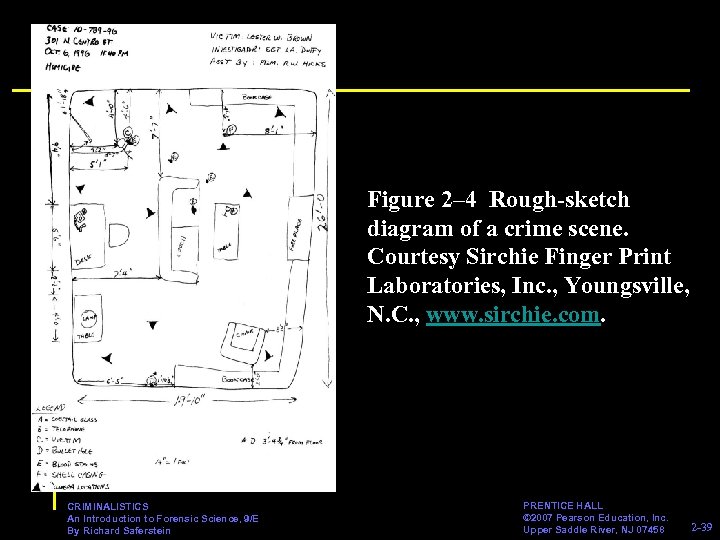 Figure 2– 4 Rough-sketch diagram of a crime scene. Courtesy Sirchie Finger Print Laboratories, Inc. , Youngsville, N. C. , www. sirchie. com. CRIMINALISTICS An Introduction to Forensic Science, 9/E By Richard Saferstein PRENTICE HALL © 2007 Pearson Education, Inc. Upper Saddle River, NJ 07458 2 -39
 Finished Sketch • Finished Sketch—A precise rendering of the crime scene, usually drawn to scale. This type is not normally completed at the crime scene. • Unlike the rough sketch, the finished sketch is drawn with care and concern for aesthetic appearance. CRIMINALISTICS An Introduction to Forensic Science, 9/E By Richard Saferstein PRENTICE HALL © 2007 Pearson Education, Inc. Upper Saddle River, NJ 07458 2 -40
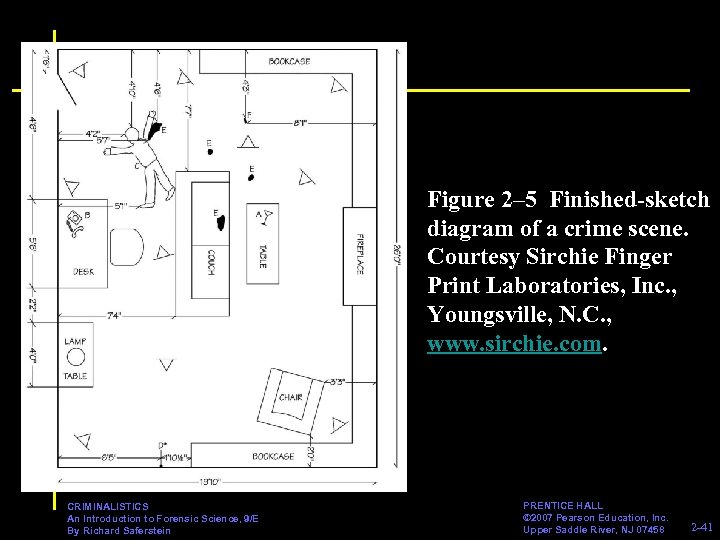 Figure 2– 5 Finished-sketch diagram of a crime scene. Courtesy Sirchie Finger Print Laboratories, Inc. , Youngsville, N. C. , www. sirchie. com. CRIMINALISTICS An Introduction to Forensic Science, 9/E By Richard Saferstein PRENTICE HALL © 2007 Pearson Education, Inc. Upper Saddle River, NJ 07458 2 -41
 Notes • Note taking - constant activity throughout the processing of the crime scene. • Must include: detailed written description of the scene with location of items of physical evidence recovered. • Must identify: – – the time an item of physical evidence was discovered by whom it was discovered how and by whom it was packaged and marked the disposition of the item after it was collected • Keep in mind: written record may be the only source of info for refreshing one’s memory. CRIMINALISTICS An Introduction to Forensic Science, 9/E By Richard Saferstein PRENTICE HALL © 2007 Pearson Education, Inc. Upper Saddle River, NJ 07458 2 -42
 Packaging • Each different item or similar items collected at different locations must be placed in separate containers. – Packaging separately prevents: • damage through contact • cross-contamination. • Well-prepared evidence collector arrives at crime scene with large assortment of packaging materials, tools ready to encounter any type of situation. CRIMINALISTICS An Introduction to Forensic Science, 9/E By Richard Saferstein PRENTICE HALL © 2007 Pearson Education, Inc. Upper Saddle River, NJ 07458 2 -43
 Packaging • Forceps and similar tools may be used to pick up small items. • Unbreakable plastic pill bottles with pressure lids: – hairs, glass, fibers, and various other kinds of small or trace evidence. • Manila envelopes, screw-cap glass vials, or cardboard pillboxes: – most trace evidence encountered at crime sites. • Ordinary mailing envelopes should not be used as evidence containers b/c powders and fine particles will leak out of their corners. CRIMINALISTICS An Introduction to Forensic Science, 9/E By Richard Saferstein PRENTICE HALL © 2007 Pearson Education, Inc. Upper Saddle River, NJ 07458 2 -44
 Packaging • Small amounts of trace evidence: – packaged in a carefully folded paper, using what is known as a “druggist fold. ” • Pill bottles, vials, pillboxes, or manila envelopes are good universal containers for most trace evidence, except: – If bloodstained materials are stored in airtight containers: • accumulation of moisture encourages the growth of mold, & can destroy the evidential value of blood. – So, wrapping paper, manila envelopes, or paper bags are recommended packaging materials. CRIMINALISTICS An Introduction to Forensic Science, 9/E By Richard Saferstein PRENTICE HALL © 2007 Pearson Education, Inc. Upper Saddle River, NJ 07458 2 -45
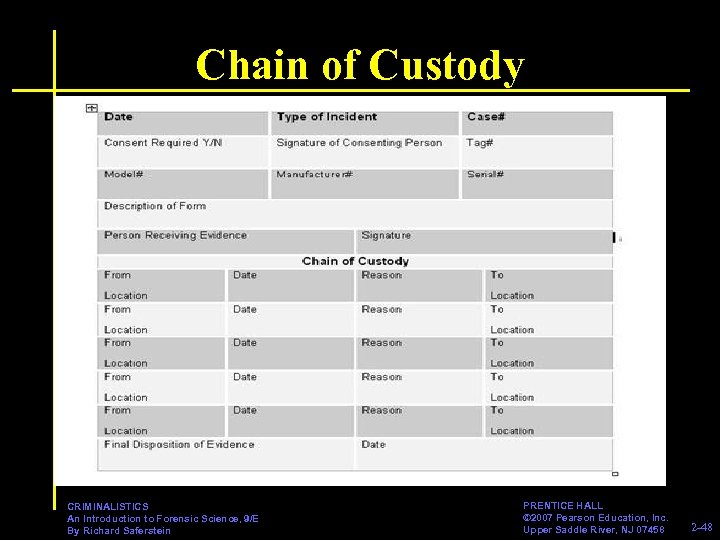
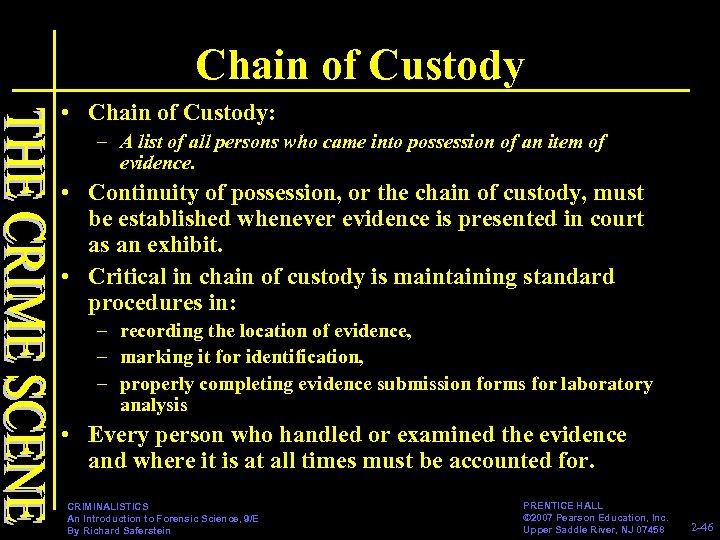 Chain of Custody • Chain of Custody: – A list of all persons who came into possession of an item of evidence. • Continuity of possession, or the chain of custody, must be established whenever evidence is presented in court as an exhibit. • Critical in chain of custody is maintaining standard procedures in: – recording the location of evidence, – marking it for identification, – properly completing evidence submission forms for laboratory analysis • Every person who handled or examined the evidence and where it is at all times must be accounted for. CRIMINALISTICS An Introduction to Forensic Science, 9/E By Richard Saferstein PRENTICE HALL © 2007 Pearson Education, Inc. Upper Saddle River, NJ 07458 2 -46
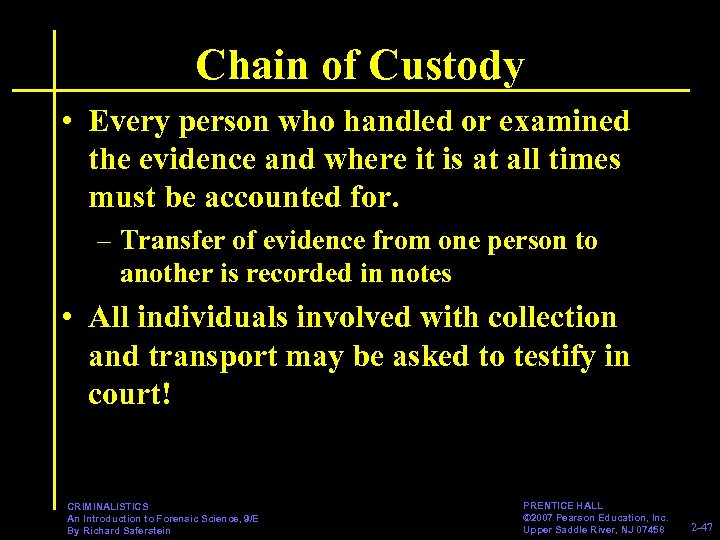 Chain of Custody • Every person who handled or examined the evidence and where it is at all times must be accounted for. – Transfer of evidence from one person to another is recorded in notes • All individuals involved with collection and transport may be asked to testify in court! CRIMINALISTICS An Introduction to Forensic Science, 9/E By Richard Saferstein PRENTICE HALL © 2007 Pearson Education, Inc. Upper Saddle River, NJ 07458 2 -47
 Chain of Custody CRIMINALISTICS An Introduction to Forensic Science, 9/E By Richard Saferstein PRENTICE HALL © 2007 Pearson Education, Inc. Upper Saddle River, NJ 07458 2 -48
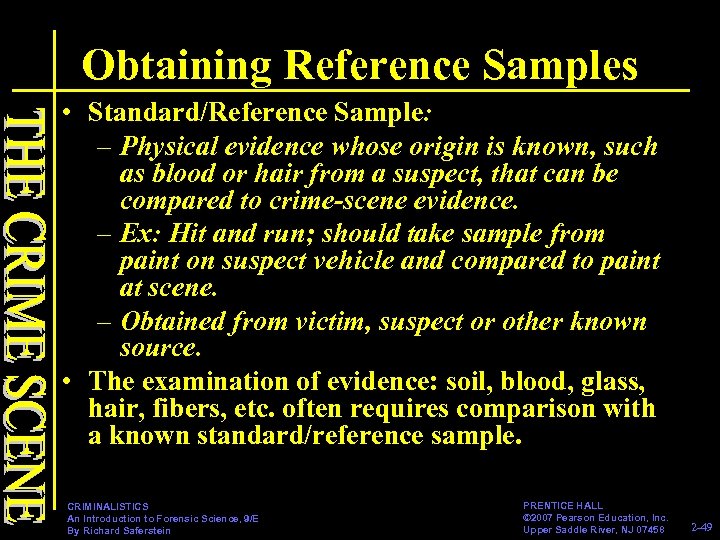 Obtaining Reference Samples • Standard/Reference Sample: – Physical evidence whose origin is known, such as blood or hair from a suspect, that can be compared to crime-scene evidence. – Ex: Hit and run; should take sample from paint on suspect vehicle and compared to paint at scene. – Obtained from victim, suspect or other known source. • The examination of evidence: soil, blood, glass, hair, fibers, etc. often requires comparison with a known standard/reference sample. CRIMINALISTICS An Introduction to Forensic Science, 9/E By Richard Saferstein PRENTICE HALL © 2007 Pearson Education, Inc. Upper Saddle River, NJ 07458 2 -49
 Obtaining Reference Samples – Hair found at crime scene valued only when compared to standard/reference sample removed from suspect or victim. – Blood-stained evidence only valued when accompanied by whole blood or buccal swab from all relevant crime-scene participants. • Most investigators have little difficulty recognizing and collecting relevant crime-scene evidence, but few seem aware of the like necessity and importance of providing the crime lab with a thorough sampling of standard/reference materials. CRIMINALISTICS An Introduction to Forensic Science, 9/E By Richard Saferstein PRENTICE HALL © 2007 Pearson Education, Inc. Upper Saddle River, NJ 07458 2 -50
 Substrate Controls • Materials adjacent or close to areas where physical evidence has been deposited. • Used to ensure that the surface on which a sample was deposited does not interfere with lab tests. Examples: – collected at arson scenes – Blood-stained material CRIMINALISTICS An Introduction to Forensic Science, 9/E By Richard Saferstein PRENTICE HALL © 2007 Pearson Education, Inc. Upper Saddle River, NJ 07458 2 -51
 Submit Evidence to Laboratory • By personal delivery or by mail; determined by distance agency must travel to laboratory and urgency of case • Most labs require an evidence submission form along with evidence. – Kind of examination requested for each type of evidence included. – However, if new evidence is uncovered, analyst is not bound to only run requested tests. CRIMINALISTICS An Introduction to Forensic Science, 9/E By Richard Saferstein PRENTICE HALL © 2007 Pearson Education, Inc. Upper Saddle River, NJ 07458 2 -52
 Crime Scene Safety • The increasing spread of AIDS and hepatitis B has sensitized the law enforcement community to the potential health hazards that can exist at crime scenes. • In reality, law enforcement officers have an extremely small chance of contracting AIDS or hepatitis at the crime scene. • The International Association for Identification Safety Committee has proposed guidelines to protect investigators at crime scenes containing potentially infectious materials that should be adhered to at all times. CRIMINALISTICS An Introduction to Forensic Science, 9/E By Richard Saferstein PRENTICE HALL © 2007 Pearson Education, Inc. Upper Saddle River, NJ 07458 2 -53
 Crime Scene Safety 1. At crime scenes where blood or body fluids involved: latex gloves and shoe coverings should be warn. 2. If potentially infectious dust or mist encountered: particle mask/ respirator, goggles, or face shield recommended also. 3. Personnel should be aware of sharp objects, knives, hypodermic syringes, razor blades, etc and place them in appropriate container with label. 4. Red biohazard bag should be used for disposal of contaminated gloves, clothing, masks, pencils, etc. and removal to approved biohazardous waste pickup. CRIMINALISTICS An Introduction to Forensic Science, 9/E By Richard Saferstein PRENTICE HALL © 2007 Pearson Education, Inc. Upper Saddle River, NJ 07458 2 -54
 Crime Scene Safety 5. Note-taking should be done while wearing uncontaminated gloves to avoid contamination or pens, pencils, notebook, paper, etc. 6. If personal protective equipment (PPE) becomes torn, must be removed immediately and person must decontaminate the potentially contaminated body area with recommended solution. 7. No eating, drinking, smoking, or applying makeup at scene of a crime. 8. All nondisposable items (lab coats, towels, personal clothing) that may be contaminated are placed in a yellow plastic bag, labeled “Infectious Linen” and laundered by a qualified service. CRIMINALISTICS An Introduction to Forensic Science, 9/E By Richard Saferstein PRENTICE HALL © 2007 Pearson Education, Inc. Upper Saddle River, NJ 07458 2 -55
 Legal Considerations • Fourth Amendment – Protection against illegal search and seizure – Searches can be conducted under four circumstances in the absence of a courtapproved search warrant • 1. in the existence of emergency circumstances • 2. the need to prevent immediate loss or destruction of evidence • 3. a search of a person or property within the immediate control of the person during a lawful arrest • 4. the involved parties give consent CRIMINALISTICS An Introduction to Forensic Science, 9/E By Richard Saferstein PRENTICE HALL © 2007 Pearson Education, Inc. Upper Saddle River, NJ 07458 2 -56
 Summary 1. Secure and isolate the crime scene 2. Record the scene 3. Conduct a systematic search for evidence 4. Collect and package physical evidence. 5. Obtain standard/reference samples 6. Maintain Chain of Custody 7. Submit evidence to the laboratory. CRIMINALISTICS An Introduction to Forensic Science, 9/E By Richard Saferstein PRENTICE HALL © 2007 Pearson Education, Inc. Upper Saddle River, NJ 07458 2 -57