


 Скачать презентацию Chapter 2 Supply and Demand Slide Copyright
3eaf5d7d1b71941c336186185003cded.ppt
- Количество слайдов: 21
 Chapter 2 Supply and Demand Slide Copyright © 2004 Mc. Graw-Hill Ryerson Limited
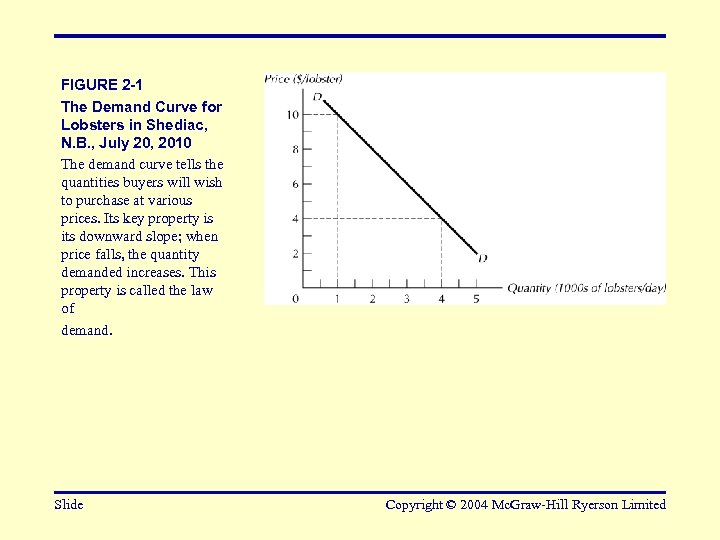 FIGURE 2 -1 The Demand Curve for Lobsters in Shediac, N. B. , July 20, 2010 The demand curve tells the quantities buyers will wish to purchase at various prices. Its key property is its downward slope; when price falls, the quantity demanded increases. This property is called the law of demand. Slide Copyright © 2004 Mc. Graw-Hill Ryerson Limited
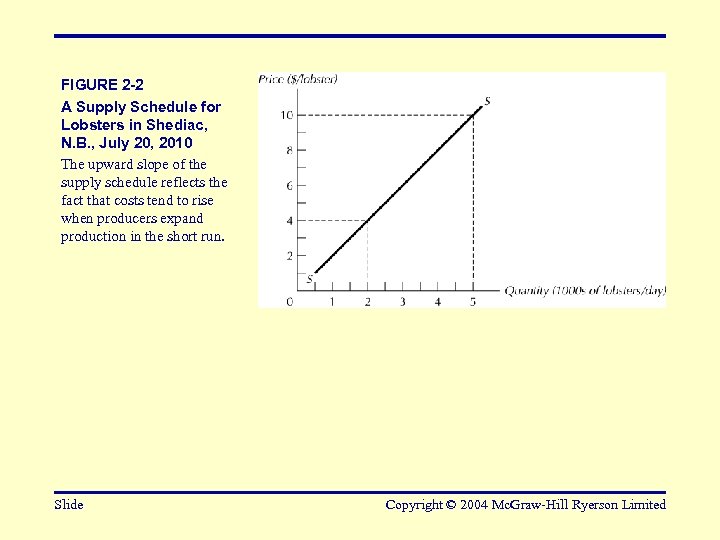 FIGURE 2 -2 A Supply Schedule for Lobsters in Shediac, N. B. , July 20, 2010 The upward slope of the supply schedule reflects the fact that costs tend to rise when producers expand production in the short run. Slide Copyright © 2004 Mc. Graw-Hill Ryerson Limited
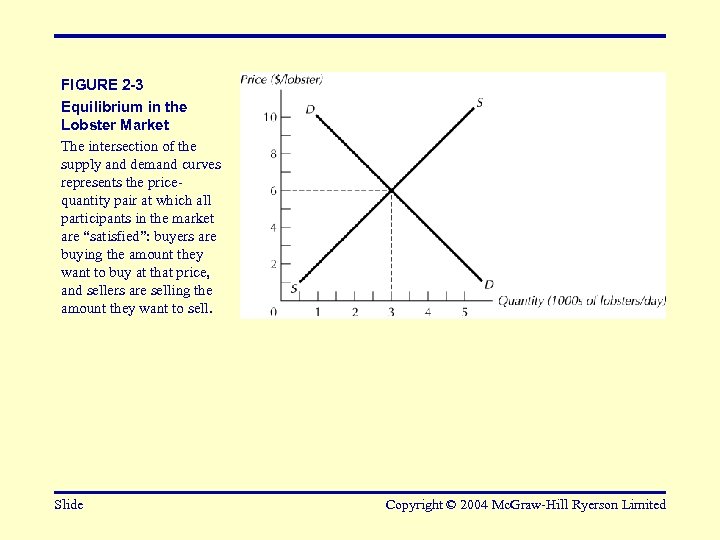 FIGURE 2 -3 Equilibrium in the Lobster Market The intersection of the supply and demand curves represents the pricequantity pair at which all participants in the market are “satisfied”: buyers are buying the amount they want to buy at that price, and sellers are selling the amount they want to sell. Slide Copyright © 2004 Mc. Graw-Hill Ryerson Limited
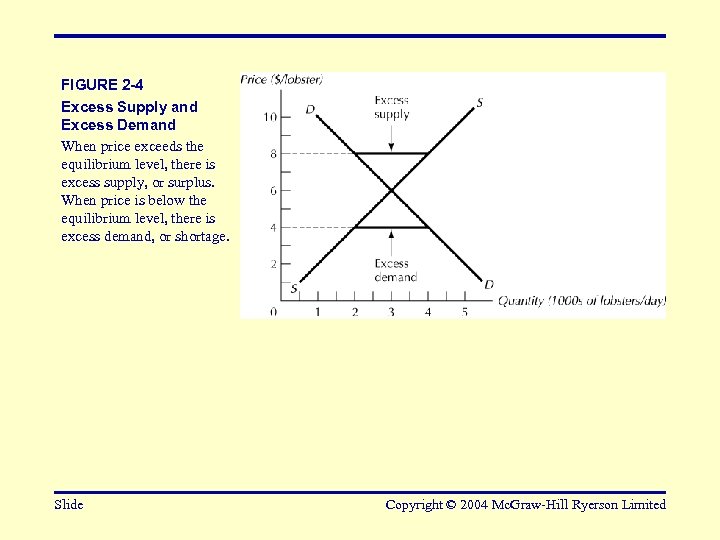 FIGURE 2 -4 Excess Supply and Excess Demand When price exceeds the equilibrium level, there is excess supply, or surplus. When price is below the equilibrium level, there is excess demand, or shortage. Slide Copyright © 2004 Mc. Graw-Hill Ryerson Limited
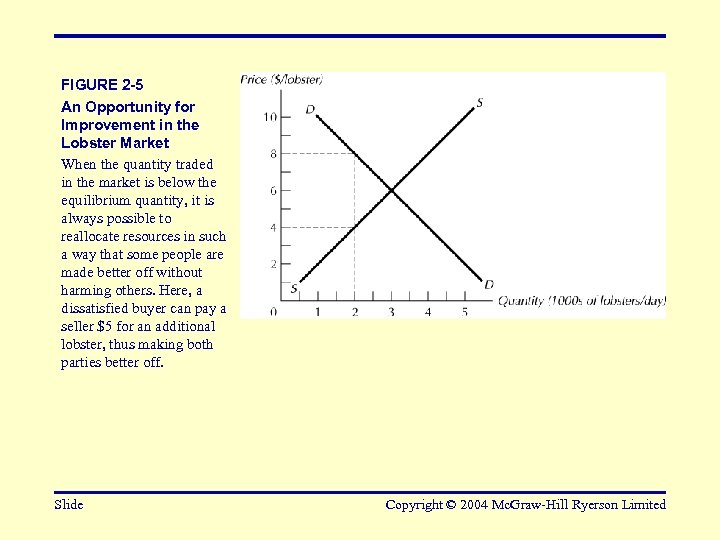 FIGURE 2 -5 An Opportunity for Improvement in the Lobster Market When the quantity traded in the market is below the equilibrium quantity, it is always possible to reallocate resources in such a way that some people are made better off without harming others. Here, a dissatisfied buyer can pay a seller $5 for an additional lobster, thus making both parties better off. Slide Copyright © 2004 Mc. Graw-Hill Ryerson Limited
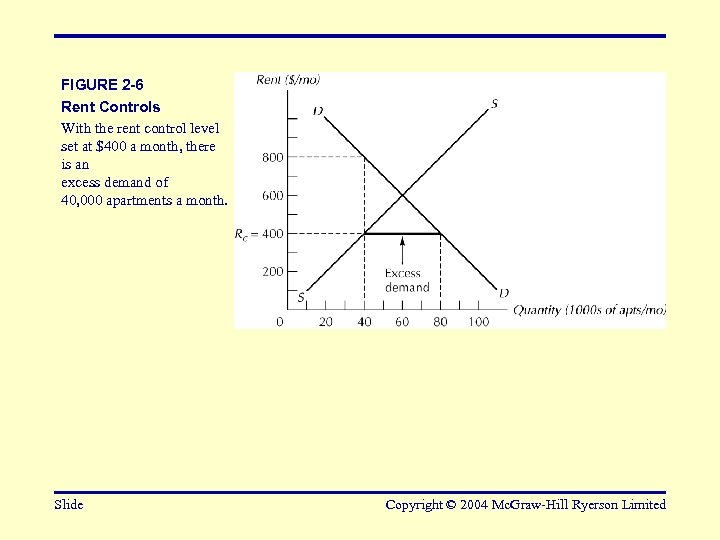 FIGURE 2 -6 Rent Controls With the rent control level set at $400 a month, there is an excess demand of 40, 000 apartments a month. Slide Copyright © 2004 Mc. Graw-Hill Ryerson Limited
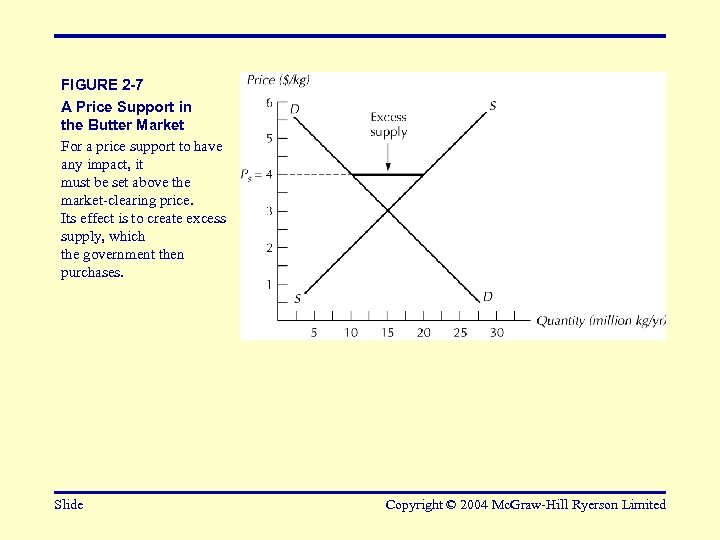 FIGURE 2 -7 A Price Support in the Butter Market For a price support to have any impact, it must be set above the market-clearing price. Its effect is to create excess supply, which the government then purchases. Slide Copyright © 2004 Mc. Graw-Hill Ryerson Limited
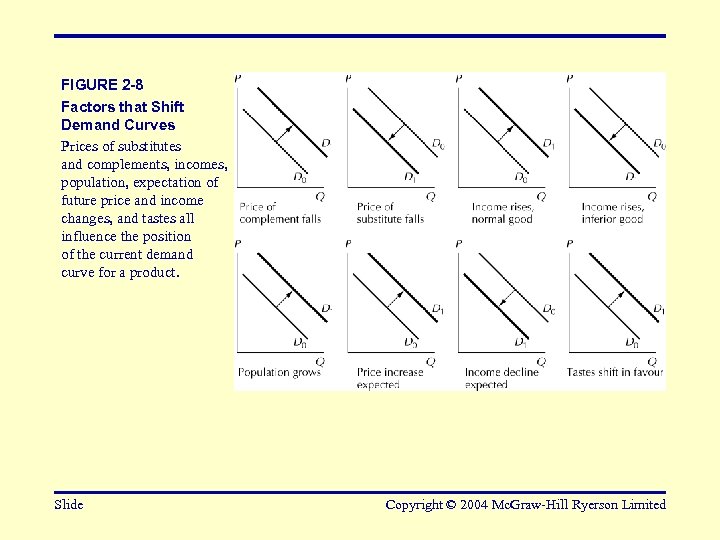 FIGURE 2 -8 Factors that Shift Demand Curves Prices of substitutes and complements, incomes, population, expectation of future price and income changes, and tastes all influence the position of the current demand curve for a product. Slide Copyright © 2004 Mc. Graw-Hill Ryerson Limited
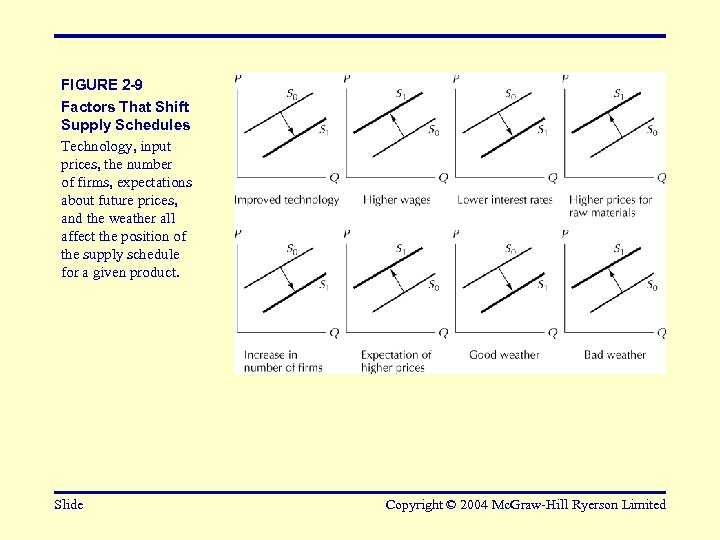 FIGURE 2 -9 Factors That Shift Supply Schedules Technology, input prices, the number of firms, expectations about future prices, and the weather all affect the position of the supply schedule for a given product. Slide Copyright © 2004 Mc. Graw-Hill Ryerson Limited
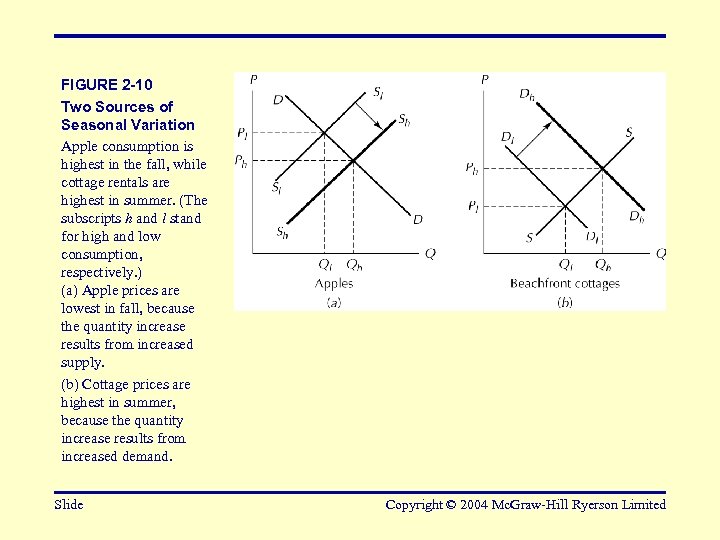 FIGURE 2 -10 Two Sources of Seasonal Variation Apple consumption is highest in the fall, while cottage rentals are highest in summer. (The subscripts h and l stand for high and low consumption, respectively. ) (a) Apple prices are lowest in fall, because the quantity increase results from increased supply. (b) Cottage prices are highest in summer, because the quantity increase results from increased demand. Slide Copyright © 2004 Mc. Graw-Hill Ryerson Limited
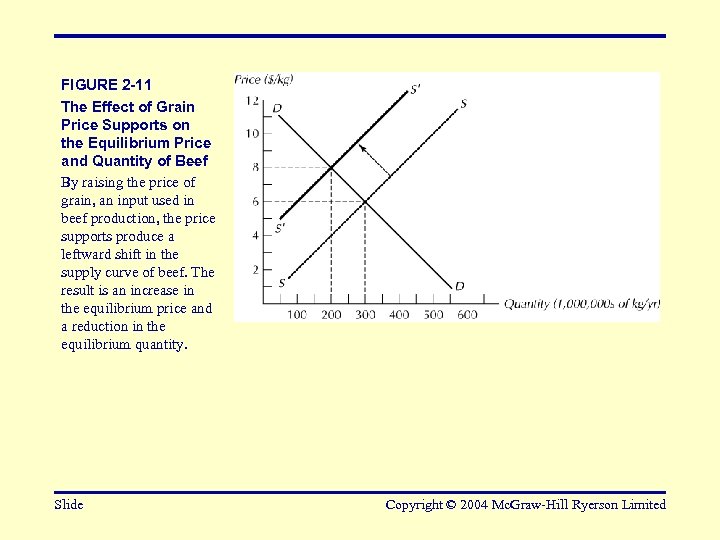 FIGURE 2 -11 The Effect of Grain Price Supports on the Equilibrium Price and Quantity of Beef By raising the price of grain, an input used in beef production, the price supports produce a leftward shift in the supply curve of beef. The result is an increase in the equilibrium price and a reduction in the equilibrium quantity. Slide Copyright © 2004 Mc. Graw-Hill Ryerson Limited
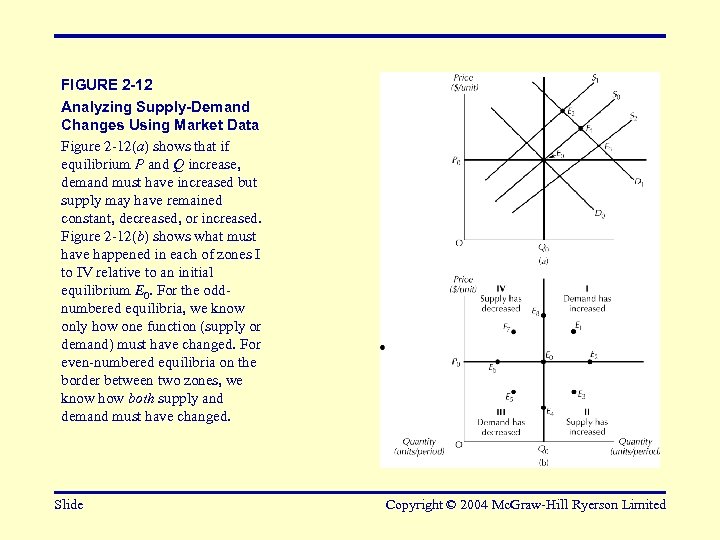 FIGURE 2 -12 Analyzing Supply-Demand Changes Using Market Data Figure 2 -12(a) shows that if equilibrium P and Q increase, demand must have increased but supply may have remained constant, decreased, or increased. Figure 2 -12(b) shows what must have happened in each of zones I to IV relative to an initial equilibrium E 0. For the oddnumbered equilibria, we know only how one function (supply or demand) must have changed. For even-numbered equilibria on the border between two zones, we know how both supply and demand must have changed. Slide Copyright © 2004 Mc. Graw-Hill Ryerson Limited
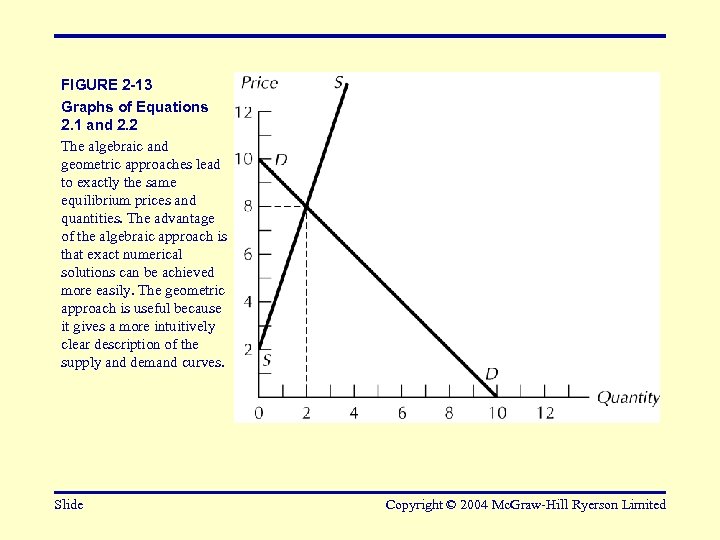 FIGURE 2 -13 Graphs of Equations 2. 1 and 2. 2 The algebraic and geometric approaches lead to exactly the same equilibrium prices and quantities. The advantage of the algebraic approach is that exact numerical solutions can be achieved more easily. The geometric approach is useful because it gives a more intuitively clear description of the supply and demand curves. Slide Copyright © 2004 Mc. Graw-Hill Ryerson Limited
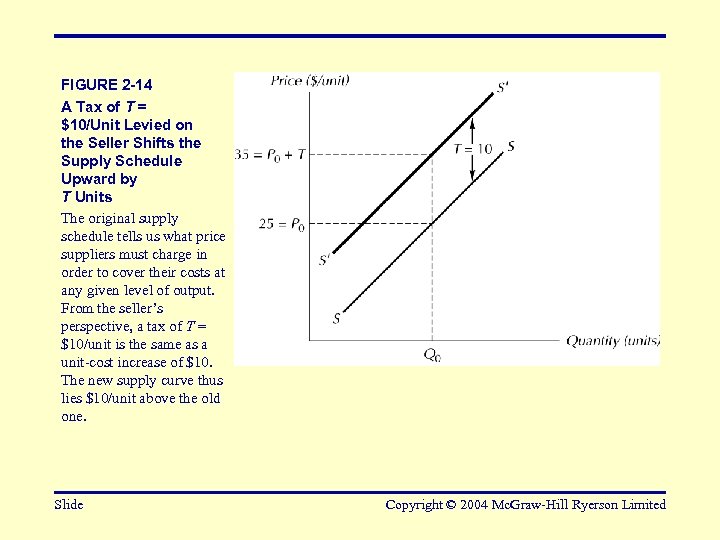 FIGURE 2 -14 A Tax of T = $10/Unit Levied on the Seller Shifts the Supply Schedule Upward by T Units The original supply schedule tells us what price suppliers must charge in order to cover their costs at any given level of output. From the seller’s perspective, a tax of T = $10/unit is the same as a unit-cost increase of $10. The new supply curve thus lies $10/unit above the old one. Slide Copyright © 2004 Mc. Graw-Hill Ryerson Limited
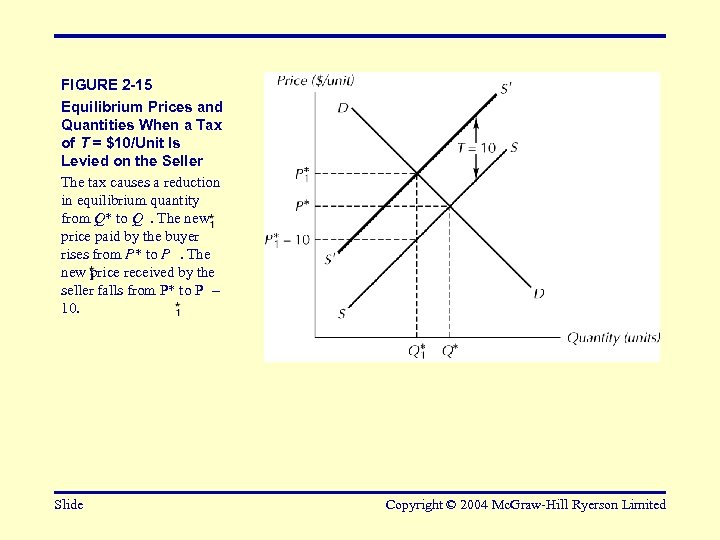 FIGURE 2 -15 Equilibrium Prices and Quantities When a Tax of T = $10/Unit Is Levied on the Seller The tax causes a reduction in equilibrium quantity from Q* to Q. The new price paid by the buyer rises from P* to P. The new price received by the seller falls from P* to P – 10. Slide Copyright © 2004 Mc. Graw-Hill Ryerson Limited
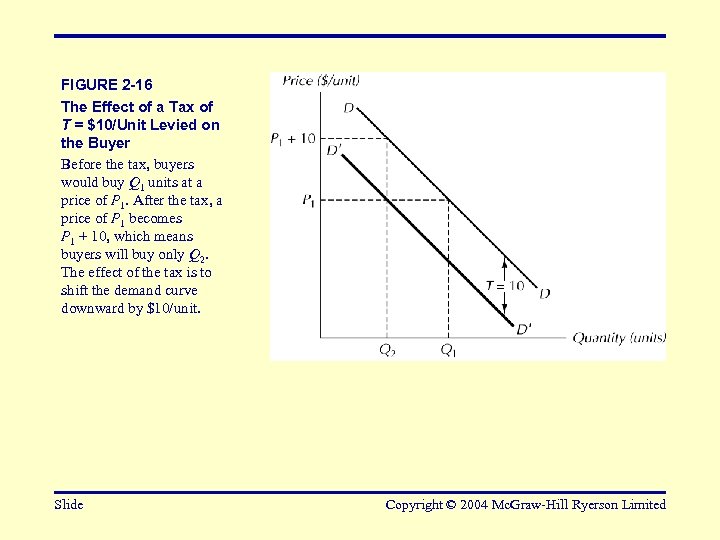 FIGURE 2 -16 The Effect of a Tax of T = $10/Unit Levied on the Buyer Before the tax, buyers would buy Q 1 units at a price of P 1. After the tax, a price of P 1 becomes P 1 + 10, which means buyers will buy only Q 2. The effect of the tax is to shift the demand curve downward by $10/unit. Slide Copyright © 2004 Mc. Graw-Hill Ryerson Limited
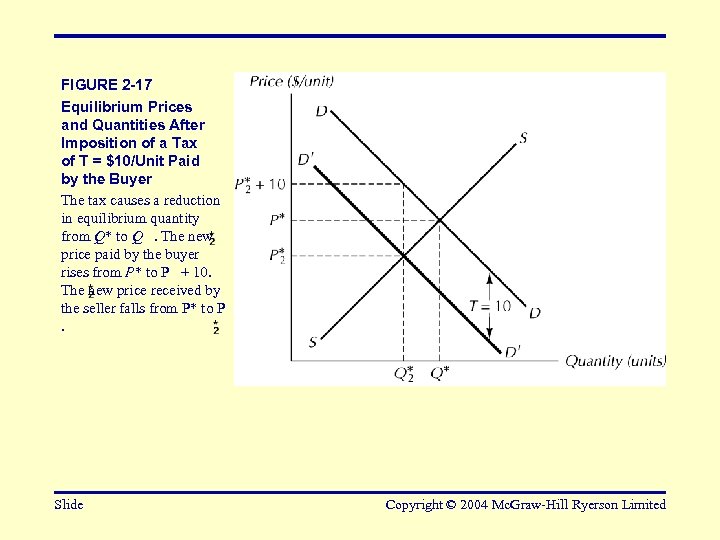 FIGURE 2 -17 Equilibrium Prices and Quantities After Imposition of a Tax of T = $10/Unit Paid by the Buyer The tax causes a reduction in equilibrium quantity from Q* to Q. The new price paid by the buyer rises from P* to P + 10. The new price received by the seller falls from P* to P. Slide Copyright © 2004 Mc. Graw-Hill Ryerson Limited
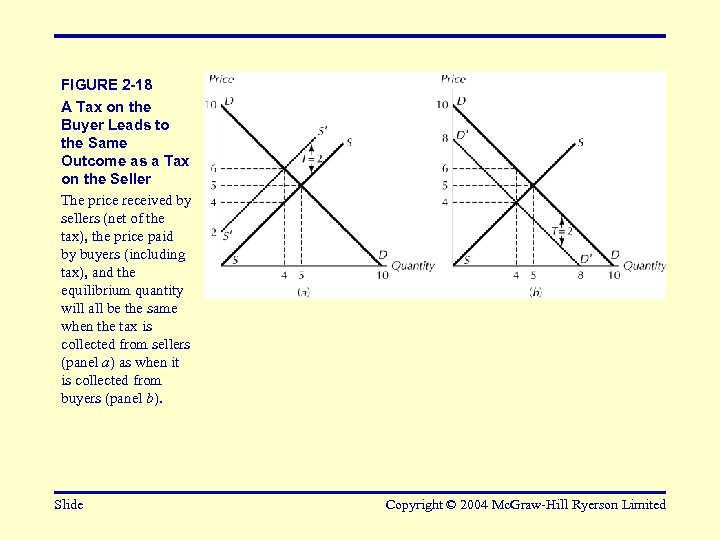 FIGURE 2 -18 A Tax on the Buyer Leads to the Same Outcome as a Tax on the Seller The price received by sellers (net of the tax), the price paid by buyers (including tax), and the equilibrium quantity will all be the same when the tax is collected from sellers (panel a) as when it is collected from buyers (panel b). Slide Copyright © 2004 Mc. Graw-Hill Ryerson Limited
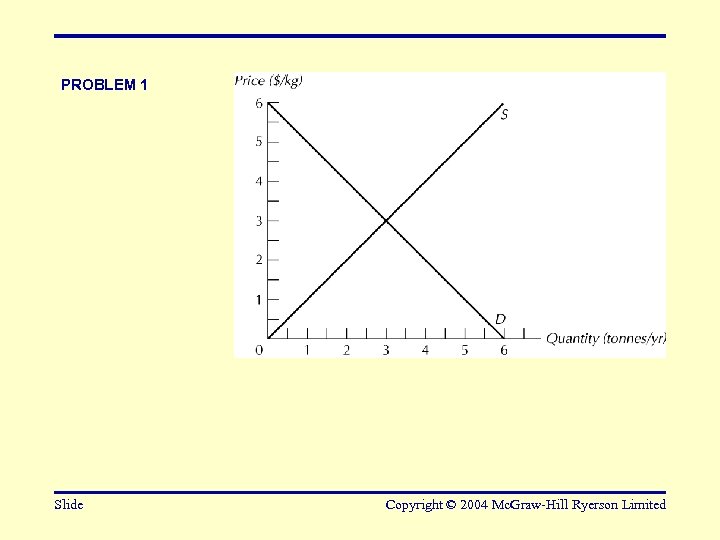 PROBLEM 1 Slide Copyright © 2004 Mc. Graw-Hill Ryerson Limited
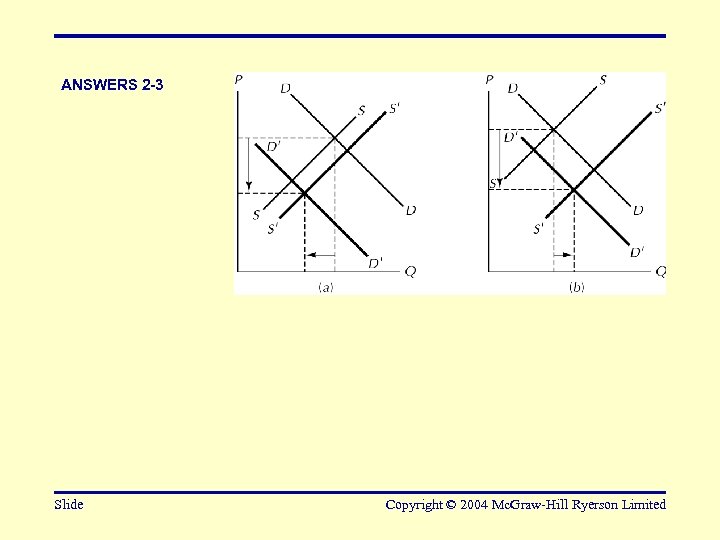 ANSWERS 2 -3 Slide Copyright © 2004 Mc. Graw-Hill Ryerson Limited