


 Скачать презентацию Chapter 2 Supply and Demand Mc Graw-Hill Irwin Copyright
335c7999d8fc886c8fbb454b0ff42271.ppt
- Количество слайдов: 43
 Chapter 2 Supply and Demand Mc. Graw-Hill/Irwin Copyright © 2008 by The Mc. Graw-Hill Companies, Inc. All Rights Reserved.
 Main Topics ¢Demand ¢Supply ¢Market equilibrium ¢Elasticities of demand supply 2 -2
 Demand Curves ¢ Product’s demand curve shows: ¢How much buyers of the product want to buy at each possible price ¢Holding fixed all other factors that affect demand ¢ On a graph: vertical axis shows $ per unit of the good, horizontal axis shows quantity demanded per unit of time ¢ Downward sloping (buying the product is less attractive when the price is high than when the price is low) 2 -3
 Determinants of Demand ¢ Demand curve holds all factors other than the product’s price constant: ¢Population growth; # of consumers ¢Consumer tastes and incomes ¢Prices of other products ¢Substitutes (An increase in the price of one product causes buyers to demand more of the other, all else equal) ¢Complements (An increase in the price of product causes buyers to demand less of the other, all else equal) ¢Government taxes or regulations 2 -4
 Shifts and Movements Along a Demand Curve ¢Change in price of the product causes a movement along the demand curve ¢A change in the quantity demanded ¢Change in another factor causes the entire demand curve to shift ¢A change in demand 2 -5
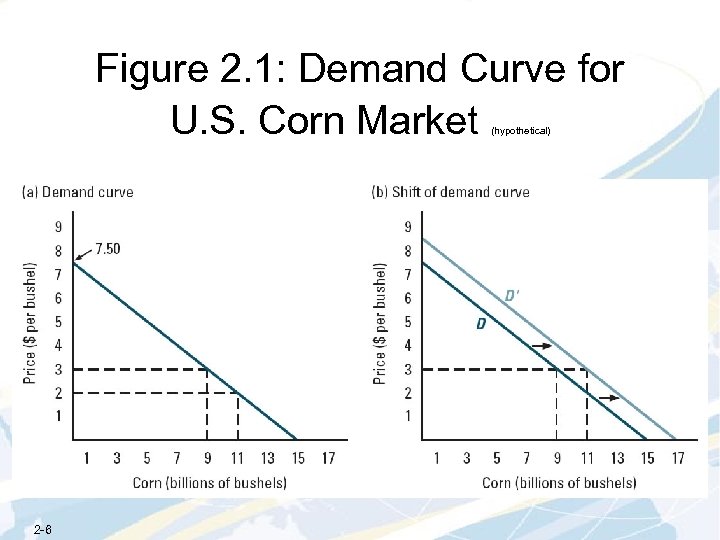 Figure 2. 1: Demand Curve for U. S. Corn Market (hypothetical) 2 -6
 Demand Functions ¢Product’s demand function is a mathematical representation of its demand ¢Describes the amount of the product buyers demand for each possible combination of price and other factors ¢Can be determined by applying statistical techniques to historical data 2 -7
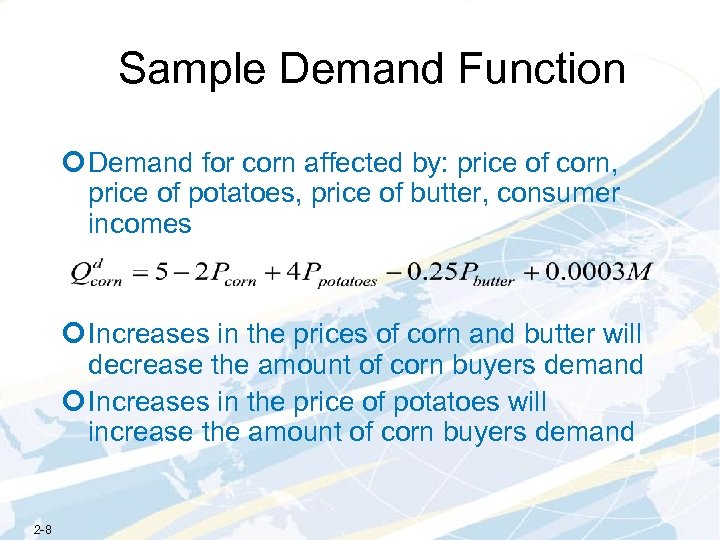 Sample Demand Function ¢ Demand for corn affected by: price of corn, price of potatoes, price of butter, consumer incomes ¢ Increases in the prices of corn and butter will decrease the amount of corn buyers demand ¢ Increases in the price of potatoes will increase the amount of corn buyers demand 2 -8
 Sample Problem 1 ¢Plot the following demand curve for wine: ¢Qd = 20 – 4 PW + 5 PB + 0. 2 I ¢Where PB (the price of beer) is $2, and I (income) is $20 ¢How does the demand curve change if average income rises to $50 or the price of beer falls to $1?
 Supply Curves ¢ Product’s supply curve shows: ¢How much sellers of the product want to sell at each possible price ¢Holding fixed all other factors that affect supply ¢ On a graph: vertical axis shows $ per unit of the good, horizontal axis shows quantity supplied per unit of time ¢ Upward sloping (selling the product is less attractive when the price is low than when the price is high) 2 -10
 Determinants of Supply ¢Supply curve holds all factors other than the product’s price constant: ¢Technology ¢Prices of inputs ¢Prices of other possible outputs ¢Government taxes or regulations 2 -11
 Shifts and Movements Along a Supply Curve ¢Change in price of the product causes a movement along the supply curve ¢A change in the quantity supplied ¢Change in another factor causes the entire supply curve to shift ¢A change in supply 2 -12
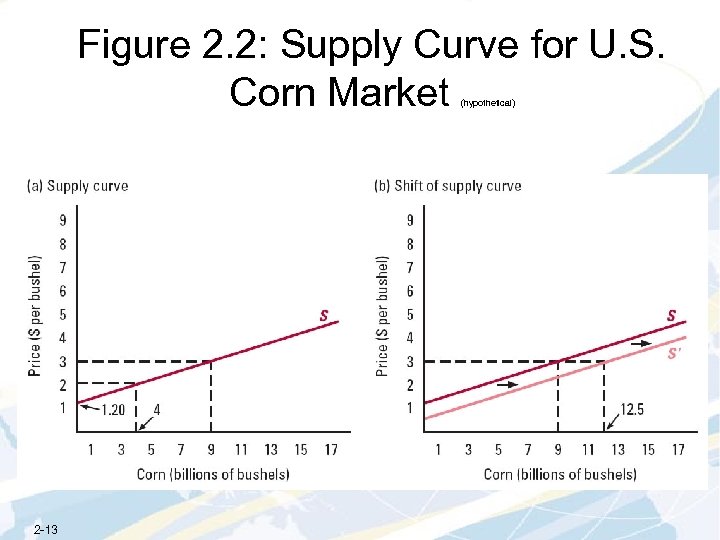 Figure 2. 2: Supply Curve for U. S. Corn Market (hypothetical) 2 -13
 Supply Functions ¢Product’s supply function is a mathematical representation of its supply ¢Describes the amount of the product sellers supply at each possible combination of price and other factors ¢Can be determined by applying statistical techniques to historical data 2 -14
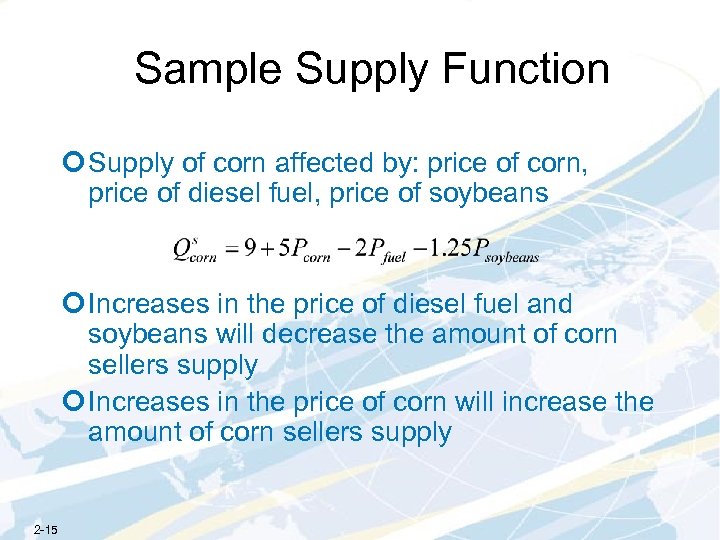 Sample Supply Function ¢ Supply of corn affected by: price of corn, price of diesel fuel, price of soybeans ¢ Increases in the price of diesel fuel and soybeans will decrease the amount of corn sellers supply ¢ Increases in the price of corn will increase the amount of corn sellers supply 2 -15
 Sample Problem 2 ¢Plot the following supply curve for wine: ¢Qs = 2 PW - PB - 0. 3 PF ¢Where PB (the price of beer) is $2 and PF (the price of fertilizer) is $10.
 Market Equilibrium ¢Supply and demand for a product interact to determine the market equilibrium ¢The equilibrium price is the price at which the amounts supplied and demanded are equal ¢Graphically, the price at which the supply and demand curves intersect 2 -17
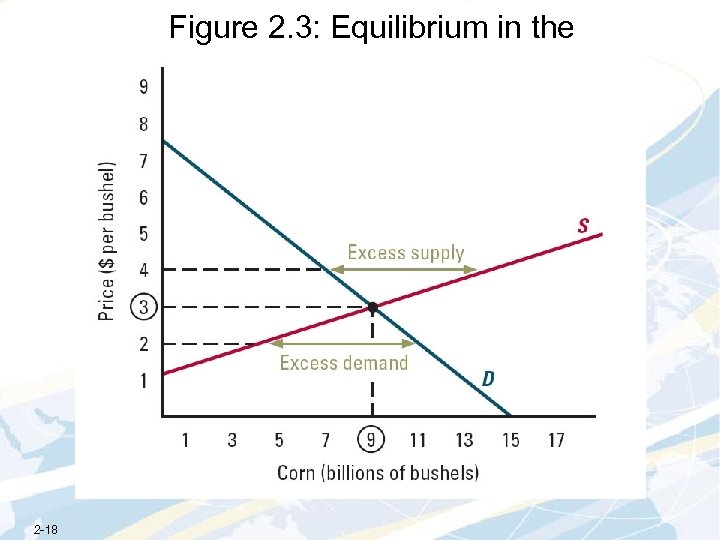 Figure 2. 3: Equilibrium in the Corn Market 2 -18
 Excess Supply, Excess Demand ¢ If price is above equilibrium price: ¢Amount supplied will be greater than amount demanded (excess supply) ¢Incentive for sellers to lower prices to boost sales ¢ If price is below equilibrium price: ¢Amount demanded will be greater than amount supplied (excess demand) ¢Incentive for buyers to offer higher prices ¢ Market prices adjust so that amount supplied equals amount demanded 2 -19
 Sample Problem 3 ¢ Find the market equilibrium given the following supply and demand functions: ¢Qd = 20 – 4 PW + 5 PB + 0. 2 I ¢Where PB (the price of beer) is $2, and I (income) is $20 ¢Qs = 2 PW - PB - 0. 3 PF ¢Where PB (the price of beer) is $2 and PF (the price of fertilizer) is $10.
 Changes in Market Equilibrium ¢Changing market conditions alter the market equilibrium ¢Changes in the determinants of supply (or demand) other than the product price cause the supply (or demand) curve to shift ¢Example: falling diesel fuel and soybean prices shift the corn supply curve out 2 -21
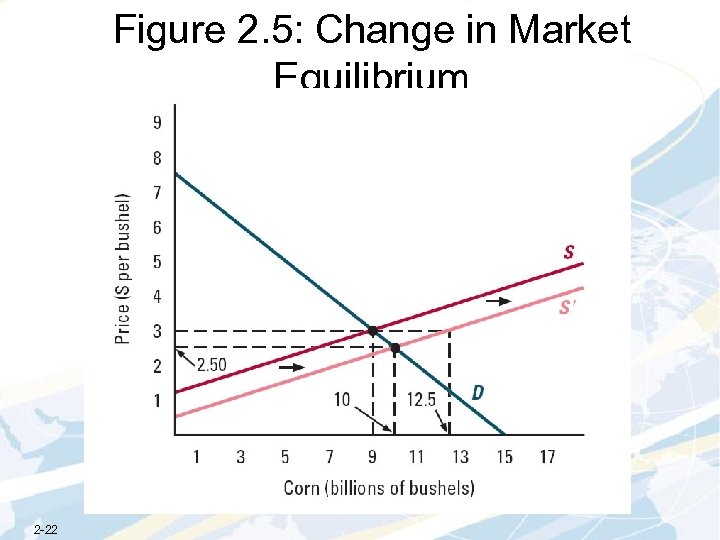 Figure 2. 5: Change in Market Equilibrium 2 -22
 Changes in Market Equilibrium ¢ Four possible ways either supply or demand curve can shift: ¢Demand can increase or decrease ¢Supply can increase or decrease ¢ Effect on market equilibrium: ¢If demand curve shifts, price and quantity change in the same direction as the curve ¢If supply curve shifts, quantity changes in the same direction as the curve but price changes in the opposite direction 2 -23
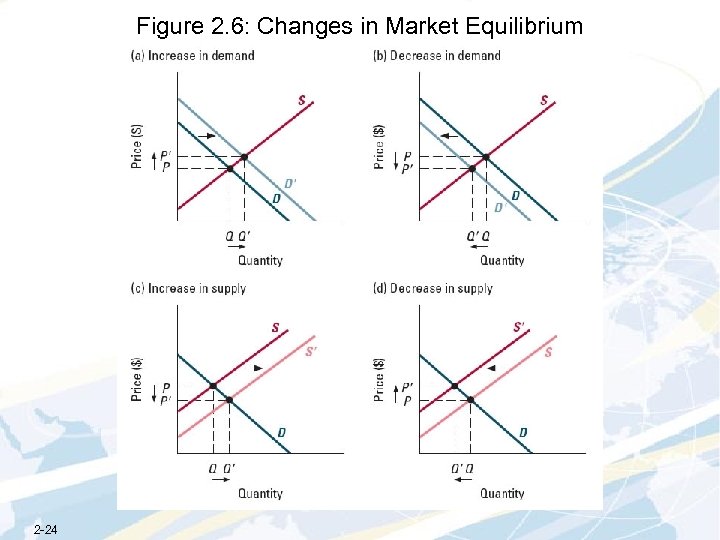 Figure 2. 6: Changes in Market Equilibrium 2 -24
 Changes in Market Equilibrium ¢Sometimes supply and demand will both shift ¢Ultimate effect on equilibrium is combination of the separate effects of changes in demand supply ¢Will be able to determine the necessary direction of price or quantity movement, but not both 2 -25
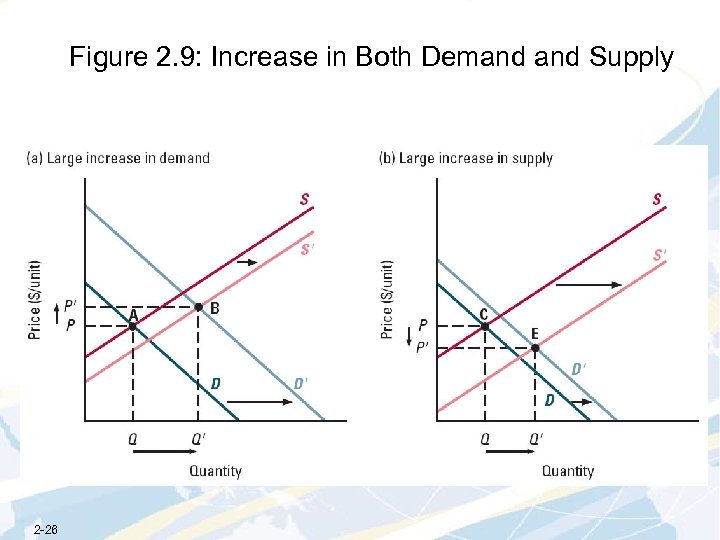 Figure 2. 9: Increase in Both Demand Supply 2 -26
 Size of Changes in Market Equilibrium ¢What determines the size of changes in market equilibrium? ¢Size of change in demand (or supply) ¢The larger the shift in demand (or supply), the larger the effect on price) ¢Steepness of the curve that does not shift ¢If the supply curve shifts, the steeper demand curve the more the price changes the less the amount bought and sold changes ¢Steepness reflects responsiveness to prices 2 -27
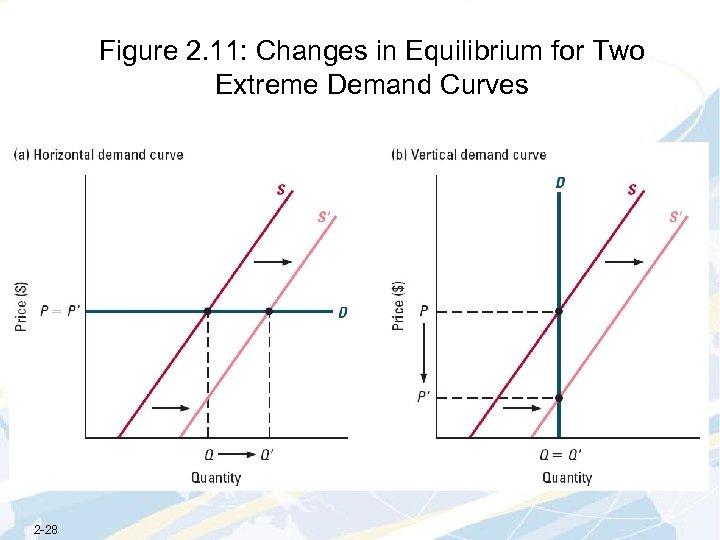 Figure 2. 11: Changes in Equilibrium for Two Extreme Demand Curves 2 -28
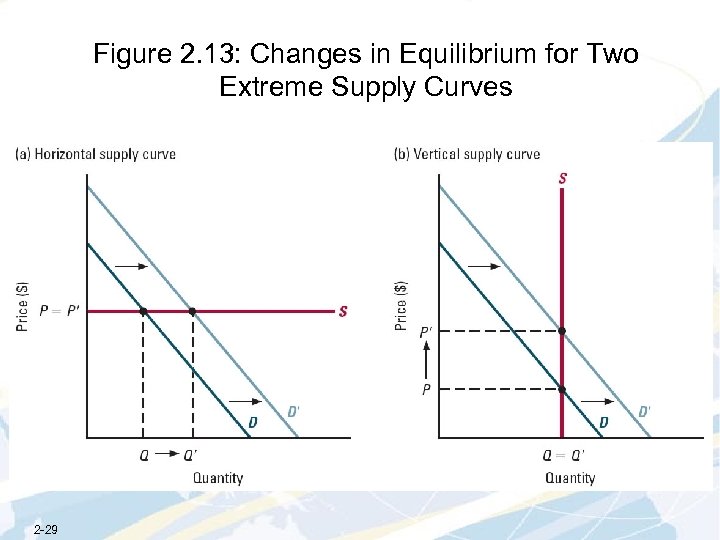 Figure 2. 13: Changes in Equilibrium for Two Extreme Supply Curves 2 -29
 Elasticities of Demand Supply ¢ A measure of the responsiveness of the amounts demanded and supplied to changes in prices ¢ Not the same as the slope of the supply or demand curve, which depends on unit of measurement. ¢ Elasticity does not depend on units (e. g. , gallons, dozens, dollars per pound) ¢Can compare elasticity across goods and services. 2 -30
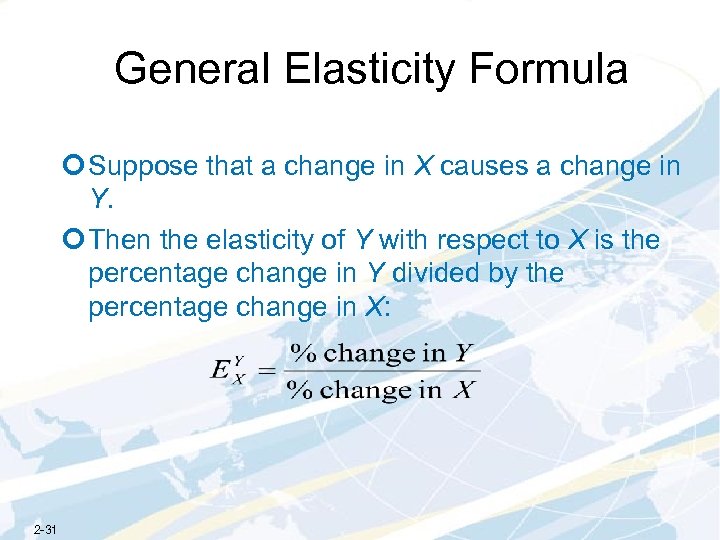 General Elasticity Formula ¢ Suppose that a change in X causes a change in Y. ¢ Then the elasticity of Y with respect to X is the percentage change in Y divided by the percentage change in X: 2 -31
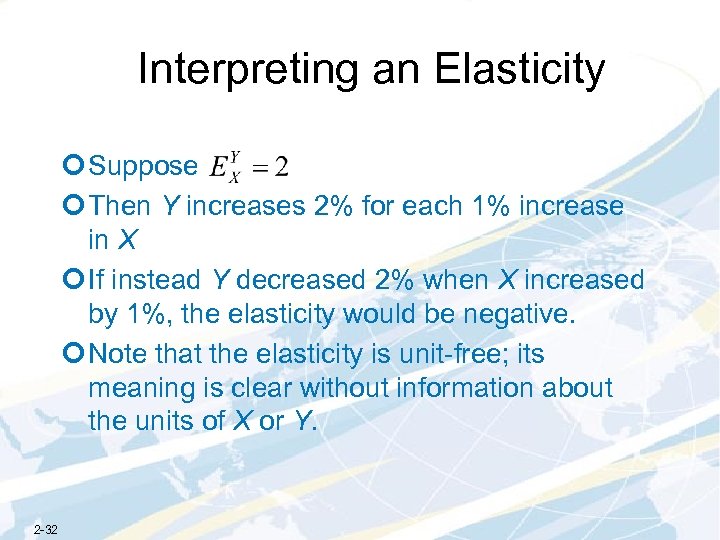 Interpreting an Elasticity ¢ Suppose ¢ Then Y increases 2% for each 1% increase in X ¢ If instead Y decreased 2% when X increased by 1%, the elasticity would be negative. ¢ Note that the elasticity is unit-free; its meaning is clear without information about the units of X or Y. 2 -32
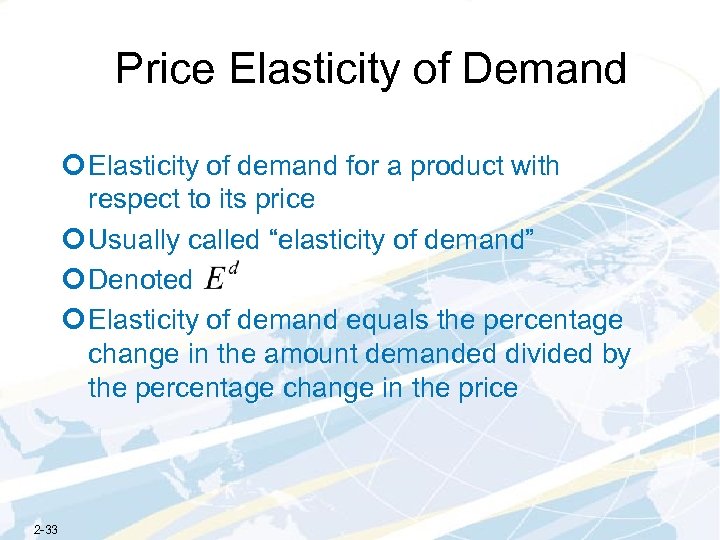 Price Elasticity of Demand ¢ Elasticity of demand for a product with respect to its price ¢ Usually called “elasticity of demand” ¢ Denoted ¢ Elasticity of demand equals the percentage change in the amount demanded divided by the percentage change in the price 2 -33
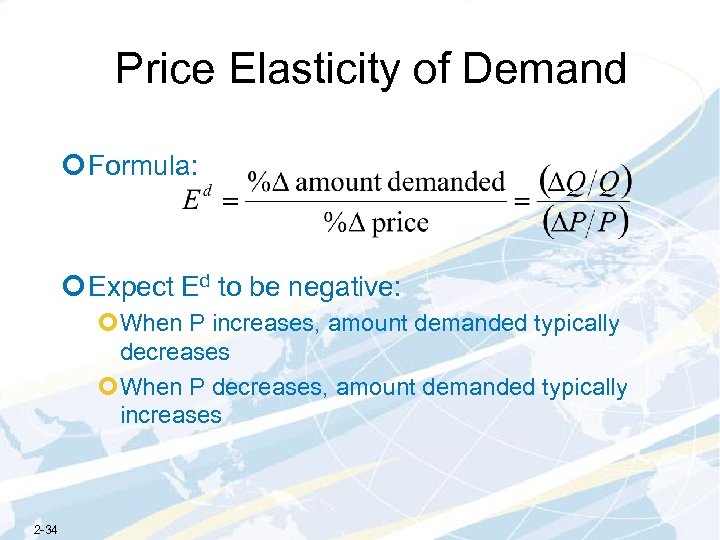 Price Elasticity of Demand ¢ Formula: ¢ Expect Ed to be negative: ¢When P increases, amount demanded typically decreases ¢When P decreases, amount demanded typically increases 2 -34
 Price Elasticity of Demand ¢Goods tend to have more price elastic demand when: ¢They have close substitutes ¢Buyers of the product consider it a luxury ¢Buyers of the product are strapped for cash and thus sensitive to changes in their expenditures ¢In general, elasticity of demand varies at different points along a demand curve 2 -35
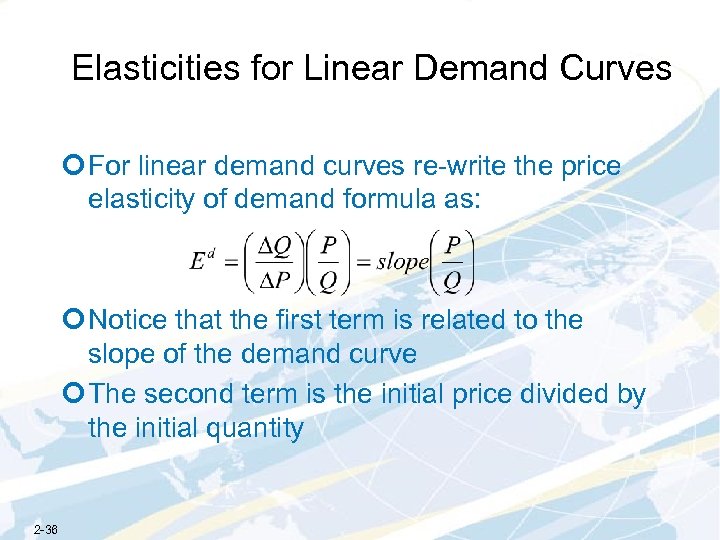 Elasticities for Linear Demand Curves ¢ For linear demand curves re-write the price elasticity of demand formula as: ¢ Notice that the first term is related to the slope of the demand curve ¢ The second term is the initial price divided by the initial quantity 2 -36
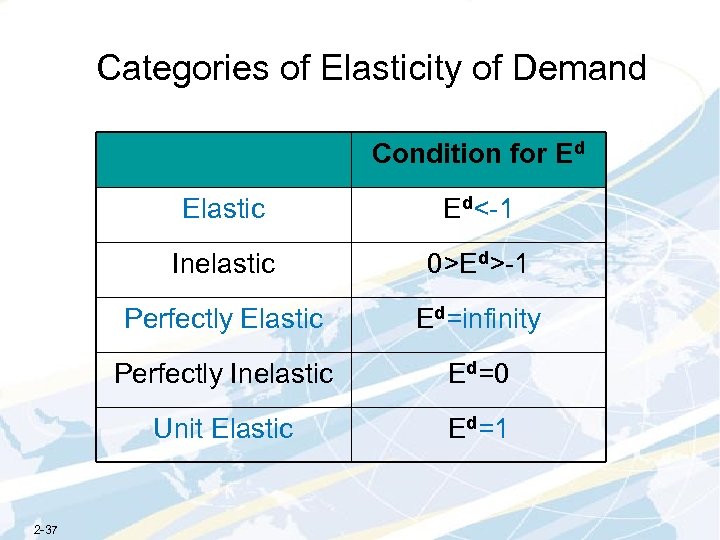 Categories of Elasticity of Demand Condition for Ed Elastic Inelastic 0>Ed>-1 Perfectly Elastic Ed=infinity Perfectly Inelastic Ed=0 Unit Elastic 2 -37 Ed<-1 Ed=1
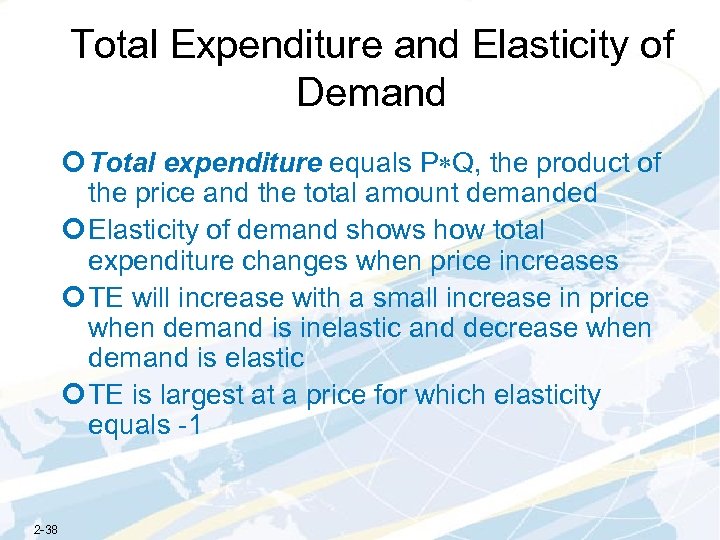 Total Expenditure and Elasticity of Demand ¢ Total expenditure equals P*Q, the product of the price and the total amount demanded ¢ Elasticity of demand shows how total expenditure changes when price increases ¢ TE will increase with a small increase in price when demand is inelastic and decrease when demand is elastic ¢ TE is largest at a price for which elasticity equals -1 2 -38
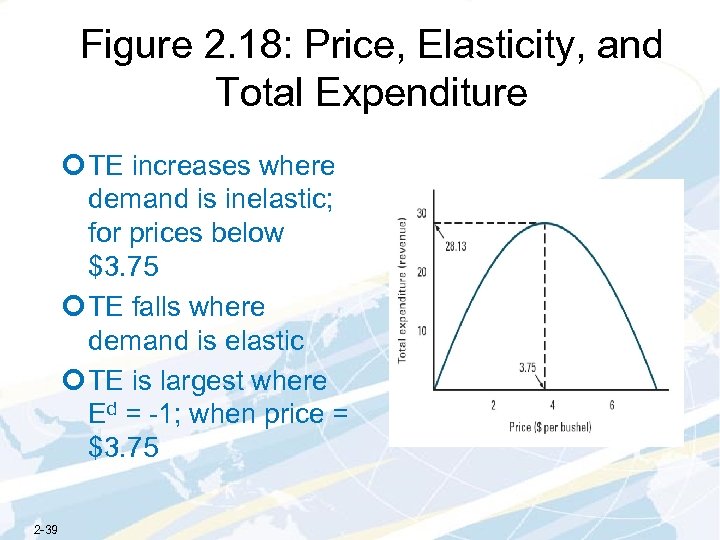 Figure 2. 18: Price, Elasticity, and Total Expenditure ¢ TE increases where demand is inelastic; for prices below $3. 75 ¢ TE falls where demand is elastic ¢ TE is largest where Ed = -1; when price = $3. 75 2 -39
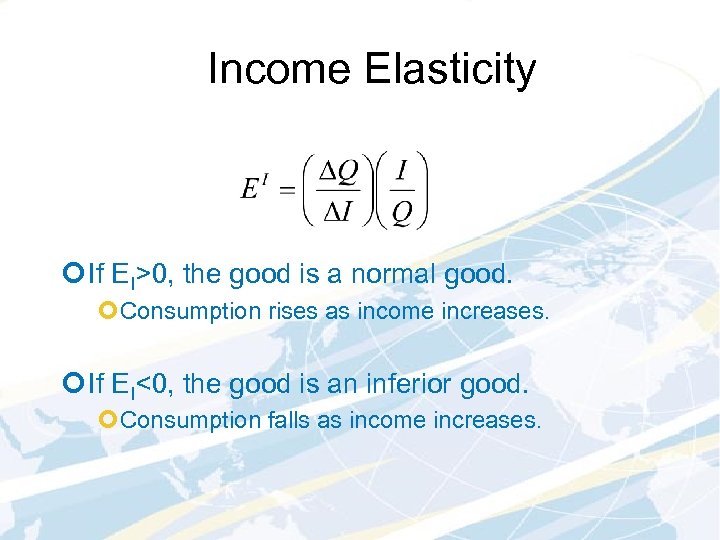 Income Elasticity ¢ If EI>0, the good is a normal good. ¢Consumption rises as income increases. ¢ If EI<0, the good is an inferior good. ¢Consumption falls as income increases.
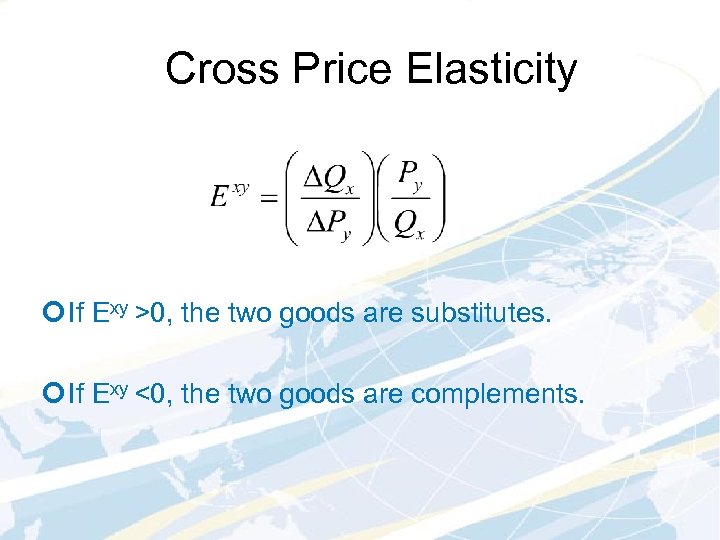 Cross Price Elasticity ¢ If Exy >0, the two goods are substitutes. ¢ If Exy <0, the two goods are complements.
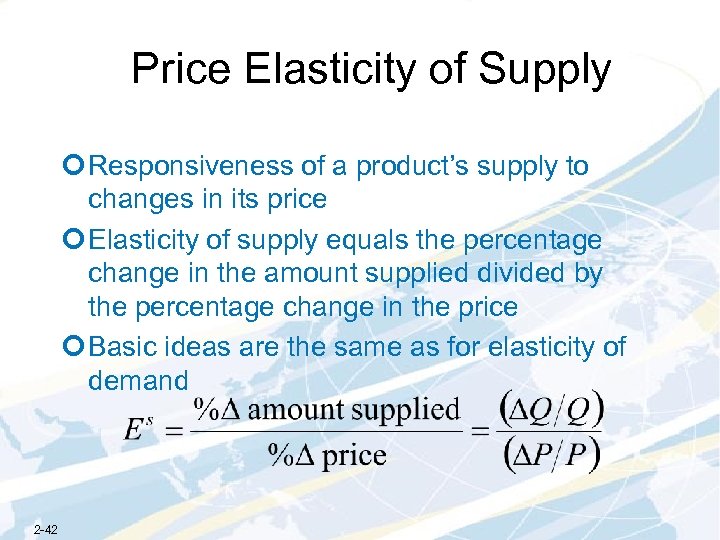 Price Elasticity of Supply ¢ Responsiveness of a product’s supply to changes in its price ¢ Elasticity of supply equals the percentage change in the amount supplied divided by the percentage change in the price ¢ Basic ideas are the same as for elasticity of demand 2 -42
 Sample Problem 4 ¢ You are the marketing manager for XYZ Corp. You have this regression result for your product: Q = 2000 – 3. 5*P + 1. 2*I. ¢ Right now, your price is 10, and the average income of your customers is $30, 000. ¢ compute income elasticity ¢ is your good a normal good or an inferior good? ¢ You expect a recession. You estimate that your customer's average income will fall 5% due to this recession. Estimate the impact on your sales.