


 Скачать презентацию Chapter 2 Shipping Outline I Introduction to
10edc8bc62505f7e97ceec1f46e5012e.ppt
- Количество слайдов: 53
 Chapter 2: Shipping
 Outline I. Introduction to shipping 1. Introduction 2. Infrastructures II. Methods of vessel charter 1. Liner charter 2. Voyage charter
 I. Introduction to shipping 1. Introduction • Advantages: – Large quantities of freight can be safely stored and move in one go – Shipping is a viable and cost- effective way for moving a large amount of goods over long distances (cheap freight) – Shipping is an important factor within the international transport chain • Disadvantages – Slow speed – Probability of risk occurring
 2. Infrastructure 2. 1. Merchant vessels 2. 1. 1. Definition • A merchant vessel is a ship that transports cargo and passengers for profitable purpose. (The Logistics and maritime economics Institute)
 II. Infrastructure 2. 1. Merchant vessels 2. 1. 2. Specifications • Ship’s name • Port of Registry: • Flag: – Conventional flag – Flag of convenience • Ship owner • Dimensions: – Length over all (LOA) – Beam
 2. 1. 2. Specifications • Classification • Draught/Draft: – Light Draught – Loaded Draught • Displacement: – Light displacement (LD – Heavy displacement (HD)
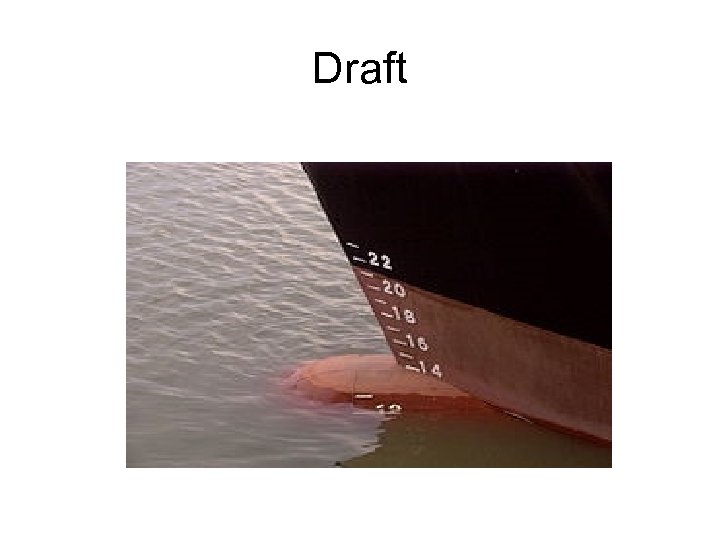 Draft
Draft
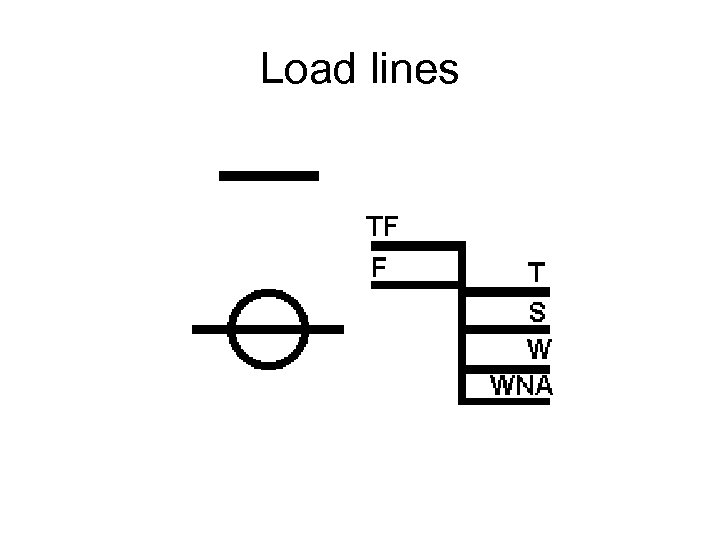 Load lines
 2. 1. 2. Specifications • • Deadweight Tons (DWT) Cargo Deadweight Tons The gross register ton (GRT) The net register ton (NRT)
 2. 1. 2. Specifications • Cargo space – Grain space – Bale space
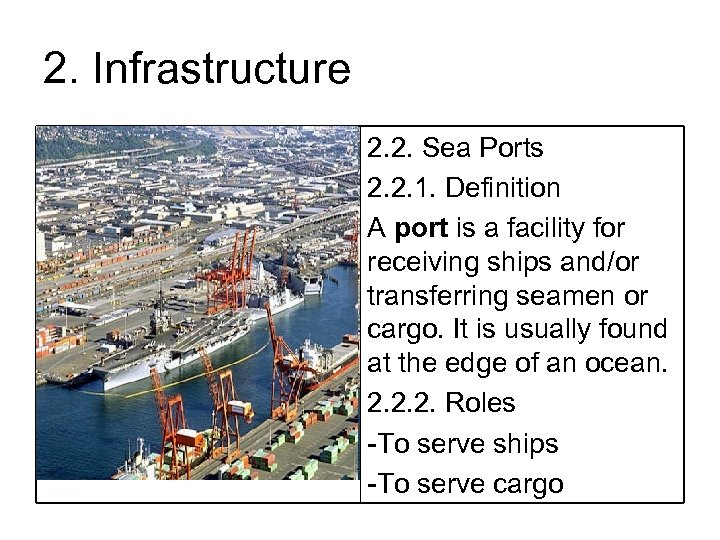 2. Infrastructure 2. 2. Sea Ports 2. 2. 1. Definition A port is a facility for receiving ships and/or transferring seamen or cargo. It is usually found at the edge of an ocean. 2. 2. 2. Roles -To serve ships -To serve cargo
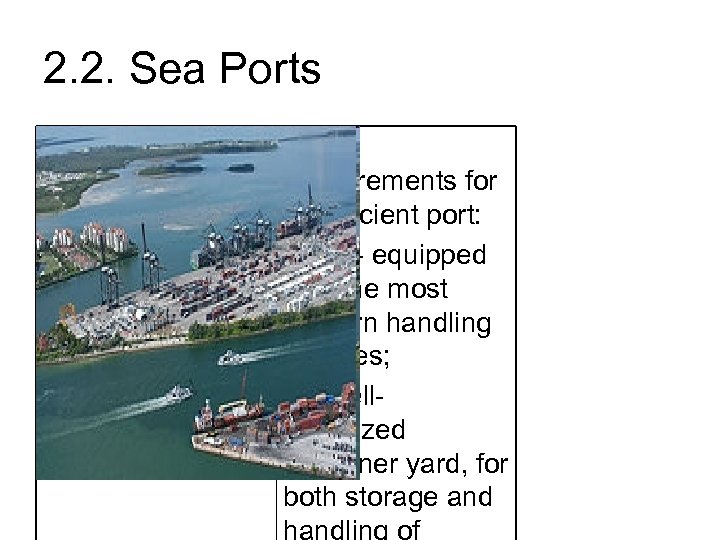 2. 2. Sea Ports 2. 2. 3. Requirements for an efficient port: - Well- equipped with the most modern handling facilities; - A well- organized container yard, for both storage and handling of
 2. 2. Sea Ports 2. 2. 3. Requirements for an efficient port: • Immediate availability of fresh water and bunker supplies for vessels alongside (at berth); • A high-end computerized system to control the smooth delivery of cargo to and from the port, to avoid any congestion and delays; • A good, highly trained and qualified workforce working 24/7 • A good rail/road/barge network to facilitate delivery; • An efficient Customs clearance system; • Foresight and forward planning to ensure that there always enough berths available, to handle larger and faster container ships; • A computer system that allows the automation of routine operations in the ports, that can be handle by remote control device; and • Making the port as customer- oriented as possible, and having a user- friendly tariff system.
 VI. Methods of vessel charter • Liner charter • Voyage charter
 A. Liner Charter 1. Definition of Liner/ Liner shipping company - A liner service is defined as one that operates to a regular sailing schedule, transporting goods along a definite route, to fixed ports of call - A liner is a vessel that is engaged in this kind of transportation
 A. Liner Charter 2. Liner characteristics – regular sailing schedules – relationships - bill of lading – terms and conditions – Liner freight
 A. Liner Charter 3. How a liner service is run? – Liner Planning Division: planning of new trade routes and fleet expansion – Ship Management Division: overall running of vessels – Liner Division: planning and logistics responsibilities for services, vessel schedules, container equipment planning, overseas offices and agencies, documentation and data communications, and handling of claims and insurance – Finance Division: company’s financial results, auditing and performing treasury functions – IT/EDI Division: computer systems and data interchange with suppliers and contractors – Human resource Division: manpower planning, staff benefits, and all industrial relations
 A. Liner Charter 4. What is a liner agent? A person or company that acts on the shipping line’s behalf and carries out their business while the vessel remains in the agent’s jurisdiction
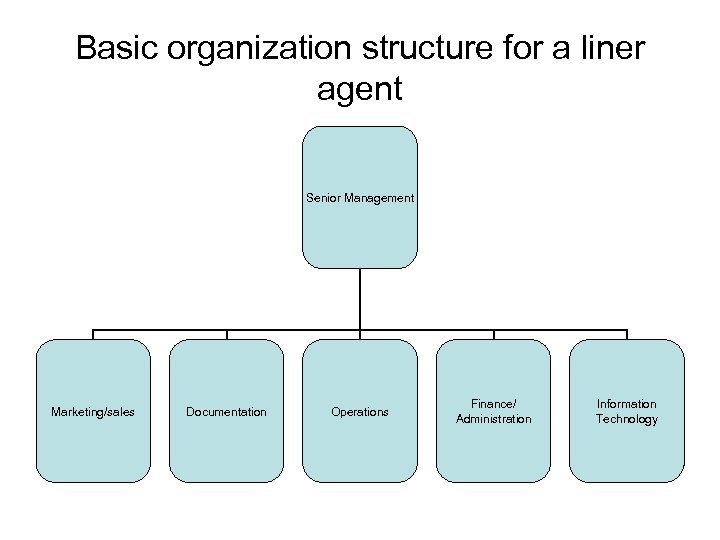 Basic organization structure for a liner agent Senior Management Marketing/sales Documentation Operations Finance/ Administration Information Technology
 6. Ocean Bills of Lading 6. 1. Definition and functions • main document used in international maritime transport • Notes: – Issuer – Issuing time – Receiver • Functions – Evidence of the contract of affreightment – Confirmation of shipment – Document of title (title of ownership)
 6. Ocean Bills of Lading 6. 2. Main types of B/L 6. 2. 1. Base on the negotiable ability of B/L • Straight B/L
 6. Ocean Bills of Lading • Order B/L
 6. Ocean Bills of Lading • To Bearer B/L
 6. Ocean Bills of Lading 6. 2. 2. Base on the issuing time • Shipped on board B/L • Received for shipment B/L
 2. Ocean Bills of Lading 6. 2. 3. Base on comments/ remarks B/L • Clean/ Perfect B/L • Unclean/ Claused B/L
 6. Ocean Bills of Lading 6. 2. 4. Other types • Surrender B/L • Seaway Bill
 6. Ocean Bills of Lading 6. 3. Content of B/L 6. 3. 1. First side of B/L • Shipper • Consignee • Notify party • Vessel • Place of receipt • Place of delivery • Port of Loading • Port of Discharge • Goods • Freight and Charges • Number of original • Place of issue • Date of issue • Signature
 6. Ocean Bills of Lading 6. 3. Content of B/L 6. 3. 1. Reverse side of B/L • Definitions: carrier, shipper, consignee • The extent of carrier’s responsibility • Excepted Perils • Regulations on loading, discharging, preserving goods • Regulations on Freight and Charges • War, Strike, riots, civil, commodition clauses • Late delivery clauses • General average clause • Both to blame collision clause • Supreme Clause
 7. Legal Systems in shipping 7. 1 International Conventions • International Convention for the unification of certain rules relating to Bills of lading/ Brussels Convention 1924/ Hague Rules • Protocol to amend International Convention for the unification of certain rules relating to Bills of lading/ Visby Protocol 1968/ Hague- Visby Rules • SDR Protocol 1979 • United Nation Convention on the carriage of goods by sea/ Hamburg Convention 1978/ Hamburg Rules 7. 2. National law • Vietnam Maritime Code, 2005
 8. Extend of carrier’s liability to the goods- International legal systems 8. 1. Period of liability: From “tackle to tackle” - Hamburg Rules: From “Port to Port”
 8. Extend of carrier’s liability to the goods- International legal systems 8. 2. Basis of liability: carrier’s liability on loss resulting from loss of or damage to the goods 8. 2. 1. Extend of liability • Hague and Hague Visby Rules • Hamburg Rules
 8. Extend of carrier’s liability to the goods- International legal systems 8. 2. Basis of liability 8. 2. 2. Main liabilities Hague and Hague Visby Rules • Provide a seaworthy ship • Trading liability • Issuing B/L Hamburg Rules: Presumed fault or neglect principle
 8. Extend of carrier’s liability to the goods- International legal systems 8. 2. Basis of liability 8. 2. 3. Excepted perils * Hague and Hague Visby Rules: 17 cases Hamburg Rules: Presumed fault or neglect principle
 8. Extend of carrier’s liability to the goods- International legal systems 8. 3. Limitation of liability: • Hague Rules • Hague- Visby Rules • SDR Protocol • Hamburg Rules
 9. Extend of carrier’s liability to the goods- Maritime Code of Vietnam, 2005 9. 1. Period of Liability 9. 2. Basis of liability 9. 3. Limits of liability
 10. Claims and actions 10. 1. Notice of loss, damage or delay - If the loss or damage is apparent: COR (Cargo Outturn Report) - If the loss or damage is not apparent: LOR (Letter of Reservation) - Delay in delivery (for Hamburg rules only):
 10. Claims and actions 10. 2. Claim and actions 10. 2. 1. Claimer - Shipper - Consignee - The holder - The insurer 10. 2. 2. Claiming documents - B/L - Commercial Invoice - Packing list - COR - ROROC - Certificate of short landed cargo - LOR - Survey report/certificate - Other papers/ documents
 10. Claims and actions 10. 3. Limitation of Actions • The Hague Rules • The Visby- Rules • The Hamburg rules
 B. Voyage Charter 1. Definition and features of Tramp vessel 1. 1. Definition 1. 2. Features: - sufficient quantity - cargo in bulk - speed - Carriage, freight, loading and discharging expense conditions
 B. Voyage Charter 2. Voyage Charter Party 2. 1. Definition 2. 2. Standard forms - Uniform standard forms: GENCON, NUVOY, SCANCON… - Specific standard forms: NORGRAIN, CEMENCO, CUBARSUGAR, RUSSWOOD, EXONVOY, MOBILVOY, SHELLVOY…
 2. 3. Content of voyage charter party 2. 3. 1. Introduction
 2. 3. Content of voyage charter party 2. 3. 2. Vessel clause
 2. 3. Content of voyage charter party 2. 3. 3. Expected ready to load
 2. 3. Content of voyage charter party 2. 3. 4. Cargo - Name of cargo - Packing - Quantity
 2. 3. Content of voyage charter party 2. 3. 5. Port of loading, port of discharge • A fixed berth • A fixed port • A fixed area • A port or an area to be indicated later Several ports
 2. 3. Content of voyage charter party • • • 2. 3. 6. Freight and charge Freight rate Freight unit Quantity: Time to pay:
 2. 3. Content of voyage charter party 2. 3. 7. Loading/discharging expense • Liner term/ Gross term/ berth terms • Free In and Out (FIO) • FI • FO
 2. 3. Content of voyage charter party 2. 3. 8. Laydays/ Laytime: loading and discharging of the cargo (the allowed time) • Manners Unit expressions * Starting point
 2. 3. Content of voyage charter party 2. 3. 9. Demurrage/ Dispatch * Demurrage • “Once on demurrage, always on demurrage” Dispatch • “Dispatch money for all time saved” “Dispatch money for all working time saved”
 2. 3. Content of voyage charter party 2. 3. 10. Carrier/ship owner’s responsibility and exceptions • Responsibilities • Exceptions
 2. 3. Content of voyage charter party • 2. 3. 11. Arbitration and law “All disputes arising out of or in relation to this contract shall be finally settled by the Vietnam International Arbitration Center at the Vietnam Chamber of Commerce and Industry in accordance with its Arbitration Rules”
 2. 3. Content of voyage charter party 2. 3. 12. Both to Blame Collision “If the (Carrying) ship comes into collision with another ship as a result of the negligence of the other ship and any act, neglect or default in the navigation or the management of the carrying ship, the Merchant undertakes to pay the carrier or where the Carrier is not the owner and in possession of the carrying ship to pay to the Carrier as trustee for the owner and/or demise charterer of the carrying ship, a sum sufficient to indemnify the Carrier and/or the owners and/or demise charterer of the carrying ship against all loss or liability to the other or non carrying ship or her owners, insofar as such loss or liability represents loss of or damage to or any claim whatsoever of the Merchant, paid or payable by the other or non carrying ship or her owners to the Merchant and set off recouped or recovered by the other or non carrying ship or her owners as part of their claim against the carrying ship or her owner or demise charterer or the Carrier. The foregoing provisions shall also apply where the owners, operators or those in charge of any ship or ships or objects, other than, or in addition to the colliding ship or objects, are at fault in respect to a collision; contact, stranding or other accident. ”
 2. 3. Content of voyage charter party 2. 3. 12. General Average and New Jason Clause • “General Average shall be adjusted in London unless otherwise agreed in Box 22 according to York- Antwerp Rules 1994 and any subsequent modification thereof. Proprietors of cargo to pay the cargo’s share in the general expense even if same have been necessitated through neglect or default of the Owners’ servant. • If General Average is to be adjusted in accordance with the law and practice of the US of America, the following clause shall apply: “ In the event of accident, danger, damage or disaster before or after the commencement of the voyage, resulting from any cause whatsoever, whether due to negligence or not, for which, or for the consequence of which, the Carrier is not responsible, by statute, contract or otherwise, the goods, Shippers, Consignees or owners of the goods shall contribute with the Carrier in general average to the payment of any sacrifices, losses or expenses of a general average nature that may be made or incurred and shall pay salvage and special charges incurred in respect of the goods. If a salving ship is owned or operated by the Carrier, salvage shall be paid for as fully as if the said salving ship or ships belonged to strangers. Such deposit as the Carrier or his agents may deem sufficient to cover the estimated contribution of the goods and any salvage and special charges thereon shall, if required, be made by the goods, Shippers, Consignees or owners of the goods to the Carrier before delivery”. ”