


 Скачать презентацию Chapter 2 Section 1 Western Asia and Egypt
404c407e3de10e63d37344f16369519f.ppt
- Количество слайдов: 49
 Chapter 2 Section 1 Western Asia and Egypt
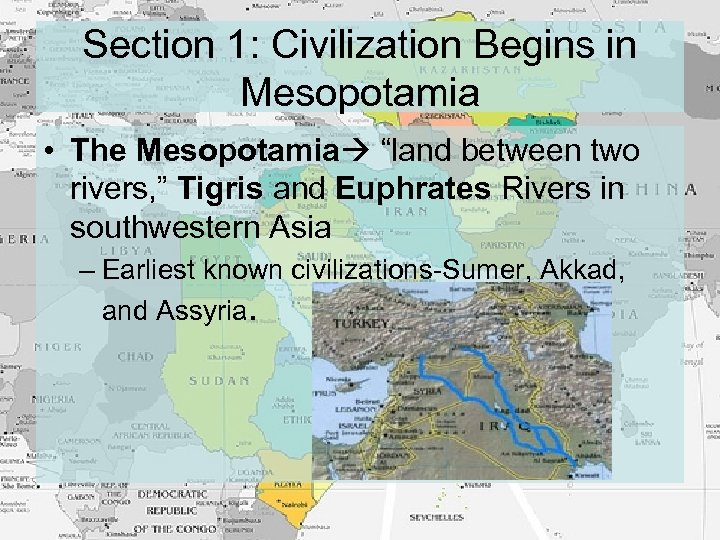 Section 1: Civilization Begins in Mesopotamia • The Mesopotamia “land between two rivers, ” Tigris and Euphrates Rivers in southwestern Asia – Earliest known civilizations-Sumer, Akkad, and Assyria.
 Section 1 (continued) • Mesopotamia – little rain, – unpredictable flooding of the two rivers deposited layers of fertile silt. – Irrigation and drainage techniques made farming possible.
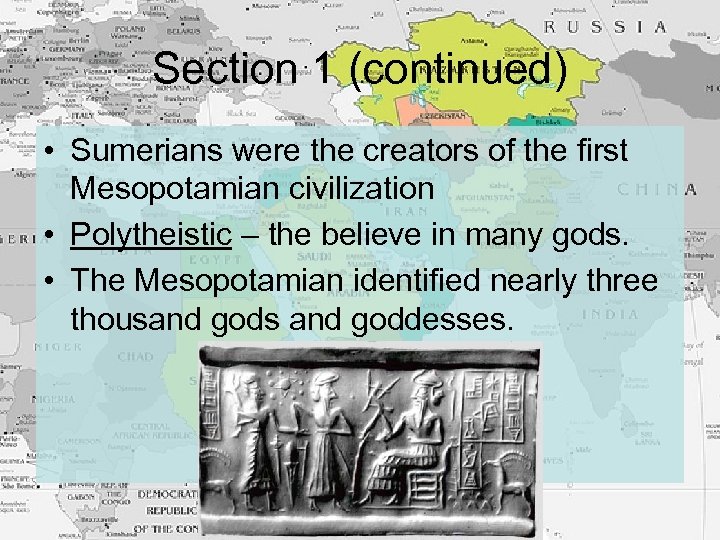 Section 1 (continued) • Sumerians were the creators of the first Mesopotamian civilization • Polytheistic – the believe in many gods. • The Mesopotamian identified nearly three thousand gods and goddesses.
 City- State of Ancient Mesopotamia • By 3000 B. C. , the Sumerians had developed city-states in southern Mesopotamia. • A city-state governs a city and the surrounding countryside
 City- State of Ancient Mesopotamia • Largest Sumerian City states. Eridu, Ur, and Uruk. – built walled cities – engaged in widespread trade.
 The Creativity of the Sumerians • invented many tools. • achievements in mathematics and astronomy. • first to make bronze out of copper and tin to create metalwork.
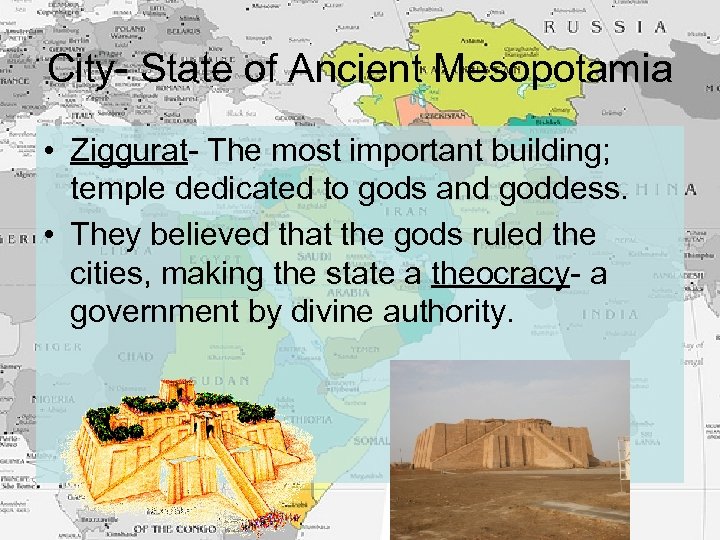 City- State of Ancient Mesopotamia • Ziggurat- The most important building; temple dedicated to gods and goddess. • They believed that the gods ruled the cities, making the state a theocracy- a government by divine authority.
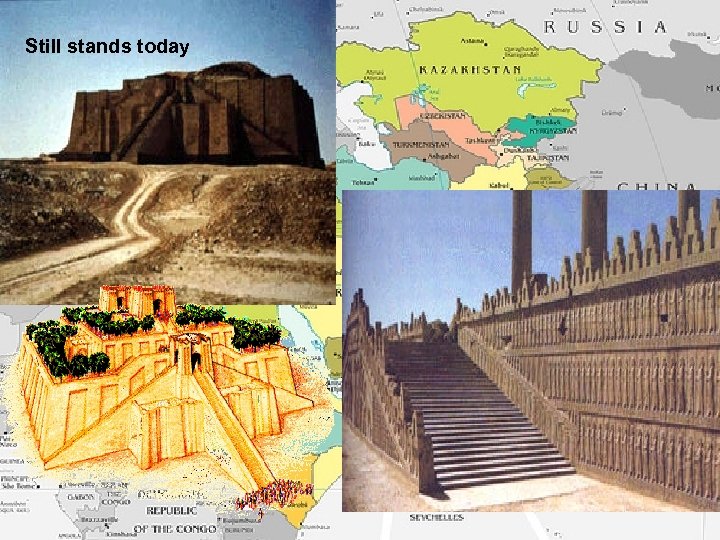 Still stands today
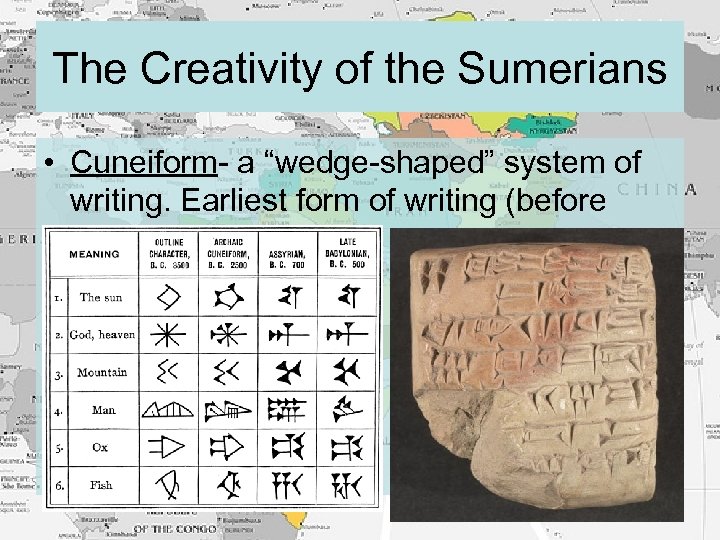 The Creativity of the Sumerians • Cuneiform- a “wedge-shaped” system of writing. Earliest form of writing (before hieroglyphics)
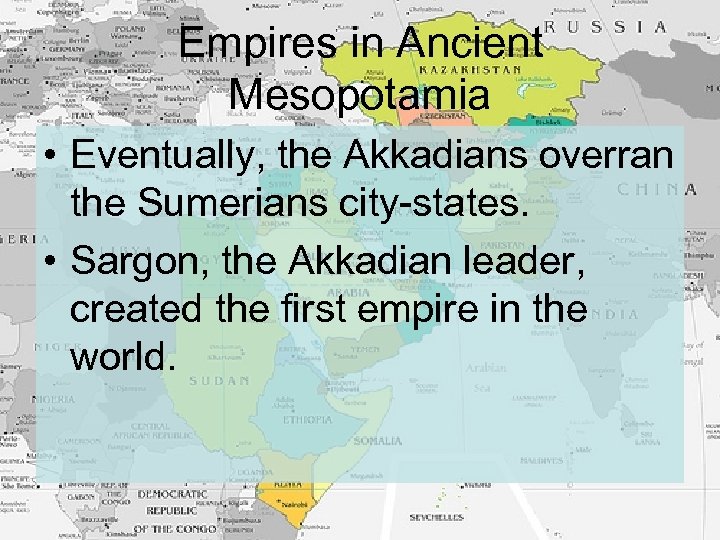 Empires in Ancient Mesopotamia • Eventually, the Akkadians overran the Sumerians city-states. • Sargon, the Akkadian leader, created the first empire in the world.
 Empires in Ancient Mesopotamia • What is an empire? - Is a large political unit or state, usually under a single leader that controls many people and territories.
 The Code of Hammurabi • Attacks caused this empire to fall by 2100 B. C. • Hammurabi, the leader of Babylon, eventually came to power. • He is remembered for his strict code of laws (the Code of Hammurabi).
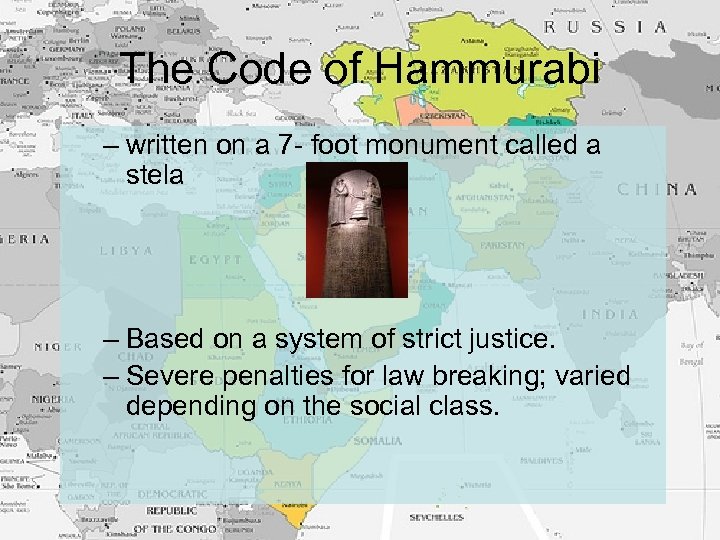 The Code of Hammurabi – written on a 7 - foot monument called a stela – Based on a system of strict justice. – Severe penalties for law breaking; varied depending on the social class.
 The Influence of Hammurabi’s Code DO NOT COPY DOWN l If anyone commits a robbery and is caught, then he shall be put to death. l If a man wishes to separate from a woman or his wife who has borne him children, then he shall give that wife her dowry, and part of the field, garden, and property, so that she can rear her children. - Those who die and leave wives, a will shall provide their wives with support for a year, provided they stay within the same household.
 The Influence of Hammurabi’s Code 3. If a man put out the eye of another man, his eye shall be put out. - Mesopotamian society was patriarchalmen dominated the society. Hammurabi’s code show that woman had fewer rights than men.
 Section 2: Egyptian Civilization • The Nile River begins in the heart of Africa. It is the longest river in the world. • The Nile River splits into two major branches, forming a triangular territory called a delta. • The Nile Delta is called Lower Egypt and the land upstream, to the south is called the Upper Egypt.
 Egyptian Civilization • Religion provided Egyptians a sense of security • They had many gods associated with natural forces. Ex. Sun gods and land gods
 Egyptians Kingdoms • Three major periods: Old, Middle and New Kingdom. • These periods had long-term stability marked by strong leadership, freedom from invasion, great building projects, and rich cultural activity. • Their history begins around 3100 B. C. , when
 The Old Kingdom • Lasted from 2700 B. C to 2200 B. C. It was a period of prosperity and splendor. • Powerful rulers over a unified state. Egyptian monarchs had several titles one of them was Pharaoh meaning “great house” or “palace”. • They had complete power to rule their people; however, they had different offices.
 The Old Kingdom • The office of vizier- a governor of a country or province who rules as a representative of a king. Responsible for the pharaoh and the whole land. • At the time, Egypt had 42 providences, which were run by governors appointed by the pharaoh. They reported to the pharaoh and vizier.
 The Old Kingdom • One of the greatest achievements was the Egyptians Pyramids. • They were dedicate to the dead. • The City of the Dead: included a pyramid for the pharaoh’s burial; smaller pyramids for his family; and mastabas-Rectangular structures with flat roofs used as toms for the pharaoh’s officials.
 The Old Kingdom • Egyptians believed that human beings had two bodies- a physical and spiritual or the ka. • If the physical body was preserved the ka could return and the ka could continue its life despite the death of the physical body. • Mummification- process of slowly drying a dead body to prevent if from rotting.
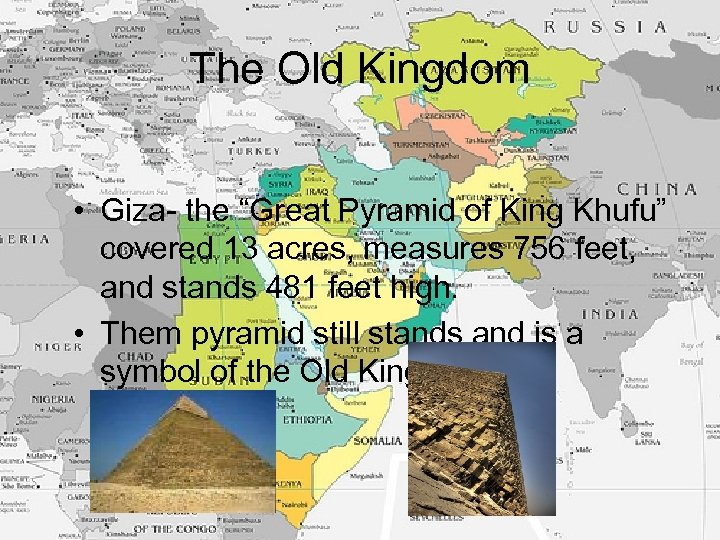 The Old Kingdom • Giza- the “Great Pyramid of King Khufu” covered 13 acres, measures 756 feet, and stands 481 feet high. • Them pyramid still stands and is a symbol of the Old Kingdom.
 The Middle Kingdom • The Old Kingdom collapsed, followed by a period that lasted 150 years. • Began in 2055 B. C to 1650 B. C, it was portrayed as the age of stability. • Nubia, located south of Egypt was conquered. As a result, fortresses were built to protect the frontier.
 The Middle Kingdom • During the Old Kingdom, the pharaoh had been seen as a god-king far from his people. • Now, the pharaoh was portrayed as the shepherd of his people and expected to build public works and provide welfare.
 The New Kingdom • The Middle Kingdom came to an end by a group of people from western Asia known as the Hyksos. • They conquered and ruled Egypt. • Learned to use bronze in the making of their farming tools and their weapons.
 The New Kingdom • Established and lasted from 1550 B. C to 1070 B. C. • During this time, Egypt created an empire that became the most powerful state in Southwest Asia. • Massive wealth boosted power of the New Kingdom pharaohs. They showed their wealth by building new temples.
 The New Kingdom • Hatshepsut- one of the first women to become pharaoh. • She was succeeded by her nephew Thutmose III. He led 17 military campaigns into Syria and Palestine and moved westward into Libya. • Built magnificent buildings to show greatness of empire.
 The New Kingdom • Amenhotep IV introduced the worship of Aten, god of the sun disk. • He changed his name to Akhenaten, and closed the temples of the gods. His actions in destroying the old gods meant to Egyptians the destruction of Egypt. • After his death, Tutankhamen, restored
 The New Kingdom • The upheavals associated with Amenhotep’s religious revolution led to a loss of Egypt's empire. • Ramses II, reigned from 1279 B. C to 1213 B. C. • Regained control of Palestine but were unable to reestablish the borders of their earlier empire.
 The New Kingdom • Collapsed in 1070 B. C with an invasion from the “Sea People”. • Egypt was dominated by the Libyans, Nubians, Persians, and Macedonians after the conquest of Alexander the Great. • In the first century, Cleopatra VII tried to reestablish its independence. However, her involvement with Rome led her to defeat and suicide. • Egypt became a providence in Rome’s empire.
 Life in Ancient Egypt • The ruling class ran the government and managed their own states. • The upper class were merchants, artisans, scribes, and tax collectors. • Middle class, were mostly in the city, they were comfortable but not elegant. • The largest and lowest class were people who worked the land. They lived in small villages.
 Life in Ancient Egypt • They married young and the husband was the master in the house. • Parents arranged marriage for their children. The purpose was to produce children, specially sons.
 Life in Ancient Egypt • Hieroglyphics- (“priest- carvings” or “sacred writings”) system of writing. • Hieratic Script- similar but the drawings used dashes, strokes, and curves to represent them. • Developed a 365 -day calendar.
 New Centers of Civilization Chapter 2 Section 3 09/9/2014
 The Role of Nomadic Peoples • Indo-Europeans-nomadic group of people who spoke a language derived from a single parent tongue. Ex) Greek, Latin, Persian, etc • 1750 B. C. , a group of Indo- Europeans formed the Hittite kingdom. – 1 st Indo-Europeans to use iron.
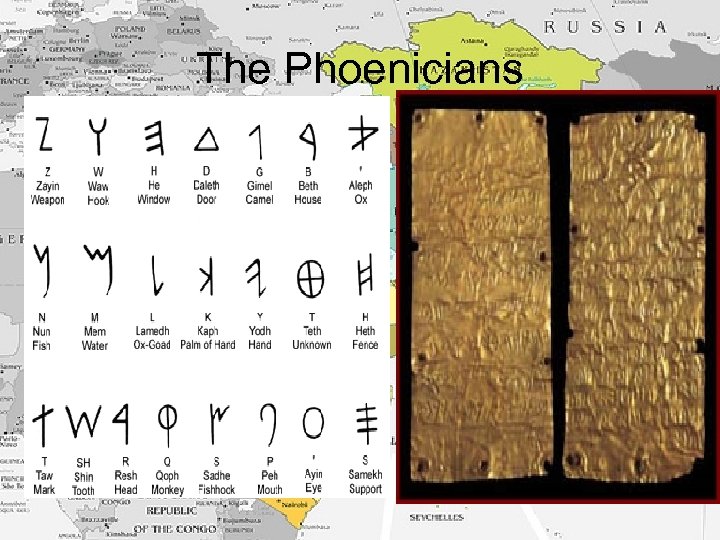
 The Phoenicians • The Phoenicians – excellent ship builders and sailors. – established an extensive trading empire. – First to create an alphabet that was passed on to the Greeks.
 The Phoenicians
 The Israelites • The founder of the Israelite kingdom was Abraham. • The Israelites created the kingdom of Israel, and King David set up its capital at Jerusalem. • David’s son, King Solomon, built a temple at Jerusalem.
 The Israelites • The Israelites’ religion, Judaism, was the first monotheistic (Belief in ___ God) religion; it later influenced Christianity and Islam. • Belief in one god called Yahwehthe creator of the world and everything in it.
 Judaism • 3 Aspects – Covenant (contract) – Law (The Ten Commandments revealed by God) – Prophets (God’s command to live justly, share with others, care for unfortunate) • Gods wishes were written down in the Hebrew Bible • Monotheistic beliefs caused friction between neighborhoods.
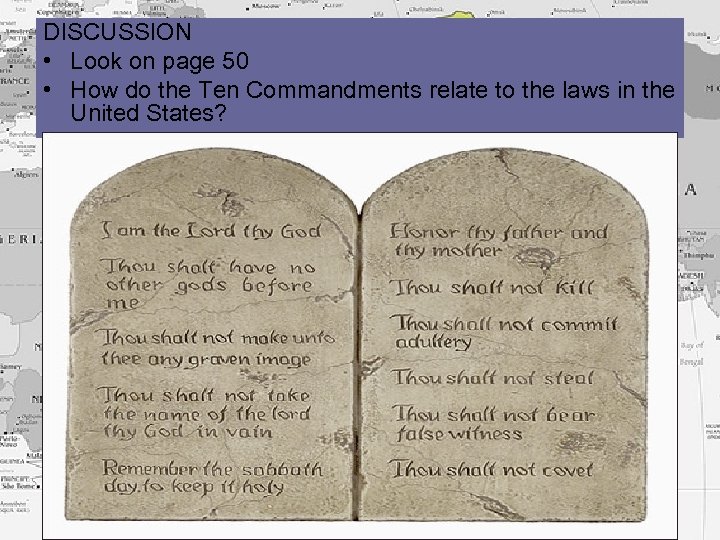 DISCUSSION • Look on page 50 • How do the Ten Commandments relate to the laws in the United States?
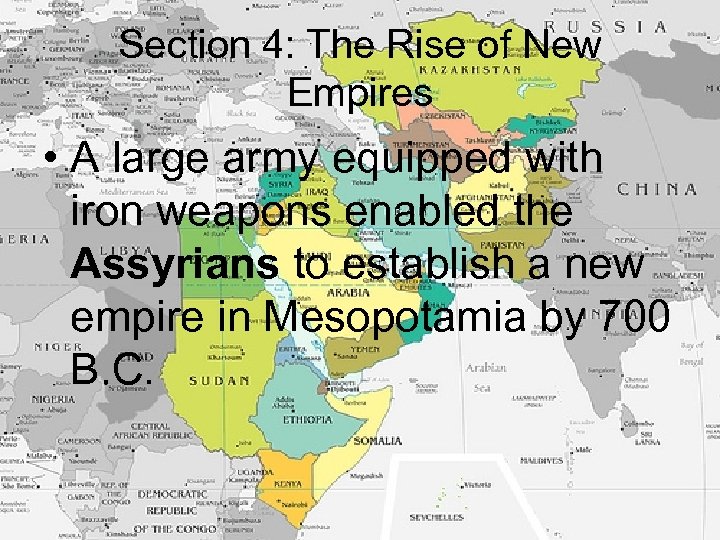 Section 4: The Rise of New Empires • A large army equipped with iron weapons enabled the Assyrians to establish a new empire in Mesopotamia by 700 B. C.
 The Rise of New Empires • Brutal warriors, the Assyrians had an effective system of communication and also one of the world’s finest libraries. • After the collapse of the Assyrian Empire, the Persian Empire became the leading power.
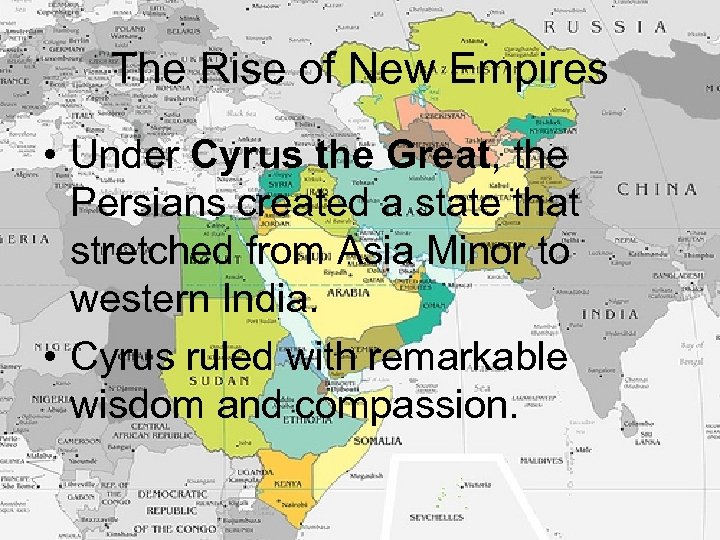 The Rise of New Empires • Under Cyrus the Great, the Persians created a state that stretched from Asia Minor to western India. • Cyrus ruled with remarkable wisdom and compassion.
 The Rise of New Empires • Cyrus’s successors expanded the empire, relying on a system of provincial governors who collected taxes, provided justice and security, and recruited soldiers. • Darius, ruled from 521 B. C. to 486 B. C added a new Persian providence in western India.
 The Rise of New Empires • Darius had a great infantry force and excellent soldiers. • However, Persian kings became isolated at their courts, surrounded by luxuries making his monarchy very weak. This led to its conquest by the Greek ruler Alexander the Great in 330 s B. C.
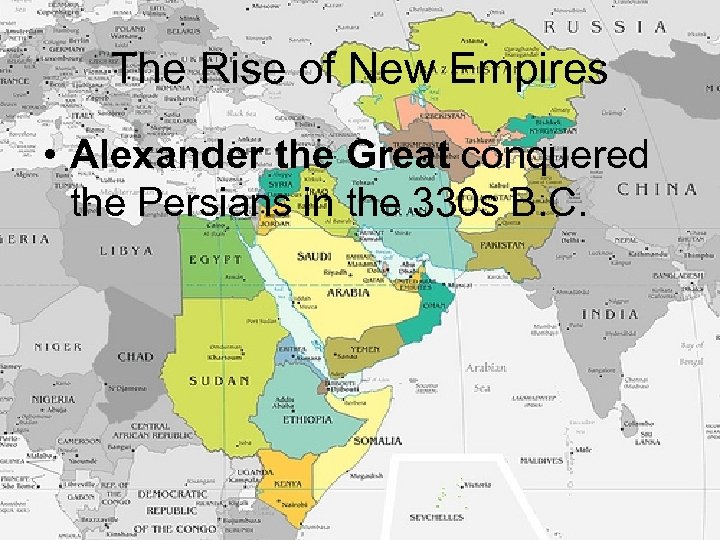 The Rise of New Empires • Alexander the Great conquered the Persians in the 330 s B. C.