 Скачать презентацию Chapter 2 Rate of Reactions Table of Contents
Rate of Reactions.pptx
- Количество слайдов: 50



Chapter 2 Rate of Reactions Table of Contents 1. Meaning and Measurement of Rate of Reactions 2. Collision Theory 3. Rate Expression and Rate Constant 4. Factors Affecting Rate
Chapter 2 Rate of Reactions Warm up • List down some moving objects with their average speeds. • Explain how you know their speeds. • Try to explain some chemical changes with their rates.
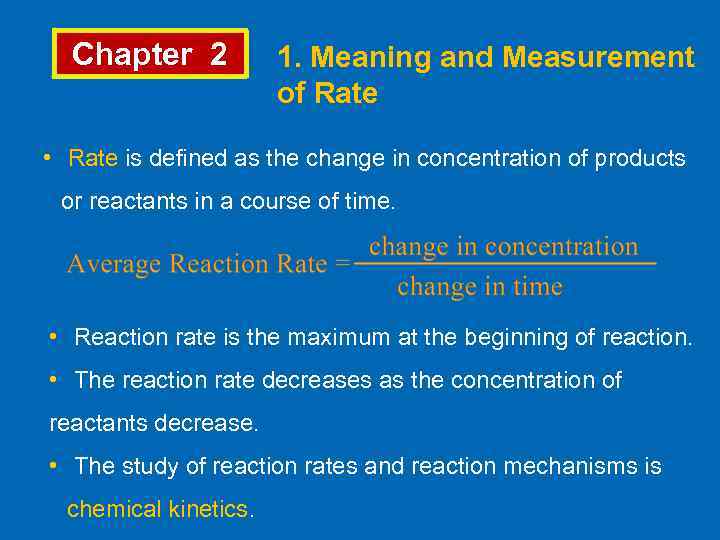
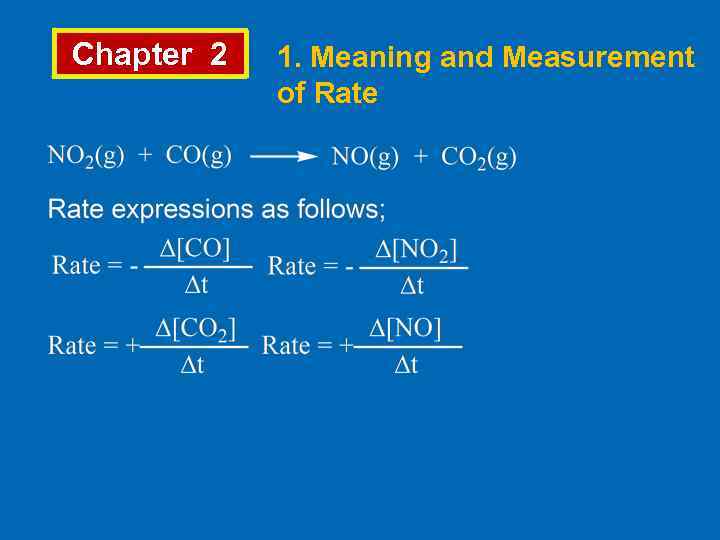
Chapter 2 1. Meaning and Measurement of Rate • Rate is defined as the change in concentration of products or reactants in a course of time. • Reaction rate is the maximum at the beginning of reaction. • The reaction rate decreases as the concentration of reactants decrease. • The study of reaction rates and reaction mechanisms is chemical kinetics.
Chapter 2 1. Meaning and Measurement of Rate
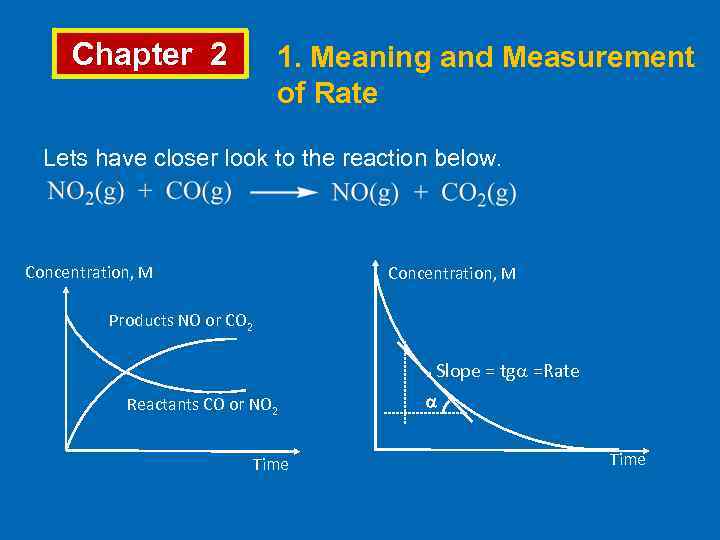
Chapter 2 1. Meaning and Measurement of Rate Lets have closer look to the reaction below. Concentration, M Products NO or CO 2 . Slope = tg =Rate Reactants CO or NO 2 Time
Chapter 2 1. Meaning and Measurement of Rate
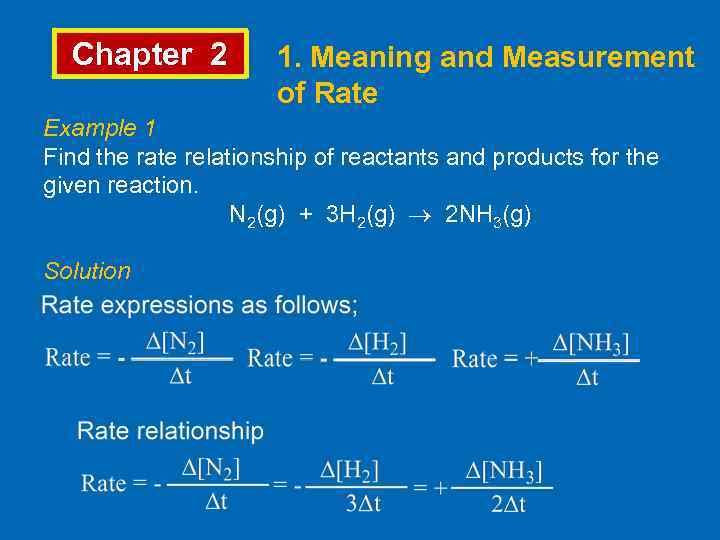
Chapter 2 1. Meaning and Measurement of Rate Example 1 Find the rate relationship of reactants and products for the given reaction. N 2(g) + 3 H 2(g) 2 NH 3(g) Solution
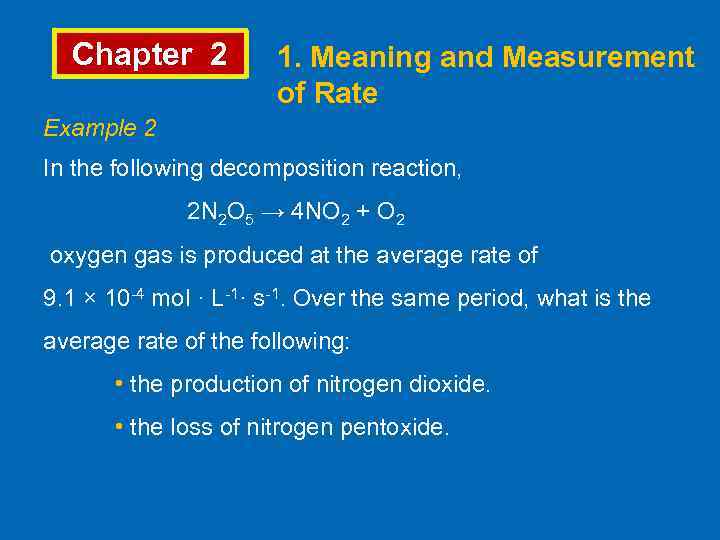
Chapter 2 1. Meaning and Measurement of Rate Example 2 In the following decomposition reaction, 2 N 2 O 5 → 4 NO 2 + O 2 oxygen gas is produced at the average rate of 9. 1 × 10 -4 mol · L-1· s-1. Over the same period, what is the average rate of the following: • the production of nitrogen dioxide. • the loss of nitrogen pentoxide.
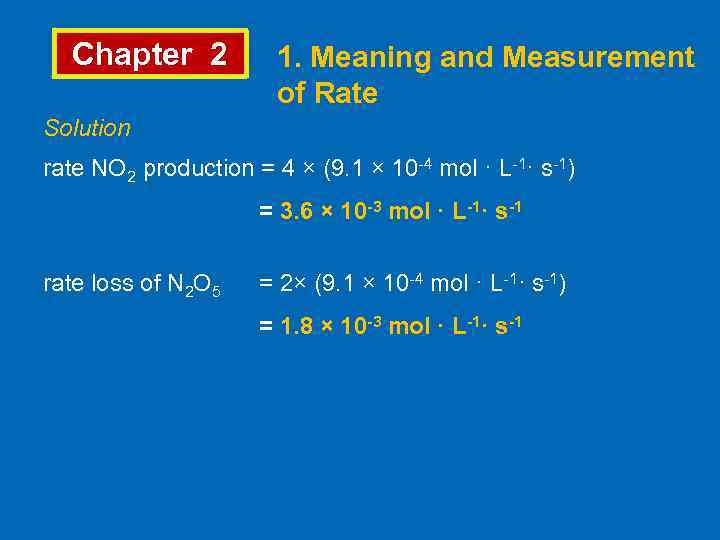
Chapter 2 1. Meaning and Measurement of Rate Solution rate NO 2 production = 4 × (9. 1 × 10 -4 mol · L-1· s-1) = 3. 6 × 10 -3 mol · L-1· s-1 rate loss of N 2 O 5 = 2× (9. 1 × 10 -4 mol · L-1· s-1) = 1. 8 × 10 -3 mol · L-1· s-1
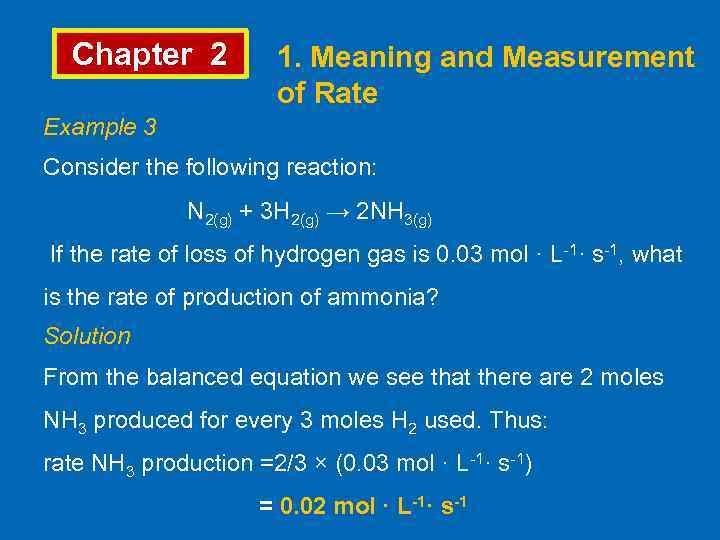
Chapter 2 1. Meaning and Measurement of Rate Example 3 Consider the following reaction: N 2(g) + 3 H 2(g) → 2 NH 3(g) If the rate of loss of hydrogen gas is 0. 03 mol · L-1· s-1, what is the rate of production of ammonia? Solution From the balanced equation we see that there are 2 moles NH 3 produced for every 3 moles H 2 used. Thus: rate NH 3 production =2/3 × (0. 03 mol · L-1· s-1) = 0. 02 mol · L-1· s-1
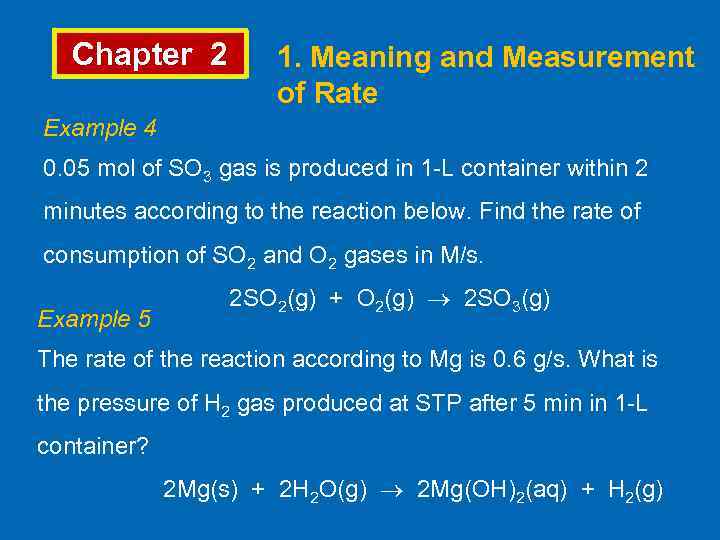
Chapter 2 1. Meaning and Measurement of Rate Example 4 0. 05 mol of SO 3 gas is produced in 1 -L container within 2 minutes according to the reaction below. Find the rate of consumption of SO 2 and O 2 gases in M/s. 2 SO 2(g) + O 2(g) 2 SO 3(g) Example 5 The rate of the reaction according to Mg is 0. 6 g/s. What is the pressure of H 2 gas produced at STP after 5 min in 1 -L container? 2 Mg(s) + 2 H 2 O(g) 2 Mg(OH)2(aq) + H 2(g)
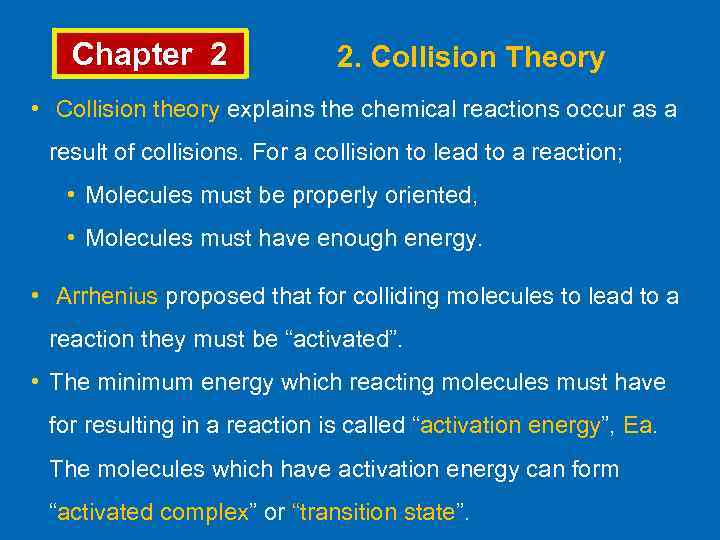
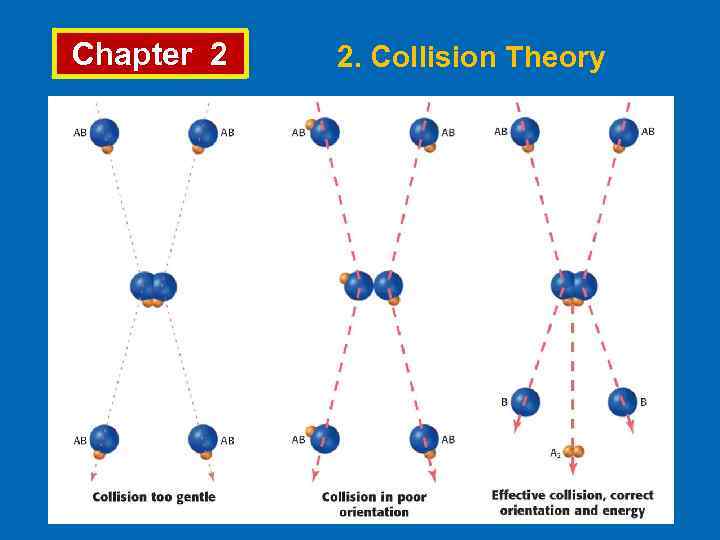
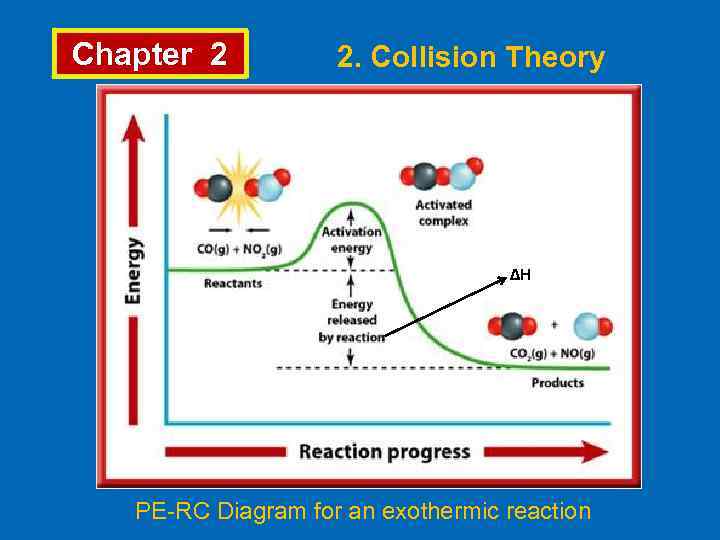
Chapter 2 2. Collision Theory • Collision theory explains the chemical reactions occur as a result of collisions. For a collision to lead to a reaction; • Molecules must be properly oriented, • Molecules must have enough energy. • Arrhenius proposed that for colliding molecules to lead to a reaction they must be “activated”. • The minimum energy which reacting molecules must have for resulting in a reaction is called “activation energy”, Ea. The molecules which have activation energy can form “activated complex” or “transition state”.
Chapter 2 2. Collision Theory
Chapter 2 2. Collision Theory
Chapter 2 2. Collision Theory
Chapter 2 2. Collision Theory ∆H PE-RC Diagram for an exothermic reaction
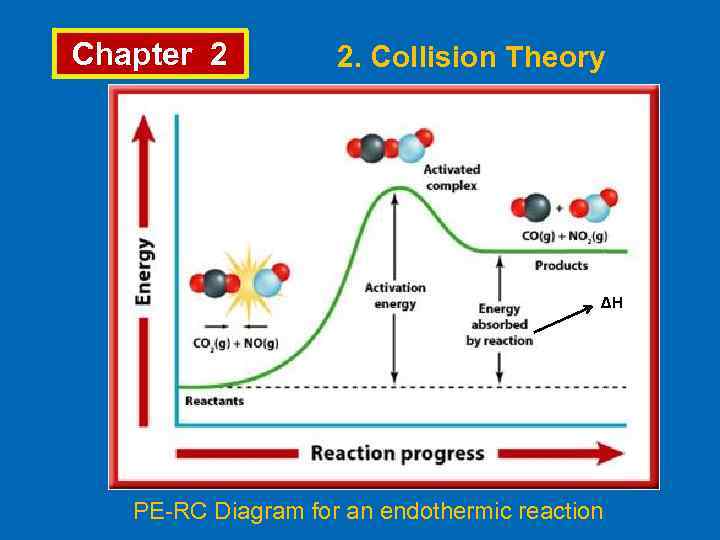
Chapter 2 2. Collision Theory ∆H PE-RC Diagram for an endothermic reaction
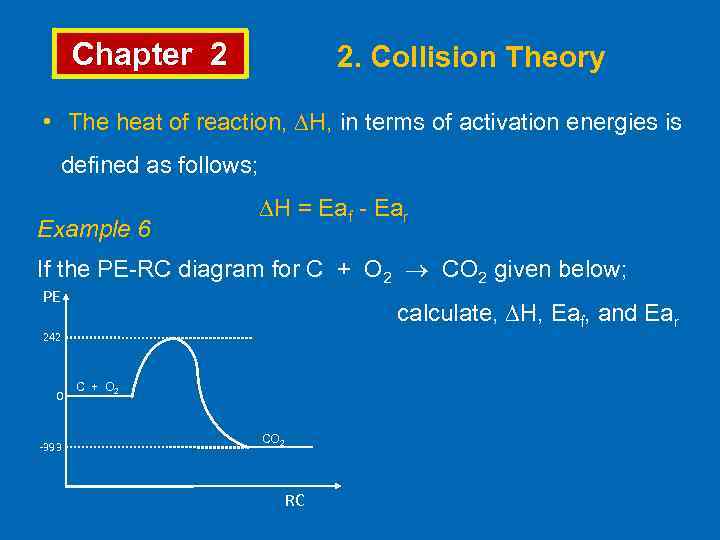
Chapter 2 2. Collision Theory • The heat of reaction, ∆H, in terms of activation energies is defined as follows; Example 6 ∆H = Eaf - Ear If the PE-RC diagram for C + O 2 CO 2 given below; PE calculate, ∆H, Eaf, and Ear 242 0 -393 C + O 2 CO 2 RC
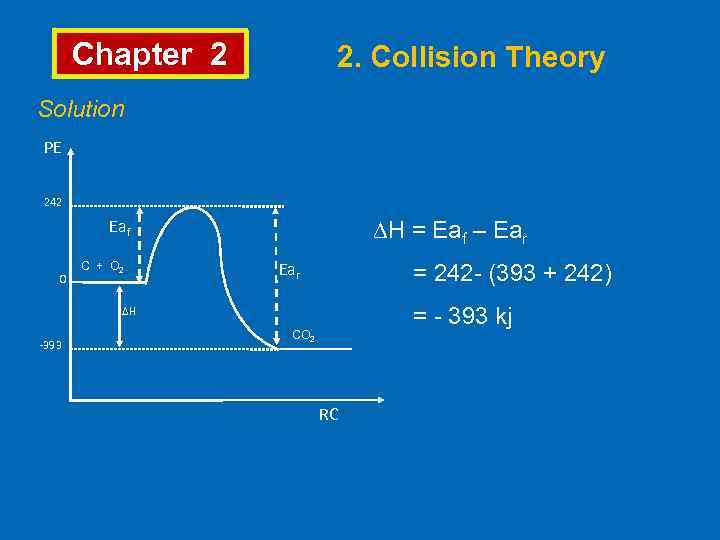
Chapter 2 2. Collision Theory Solution PE 242 Eaf 0 C + O 2 ∆H = Eaf – Ear = 242 - (393 + 242) = - 393 kj ∆H -393 CO 2 RC
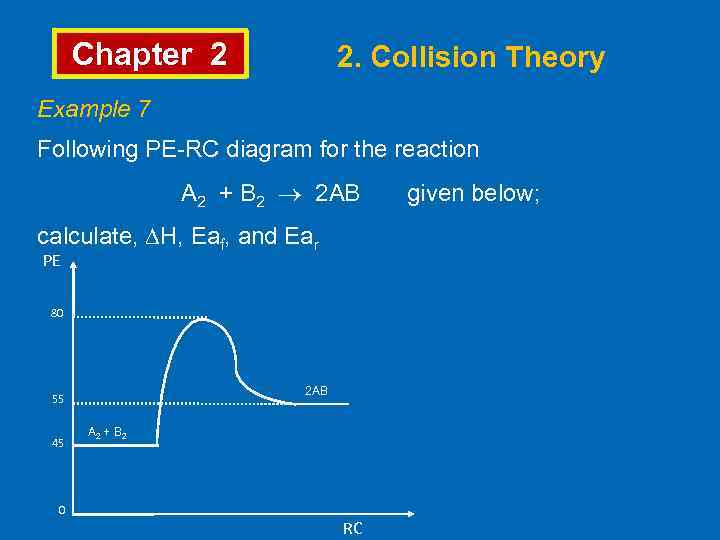
Chapter 2 2. Collision Theory Example 7 Following PE-RC diagram for the reaction A 2 + B 2 2 AB given below; calculate, ∆H, Eaf, and Ear PE 80 2 AB 55 45 A 2 + B 2 0 RC
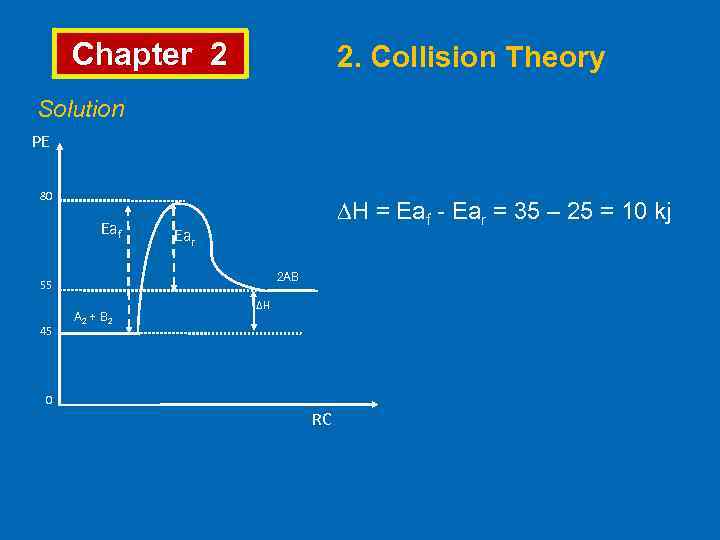
Chapter 2 2. Collision Theory Solution PE 80 Eaf ∆H = Eaf - Ear = 35 – 25 = 10 kj Ear 2 AB 55 45 A 2 + B 2 ∆H 0 RC

Chapter 2 2. Collision Theory Example 8 Answer the following questions based on the potential energy diagram shown here: a. Does the graph represent an endothermic or exothermic reaction? b. Label the position of the reactants, products, and activated complex. c. Determine the heat of reaction, ΔH, (enthalpy change) for this reaction. d. Determine the activation energy, Ea for this reaction. e. How much energy is released or absorbed during the reaction? f. How much energy is required for this reaction to occur?
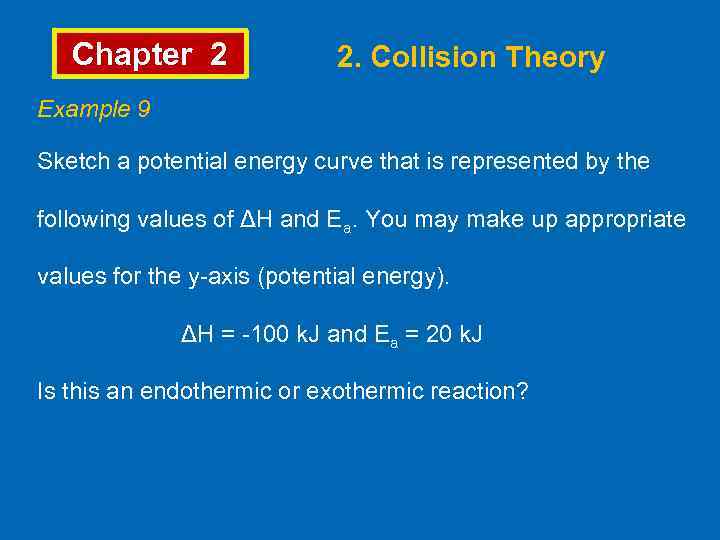
Chapter 2 2. Collision Theory Example 9 Sketch a potential energy curve that is represented by the following values of ΔH and Ea. You may make up appropriate values for the y-axis (potential energy). ΔH = -100 k. J and Ea = 20 k. J Is this an endothermic or exothermic reaction?
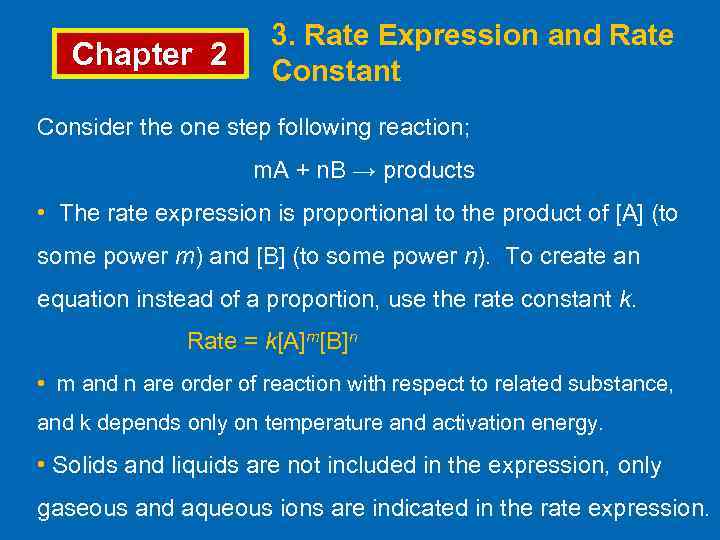
Chapter 2 3. Rate Expression and Rate Constant Consider the one step following reaction; m. A + n. B → products • The rate expression is proportional to the product of [A] (to some power m) and [B] (to some power n). To create an equation instead of a proportion, use the rate constant k. Rate = k[A]m[B]n • m and n are order of reaction with respect to related substance, and k depends only on temperature and activation energy. • Solids and liquids are not included in the expression, only gaseous and aqueous ions are indicated in the rate expression.
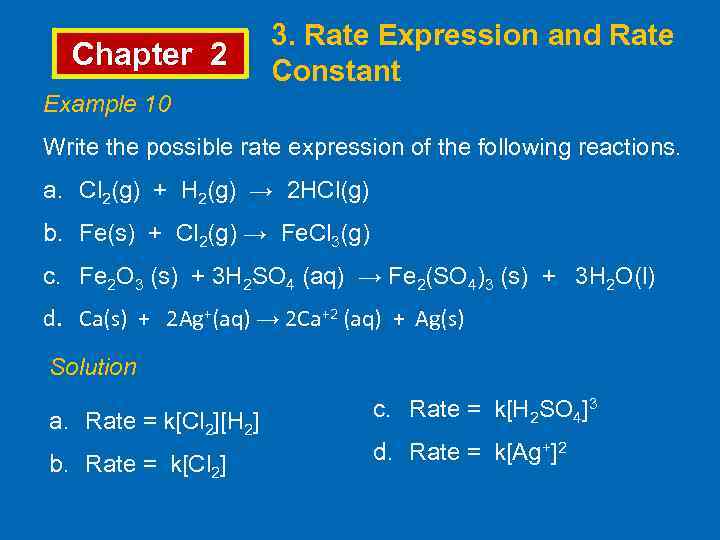
Chapter 2 3. Rate Expression and Rate Constant Example 10 Write the possible rate expression of the following reactions. a. Cl 2(g) + H 2(g) → 2 HCl(g) b. Fe(s) + Cl 2(g) → Fe. Cl 3(g) c. Fe 2 O 3 (s) + 3 H 2 SO 4 (aq) → Fe 2(SO 4)3 (s) + 3 H 2 O(l) d. Ca(s) + 2 Ag+(aq) → 2 Ca+2 (aq) + Ag(s) Solution a. Rate = k[Cl 2][H 2] b. Rate = k[Cl 2] c. Rate = k[H 2 SO 4]3 d. Rate = k[Ag+]2
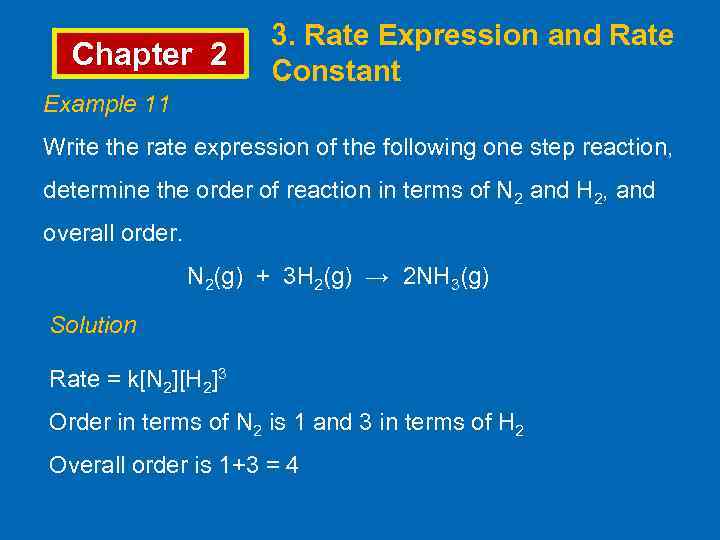
Chapter 2 3. Rate Expression and Rate Constant Example 11 Write the rate expression of the following one step reaction, determine the order of reaction in terms of N 2 and H 2, and overall order. N 2(g) + 3 H 2(g) → 2 NH 3(g) Solution Rate = k[N 2][H 2]3 Order in terms of N 2 is 1 and 3 in terms of H 2 Overall order is 1+3 = 4
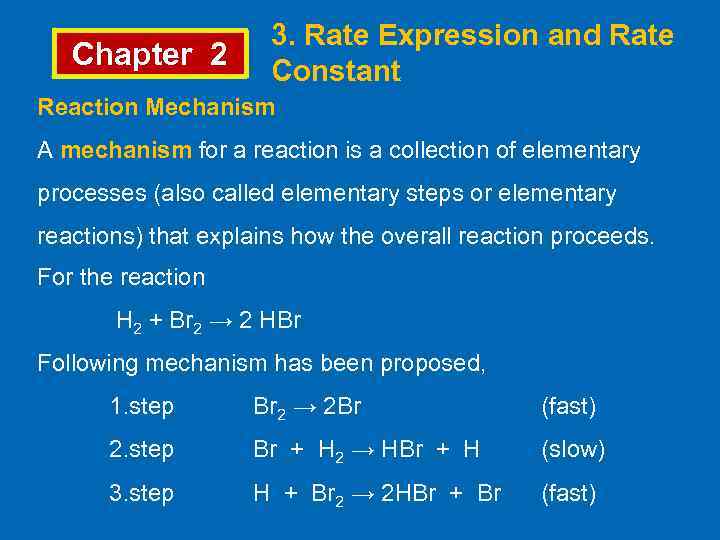
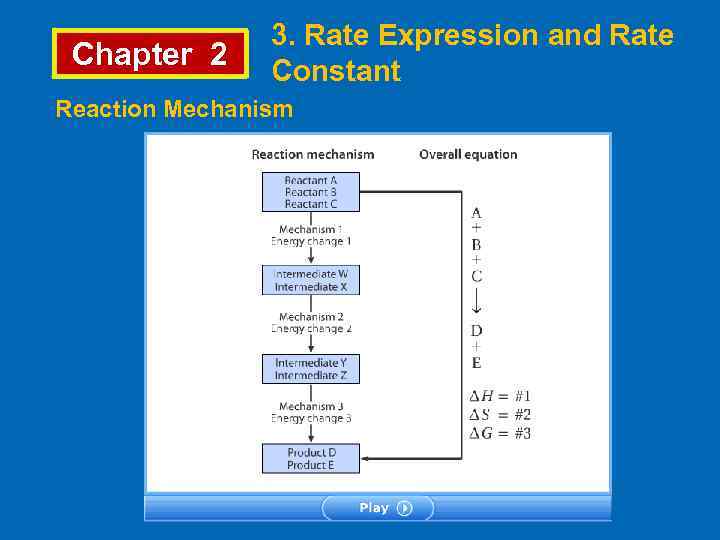
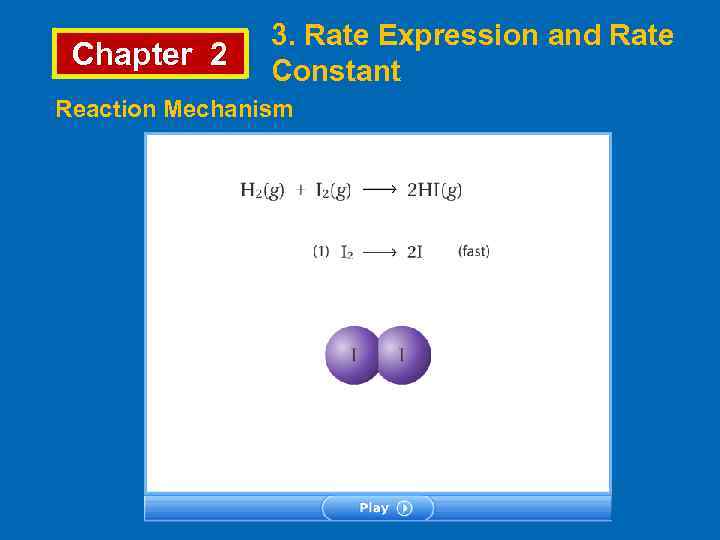
Chapter 2 3. Rate Expression and Rate Constant Reaction Mechanism A mechanism for a reaction is a collection of elementary processes (also called elementary steps or elementary reactions) that explains how the overall reaction proceeds. For the reaction H 2 + Br 2 → 2 HBr Following mechanism has been proposed, 1. step Br 2 → 2 Br (fast) 2. step Br + H 2 → HBr + H (slow) 3. step H + Br 2 → 2 HBr + Br (fast)
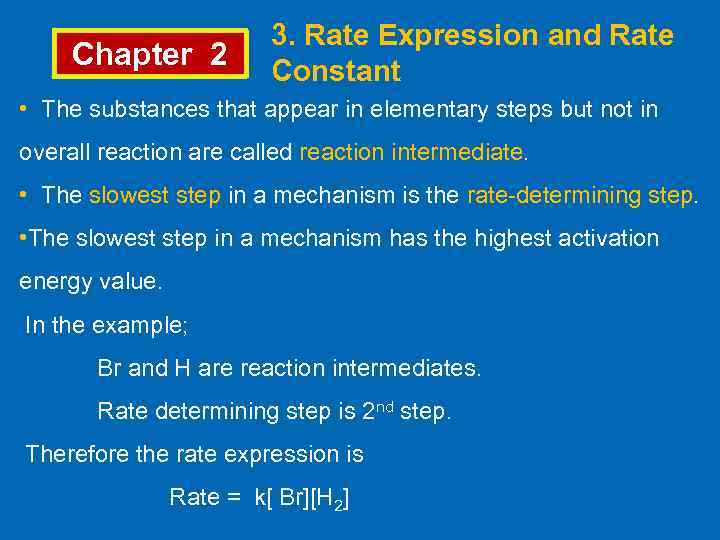
Chapter 2 3. Rate Expression and Rate Constant • The substances that appear in elementary steps but not in overall reaction are called reaction intermediate. • The slowest step in a mechanism is the rate-determining step. • The slowest step in a mechanism has the highest activation energy value. In the example; Br and H are reaction intermediates. Rate determining step is 2 nd step. Therefore the rate expression is Rate = k[ Br][H 2]
Chapter 2 3. Rate Expression and Rate Constant Reaction Mechanism
Chapter 2 3. Rate Expression and Rate Constant Reaction Mechanism
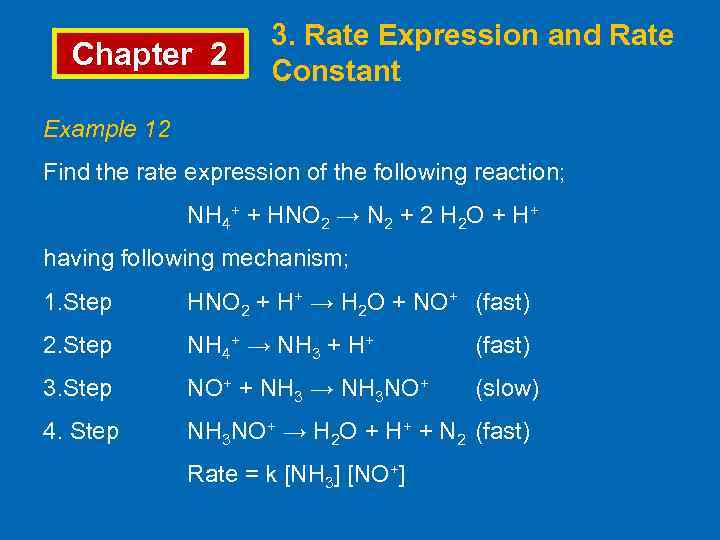
Chapter 2 3. Rate Expression and Rate Constant Example 12 Find the rate expression of the following reaction; NH 4+ + HNO 2 → N 2 + 2 H 2 O + H+ having following mechanism; 1. Step HNO 2 + H+ → H 2 O + NO+ (fast) 2. Step NH 4+ → NH 3 + H+ (fast) 3. Step NO+ + NH 3 → NH 3 NO+ (slow) 4. Step NH 3 NO+ → H 2 O + H+ + N 2 (fast) Rate = k [NH 3] [NO+]
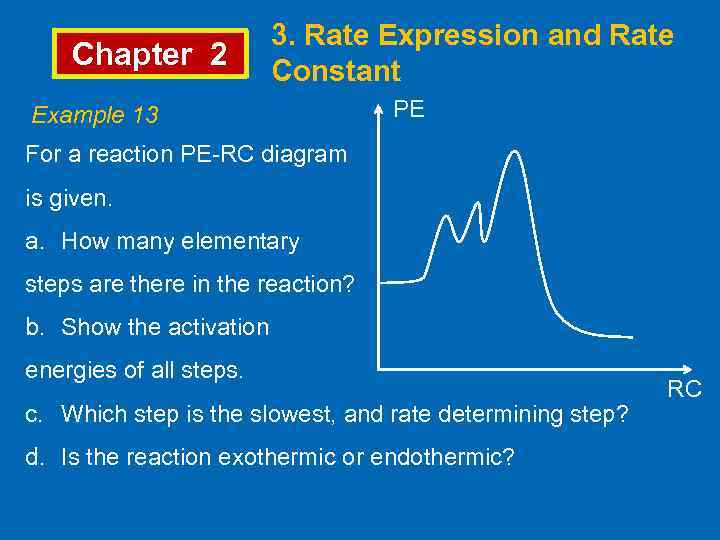
Chapter 2 3. Rate Expression and Rate Constant Example 13 PE For a reaction PE-RC diagram is given. a. How many elementary steps are there in the reaction? b. Show the activation energies of all steps. c. Which step is the slowest, and rate determining step? d. Is the reaction exothermic or endothermic? RC
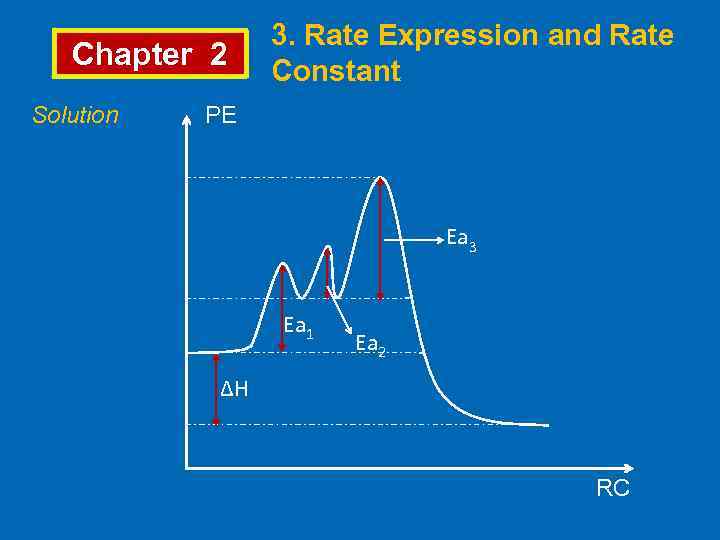
Chapter 2 Solution 3. Rate Expression and Rate Constant PE Ea 3 Ea 1 Ea 2 ∆H RC
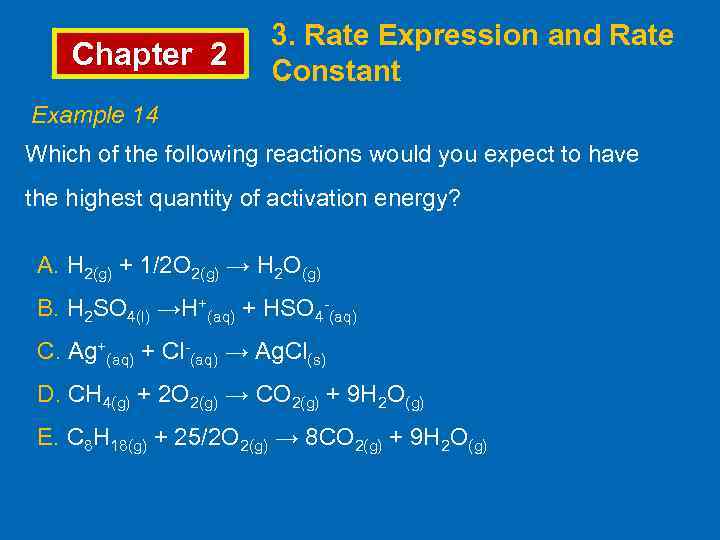
Chapter 2 3. Rate Expression and Rate Constant Example 14 Which of the following reactions would you expect to have the highest quantity of activation energy? A. H 2(g) + 1/2 O 2(g) → H 2 O(g) B. H 2 SO 4(l) →H+(aq) + HSO 4 -(aq) C. Ag+(aq) + Cl-(aq) → Ag. Cl(s) D. CH 4(g) + 2 O 2(g) → CO 2(g) + 9 H 2 O(g) E. C 8 H 18(g) + 25/2 O 2(g) → 8 CO 2(g) + 9 H 2 O(g)
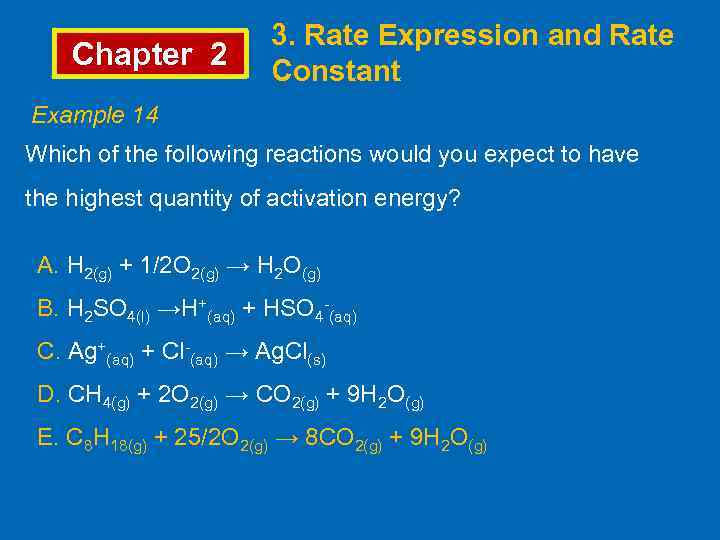
Chapter 2 3. Rate Expression and Rate Constant Example 14 Which of the following reactions would you expect to have the highest quantity of activation energy? A. H 2(g) + 1/2 O 2(g) → H 2 O(g) B. H 2 SO 4(l) →H+(aq) + HSO 4 -(aq) C. Ag+(aq) + Cl-(aq) → Ag. Cl(s) D. CH 4(g) + 2 O 2(g) → CO 2(g) + 9 H 2 O(g) E. C 8 H 18(g) + 25/2 O 2(g) → 8 CO 2(g) + 9 H 2 O(g)
Chapter 2 4. Factors Affecting Rate
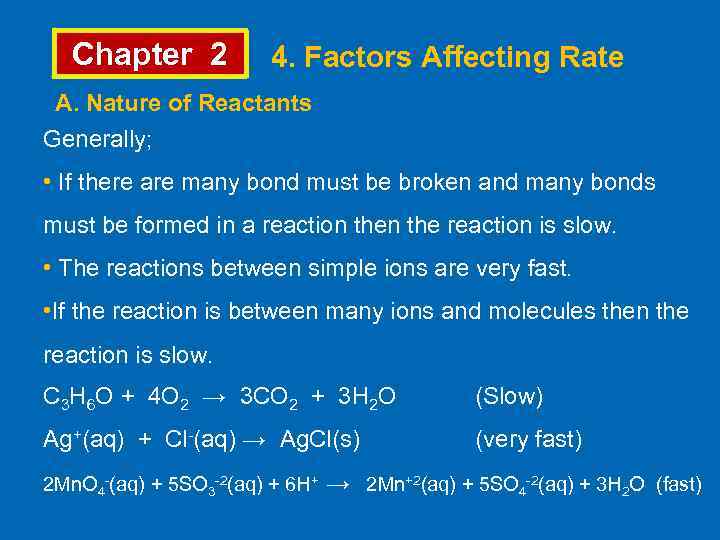
Chapter 2 4. Factors Affecting Rate A. Nature of Reactants Generally; • If there are many bond must be broken and many bonds must be formed in a reaction the reaction is slow. • The reactions between simple ions are very fast. • If the reaction is between many ions and molecules then the reaction is slow. C 3 H 6 O + 4 O 2 → 3 CO 2 + 3 H 2 O (Slow) Ag+(aq) + Cl-(aq) → Ag. Cl(s) (very fast) 2 Mn. O 4 -(aq) + 5 SO 3 -2(aq) + 6 H+ → 2 Mn+2(aq) + 5 SO 4 -2(aq) + 3 H 2 O (fast)
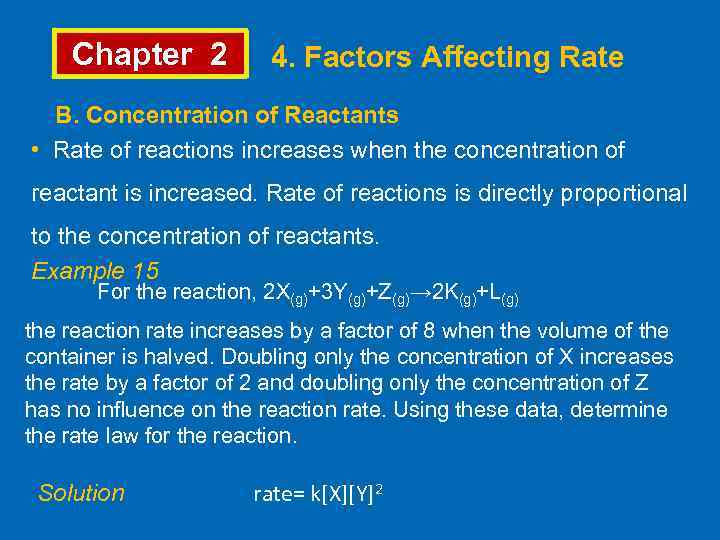
Chapter 2 4. Factors Affecting Rate B. Concentration of Reactants • Rate of reactions increases when the concentration of reactant is increased. Rate of reactions is directly proportional to the concentration of reactants. Example 15 For the reaction, 2 X(g)+3 Y(g)+Z(g)→ 2 K(g)+L(g) the reaction rate increases by a factor of 8 when the volume of the container is halved. Doubling only the concentration of X increases the rate by a factor of 2 and doubling only the concentration of Z has no influence on the reaction rate. Using these data, determine the rate law for the reaction. Solution rate= k[X][Y]2
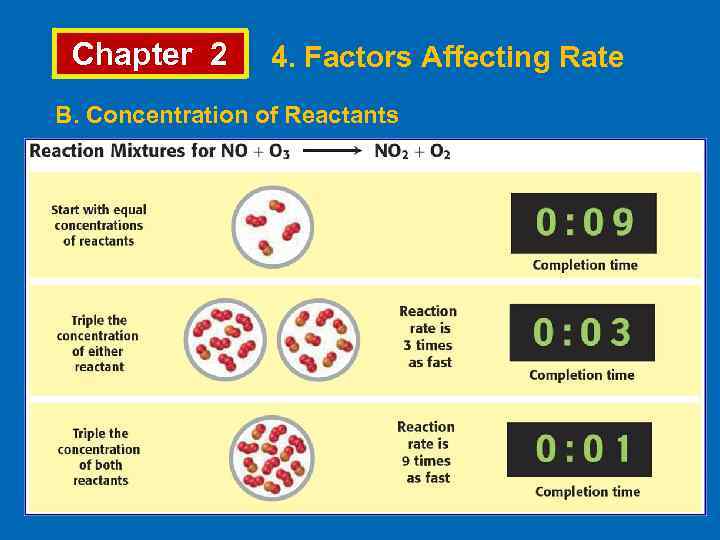
Chapter 2 4. Factors Affecting Rate B. Concentration of Reactants
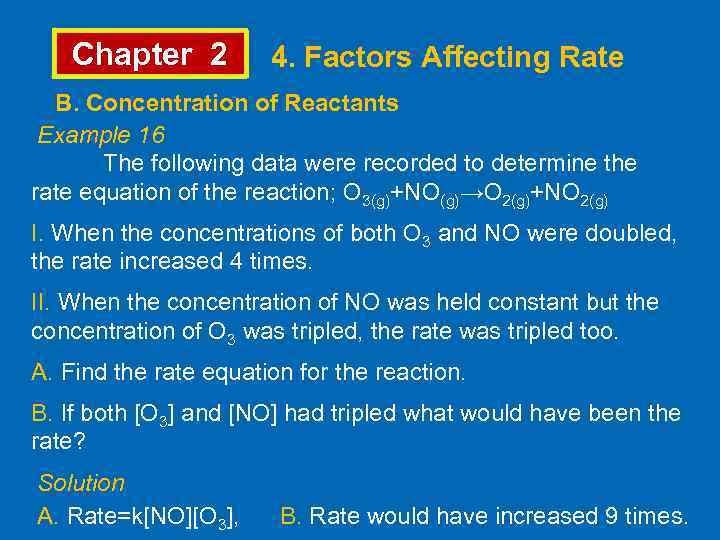
Chapter 2 4. Factors Affecting Rate B. Concentration of Reactants Example 16 The following data were recorded to determine the rate equation of the reaction; O 3(g)+NO(g)→O 2(g)+NO 2(g) I. When the concentrations of both O 3 and NO were doubled, the rate increased 4 times. II. When the concentration of NO was held constant but the concentration of O 3 was tripled, the rate was tripled too. A. Find the rate equation for the reaction. B. If both [O 3] and [NO] had tripled what would have been the rate? Solution A. Rate=k[NO][O 3], B. Rate would have increased 9 times.
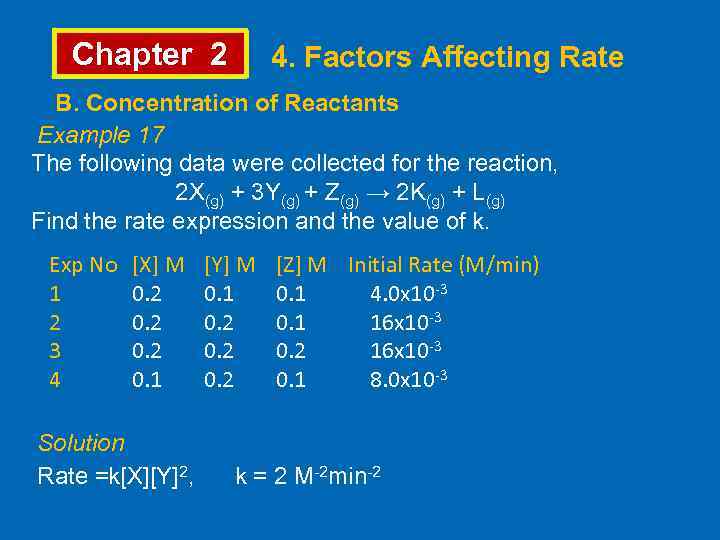
Chapter 2 4. Factors Affecting Rate B. Concentration of Reactants Example 17 The following data were collected for the reaction, 2 X(g) + 3 Y(g) + Z(g) → 2 K(g) + L(g) Find the rate expression and the value of k. Exp No 1 2 3 4 [X] M 0. 2 0. 1 [Y] M 0. 1 0. 2 [Z] M Initial Rate (M/min) 0. 1 4. 0 x 10 -3 0. 1 16 x 10 -3 0. 2 16 x 10 -3 0. 1 8. 0 x 10 -3 Solution Rate =k[X][Y]2, k = 2 M-2 min-2
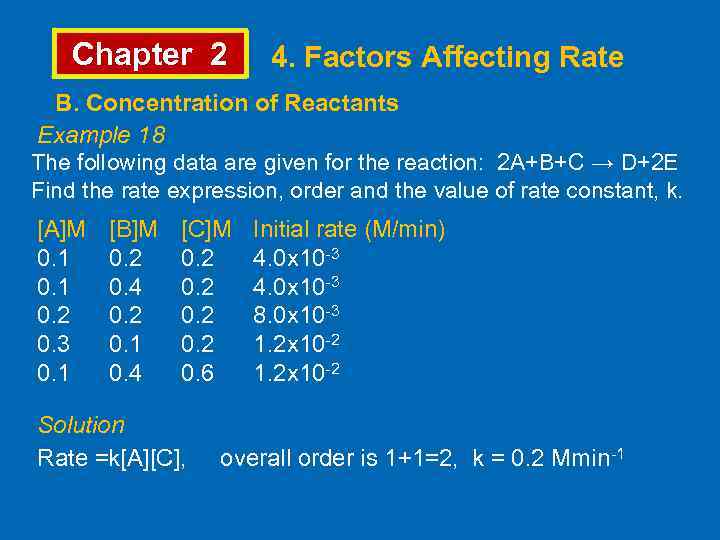
Chapter 2 4. Factors Affecting Rate B. Concentration of Reactants Example 18 The following data are given for the reaction: 2 A+B+C → D+2 E Find the rate expression, order and the value of rate constant, k. [A]M 0. 1 0. 2 0. 3 0. 1 [B]M 0. 2 0. 4 0. 2 0. 1 0. 4 [C]M 0. 2 0. 6 Initial rate (M/min) 4. 0 x 10 -3 8. 0 x 10 -3 1. 2 x 10 -2 Solution Rate =k[A][C], overall order is 1+1=2, k = 0. 2 Mmin-1
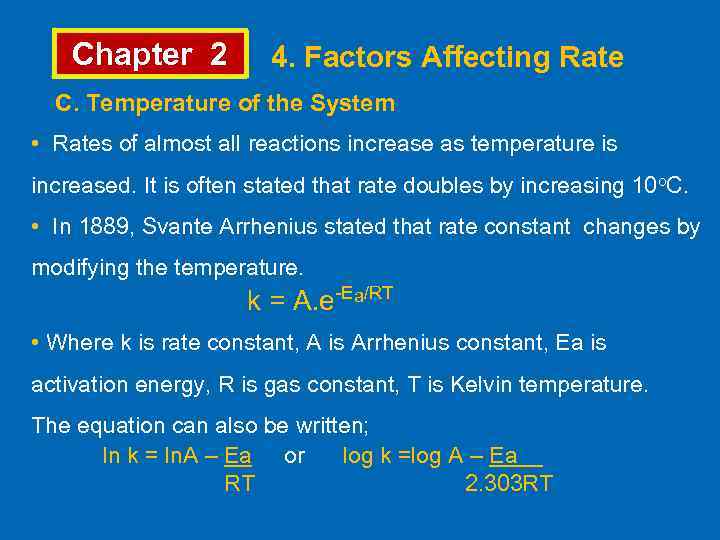
Chapter 2 4. Factors Affecting Rate C. Temperature of the System • Rates of almost all reactions increase as temperature is increased. It is often stated that rate doubles by increasing 10 o. C. • In 1889, Svante Arrhenius stated that rate constant changes by modifying the temperature. k = A. e-Ea/RT • Where k is rate constant, A is Arrhenius constant, Ea is activation energy, R is gas constant, T is Kelvin temperature. The equation can also be written; ln k = ln. A – Ea or log k =log A – Ea RT 2. 303 RT
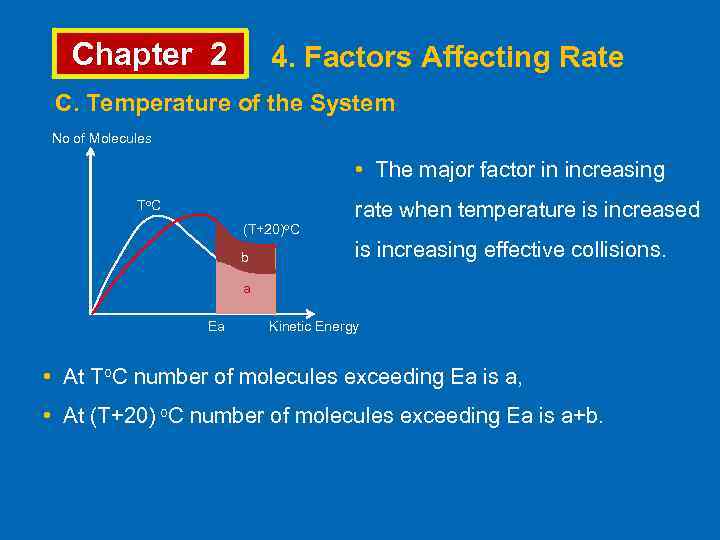
Chapter 2 4. Factors Affecting Rate C. Temperature of the System No of Molecules • The major factor in increasing To. C (T+20)o. C b rate when temperature is increased is increasing effective collisions. a Ea Kinetic Energy • At To. C number of molecules exceeding Ea is a, • At (T+20) o. C number of molecules exceeding Ea is a+b.
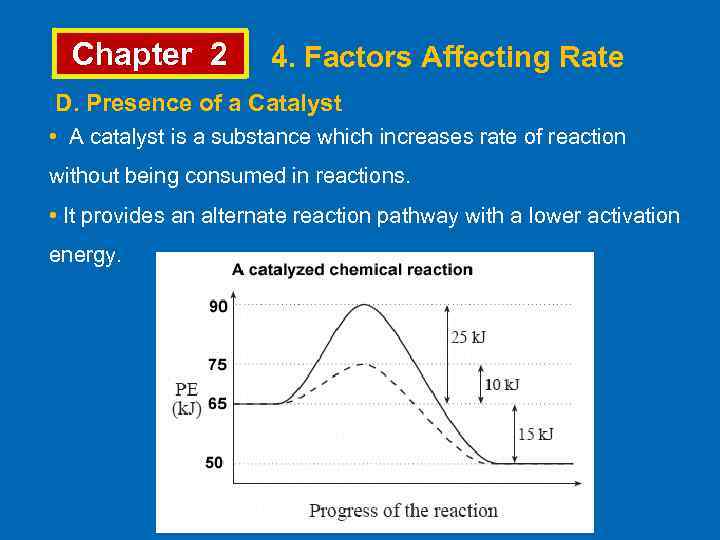
Chapter 2 4. Factors Affecting Rate D. Presence of a Catalyst • A catalyst is a substance which increases rate of reaction without being consumed in reactions. • It provides an alternate reaction pathway with a lower activation energy.
Chapter 2 4. Factors Affecting Rate D. Presence of a Catalyst
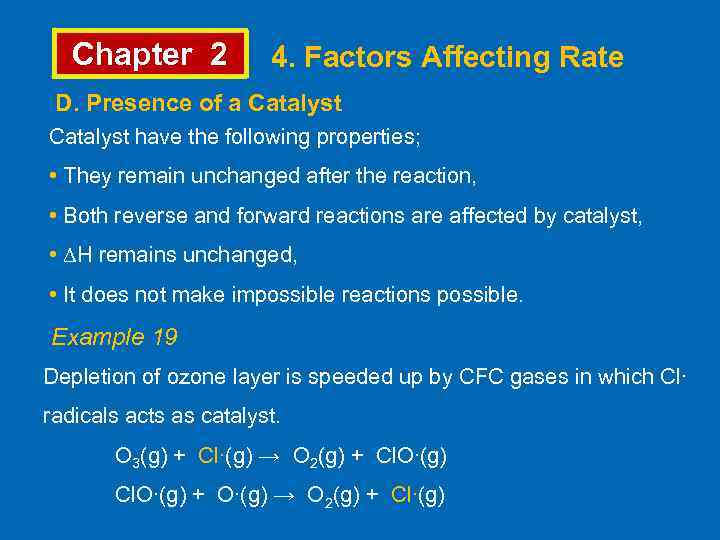
Chapter 2 4. Factors Affecting Rate D. Presence of a Catalyst have the following properties; • They remain unchanged after the reaction, • Both reverse and forward reactions are affected by catalyst, • ∆H remains unchanged, • It does not make impossible reactions possible. Example 19 Depletion of ozone layer is speeded up by CFC gases in which Cl∙ radicals acts as catalyst. O 3(g) + Cl∙(g) → O 2(g) + Cl. O∙(g) + O∙(g) → O 2(g) + Cl∙(g)
Chapter 2 4. Factors Affecting Rate D. Presence of a Catalyst
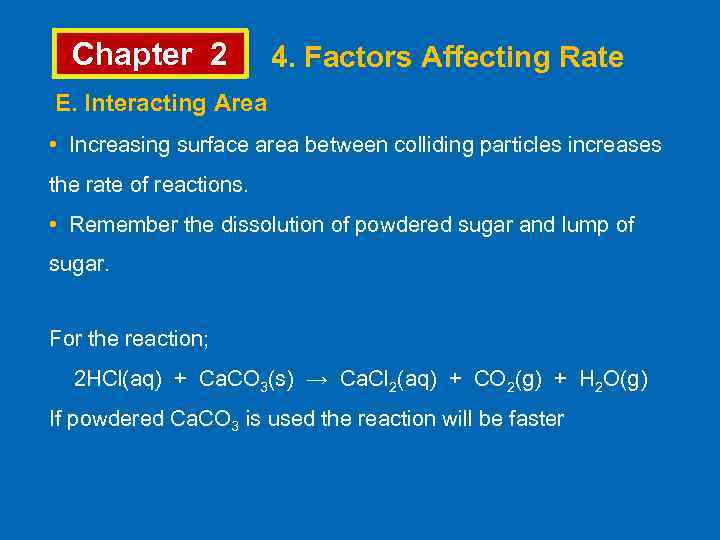
Chapter 2 4. Factors Affecting Rate E. Interacting Area • Increasing surface area between colliding particles increases the rate of reactions. • Remember the dissolution of powdered sugar and lump of sugar. For the reaction; 2 HCl(aq) + Ca. CO 3(s) → Ca. Cl 2(aq) + CO 2(g) + H 2 O(g) If powdered Ca. CO 3 is used the reaction will be faster

End of the chapter 2
Скачать презентацию Chapter 2 Rate of Reactions Table of Contents
Rate of Reactions.pptx