 Скачать презентацию Chapter 2 part 3 CPUs High Performance Embedded
b9d7c66182da624fcb553c3be4dc9182.ppt
- Количество слайдов: 54



Chapter 2, part 3: CPUs High Performance Embedded Computing Wayne Wolf
Topics n n Bus encoding. Security-oriented architectures. CPU simulation. Configurable processors.
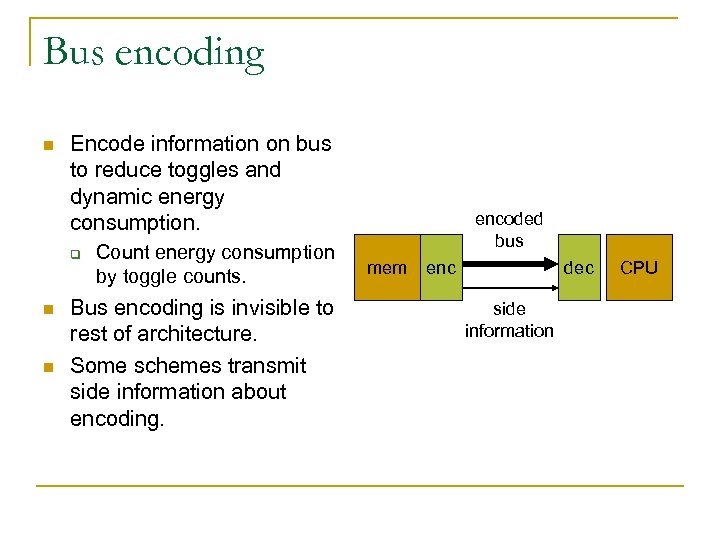
Bus encoding n Encode information on bus to reduce toggles and dynamic energy consumption. q n n Count energy consumption by toggle counts. Bus encoding is invisible to rest of architecture. Some schemes transmit side information about encoding. encoded bus mem enc dec side information CPU
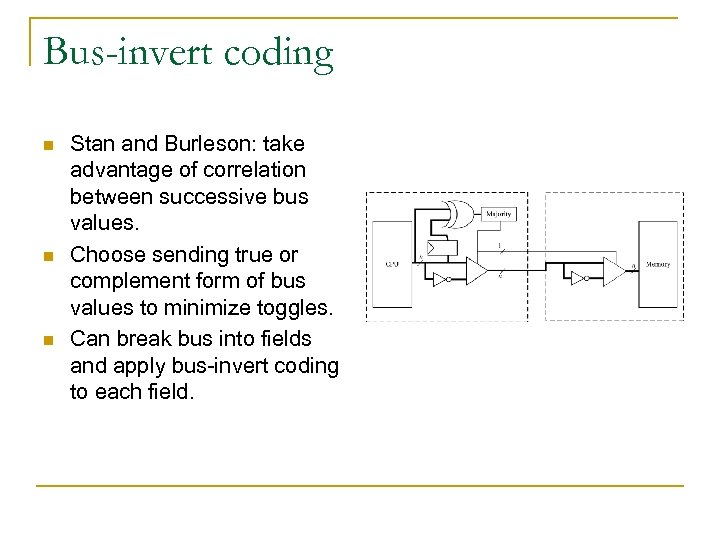
Bus-invert coding n n n Stan and Burleson: take advantage of correlation between successive bus values. Choose sending true or complement form of bus values to minimize toggles. Can break bus into fields and apply bus-invert coding to each field.
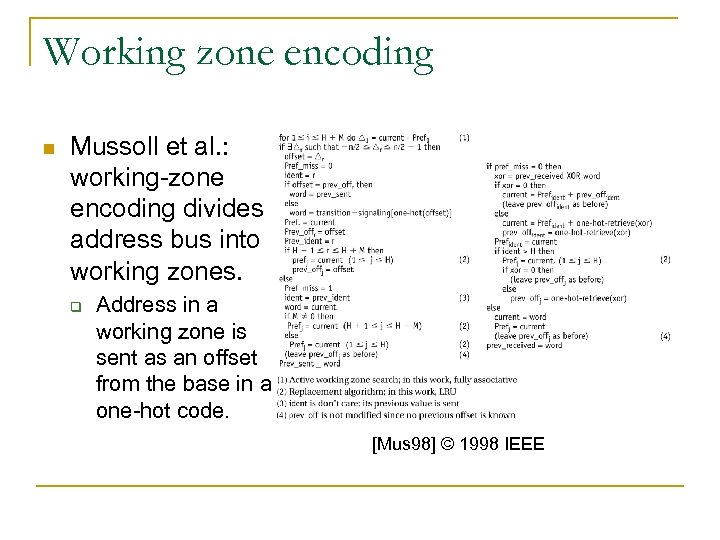
Working zone encoding n Mussoll et al. : working-zone encoding divides address bus into working zones. q Address in a working zone is sent as an offset from the base in a one-hot code. [Mus 98] © 1998 IEEE
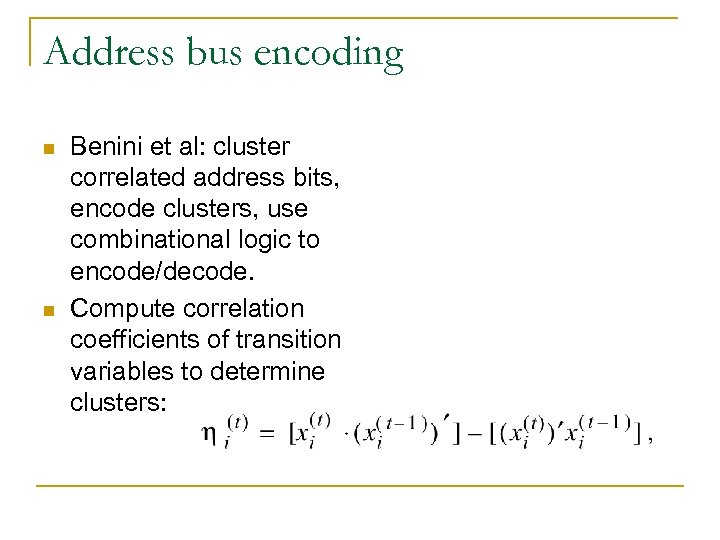
Address bus encoding n n Benini et al: cluster correlated address bits, encode clusters, use combinational logic to encode/decode. Compute correlation coefficients of transition variables to determine clusters:
![Benini et al. results [Ben 98] © 1998 IEEE](https://present5.com/presentation/b9d7c66182da624fcb553c3be4dc9182/image-7.jpg "Benini et al. results [Ben 98] © 1998 IEEE")
Benini et al. results [Ben 98] © 1998 IEEE
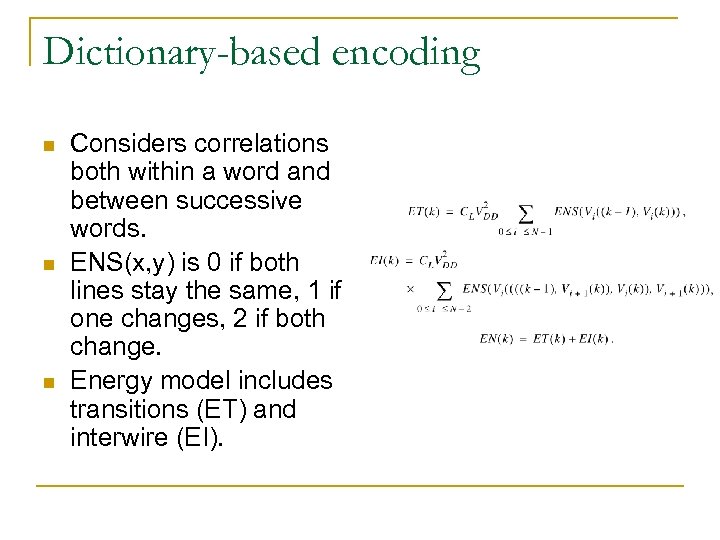
Dictionary-based encoding n n n Considers correlations both within a word and between successive words. ENS(x, y) is 0 if both lines stay the same, 1 if one changes, 2 if both change. Energy model includes transitions (ET) and interwire (EI).
![Lv et al. pattern frequency results [Lv 03] © 2003 IEEE](https://present5.com/presentation/b9d7c66182da624fcb553c3be4dc9182/image-9.jpg "Lv et al. pattern frequency results [Lv 03] © 2003 IEEE")
Lv et al. pattern frequency results [Lv 03] © 2003 IEEE
![Lv et al. dictionary-based architecture [Lv 03] © 2003 IEEE](https://present5.com/presentation/b9d7c66182da624fcb553c3be4dc9182/image-10.jpg "Lv et al. dictionary-based architecture [Lv 03] © 2003 IEEE")
Lv et al. dictionary-based architecture [Lv 03] © 2003 IEEE
![Lv et al. energy savings [Lv 03] © 2003 IEEE](https://present5.com/presentation/b9d7c66182da624fcb553c3be4dc9182/image-11.jpg "Lv et al. energy savings [Lv 03] © 2003 IEEE")
Lv et al. energy savings [Lv 03] © 2003 IEEE
Security-oriented architectures n A variety of attacks: q q n n Typical desktop/server attacks, such as Trojan horses and viruses. Physical access allows side channel attacks. Cryptographic instruction sets have been developed for several architectures. Embedded systems architecture must add protection for side effects, consider energy consumption.
Smart cards n n Used to identify holder, carry money, etc. Self-programmable one-chip microcomputer architecture: q q q Allows processor to change code or data. Memory is divided into two sections. Registers allow program in one section to modify the other section without interfering with the executing program.
Secure architectures n n MIPS, ARM offer security extensions, including encryption instructions, memory management, etc. SAFE-OPS embeds a watermark into code using register assignment. FPGA accelerator checks the validity of the watermark during execution.
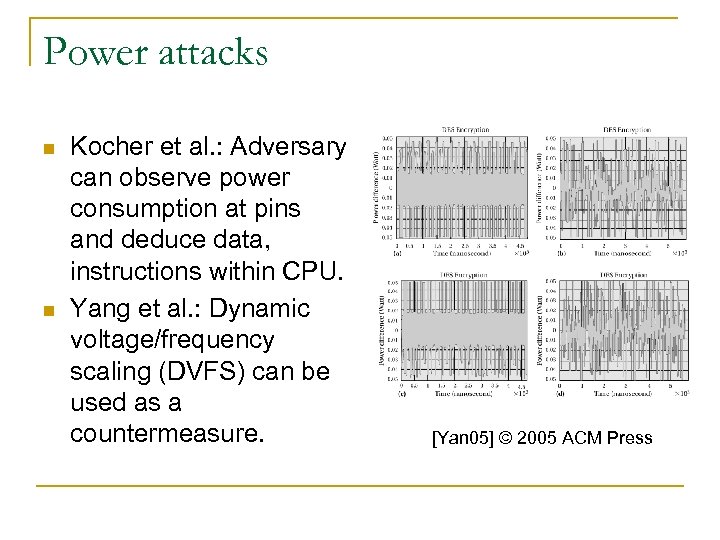
Power attacks n n Kocher et al. : Adversary can observe power consumption at pins and deduce data, instructions within CPU. Yang et al. : Dynamic voltage/frequency scaling (DVFS) can be used as a countermeasure. [Yan 05] © 2005 ACM Press
CPU simulation n n Performance vs. energy/power simulation. Temporal accuracy. Trace vs. execution. Simulation vs. direct execution.
![Engblom embedded vs. SPEC comparison [Eng 99 b] © 1999 ACM Press](https://present5.com/presentation/b9d7c66182da624fcb553c3be4dc9182/image-17.jpg "Engblom embedded vs. SPEC comparison [Eng 99 b] © 1999 ACM Press")
Engblom embedded vs. SPEC comparison [Eng 99 b] © 1999 ACM Press
Trace-based analysis n n n Instrumentation generates side information. PC-sampling checks PC value during execution. Can measure control flow, memory accesses.
Microarchitecture-modeling simulators n Varying levels of detail: q q n n Instruction scheduler is not cycle-accurate. Cycle timers are cycle-accurate. Can simulate for performance or energy/power. Typically written in general-purpose programming language, not hardware description language.
PC sampling n n Example: Unix prof. Interrupts are used to sample PC periodically. q q q Must run on the platform. Doesn’t provide complete trace. Subject to sampling problems: undersampling, periodicity problems.
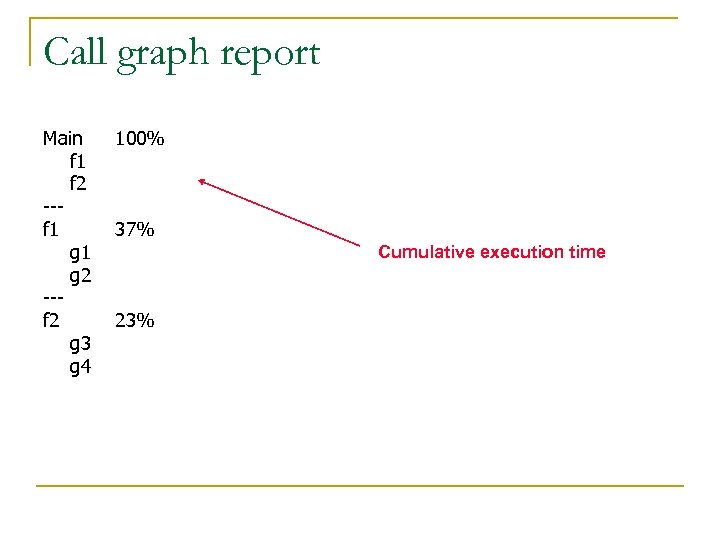
Call graph report Main f 1 f 2 --f 1 g 2 --f 2 g 3 g 4 100% 37% Cumulative execution time 23%
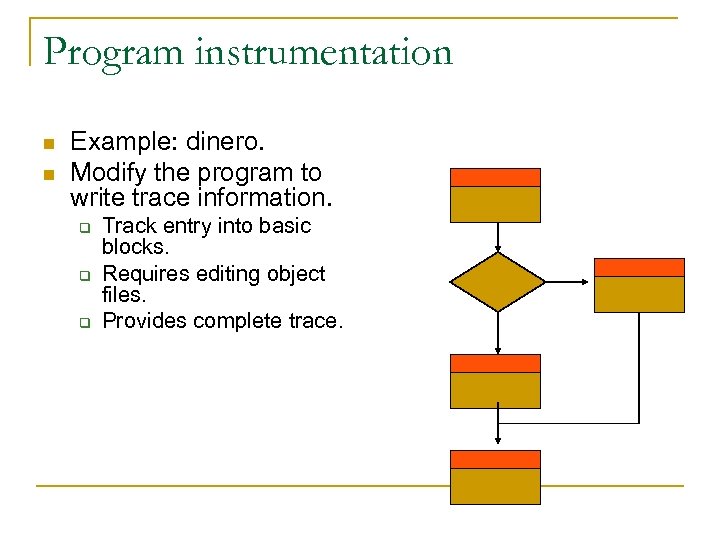
Program instrumentation n n Example: dinero. Modify the program to write trace information. q q q Track entry into basic blocks. Requires editing object files. Provides complete trace.
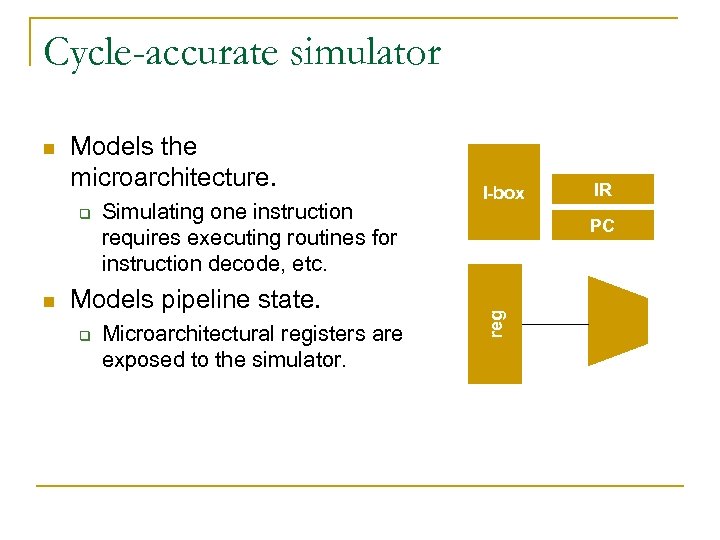
Cycle-accurate simulator Models the microarchitecture. q n Simulating one instruction requires executing routines for instruction decode, etc. Models pipeline state. q Microarchitectural registers are exposed to the simulator. I-box IR PC reg n
Trace-based vs. execution-based n Trace-based: q q Gather trace first, then generate timing information. Basic timing information is simpler to generate. Full timing information may require regenerating information from the original execution. Requires owning the platform. n Execution-based: q q q Simulator fully executes the instruction. Requires a more complex simulator. Requires explicit knowledge of the microarchitecture, not just instruction execution times.
Sources of timing information n Data book tables: q q Time of individual instructions. Penalties for various hazards. n Microarchitecture: q q Depends from the structure of machine. Derived from execution of the instruction in the microarchitecture.
Levels of detail in simulation n Instruction schedulers: q q n Models availability of microarchitectural resources. May not capture all interactions. Cycle timers: q q Models full microarchitecture. Most accurate, requires exact model of the microarchitecture.
Modular simulators n Model instructions through a description file. q n Drives assembler, basic behavioral simulation. Assemble a simulation program from code modules. q Can add your own code.
Early approaches to power modeling n Instruction macromodels: q n Data-dependent models: q n ADD = 1 mw, JMP = 2 mw, etc. Based on data value statistics. Transition-based models.
Power simulation n n Model capacitance in the processor. Keep track of activity in the processor. q n Requires full simulation. Activity determines capacitive charge/discharge, which determines power consumption.
Simple. Power simulator n Cycle-accurate simulator. q n Simple. Scalar-style cycle-accurate simulator. Transition-based power analysis. q Estimates energy of data path, memory, and busses on every clock cycle.
RTL power estimation interface n A power estimator is required for each functional unit modeled in the simulator. q n Functional interface makes the simulator more modular. Power estimator takes same arguments as the performance simulation module.
Switch capacitance tables n n n Model functional units such as ALU, register files, multiplexers, etc. Capture technology-dependent capacitance of the unit. Two types of model: q Bit-independent: each bit is independent, model is one bit wide. q Bit-dependent: bits interact (as in adder), model must be multiple bits. Analytical models used for memories. Adder model is built from sub-model for adder slice.
Wattch power simulator n n Built on top of Simple. Scalar. Adds parameterized power models for the functional units.
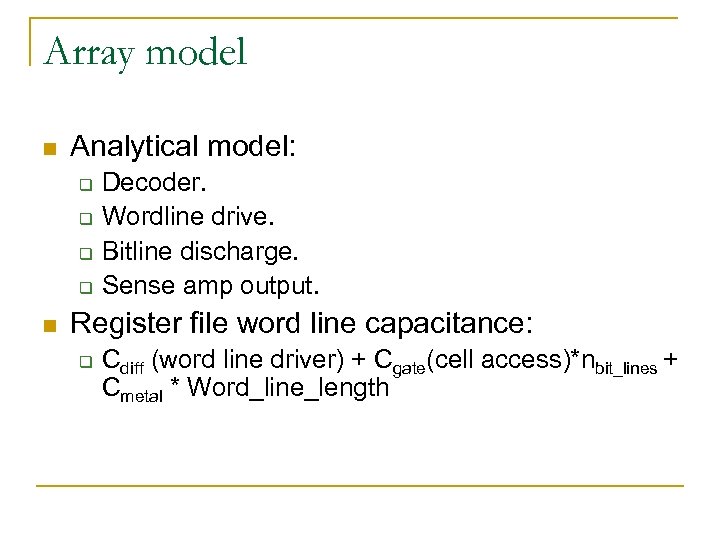
Array model n Analytical model: q q n Decoder. Wordline drive. Bitline discharge. Sense amp output. Register file word line capacitance: q Cdiff (word line driver) + Cgate(cell access)*nbit_lines + Cmetal * Word_line_length
Bus, function unit models n n Bus model based upon length of bus, capacitance of bus lines. Models for ALUs, etc. based upon transistion models.
Clock network power model n n Clock is a major power sink in modern designs. Major elements of the clock power model: q q q n Global clock lines. Global drivers. Loads on the clock network. Must handle gated clocks.
Automated CPU design n Customize aspects of CPU for application: q q q n n Instruction set. Memory system. Busses and I/O. Tools help design and implement custom CPUs. FPGAs make it easier to implement custom CPUs. Application-specific instruction processor (ASIP) has custom instruction set. Configurable processor is generated by a tool set. M
Types of customization n n New instructions: operations, operands, remove unused instructions. Specialized pipelines. Specialized memory hierarchy. Busses and peripherals.

Techniques n n n Architecture optimization tools help choose the instruction set and microarchitecture. Configuration tools implement the microarchitecture (and perhaps compiler). Early example: MIMOLA analyzed programs, created microarchitecture and instructions, synthesized logic.
CPU configuration process
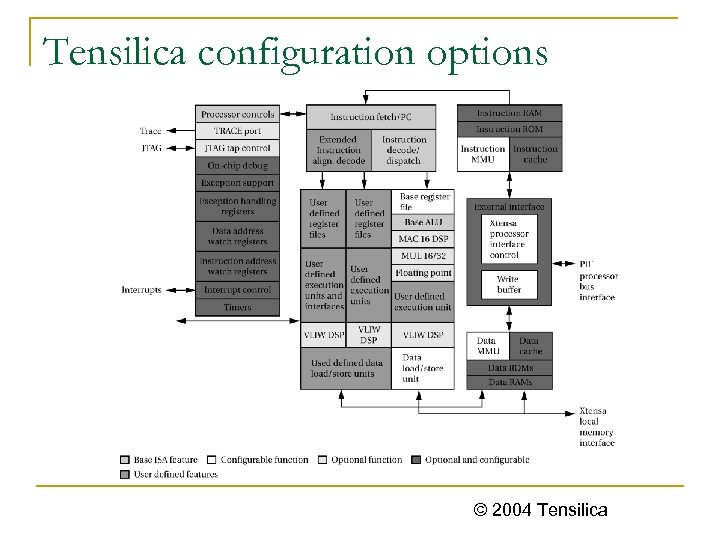
Tensilica configuration options © 2004 Tensilica
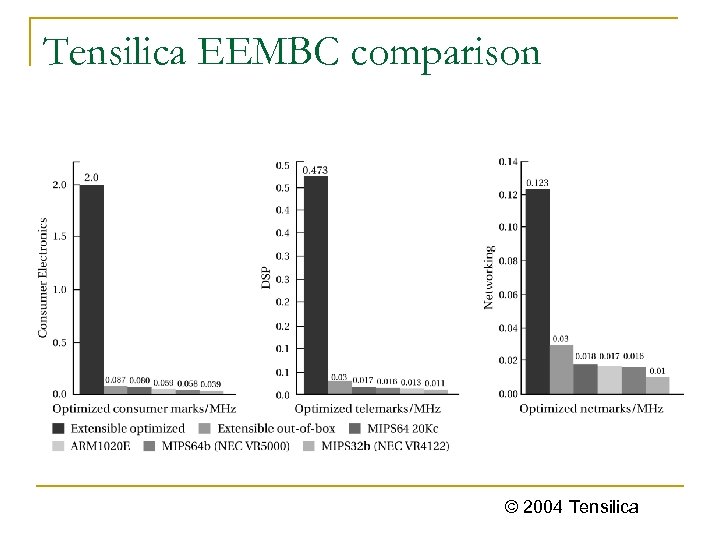
Tensilica EEMBC comparison © 2004 Tensilica
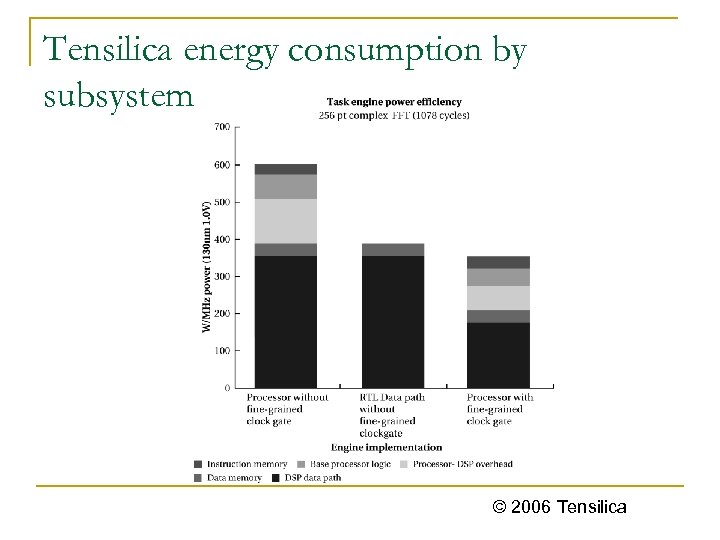
Tensilica energy consumption by subsystem © 2006 Tensilica
Toshiba Me. Pcore
![LISA language [Hof 01] © 2001 IEEE](https://present5.com/presentation/b9d7c66182da624fcb553c3be4dc9182/image-45.jpg "LISA language [Hof 01] © 2001 IEEE")
LISA language [Hof 01] © 2001 IEEE
LISA descriptions and generation n n Memory model includes registers and other memories. Uses clause binds operations to hardware. Timing specified by PIPELINE, IN, ACTIVATION, ENTITY. Generates hierarchical VHDL design.
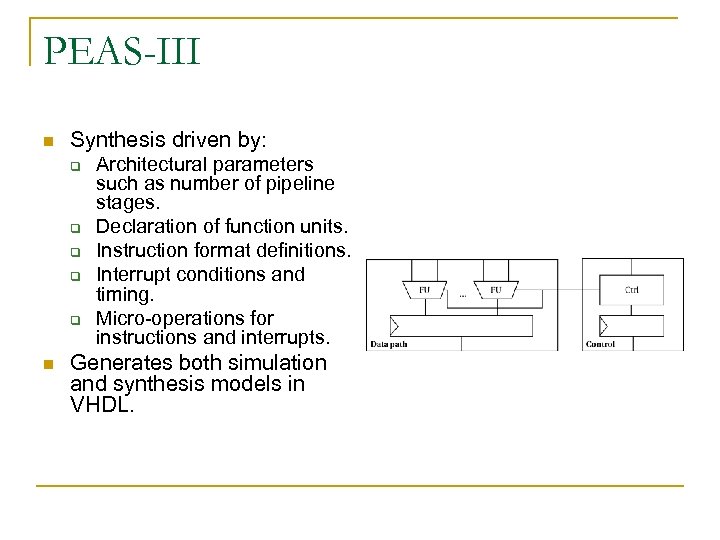
PEAS-III n Synthesis driven by: q q q n Architectural parameters such as number of pipeline stages. Declaration of function units. Instruction format definitions. Interrupt conditions and timing. Micro-operations for instructions and interrupts. Generates both simulation and synthesis models in VHDL.
Instruction set synthesis n n Generate instruction set from application program, other requirements. Sun et al. analyzed design space for simple BYTESWAP() program. [Sun 04] © 2004 IEEE
Holmer and Despain n n 1% rule---don’t add instruction unless it improves performance by 1%. Objective function (C = # cycles, I = # instruction types, S = # instructions in program): q q n 100 ln C + I 100 ln C + 20 ln S + I Used microcode compaction algorithms to find instructions.
Other techniques n Huang and Despain used simulated annealing to search the design space. q n Moves could reschedule micro-op, exchange micro-ops, insert or delete time steps. Kastner et al. used clustering to generate instructions. q Clusters must cover the program graph.
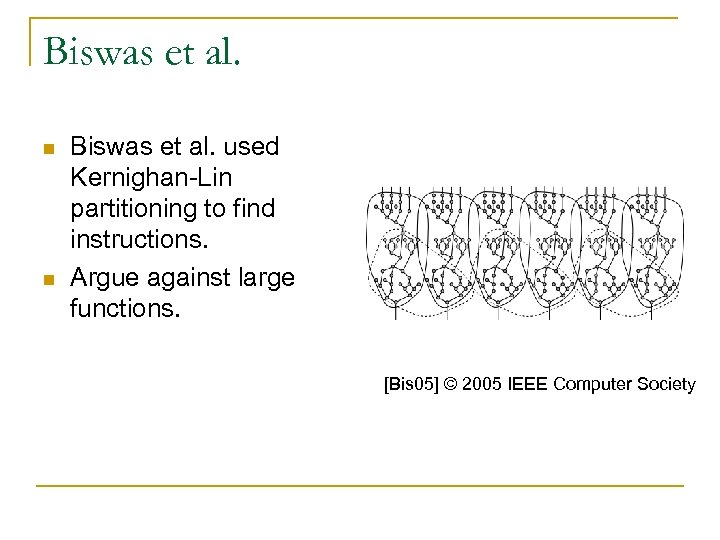
Biswas et al. n n Biswas et al. used Kernighan-Lin partitioning to find instructions. Argue against large functions. [Bis 05] © 2005 IEEE Computer Society
Complex function definition n Atasu et al. try to combine many operations into an instruction: q q n Disjoint operator graphs. Multi-output instructions. Operator graph must be convex---value cannot leave, then re-enter the instruction. [Ata 03] © 2003 ACM Press
Other techniques n n Pozzi and Ienne extract large instructions, generating multi-cycle operations and multiple memory ports. Tensilica Xpres compiler designs instruction sets: operator fusion, vector, etc.
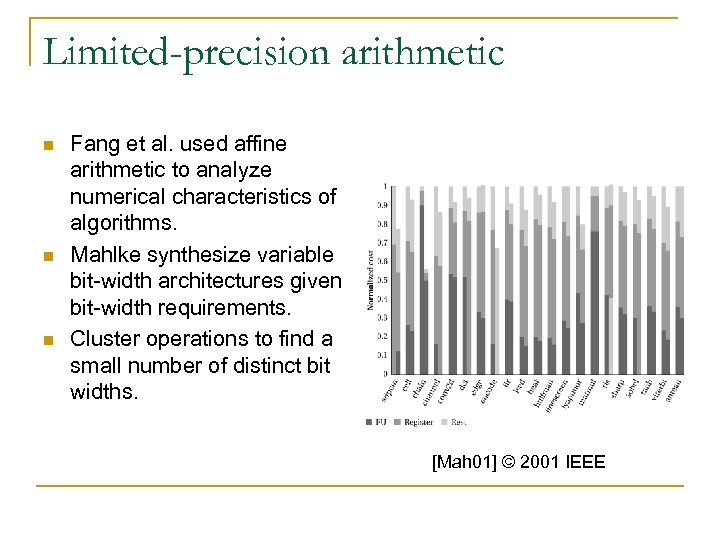
Limited-precision arithmetic n n n Fang et al. used affine arithmetic to analyze numerical characteristics of algorithms. Mahlke synthesize variable bit-width architectures given bit-width requirements. Cluster operations to find a small number of distinct bit widths. [Mah 01] © 2001 IEEE
Скачать презентацию Chapter 2 part 3 CPUs High Performance Embedded
b9d7c66182da624fcb553c3be4dc9182.ppt