


 Скачать презентацию Chapter 2 Origins of American Government 2 1
23190f96051166efcbcc9216751707c1.ppt
- Количество слайдов: 31
 Chapter 2: Origins of American Government 2. 1: Our Political Beginnings 2. 2: The Coming of Independence 2. 3: The Critical Period 2. 4: Creating the Constitution 2. 5: Ratifying the Constitution
 Drawing From Greek History n The Ekklesia n Any member of the demos was welcomed to attend the meetings of the ekklesia, n The Boule n The second important institution was the boule, or Council of Five Hundred chosen by lot. n The Dikasteria n Every day, more than 500 jurors were chosen by lot from a pool of male citizens older than 30.
 Rome In Rome, however, elected officials from the lower and upper class met in a legislature, called a Senate. Because these individuals were elected, Rome was Republic
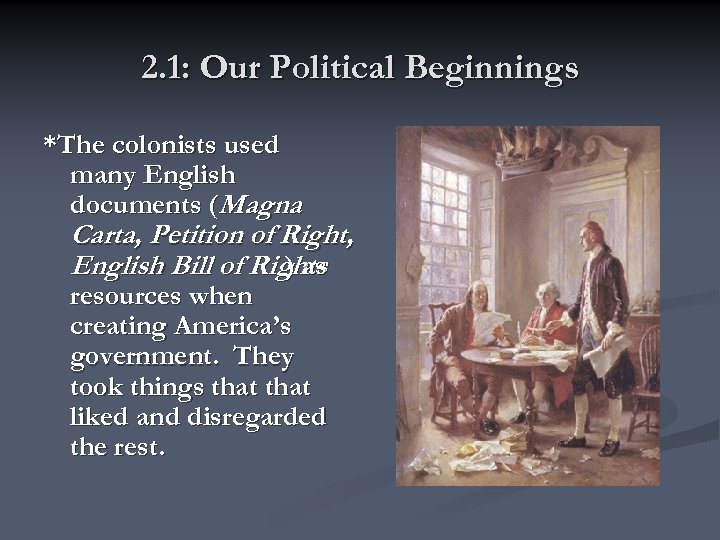 2. 1: Our Political Beginnings *The colonists used many English documents (Magna Carta, Petition of Right, English Bill of Rights ) as resources when creating America’s government. They took things that liked and disregarded the rest.
 British: Parliament n Parliament: Henry III of England started a tradition of meeting with high officials (birth of our Congress) n 1628 Petition of Rights n By the 1600’s, parliament included representatives of the common people and was more powerful than the monarch eventually removing, the king in 1688 in a peaceful revolution. --
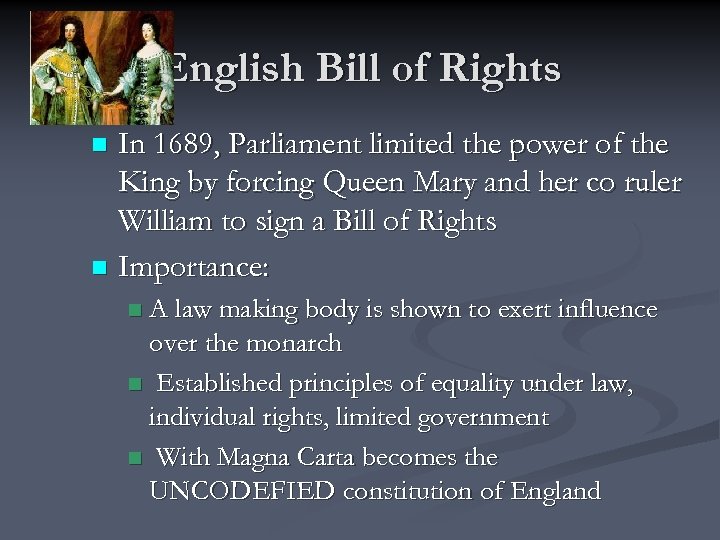 English Bill of Rights In 1689, Parliament limited the power of the King by forcing Queen Mary and her co ruler William to sign a Bill of Rights n Importance: n A law making body is shown to exert influence over the monarch n Established principles of equality under law, individual rights, limited government n With Magna Carta becomes the UNCODEFIED constitution of England n
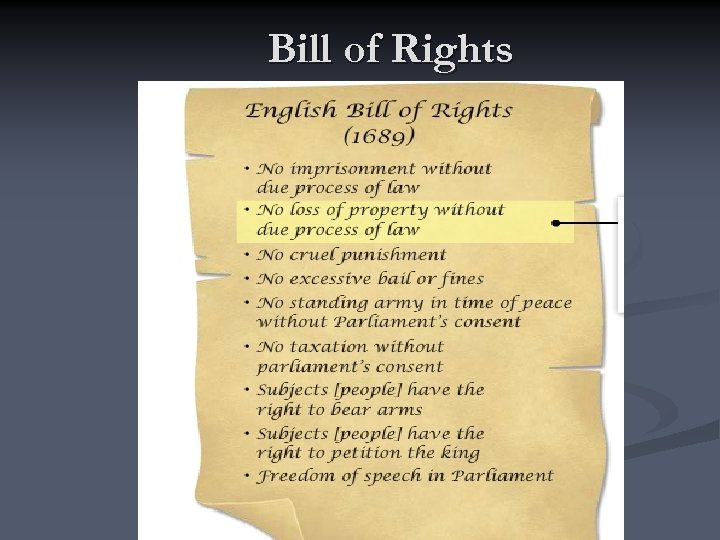 Bill of Rights
 1 st English Settlements n n n 1607 - Jamestown, Virginia ***This was the first Permanent English Settlement in America House of Burgesses was formed: the first Congress was composed of 2 men from each county. These 22 men would meet with the appointed governor and his council. The House of burgess was important because it created a foundation for representation in America
 Mayflower Compact Pilgrims Established MAYFLOWER COMPACT, the first written form of government in America. n Importance: n A covenant, an agreement by all in the civil body to govern themselves n Stressed equality n Self government n Majority Rule n Direct Democracy n
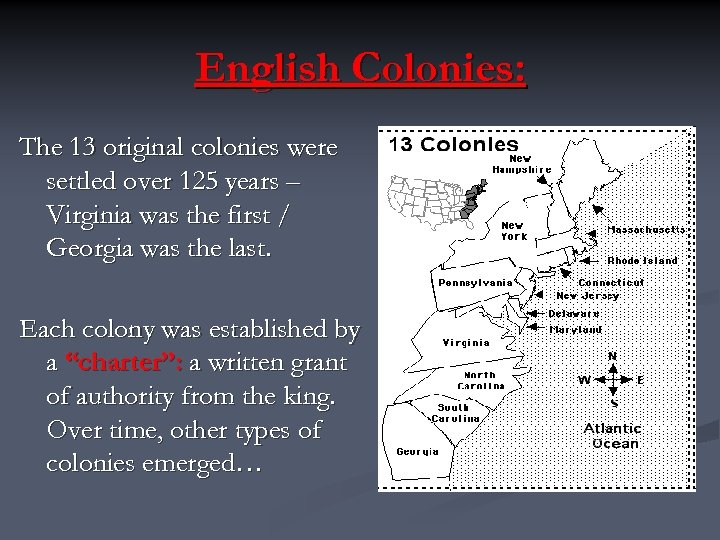 English Colonies: The 13 original colonies were settled over 125 years – Virginia was the first / Georgia was the last. Each colony was established by a “charter”: a written grant of authority from the king. Over time, other types of colonies emerged…
 Types of Colonies: 1. “Charter”: largely self-governing – leaders were elected by property owners – could make many of their own laws (Conn / RI). 2. “Proprietary”: organized by a proprietor (person who the king had granted land) – governor was appointed by proprietor – less freedom than charter colonies (MY / DE). 3. “Royal”: royal crown organized most of government – all new laws needed approval – least freedom of the 3 types (8 by time of Amer. Rev. )
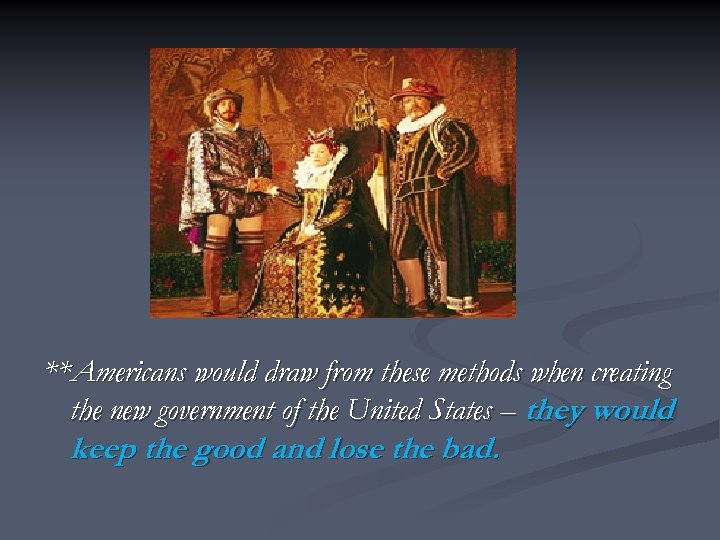 **Americans would draw from these methods when creating the new government of the United States – they would keep the good and lose the bad.
 2. 2: The Coming of Independence In the beginning, colonists were given a decent amount of freedom and self-government. Over time, England (King George III) began to restrict this freedom. *The colonists had no representatives in English Parliament, which they greatly resented. *England was more than 3, 000 miles (and 2 months journey) away. When England began passing restrictive laws, the colonists soon considered protest and eventually rebellion.
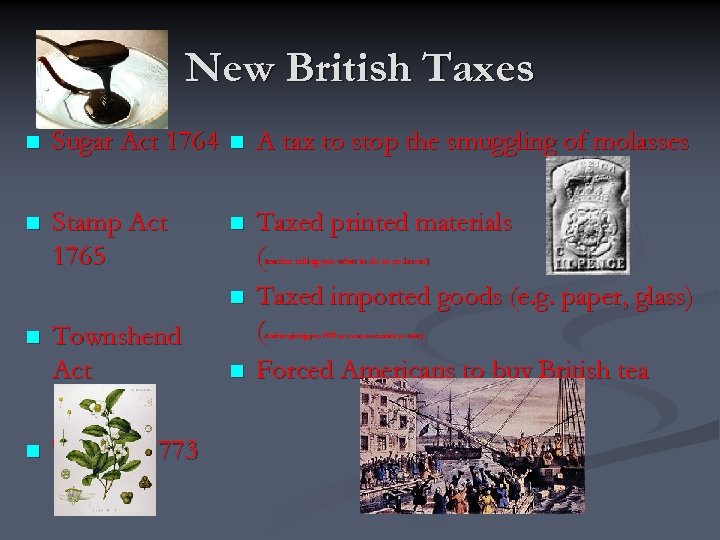 New British Taxes n Sugar Act 1764 n A tax to stop the smuggling of molasses n Stamp Act 1765 n Taxed printed materials ( Taxed imported goods (e. g. paper, glass) ( Forced Americans to buy British teacher telling you what to do in yo house) n n n Townshend Act Tea Act 1773 teacher giving you HW as a way to control yo time) n
 New British Practices n Vice Admiralty Courts 1763 n Courts run by military officers not civilians n Proclamation of 1763 n Restricted movement up to the Appalachian Mountains n Quartering Act 1765 n Colonists had to provide British troops with room and board n Writs of Assistance 1767 n Search warrants that allowed officers to search for smuggled goods
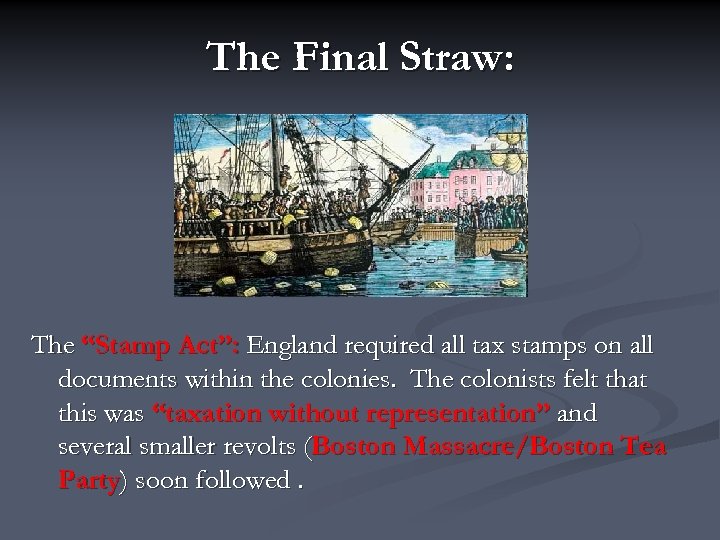 The Final Straw: The “Stamp Act”: England required all tax stamps on all documents within the colonies. The colonists felt that this was “taxation without representation” and several smaller revolts (Boston Massacre/Boston Tea Party) soon followed.
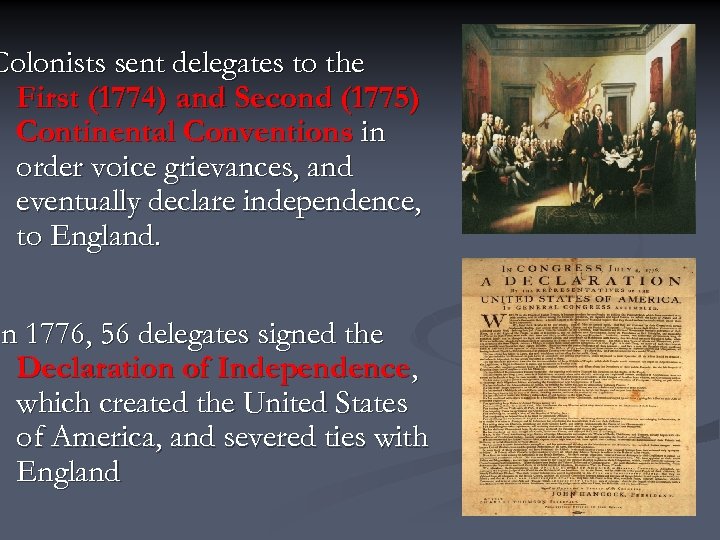 Colonists sent delegates to the First (1774) and Second (1775) Continental Conventions in order voice grievances, and eventually declare independence, to England. In 1776, 56 delegates signed the Declaration of Independence, which created the United States of America, and severed ties with England
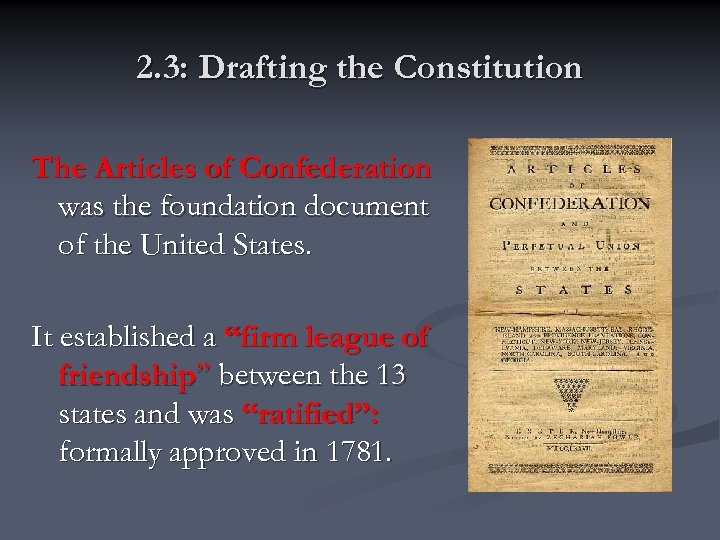 2. 3: Drafting the Constitution The Articles of Confederation was the foundation document of the United States. It established a “firm league of friendship” between the 13 states and was “ratified”: formally approved in 1781.
 The Articles of Confederation: Congress: unicameral – its powers were very limited was and each state had one vote (regardless of its population). The States: agreed to follow the acts of Congress, provide funds and troops requested by Congress, treat citizens of other state fairly and equally, and allow open travel and trade between states (among other things).
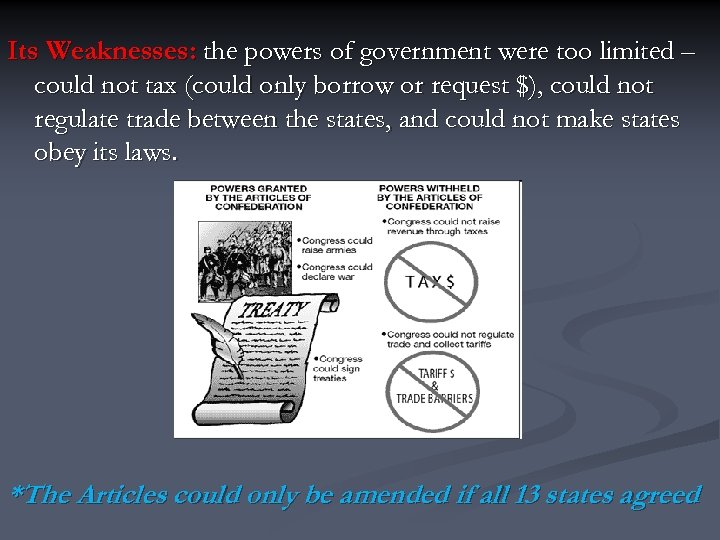 Its Weaknesses: the powers of government were too limited – could not tax (could only borrow or request $), could not regulate trade between the states, and could not make states obey its laws. *The Articles could only be amended if all 13 states agreed
 States instantly became jealous and suspicious of one another (Congress couldn’t act). States refused to follow Congressional decisions, taxed each other’s goods, banned trade, and organized their own militaries and currencies. Violence and economic chaos broke out. Very quickly, leaders realized that a new foundation of government was needed. In 1787, state delegates met in Philadelphia in order to construct this new foundation. This meeting became known as the Constitutional Convention.
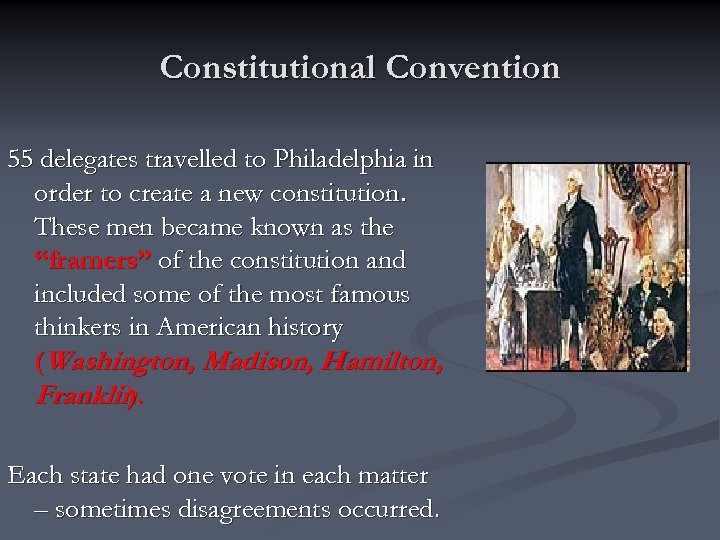 Constitutional Convention 55 delegates travelled to Philadelphia in order to create a new constitution. These men became known as the “framers” of the constitution and included some of the most famous thinkers in American history (Washington, Madison, Hamilton, Franklin ). Each state had one vote in each matter – sometimes disagreements occurred.
 The Virginian Plan: Called for a national government with expanded powers and three branches. Congress would be bicameral and representation in each house would be based on each state’s population or on the amount of money it donated to the central government. *This plan favored larger, wealthier states.
 The New Jersey Plan: Called for a national government with limited extra powers. Congress would be unicameral, with each state represented equally. *This plan created an equal playing field for smaller, less wealthy states.
 The Connecticut Compromise: Created a bicameral Congress – in the smaller Senate, each state would be represented equally. In the larger House, representation of each state would be based on population. *This plan satisfied both large and small states and became known as the Great Compromise.
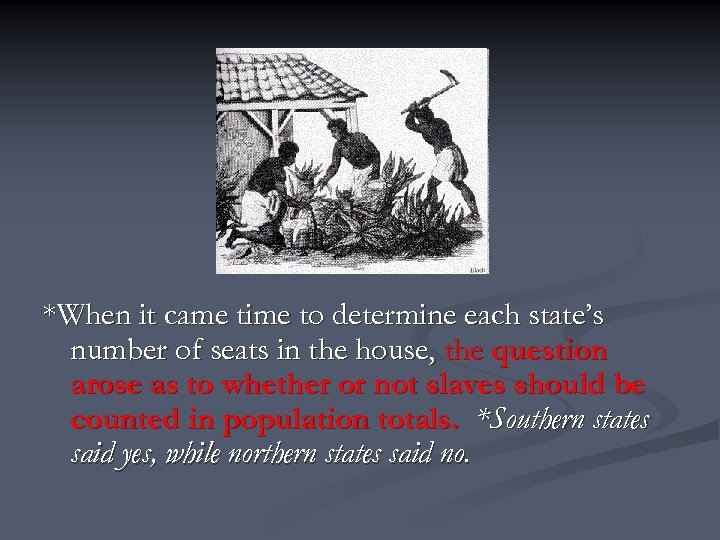 *When it came time to determine each state’s number of seats in the house, the question arose as to whether or not slaves should be counted in population totals. *Southern states said yes, while northern states said no.
 The Three-Fifths Compromise: Stated that all “free persons” would be counted, and so would “three-fifths” of all other persons. *Taxes paid by each state was based on population – this compromise came at a price for southern states. The U. S. Constitution became known as a “bundle of compromises”. details were often argued, the While major principles were unanimous – limited government and popular sovereignty.
 2. 5: Ratifying the Constitution Many people opposed the new constitution – two opposing sides quickly emerged: “Federalists”: favored the new constitution – believed the Articles of Confederation were too weak and that a new government was necessary. “Anti-Federalists”: opposed the new constitution – believed the new government had too much power and that there should be a bill of rights that guaranteed individual freedoms.
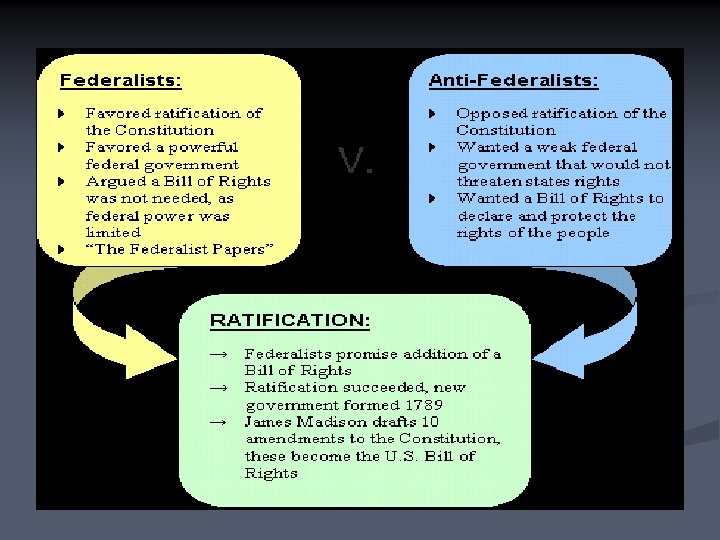
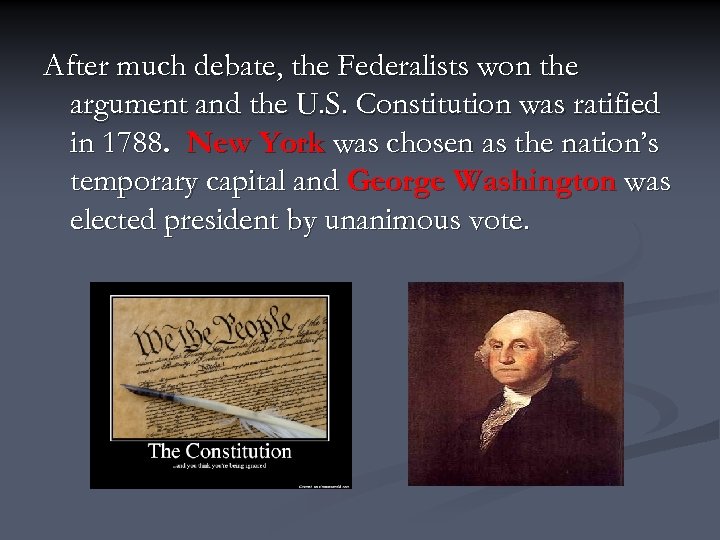 After much debate, the Federalists won the argument and the U. S. Constitution was ratified in 1788. New York was chosen as the nation’s temporary capital and George Washington was elected president by unanimous vote.
 Group Activity: In groups of 3 or 4 – describe the following arguments that took place when creating the constitution: 1. The Virginia Plan (how was government set up? ) 2. The New Jersey Plan (how was government set up? ) 3. The Connecticut Compromise (how was it settled? ) 4. The 3/5 Compromise (how were slaves dealt with? )