


 Скачать презентацию Chapter 2 Operations Strategy Operations Management SAUNGWEME PW
1bb3916973f3b401dfe12f9c0f7f271f.ppt
- Количество слайдов: 38
 Chapter 2 Operations Strategy Operations Management SAUNGWEME PW 1 MSU GWERU
 Lecture Outline • • Strategy Formulation Competitive Priorities Operations’ Role in Corporate Strategy and the Internet Strategic Decisions in Operations Strategy Deployment Issues and Trends in Operations 2
 Four Steps for Strategy Formulation • Defining a primary task – What is the firm in the business of doing? • Assessing core competencies – What does the firm do better than anyone else? • Determining order winners and order qualifiers – What wins the order? – What qualifies an item to be considered for purchase? • Positioning the firm – How will the firm compete? 3
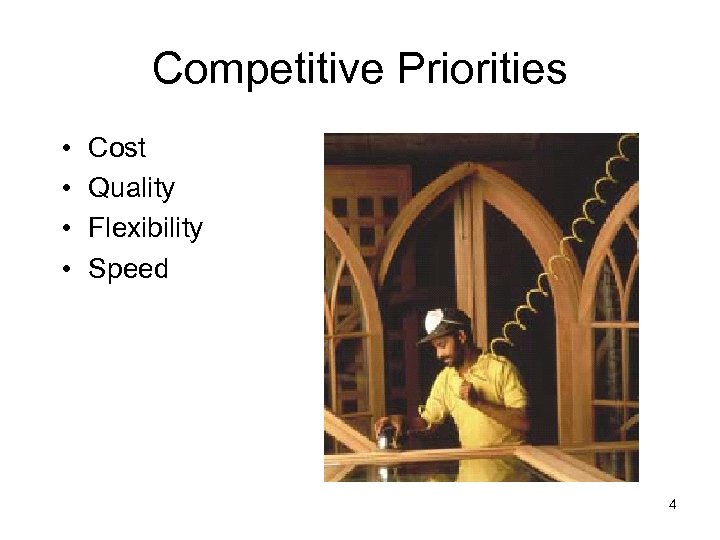 Competitive Priorities • • Cost Quality Flexibility Speed 4
 Competitive Priorities: Cost • Lincoln Electric – reduced costs by $10 million a year for 10 years – skilled machine operators save the company millions that would have been spent on automated equipment • Southwest Airlines – one type of airplane facilitates crew changes, recordkeeping, maintenance, and inventory costs – direct flights mean no baggage transfers – $30 million annual savings in travel agent commissions by requiring customers to contact the airline directly 5
 Competitive Priorities: Quality • Ritz-Carlton - one customer at a time – Every employee is empowered to satisfy a guest’s wish – Teams at all levels set objectives and devise quality action plans – Each hotel has a quality leader – Quality reports tracks • guest room preventive maintenance cycles • percentage of check-ins with no waiting • time spent to achieve industry-best clean room appearance – Guest Preference Reports are recorded in a database 6
 Competitive Priorities: Flexibility • Andersen Windows – number of products offered grew from 28, 000 to 86, 000 – number of errors are down to 1 per 200 truckloads • Custom Foot Shoe Store: – customer’s feet are scanned electronically to capture measurements – custom shoes are mailed to the customer’s home in weeks – prices are comparable to off-the-shelf shoes • National Bicycle Industrial Company – offers 11, 231, 862 variations – delivers within two weeks at costs only 10% above standard models 7
 Competitive Priorities: Speed Citicorp - advertises a 15 -minute mortgage approval L. L. Bean - ships orders the day they are received Wal-Mart - replenishes its stock twice a week Hewlett-Packard - produces electronic testing equipment in five days General Electric - reduces time to manufacture circuitbreaker boxes into three days and dishwashers into 18 hours Dell - ships custom-built computers in two days Motorola - needs less than 30 minutes to build to order pagers 8
 Operations’ Role in Corporate Strategy • Operations provides support for a differentiated strategy • Operations serves as a firm’s distinctive competence in executing similar strategies better than competitors 9
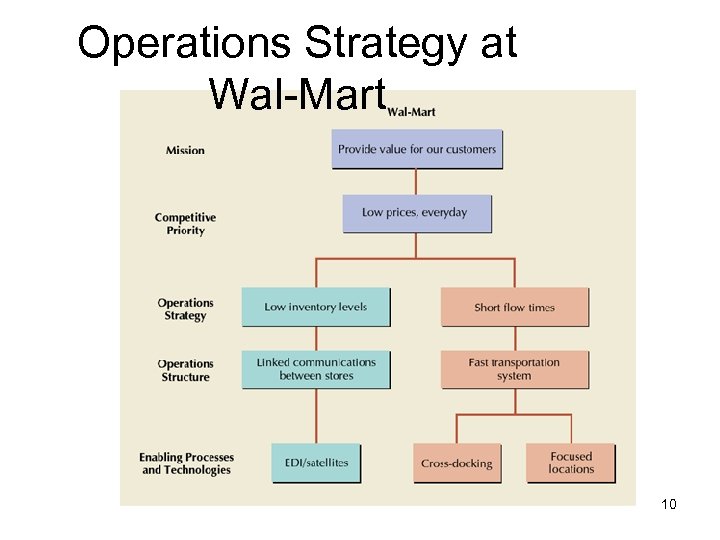 Operations Strategy at Wal-Mart 10
 Strategy and the Internet • Internet can be used to create a distinctive business strategy • e. Bay – unlimited capacity and a huge market – all work is done by buyers and sellers and there is no marginal cost • Cisco – integrated value chain is its competitive advantage 11
 Strategy and the Internet (cont. ) • Internet can be used to strengthen existing competitive advantages by integrating new and traditional activities – GE’s Trading Process Network: an automated Web-based purchasing system • cut average purchasing cost in half • enabled a much larger group of suppliers to bid on jobs • customers were able to track their orders through shop in real time – Intel • sells $2 billion a month over the Internet • purchases 80% of its direct materials online • replaced 19, 000 sales-order faxes received daily 12
 Strategy and the Internet (cont. ) • Lessons from the dot com shakedown – Internet is the great equalizer • allows innovations to be copied with little investment • companies may reach larger market • customers have more information and can compare prices and features of their products. • These benefits are temporary unless… – Companies provide unique value to customer 13
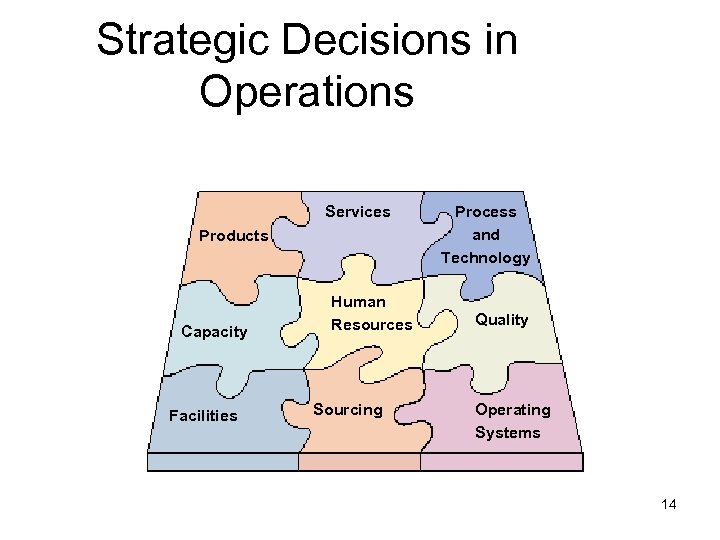 Strategic Decisions in Operations Services Products Capacity Facilities Human Resources Sourcing Process and Technology Quality Operating Systems 14
 Operations Strategy: Products and Services • Make-to-Order – products and services are made to customer specifications after an order has been received • Make-to-Stock – products and services are made in anticipation of demand • Assemble-to-Order – products and services add options according to customer specifications 15
 Production Strategy: Processes and technology • Project – one-at-a-time production of a product to customer order • Batch Production – systems process many different jobs at the same time in groups (or batches) • Mass Production – large volumes of a standard product for a mass market • Continuous Production – used for very high volume commodity products 16
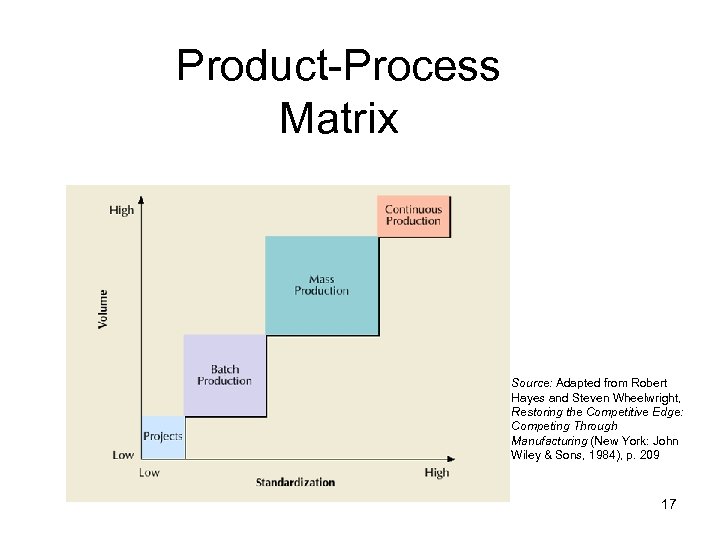 Product-Process Matrix Source: Adapted from Robert Hayes and Steven Wheelwright, Restoring the Competitive Edge: Competing Through Manufacturing (New York: John Wiley & Sons, 1984), p. 209 17
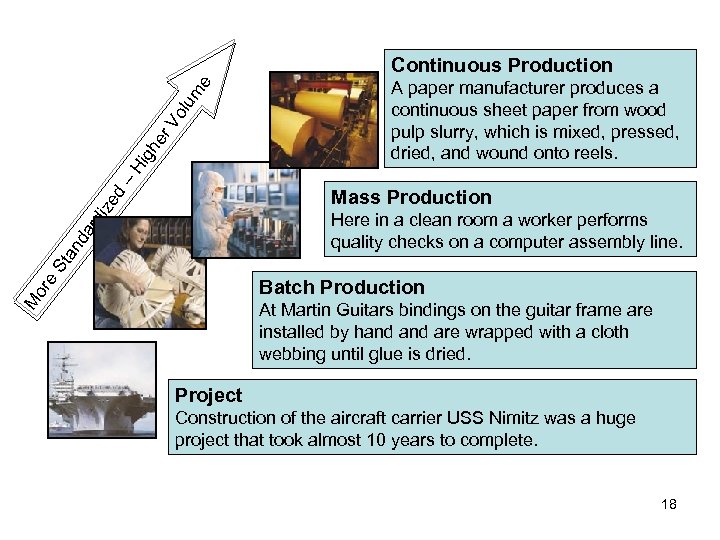 – Hi gh er Vo lum e Continuous Production A paper manufacturer produces a continuous sheet paper from wood pulp slurry, which is mixed, pressed, dried, and wound onto reels. rd ize d Mass Production St an da Here in a clean room a worker performs quality checks on a computer assembly line. M or e Batch Production At Martin Guitars bindings on the guitar frame are installed by hand are wrapped with a cloth webbing until glue is dried. Project Construction of the aircraft carrier USS Nimitz was a huge project that took almost 10 years to complete. 18
 Service Strategy: Processes and Technology • Professional Service – highly customized and very labor intensive • Service Shop – customized and labor intensive • Mass Service – less customized and less labor intensive • Service Factory – least customized and least labor intensive 19
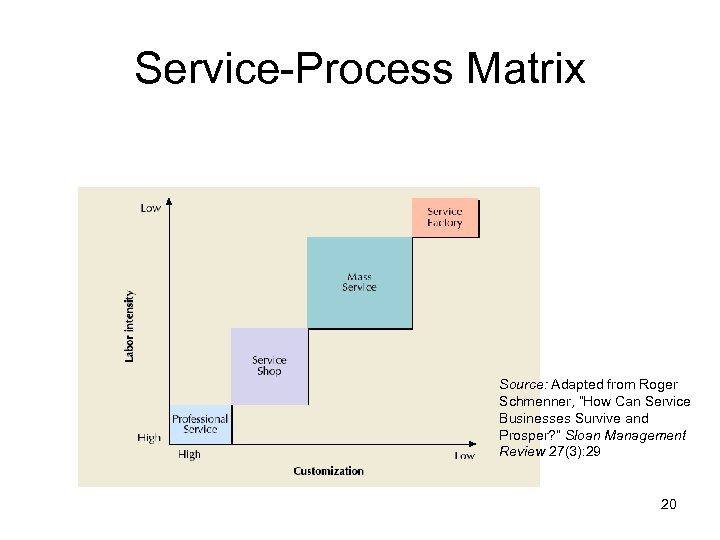 Service-Process Matrix Source: Adapted from Roger Schmenner, “How Can Service Businesses Survive and Prosper? ” Sloan Management Review 27(3): 29 20
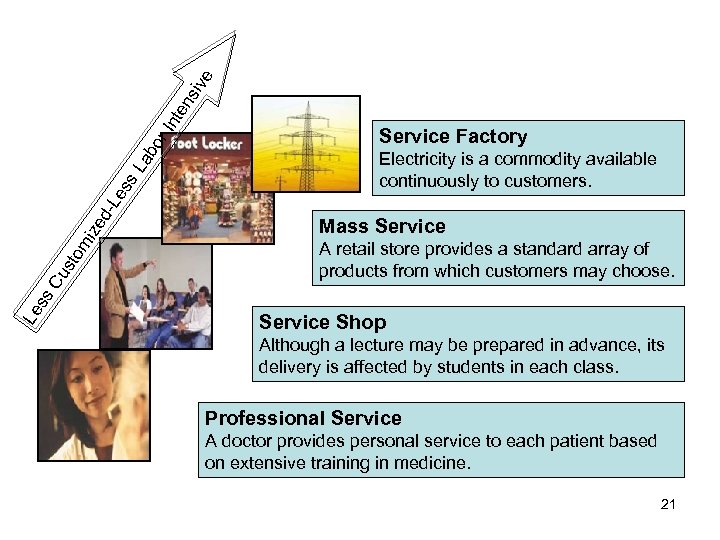 nte ns ive r. I bo La Electricity is a commodity available continuously to customers. Le ss C us to mi ze d- Le ss Service Factory Mass Service A retail store provides a standard array of products from which customers may choose. Service Shop Although a lecture may be prepared in advance, its delivery is affected by students in each class. Professional Service A doctor provides personal service to each patient based on extensive training in medicine. 21
 Operations Strategy: Capacity and Facility • Capacity strategic decisions include: – When, how much, and in what form to alter capacity • Facility strategic decisions include: – Whether demand should be met with a few large facilities or with several smaller ones – Whether facilities should focus on serving certain geographic regions, product lines, or customers – Facility location can also be a strategic decision 22
 Operations Strategy: Human Resources • What are the skill levels and degree of autonomy required to operate production system? • What are the training requirements and selection criteria? • What are the policies on performance evaluations, compensation, and incentives? • Will workers be salaried, paid an hourly rate, or paid a piece rate? • Will profit sharing be allowed, and if so, on what criteria? 23
 Operations Strategy: Human Resources (cont. ) • Will workers perform individual tasks or work in teams? • Will they have supervisors or work in selfmanaged work groups? • How many levels of management will be required? • Will extensive worker training be necessary? • Should workforce be cross-trained? • What efforts will be made in terms of retention? 24
 Operations Strategy: Quality • What is the target level of quality for our products and services? • How will it be measured? • How will employees be involved with quality? • What will the responsibilities of the quality department be? 25
 Operations Strategy: Quality (cont. ) • What types of systems will be set up to ensure quality? • How will quality awareness be maintained? • How will quality efforts be evaluated? • How will customer perceptions of quality be determined? • How will decisions in other functional areas affect quality? 26
 Operations Strategy: Sourcing • Vertical Integration – degree to which a firm produces parts that go into its products • Strategic Decisions – How much work should be done outside the firm? – On what basis should particular items be made in-house? – When should items be outsourced? – How should suppliers be selected? 27
 Operations Strategy: Sourcing (cont. ) – What type of relationship should be maintained with suppliers? – What is expected from suppliers? – How many suppliers should be used? – How can quality and dependability of suppliers be ensured? – How can suppliers be encouraged to collaborate? 28
 Operations Strategy: Operating Systems • How will operating systems execute strategic decisions? • How does one align information technology and operations strategic goals? • How does information technology support both customer and worker demands for rapid access, storage, and retrieval of information? • How does information technology support decisions making process related to inventory levels, scheduling priorities, and reward systems? 29
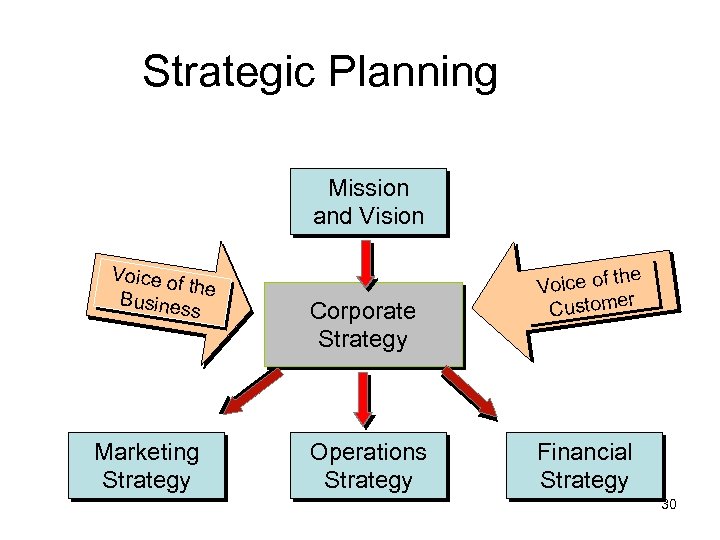 Strategic Planning Mission and Vision Voice o f the Busines s Marketing Strategy Corporate Strategy Operations Strategy the Voice of r Custome Financial Strategy 30
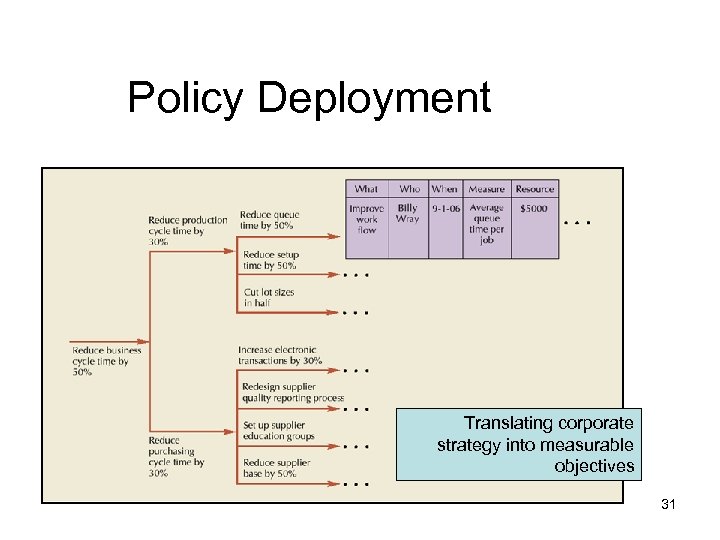 Policy Deployment Translating corporate strategy into measurable objectives 31
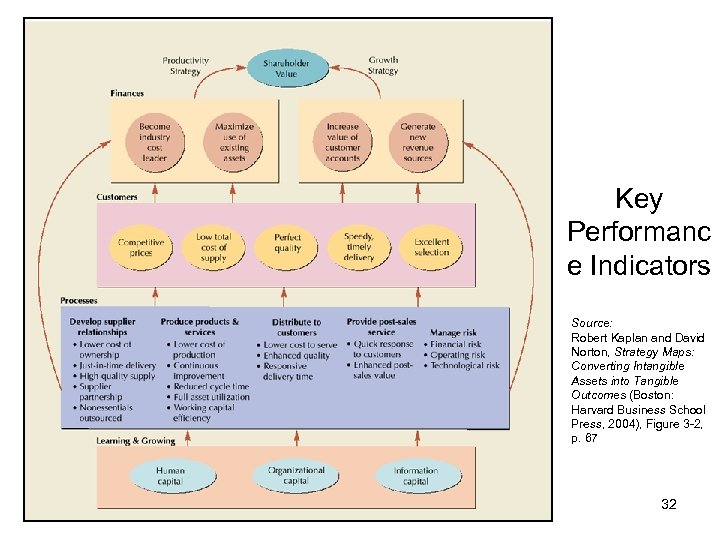 Key Performanc e Indicators Source: Robert Kaplan and David Norton, Strategy Maps: Converting Intangible Assets into Tangible Outcomes (Boston: Harvard Business School Press, 2004), Figure 3 -2, p. 67 32
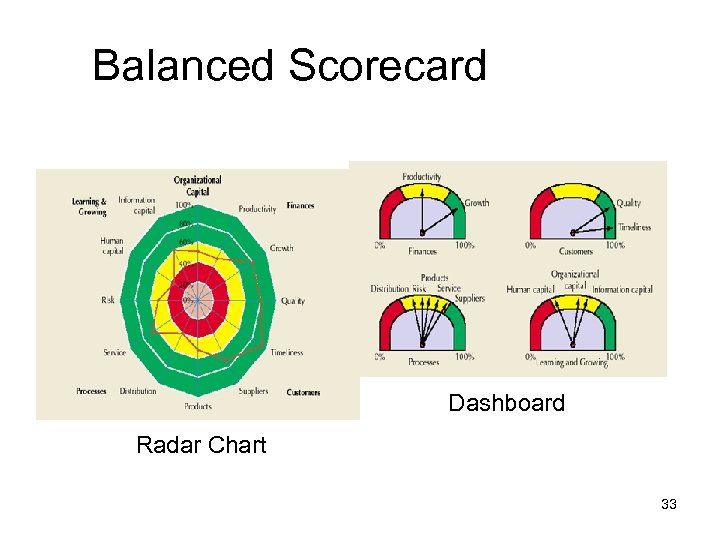 Balanced Scorecard Dashboard Radar Chart 33
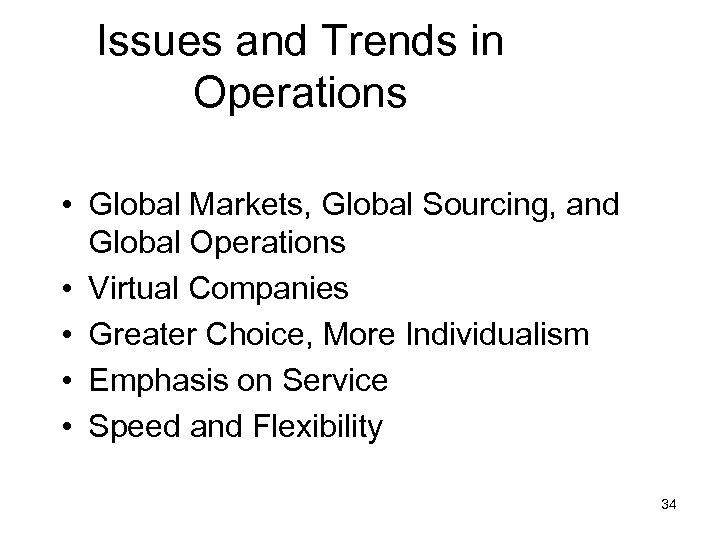 Issues and Trends in Operations • Global Markets, Global Sourcing, and Global Operations • Virtual Companies • Greater Choice, More Individualism • Emphasis on Service • Speed and Flexibility 34
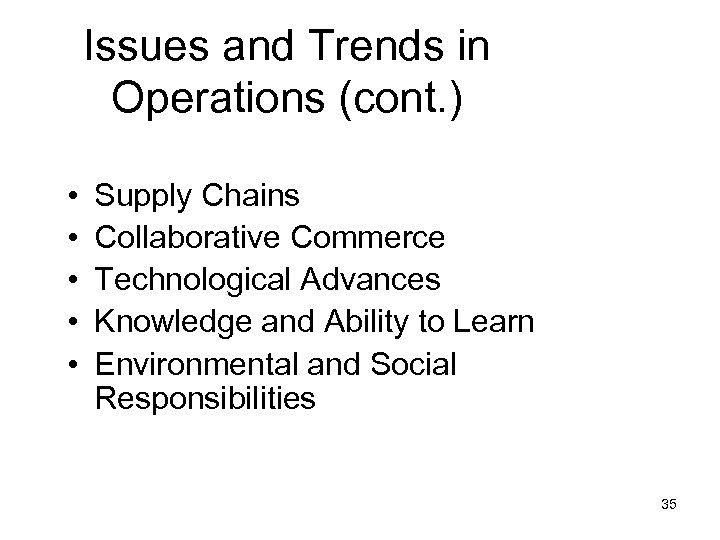 Issues and Trends in Operations (cont. ) • • • Supply Chains Collaborative Commerce Technological Advances Knowledge and Ability to Learn Environmental and Social Responsibilities 35
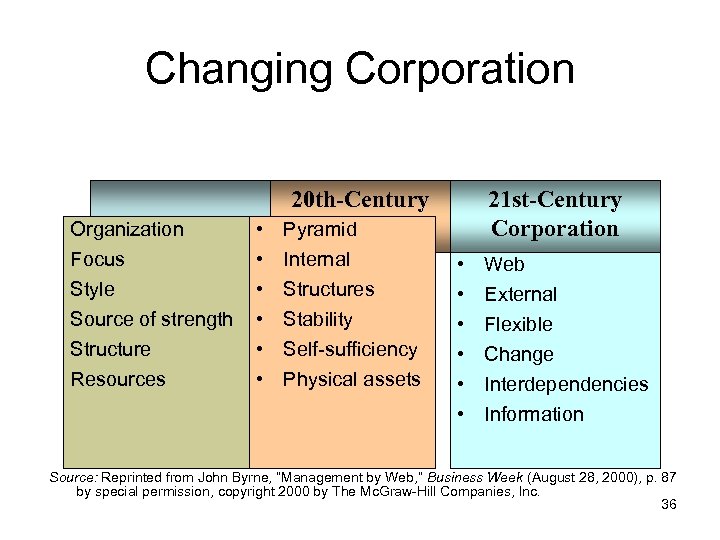 Changing Corporation 20 th-Century Characteristic • Pyramid Corporation Organization Focus Style Source of strength Structure Resources • • • Internal Structures Stability Self-sufficiency Physical assets 21 st-Century Corporation • • • Web External Flexible Change Interdependencies Information Source: Reprinted from John Byrne, “Management by Web, ” Business Week (August 28, 2000), p. 87 by special permission, copyright 2000 by The Mc. Graw-Hill Companies, Inc. 36
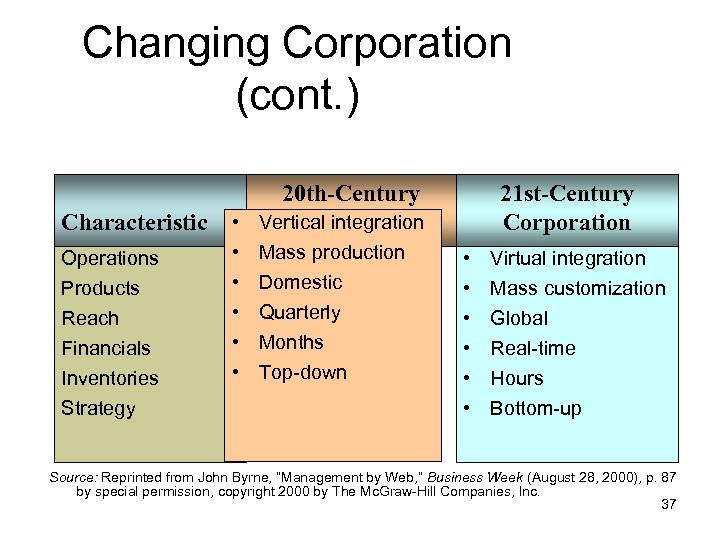 Changing Corporation (cont. ) Characteristic Operations Products Reach Financials Inventories Strategy 20 th-Century • Vertical integration Corporation • • • Mass production Domestic Quarterly Months Top-down 21 st-Century Corporation • • • Virtual integration Mass customization Global Real-time Hours Bottom-up Source: Reprinted from John Byrne, “Management by Web, ” Business Week (August 28, 2000), p. 87 by special permission, copyright 2000 by The Mc. Graw-Hill Companies, Inc. 37
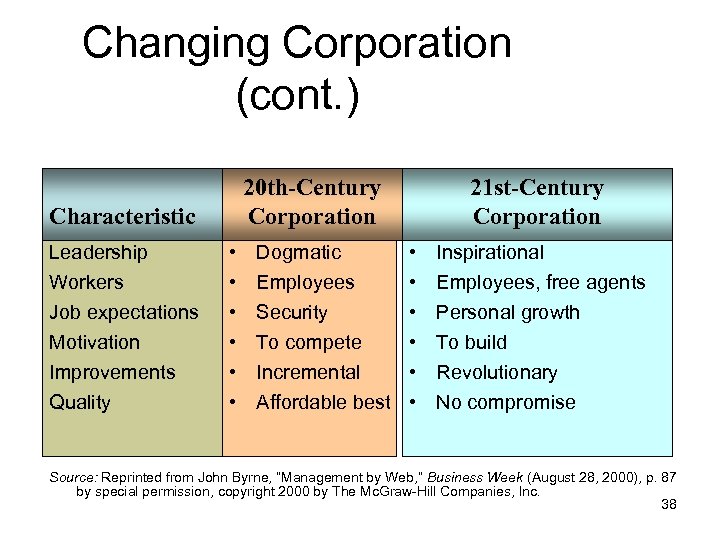 Changing Corporation (cont. ) 20 th-Century Corporation Characteristic Leadership Workers Job expectations Motivation Improvements Quality • • Security • To compete • Incremental • Affordable best • Dogmatic Employees 21 st-Century Corporation Inspirational Employees, free agents Personal growth To build Revolutionary No compromise Source: Reprinted from John Byrne, “Management by Web, ” Business Week (August 28, 2000), p. 87 by special permission, copyright 2000 by The Mc. Graw-Hill Companies, Inc. 38