


 Скачать презентацию Chapter 2 Operations Strategy Operations Management — 5
16916be48744b6fec1d95b7d825ede36.ppt
- Количество слайдов: 39
 Chapter 2 Operations Strategy Operations Management - 5 th Edition Roberta Russell & Bernard W. Taylor, III Copyright 2006 John Wiley & Sons, Inc. Beni Asllani University of Tennessee at Chattanooga
 Lecture Outline w w w w Strategy Formulation Competitive Priorities Operations’ Role in Corporate Strategy and the Internet Strategic Decisions in Operations Strategy Deployment Issues and Trends in Operations Copyright 2006 John Wiley & Sons, Inc. 2
 Four Steps for Strategy Formulation w Defining a primary task n What is the firm in the business of doing? w Assessing core competencies n What does the firm do better than anyone else? w Determining order winners and order qualifiers n n What wins the order? What qualifies an item to be considered for purchase? w Positioning the firm n How will the firm compete? Copyright 2006 John Wiley & Sons, Inc. 3
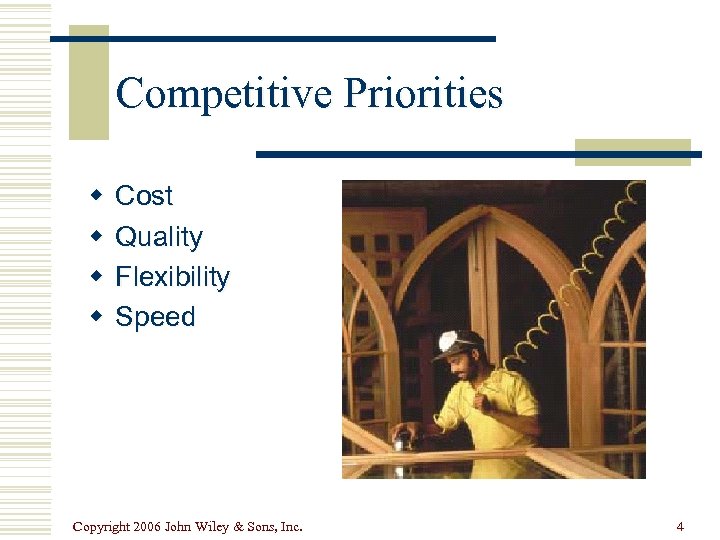 Competitive Priorities w w Cost Quality Flexibility Speed Copyright 2006 John Wiley & Sons, Inc. 4
 Competitive Priorities: Cost w Lincoln Electric n n reduced costs by $10 million a year for 10 years skilled machine operators save the company millions that would have been spent on automated equipment w Southwest Airlines n n n one type of airplane facilitates crew changes, recordkeeping, maintenance, and inventory costs direct flights mean no baggage transfers $30 million annual savings in travel agent commissions by requiring customers to contact the airline directly Copyright 2006 John Wiley & Sons, Inc. 5
 Competitive Priorities: Quality w Ritz-Carlton - one customer at a time n n Every employee is empowered to satisfy a guest’s wish Teams at all levels set objectives and devise quality action plans Each hotel has a quality leader Quality reports tracks l l l n guest room preventive maintenance cycles percentage of check-ins with no waiting time spent to achieve industry-best clean room appearance Guest Preference Reports are recorded in a database Copyright 2006 John Wiley & Sons, Inc. 6
 Competitive Priorities: Flexibility w Andersen Windows n n number of products offered grew from 28, 000 to 86, 000 number of errors are down to 1 per 200 truckloads w Custom Foot Shoe Store: n n n customer’s feet are scanned electronically to capture measurements custom shoes are mailed to the customer’s home in weeks prices are comparable to off-the-shelf shoes w National Bicycle Industrial Company n n offers 11, 231, 862 variations delivers within two weeks at costs only 10% above standard models Copyright 2006 John Wiley & Sons, Inc. 7
 Competitive Priorities: Speed w Citicorp n advertises a 15 -minute mortgage approval w L. L. Bean n ships orders the day they are received w Wal-Mart n replenishes its stock twice a week w Hewlett-Packard n produces electronic testing equipment in five days w General Electric n reduces time to manufacture circuit-breaker boxes into three days and dishwashers into 18 hours w Dell n ships custom-built computers in two days w Motorola n needs less than 30 minutes to build to order pagers Copyright 2006 John Wiley & Sons, Inc. 8
 Operations’ Role in Corporate Strategy w Operations provides support for a differentiated strategy w Operations serves as a firm’s distinctive competence in executing similar strategies better than competitors Copyright 2006 John Wiley & Sons, Inc. 9
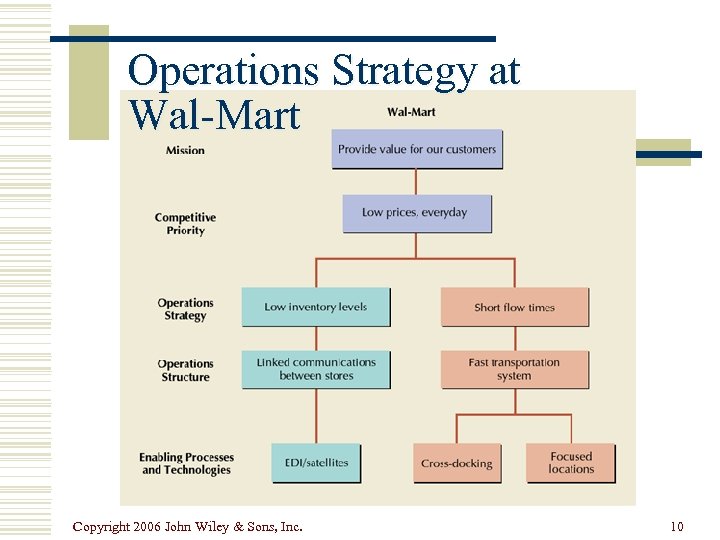 Operations Strategy at Wal-Mart Copyright 2006 John Wiley & Sons, Inc. 10
 Strategy and the Internet w Internet can be used to create a distinctive business strategy l e. Bay w unlimited capacity and a huge market w all work is done by buyers and sellers and there is no marginal cost l Cisco w integrated value chain is its competitive advantage Copyright 2006 John Wiley & Sons, Inc. 11
 Strategy and the Internet (cont. ) w Internet can be used to strengthen existing competitive advantages by integrating new and traditional activities n GE’s Trading Process Network: an automated Web-based purchasing system l l l n cut average purchasing cost in half enabled a much larger group of suppliers to bid on jobs customers were able to track their orders through shop in real time Intel l sells $2 billion a month over the Internet purchases 80% of its direct materials online replaced 19, 000 sales-order faxes received daily Copyright 2006 John Wiley & Sons, Inc. 12
 Strategy and the Internet (cont. ) w Lessons from the dot com shakedown n Internet is the great equalizer l l n allows innovations to be copied with little investment companies may reach larger market customers have more information and can compare prices and features of their products. These benefits are temporary unless… Companies provide unique value to customer Copyright 2006 John Wiley & Sons, Inc. 13
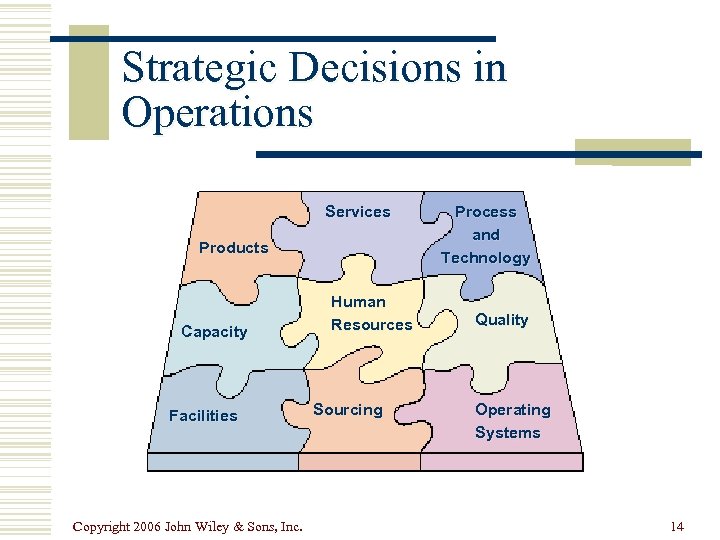 Strategic Decisions in Operations Services Products Capacity Facilities Copyright 2006 John Wiley & Sons, Inc. Human Resources Sourcing Process and Technology Quality Operating Systems 14
 Operations Strategy: Products and Services w Make-to-Order n products and services are made to customer specifications after an order has been received w Make-to-Stock n products and services are made in anticipation of demand w Assemble-to-Order n products and services add options according to customer specifications Copyright 2006 John Wiley & Sons, Inc. 15
 Production Strategy: Processes and technology w Project n one-at-a-time production of a product to customer order w Batch Production n systems process many different jobs at the same time in groups (or batches) w Mass Production n large volumes of a standard product for a mass market w Continuous Production n used for very high volume commodity products Copyright 2006 John Wiley & Sons, Inc. 16
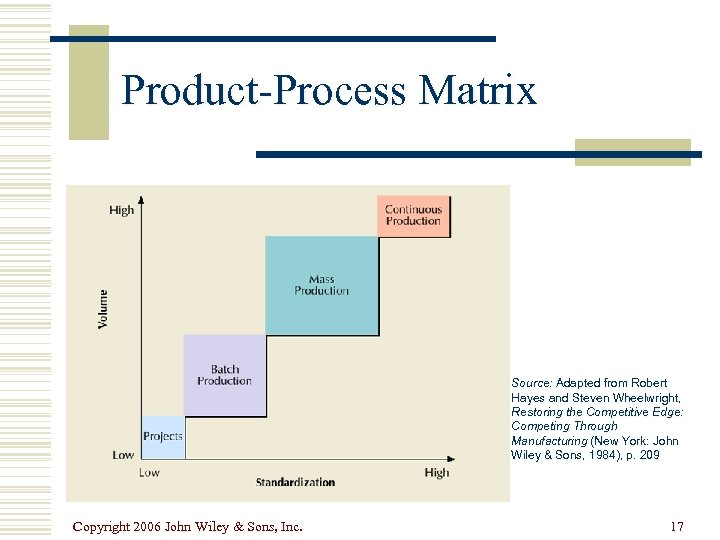 Product-Process Matrix Source: Adapted from Robert Hayes and Steven Wheelwright, Restoring the Competitive Edge: Competing Through Manufacturing (New York: John Wiley & Sons, 1984), p. 209 Copyright 2006 John Wiley & Sons, Inc. 17
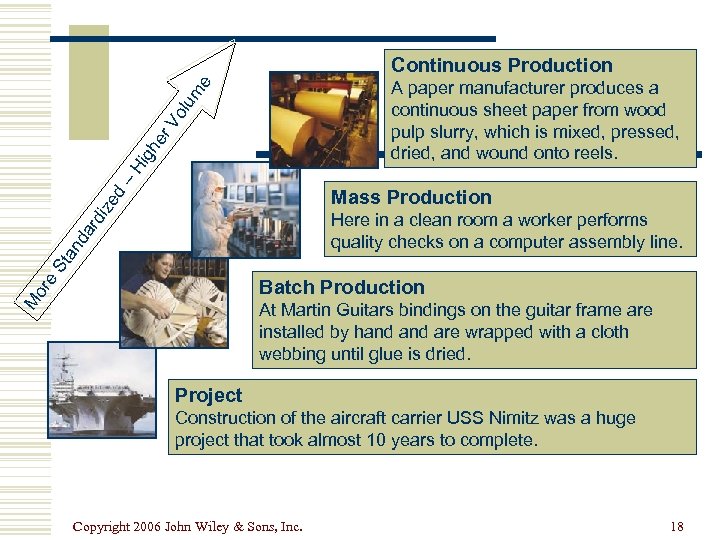 Continuous Production – Hi gh er Vo lum e A paper manufacturer produces a continuous sheet paper from wood pulp slurry, which is mixed, pressed, dried, and wound onto reels. St an da rd ize d Mass Production Here in a clean room a worker performs quality checks on a computer assembly line. M or e Batch Production At Martin Guitars bindings on the guitar frame are installed by hand are wrapped with a cloth webbing until glue is dried. Project Construction of the aircraft carrier USS Nimitz was a huge project that took almost 10 years to complete. Copyright 2006 John Wiley & Sons, Inc. 18
 Service Strategy: Processes and Technology w Professional Service n highly customized and very labor intensive w Service Shop n customized and labor intensive w Mass Service n less customized and less labor intensive w Service Factory n least customized and least labor intensive Copyright 2006 John Wiley & Sons, Inc. 19
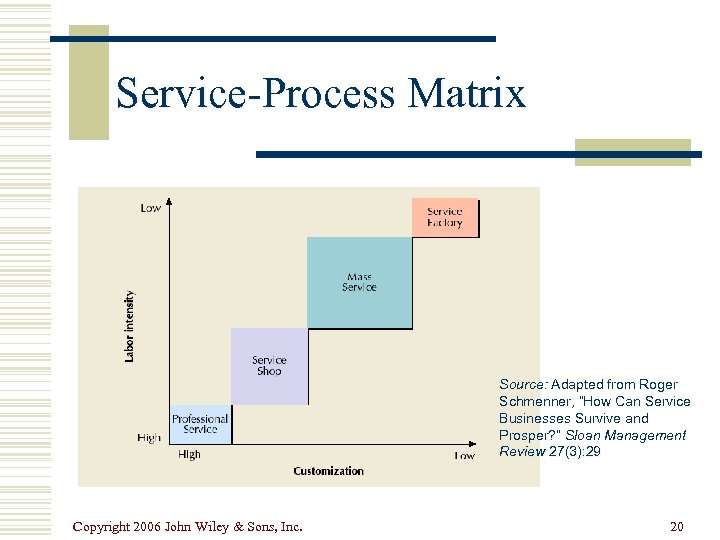 Service-Process Matrix Source: Adapted from Roger Schmenner, “How Can Service Businesses Survive and Prosper? ” Sloan Management Review 27(3): 29 Copyright 2006 John Wiley & Sons, Inc. 20
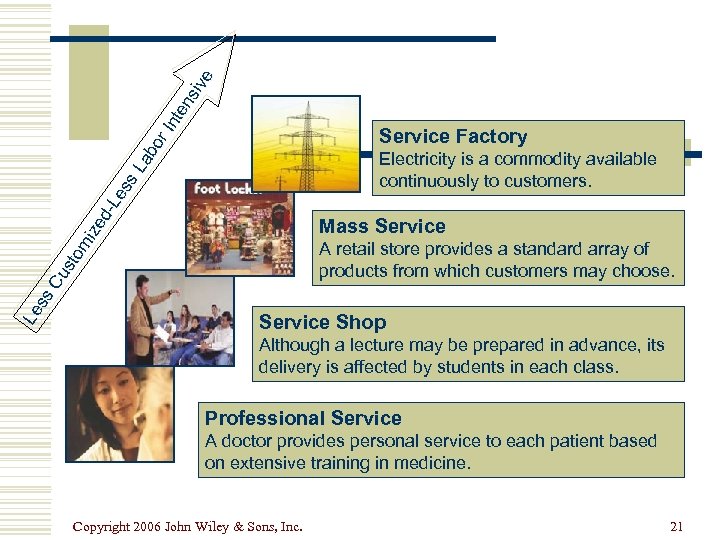 In t en siv e Le ss Cu s to mi ze d. Le ss La bo r Service Factory Electricity is a commodity available continuously to customers. Mass Service A retail store provides a standard array of products from which customers may choose. Service Shop Although a lecture may be prepared in advance, its delivery is affected by students in each class. Professional Service A doctor provides personal service to each patient based on extensive training in medicine. Copyright 2006 John Wiley & Sons, Inc. 21
 Operations Strategy: Capacity and Facility w Capacity strategic decisions include: n When, how much, and in what form to alter capacity w Facility strategic decisions include: n n n Whether demand should be met with a few large facilities or with several smaller ones Whether facilities should focus on serving certain geographic regions, product lines, or customers Facility location can also be a strategic decision Copyright 2006 John Wiley & Sons, Inc. 22
 Operations Strategy: Human Resources w What are the skill levels and degree of autonomy required to operate production system? w What are the training requirements and selection criteria? w What are the policies on performance evaluations, compensation, and incentives? w Will workers be salaried, paid an hourly rate, or paid a piece rate? w Will profit sharing be allowed, and if so, on what criteria? Copyright 2006 John Wiley & Sons, Inc. 23
 Operations Strategy: Human Resources (cont. ) w Will workers perform individual tasks or work in teams? w Will they have supervisors or work in selfmanaged work groups? w How many levels of management will be required? w Will extensive worker training be necessary? w Should workforce be cross-trained? w What efforts will be made in terms of retention? Copyright 2006 John Wiley & Sons, Inc. 24
 Operations Strategy: Quality w What is the target level of quality for our products and services? w How will it be measured? w How will employees be involved with quality? w What will the responsibilities of the quality department be? Copyright 2006 John Wiley & Sons, Inc. 25
 Operations Strategy: Quality (cont. ) w What types of systems will be set up to ensure quality? w How will quality awareness be maintained? w How will quality efforts be evaluated? w How will customer perceptions of quality be determined? w How will decisions in other functional areas affect quality? Copyright 2006 John Wiley & Sons, Inc. 26
 Operations Strategy: Sourcing w Vertical Integration n degree to which a firm produces parts that go into its products w Strategic Decisions n n How much work should be done outside the firm? On what basis should particular items be made in-house? When should items be outsourced? How should suppliers be selected? Copyright 2006 John Wiley & Sons, Inc. 27
 Operations Strategy: Sourcing (cont. ) n n n What type of relationship should be maintained with suppliers? What is expected from suppliers? How many suppliers should be used? How can quality and dependability of suppliers be ensured? How can suppliers be encouraged to collaborate? Copyright 2006 John Wiley & Sons, Inc. 28
 Operations Strategy: Operating Systems w How will operating systems execute strategic decisions? w How does one align information technology and operations strategic goals? w How does information technology support both customer and worker demands for rapid access, storage, and retrieval of information? w How does information technology support decisions making process related to inventory levels, scheduling priorities, and reward systems? Copyright 2006 John Wiley & Sons, Inc. 29
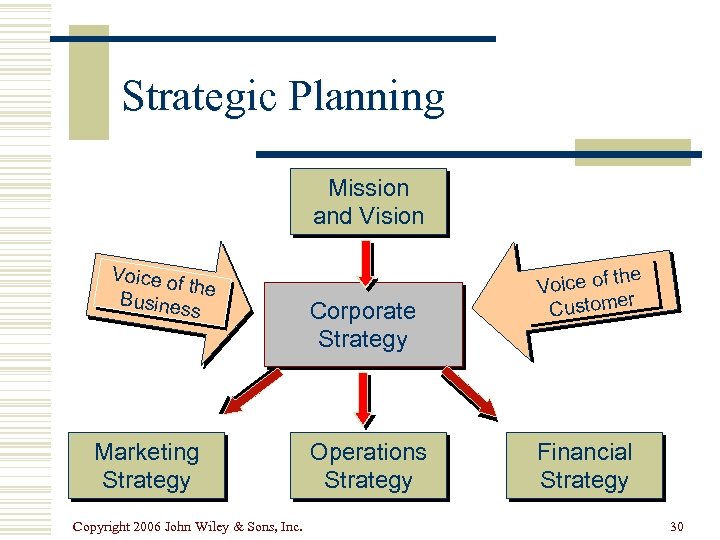 Strategic Planning Mission and Vision Voice o f the Busines s Marketing Strategy Copyright 2006 John Wiley & Sons, Inc. Corporate Strategy Operations Strategy the Voice of r Custome Financial Strategy 30
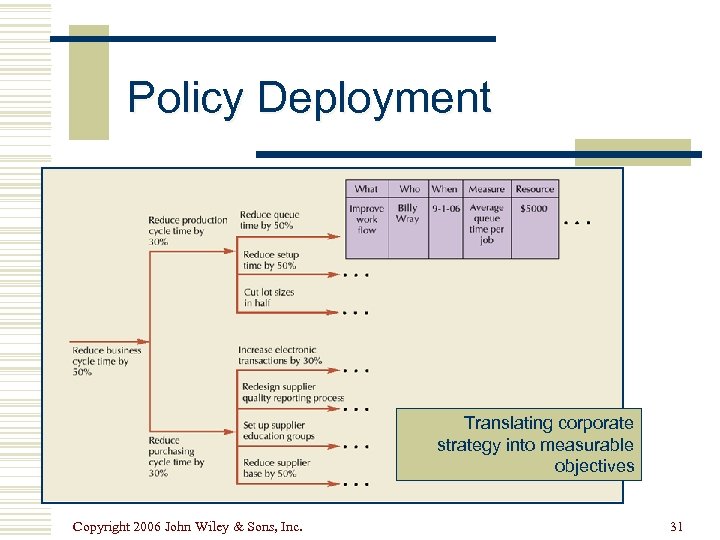 Policy Deployment Translating corporate strategy into measurable objectives Copyright 2006 John Wiley & Sons, Inc. 31
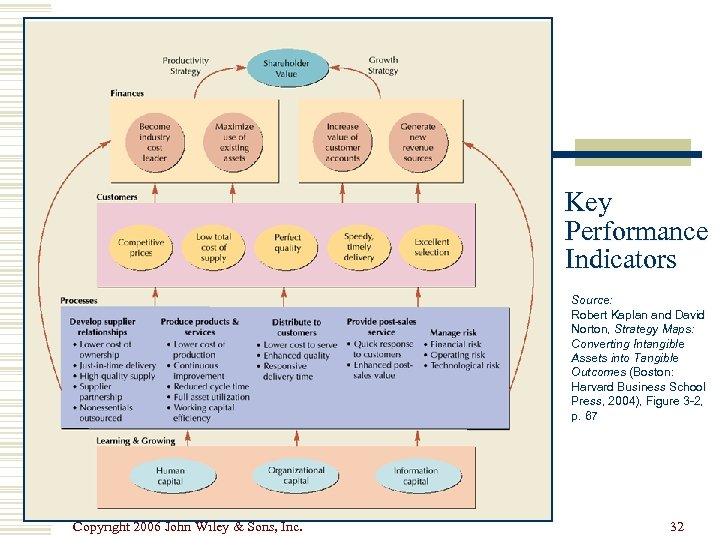 Key Performance Indicators Source: Robert Kaplan and David Norton, Strategy Maps: Converting Intangible Assets into Tangible Outcomes (Boston: Harvard Business School Press, 2004), Figure 3 -2, p. 67 Copyright 2006 John Wiley & Sons, Inc. 32
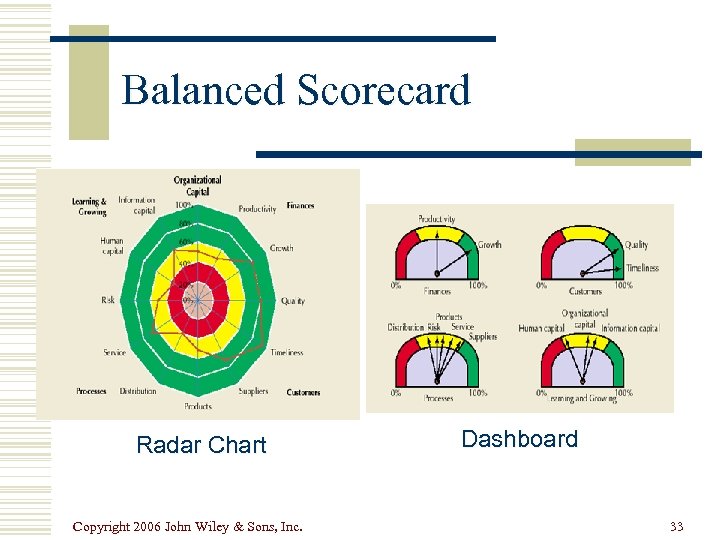 Balanced Scorecard Radar Chart Copyright 2006 John Wiley & Sons, Inc. Dashboard 33
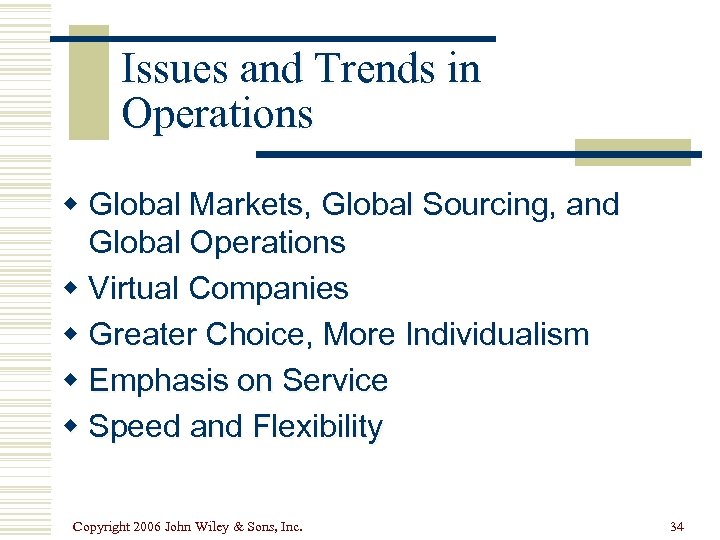 Issues and Trends in Operations w Global Markets, Global Sourcing, and Global Operations w Virtual Companies w Greater Choice, More Individualism w Emphasis on Service w Speed and Flexibility Copyright 2006 John Wiley & Sons, Inc. 34
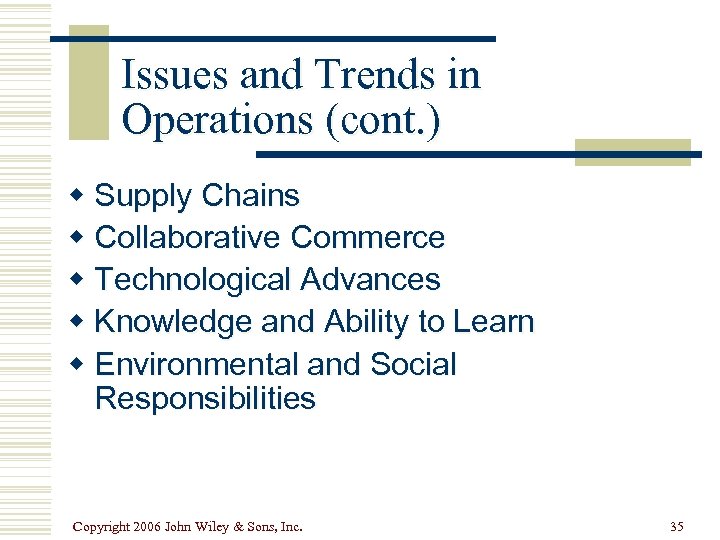 Issues and Trends in Operations (cont. ) w Supply Chains w Collaborative Commerce w Technological Advances w Knowledge and Ability to Learn w Environmental and Social Responsibilities Copyright 2006 John Wiley & Sons, Inc. 35
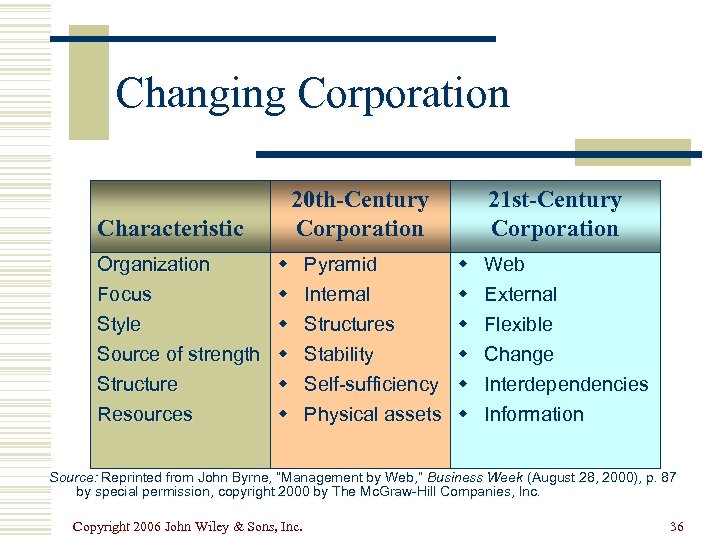 Changing Corporation Characteristic 20 th-Century Corporation w w Style w Source of strength w Structure w Resources w Organization Focus w w Structures w Stability w Self-sufficiency w Physical assets w Pyramid Internal 21 st-Century Corporation Web External Flexible Change Interdependencies Information Source: Reprinted from John Byrne, “Management by Web, ” Business Week (August 28, 2000), p. 87 by special permission, copyright 2000 by The Mc. Graw-Hill Companies, Inc. Copyright 2006 John Wiley & Sons, Inc. 36
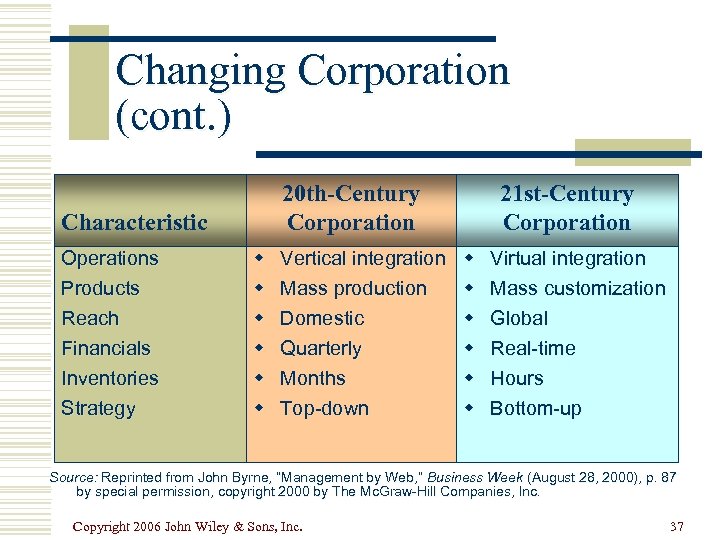 Changing Corporation (cont. ) 20 th-Century Corporation Characteristic Operations Products Reach Financials Inventories Strategy w w w 21 st-Century Corporation Vertical integration w Virtual integration Mass production w Mass customization Domestic w Global Quarterly Months Top-down w Real-time w Hours w Bottom-up Source: Reprinted from John Byrne, “Management by Web, ” Business Week (August 28, 2000), p. 87 by special permission, copyright 2000 by The Mc. Graw-Hill Companies, Inc. Copyright 2006 John Wiley & Sons, Inc. 37
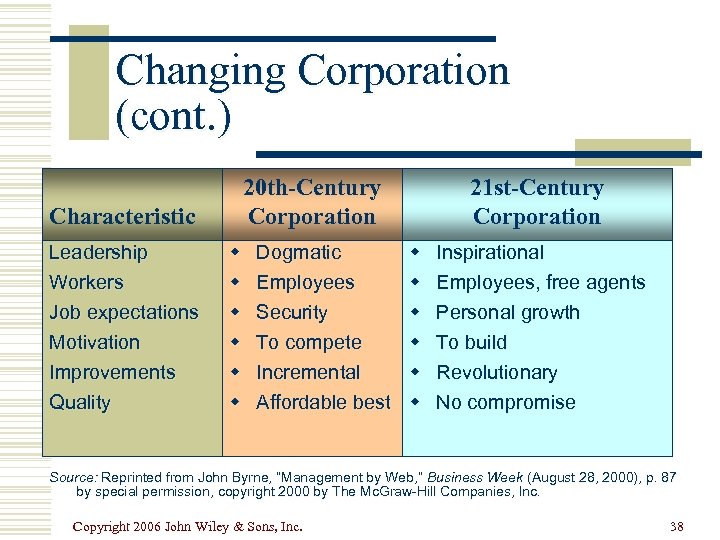 Changing Corporation (cont. ) 20 th-Century Corporation Characteristic Leadership Workers Job expectations Motivation Improvements Quality w w w w Security w To compete w Incremental w Affordable best w Dogmatic Employees 21 st-Century Corporation Inspirational Employees, free agents Personal growth To build Revolutionary No compromise Source: Reprinted from John Byrne, “Management by Web, ” Business Week (August 28, 2000), p. 87 by special permission, copyright 2000 by The Mc. Graw-Hill Companies, Inc. Copyright 2006 John Wiley & Sons, Inc. 38
 Copyright 2006 John Wiley & Sons, Inc. All rights reserved. Reproduction or translation of this work beyond that permitted in section 117 of the 1976 United States Copyright Act without express permission of the copyright owner is unlawful. Request for further information should be addressed to the Permission Department, John Wiley & Sons, Inc. The purchaser may make back-up copies for his/her own use only and not for distribution or resale. The Publisher assumes no responsibility for errors, omissions, or damages caused by the use of these programs or from the use of the information herein. Copyright 2006 John Wiley & Sons, Inc. 39