


 Скачать презентацию Chapter 2 Network Models Term 081 Chapter-2 -1
d1506c0d0ff63c9bb7087557085dcc9e.ppt
- Количество слайдов: 54
 Chapter 2 Network Models Term 081 Chapter-2 -1 CS 331 - Fakhry Khellah
 Protocol Layers and Service Models n Computer network architecture is complex Too many components n How to understand its architecture? n How to allow developers and users to deal with this complexity? Solution n Computer networks functions are designed and implemented as layers n Layers are logical groupings of all the processes required for effective data exchange n Layer n-1 provides some service to the layer n through a welldefined interface (boundary between each two layers) n Each interface defines what information, operations, and services a layer must provide for the layer above it. n These layers are distributed across all nodes in the network n n Term 081 Chapter-2 -2 CS 331 - Fakhry Khellah
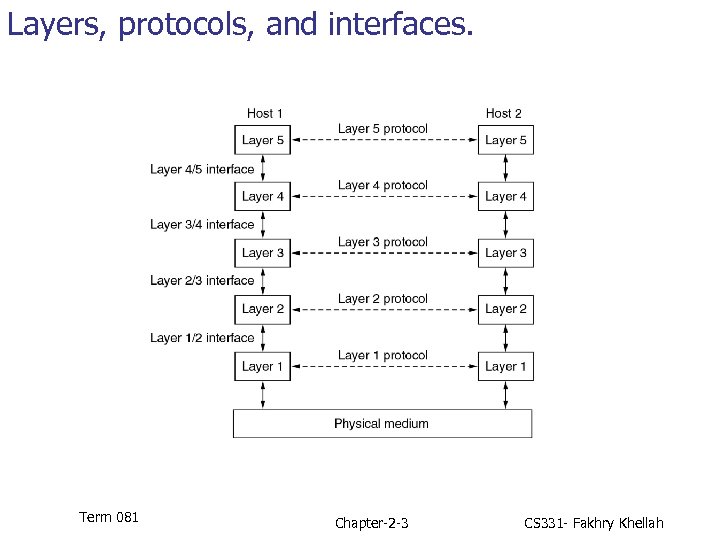 Layers, protocols, and interfaces. Term 081 Chapter-2 -3 CS 331 - Fakhry Khellah
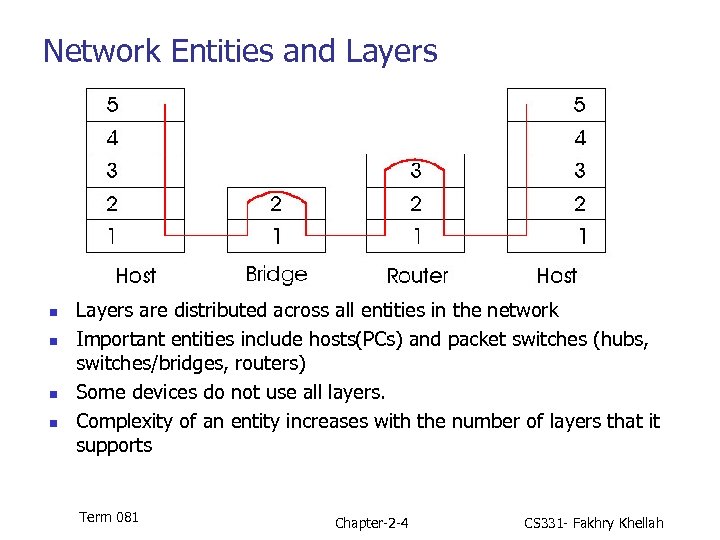 Network Entities and Layers n n Layers are distributed across all entities in the network Important entities include hosts(PCs) and packet switches (hubs, switches/bridges, routers) Some devices do not use all layers. Complexity of an entity increases with the number of layers that it supports Term 081 Chapter-2 -4 CS 331 - Fakhry Khellah
 Advantages of Layered Architecture n n n Breaks the complicated communication process into layers of simpler processes which allows easier hardware or software implementation Each layer implements distinct set of protocols (functions) which means that : n The implementation of each layer can be done independently of the other layers. n This allows different manufacturers to supply the hardware and software needed to the different layers encourages collaboration & Competition Well-defined layers interfaces allow changing the implementation of one layer with a completely different implementation without affecting the other layers Term 081 Chapter-2 -5 CS 331 - Fakhry Khellah
 Standard Protocol Models n The protocols of the various layers are called protocol stack n Two Standard Protocol models (stack) exist: n n Open System Interconnect (OSI) Transmission Control Protocol/Internet Protocol (TCP/IP) Term 081 Chapter-2 -6 CS 331 - Fakhry Khellah
 OSI Model n n n Developed by ISO (the International Organization for Standardization) in 1970 s Provides framework for standardization An open system is a set of protocols that allow any two different systems to communicate regardless of their underlying architecture. Describes how data and network information moves from an application in one computer to an application in another computer. Dominated before 1990 Term 081 Chapter-2 -7 CS 331 - Fakhry Khellah
 OSI Model Term 081 Chapter-2 -8 CS 331 - Fakhry Khellah
 OSI Model To remember the 7 layers is the sentence “All people seem to need data processing” Term 081 Chapter-2 -9 CS 331 - Fakhry Khellah
 Subgroups of Layers n Network support layers n n n User support layers n n n 1, 2 and 3, physical, data link and network Deal with the physical aspects of moving data from one device to another 5, 6 and 7, session, presentation and application Allow interoperability among unrelated software systems Transport Layer n n 4 transport Links the two subgroups Term 081 Chapter-2 -10 CS 331 - Fakhry Khellah
 OSI Protocols Implementation n n A protocol layer can be implemented in software, in hardware, or in a combination of the two Application, Presentation, Session and Transport are implemented in software Network is a mixed implementation of hardware and software Physical and data link are implemented in hardware in the network interface card (NIC) Term 081 Chapter-2 -11 CS 331 - Fakhry Khellah
 Peer-to-Peer Processes Peers are entities (processes, hardware devices) on two or more machines communicating at a given layer Term 081 Chapter-2 -12 CS 331 - Fakhry Khellah
 OSI model-Basic Operation n n Peer-to-Peer communication: Each layer on a sending node communicates (logically) with its peer layer on the receiving node using formatted blocks of data called Protocol Data Units (PDU) PDU = combination of data from the next higher layer and the control information of the current layer (Specific requests and instructions) n Control information are given in the header field of the block except for the data link (has both header and trailer) n Control information is read and executed ONLY by the peer layer on the receiving node Term 081 Chapter-2 -13 CS 331 - Fakhry Khellah
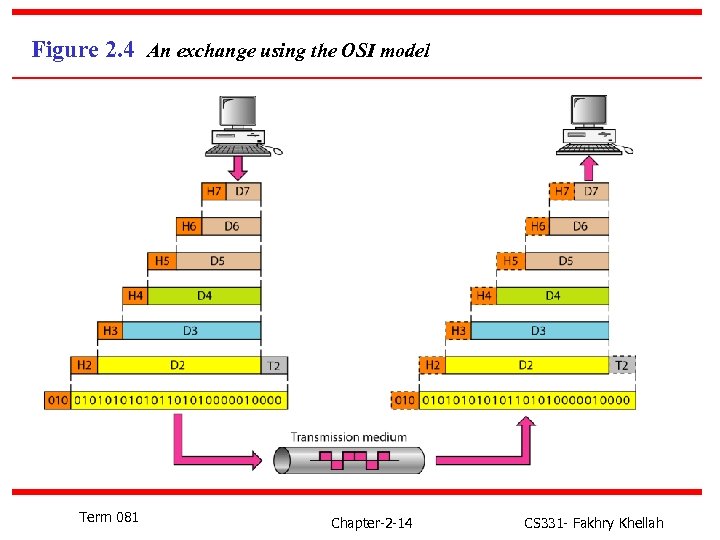 Figure 2. 4 An exchange using the OSI model Term 081 Chapter-2 -14 CS 331 - Fakhry Khellah
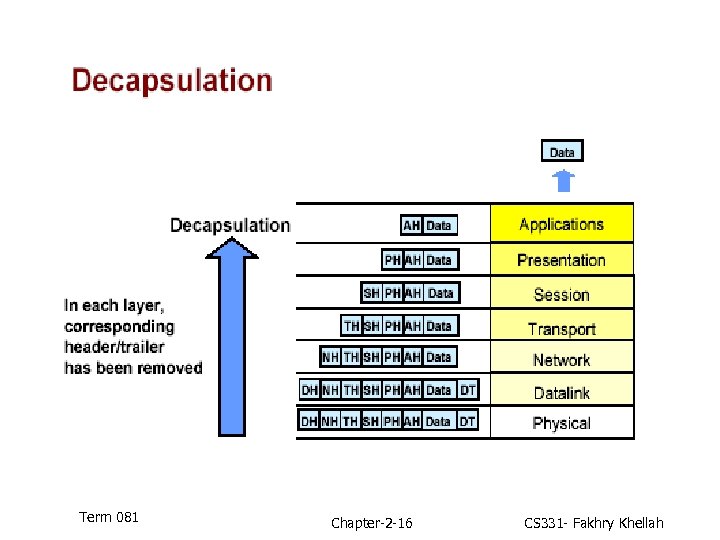
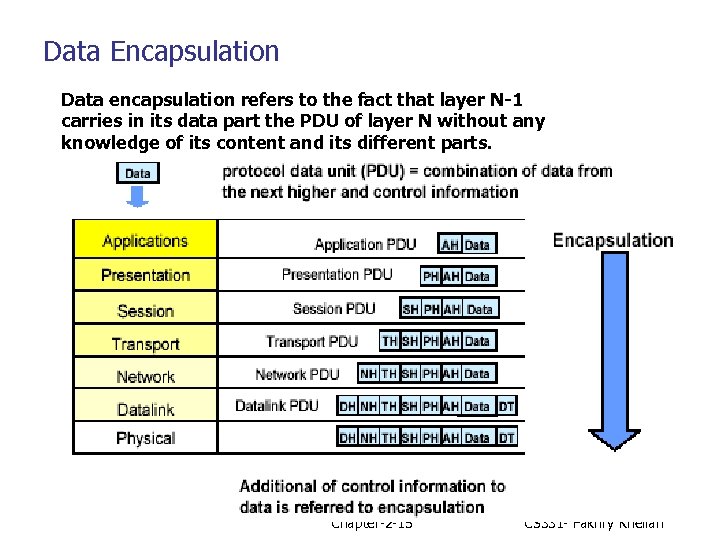 Data Encapsulation Data encapsulation refers to the fact that layer N-1 carries in its data part the PDU of layer N without any knowledge of its content and its different parts. Term 081 Chapter-2 -15 CS 331 - Fakhry Khellah
 Term 081 Chapter-2 -16 CS 331 - Fakhry Khellah
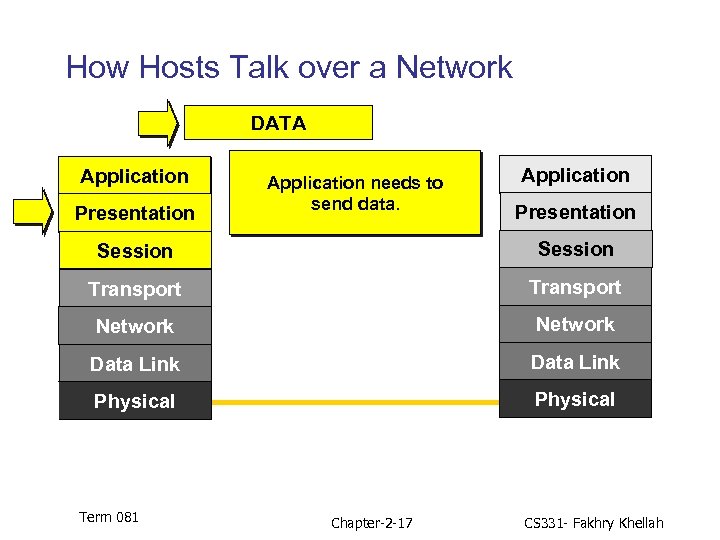 How Hosts Talk over a Network DATA Application Presentation Application needs to send data. Application Presentation Session Transport Network Data Link Physical Term 081 Chapter-2 -17 CS 331 - Fakhry Khellah
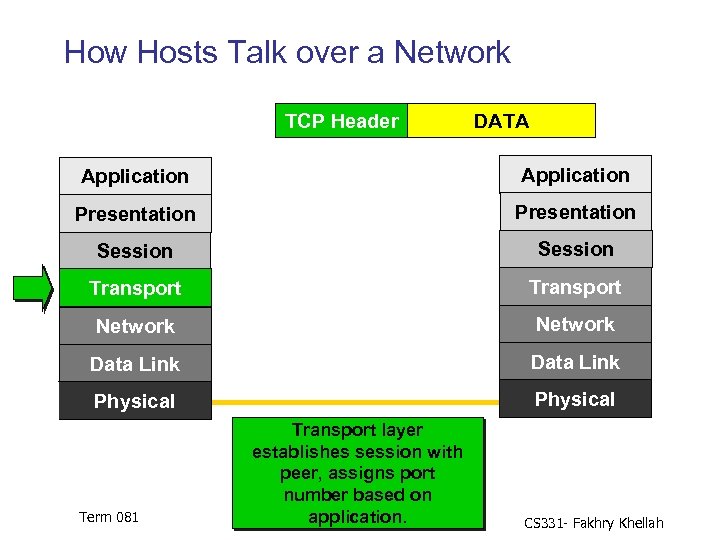 How Hosts Talk over a Network TCP Header DATA Application Presentation Session Transport Network Data Link Physical Term 081 Transport layer establishes session with peer, assigns port number based on application. Chapter-2 -18 CS 331 - Fakhry Khellah
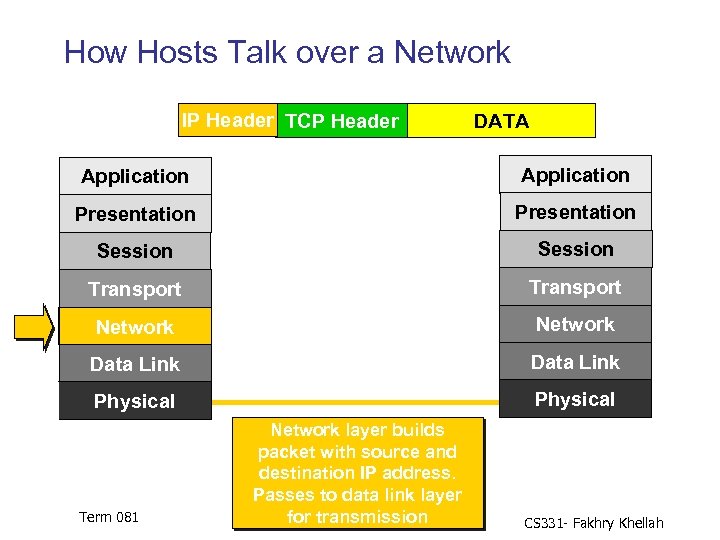 How Hosts Talk over a Network IP Header TCP Header DATA Application Presentation Session Transport Network Data Link Physical Term 081 Network layer builds packet with source and destination IP address. Passes to data link layer for transmission Chapter-2 -19 CS 331 - Fakhry Khellah
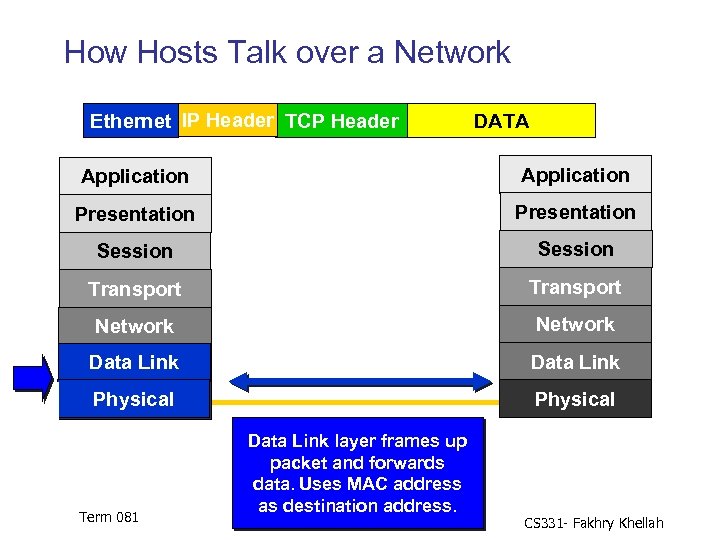 How Hosts Talk over a Network Ethernet IP Header TCP Header DATA Application Presentation Session Transport Network Data Link Physical Term 081 Data Link layer frames up packet and forwards data. Uses MAC address as destination address. Chapter-2 -20 CS 331 - Fakhry Khellah
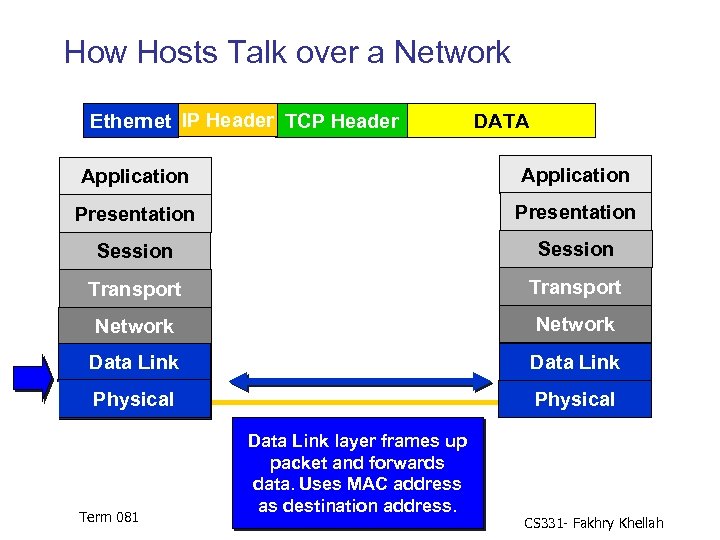 How Hosts Talk over a Network Ethernet IP Header TCP Header DATA Application Presentation Session Transport Network Data Link Physical Term 081 Data Link layer frames up packet and forwards data. Uses MAC address as destination address. Chapter-2 -21 CS 331 - Fakhry Khellah
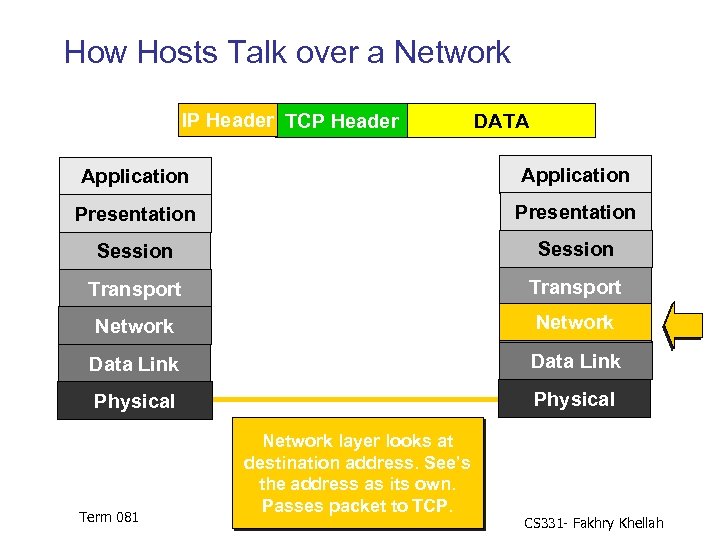 How Hosts Talk over a Network IP Header TCP Header DATA Application Presentation Session Transport Network Data Link Physical Term 081 Network layer looks at destination address. See’s the address as its own. Passes packet to TCP. Chapter-2 -22 CS 331 - Fakhry Khellah
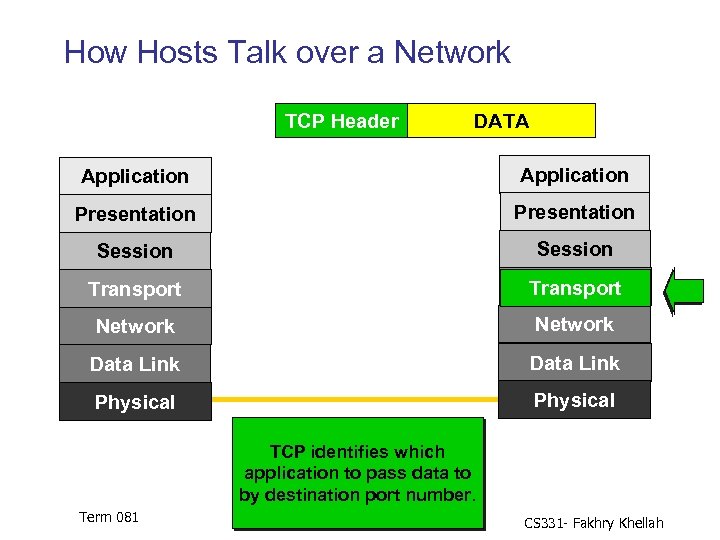 How Hosts Talk over a Network TCP Header DATA Application Presentation Session Transport Network Data Link Physical TCP identifies which application to pass data to by destination port number. Term 081 Chapter-2 -23 CS 331 - Fakhry Khellah
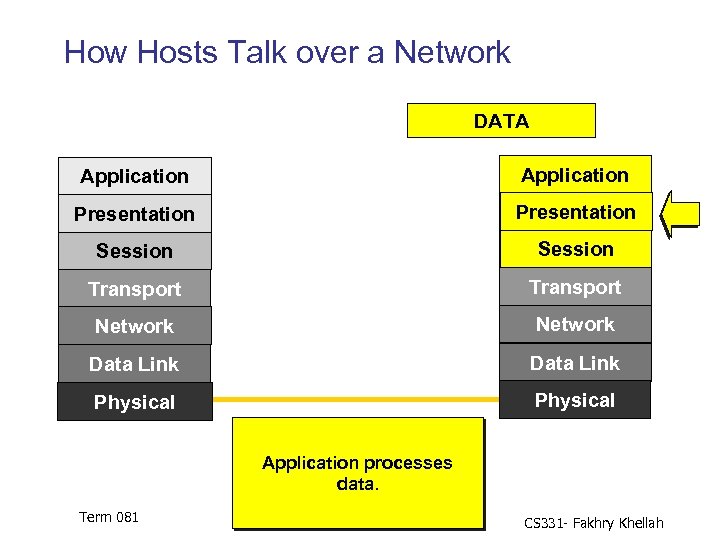 How Hosts Talk over a Network DATA Application Presentation Session Transport Network Data Link Physical Application processes data. Term 081 Chapter-2 -24 CS 331 - Fakhry Khellah
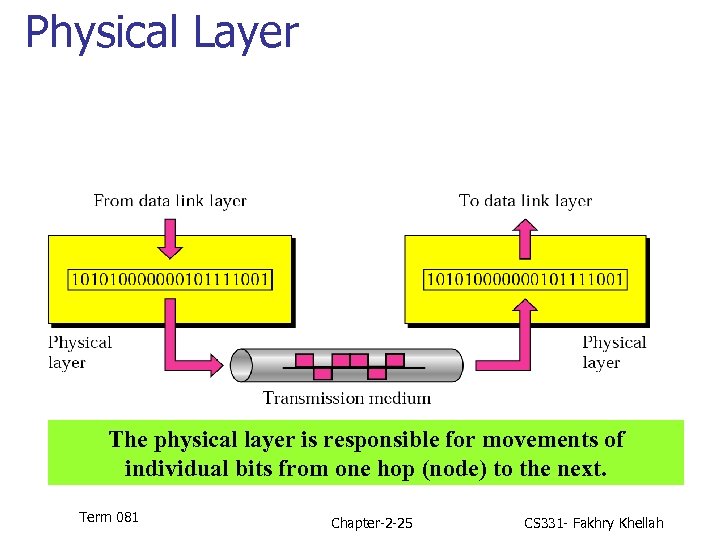 Physical Layer The physical layer is responsible for movements of individual bits from one hop (node) to the next. Term 081 Chapter-2 -25 CS 331 - Fakhry Khellah
 Physical Layer n Deals with the actual communication media Defines the physical characteristics of interfaces and transmission media n the way devices are connected to each other and to the link (topology) n Shape, size and number of pins of connectors n What voltages and currents are used n The type of transmission media n Transmission mode (duplex type) n Representation of bits – encoding into Electrical or Optical signals n Data Rate = transmission rate = bandwidth (number of bits sent per second) n Synchronization of bits (sender and receiver clocks must be synchronized) n Devices that operates at this level: Network card, hub, repeater n Term 081 Chapter-2 -26 CS 331 - Fakhry Khellah
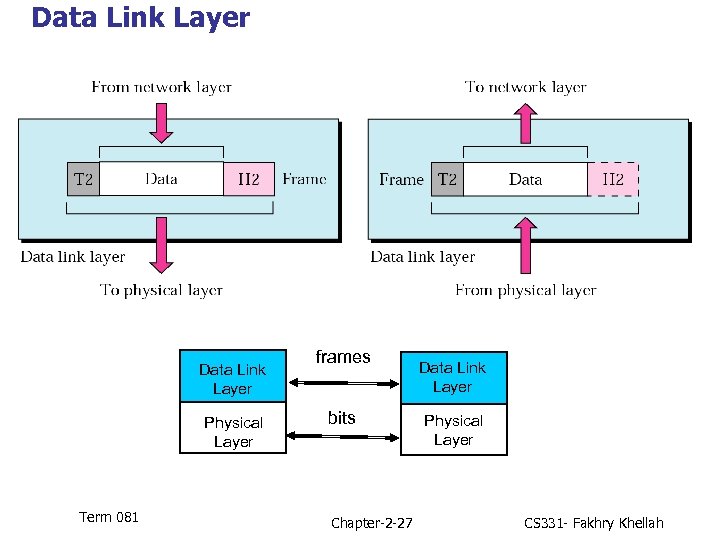 Data Link Layer Physical Layer Term 081 frames bits Chapter-2 -27 Data Link Layer Physical Layer CS 331 - Fakhry Khellah
 Note The data link layer is responsible for moving frames (data link PDU) from one hop (node) to the next. Term 081 Chapter-2 -28 CS 331 - Fakhry Khellah
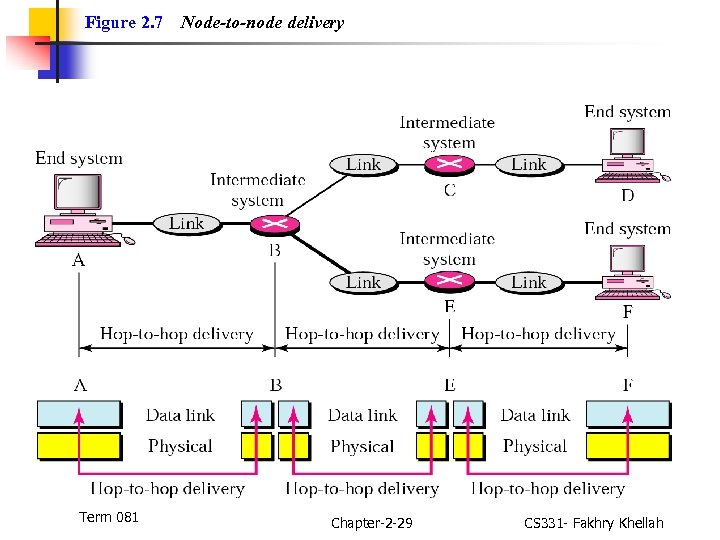 Figure 2. 7 Term 081 Node-to-node delivery Chapter-2 -29 CS 331 - Fakhry Khellah
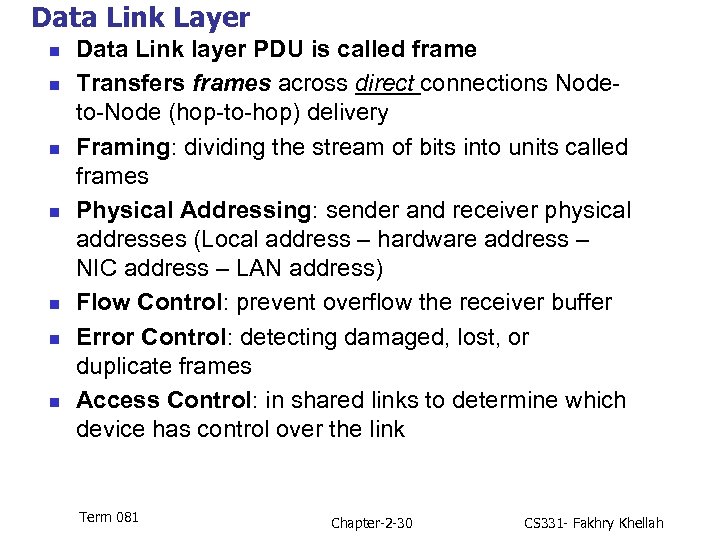 Data Link Layer n n n n Data Link layer PDU is called frame Transfers frames across direct connections Nodeto-Node (hop-to-hop) delivery Framing: dividing the stream of bits into units called frames Physical Addressing: sender and receiver physical addresses (Local address – hardware address – NIC address – LAN address) Flow Control: prevent overflow the receiver buffer Error Control: detecting damaged, lost, or duplicate frames Access Control: in shared links to determine which device has control over the link Term 081 Chapter-2 -30 CS 331 - Fakhry Khellah
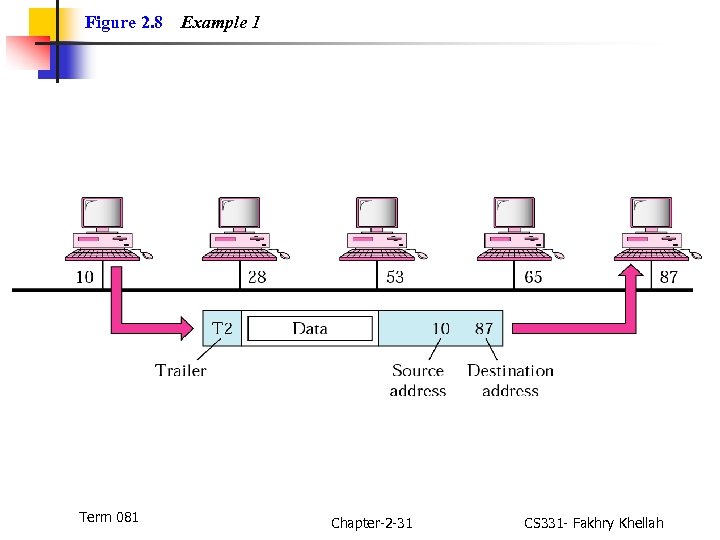 Figure 2. 8 Term 081 Example 1 Chapter-2 -31 CS 331 - Fakhry Khellah
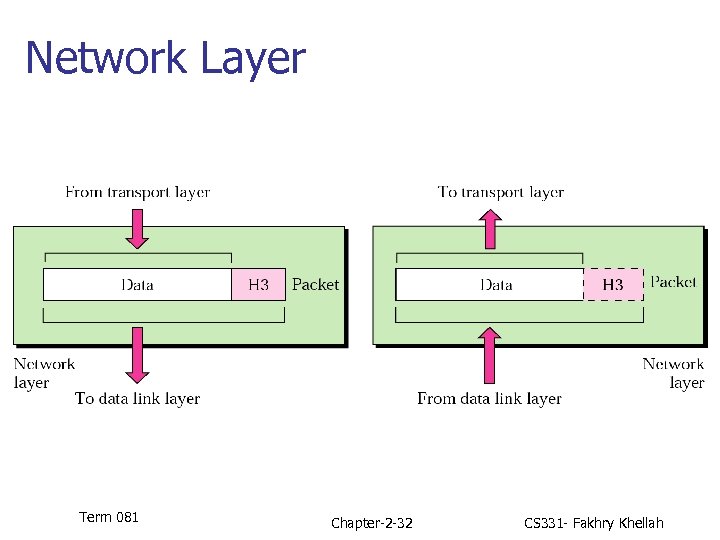 Network Layer Term 081 Chapter-2 -32 CS 331 - Fakhry Khellah
 Note The network layer is responsible for the delivery of individual packets from the source host to the destination host. Term 081 Chapter-2 -33 CS 331 - Fakhry Khellah
 Network Layer PDU is called Packet or Datagram n Source-to-destination (host-to-host) delivery of a PACKET possible across MULTIPLE networks. n If two systems are connected to the same link, there is usually no need for a network layer (in theory). n Logical addressing § A unique global address that distinguishes each host connected to the Internet § In the internet it is called IP address § Routing § connecting devices (routers ) route or switch the n packets to their final destination. Term 081 Chapter-2 -34 CS 331 - Fakhry Khellah
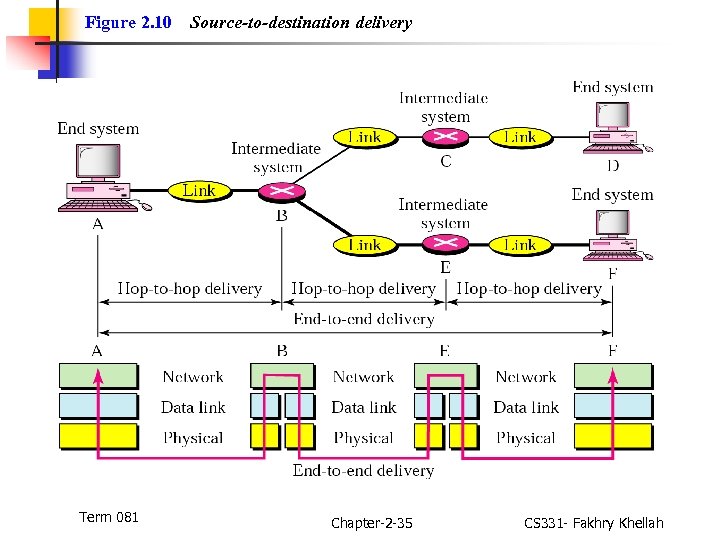 Figure 2. 10 Term 081 Source-to-destination delivery Chapter-2 -35 CS 331 - Fakhry Khellah
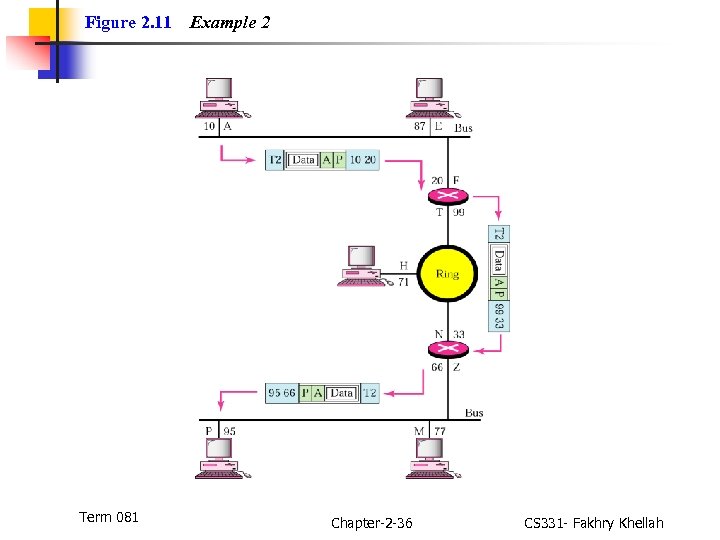 Figure 2. 11 Term 081 Example 2 Chapter-2 -36 CS 331 - Fakhry Khellah
 Note The transport layer is responsible for the delivery of a message from one process to another. Term 081 Chapter-2 -37 CS 331 - Fakhry Khellah
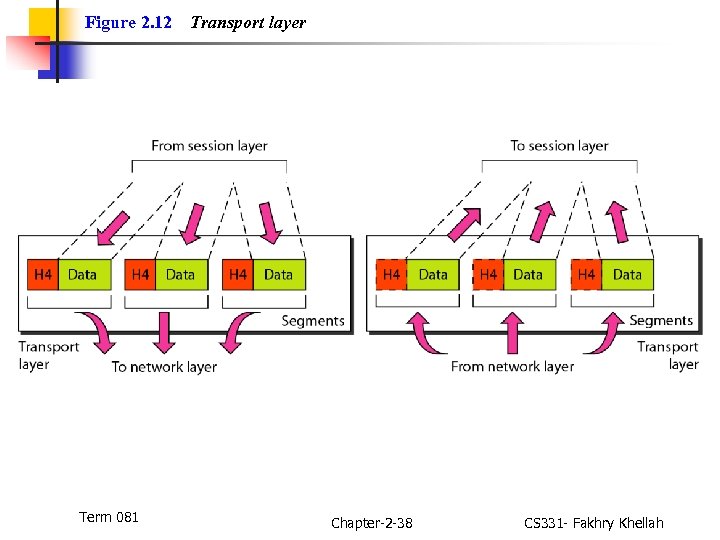 Figure 2. 12 Term 081 Transport layer Chapter-2 -38 CS 331 - Fakhry Khellah
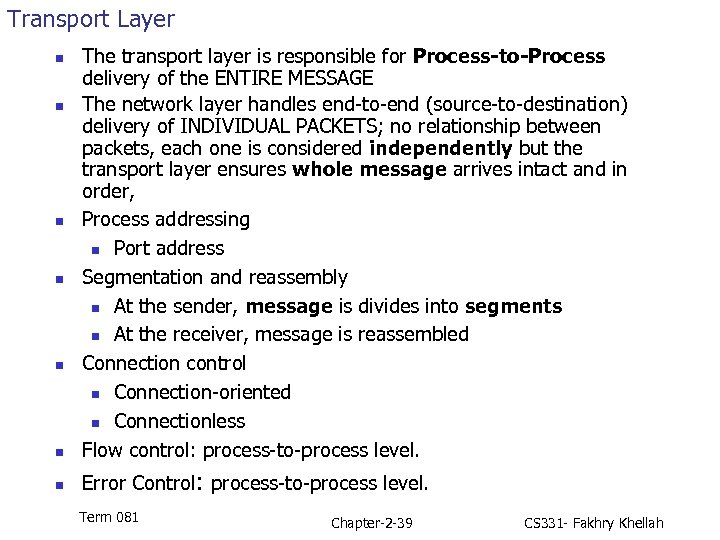 Transport Layer n The transport layer is responsible for Process-to-Process delivery of the ENTIRE MESSAGE The network layer handles end-to-end (source-to-destination) delivery of INDIVIDUAL PACKETS; no relationship between packets, each one is considered independently but the transport layer ensures whole message arrives intact and in order, Process addressing n Port address Segmentation and reassembly n At the sender, message is divides into segments n At the receiver, message is reassembled Connection control n Connection-oriented n Connectionless Flow control: process-to-process level. n Error Control: process-to-process level. n n n Term 081 Chapter-2 -39 CS 331 - Fakhry Khellah
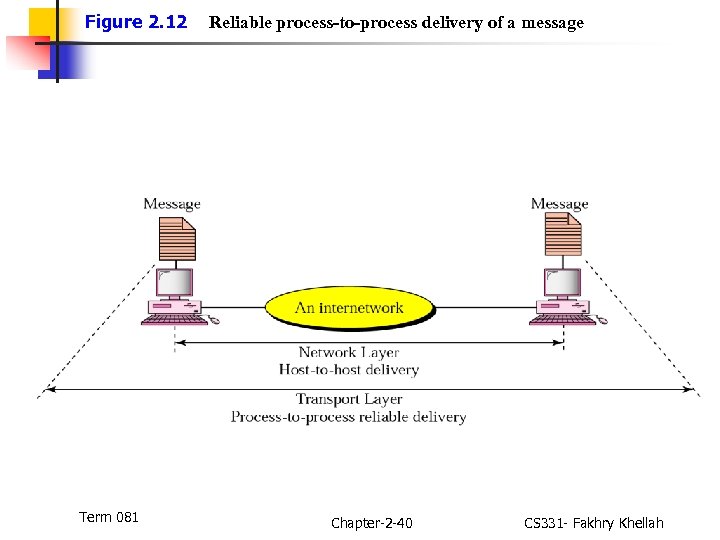 Figure 2. 12 Term 081 Reliable process-to-process delivery of a message Chapter-2 -40 CS 331 - Fakhry Khellah
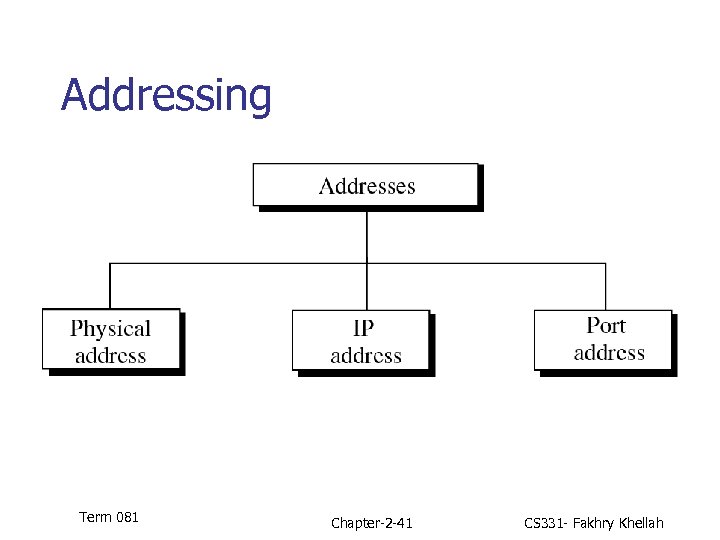 Addressing Figure 2. 16 Pg 35 FOROUZAN 03 Term 081 Chapter-2 -41 CS 331 - Fakhry Khellah
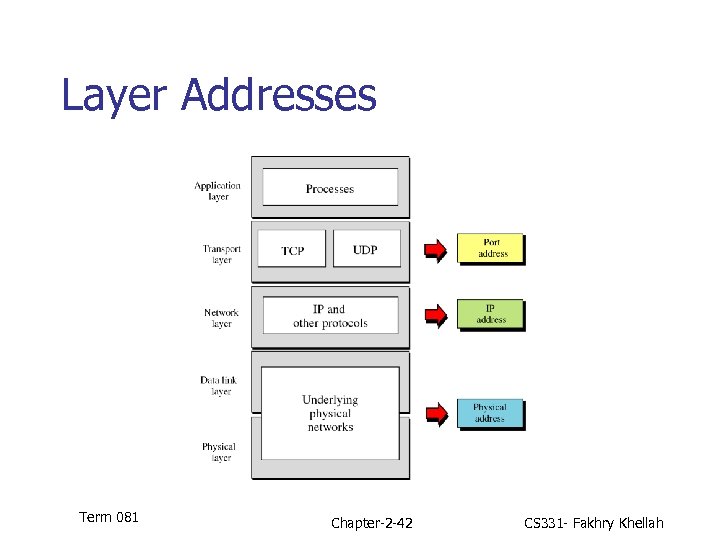 Layer Addresses Term 081 Chapter-2 -42 CS 331 - Fakhry Khellah
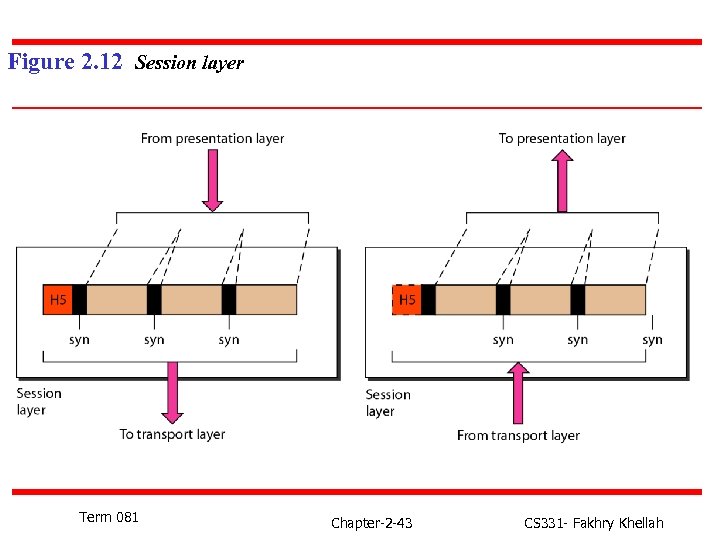 Figure 2. 12 Session layer Term 081 Chapter-2 -43 CS 331 - Fakhry Khellah
 Session n Setting up, managing, and terminating sessions (connections) between different applications n Keeping different applications data separate from other application data n Multiple file downloads requested by a particular FTP application n Multiple telnet (remote connection to a device) connections from a single host n Web pages retrievals from web server Dialog control n Full/Half duplex Synchronization checkpoints n Allow long transmissions to continue from where they were after a crash Term 081 Chapter-2 -44 CS 331 - Fakhry Khellah
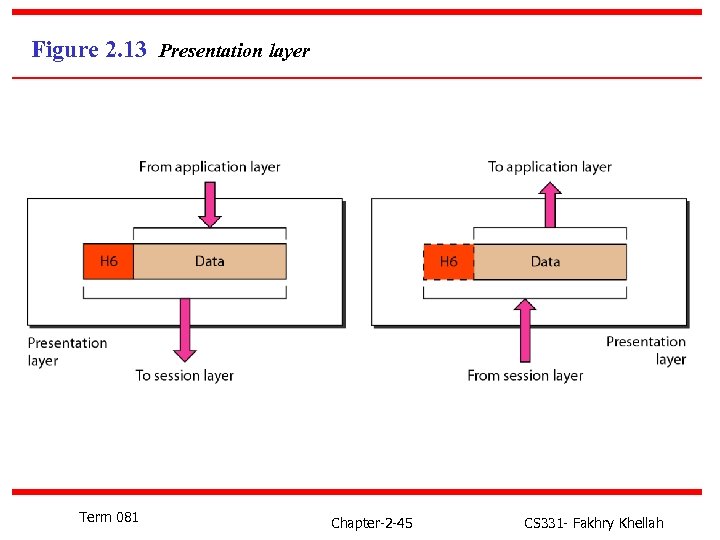 Figure 2. 13 Presentation layer Term 081 Chapter-2 -45 CS 331 - Fakhry Khellah
 Presentation n Translation n Allows devices with different data representations to communicate (interoperability). n Sender format common format Receiver format n The input of “Cisco” on a Mainframe terminal, which is working with an EBCDIC code set, would result in “¢¹½³? “ on a PC, because it uses ASCII. Encryption/decryption Compression => Less bits (multimedia applications) Term 081 Chapter-2 -46 CS 331 - Fakhry Khellah
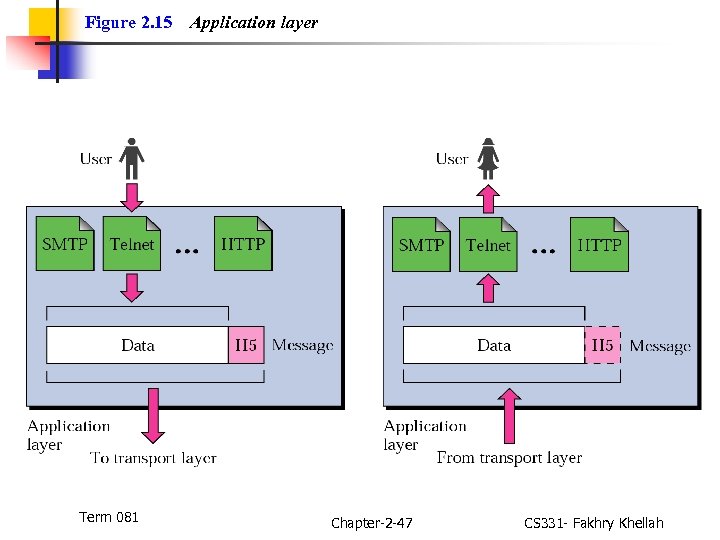 Figure 2. 15 Term 081 Application layer Chapter-2 -47 CS 331 - Fakhry Khellah
 Application n User interface and Network services that allow user applications to access the network n n Internet Browser uses the HTTP application -layer protocol to access a WWW Telnet => remote host access File transfer, access and management Mail services Term 081 Chapter-2 -48 CS 331 - Fakhry Khellah
 TCP/IP Protocol Suite n Developed in 1970 s § Is a suite of protocols named after the two most important protocols TCP and IP but includes other protocols such as UDP, etc n Consists of Five layers n The first four lower layers correspond to the first four layers of the OSI model. n The three top layers in the OSI model, however, are represented in TCP/IP by a single layer called the application layer. Term 081 Chapter-2 -49 CS 331 - Fakhry Khellah
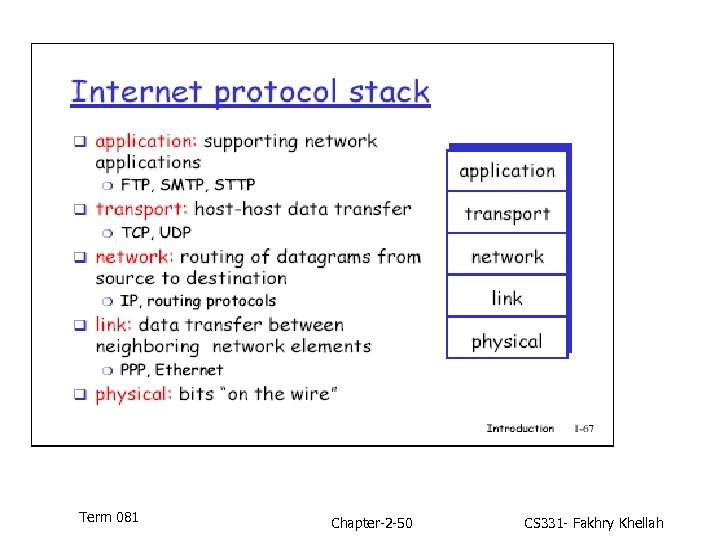 Term 081 Chapter-2 -50 CS 331 - Fakhry Khellah
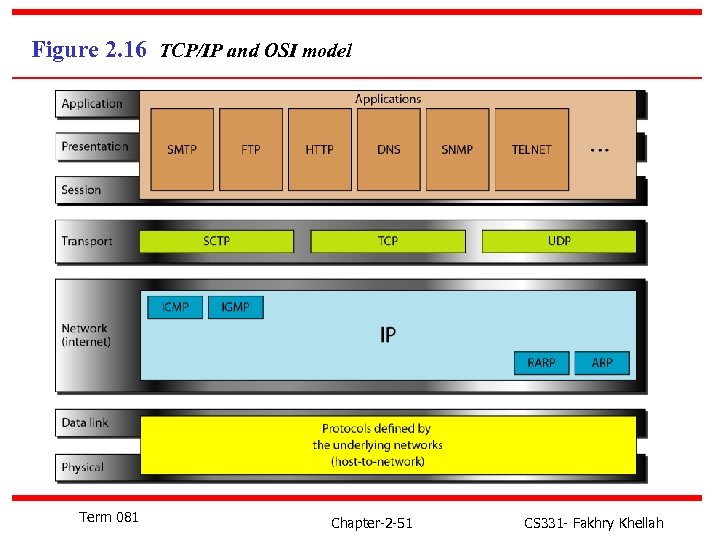 Figure 2. 16 TCP/IP and OSI model Term 081 Chapter-2 -51 CS 331 - Fakhry Khellah
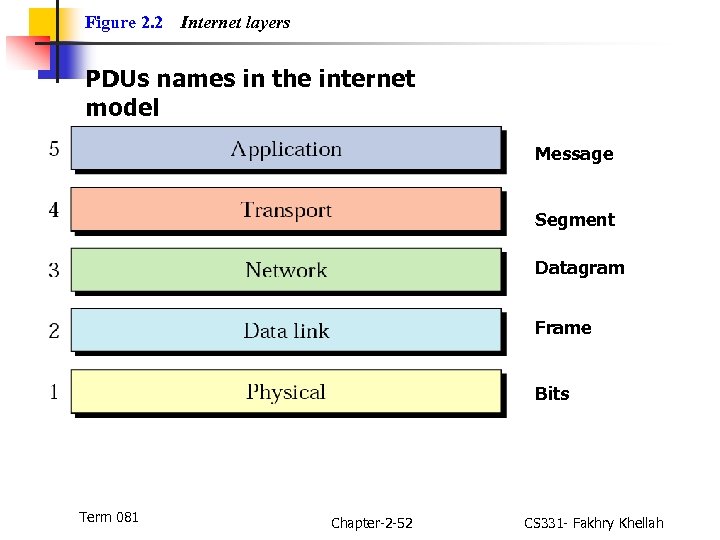 Figure 2. 2 Internet layers PDUs names in the internet model Message Segment Datagram Frame Bits Term 081 Chapter-2 -52 CS 331 - Fakhry Khellah
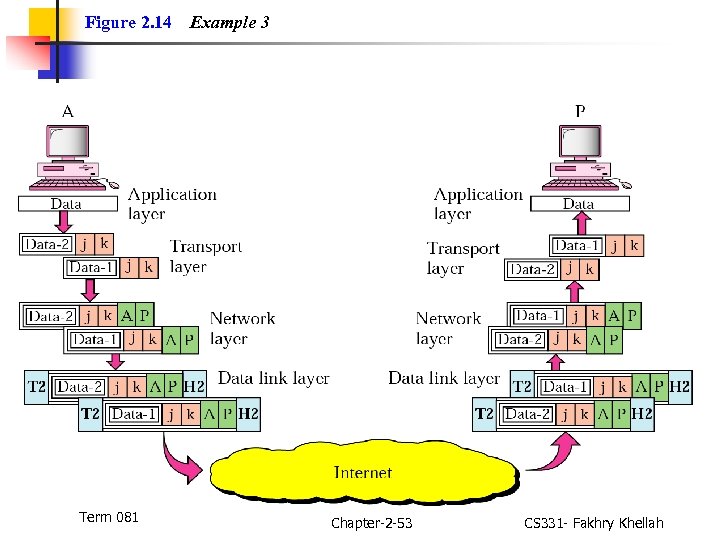 Figure 2. 14 Term 081 Example 3 Chapter-2 -53 CS 331 - Fakhry Khellah
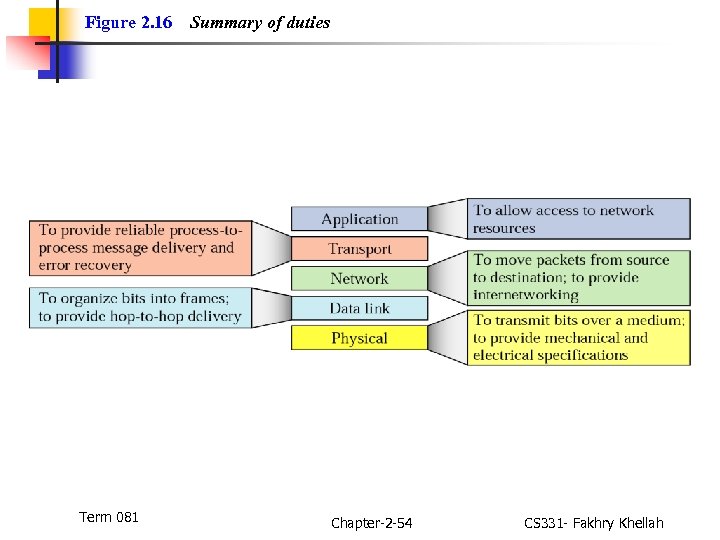 Figure 2. 16 Term 081 Summary of duties Chapter-2 -54 CS 331 - Fakhry Khellah