 Скачать презентацию Chapter 2 Major Business Initiatives Mc Graw-Hill Irwin
584dceb3bd55e47f35f430e83b89543b.ppt
- Количество слайдов: 61



Chapter 2 Major Business Initiatives Mc. Graw-Hill/Irwin © 2008 The Mc. Graw-Hill Companies, All Rights Reserved
STUDENT LEARNING OUTCOMES 1. Describe how to use Porter’s Five Forces Model to evaluate the attractiveness of an industry. 2. Describe the role of value chains in identifying value-added and value-reducing processes. 3. Define SCM systems and describe their strategic and competitive opportunities and IT support. 2 -2
STUDENT LEARNING OUTCOMES 4. Define CRM systems and describe their strategic and competitive opportunities and IT support. 5. Define BI systems and describe their strategic and competitive opportunities and IT support. 6. Define e-collaboration and describe its strategic and competitive opportunities and IT support. 2 -3
Business Intelligence Is Key to the Success of the Miami Dolphins • Professional sports is very much a business • Find great players and coaches • Work with ticket sales, merchandise sales, concession sales, and stadium events 2 -4
Business Intelligence Is Key to the Success of the Miami Dolphins • Ticket sales are key • Dolphins must know who buys tickets, when many tickets are unsold, etc • Old way – ticket information only once or twice per week • New way (with IT) – ticket information on a daily basis 2 -5
Business Intelligence Is Key to the Success of the Miami Dolphins • Class poll… 1. How does this help with customer relationship management? 2. Do you receive marketing material from pro team? Whom? 3. Top-line or bottom-line initiative? 2 -6
INTRODUCTION • Businesses must be innovative to stay in business and succeed • IT can be a powerful tool • Must use IT within business strategy to be successful 2 -7
INTRODUCTION • Major business initiatives that need IT 1. 2. 3. 4. Customer relationship management (CRM) Supply chain management (SCM) Business intelligence (BI) E-collaboration 2 -8
INTRODUCTION • Back to strategy… – Top-line versus bottom-line (Chapter 1) – Run-Grow-Transform framework (Chapter 1) – Porter’s Five Forces Model (Here) – Value chains (Here) 2 -9
PORTER’S FIVE FORCES MODEL • Five Forces Model – helps determine the relative attractiveness of an industry and includes 1. 2. 3. 4. 5. Buyer power Supplier power Threat of substitute products and services Threat of new entrants Rivalry among existing competitors 2 -10
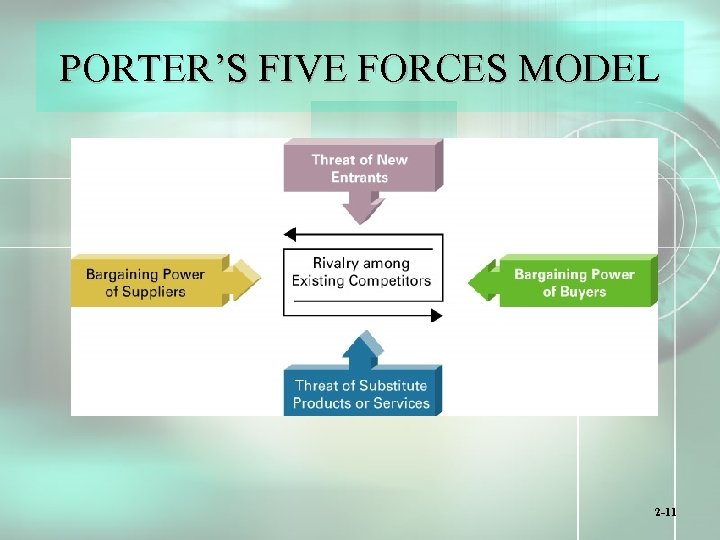
PORTER’S FIVE FORCES MODEL 2 -11
Buyer Power • Buyer power – high when buyers have many choices; low when there are very few choices • As a provider of products and services – want low buyer power • As a consumer of products and services – want high buyer power 2 -12
Buyer Power • IT can help you (as a provider) reduce buyer power • Examples (all enabled by IT) – Loyalty program – rewards customers for repeated business • • • Airline industry Hotels Grocery stores 2 -13
Supplier Power • Supplier power – high when buyers have few choices; low when buyers have many choices • The opposite of buyer power • As a business, you want… – High buyer power when making purchases – High supplier power when selling products and services 2 -14
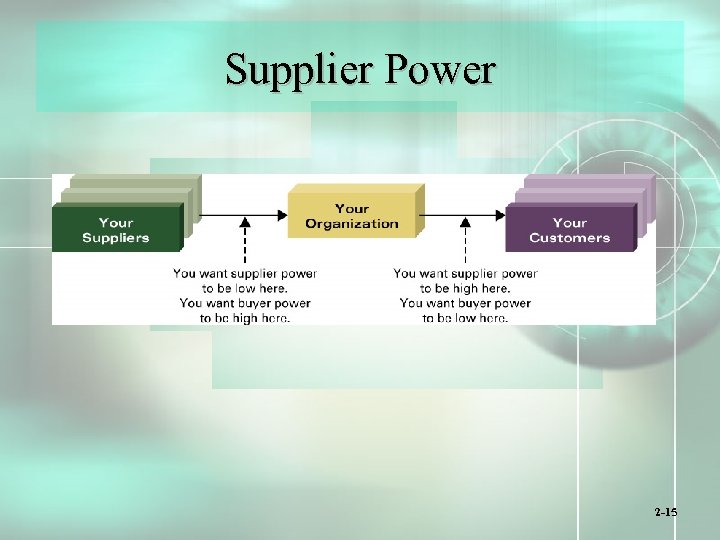
Supplier Power 2 -15
Threat of Substitute Products or Services • Threat of substitute products or services – high when there are many alternatives; low when there are few • Switching costs can help • Switching cost – costs that make customers reluctant to switch 2 -16
Threat of New Entrants • Threat of new entrants – high when it is easy for new competitors to start; low when it is not • Entry barrier – feature that customers want and new competition must provide to enter market – ATMs, online banking, etc 2 -17
Rivalry Among Existing Competitors • Rivalry among existing competitors – high in a fiercely competitive market; low in a more complacent market • Example – retail grocers – Highly competitive – Use IT to compete on price 2 -18
Five Forces Model Summary • Helps determine the attractiveness of an industry • Should enter or expand operations in an industry? • How can IT help? – Increase/reduce buyer/supplier power? – Create/eliminate an entry barrier? 2 -19
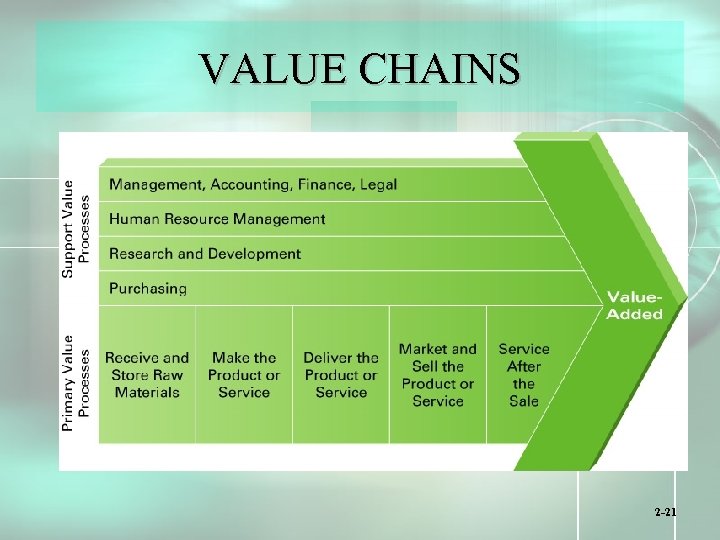
VALUE CHAINS • Value chain – organization as a chain – or series – of processes, each of which either add to or reduce value • Business process – set of activities that accomplishes a specific task – Ordering processing – Sales transaction 2 -20
VALUE CHAINS 2 -21
VALUE CHAINS • Primary value processes (along bottom) – creates, delivers, markets, and sells products and services • Support value processes (along top) – support primary value processes 2 -22
Identifying Processes that Add Value • Talbott – premier necktie manufacturer • Value-added process – information gathered by surveying customers – Manufacturing high quality – Purchasing quality materials 2 -23
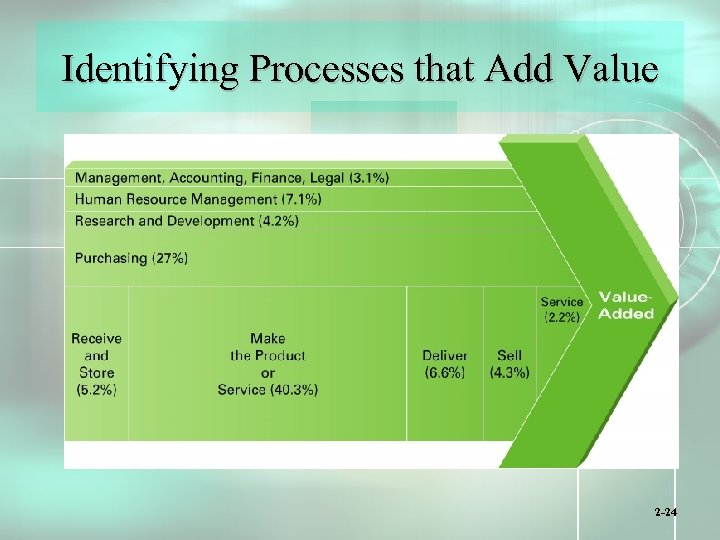
Identifying Processes that Add Value 2 -24
Identifying Processes that Reduce Value • Value-reducing processes – information gathered from same customer surveys • Out of stock items (for Talbott) • Goal – use IT to get timely information to sales force 2 -25
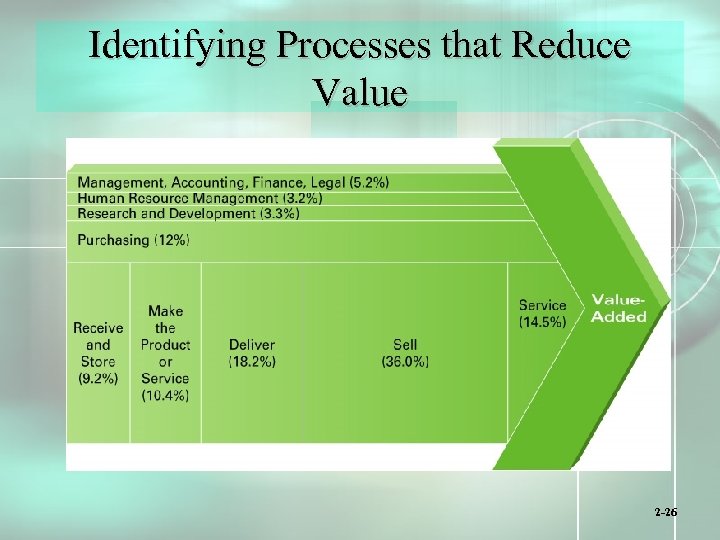
Identifying Processes that Reduce Value 2 -26
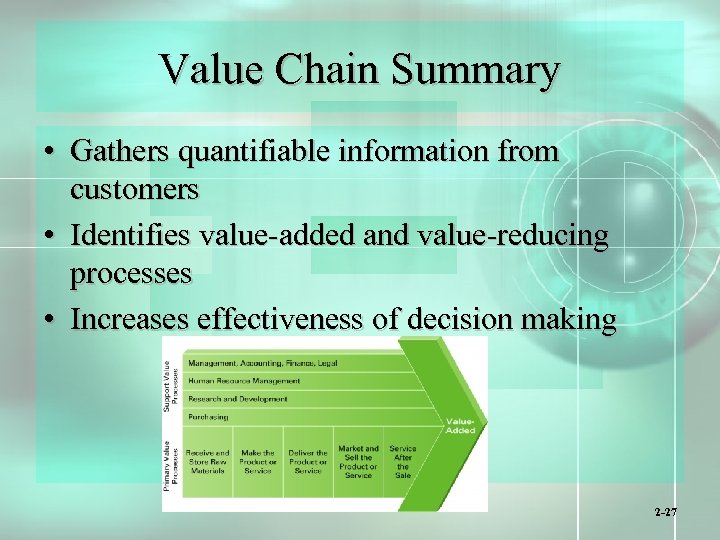
Value Chain Summary • Gathers quantifiable information from customers • Identifies value-added and value-reducing processes • Increases effectiveness of decision making 2 -27
SUPPLY CHAIN MANAGEMENT • Supply chain management (SCM) – tracks inventory and information among processes and across companies • SCM system – IT support for supply chain management • Dell – famous for its sell-source-ship supply chain model 2 -28
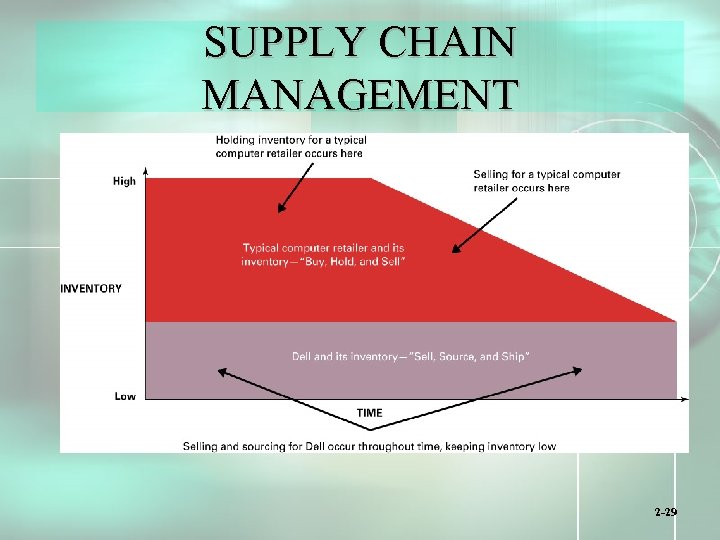
SUPPLY CHAIN MANAGEMENT 2 -29
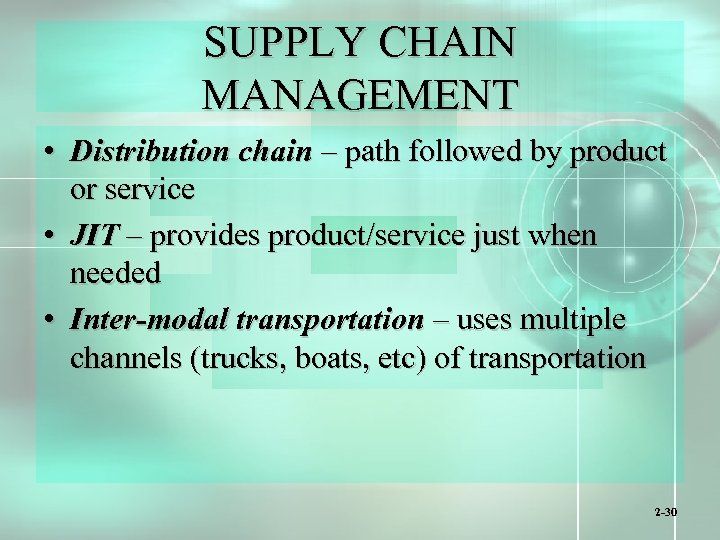
SUPPLY CHAIN MANAGEMENT • Distribution chain – path followed by product or service • JIT – provides product/service just when needed • Inter-modal transportation – uses multiple channels (trucks, boats, etc) of transportation 2 -30
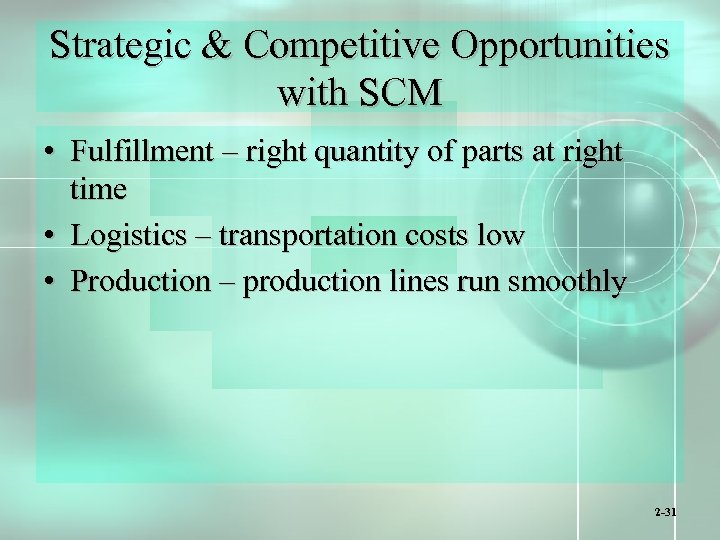
Strategic & Competitive Opportunities with SCM • Fulfillment – right quantity of parts at right time • Logistics – transportation costs low • Production – production lines run smoothly 2 -31
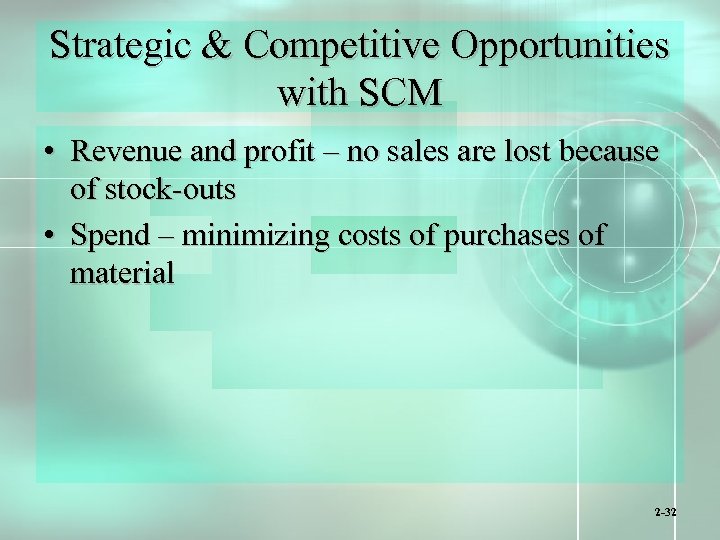
Strategic & Competitive Opportunities with SCM • Revenue and profit – no sales are lost because of stock-outs • Spend – minimizing costs of purchases of material 2 -32
IT Support for SCM • Previously specialized providers (i 2, Manugistics, etc) • Now dominated by enterprise software providers – SAP – Oracle – People. Soft 2 -33
IT Support for SCM • Supply Chain Knowledge Base – http: //supplychain. ittoolbox. com • Supply Chain Management Review – www. manufacturing. net/scm • Logistics/Supply Chain – http: //logistics. about. com 2 -34
CUSTOMER RELATIONSHIP MANAGEMENT • Part of Miami Dolphins opening case study • CRM system – uses information about customers to gain insight in order to serve them better • Sales force automation • Customer service and support • Marketing campaign management 2 -35
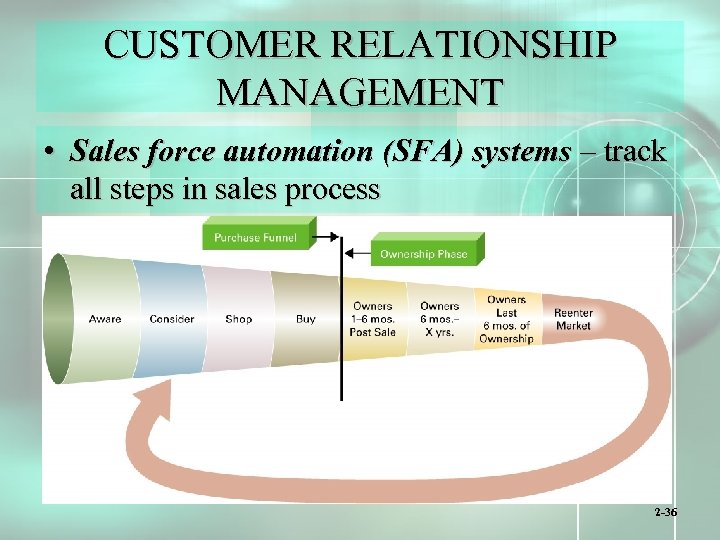
CUSTOMER RELATIONSHIP MANAGEMENT • Sales force automation (SFA) systems – track all steps in sales process 2 -36
Strategic & Competitive Opportunities with CRM • • • More effective marketing campaigns Efficient sales process Superior after-sale service and support Treat customers better Tailor offerings in response to needs 2 -37
IT Support for CRM • Front office systems – primary interface to customers and sales channels • Back office systems – fulfill and support customer orders • Databases are central 2 -38
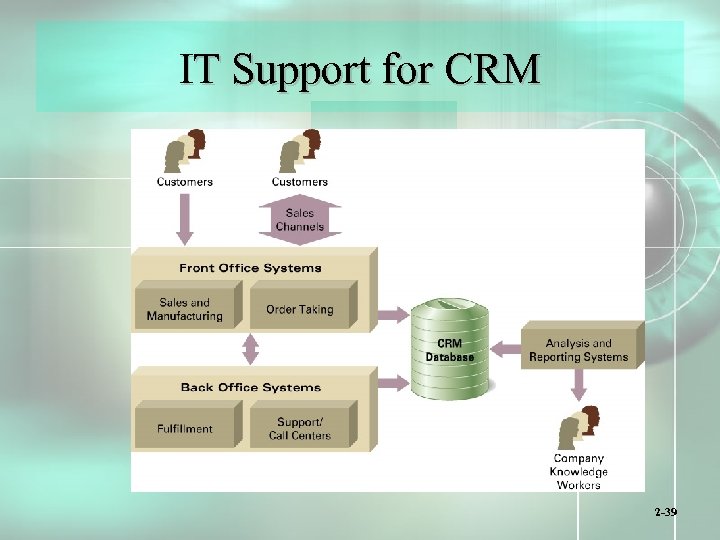
IT Support for CRM 2 -39
IT Support for CRM • CRM Today – www. crm 2 day. com • Customer Management Community – www. insightexec. com • CIO Magazine Enterprise CRM – www. cio. com/enterprise/crm/index. html 2 -40
BUSINESS INTELLIGENCE • Business intelligence – knowledge about competitors, suppliers, your own internal operations, etc • Combined forms of information to create real knowledge • Encompasses everything that affects your business • Helps you make strategic business decisions 2 -41
BUSINESS INTELLIGENCE • BI system – support business intelligence function – Capabilities in the firm – State of the art, trends, and future directions – External environment affecting competition – Actions of competitors 2 -42
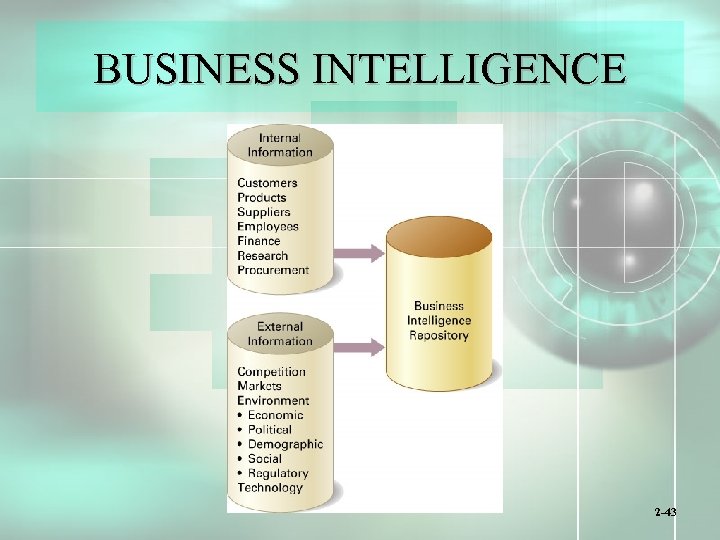
BUSINESS INTELLIGENCE 2 -43
BUSINESS INTELLIGENCE • The focus of Chapter 3 • Data warehouses – collections of information (BI) from multiple operational databases • Data marts – focused portion of a data warehouse 2 -44
Strategic and Competitive Opportunities with BI • • • Corporate performance management Optimizing customer relations Traditional decision support Management reporting of BI Information right time, location, and form (personal information dimensions) 2 -45
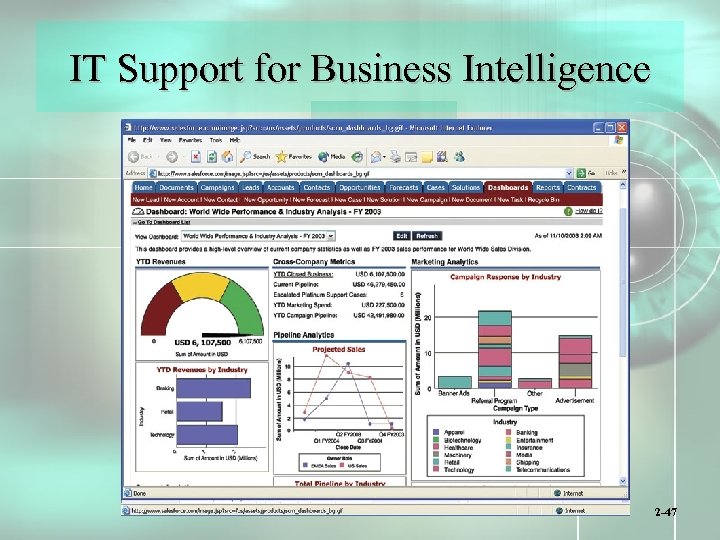
IT Support for Business Intelligence • Web supports many BI systems • Movement toward specialized BI packages • Digital dashboard – displays key information tailored to an individual 2 -46
IT Support for Business Intelligence 2 -47
IT Support for Business Intelligence • Business Intelligence Knowledge Base – http: //businessintelligence. ittoolbox. com • Business Intelligence. com – www. businessintelligence. com • Business Intelligence Evaluation Center – www. bievaluation. com 2 -48
E-COLLABORATION • E-collaboration – technology for – Work activities – Knowledge management – Social networking – Learning • ICE – environment in which virtual teams do their work • Virtual team – when team members are located in varied geographical locations 2 -49
E-COLLABORATION • Start with e-mail and get more advanced • Workflow system – facilitates automation of business processes (value chain implementation) • Workflow – steps, from beginning to end, required for a business process 2 -50
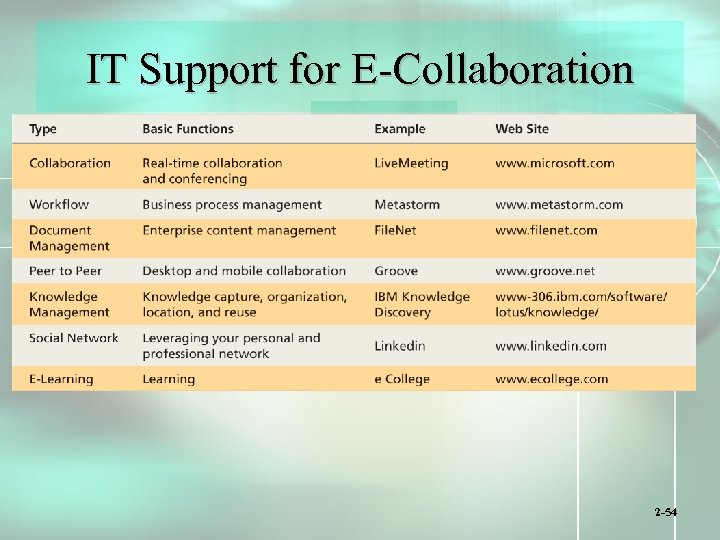
E-COLLABORATION • Knowledge management (KM) system – supports capturing, organization, and dissemination of knowledge (know-how) – Avoids reinventing the wheel • Social network system – links you to people you know, and from there, people they know – Referral service 2 -51
Strategic & Competitive Opportunities with E-Collaboration • Joint ventures on large projects within an industry • Collaborative preferred provider relationships • Sharing knowledge • Making the most of contacts 2 -52
IT Support for E-Collaboration • Presence awareness – determines if person is immediately reachable • Peer-to-peer collaboration software – communicate and share files in real time without central server • Social network systems 2 -53
IT Support for E-Collaboration 2 -54
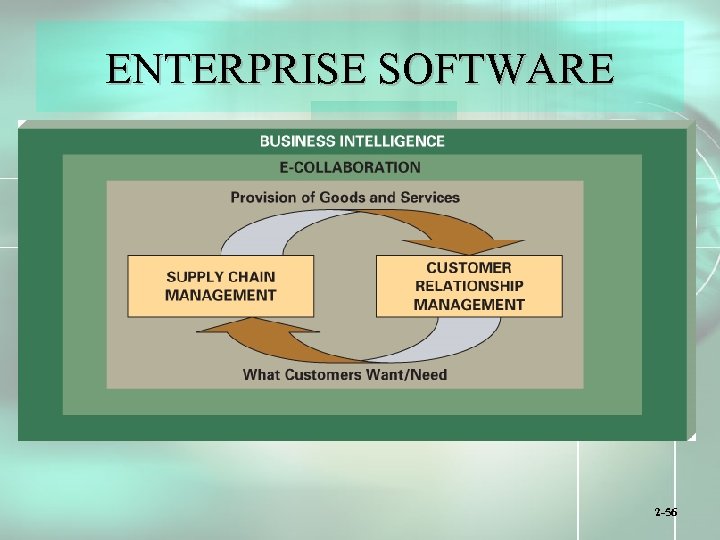
ENTERPRISE SOFTWARE • SCM, CRM, BI, and e-collaboration must be integrated • Achieved with ERP systems • Enterprise resource planning (ERP) system – software for business management supporting – Planning and manufacturing – Sales and marketing – Distribution and accounting – Finance, HR, and project management 2 -55
ENTERPRISE SOFTWARE 2 -56
BACK TO THE BEGINNING • It all starts with business strategy • Strategy determines IT use and support • Top-line or bottom-line – Do you want to increase revenue or cut costs? 2 -57
BACK TO THE BEGINNING • Run-Grow-Transform framework – How will you allocate IT dollars to initiatives? • Five Forces Model – How will you use technology to affect aspects of this model? 2 -58
BACK TO THE BEGINNING • Value chain – How can you increase value-added processes? – How can you decrease value-reducing processes? – How will IT help? 2 -59
CAN YOU… 1. Describe how to use Porter’s Five Forces Model to evaluate the attractiveness of an industry. 2. Describe the role of value chains in identifying value-added and value-reducing processes. 3. Define SCM systems and describe their strategic and competitive opportunities and IT support. 2 -60
CAN YOU… 4. Define CRM systems and describe their strategic and competitive opportunities and IT support. 5. Define BI systems and describe their strategic and competitive opportunities and IT support. 6. Define e-collaboration and describe its strategic and competitive opportunities and IT support. 2 -61
Скачать презентацию Chapter 2 Major Business Initiatives Mc Graw-Hill Irwin
584dceb3bd55e47f35f430e83b89543b.ppt