


 Скачать презентацию Chapter 2 Introduction to Ethics for the Information
1f65c5fa3c2488ac360f4d68a4d9f5f3.ppt
- Количество слайдов: 72
 Chapter 2: Introduction to Ethics for the Information Age Fourth Edition by Michael J. Quinn Copyright © 2011 Pearson Education, Inc. Publishing as Pearson Addison-Wesley
 Chapter Overview • • Introduction Review of eight ethical theories Comparing workable ethical theories Morality of breaking the law 1 -2 Copyright © 2011 Pearson Education, Inc. Publishing as Pearson Addison-Wesley 1 -2
 We Live in Communities (London, England at night from space) Image courtesy of NASA 1 -3 Copyright © 2011 Pearson Education, Inc. Publishing as Pearson Addison-Wesley 1 -3
 The Ethical Point of View • Most everyone shares “core values”, desiring – Life – Happiness – Ability to accomplish goals • Two ways to view world – Selfish point of view: consider only own self and its core values – Ethical point of view: respect other people and their core values 1 -4 Copyright © 2011 Pearson Education, Inc. Publishing as Pearson Addison-Wesley 1 -4
 Defining Terms • Society: – Association of people organized under a system of rules – Rules: advance the good of members over time • Morality – A society’s rules of conduct – What people ought / ought not to do in various situations • Ethics – Rational examination of morality – Evaluation of people’s behavior 1 -5 Copyright © 2011 Pearson Education, Inc. Publishing as Pearson Addison-Wesley 1 -5
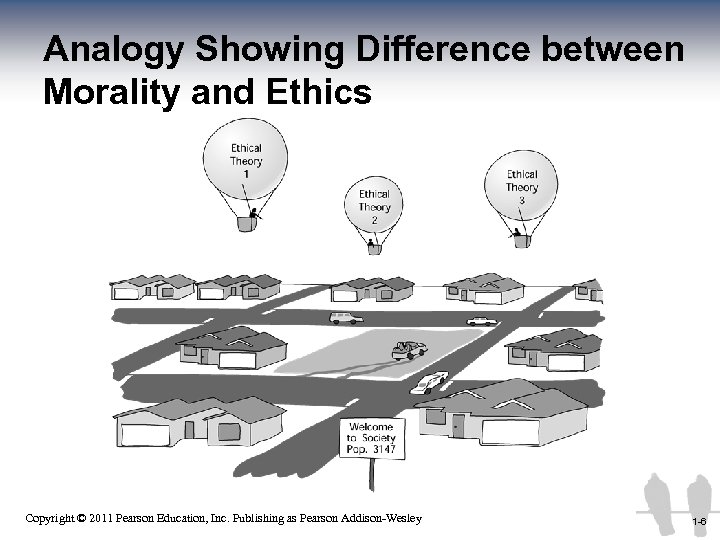 Analogy Showing Difference between Morality and Ethics 1 -6 Copyright © 2011 Pearson Education, Inc. Publishing as Pearson Addison-Wesley 1 -6
 Why Study Ethics? • Ethics: A way to decide the best thing to do • New problems accompany new technologies • “Common wisdom” may not exist for novel situations brought about by new technologies 1 -7 Copyright © 2011 Pearson Education, Inc. Publishing as Pearson Addison-Wesley 1 -7
 Scenario 1 • • Did Alexis do anything wrong? Who benefited from Alexis’s course of action? Who was hurt by Alexis’s course of action? Did Alexis have an unfair advantage over high school classmates? • Would any of your answers change if it turns out Alexis did not win a college scholarship after all? • Are there better ways Alexis could have achieved her objective? • What additional information, if any, would help 1 -8 you answer the previous question? Copyright © 2011 Pearson Education, Inc. Publishing as Pearson Addison-Wesley 1 -8
 Scenario 2 • Did the anti-spam organization do anything wrong? • Did the ISPs that refused to accept email from the blacklisted ISPs do anything wrong? • Who benefited from the organization’s action? • Who was hurt by the organization’s action? • Could the organization have achieved its goals through a better course of action? • What additional information, if any, would help you answer the previous question? 1 -9 Copyright © 2011 Pearson Education, Inc. Publishing as Pearson Addison-Wesley 1 -9
 Scenario 3 • Did the East Dakota State Police do anything wrong? • Who benefited from the actions of the EDSP? • Who was harmed by the actions of the EDSP? • What other courses of action could the EDSP have taken to achieve its objectives? • What additional information, if any, would help you answer the previous question? 1 -10 Copyright © 2011 Pearson Education, Inc. Publishing as Pearson Addison-Wesley 1 -10
 Scenario 4 • Should you recommend release of the product next week? • Who will benefit if the company follows your recommendation? • Who will be harmed if the company follows your recommendation? • Do you have an obligation to any group of people that may be affected by your decision? • What additional information, if any, would help you answer the previous question? 1 -11 Copyright © 2011 Pearson Education, Inc. Publishing as Pearson Addison-Wesley 1 -11
 More on Ethics • Ethics: rational, systematic analysis – “Doing ethics”: answers need explanations – Explanations: facts, shared values, logic • Ethics: voluntary, moral choices • Involuntary, e. g. , swerve to avoid obscured pedestrian, kill another pedestrian -> reflex. • Not moral realm, e. g. , choosing car color -> not reasoned choice. • Drunk driver ->voluntary choice. • Workable ethical theory: produces explanations that might be persuasive to a skeptical, yet open 1 -12 minded audience Copyright © 2011 Pearson Education, Inc. Publishing as Pearson Addison-Wesley 1 -12
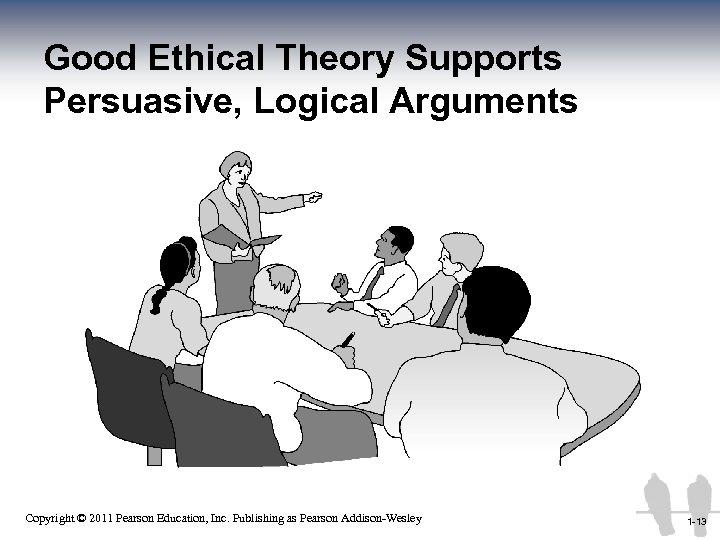 Good Ethical Theory Supports Persuasive, Logical Arguments 1 -13 Copyright © 2011 Pearson Education, Inc. Publishing as Pearson Addison-Wesley 1 -13
 2. 2 Subjective Relativism • Relativism – No universal norms of right and wrong – One person can say “X is right, ” another can say “X is wrong, ” and both can be right • Subjective relativism – Each person decides right and wrong for himself or herself – “What’s right for you may not be right for me” 1 -14 Copyright © 2011 Pearson Education, Inc. Publishing as Pearson Addison-Wesley 1 -14
 Case for Subjective Relativism • Well-meaning and intelligent people disagree on moral issues • e. g. , rational people on both sides of abortion issues • Ethical debates are disagreeable and pointless 1 -15 Copyright © 2011 Pearson Education, Inc. Publishing as Pearson Addison-Wesley 1 -15
 Case Against Subjective Relativism • Blurs distinction between doing what you think is right and doing what you want to do • “Who are you to tell me what to do or not” – not very moralist. • Makes no moral distinction between the actions of different people – Hitler vs. Mother Theresa, each thought doing right • SR and tolerance are two different things – Tolerate intolerance? – Given, tolerance = universal moral norm, SR is incompatible. • Decisions may not be based on reason • Not a workable ethical theory Copyright © 2011 Pearson Education, Inc. Publishing as Pearson Addison-Wesley 1 -16
 2. 3 Cultural Relativism • What is “right” and “wrong” depends upon a society’s actual moral guidelines • These guidelines vary from place to place and from time to time • A particular action may be right in one society at one time and wrong in other society or at another time • Right/wrong for same society at different times • Right/wrong for different societies at same time. • Pedestrian Accident Dilemma. 1 -17 Copyright © 2011 Pearson Education, Inc. Publishing as Pearson Addison-Wesley 1 -17
 Case for Cultural Relativism • Different social contexts demand different moral guidelines • Shifted survival from human race -> Impact on nature • It is arrogant for one society to judge another • Technology has not made us necessarily more intelligent than previous societies. • 21 st century vs. 15 th century 1 -18 Copyright © 2011 Pearson Education, Inc. Publishing as Pearson Addison-Wesley 1 -18
 Case Against Cultural Relativism • Because two societies do have different moral views doesn’t mean they ought to have different views • • It doesn’t explain how moral guidelines are determined • • Drought – aqueduct vs. human sacrifices. Poll individuals, not interested in personal views, back to square one. What if there are no cultural norms? – e. g. , Internet -> sharing copyright material -> ok/not ok? • It doesn’t account for evolution of moral guidelines. • • It provides no way out for cultures in conflict • • Core values do exist in all societies (e. g. , truth). Invalidates this theory. Only indirectly based on reason • • Consider: documentation is good but all not styles. Some practices should be forbidden. Societies do, in fact, share certain core values • • Israel vs. Palestine; no common ground to reconcile. Existence of many acceptable practices does not imply all practices are acceptable (many/any fallacy) • • Segregation challenged; yesteryear’s standards, it was wrong, today’s standards, did nothing wrong. Sometimes based on traditions not reasoning. Not a workable ethical theory Copyright © 2011 Pearson Education, Inc. Publishing as Pearson Addison-Wesley 1 -19
 2. 4 Divine Command Theory • Good actions: those aligned with God’s will • Bad actions: those contrary to God’s will • Holy books reveal God’s will • We should holy books as moral decisionmaking guides 1 -20 Copyright © 2011 Pearson Education, Inc. Publishing as Pearson Addison-Wesley 1 -20
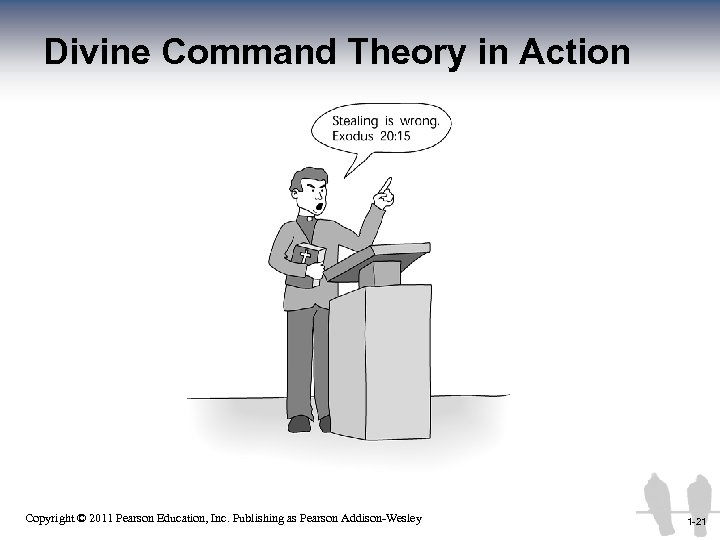 Divine Command Theory in Action 1 -21 Copyright © 2011 Pearson Education, Inc. Publishing as Pearson Addison-Wesley 1 -21
 Case for Divine Command Theory • We owe obedience to our Creator • God is all-good and all-knowing • God is the ultimate authority 1 -22 Copyright © 2011 Pearson Education, Inc. Publishing as Pearson Addison-Wesley 1 -22
 Case Against Divine Command Theory • Different holy books disagree • e. g. , Catholic vs. Protestant bible. • Society is multicultural, secular • Atheism, other religions (e. g. , Buddhism) • Some modern moral problems not addressed in scripture • Fallback on analogy; not scripture. • “The good” ≠ “God” (equivalence fallacy) • i. e. , good is outside of God. • Based on obedience, not reason – Not based on facts, reasoning. Abraham vs. Cain • Not a workable ethical theory Copyright © 2011 Pearson Education, Inc. Publishing as Pearson Addison-Wesley 1 -23
 2. 5 Ethical Egoism • Each person should focus exclusively on his or her self-interest • Morally right action: that action that provides self with maximum long-term benefit • Philosophy espoused by Ayn Rand, author of The Fountainhead and Atlas Shrugged 1 -24 Copyright © 2011 Pearson Education, Inc. Publishing as Pearson Addison-Wesley 1 -24
 Case for Ethical Egoism • It is practical since we are already inclined to do what’s best for ourselves • The community can benefit when individuals put their well-being first • Other moral principles are rooted in the principle of self-interest 1 -25 Copyright © 2011 Pearson Education, Inc. Publishing as Pearson Addison-Wesley 1 -25
 Case Against Ethical Egoism • An easy moral philosophy may not be the best moral philosophy • Easier-to-live by philosophy ≠ Good philosophy. • Not true that people naturally act in their own long-term self-interest • We’re human -> live for near-term. • Social injustices have occurred when individuals have put their own interests first • e. g. , slavery. • Other moral principles are superior to principle of selfinterest • e. g. , preserving life vs. self interest. • Ethical egoism is a form of bigotry • Not a workable ethical theory Copyright © 2011 Pearson Education, Inc. Publishing as Pearson Addison-Wesley 1 -26
 2. 6 Kantianism • Good will: the desire to do the right thing • Torn between – What we want to do vs. What we ought to do • Immanuel Kant: Only thing in the world that is good without qualification is a good will • Reason should cultivate desire to do right thing 1 -27 Copyright © 2011 Pearson Education, Inc. Publishing as Pearson Addison-Wesley 1 -27
 Categorical Imperative (1 st Formulation) Act only from moral rules that you can at the same time will to be universal moral laws. 1 -28 Copyright © 2011 Pearson Education, Inc. Publishing as Pearson Addison-Wesley 1 -28
 Illustration of 1 st Formulation • Question: Can a person in dire straits make a promise with the intention of breaking it later? • Proposed rule: “I may make promises with the intention of later breaking them. ” • The person in trouble wants his promise to be believed so he can get what he needs. • Universalize rule: Everyone may make & break promises • Everyone breaking promises would make promises unbelievable, contradicting desire to have promise believed • The rule is flawed. The answer is “No. ” 1 -29 Copyright © 2011 Pearson Education, Inc. Publishing as Pearson Addison-Wesley 1 -29
 Categorical Imperative (2 nd Formulation) Act so that you treat both yourself and other people as ends in themselves and never only as a means to an end. This is usually an easier formulation to work with than the first formulation of the Categorical Imperative. 1 -30 Copyright © 2011 Pearson Education, Inc. Publishing as Pearson Addison-Wesley 1 -30
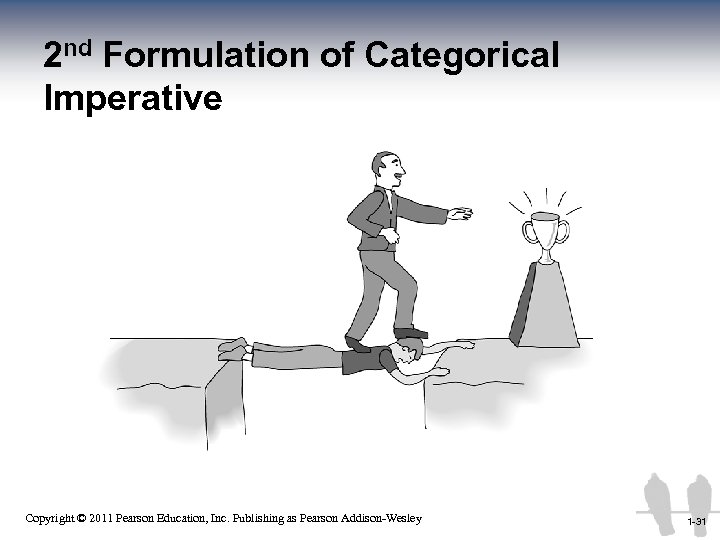 2 nd Formulation of Categorical Imperative 1 -31 Copyright © 2011 Pearson Education, Inc. Publishing as Pearson Addison-Wesley 1 -31
 Plagiarism Scenario • Carla – Single mother – Works full time – Takes two evening courses/semester • History class – Requires more work than normal – Carla earning an “A” on all work so far – Carla doesn’t have time to write final report • Carla purchases report and submits it as her own work 1 -32 Copyright © 2011 Pearson Education, Inc. Publishing as Pearson Addison-Wesley 1 -32
 Kantian Evaluation (1 st Formulation) • Carla wants credit for plagiarized report • Rule: “You may claim credit for work performed by someone else” • If rule universalized, reports would no longer be credible indicator’s of student’s knowledge, and professors would not give credit for reports • Proposal moral rule is self-defeating • It is wrong for Carla to turn in a purchased report 1 -33 Copyright © 2011 Pearson Education, Inc. Publishing as Pearson Addison-Wesley 1 -33
 Kantian Evaluation (2 nd Formulation) • Carla submitted another person’s work as her own • She attempted to deceive professor • She treated professor as a means to an end – End: passing the course – Means: professor issues grade • What Carla did was wrong 1 -34 Copyright © 2011 Pearson Education, Inc. Publishing as Pearson Addison-Wesley 1 -34
 Case for Kantianism • • Rational Produces universal moral guidelines Treats all persons as moral equals Workable ethical theory 1 -35 Copyright © 2011 Pearson Education, Inc. Publishing as Pearson Addison-Wesley 1 -35
 Perfect and Imperfect Duties • Perfect duty: duty obliged to fulfill without exception – Example: Telling the truth • Imperfect duty: duty obliged to fulfill in general but not in every instance – Example: Helping others 1 -36 Copyright © 2011 Pearson Education, Inc. Publishing as Pearson Addison-Wesley 1 -36
 Case Against Kantianism • Sometimes no rule adequately characterizes an action – e. g. , Am I stealing? Am I caring for my children? • Sometimes there is no way to resolve a conflict between rules – In a conflict between a perfect duty and an imperfect duty, perfect duty prevails – In a conflict between two perfect duties, no solution – e. g. , Should not steal vs. Protect lives of innocent people. • Kantianism allows no exceptions to perfect duties – e. g. , Mom’s ugly haircut Copyright © 2011 Pearson Education, Inc. Publishing as Pearson Addison-Wesley 1 -37
 2. 7 Act Utilitarianism 1 -38 Copyright © 2011 Pearson Education, Inc. Publishing as Pearson Addison-Wesley 1 -38
 Principle of Utility • • Jeremy Bentham and John Stuart Mill An action is good if it benefits someone An action is bad if it harms someone Utility: tendency of an object to produce happiness or prevent unhappiness for an individual or a community • Happiness = advantage = benefit = good = pleasure • Unhappiness = disadvantage = cost = evil = pain 1 -39 Copyright © 2011 Pearson Education, Inc. Publishing as Pearson Addison-Wesley 1 -39
 Principle of Utility (Greatest Happiness Principle) An action is right (or wrong) to the extent that it increases (or decreases) the total happiness of the affected parties. 1 -40 Copyright © 2011 Pearson Education, Inc. Publishing as Pearson Addison-Wesley 1 -40
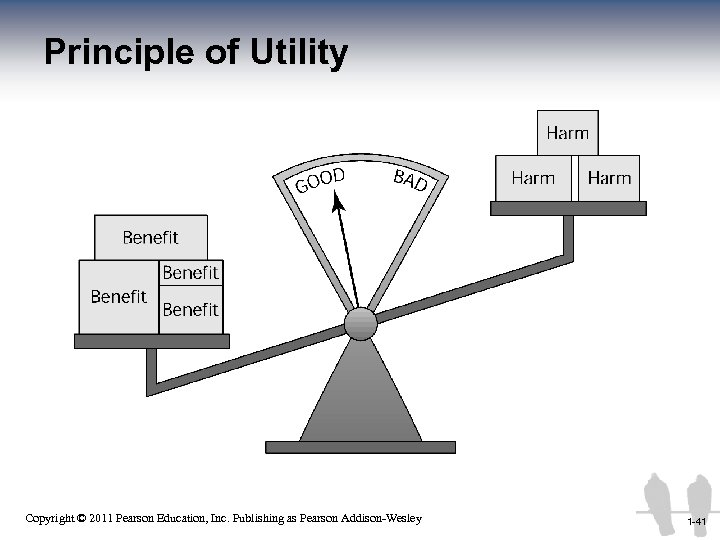 Principle of Utility 1 -41 Copyright © 2011 Pearson Education, Inc. Publishing as Pearson Addison-Wesley 1 -41
 Act Utilitarianism • Utilitarianism – Morality of an action has nothing to do with intent – Focuses on the consequences – A consequentialist theory • Act utilitarianism – Add up change in happiness of all affected beings – Sum > 0, action is good – Sum < 0, action is bad 1 -42 Copyright © 2011 Pearson Education, Inc. Publishing as Pearson Addison-Wesley 1 -42
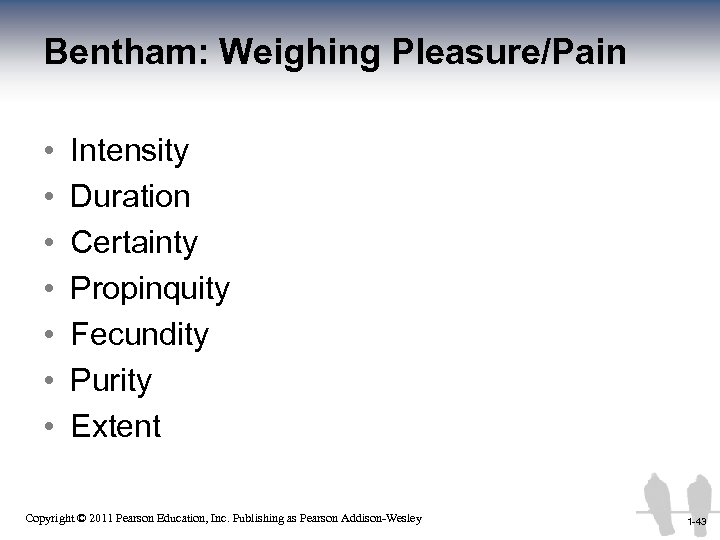 Bentham: Weighing Pleasure/Pain • • Intensity Duration Certainty Propinquity Fecundity Purity Extent 1 -43 Copyright © 2011 Pearson Education, Inc. Publishing as Pearson Addison-Wesley 1 -43
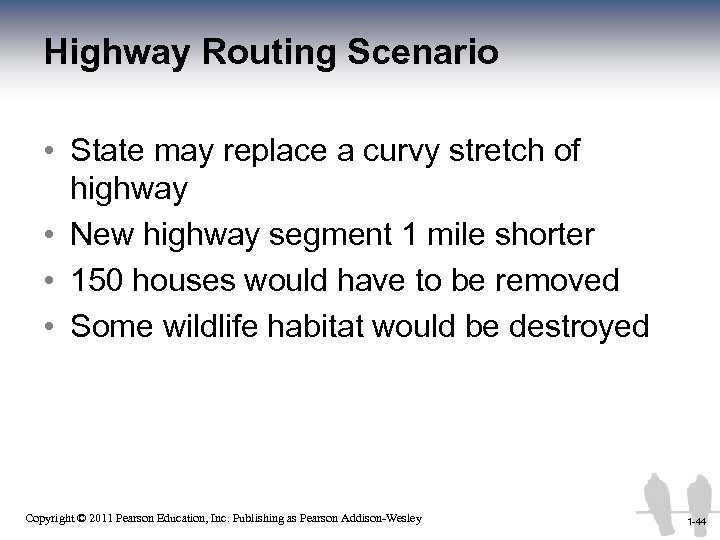 Highway Routing Scenario • State may replace a curvy stretch of highway • New highway segment 1 mile shorter • 150 houses would have to be removed • Some wildlife habitat would be destroyed 1 -44 Copyright © 2011 Pearson Education, Inc. Publishing as Pearson Addison-Wesley 1 -44
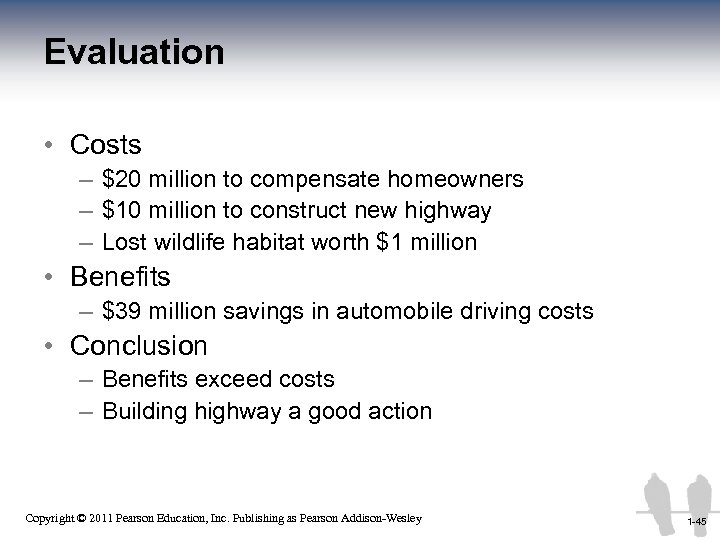 Evaluation • Costs – $20 million to compensate homeowners – $10 million to construct new highway – Lost wildlife habitat worth $1 million • Benefits – $39 million savings in automobile driving costs • Conclusion – Benefits exceed costs – Building highway a good action 1 -45 Copyright © 2011 Pearson Education, Inc. Publishing as Pearson Addison-Wesley 1 -45
 Case for Act Utilitarianism • • Focuses on happiness Down-to-earth (practical) Comprehensive Workable ethical theory 1 -46 Copyright © 2011 Pearson Education, Inc. Publishing as Pearson Addison-Wesley 1 -46
 Case Against Act Utilitarianism • Unclear whom to include in calculations • Whom? How far into future? • Too much work • Ignores our innate sense of duty • Duty/Obligation carries no weight; only consequences matter • 1000 units for A vs. 1001 units for B • Cannot predict consequences of action with certainty • Susceptible to the problem of moral luck • e. g. , Hospital Flowers Copyright © 2011 Pearson Education, Inc. Publishing as Pearson Addison-Wesley 1 -47
 2. 8 Rule Utilitarianism • We ought to adopt moral rules which, if followed by everyone, will lead to the greatest increase in total happiness • Act utilitarianism applies Principle of Utility to individual actions • Rule utilitarianism applies Principle of Utility to moral rules 1 -48 Copyright © 2011 Pearson Education, Inc. Publishing as Pearson Addison-Wesley 1 -48
 Anti-Worm Scenario • August 2003: Blaster worm infected thousands of Windows computers • Soon after, Nachi worm appeared – – Took control of vulnerable computer Located and destroyed copies of Blaster Downloaded software patch to fix security problem Used computer as launching pad to try to “infect” other vulnerable PCs 1 -49 Copyright © 2011 Pearson Education, Inc. Publishing as Pearson Addison-Wesley 1 -49
 Evaluation using Rule Utilitarianism • Proposed rule: If I can write a helpful worm that removes a harmful worm from infected computers and shields them from future attacks, I should do so • Who would benefit – People who do not keep their systems updated • Who would be harmed – People who use networks – People who’s computers are invaded by buggy antiworms – System administrators • Conclusion: Harm outweighs benefits. Releasing anti -worm is wrong. 1 -50 Copyright © 2011 Pearson Education, Inc. Publishing as Pearson Addison-Wesley 1 -50
 Case for Rule Utilitarianism • Compared to act utilitarianism, it is easier to perform the utilitarian calculus. • Not every moral decision requires performing utilitarian calculus. • Moral rules survive exceptional situations • e. g. , Promise 1000 goods for A, but could produce 1001 for B. Act Util would say break promise but Rule Util reasons long-term consequences produces more good • Avoids the problem of moral luck – Back to the ‘hospital flowers’. • Workable ethical theory Copyright © 2011 Pearson Education, Inc. Publishing as Pearson Addison-Wesley 1 -51
 Case Against Utilitarianism in General • All consequences must be measured on a single scale. – All units must be the same in order to do the sum – In certain circumstances utilitarians must quantify the value of a human life • e. g. , divorce resulting from highway routing scenario • Utilitarianism ignores the problem of an unjust distribution of good consequences. – Utilitarianism does not mean “the greatest good of the greatest number” • 100 units for all vs. 200 for ½ and ½ get nothing – That requires a principle of justice – What happens when a conflict arises between the Principle of Utility and a principle of justice? Copyright © 2011 Pearson Education, Inc. Publishing as Pearson Addison-Wesley 1 -52
 2. 9 Social Contract Theory • Thomas Hobbes – “State of nature” • Everyone looking out for themselves” – We implicitly accept a social contract • Establishment of moral rules to govern relations among citizens • Government capable of enforcing these rules • Jean-Jacques Rousseau – In ideal society, no one above rules – That prevents society from enacting bad rules 1 -53 Copyright © 2011 Pearson Education, Inc. Publishing as Pearson Addison-Wesley 1 -53
 James Rachels’s Definition “Morality consists in the set of rules, governing how people are to treat one another, that rational people will agree to accept, for their mutual benefit, on the condition that others follow those rules as well. ” • Kantians: Right to according to a rule if can be universalized. • Social Contract Theorists: Right to according to a rule if people collectively accept it as binding. 1 -54 Copyright © 2011 Pearson Education, Inc. Publishing as Pearson Addison-Wesley 1 -54
 Kinds of Rights • Negative right: A right that another can guarantee by leaving you alone – e. g. , Right to free expression • Positive right: A right obligating others to do something on your behalf – e. g. , Right to a free education. • Absolute right: A right guaranteed without exception • Limited right: A right that may be restricted based on the circumstances Copyright © 2011 Pearson Education, Inc. Publishing as Pearson Addison-Wesley 1 -55
 Correlation between Types of Rights • Positive rights tend to be more limited -> – e. g. , free education up to a certain point (K-12) • Negative rights tends to be more absolute > – e. g. , “right to life” 1 -56 Copyright © 2011 Pearson Education, Inc. Publishing as Pearson Addison-Wesley 1 -56
 John Rawls’s Principles of Justice • Each person may claim a “fully adequate” number of basic rights and liberties, so long as these claims are consistent with everyone else having a claim to the same rights and liberties • Any social and economic inequalities must – Be associated with positions that everyone has a fair and equal opportunity to achieve – Be to the greatest benefit of the least-advantaged members of society (the difference principle) • e. g. , graduated income tax system (higher income, higher %) • Violation, e. g. , military draft system (people with less means, higher probability) 1 -57 Copyright © 2011 Pearson Education, Inc. Publishing as Pearson Addison-Wesley 1 -57
 DVD Rental Scenario • Bill owns chain of DVD rental stores • Collects information about rentals from customers • Constructs profiles of customers • Sells profiles to direct marketing firms • Some customers happy to receive more mail order catalogs; others unhappy at increase in “junk mail” 1 -58 Copyright © 2011 Pearson Education, Inc. Publishing as Pearson Addison-Wesley 1 -58
 Evaluation (Social Contract Theory) • Consider rights of Bill, customers, and mail order companies. • Does customer have right to expect name, address to be kept confidential? • If customer rents DVD from bill, who owns information about transaction? • If Bill and customer have equal rights to information, Bill did nothing wrong to sell information. • If customers have right to expect name and address or transaction to be confidential without giving permission, then Bill was wrong to sell information without asking for permission. 1 -59 Copyright © 2011 Pearson Education, Inc. Publishing as Pearson Addison-Wesley 1 -59
 Case for Social Contract Theory • Framed in language of rights • Explains why people act in self-interest without common agreement -> • Bottom line: implicit agreement between all. Common good best realized when all cooperate • Provides clear analysis of certain citizen/government problems -> – Liberty vs. incarceration. Everyone benefits when everyone bears burden. – Civil Disobedience: Kantians, Utilitarians can’t justify but Social Contract Theorists can. • i. e. , receive certain benefits by bearing certain burdens. • Workable ethical theory Copyright © 2011 Pearson Education, Inc. Publishing as Pearson Addison-Wesley 1 -60
 Case Against Social Contract Theory • No one signed contract • Some actions have multiple characterizations -> • Same problem as Kantianism. • Conflicting rights problem -> – Same problem as Kantianism. – e. g. , abortion – right to privacy vs. right to life • May unjustly treat people who cannot uphold contract – Deliberately break law vs. Don’t understand. – e. g. , drug addicts who steal to feed addiction. Copyright © 2011 Pearson Education, Inc. Publishing as Pearson Addison-Wesley 1 -61
 2. 10 Comparing Workable Ethical Theories 1 -62 Copyright © 2011 Pearson Education, Inc. Publishing as Pearson Addison-Wesley 1 -62
 Objectivism vs. Relativism • Objectivism: Morality has an existence outside the human mind • Relativism: Morality is a human invention • Kantianism, utilitarianism, and social contract theory examples of objectivism 1 -63 Copyright © 2011 Pearson Education, Inc. Publishing as Pearson Addison-Wesley 1 -63
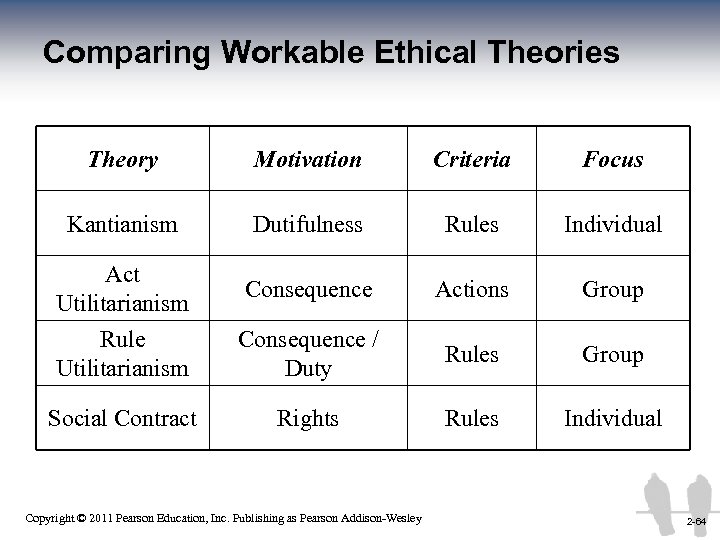 Comparing Workable Ethical Theories Theory Motivation Criteria Focus Kantianism Dutifulness Rules Individual Act Utilitarianism Consequence Actions Group Rule Utilitarianism Consequence / Duty Rules Group Social Contract Rights Rules Individual 1 -64 Copyright © 2011 Pearson Education, Inc. Publishing as Pearson Addison-Wesley 2 -64
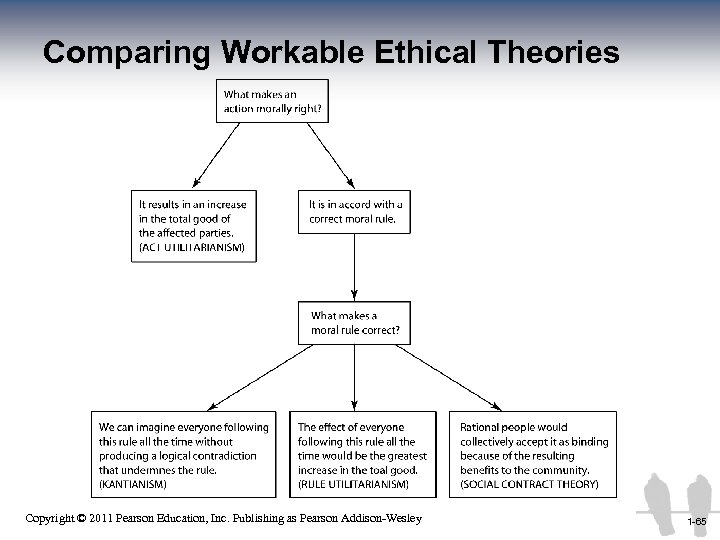 Comparing Workable Ethical Theories 1 -65 Copyright © 2011 Pearson Education, Inc. Publishing as Pearson Addison-Wesley 1 -65
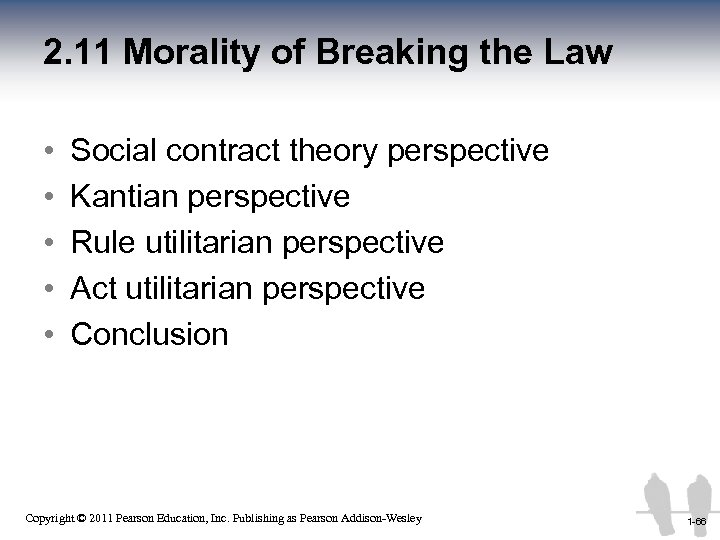 2. 11 Morality of Breaking the Law • • • Social contract theory perspective Kantian perspective Rule utilitarian perspective Act utilitarian perspective Conclusion 1 -66 Copyright © 2011 Pearson Education, Inc. Publishing as Pearson Addison-Wesley 1 -66
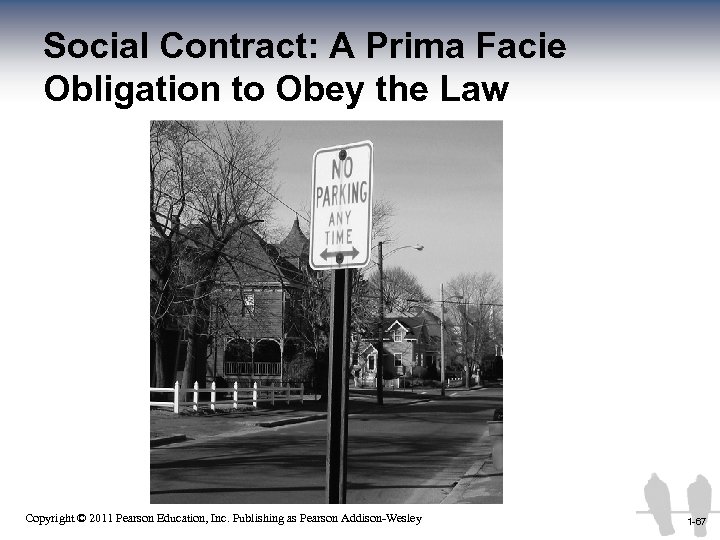 Social Contract: A Prima Facie Obligation to Obey the Law 1 -67 Copyright © 2011 Pearson Education, Inc. Publishing as Pearson Addison-Wesley 1 -67
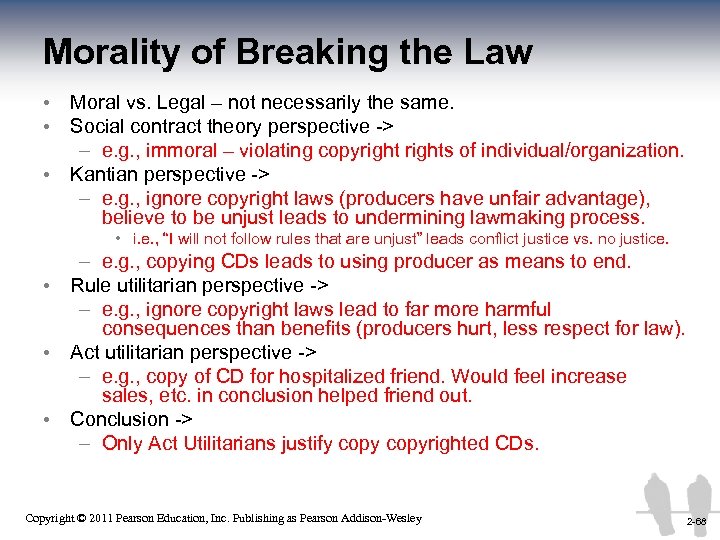 Morality of Breaking the Law • Moral vs. Legal – not necessarily the same. • Social contract theory perspective -> – e. g. , immoral – violating copyrights of individual/organization. • Kantian perspective -> – e. g. , ignore copyright laws (producers have unfair advantage), believe to be unjust leads to undermining lawmaking process. • i. e. , “I will not follow rules that are unjust” leads conflict justice vs. no justice. – e. g. , copying CDs leads to using producer as means to end. • Rule utilitarian perspective -> – e. g. , ignore copyright laws lead to far more harmful consequences than benefits (producers hurt, less respect for law). • Act utilitarian perspective -> – e. g. , copy of CD for hospitalized friend. Would feel increase sales, etc. in conclusion helped friend out. • Conclusion -> – Only Act Utilitarians justify copyrighted CDs. 1 -68 Copyright © 2011 Pearson Education, Inc. Publishing as Pearson Addison-Wesley 2 -68
 Summary 1 -69 Copyright © 2011 Pearson Education, Inc. Publishing as Pearson Addison-Wesley 1 -69
 Insights Offered by Various Theories • Kantianism: Interactions with other people should respect them as rational beings • Utilitarians: You should consider the consequences of an action before deciding whether it’s right or wrong • Social contract theory: We should promote collective rights, such as the rights to life, liberty, and property 1 -70 Copyright © 2011 Pearson Education, Inc. Publishing as Pearson Addison-Wesley 1 -70
 Mixing Theories • You can consider duties and rights and consequences when making moral decisions • But what will you do when you can’t respect rights absolutely and still maximize the total beneficial consequences? • Contemplation of what it means to be a person of good character leads to a discussion of virtue ethics (to be discussed in Chapter 8) 1 -71 Copyright © 2011 Pearson Education, Inc. Publishing as Pearson Addison-Wesley 1 -71
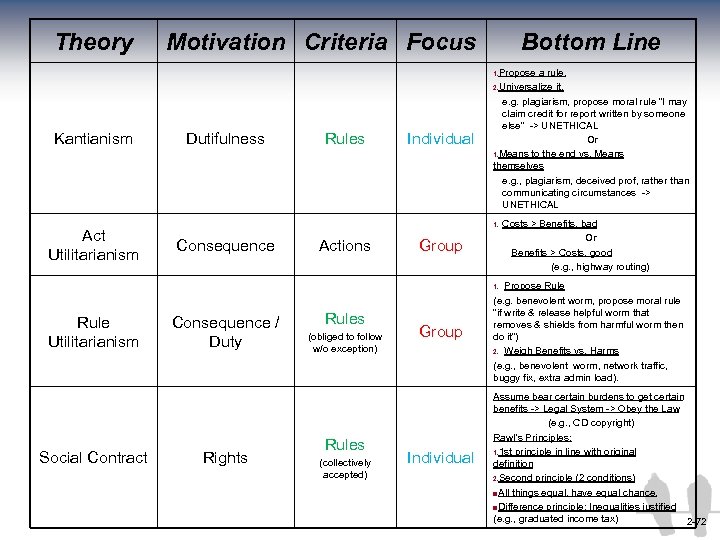 Theory Motivation Criteria Focus Bottom Line 1. Propose Kantianism Act Utilitarianism Dutifulness Rules Individual a rule. 2. Universalize it. e. g. plagiarism, propose moral rule “I may claim credit for report written by someone else” -> UNETHICAL Or 1. Means to the end vs. Means themselves e. g. , plagiarism, deceived prof, rather than communicating circumstances -> UNETHICAL 1. Consequence Actions Group Costs > Benefits, bad Or Benefits > Costs, good (e. g. , highway routing) Propose Rule (e. g. benevolent worm, propose moral rule “if write & release helpful worm that removes & shields from harmful worm then do it”) 2. Weigh Benefits vs. Harms (e. g. , benevolent worm, network traffic, buggy fix, extra admin load). 1. Rule Utilitarianism Social Contract Consequence / Duty Rights Rules (obliged to follow w/o exception) Rules (collectively accepted) Group Individual Copyright © 2011 Pearson Education, Inc. Publishing as Pearson Addison-Wesley Assume bear certain burdens to get certain benefits -> Legal System -> Obey the Law (e. g. , CD copyright) Rawl’s Principles; 1. 1 st principle in line with original definition 2. Second principle (2 conditions) 1 -72 n. All things equal, have equal chance. n. Difference principle; Inequalities justified (e. g. , graduated income tax) 2 -72