


 Скачать презентацию Chapter 2 Infancy Module 2 3 Social and
2a1625b2b6a9cb577c95e69cc451bc5a.ppt
- Количество слайдов: 71
 Chapter 2: Infancy Module 2. 3 Social and Personality Development in Infancy Discovering the Lifespan - Robert S. Feldman Copyright © 2009 Pearson Education, Inc. , Upper Saddle River, NJ 07458. All rights reserved.
 DEVELOPING THE ROOTS OF SOCIABILITY Discovering the Lifespan - Robert S. Feldman Copyright © 2009 Pearson Education, Inc. , Upper Saddle River, NJ 07458. All rights reserved.
 Basic Familiar Expressions • Remarkably similar across the most diverse cultures • Nonverbal encoding fairly consistent among people of all ages 129 Discovering the Lifespan - Robert S. Feldman Copyright © 2009 Pearson Education, Inc. , Upper Saddle River, NJ 07458. All rights reserved.
 Facial Expression of Emotions • Important nonverbal communication tool used in everyday social interactions Discovering the Lifespan - Robert S. Feldman Copyright © 2009 Pearson Education, Inc. , Upper Saddle River, NJ 07458. All rights reserved.
 Who IS that strange person, anyway? • Stranger anxiety – Memory develops ability to recognize familiar people emerges abililty to anticipate and predict events increases appearance of unknown person causes fear – Common around 6 months – Significant difference among infants and situations 130 Discovering the Lifespan - Robert S. Feldman Copyright © 2009 Pearson Education, Inc. , Upper Saddle River, NJ 07458. All rights reserved.
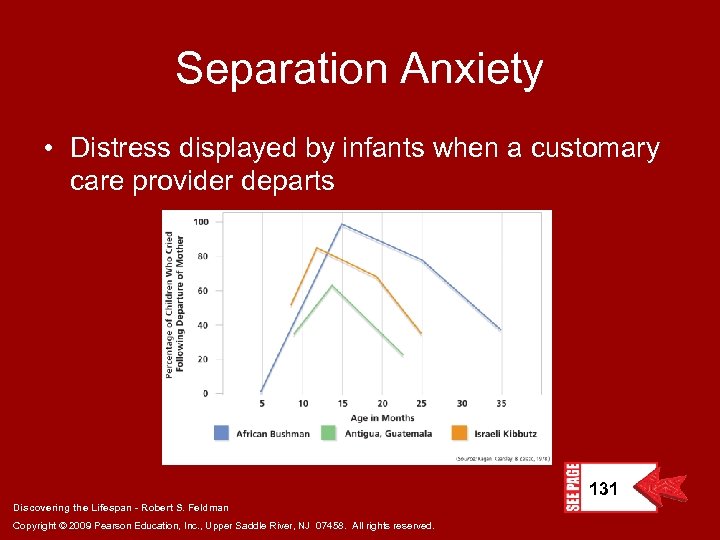 Separation Anxiety • Distress displayed by infants when a customary care provider departs 131 Discovering the Lifespan - Robert S. Feldman Copyright © 2009 Pearson Education, Inc. , Upper Saddle River, NJ 07458. All rights reserved.
 Separation Anxiety • Universal across cultures • Begins about 7 -8 months; peaks around 14 months • Largely attributable to same reasons as stranger anxiety 131 Discovering the Lifespan - Robert S. Feldman Copyright © 2009 Pearson Education, Inc. , Upper Saddle River, NJ 07458. All rights reserved.
 Smiling • Earliest smiles: little meaning • 6 to 9 weeks: – Begin reliable smiling – Smile first relatively indiscriminate then selective • 18 months: – Social smiling more frequent toward humans than nonhuman objects • End of 2 nd year: – Use smiling purposefully – Show sensitivity to emotional expressions of others 131 Discovering the Lifespan - Robert S. Feldman Copyright © 2009 Pearson Education, Inc. , Upper Saddle River, NJ 07458. All rights reserved.
 Decoding Others’ Facial and Vocal Expressions • Imitative abilities early in life may pave way for nonverbal decoding • Infants interpret others’ facial and vocal expressions that carry meaning – In first 6 to 8 weeks – By 4 months 132 Discovering the Lifespan - Robert S. Feldman Copyright © 2009 Pearson Education, Inc. , Upper Saddle River, NJ 07458. All rights reserved.
 If you’re happy and she knows it… • Social referencing – First occurs around 8 -9 months – Intentional search for cues – Aids in understanding others’ behavior in context 132 Discovering the Lifespan - Robert S. Feldman Copyright © 2009 Pearson Education, Inc. , Upper Saddle River, NJ 07458. All rights reserved.
 Do infants really know who they are? Discovering the Lifespan - Robert S. Feldman Copyright © 2009 Pearson Education, Inc. , Upper Saddle River, NJ 07458. All rights reserved.
 Development of Self-Awareness • Roots of self-awareness – Begin to grow around 12 months – Influenced by cultural upbringing • Research – Rouge spot • Average awareness begins 17 to 24 months – Complicated tasks requests • Awareness of inabilities around 23 -24 months 133 Discovering the Lifespan - Robert S. Feldman Copyright © 2009 Pearson Education, Inc. , Upper Saddle River, NJ 07458. All rights reserved.
 Just Think About That! • Theory of mind – Knowledge and beliefs how mind works and influences behavior – Child explanations used to explain how others think 133 Discovering the Lifespan - Robert S. Feldman Copyright © 2009 Pearson Education, Inc. , Upper Saddle River, NJ 07458. All rights reserved.
 How does a theory of mind develop? • See other people as compliant agents • Begin to understand causality and intentionality • Demonstrate rudiments of empathy • Begin to use deception to fool others 133 Discovering the Lifespan - Robert S. Feldman Copyright © 2009 Pearson Education, Inc. , Upper Saddle River, NJ 07458. All rights reserved.
 Review and Apply REVIEW • Infants appear to express and to experience emotions, and their emotions broaden in range to reflect increasingly complex emotional states. Discovering the Lifespan - Robert S. Feldman Copyright © 2009 Pearson Education, Inc. , Upper Saddle River, NJ 07458. All rights reserved. 134
 Review and Apply REVIEW • The ability to decode the nonverbal facial and vocal expressions of others develops early in infants. • Infants develop self-awareness, the knowledge that they exist separately from the rest of the world, after about 12 months of age and by the age of 2, children have developed the rudiments of a theory of mind. Discovering the Lifespan - Robert S. Feldman Copyright © 2009 Pearson Education, Inc. , Upper Saddle River, NJ 07458. All rights reserved. 134
 Review and Apply APPLY • Why would the sad or flat emotional expressiveness of a depressed parent be hard on an infant? How might it be counteracted? 134 Discovering the Lifespan - Robert S. Feldman Copyright © 2009 Pearson Education, Inc. , Upper Saddle River, NJ 07458. All rights reserved.
 FORMING RELATIONSHIPS Discovering the Lifespan - Robert S. Feldman Copyright © 2009 Pearson Education, Inc. , Upper Saddle River, NJ 07458. All rights reserved.
 Understanding Attachment • Earliest animal research suggests attachment based on biologically determined factors – Lorenz imprinted goslings – Harlow contact-seeking monkeys 135 Discovering the Lifespan - Robert S. Feldman Copyright © 2009 Pearson Education, Inc. , Upper Saddle River, NJ 07458. All rights reserved.
 Understanding Attachment Earliest human research suggests attachment based on needs for safety and security • Bowlby: – Attachment provides home base through qualitatively unique relationship with individual who best provides safety – As children become more independent, they progressively roam further away from their secure base 135 Discovering the Lifespan - Robert S. Feldman Copyright © 2009 Pearson Education, Inc. , Upper Saddle River, NJ 07458. All rights reserved.
 Attachment and Love Theories of Attachment • Bowlby — stresses importance of attachment in first year and responsiveness of caregiver Discovering the Lifespan - Robert S. Feldman Copyright © 2009 Pearson Education, Inc. , Upper Saddle River, NJ 07458. All rights reserved.
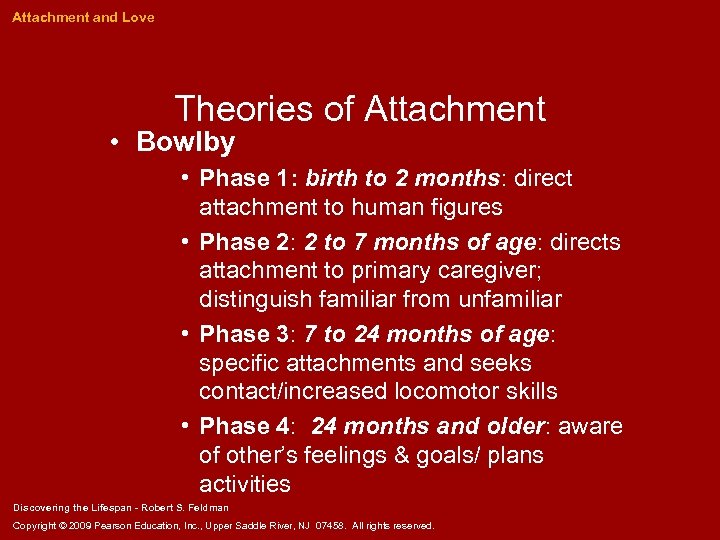 Attachment and Love Theories of Attachment • Bowlby • Phase 1: birth to 2 months: direct attachment to human figures • Phase 2: 2 to 7 months of age: directs attachment to primary caregiver; distinguish familiar from unfamiliar • Phase 3: 7 to 24 months of age: specific attachments and seeks contact/increased locomotor skills • Phase 4: 24 months and older: aware of other’s feelings & goals/ plans activities Discovering the Lifespan - Robert S. Feldman Copyright © 2009 Pearson Education, Inc. , Upper Saddle River, NJ 07458. All rights reserved.
 How Strange! • Ainsworth Strange Situation – Widely used experimental technique to measure attachment – Sequence of staged episodes that illustrate strength of attachment between child and (typically) mother 135 Discovering the Lifespan - Robert S. Feldman Copyright © 2009 Pearson Education, Inc. , Upper Saddle River, NJ 07458. All rights reserved.
 Do all infants attach? • Reactions to Strange Situation vary considerably • One-year-olds typically show one of four major patterns (See Table 2 -9 for summary) 135 Discovering the Lifespan - Robert S. Feldman Copyright © 2009 Pearson Education, Inc. , Upper Saddle River, NJ 07458. All rights reserved.
 Attachment and Love Individual Differences and the Strange Situation • Ainsworth’s measure of infant attachment to caregiver – Requires infant to move through a series of introductions, separations, and reunions – Some infants have more positive attachments than others Discovering the Lifespan - Robert S. Feldman Copyright © 2009 Pearson Education, Inc. , Upper Saddle River, NJ 07458. All rights reserved.
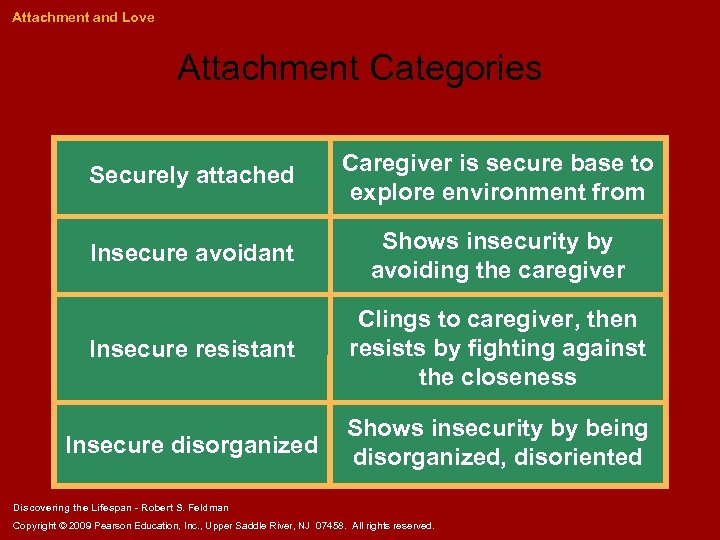 Attachment and Love Attachment Categories Securely attached Caregiver is secure base to explore environment from Insecure avoidant Shows insecurity by avoiding the caregiver Insecure resistant Clings to caregiver, then resists by fighting against the closeness Insecure disorganized Shows insecurity by being disorganized, disoriented Discovering the Lifespan - Robert S. Feldman Copyright © 2009 Pearson Education, Inc. , Upper Saddle River, NJ 07458. All rights reserved.
 Attachment and Love The Significance of Attachment • Secure attachment in first year is important foundation for psychological development • Some developmentalists believe too much emphasis on attachment bond in infancy – Ignores the diversity of socializing agents and contexts that exists in an infant’s world – Ignores that infants are highly resilient and adaptive Discovering the Lifespan - Robert S. Feldman Copyright © 2009 Pearson Education, Inc. , Upper Saddle River, NJ 07458. All rights reserved.
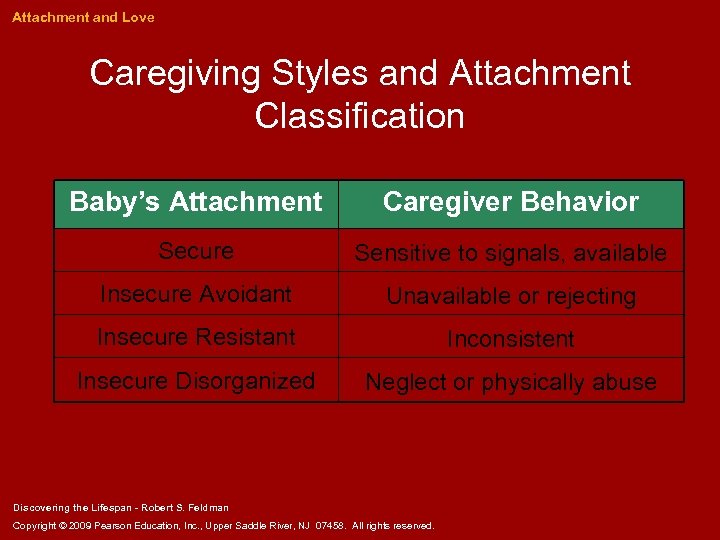 Attachment and Love Caregiving Styles and Attachment Classification Baby’s Attachment Caregiver Behavior Secure Sensitive to signals, available Insecure Avoidant Unavailable or rejecting Insecure Resistant Inconsistent Insecure Disorganized Neglect or physically abuse Discovering the Lifespan - Robert S. Feldman Copyright © 2009 Pearson Education, Inc. , Upper Saddle River, NJ 07458. All rights reserved.
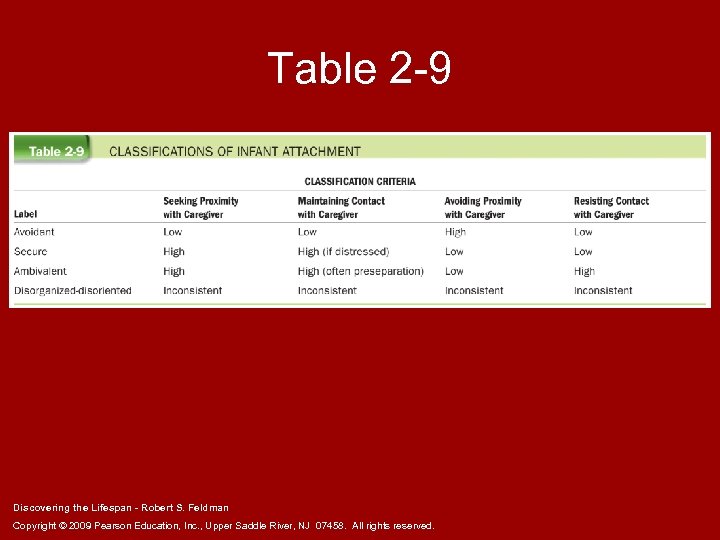 Table 2 -9 Discovering the Lifespan - Robert S. Feldman Copyright © 2009 Pearson Education, Inc. , Upper Saddle River, NJ 07458. All rights reserved.
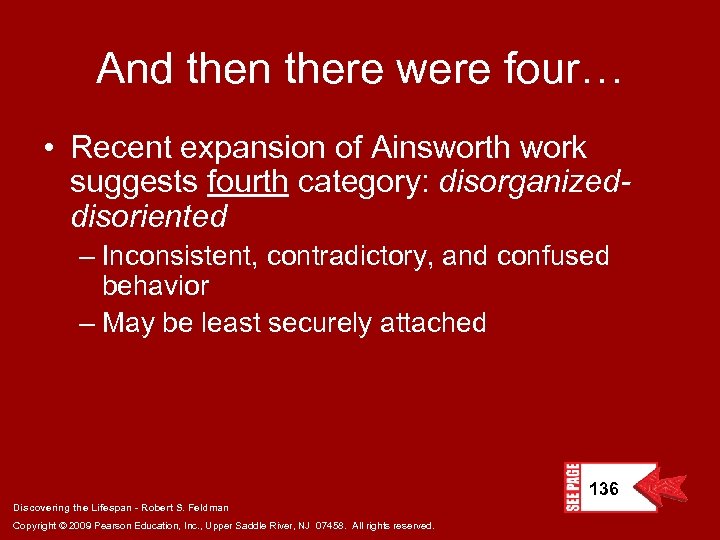 And then there were four… • Recent expansion of Ainsworth work suggests fourth category: disorganizeddisoriented – Inconsistent, contradictory, and confused behavior – May be least securely attached 136 Discovering the Lifespan - Robert S. Feldman Copyright © 2009 Pearson Education, Inc. , Upper Saddle River, NJ 07458. All rights reserved.
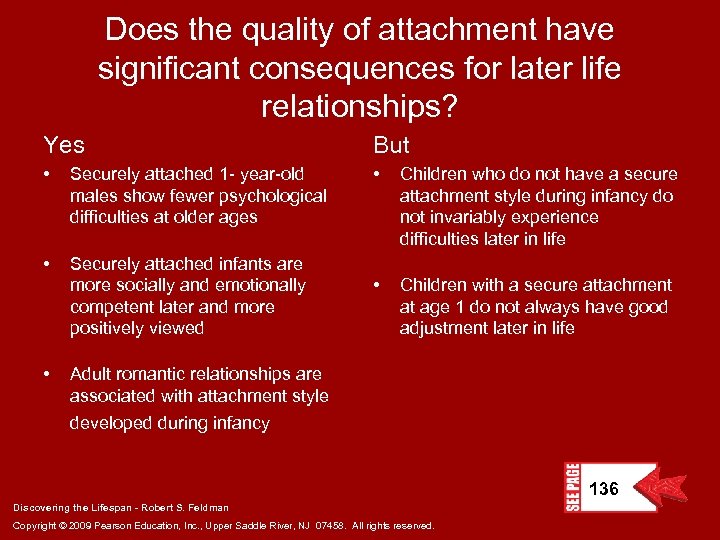 Does the quality of attachment have significant consequences for later life relationships? Yes But • Securely attached 1 - year-old males show fewer psychological difficulties at older ages • Children who do not have a secure attachment style during infancy do not invariably experience difficulties later in life • Securely attached infants are more socially and emotionally competent later and more positively viewed • Children with a secure attachment at age 1 do not always have good adjustment later in life • Adult romantic relationships are associated with attachment style developed during infancy 136 Discovering the Lifespan - Robert S. Feldman Copyright © 2009 Pearson Education, Inc. , Upper Saddle River, NJ 07458. All rights reserved.
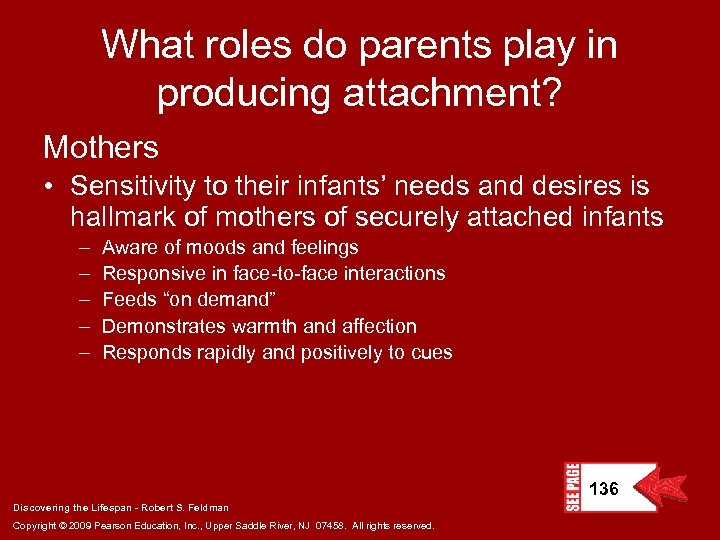 What roles do parents play in producing attachment? Mothers • Sensitivity to their infants’ needs and desires is hallmark of mothers of securely attached infants – – – Aware of moods and feelings Responsive in face-to-face interactions Feeds “on demand” Demonstrates warmth and affection Responds rapidly and positively to cues 136 Discovering the Lifespan - Robert S. Feldman Copyright © 2009 Pearson Education, Inc. , Upper Saddle River, NJ 07458. All rights reserved.
 What roles do parents play in producing attachment? Fathers • Expressions of nurturance, warmth, affection, support, and concern are extremely important to infant emotional and social well-being 137 Discovering the Lifespan - Robert S. Feldman Copyright © 2009 Pearson Education, Inc. , Upper Saddle River, NJ 07458. All rights reserved.
 Cultural Differences • Differences in ways fathers and mothers play with their children occur in many US families and in very diverse cultures How then does culture affect attachment? 137 Discovering the Lifespan - Robert S. Feldman Copyright © 2009 Pearson Education, Inc. , Upper Saddle River, NJ 07458. All rights reserved.
 Developmental Diversity Does attachment differ across cultures? • Research findings suggest human attachment is not as culturally universal as Bowlby predicted • Certain attachment patterns seem more likely among infants of particular cultures: – Germany – Israel and Japan – China and Canada 137 Discovering the Lifespan - Robert S. Feldman Copyright © 2009 Pearson Education, Inc. , Upper Saddle River, NJ 07458. All rights reserved.
 Which conclusion is “Right”? Discovering the Lifespan - Robert S. Feldman Copyright © 2009 Pearson Education, Inc. , Upper Saddle River, NJ 07458. All rights reserved.
 Feldman’s Conclusions • Attachment is viewed as susceptible to cultural norms and expectations • Cross-cultural and within-cultural differences reflect nature of measure employed and expectations of various cultures 137 Discovering the Lifespan - Robert S. Feldman Copyright © 2009 Pearson Education, Inc. , Upper Saddle River, NJ 07458. All rights reserved.
 Feldman’s Conclusions • Attachment should be viewed as a general tendency, that varies in way it is expressed according to how actively caregivers in a society seek to instill independence in their children • Secure attachment, as defined by the Westernoriented Strange Situation, is seen earliest in cultures that promote independence, but may be delayed in societies in which independence is less important cultural value 137 Discovering the Lifespan - Robert S. Feldman Copyright © 2009 Pearson Education, Inc. , Upper Saddle River, NJ 07458. All rights reserved.
 Hey Baby, Baby! • Babies react positively to presence of peers from early in life and engage in rudimentary forms of social interaction • Infants’ sociability is expressed in several ways – Earliest months of life – Nine- to twelve-month-olds 137 Discovering the Lifespan - Robert S. Feldman Copyright © 2009 Pearson Education, Inc. , Upper Saddle River, NJ 07458. All rights reserved.
 “Expert” Infants • With age, infants begin to imitate each other – Impart information and skills from “experts” infant peers – May be inborn skill 138 Discovering the Lifespan - Robert S. Feldman Copyright © 2009 Pearson Education, Inc. , Upper Saddle River, NJ 07458. All rights reserved.
 Mirror, mirror, in the brain… • Mirror neurons – Fire not only when an individual enacts particular behavior, but also when individual simply observes another organism carrying out same behavior – Help infants understand others’ actions and to develop theory of mind – Dysfunction may be related to some developmental disorders 138 Discovering the Lifespan - Robert S. Feldman Copyright © 2009 Pearson Education, Inc. , Upper Saddle River, NJ 07458. All rights reserved.
 Review and Apply REVIEW • Attachment, the positive emotional bond between an infant and a significant individual, affects a person’s later social competence as an adult. 138 Discovering the Lifespan - Robert S. Feldman Copyright © 2009 Pearson Education, Inc. , Upper Saddle River, NJ 07458. All rights reserved.
 Review and Apply REVIEW • Infants and the persons with whom they interact engage in reciprocal socialization as they mutually adjust to one another’s interactions. • Infants react differently to other children than to inanimate objects, and gradually they engage in increasing amounts of peer social interaction. 138 Discovering the Lifespan - Robert S. Feldman Copyright © 2009 Pearson Education, Inc. , Upper Saddle River, NJ 07458. All rights reserved.
 Review and Apply APPLY • In what sort of society might an avoidant attachment style be encouraged by cultural attitudes toward child rearing? In such a society, would characterizing the infant’s consistent avoidance of its mother as anger be an accurate interpretation? 138 Discovering the Lifespan - Robert S. Feldman Copyright © 2009 Pearson Education, Inc. , Upper Saddle River, NJ 07458. All rights reserved.
 DIFFERENCES AMONG INFANTS Discovering the Lifespan - Robert S. Feldman Copyright © 2009 Pearson Education, Inc. , Upper Saddle River, NJ 07458. All rights reserved.
 Characteristics That Make Infants Unique Personality • Sum total of enduring characteristics differentiating one individual from another • From birth onward, infants begin to show unique, stable traits and behaviors that ultimately lead to their development as distinct, special individuals 139 Discovering the Lifespan - Robert S. Feldman Copyright © 2009 Pearson Education, Inc. , Upper Saddle River, NJ 07458. All rights reserved.
 What were YOU like? Discovering the Lifespan - Robert S. Feldman Copyright © 2009 Pearson Education, Inc. , Upper Saddle River, NJ 07458. All rights reserved.
 Erikson: Psychosocial Development Early experiences responsible for shaping key aspects of personalities • Stage 1: trust versus mistrust – – • Trust = sense of hope and success Mistrust = sense of harsh, unfriendly world Stage 2: autonomy-versus-shame-anddoubt stage – – Autonomy = sense of independence Shame and doubt = sense of self-doubt and unhappiness 139 Discovering the Lifespan - Robert S. Feldman Copyright © 2009 Pearson Education, Inc. , Upper Saddle River, NJ 07458. All rights reserved.
 Another View: Temperament and Stabilities in Infant Behavior What is temperament? Discovering the Lifespan - Robert S. Feldman Copyright © 2009 Pearson Education, Inc. , Upper Saddle River, NJ 07458. All rights reserved.
 How does temperament apply to infants? • Temperament – Refers to how children behave, as opposed to what they do or why they do it – Displays as differences in general disposition from birth, largely due initially to genetic factors – Tends to be fairly stable well into adolescence – Is not fixed and unchangeable and can be modified by childrearing practices 139 Discovering the Lifespan - Robert S. Feldman Copyright © 2009 Pearson Education, Inc. , Upper Saddle River, NJ 07458. All rights reserved.
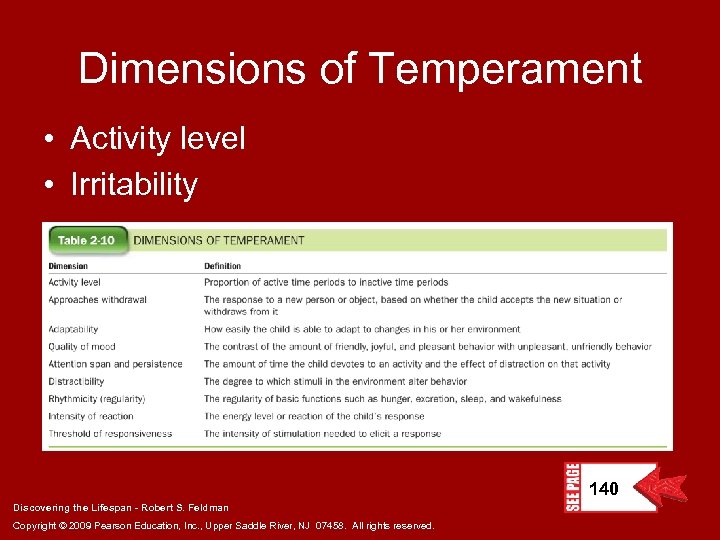 Dimensions of Temperament • Activity level • Irritability 140 Discovering the Lifespan - Robert S. Feldman Copyright © 2009 Pearson Education, Inc. , Upper Saddle River, NJ 07458. All rights reserved.
 Categorizing Temperament Babies can be described according to one of several temperament profiles: • • Easy babies Difficult babies Slow-to-warm up babies Inconsistently categorized babies Thomas and Chess, 1980 Discovering the Lifespan - Robert S. Feldman Copyright © 2009 Pearson Education, Inc. , Upper Saddle River, NJ 07458. All rights reserved. 140
 Temperament • Individual’s behavioral style and characteristic way of emotional response – Closely linked to personality Discovering the Lifespan - Robert S. Feldman Copyright © 2009 Pearson Education, Inc. , Upper Saddle River, NJ 07458. All rights reserved.
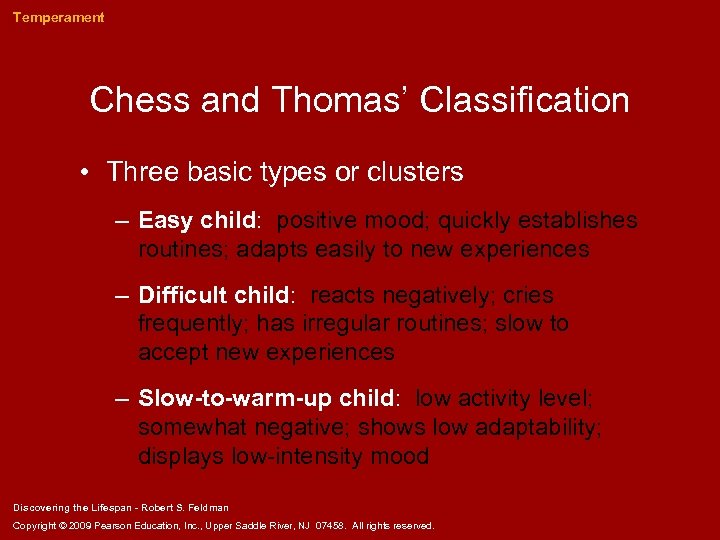 Temperament Chess and Thomas’ Classification • Three basic types or clusters – Easy child: positive mood; quickly establishes routines; adapts easily to new experiences – Difficult child: reacts negatively; cries frequently; has irregular routines; slow to accept new experiences – Slow-to-warm-up child: low activity level; somewhat negative; shows low adaptability; displays low-intensity mood Discovering the Lifespan - Robert S. Feldman Copyright © 2009 Pearson Education, Inc. , Upper Saddle River, NJ 07458. All rights reserved.
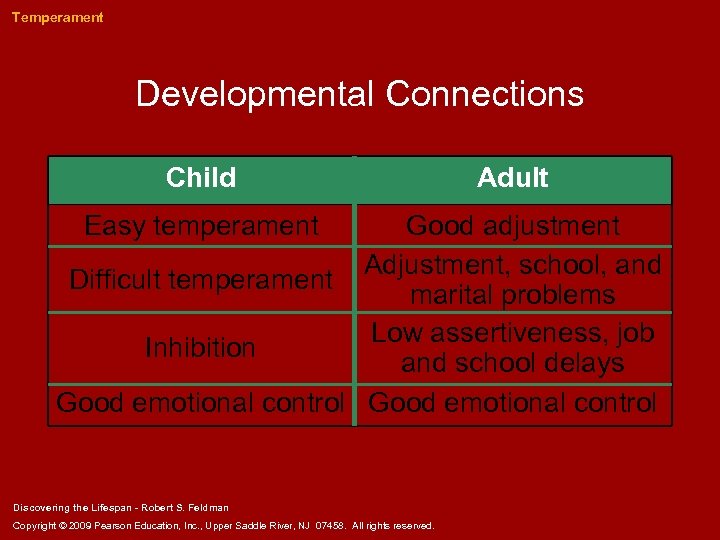 Temperament Developmental Connections Child Easy temperament Adult Good adjustment Adjustment, school, and Difficult temperament marital problems Low assertiveness, job Inhibition and school delays Good emotional control Discovering the Lifespan - Robert S. Feldman Copyright © 2009 Pearson Education, Inc. , Upper Saddle River, NJ 07458. All rights reserved.
 Temperament Biological Foundations and Experience • Physiological characteristics are associated with different temperaments • Heredity is aspect of temperament’s biological foundations • Attributes become more stable over time as self-perceptions, behavioral preferences, and social experiences form personality Discovering the Lifespan - Robert S. Feldman Copyright © 2009 Pearson Education, Inc. , Upper Saddle River, NJ 07458. All rights reserved.
 Temperament Developmental Contexts • Gender may be important factor that influences fate of temperament • Many aspects of child’s environment encourage or discourage persistence of temperament characteristics • Goodness of Fit – Match between child’s temperament and environmental demands Discovering the Lifespan - Robert S. Feldman Copyright © 2009 Pearson Education, Inc. , Upper Saddle River, NJ 07458. All rights reserved.
 Temperament Parenting and Child’s Temperament • Some temperament characteristics pose more challenges than others • Management strategies that worked for one child may not work for next one – Be sensitive to individual characteristics of child – Structure the child’s environment to provide as good a fit as possible with child’s temperament – Avoid labeling as “difficult child” Discovering the Lifespan - Robert S. Feldman Copyright © 2009 Pearson Education, Inc. , Upper Saddle River, NJ 07458. All rights reserved.
 Does temperament matter? Discovering the Lifespan - Robert S. Feldman Copyright © 2009 Pearson Education, Inc. , Upper Saddle River, NJ 07458. All rights reserved.
 True or false? Behavior exhibited by girls and boys is interpreted in very different ways by adults. Discovering the Lifespan - Robert S. Feldman Copyright © 2009 Pearson Education, Inc. , Upper Saddle River, NJ 07458. All rights reserved.
 How is this difference manifested? • Parent-child play patterns • Different styles of activity and interaction from parents • Parental gender-based interpretation of child behavior 142 Discovering the Lifespan - Robert S. Feldman Copyright © 2009 Pearson Education, Inc. , Upper Saddle River, NJ 07458. All rights reserved.
 Gender Differences Adults view behavior of children through lens of gender • All cultures prescribe gender roles for males and females • These roles differ greatly between cultures • Considerable amount of disagreement over extent and causes of gender differences • Differences between male and female infants, are generally minor 142 Discovering the Lifespan - Robert S. Feldman Copyright © 2009 Pearson Education, Inc. , Upper Saddle River, NJ 07458. All rights reserved.
 Gender Roles Gender differences emerge with age • By age 1: – Able to distinguish between males and females – Girls prefer to play with dolls or stuffed animals, while boys seek out blocks and trucks • By age 2: – Boys behave more independently and less compliantly than girls • May be reinforced by parental choices or by levels hormonal levels 142 Discovering the Lifespan - Robert S. Feldman Copyright © 2009 Pearson Education, Inc. , Upper Saddle River, NJ 07458. All rights reserved.
 And so… • Differences in behavior between boys and girls begin in infancy and future continue throughout childhood (and beyond) • Although gender differences have complex causes, representing some combination of innate, biologically related factors and environmental factors • These differences play profound role in social and emotional development of infants 142 Discovering the Lifespan - Robert S. Feldman Copyright © 2009 Pearson Education, Inc. , Upper Saddle River, NJ 07458. All rights reserved.
 Family Life in 21 st Century • Number of single-parent families has increased dramatically in last two decades • Average size of families is shrinking • Despite overall decline, half million births to teenage women, the vast majority of whom are unmarried • Close to 50 percent of children under age of 3 are cared for by other adults while their parents work, and more than half of mothers of infants work outside home • One in three US children lives in low income households Discovering the Lifespan - Robert S. Feldman Copyright © 2009 Pearson Education, Inc. , Upper Saddle River, NJ 07458. All rights reserved. 142
 Good news, bad news! Good news: Direct benefits • High-quality child care outside home produces only minor differences Bad news: • Infants less secure when in low-quality child care • Children who spend long hours lower have ability to work independently Good news: Indirect benefits • Children in lower income • Children who spend ten households and those or more hours a week in whose mothers are single group child care for a may benefit year or more have an increased probability of 144 being disruptive in class Discovering the Lifespan - Robert S. Feldman Copyright © 2009 Pearson Education, Inc. , Upper Saddle River, NJ 07458. All rights reserved.
 Becoming an Informed Consumer of Development Choosing the Right Infant Care Provider The American Psychological Association suggests that parents consider these questions in choosing a program: • Are there enough providers? • Are group sizes manageable? • Has the center complied with all governmental regulations, and is it licensed? • Do the people providing the care seem to like what they are doing? 144 Discovering the Lifespan - Robert S. Feldman Copyright © 2009 Pearson Education, Inc. , Upper Saddle River, NJ 07458. All rights reserved.
 Becoming an Informed Consumer of Development Choosing the Right Infant Care Provider The American Psychological Association suggests that parents consider these questions in choosing a program: • What do the caregivers do during the day? • Are the children safe and clean? • What training do the providers have in caring for children? • Is the environment happy and cheerful? 144 Discovering the Lifespan - Robert S. Feldman Copyright © 2009 Pearson Education, Inc. , Upper Saddle River, NJ 07458. All rights reserved.
 Review and Apply REVIEW • According to Erikson, during infancy individuals move from the trust-versus-mistrust stage of psychosocial development to the autonomy-versusshame-and-guilt stage. • Temperament encompasses enduring levels of arousal and emotionality that are characteristic of an individual. • Gender differences become more pronounced as infants age. 145 Discovering the Lifespan - Robert S. Feldman Copyright © 2009 Pearson Education, Inc. , Upper Saddle River, NJ 07458. All rights reserved.
 Review and Apply REVIEW • Child care outside of the home can have neutral, positive, or negative effects on the social development of children, depending largely on its quality. 145 Discovering the Lifespan - Robert S. Feldman Copyright © 2009 Pearson Education, Inc. , Upper Saddle River, NJ 07458. All rights reserved.
 Review and Apply APPLY • If you were introducing a bill in Congress regarding the minimum licensing requirements for child care centers, what would you emphasize? 145 Discovering the Lifespan - Robert S. Feldman Copyright © 2009 Pearson Education, Inc. , Upper Saddle River, NJ 07458. All rights reserved.