 Скачать презентацию Chapter 2 Individual Behaviour Personality and Values Mc
1ec7cd4ebbe7e1fa86b2244e2e4ec9e0.ppt
- Количество слайдов: 37



Chapter 2 Individual Behaviour, Personality and Values Mc. Shane-Olekalns-Travaglione OB Pacific Rim 3 e 1 © 2010 The Mc. Graw-Hill Companies, Inc. All rights reserved
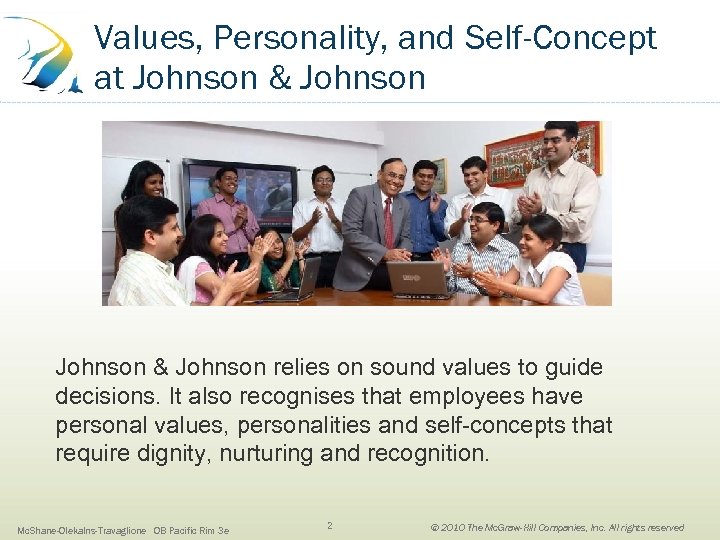
Values, Personality, and Self-Concept at Johnson & Johnson relies on sound values to guide decisions. It also recognises that employees have personal values, personalities and self-concepts that require dignity, nurturing and recognition. Mc. Shane-Olekalns-Travaglione OB Pacific Rim 3 e 2 © 2010 The Mc. Graw-Hill Companies, Inc. All rights reserved
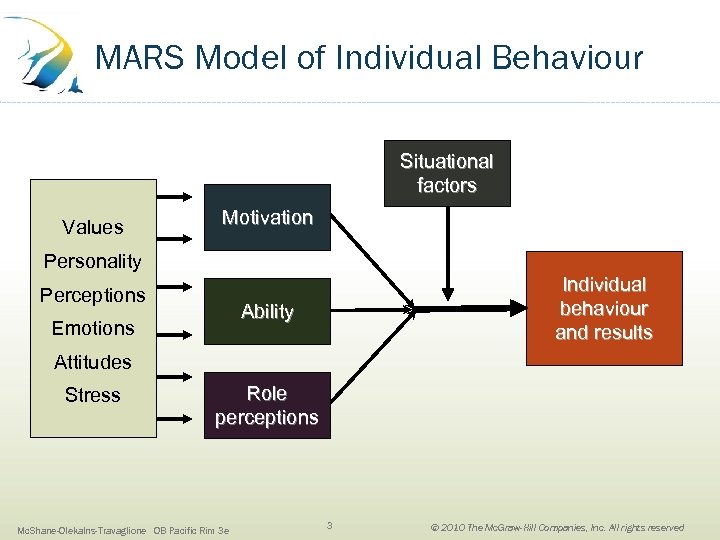
MARS Model of Individual Behaviour Situational factors Values Motivation Personality Perceptions Individual behaviour and results Ability Emotions Attitudes Stress Role perceptions Mc. Shane-Olekalns-Travaglione OB Pacific Rim 3 e 3 © 2010 The Mc. Graw-Hill Companies, Inc. All rights reserved
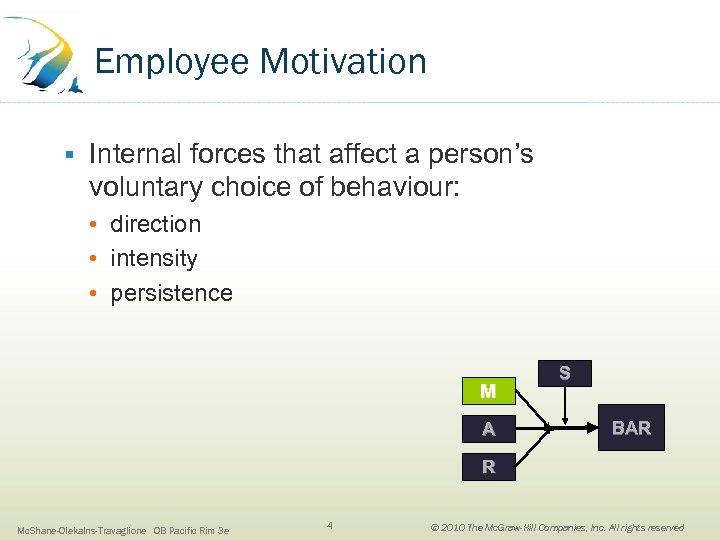
Employee Motivation § Internal forces that affect a person’s voluntary choice of behaviour: • direction • intensity • persistence M A S BAR R Mc. Shane-Olekalns-Travaglione OB Pacific Rim 3 e 4 © 2010 The Mc. Graw-Hill Companies, Inc. All rights reserved
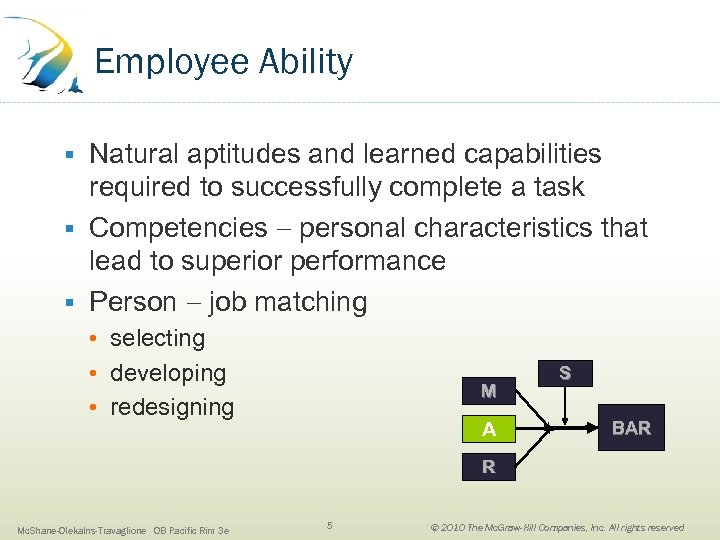
Employee Ability Natural aptitudes and learned capabilities required to successfully complete a task § Competencies personal characteristics that lead to superior performance § Person job matching § • selecting • developing • redesigning M A S BAR R Mc. Shane-Olekalns-Travaglione OB Pacific Rim 3 e 5 © 2010 The Mc. Graw-Hill Companies, Inc. All rights reserved
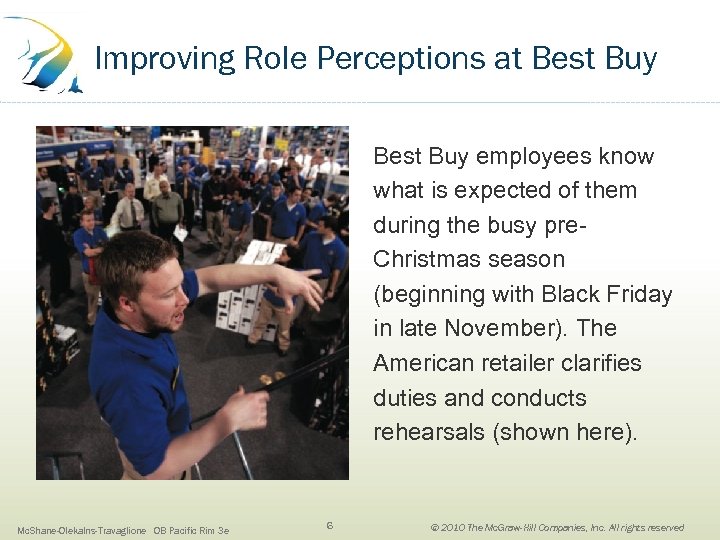
Improving Role Perceptions at Best Buy employees know what is expected of them during the busy pre. Christmas season (beginning with Black Friday in late November). The American retailer clarifies duties and conducts rehearsals (shown here). Mc. Shane-Olekalns-Travaglione OB Pacific Rim 3 e 6 © 2010 The Mc. Graw-Hill Companies, Inc. All rights reserved
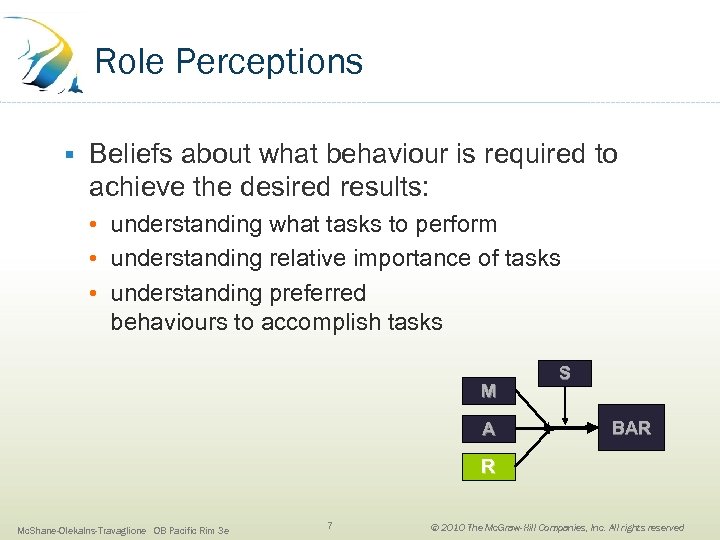
Role Perceptions § Beliefs about what behaviour is required to achieve the desired results: • understanding what tasks to perform • understanding relative importance of tasks • understanding preferred behaviours to accomplish tasks M A S BAR R Mc. Shane-Olekalns-Travaglione OB Pacific Rim 3 e 7 © 2010 The Mc. Graw-Hill Companies, Inc. All rights reserved
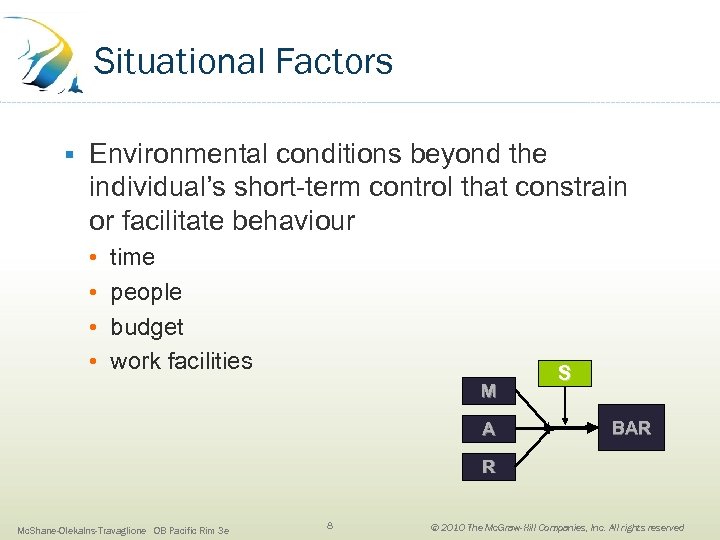
Situational Factors § Environmental conditions beyond the individual’s short-term control that constrain or facilitate behaviour • • time people budget work facilities M A S BAR R Mc. Shane-Olekalns-Travaglione OB Pacific Rim 3 e 8 © 2010 The Mc. Graw-Hill Companies, Inc. All rights reserved
Defining Personality § Relatively enduring pattern of thoughts, emotions, and behaviours that characterise a person, along with the psychological processes behind those characteristics • External traits – observable behaviours • Internal states – thoughts, values, etc. inferred from behaviours • Some variability, adjust to suit the situation Mc. Shane-Olekalns-Travaglione OB Pacific Rim 3 e 9 © 2010 The Mc. Graw-Hill Companies, Inc. All rights reserved
Nature vs. Nurture of Personality § Influenced by Nature • Heredity explains about 50 per cent of behavioural tendencies and 30 per cent of temperament • Minnesota studies – twins had similar behaviour patterns § Influenced by Nurture • Personality isn’t stable at birth • Influenced by socialisation, life experiences, learning • Stabilises throughout adolescence • Executive function uses self-concept to steer behaviour Mc. Shane-Olekalns-Travaglione OB Pacific Rim 3 e 10 © 2010 The Mc. Graw-Hill Companies, Inc. All rights reserved
Five-Factor Personality Model (CANOE) Conscientiousness Careful, dependable Agreeableness Courteous, caring Neuroticism Anxious, hostile Openness to experience Sensitive, flexible Extroversion Outgoing, talkative Mc. Shane-Olekalns-Travaglione OB Pacific Rim 3 e 11 © 2010 The Mc. Graw-Hill Companies, Inc. All rights reserved
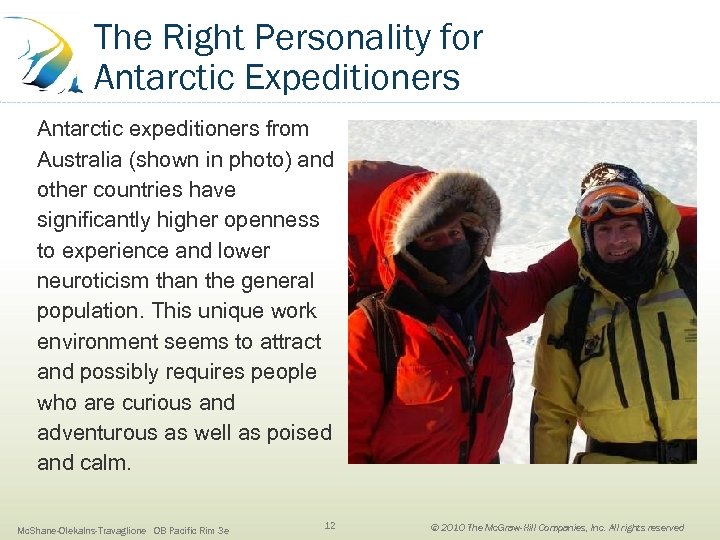
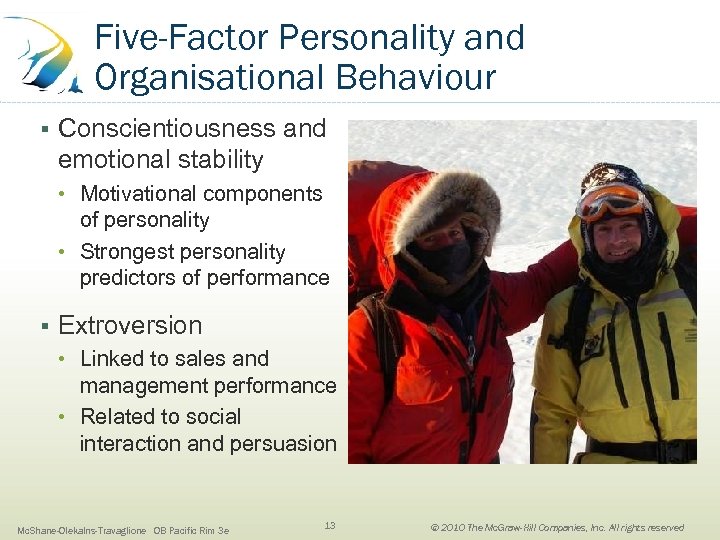
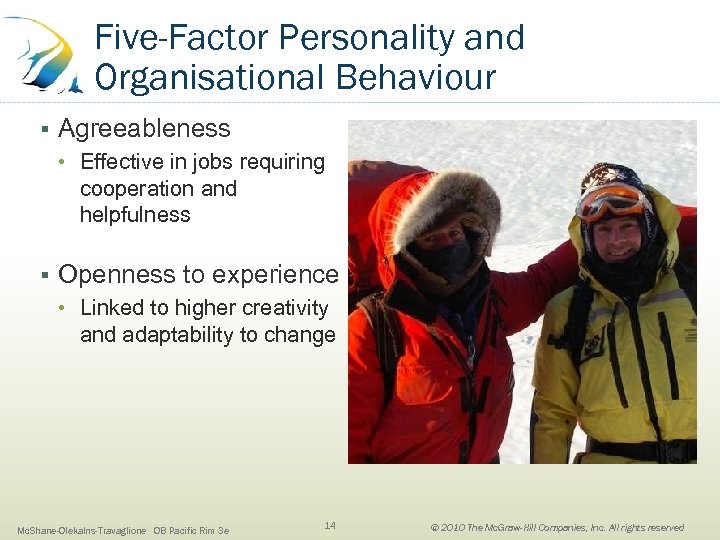
The Right Personality for Antarctic Expeditioners Antarctic expeditioners from Australia (shown in photo) and other countries have significantly higher openness to experience and lower neuroticism than the general population. This unique work environment seems to attract and possibly requires people who are curious and adventurous as well as poised and calm. Mc. Shane-Olekalns-Travaglione OB Pacific Rim 3 e 12 © 2010 The Mc. Graw-Hill Companies, Inc. All rights reserved
Five-Factor Personality and Organisational Behaviour § Conscientiousness and emotional stability • Motivational components of personality • Strongest personality predictors of performance § Extroversion • Linked to sales and management performance • Related to social interaction and persuasion Mc. Shane-Olekalns-Travaglione OB Pacific Rim 3 e 13 © 2010 The Mc. Graw-Hill Companies, Inc. All rights reserved
Five-Factor Personality and Organisational Behaviour § Agreeableness • Effective in jobs requiring cooperation and helpfulness § Openness to experience • Linked to higher creativity and adaptability to change Mc. Shane-Olekalns-Travaglione OB Pacific Rim 3 e 14 © 2010 The Mc. Graw-Hill Companies, Inc. All rights reserved
Jungian Personality Theory § Swiss psychiatrist Carl Jung § Identifies preferences for perceiving the environment and obtaining/processing information § Commonly measured by Myers-Briggs Type Indicator (MBTI) Mc. Shane-Olekalns-Travaglione OB Pacific Rim 3 e 15 © 2010 The Mc. Graw-Hill Companies, Inc. All rights reserved
Myers-Briggs Type Indicator (MBTI) § Extroversion versus introversion • Similar to five-factor dimension § Sensing versus intuition • Collecting information through senses versus through intuition, inspiration or subjective sources § Thinking versus feeling • Processing and evaluating information • Using rational logic versus personal values § Judging versus perceiving • Orienting self to the outer world • Order and structure or flexibility and spontaneity Mc. Shane-Olekalns-Travaglione OB Pacific Rim 3 e 16 © 2010 The Mc. Graw-Hill Companies, Inc. All rights reserved
Self-Concept Definition and Elements § An individual’s self-beliefs and self-evaluations • Guides individual decisions and behaviour § Three Cs of self-concept 1. Complexity – people have multiple self-concepts 2. Consistency – similar personality and values across multiple selves 3. Clarity – clearly and confidently described, internally consistent, and stable across time. Mc. Shane-Olekalns-Travaglione OB Pacific Rim 3 e 17 © 2010 The Mc. Graw-Hill Companies, Inc. All rights reserved
Four ‘Selves’ of Self-Concept § Self-enhancement • Promoting and protecting our positive self-view § Self-verification • Affirming our existing self-concept (good and bad elements) § Self-evaluation • Evaluating ourselves through self-esteem, self-efficacy and locus of control § Social self • Defining ourselves in terms of group membership Mc. Shane-Olekalns-Travaglione OB Pacific Rim 3 e 18 © 2010 The Mc. Graw-Hill Companies, Inc. All rights reserved
Self-Concept: Self-Enhancement § Drive to promote/protect a positive self-view • Competent, attractive, lucky, ethical, valued § Positive self-concept outcomes: • Better personal adjustment and mental/physical health • Inflates personal causation and probability of success Mc. Shane-Olekalns-Travaglione OB Pacific Rim 3 e 19 © 2010 The Mc. Graw-Hill Companies, Inc. All rights reserved
Self-Concept: Self-Verification Motivation to verify/maintain our self-concept § Stabilises our self-concept § People prefer feedback consistent with their self-concept § Self-verification outcomes: § • We ignore or reject information inconsistent with our current self-concept • We interact more with those who affirm/reflect our current self-concept Mc. Shane-Olekalns-Travaglione OB Pacific Rim 3 e 20 © 2010 The Mc. Graw-Hill Companies, Inc. All rights reserved
Self-Concept: Self-Evaluation § Self-esteem • High self-esteem – less influenced, more persistent/logical § Self-efficacy • Belief in one’s ability, motivation, role perceptions, and situation to complete a task successfully • General vs. task-specific self-efficacy § Locus of control • General belief about personal control over life events • Higher self-evaluation with internal locus of control Mc. Shane-Olekalns-Travaglione OB Pacific Rim 3 e 21 © 2010 The Mc. Graw-Hill Companies, Inc. All rights reserved
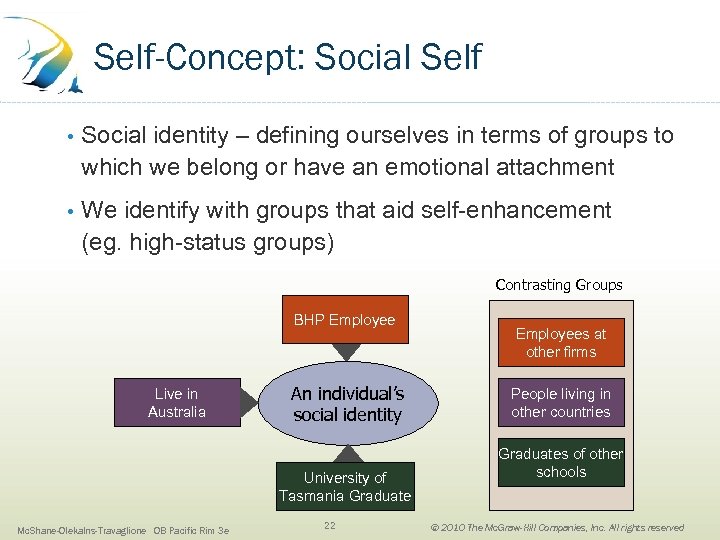
Self-Concept: Social Self • Social identity – defining ourselves in terms of groups to which we belong or have an emotional attachment • We identify with groups that aid self-enhancement (eg. high-status groups) Contrasting Groups BHP Employee Live in Australia An individual’s social identity University of Tasmania Graduate Mc. Shane-Olekalns-Travaglione OB Pacific Rim 3 e 22 Employees at other firms People living in other countries Graduates of other schools © 2010 The Mc. Graw-Hill Companies, Inc. All rights reserved
Values in the Workplace Stable, evaluative beliefs that guide our preferences § Define right or wrong, good or bad § Value system – hierarchy of values § Mc. Shane-Olekalns-Travaglione OB Pacific Rim 3 e 23 © 2010 The Mc. Graw-Hill Companies, Inc. All rights reserved
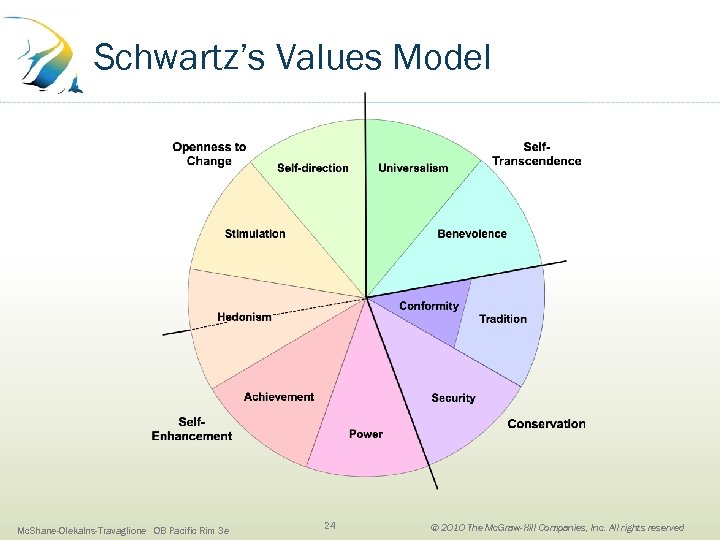
Schwartz’s Values Model Mc. Shane-Olekalns-Travaglione OB Pacific Rim 3 e 24 © 2010 The Mc. Graw-Hill Companies, Inc. All rights reserved
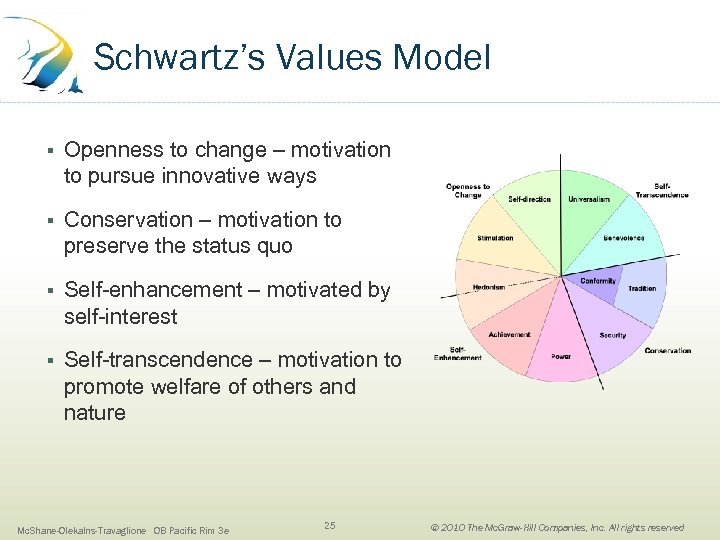
Schwartz’s Values Model § Openness to change – motivation to pursue innovative ways § Conservation – motivation to preserve the status quo § Self-enhancement – motivated by self-interest § Self-transcendence – motivation to promote welfare of others and nature Mc. Shane-Olekalns-Travaglione OB Pacific Rim 3 e 25 © 2010 The Mc. Graw-Hill Companies, Inc. All rights reserved
Values and Behaviour § Habitual behaviour usually consistent with values, but conscious behaviour less so because values are abstract constructs § Decisions and behaviour are linked to values when: • We are mindful of our values • We have logical reasons to apply values in that situation • The situation does not interfere Mc. Shane-Olekalns-Travaglione OB Pacific Rim 3 e 26 © 2010 The Mc. Graw-Hill Companies, Inc. All rights reserved
Value Congruence § Where two or more entities have similar value systems § Problems with incongruence • Incompatible decisions • Lower satisfaction/loyalty • Higher stress and turnover § Benefits of incongruence • Constructive conflict, better decision making • Avoids ‘corporate cults’ Mc. Shane-Olekalns-Travaglione OB Pacific Rim 3 e 27 © 2010 The Mc. Graw-Hill Companies, Inc. All rights reserved
Values Across Cultures: Individualism and Collectivism § Degree that people value duty to their group (collectivism) versus independence and person uniqueness (individualism) § Previously considered opposites, but unrelated – i. e. possible to value high individualism and high collectivism Mc. Shane-Olekalns-Travaglione OB Pacific Rim 3 e 28 © 2010 The Mc. Graw-Hill Companies, Inc. All rights reserved
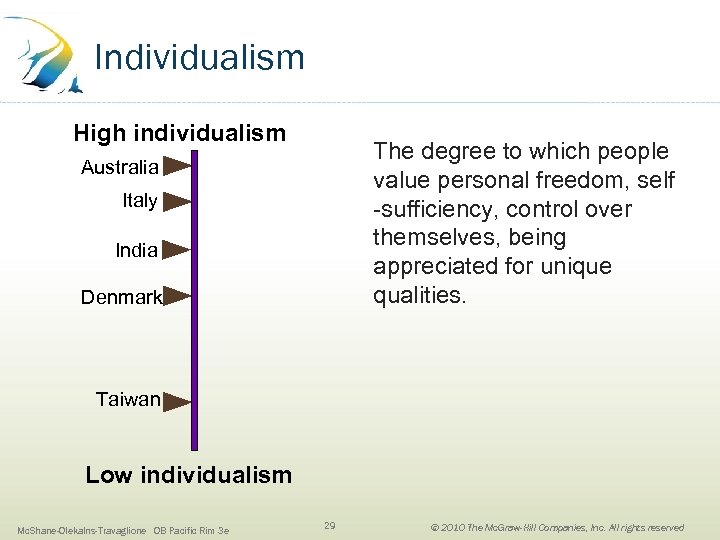
Individualism High individualism The degree to which people value personal freedom, self -sufficiency, control over themselves, being appreciated for unique qualities. Australia Italy India Denmark Taiwan Low individualism Mc. Shane-Olekalns-Travaglione OB Pacific Rim 3 e 29 © 2010 The Mc. Graw-Hill Companies, Inc. All rights reserved
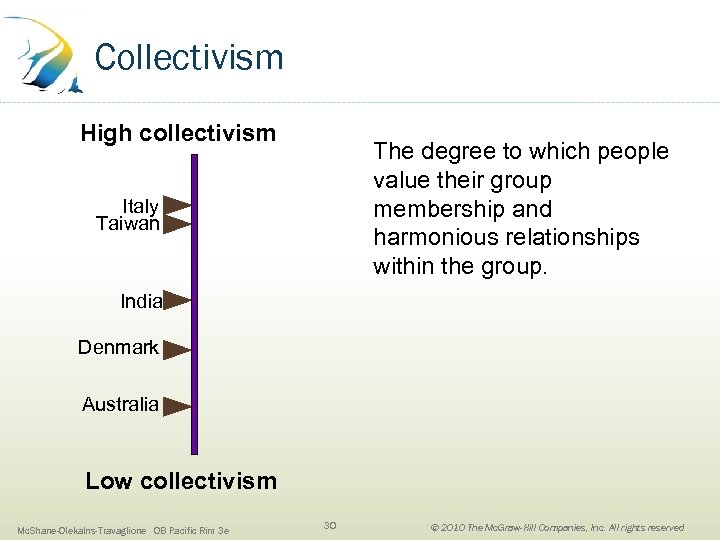
Collectivism High collectivism The degree to which people value their group membership and harmonious relationships within the group. Italy Taiwan India Denmark Australia Low collectivism Mc. Shane-Olekalns-Travaglione OB Pacific Rim 3 e 30 © 2010 The Mc. Graw-Hill Companies, Inc. All rights reserved
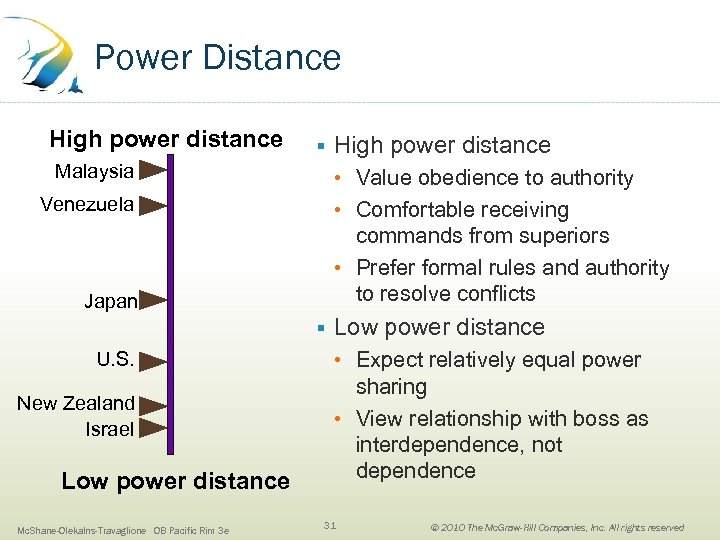
Power Distance High power distance § Malaysia • Value obedience to authority • Comfortable receiving commands from superiors • Prefer formal rules and authority to resolve conflicts Venezuela Japan § U. S. New Zealand Israel Low power distance Mc. Shane-Olekalns-Travaglione OB Pacific Rim 3 e High power distance Low power distance • Expect relatively equal power sharing • View relationship with boss as interdependence, not dependence 31 © 2010 The Mc. Graw-Hill Companies, Inc. All rights reserved
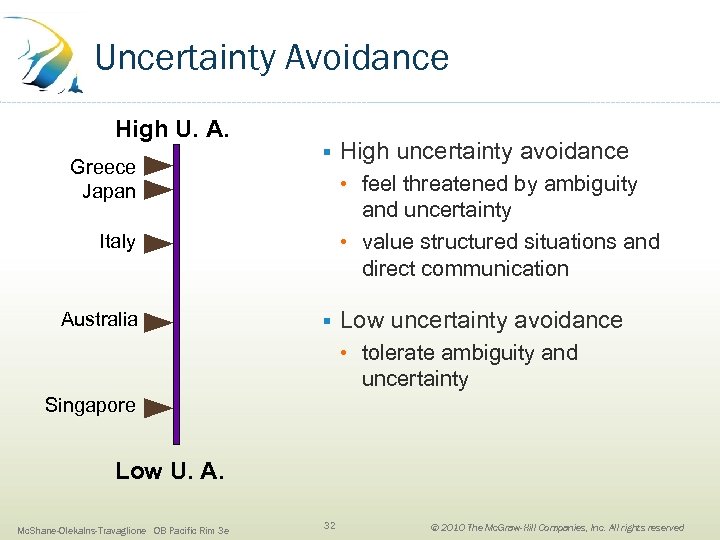
Uncertainty Avoidance High U. A. Greece Japan § • feel threatened by ambiguity and uncertainty • value structured situations and direct communication Italy Australia High uncertainty avoidance § Low uncertainty avoidance • tolerate ambiguity and uncertainty Singapore Low U. A. Mc. Shane-Olekalns-Travaglione OB Pacific Rim 3 e 32 © 2010 The Mc. Graw-Hill Companies, Inc. All rights reserved
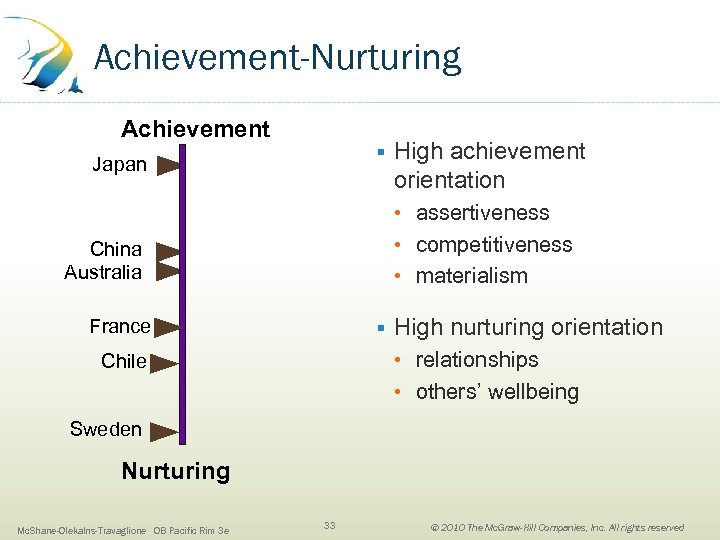
Achievement-Nurturing Achievement § Japan High achievement orientation • assertiveness • competitiveness • materialism China Australia France § High nurturing orientation • relationships • others’ wellbeing Chile Sweden Nurturing Mc. Shane-Olekalns-Travaglione OB Pacific Rim 3 e 33 © 2010 The Mc. Graw-Hill Companies, Inc. All rights reserved
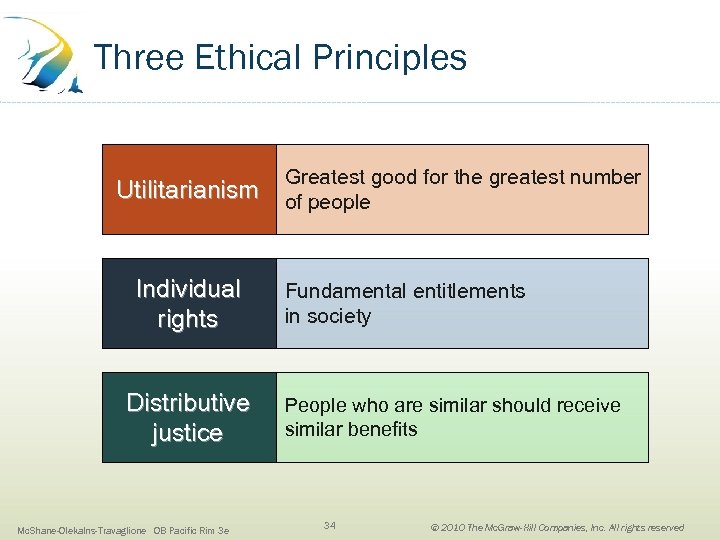
Three Ethical Principles Greatest good for the greatest number Utilitarianism of people Individual rights Distributive justice Mc. Shane-Olekalns-Travaglione OB Pacific Rim 3 e Fundamental entitlements in society People who are similar should receive similar benefits 34 © 2010 The Mc. Graw-Hill Companies, Inc. All rights reserved
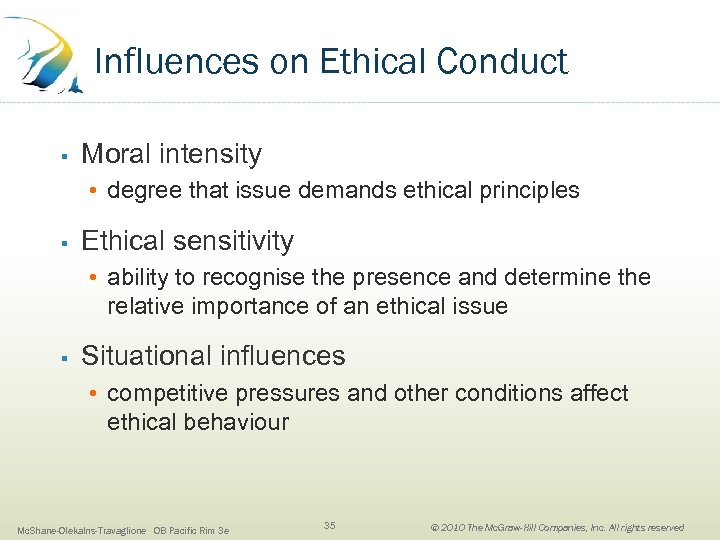
Influences on Ethical Conduct § Moral intensity • degree that issue demands ethical principles § Ethical sensitivity • ability to recognise the presence and determine the relative importance of an ethical issue § Situational influences • competitive pressures and other conditions affect ethical behaviour Mc. Shane-Olekalns-Travaglione OB Pacific Rim 3 e 35 © 2010 The Mc. Graw-Hill Companies, Inc. All rights reserved
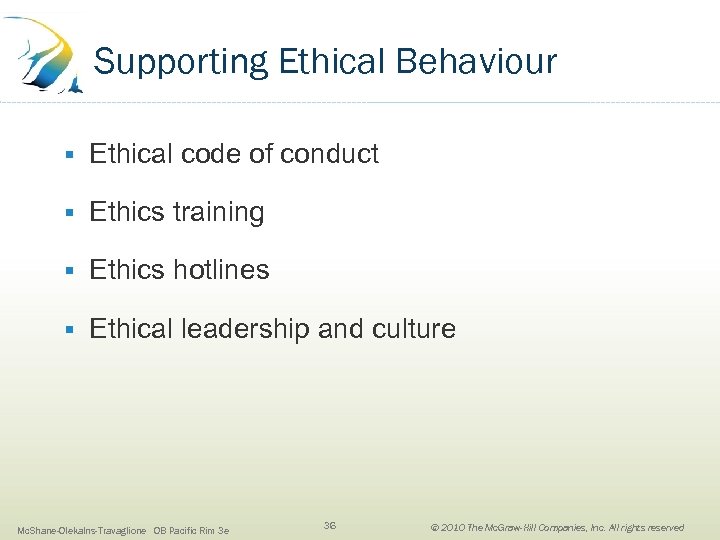
Supporting Ethical Behaviour § Ethical code of conduct § Ethics training § Ethics hotlines § Ethical leadership and culture Mc. Shane-Olekalns-Travaglione OB Pacific Rim 3 e 36 © 2010 The Mc. Graw-Hill Companies, Inc. All rights reserved
Chapter 2 Individual Behaviour, Personality and Values Mc. Shane-Olekalns-Travaglione OB Pacific Rim 3 e 37 © 2010 The Mc. Graw-Hill Companies, Inc. All rights reserved
Скачать презентацию Chapter 2 Individual Behaviour Personality and Values Mc
1ec7cd4ebbe7e1fa86b2244e2e4ec9e0.ppt