


 Скачать презентацию Chapter 2 Human Resource Management in the International
c9c343d2f978f41d87f66b6b8a0186dd.ppt
- Количество слайдов: 26
 Chapter 2 Human Resource Management in the International Firm: The Framework Mc. Graw-Hill/Irwin Copyright © 2011 by The Mc. Graw-Hill Companies, Inc. All rights reserved.
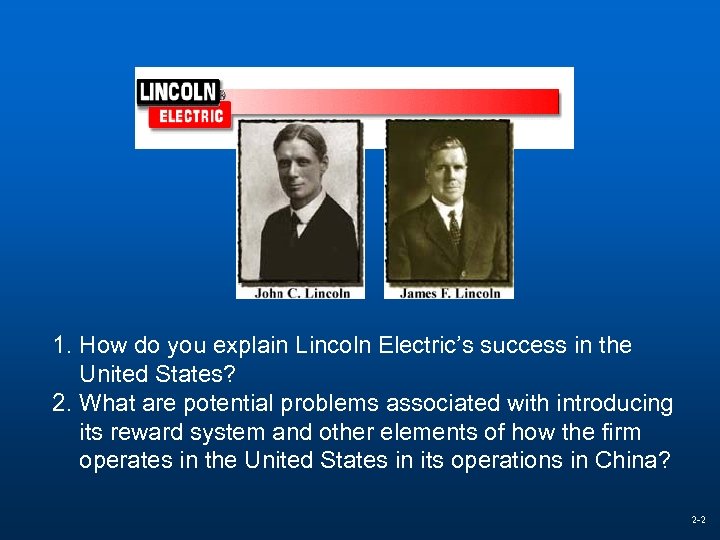 1. How do you explain Lincoln Electric’s success in the United States? 2. What are potential problems associated with introducing its reward system and other elements of how the firm operates in the United States in its operations in China? 2 -2
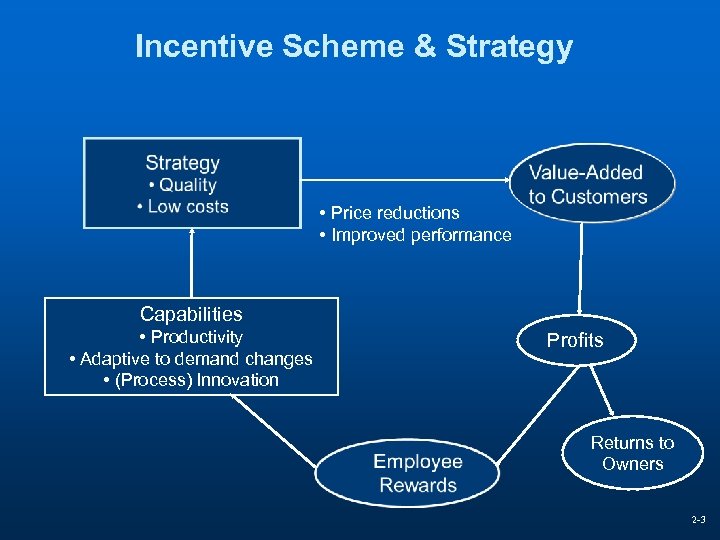 Incentive Scheme & Strategy • Price reductions • Improved performance Capabilities • Productivity • Adaptive to demand changes • (Process) Innovation Profits Returns to Owners 2 -3
 The People Strategy Process Business Strategy and Organisational Capabilities; Strategy has to do with making forward-looking choices under conditions of uncertainty. - Choices which parts of value chain the firm will focus on, - What will develop and do in house n n n Buy in from outside Geographical mrkts it will serve Myraid of other choices. 2 -4
 The People Strategy Process During 1980 s strategy meant competitive positioning based on the analysis of industry characteristic, Then, having the right strategy was not enough, You also need a capacity to execute strategy, (having also right leaders to implement, managing major changes, rewards for new strategy, and soon. . . ) Focus of strategic HRM was on strategy implementation. 2 -5
 Strategy Process In 1990 s the resource-based view of the firm came in Organisational Capabilities: ‘The ability to perform repeatedly a productive task which relates to a firms’s capacity for creating value through effecting the transformation of input , To output; ‘The firm’s ability to combine and leverage its resources to bring about a desired end. Capabilities: 3 M innovations, Toyota – improvement process in manufacturing Sothwest Airlines – deliver customer experience at low prices Those managing capabilities earn higher returns. Because competitive advantage is more sustainable. Capabilities are difficult to unravel and hard to imitate. 2 -6
 Organisational Capabilities • In most cases firm must put in place a range of capabilities to create value. There are usually few that drive the company’s competitive advantage. • These differentiating capabilities must satisfy ; • 1. They must create value for the customer • 2. The capability has to be rare and unique, • 3. The capability has to be difficult to duplicate. . . 2 -7
 Organisational Capabilities in MNCs Best practices; Haier in China, CEMEX in Mexico, Lincoln Electric and Southwest Airlines in USA, Toyota in Japan. While they deploy very different HR practices, all these companies are clear about which organisational capabilities are needed to support their business model, and they make sure that their HR practices drive the necessary actions and behaviours. However, as they internationalize it becomes more challenging. It is difficult to transfer organisational capabilities abroad. The underlying HR practices do not necessarily travel well to a different environment. 2 -8
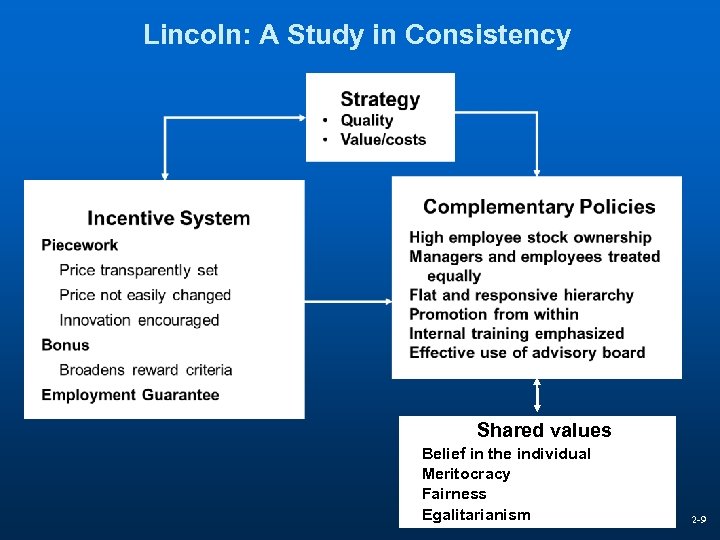 Lincoln: A Study in Consistency Shared values Belief in the individual Meritocracy Fairness Egalitarianism 2 -9
 Best Practices may also fail A number of firms have tried to copy Lincoln’s compensation system but failed. What they have missed is that at Lincoln, the piece-rate system is only one of the tools that drive cost flexibility and productivity. It is the unique bundling of people management and organisational practices that produces the desired effect. 2 -10
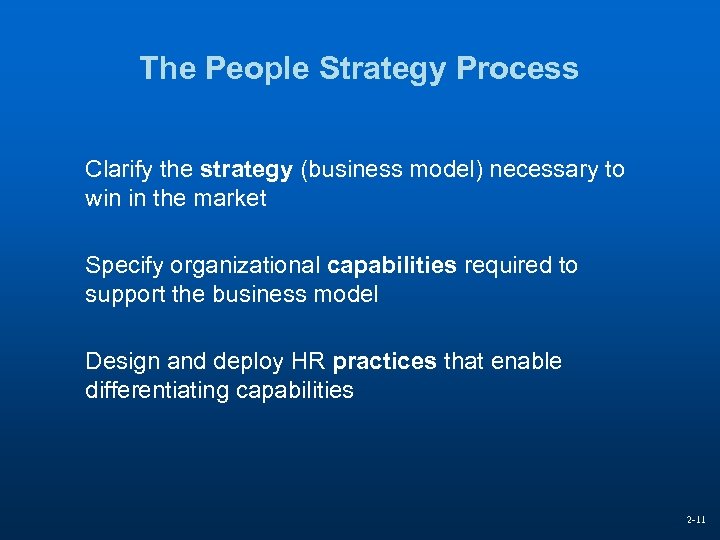 The People Strategy Process Clarify the strategy (business model) necessary to win in the market Specify organizational capabilities required to support the business model Design and deploy HR practices that enable differentiating capabilities 2 -11
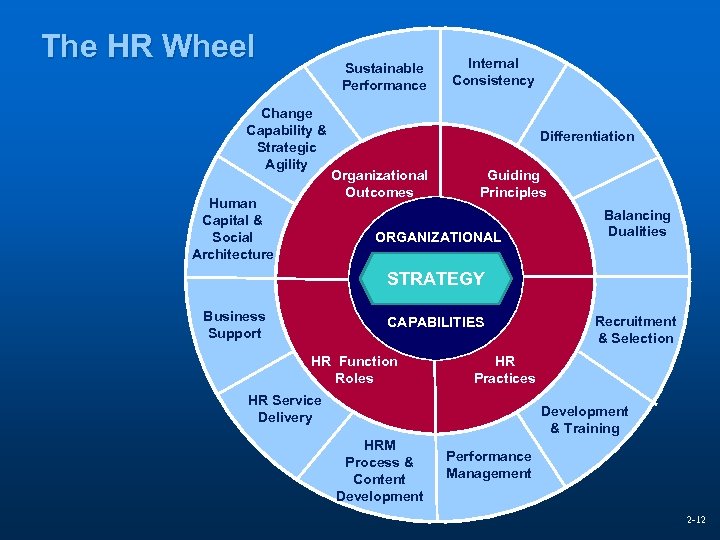 The HR Wheel Sustainable Performance Change Capability & Strategic Agility Human Capital & Social Architecture Internal Consistency Differentiation Organizational Outcomes Guiding Principles ORGANIZATIONAL Balancing Dualities STRATEGY Business Support CAPABILITIES HR Function Roles Recruitment & Selection HR Practices HR Service Delivery Development & Training HRM Process & Content Development Performance Management 2 -12
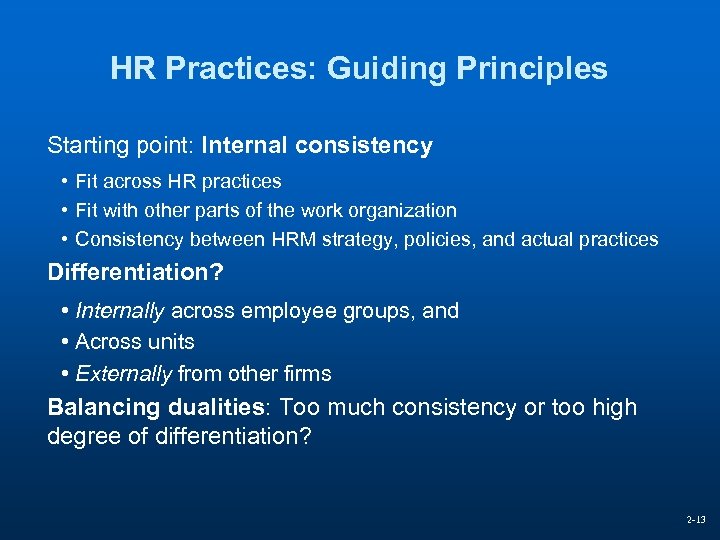 HR Practices: Guiding Principles Starting point: Internal consistency • Fit across HR practices • Fit with other parts of the work organization • Consistency between HRM strategy, policies, and actual practices Differentiation? • Internally across employee groups, and • Across units • Externally from other firms Balancing dualities: Too much consistency or too high degree of differentiation? 2 -13
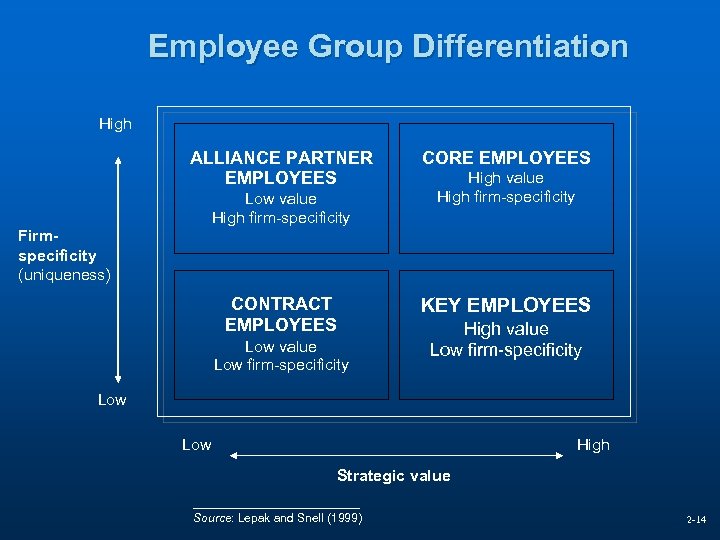 Employee Group Differentiation High ALLIANCE PARTNER EMPLOYEES Low value High firm-specificity CORE EMPLOYEES High value High firm-specificity Firmspecificity (uniqueness) CONTRACT EMPLOYEES Low value Low firm-specificity KEY EMPLOYEES High value Low firm-specificity Low High Strategic value _____________ Source: Lepak and Snell (1999) 2 -14
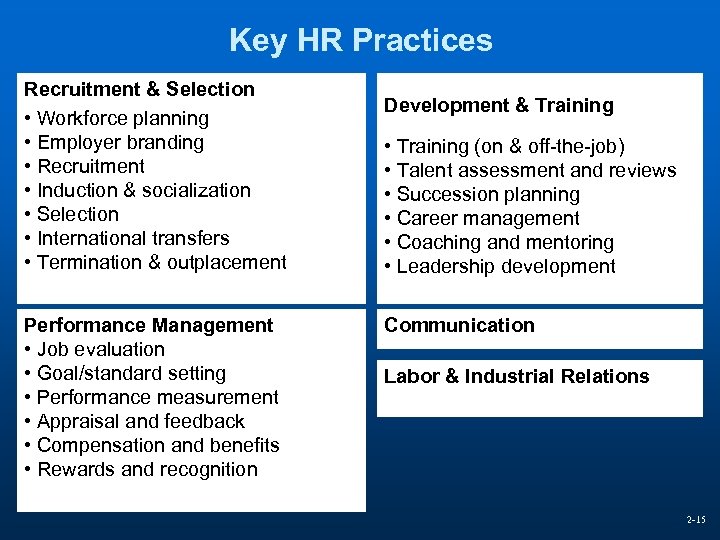 Key HR Practices Recruitment & Selection • Workforce planning • Employer branding • Recruitment • Induction & socialization • Selection • International transfers • Termination & outplacement Performance Management • Job evaluation • Goal/standard setting • Performance measurement • Appraisal and feedback • Compensation and benefits • Rewards and recognition Development & Training • Training (on & off-the-job) • Talent assessment and reviews • Succession planning • Career management • Coaching and mentoring • Leadership development Communication Labor & Industrial Relations 2 -15
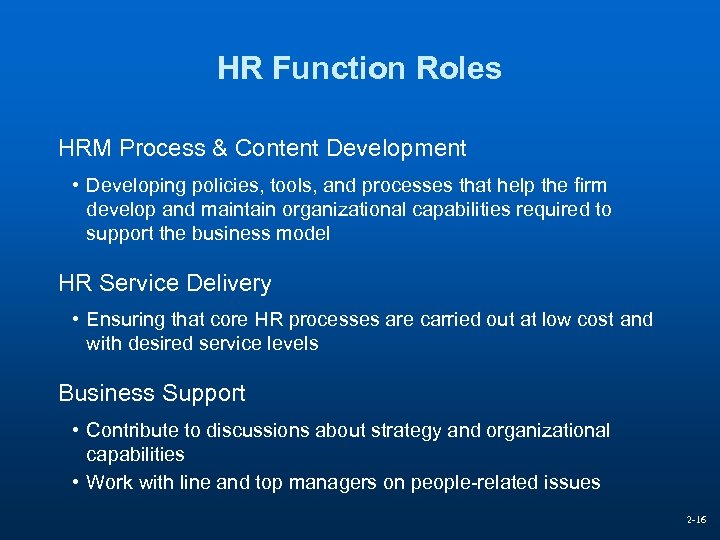 HR Function Roles HRM Process & Content Development • Developing policies, tools, and processes that help the firm develop and maintain organizational capabilities required to support the business model HR Service Delivery • Ensuring that core HR processes are carried out at low cost and with desired service levels Business Support • Contribute to discussions about strategy and organizational capabilities • Work with line and top managers on people-related issues 2 -16
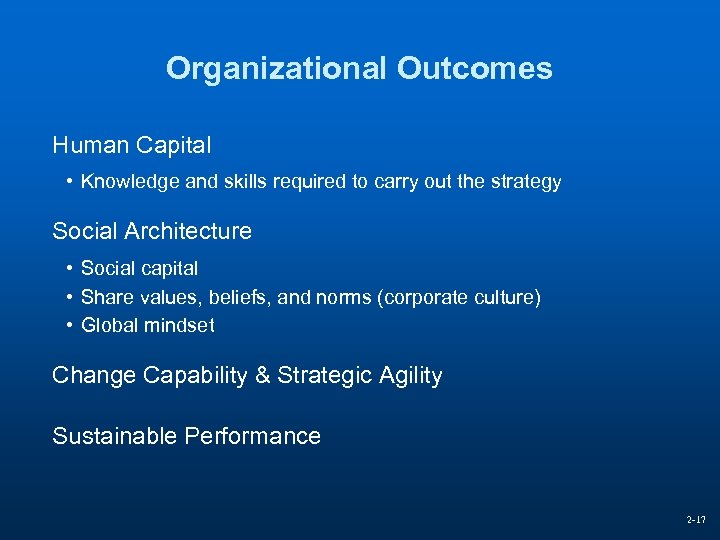 Organizational Outcomes Human Capital • Knowledge and skills required to carry out the strategy Social Architecture • Social capital • Share values, beliefs, and norms (corporate culture) • Global mindset Change Capability & Strategic Agility Sustainable Performance 2 -17
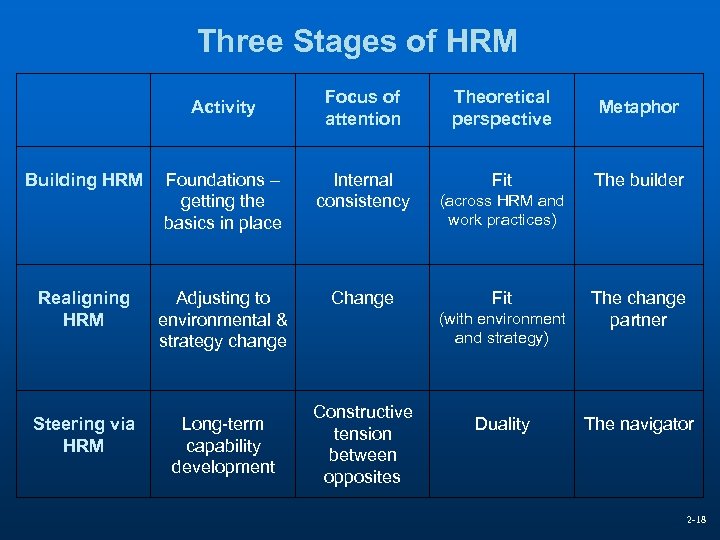 Three Stages of HRM Focus of attention Theoretical perspective Metaphor Foundations – getting the basics in place Internal consistency Fit The builder Realigning HRM Adjusting to environmental & strategy change Change Steering via HRM Long-term capability development Activity Building HRM (across HRM and work practices) Fit (with environment and strategy) Constructive tension between opposites Duality The change partner The navigator 2 -18
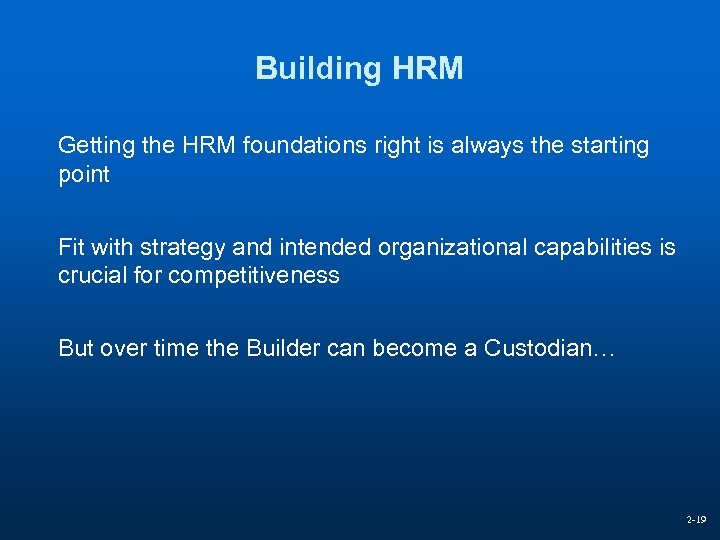 Building HRM Getting the HRM foundations right is always the starting point Fit with strategy and intended organizational capabilities is crucial for competitiveness But over time the Builder can become a Custodian… 2 -19
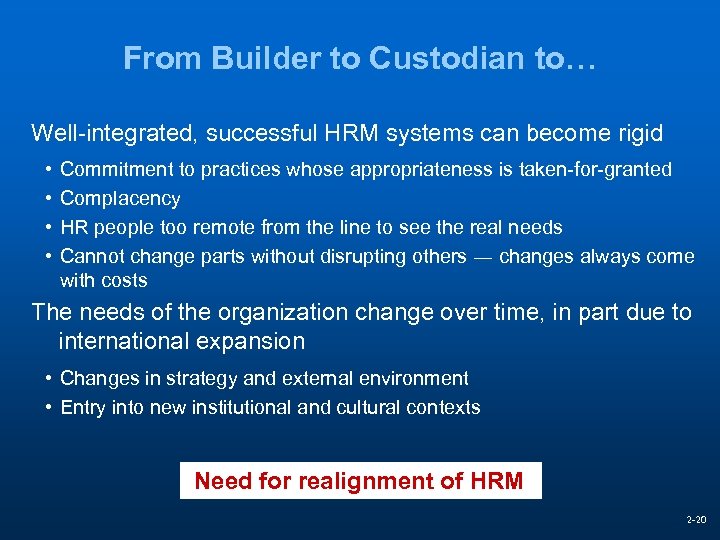 From Builder to Custodian to… Well-integrated, successful HRM systems can become rigid • • Commitment to practices whose appropriateness is taken-for-granted Complacency HR people too remote from the line to see the real needs Cannot change parts without disrupting others ― changes always come with costs The needs of the organization change over time, in part due to international expansion • Changes in strategy and external environment • Entry into new institutional and cultural contexts Need for realignment of HRM 2 -20
 HR and Change To realign HRM successfully the HR function must: • • Understand the new strategy and the organizational capabilities required to support it Design and successfully implement HR practices that help fill organizational capabilities gaps through - Investments in Human Capital - Developments in the Social Architecture of the firm But HR is also increasingly expected to act as a sparring partner to line management in discussions on how to manage processes of change …. . . and point to the dangers of becoming fixated on change! 2 -21
 Tensions and Contradictions facing Multinational Firms Short term versus Long term Entrepreneurship versus Global customer orientation Local responsiveness versus Global integration Innovativeness versus Global efficiency Challenge versus Risk management Engagement versus Explanation Teamwork versus Accountability Loyalty versus Layoffs Change versus Continuity 2 -22
 From Tensions and Contradictions to Dualities Short term AND Long term Entrepreneurship AND Global customer orientation Local responsivenes AND Global integration Innovativeness AND Globally efficiency Challenge AND Risk management Engagement AND Explanation Teamwork AND Accountability Loyalty AND Layoffs Change AND Continuity 2 -23
 Some of the Dualities Facing Multinal Firms Managing today’s assets— building tomorrow’s assets Satisfying customer needs— being ahead of the customer Short term—long term Exploitation—exploration Loose—tight Opportunistic—planned Entrepreneurship— control/accountability Flexibility—efficiency Competition—partnership Low cost—high value-added Differentiation—integration Decentralization—centralization Unit performance—corporate integration Individual accountability—team responsibility Change—continuity Speed of responsiveness—care in implementation Professional—generalist Technical logic—business logic Taking risks—avoiding failures Task orientation—people orientation 2 -24
 Steering between dualities is crucial for the multinational corporation It’s the key task for the Navigator function of HRM 1 -25
 Get the basics right … … then focus on the change agenda … … and prepare yourself to manage tension and contradiction 2 -26