 Скачать презентацию Chapter 2 E-Business How Businesses Use Information Systems
laudon_ess7_ch02.ppt.pptx
- Количество слайдов: 26



Chapter 2 E-Business: How Businesses Use Information Systems 2. * © 2007 by Prentice Hall
Essentials of Business Information Systems Chapter 2 E-Business: How Businesses Use Information Systems STUDENT OBJECTIVES • Identify and describe the major features of a business that are important for understanding the role of information systems. • Describe the information systems supporting the major business functions: sales and marketing, manufacturing and production, finance and accounting, and human resources. • Evaluate the role played by systems serving the various levels of management in a business and their relationship to each other. 2. * © 2007 by Prentice Hall
Essentials of Business Information Systems Chapter 2 E-Business: How Businesses Use Information Systems STUDENT OBJECTIVES (Continued) • Explain how enterprise applications and intranets promote business process integration and improve organizational performance. • Assess the role of the information systems function in a business. 2. * © 2007 by Prentice Hall
Essentials of Business Information Systems Chapter 2 E-Business: How Businesses Use Information Systems Help Kia Solve Its Quality Problems • Problem: High level of defects in product, new government requirements for reporting defects. • Solutions: Improve quality and monitor defects so that defects and quality problems are easily identified. • Infogain data repository and Clarify CRM system link results in reduced costs and increased sales. • Demonstrates IT’s role in centralizing data, interfacing with customers, and improving production processes. • Illustrates digital technology’s role in improved quality and lower rate of defects leading to customer satisfaction and repeat business. 2. * © 2007 by Prentice Hall
Essentials of Business Information Systems Chapter 2 E-Business: How Businesses Use Information Systems Help Kia Solve Its Quality Problems Interactive Session: Kia Motors 2. * © 2007 by Prentice Hall
Essentials of Business Information Systems Chapter 2 E-Business: How Businesses Use Information Systems Components of a Business A business is a formal organization that makes products or provides a service in order to make a profit. Organizing a Business: Basic Business Functions 2. * © 2007 by Prentice Hall
Essentials of Business Information Systems Chapter 2 E-Business: How Businesses Use Information Systems Components of a Business Processes 2. * © 2007 by Prentice Hall
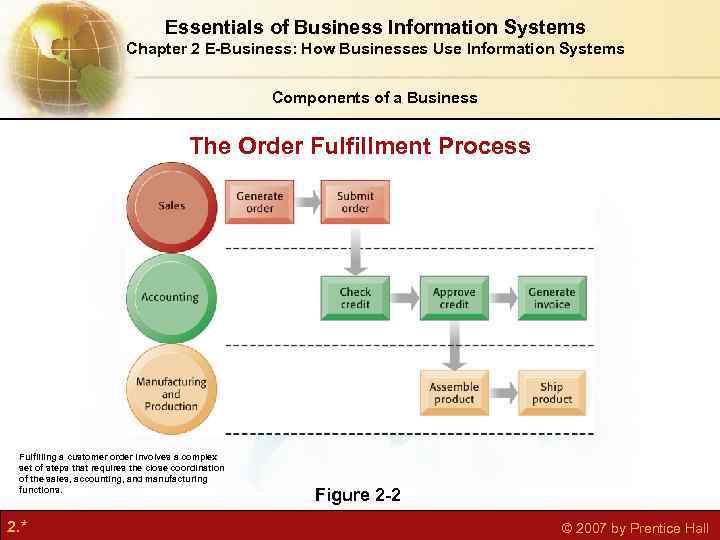
Essentials of Business Information Systems Chapter 2 E-Business: How Businesses Use Information Systems Components of a Business The Order Fulfillment Process Fulfilling a customer order involves a complex set of steps that requires the close coordination of the sales, accounting, and manufacturing functions. 2. * Figure 2 -2 © 2007 by Prentice Hall
Essentials of Business Information Systems Chapter 2 E-Business: How Businesses Use Information Systems Components of a Business Managing a Business and Firm Hierarchies • Senior management • Middle management • Operational management • Knowledge workers • Data workers • Production or service workers 2. * © 2007 by Prentice Hall
Essentials of Business Information Systems Chapter 2 E-Business: How Businesses Use Information Systems Components of a Business The Business Environment • Global environment factors • Technology and science • Economy • Politics • International change 2. * • Immediate environment factors • Customers • Suppliers • Competitors • Regulations • Stockholders © 2007 by Prentice Hall
Essentials of Business Information Systems Chapter 2 E-Business: How Businesses Use Information Systems Components of a Business The Role of Information Systems in a Business 2. * © 2007 by Prentice Hall
Essentials of Business Information Systems Chapter 2 E-Business: How Businesses Use Information Systems Types of Business Information Systems from a Functional Perspective 2. * © 2007 by Prentice Hall
Essentials of Business Information Systems Chapter 2 E-Business: How Businesses Use Information Systems Types of Business Information Systems from a Constituency Perspective 2. * © 2007 by Prentice Hall
Essentials of Business Information Systems Chapter 2 E-Business: How Businesses Use Information Systems Types of Business Information Systems Managing Employee Incentives: Wachovia’s Strategic Weapon 2. * © 2007 by Prentice Hall
Essentials of Business Information Systems Chapter 2 E-Business: How Businesses Use Information Systems Types of Business Information Systems Interactive Session: Wachovia 2. * © 2007 by Prentice Hall
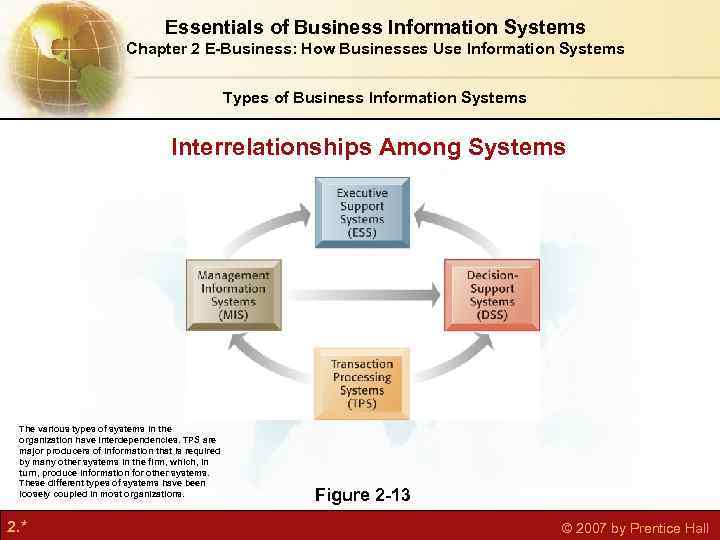
Essentials of Business Information Systems Chapter 2 E-Business: How Businesses Use Information Systems Types of Business Information Systems Interrelationships Among Systems The various types of systems in the organization have interdependencies. TPS are major producers of information that is required by many other systems in the firm, which, in turn, produce information for other systems. These different types of systems have been loosely coupled in most organizations. 2. * Figure 2 -13 © 2007 by Prentice Hall
Essentials of Business Information Systems Chapter 2 E-Business: How Businesses Use Information Systems That Span the Enterprise Applications 2. * © 2007 by Prentice Hall
Essentials of Business Information Systems Chapter 2 E-Business: How Businesses Use Information Systems That Span the Enterprise Systems 2. * © 2007 by Prentice Hall
Essentials of Business Information Systems Chapter 2 E-Business: How Businesses Use Information Systems That Span the Enterprise Supply Chain Management Systems 2. * © 2007 by Prentice Hall
Essentials of Business Information Systems Chapter 2 E-Business: How Businesses Use Information Systems That Span the Enterprise Customer Relationship Management Systems 2. * © 2007 by Prentice Hall
Essentials of Business Information Systems Chapter 2 E-Business: How Businesses Use Information Systems That Span the Enterprise Knowledge Management Systems 2. * © 2007 by Prentice Hall
Essentials of Business Information Systems Chapter 2 E-Business: How Businesses Use Information Systems That Span the Enterprise Haworth Overhauls Supply Chain Management 2. * © 2007 by Prentice Hall
Essentials of Business Information Systems Chapter 2 E-Business: How Businesses Use Information Systems That Span the Enterprise Intranets and Extranets • Technology platforms that increase integration and expedite the flow of information • Intranets: internal networks based on Internet standards • Extranets: intranets that are extended for authorized use outside the company • Intranets often utilize a portal • Extranets facilitate collaboration 2. * © 2007 by Prentice Hall
Essentials of Business Information Systems Chapter 2 E-Business: How Businesses Use Information Systems That Span the Enterprise E-Business, E-Commerce, and E-Government • E-business refers to the use of digital technolgoy and the Internet to drive major business processes • E-commerce is a subset of E-Business that involves buying and selling goods and services through the Internet • E-government refers to using Internet technology to deliver information and services to citizens, employees, and businesses 2. * © 2007 by Prentice Hall
Essentials of Business Information Systems Chapter 2 E-Business: How Businesses Use Information Systems The Information System’s Function in Business The Information Systems Department • Programmers • Systems analysts • Information systems managers • Chief information officer (CIO) • End users 2. * © 2007 by Prentice Hall
Essentials of Business Information Systems Chapter 2 E-Business: How Businesses Use Information Systems The Information System’s Function in Business Organizing the Information Systems Function • Small companies often rely on a single person for information technology services rather than an information systems department • Some large firms with IS departments decentralize them so that each functional area of the business has its own information systems • Other large firms may depend on a central department that makes technology decisions for the entire company 2. * © 2007 by Prentice Hall
Скачать презентацию Chapter 2 E-Business How Businesses Use Information Systems
laudon_ess7_ch02.ppt.pptx