 Скачать презентацию Chapter 2 Describing Variables 2 5 Measures of
3e26d4decd41b6b2d739521f99c8fe40.ppt
- Количество слайдов: 22



Chapter 2 Describing Variables 2. 5 Measures of Dispersion 3/16/2018
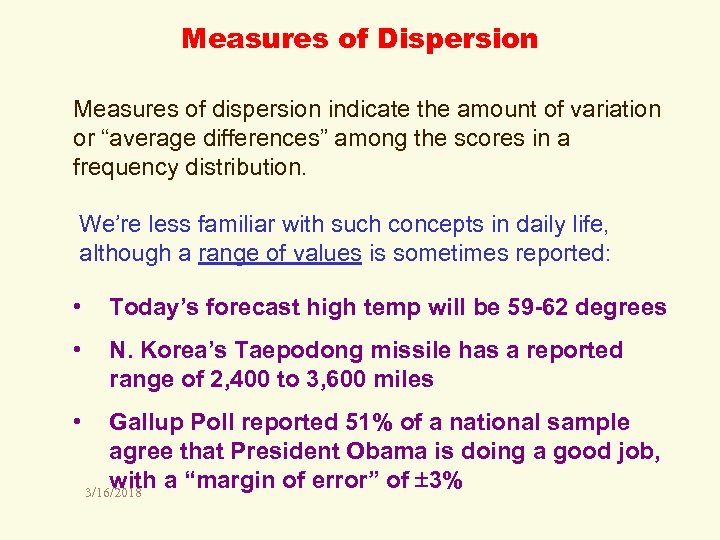
Measures of Dispersion Measures of dispersion indicate the amount of variation or “average differences” among the scores in a frequency distribution. We’re less familiar with such concepts in daily life, although a range of values is sometimes reported: • Today’s forecast high temp will be 59 -62 degrees • N. Korea’s Taepodong missile has a reported range of 2, 400 to 3, 600 miles • Gallup Poll reported 51% of a national sample agree that President Obama is doing a good job, with a “margin of error” of 3% 3/16/2018
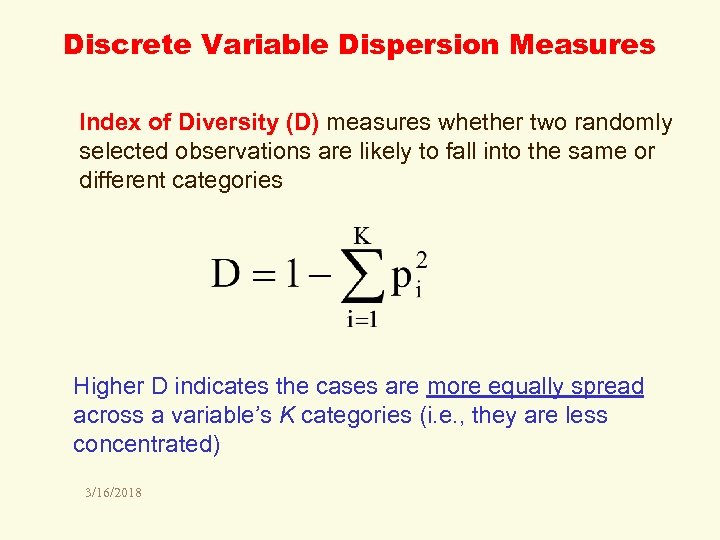
Discrete Variable Dispersion Measures Index of Diversity (D) measures whether two randomly selected observations are likely to fall into the same or different categories Higher D indicates the cases are more equally spread across a variable’s K categories (i. e. , they are less concentrated) 3/16/2018
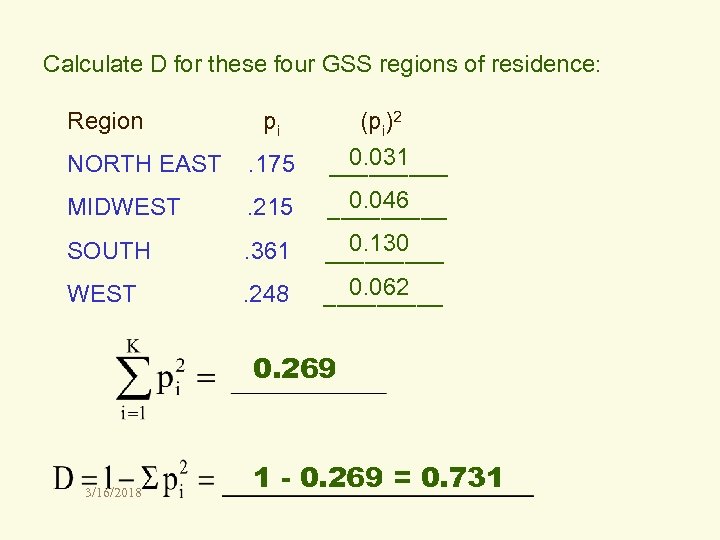
Calculate D for these four GSS regions of residence: Region pi (pi)2 NORTH EAST . 175 0. 031 _____ MIDWEST . 215 0. 046 _____ SOUTH . 361 0. 130 _____ WEST . 248 0. 062 _____ 0. 269 3/16/2018 1 - 0. 269 = 0. 731
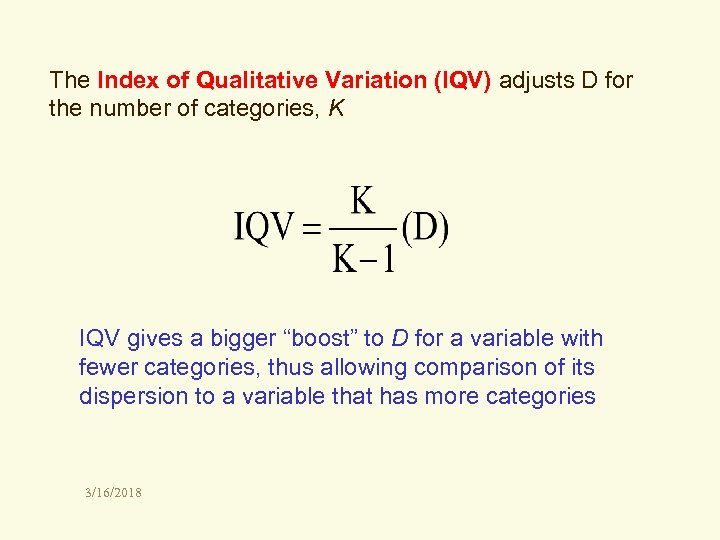
The Index of Qualitative Variation (IQV) adjusts D for the number of categories, K IQV gives a bigger “boost” to D for a variable with fewer categories, thus allowing comparison of its dispersion to a variable that has more categories 3/16/2018
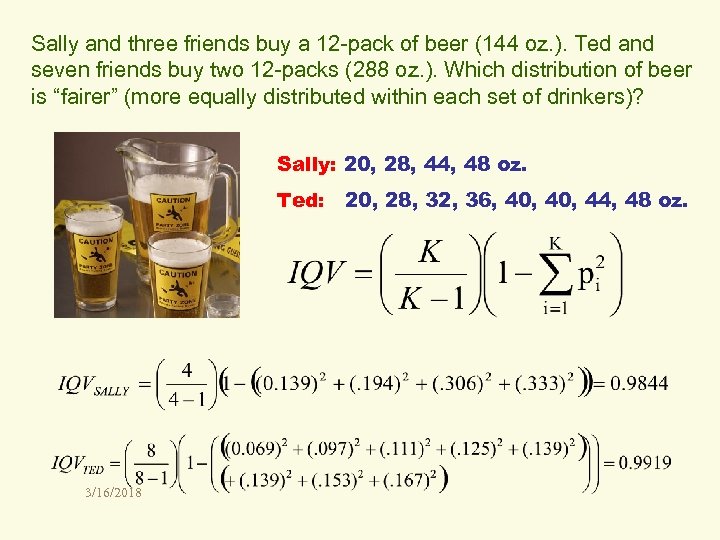
Sally and three friends buy a 12 -pack of beer (144 oz. ). Ted and seven friends buy two 12 -packs (288 oz. ). Which distribution of beer is “fairer” (more equally distributed within each set of drinkers)? Sally: 20, 28, 44, 48 oz. Ted: 3/16/2018 20, 28, 32, 36, 40, 44, 48 oz.
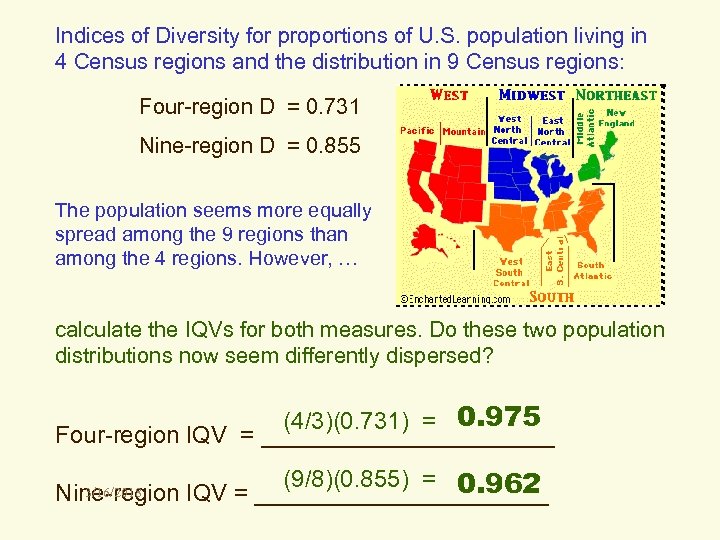
Indices of Diversity for proportions of U. S. population living in 4 Census regions and the distribution in 9 Census regions: Four-region D = 0. 731 Nine-region D = 0. 855 The population seems more equally spread among the 9 regions than among the 4 regions. However, … calculate the IQVs for both measures. Do these two population distributions now seem differently dispersed? (4/3)(0. 731) = 0. 975 Four-region IQV = ___________ (9/8)(0. 855) = 0. 962 Nine-region IQV = ___________ 3/16/2018
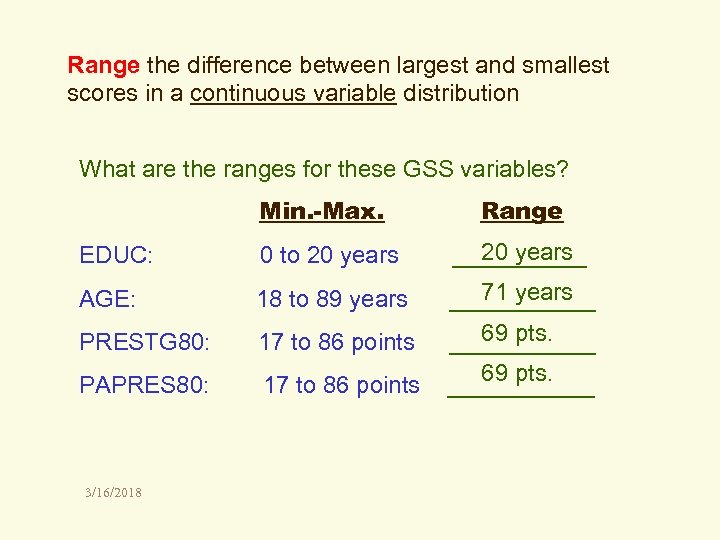
Range the difference between largest and smallest scores in a continuous variable distribution What are the ranges for these GSS variables? Min. -Max. Range EDUC: 0 to 20 years _____ AGE: 18 to 89 years PRESTG 80: 17 to 86 points 71 years ______ 69 pts. ______ PAPRES 80: 17 to 86 points 69 pts. ______ 3/16/2018
Average Absolute Deviation (AAD) Read this subsection (pp. 48 -49) for yourself, as background info for the variance & standard deviation Because ADD is never used in research statistics, we won’t spend any time on it in lecture 3/16/2018
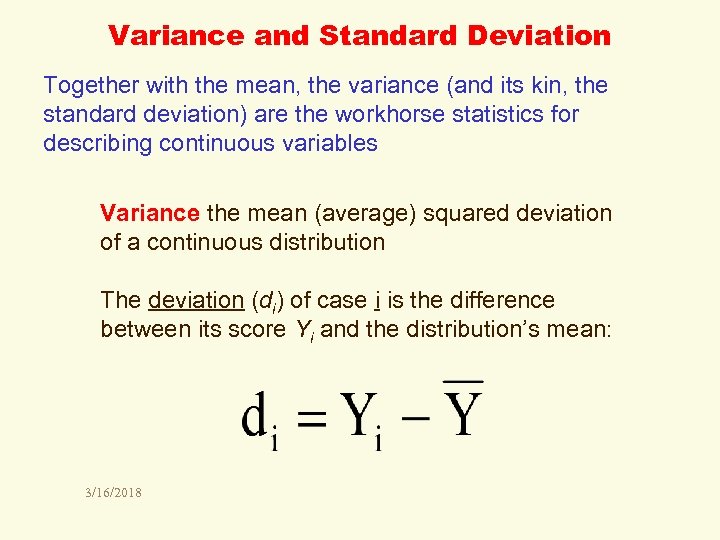
Variance and Standard Deviation Together with the mean, the variance (and its kin, the standard deviation) are the workhorse statistics for describing continuous variables Variance the mean (average) squared deviation of a continuous distribution The deviation (di) of case i is the difference between its score Yi and the distribution’s mean: 3/16/2018
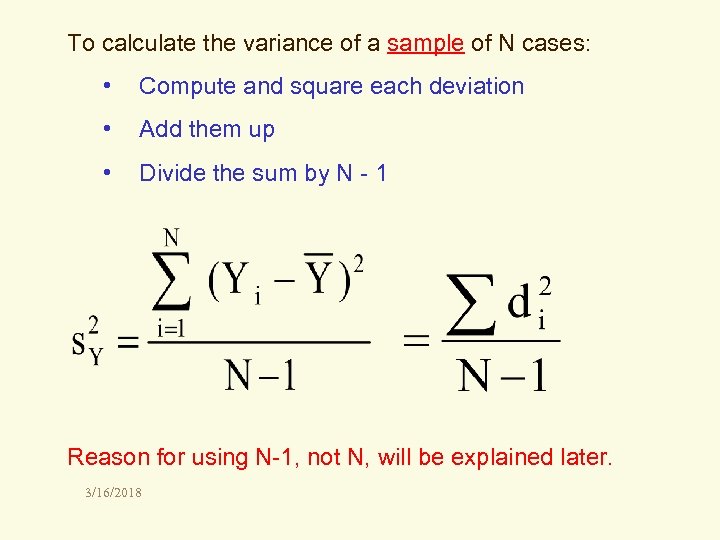
To calculate the variance of a sample of N cases: • Compute and square each deviation • Add them up • Divide the sum by N - 1 Reason for using N-1, not N, will be explained later. 3/16/2018
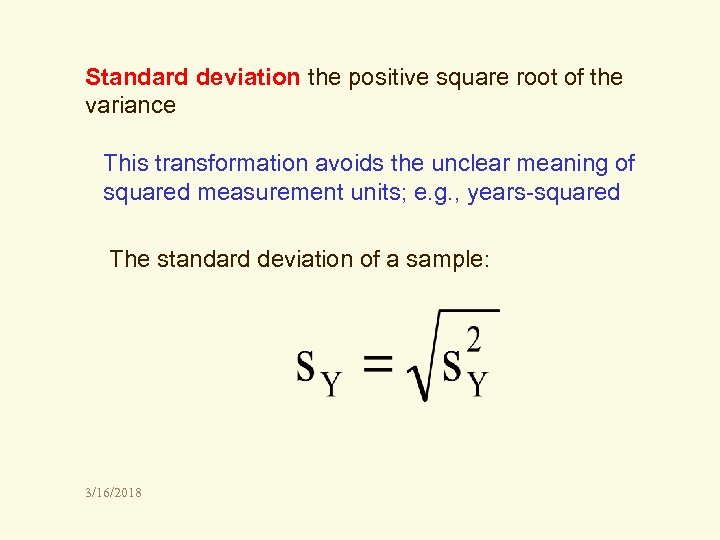
Standard deviation the positive square root of the variance This transformation avoids the unclear meaning of squared measurement units; e. g. , years-squared The standard deviation of a sample: 3/16/2018
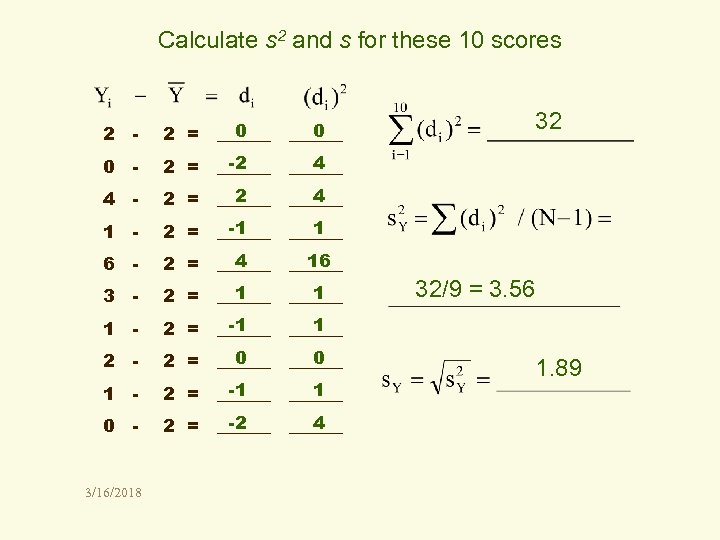
Calculate s 2 and s for these 10 scores 2 - 0 0 2 = ______ 0 - -2 4 2 = ______ 4 - 2 4 2 = ______ 1 - -1 1 2 = ______ 6 - 4 16 2 = ______ 3 - 1 1 2 = ______ 1 - -1 1 2 = ______ 2 - 0 0 2 = ______ 1 - -1 1 2 = ______ 0 - -2 4 2 = ______ 32 3/16/2018 32/9 = 3. 56 1. 89
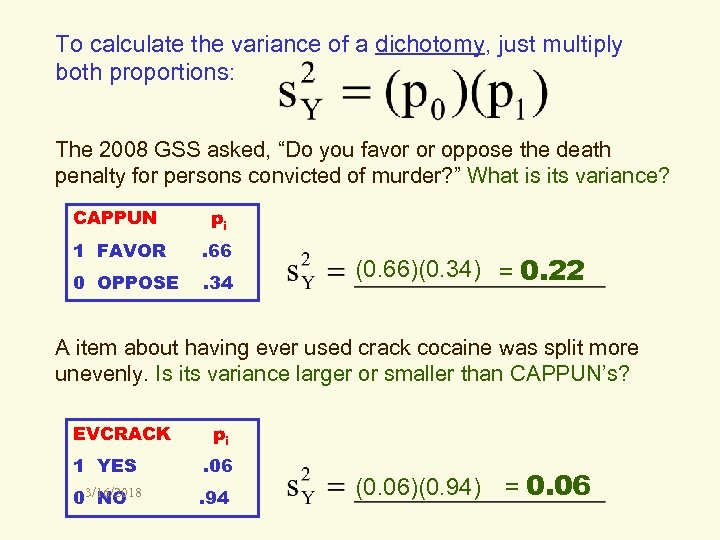
To calculate the variance of a dichotomy, just multiply both proportions: The 2008 GSS asked, “Do you favor or oppose the death penalty for persons convicted of murder? ” What is its variance? CAPPUN pi 1 FAVOR . 66 0 OPPOSE . 34 (0. 66)(0. 34) = 0. 22 A item about having ever used crack cocaine was split more unevenly. Is its variance larger or smaller than CAPPUN’s? EVCRACK pi 1 YES . 06 03/16/2018 NO . 94 (0. 06)(0. 94) = 0. 06
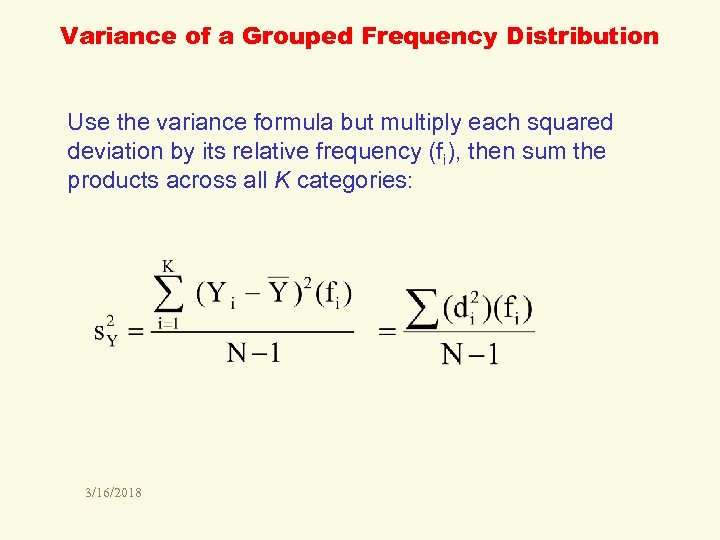
Variance of a Grouped Frequency Distribution Use the variance formula but multiply each squared deviation by its relative frequency (fi), then sum the products across all K categories: 3/16/2018
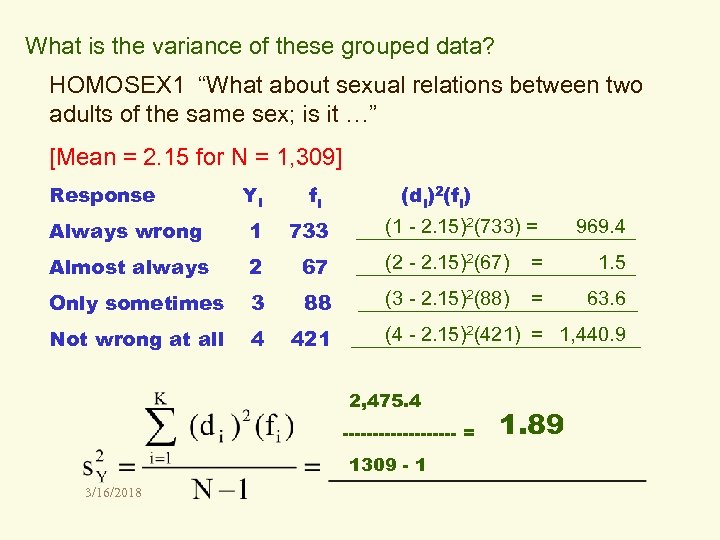
What is the variance of these grouped data? HOMOSEX 1 “What about sexual relations between two adults of the same sex; is it …” [Mean = 2. 15 for N = 1, 309] Response Yi fi (di)2(fi) Always wrong 1 733 (1 - 2. 15)2(733) = 969. 4 ______________ Almost always 2 67 (2 - 2. 15)2(67) = 1. 5 ______________ Only sometimes 3 88 (3 - 2. 15)2(88) = 63. 6 ______________ Not wrong at all 4 421 (4 - 2. 15)2(421) = 1, 440. 9 _______________ 2, 475. 4 ---------- = 1309 - 1 3/16/2018 1. 89
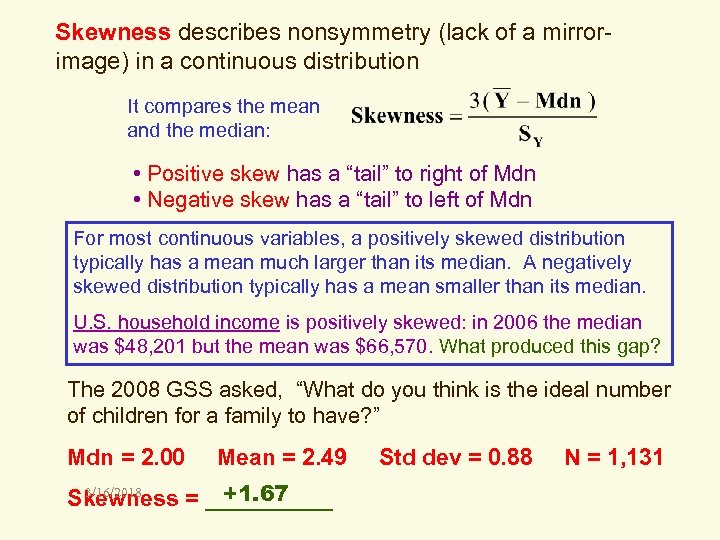
Skewness describes nonsymmetry (lack of a mirrorimage) in a continuous distribution It compares the mean and the median: • Positive skew has a “tail” to right of Mdn • Negative skew has a “tail” to left of Mdn For most continuous variables, a positively skewed distribution typically has a mean much larger than its median. A negatively skewed distribution typically has a mean smaller than its median. U. S. household income is positively skewed: in 2006 the median was $48, 201 but the mean was $66, 570. What produced this gap? The 2008 GSS asked, “What do you think is the ideal number of children for a family to have? ” Mdn = 2. 00 Mean = 2. 49 3/16/2018 +1. 67 Skewness = _____ Std dev = 0. 88 N = 1, 131
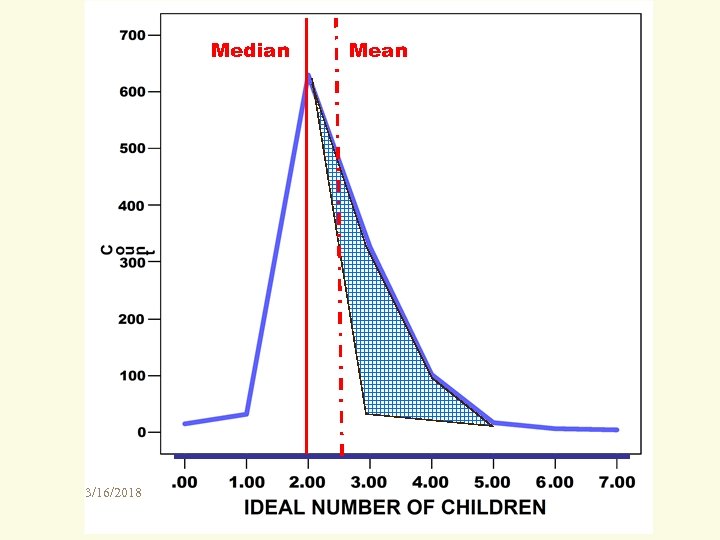
Median 3/16/2018 Mean
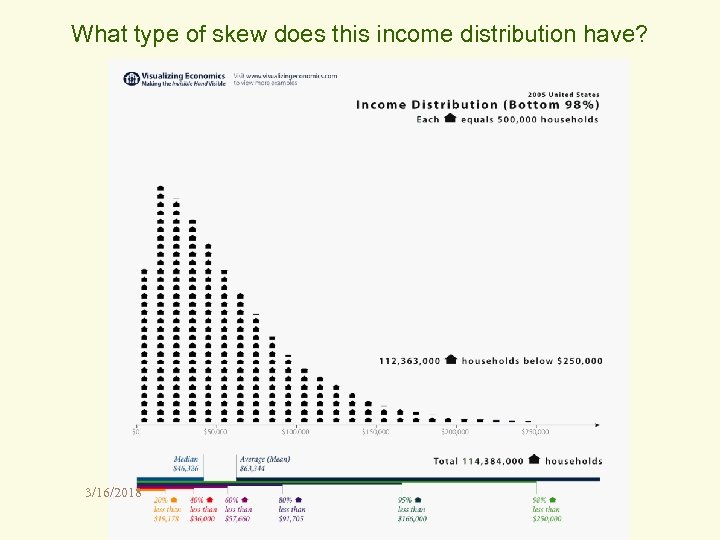
What type of skew does this income distribution have? 3/16/2018
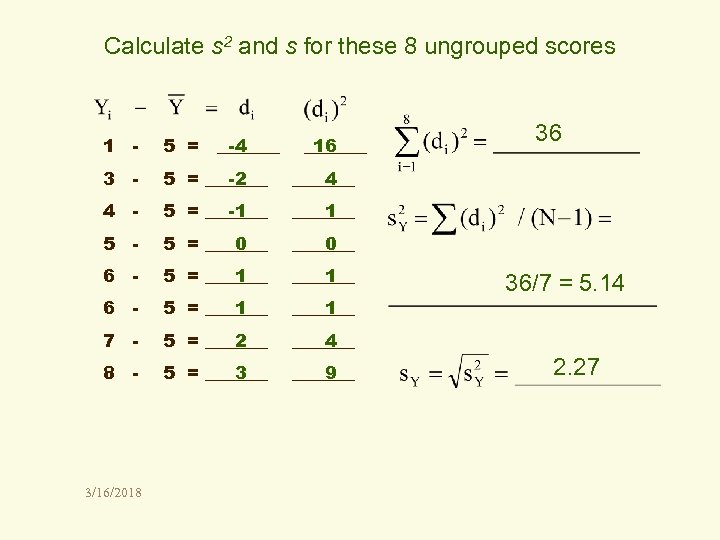
Calculate s 2 and s for these 8 ungrouped scores 1 - 5 = _______ -4 3 - 5 = _______ -2 4 - 5 = _______ -1 _______ 1 5 - 5 = _______ 0 6 - 5 = _______ 1 7 - 5 = _______ 2 _______ 4 8 - 5 = _______ 3 _______ 9 36 _______ 4 3/16/2018 _______ 16 36/7 = 5. 14 2. 27
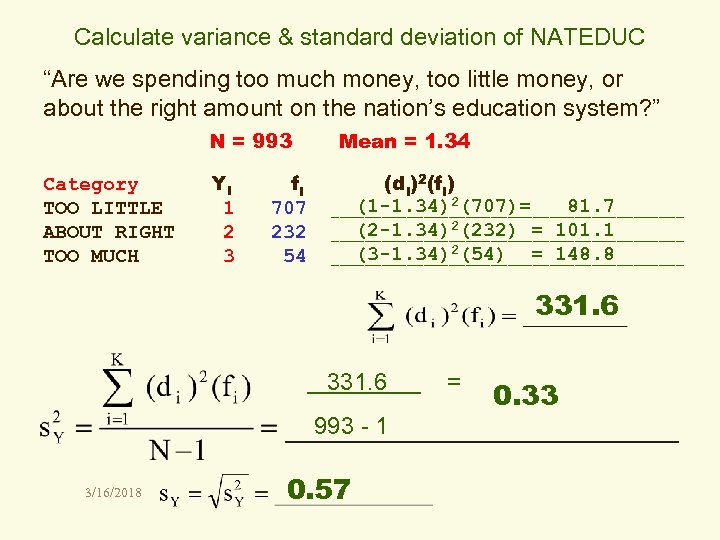
Calculate variance & standard deviation of NATEDUC “Are we spending too much money, too little money, or about the right amount on the nation’s education system? ” N = 993 Category TOO LITTLE ABOUT RIGHT TOO MUCH Yi 1 2 3 fi 707 232 54 Mean = 1. 34 (di)2(fi) (1 -1. 34)2(707)= 81. 7 _____________________ (2 -1. 34)2(232) = 101. 1 _____________________ (3 -1. 34)2(54) = 148. 8 _____________________ 331. 6 993 - 1 3/16/2018 0. 57 = 0. 33
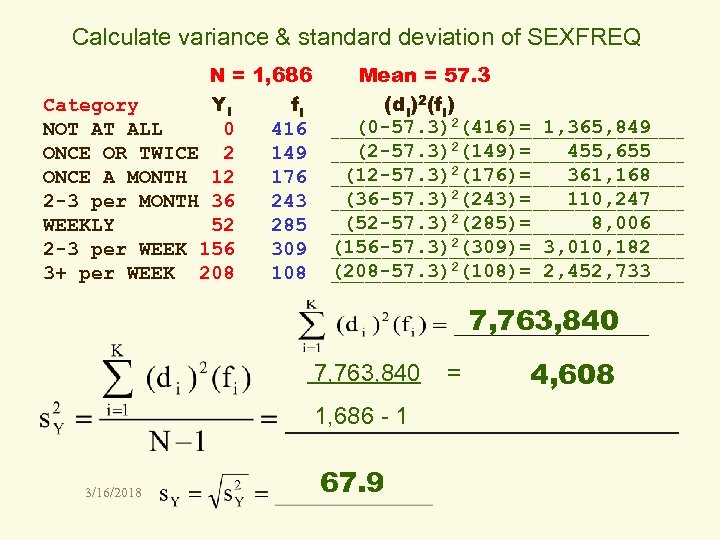
Calculate variance & standard deviation of SEXFREQ N = 1, 686 Mean = 57. 3 Category Yi fi (di)2(fi) (0 -57. 3)2(416)= 1, 365, 849 NOT AT ALL 0 416 _____________________ (2 -57. 3)2(149)= 455, 655 ONCE OR TWICE 2 149 _____________________ (12 -57. 3)2(176)= 361, 168 ONCE A MONTH 12 176 _____________________ (36 -57. 3)2(243)= 110, 247 2 -3 per MONTH 36 243 _____________________ (52 -57. 3)2(285)= 8, 006 WEEKLY 52 285 _____________________ 2 -3 per WEEK 156 309 (156 -57. 3)2(309)= 3, 010, 182 _____________________ 3+ per WEEK 208 108 (208 -57. 3)2(108)= 2, 452, 733 _____________________ 7, 763, 840 1, 686 - 1 3/16/2018 67. 9 = 4, 608
Скачать презентацию Chapter 2 Describing Variables 2 5 Measures of
3e26d4decd41b6b2d739521f99c8fe40.ppt