


 Скачать презентацию Chapter 2 Demand Supply Analysis 1 Chapter
b199c3ee74a5b1c64860cfe4a16038e6.ppt
- Количество слайдов: 42
 Chapter 2 Demand Supply Analysis 1
 Chapter Two Overview 1. Motivation – U. S. corn markets 2. Competitive Markets Defined 3. The Market Demand Curve 4. The Market Supply Curve 5. Equilibrium 6. Characterizing Demand Supply – Elasticity 7. Back of the Envelope Techniques Chapter Two 2
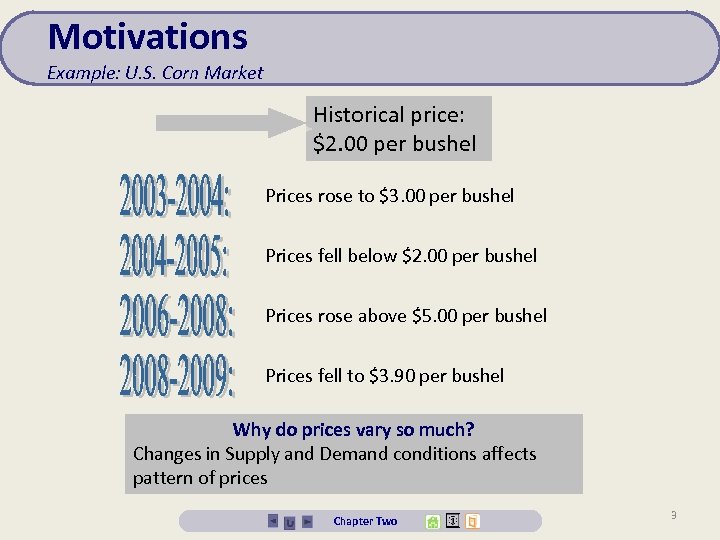 Motivations Example: U. S. Corn Market Historical price: $2. 00 per bushel Prices rose to $3. 00 per bushel Prices fell below $2. 00 per bushel Prices rose above $5. 00 per bushel Prices fell to $3. 90 per bushel Why do prices vary so much? Changes in Supply and Demand conditions affects pattern of prices Chapter Two 3
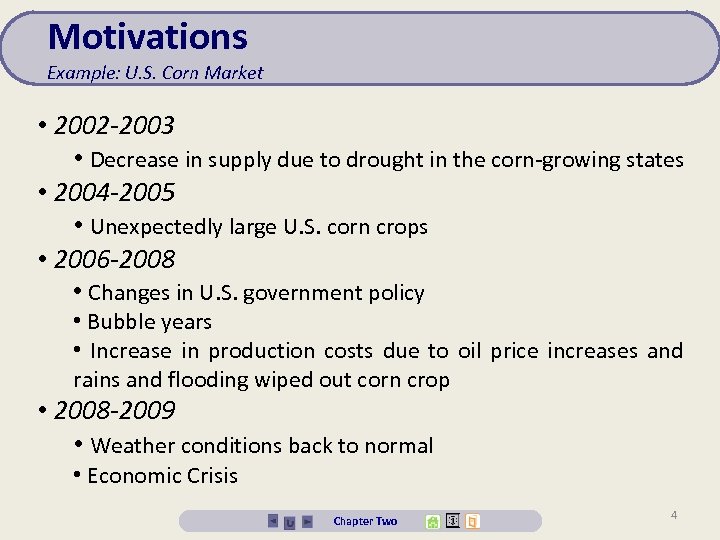 Motivations Example: U. S. Corn Market • 2002 -2003 • Decrease in supply due to drought in the corn-growing states • 2004 -2005 • Unexpectedly large U. S. corn crops • 2006 -2008 • Changes in U. S. government policy • Bubble years • Increase in production costs due to oil price increases and rains and flooding wiped out corn crop • 2008 -2009 • Weather conditions back to normal • Economic Crisis Chapter Two 4
 Competitive Markets Defined: Competitive Markets are those with sellers and buyers that are small and numerous enough that they take the market price as given when they decide how much to buy and sell. Chapter Two 5
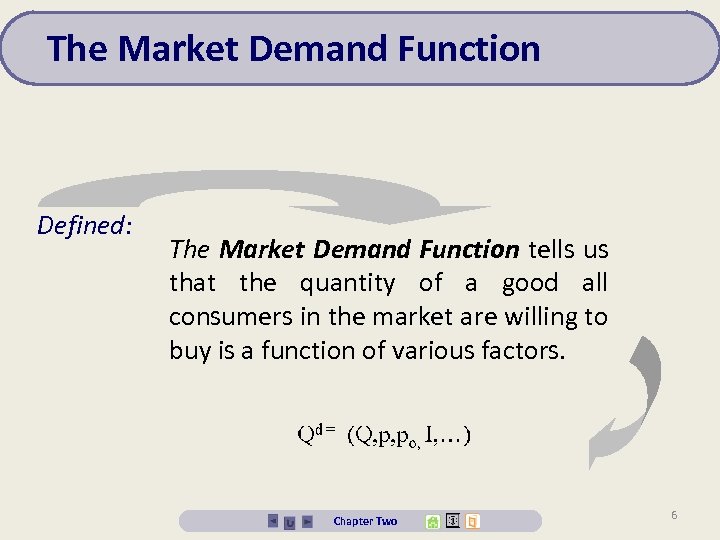 The Market Demand Function Defined: The Market Demand Function tells us that the quantity of a good all consumers in the market are willing to buy is a function of various factors. Chapter Two 6
 Market Demand • Derived Demand • The part of demand for a good that is derived from the production and sale of other goods. • Direct Demand • The part of demand for a good that comes from the desire of buyers to directly consume the good itself. Chapter Two 7
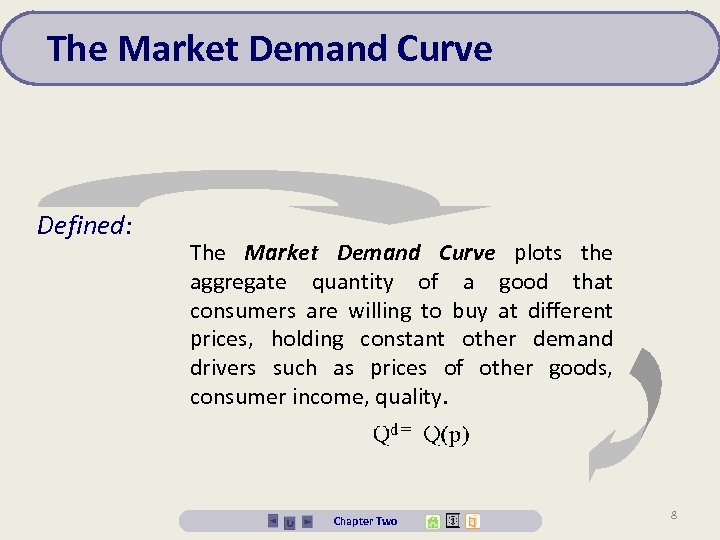 The Market Demand Curve Defined: The Market Demand Curve plots the aggregate quantity of a good that consumers are willing to buy at different prices, holding constant other demand drivers such as prices of other goods, consumer income, quality. Chapter Two 8
 The Law of Demand Defined: The Law of Demand states that the quantity of a good demanded decreases when the price of this good increases. Chapter Two 9
 Demand Curve Rule Defined: A move along the demand curve for a good can only be triggered by a change in the price of that good. Any change in another factor that affects the consumers’ willingness to pay for the good results in a shift in the demand curve for the good. Chapter Two 10
 Shifts of the Demand Curve The Demand Curve shifts when factors other than own price change ü If the change increases the willingness of consumers to acquire the good, the demand curve shifts right ü If the change decreases the willingness of consumers to acquire the good, the demand curve shifts left Chapter Two 11
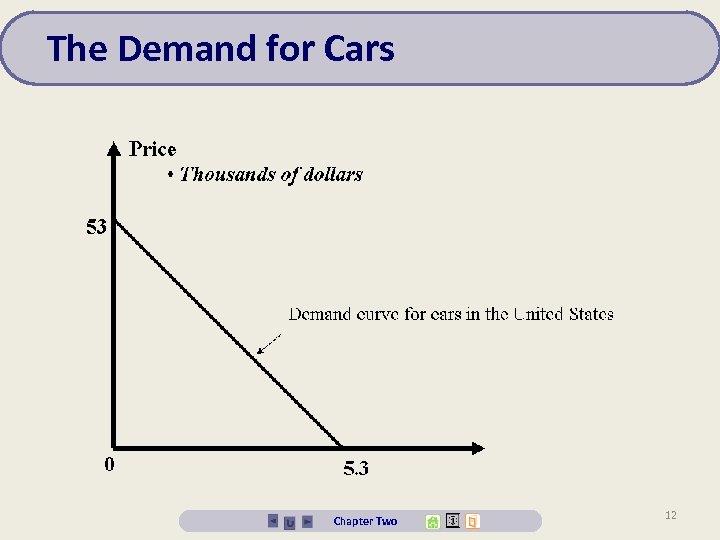 The Demand for Cars Chapter Two 12
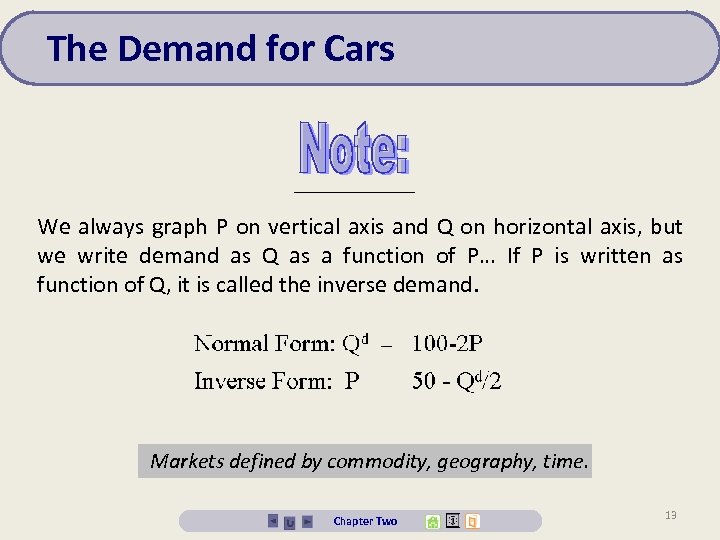 The Demand for Cars We always graph P on vertical axis and Q on horizontal axis, but we write demand as Q as a function of P… If P is written as function of Q, it is called the inverse demand. Markets defined by commodity, geography, time. Chapter Two 13
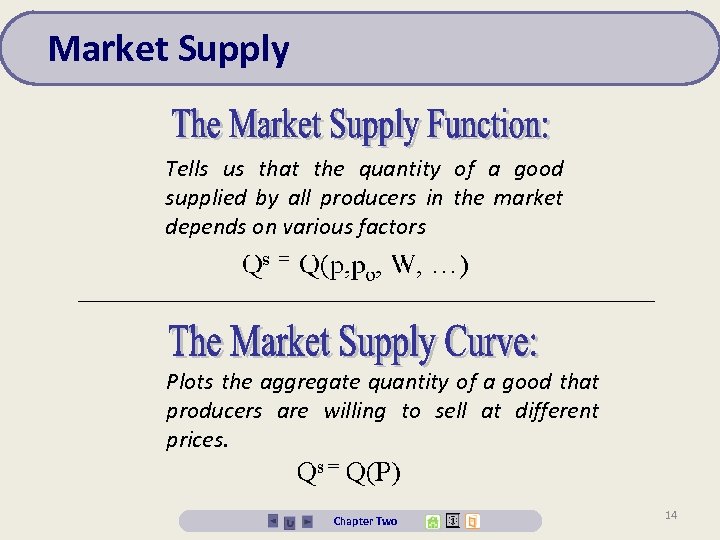 Market Supply Tells us that the quantity of a good supplied by all producers in the market depends on various factors Plots the aggregate quantity of a good that producers are willing to sell at different prices. Chapter Two 14
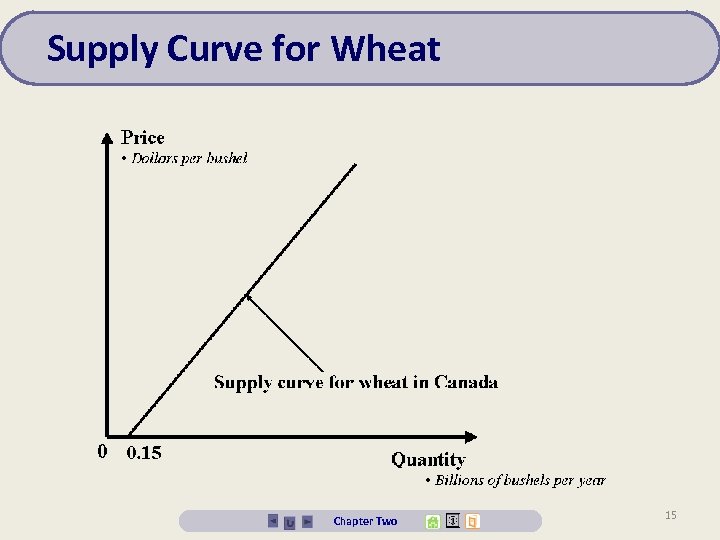 Supply Curve for Wheat Chapter Two 15
 The Law of Supply Defined: The Law of Supply states that the quantity of a good offered increases when the price of this good increases. Chapter Two 16
 Supply Curve Rule Defined: A move along the supply curve for a good can only be triggered by a change in the price of that good. Any change in another factor that affects the producers’ willingness to offer for the good results in a shift in the supply curve for the good. Chapter Two 17
 The Law of Supply The Supply Curve shifts when factors other than own price change ü If the change increases the willingness of producers to offer the good at the same price, the supply curve shifts right ü If the change decreases the willingness of producers to offer the good at the same price, the supply curve shifts left Chapter Two 18
 Market Equilibrium • is a price such that, at this price, the quantities demanded and supplied are the same. • is a point at which there is no tendency for the market price to change as long as exogenous variables remain unchanged. Demand supply curves intersect at equilibrium Sup d n ema D ply Chapter Two 19
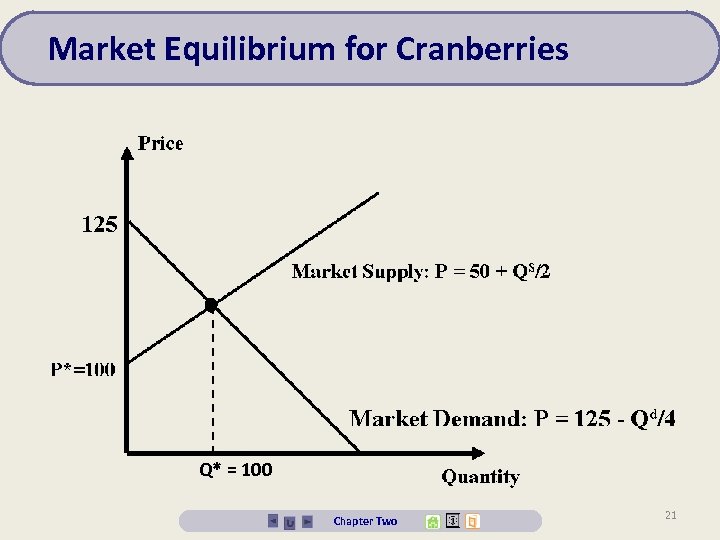
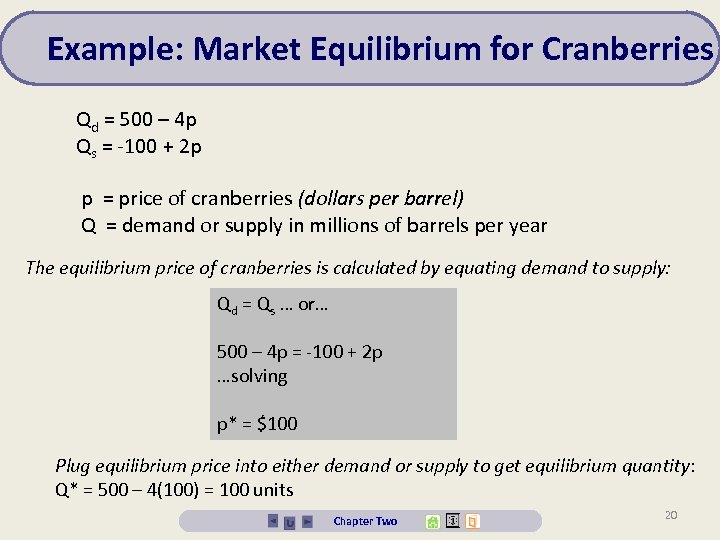 Example: Market Equilibrium for Cranberries Qd = 500 – 4 p Qs = -100 + 2 p p = price of cranberries (dollars per barrel) Q = demand or supply in millions of barrels per year The equilibrium price of cranberries is calculated by equating demand to supply: Qd = Qs … or… 500 – 4 p = -100 + 2 p …solving p* = $100 Plug equilibrium price into either demand or supply to get equilibrium quantity: Q* = 500 – 4(100) = 100 units Chapter Two 20
 Market Equilibrium for Cranberries Q* = 100 Chapter Two 21
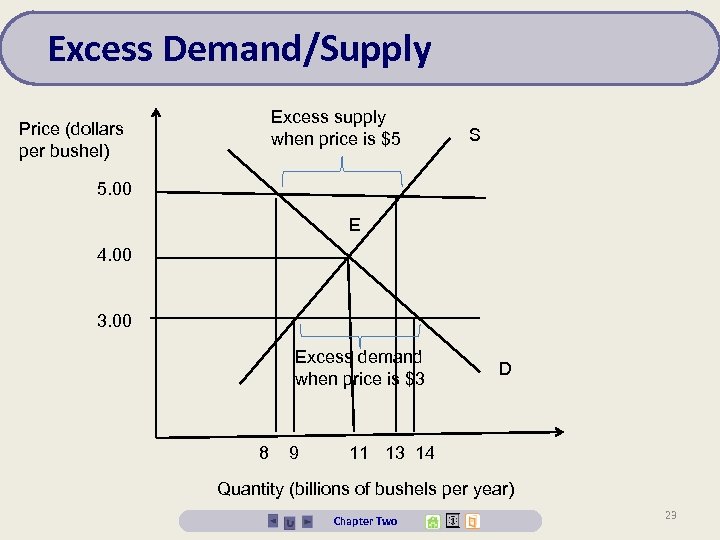
 Excess Demand/Supply Excess Demand: A situation in which the quantity demanded at a given price exceeds the quantity supplied. Excess Supply: A situation in which the quantity supplied at a given price exceeds the quantity demanded. If there is no excess supply or excess demand, there is no pressure for prices to change and thus there is equilibrium. When a change in an exogenous variable causes the demand curve or the supply curve to shift, the equilibrium shifts as well. Chapter Two 22
 Excess Demand/Supply Excess supply when price is $5 Price (dollars per bushel) S 5. 00 E 4. 00 3. 00 Excess demand when price is $3 8 9 D 11 13 14 Quantity (billions of bushels per year) Chapter Two 23
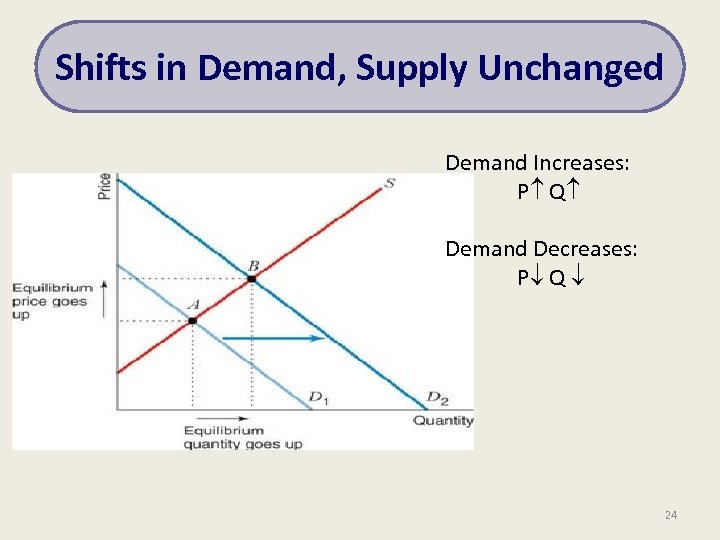 Shifts in Demand, Supply Unchanged Demand Increases: P Q Demand Decreases: P Q 24
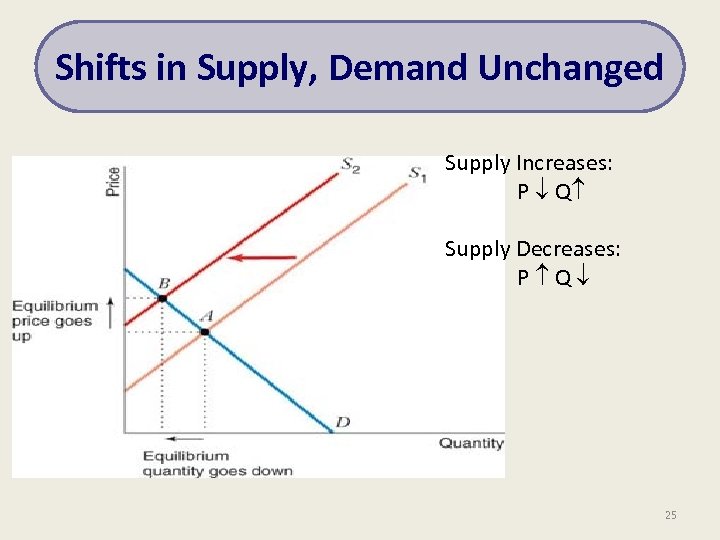 Shifts in Supply, Demand Unchanged Supply Increases: P Q Supply Decreases: P Q 25
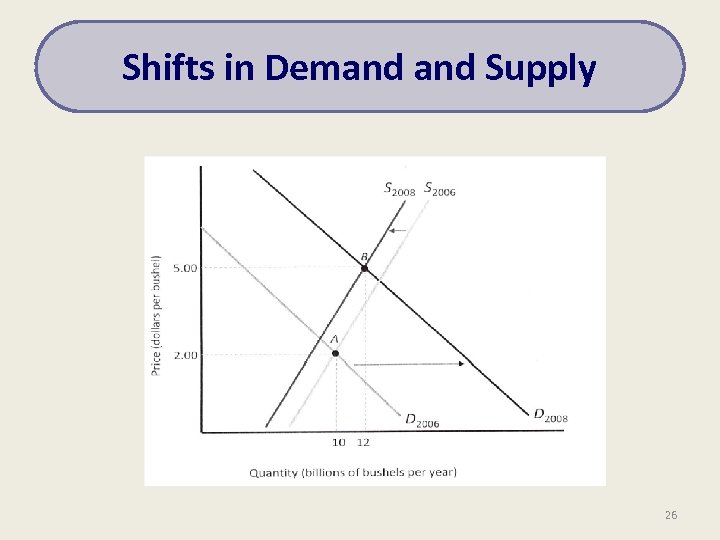 Shifts in Demand Supply 26
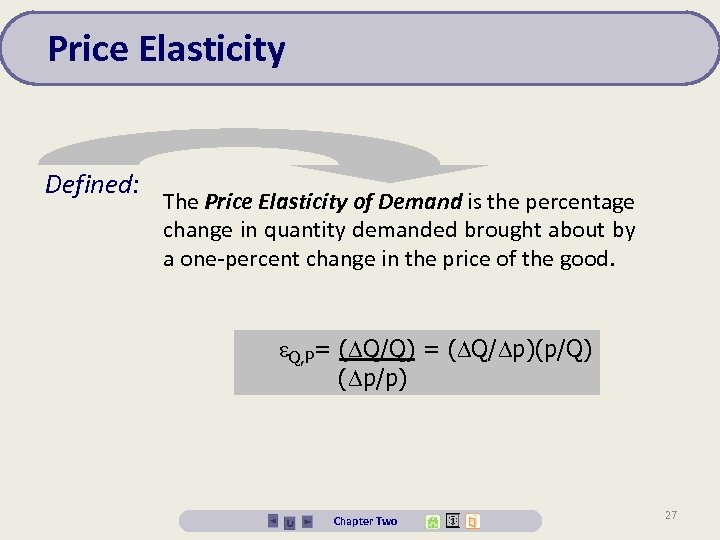 Price Elasticity Defined: The Price Elasticity of Demand is the percentage change in quantity demanded brought about by a one-percent change in the price of the good. Q, P= ( Q/Q) = ( Q/ p)(p/Q) ( p/p) Chapter Two 27
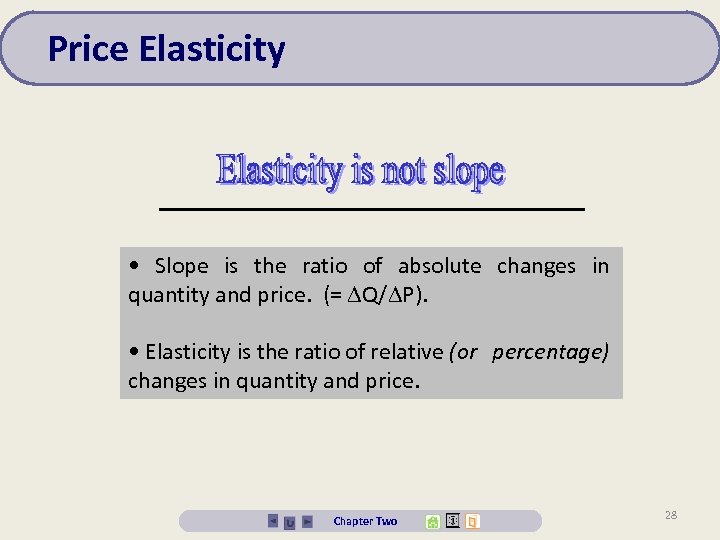 Price Elasticity • Slope is the ratio of absolute changes in quantity and price. (= Q/ P). • Elasticity is the ratio of relative (or percentage) changes in quantity and price. Chapter Two 28
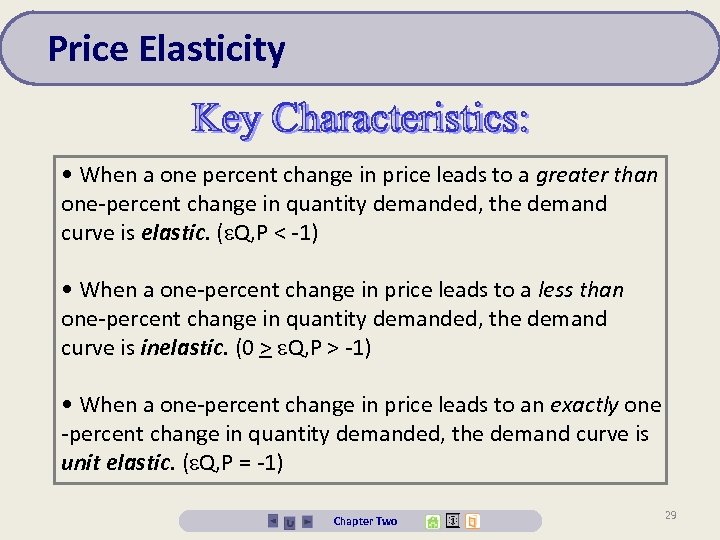 Price Elasticity • When a one percent change in price leads to a greater than one-percent change in quantity demanded, the demand curve is elastic. ( Q, P < -1) • When a one-percent change in price leads to a less than one-percent change in quantity demanded, the demand curve is inelastic. (0 > Q, P > -1) • When a one-percent change in price leads to an exactly one -percent change in quantity demanded, the demand curve is unit elastic. ( Q, P = -1) Chapter Two 29
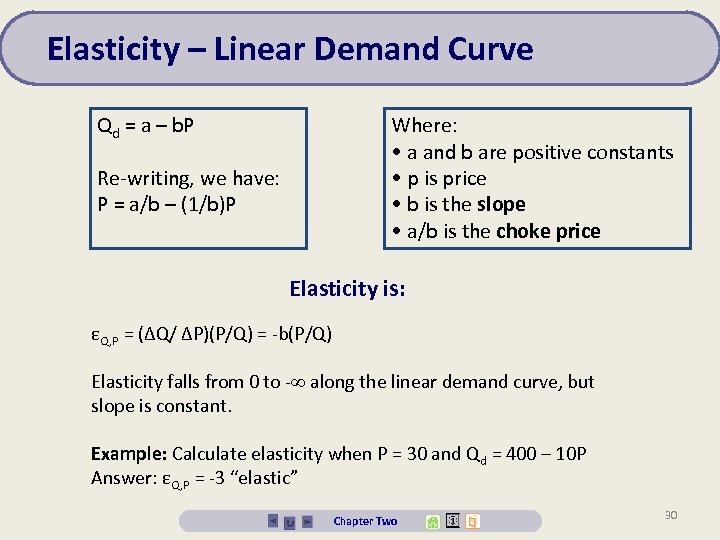 Elasticity – Linear Demand Curve Qd = a – b. P Where: • a and b are positive constants • p is price • b is the slope • a/b is the choke price Re-writing, we have: P = a/b – (1/b)P Elasticity is: εQ, P = (ΔQ/ ΔP)(P/Q) = -b(P/Q) Elasticity falls from 0 to - along the linear demand curve, but slope is constant. Example: Calculate elasticity when P = 30 and Qd = 400 – 10 P Answer: εQ, P = -3 “elastic” Chapter Two 30
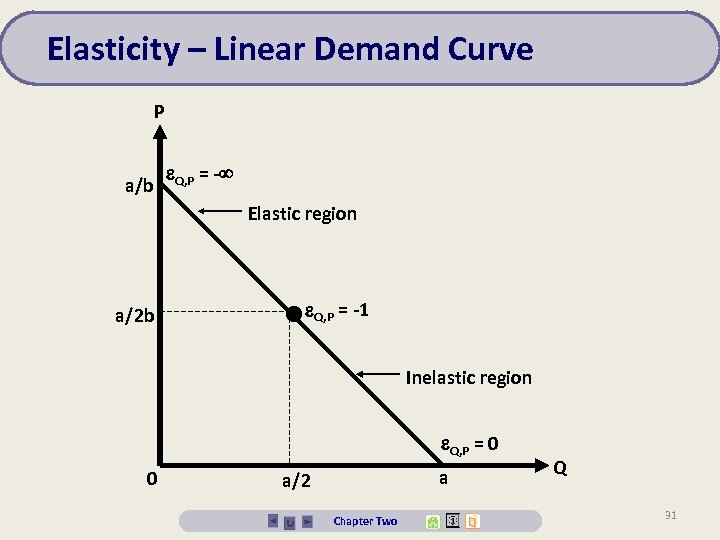 Elasticity – Linear Demand Curve P a/b Q, P = - Elastic region a/2 b • Q, P = -1 Inelastic region Q, P = 0 0 a a/2 Chapter Two Q 31
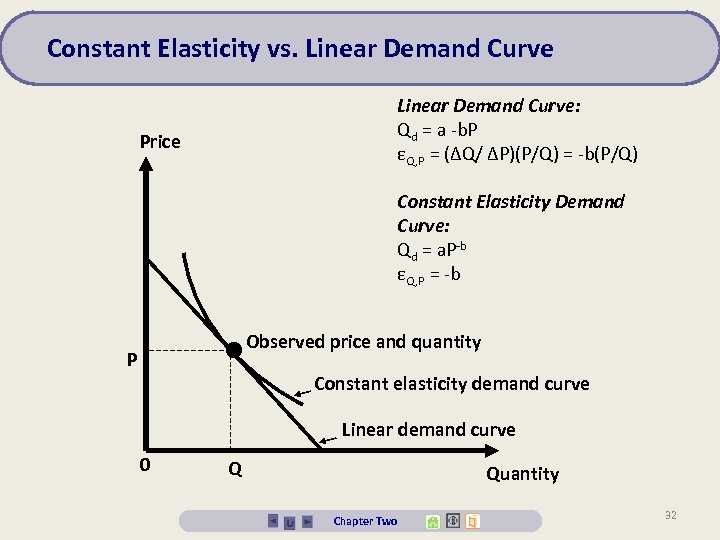 Constant Elasticity vs. Linear Demand Curve: Qd = a -b. P εQ, P = (ΔQ/ ΔP)(P/Q) = -b(P/Q) Price Constant Elasticity Demand Curve: Qd = a. P-b εQ, P = -b • P Observed price and quantity Constant elasticity demand curve Linear demand curve 0 Q Quantity Chapter Two 32
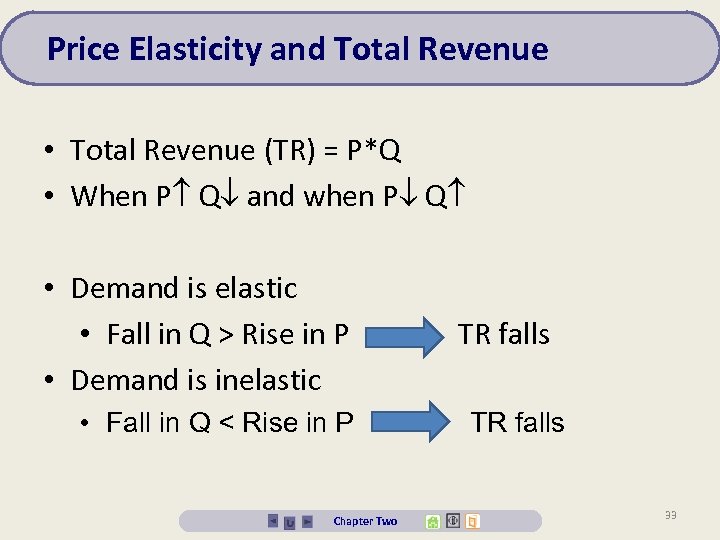 Price Elasticity and Total Revenue • Total Revenue (TR) = P*Q • When P Q and when P Q • Demand is elastic • Fall in Q > Rise in P • Demand is inelastic • Fall in Q < Rise in P Chapter Two TR falls 33
 Determinants of Price Elasticity of Demand • Availability of Substitutes – More substitutes → more price elastic – Goods which have price inelastic at the market level, like cigarettes, can be highly price elastic at the brand level • Necessities versus Luxuries – Necessities → less price elastic • Importance in Buyer’s Budget – More important → more price elastic • Time Horizon – Long-run → more price elastic Chapter Two 34
 Elasticity in the Long-run versus the Short-run • Long-run demand curve – demand curve when consumers can fully adjust their purchase decisions to changes in price • Short-run demand curve – demand curve when consumers can fully adjust their purchase decisions to changes in price • Long-run supply curve – supply curve when sellers can fully adjust their supply decisions to changes in price • Short-run supply curve – supply curve when sellers can fully adjust their supply decisions to changes in price Chapter Two 35
 Durable Goods Defined: The Durable Good is a good that provides valuable services over a long time (usually many years). Demand for non-durables is less elastic in the short run when consumers can only partially adapt their behavior. Demand for durables is more elastic in the short run because consumers can delay purchase. Chapter Two 36
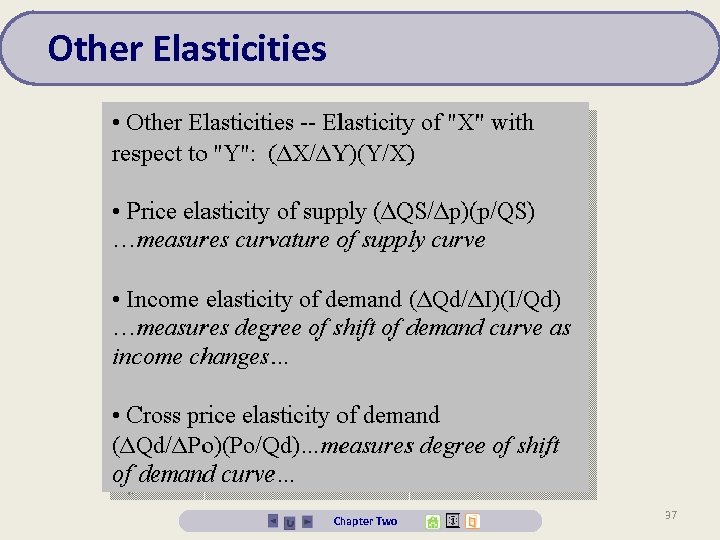 Other Elasticities Chapter Two 37
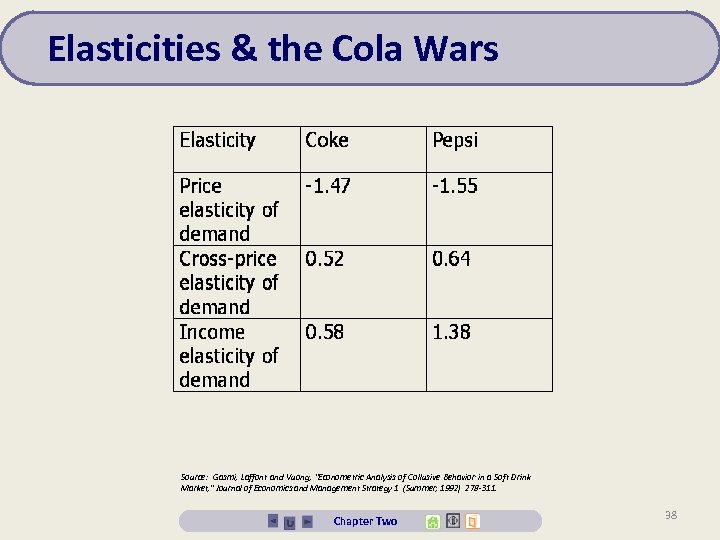 Elasticities & the Cola Wars Source: Gasmi, Laffont and Vuong, "Econometric Analysis of Collusive Behavior in a Soft Drink Market, " Journal of Economics and Management Strategy 1 (Summer, 1992) 278 -311. Chapter Two 38
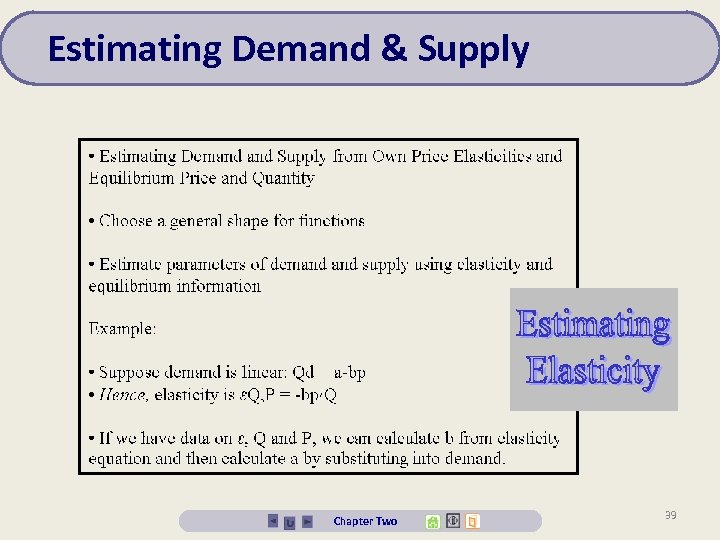 Estimating Demand & Supply Chapter Two 39
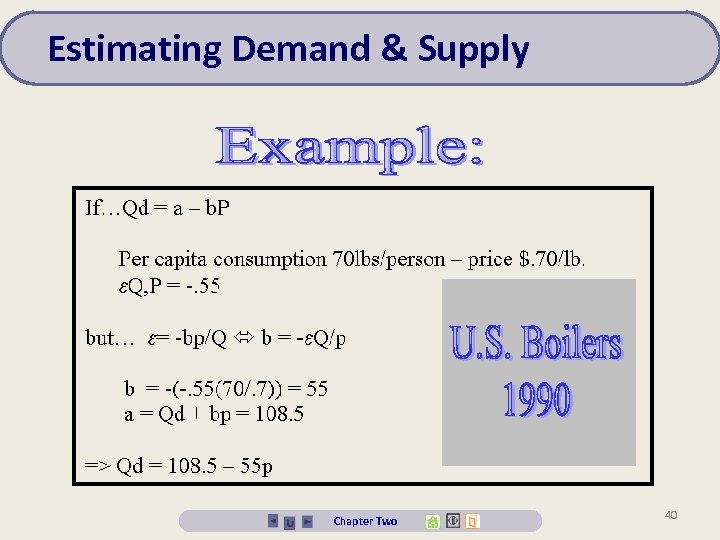 Estimating Demand & Supply Chapter Two 40
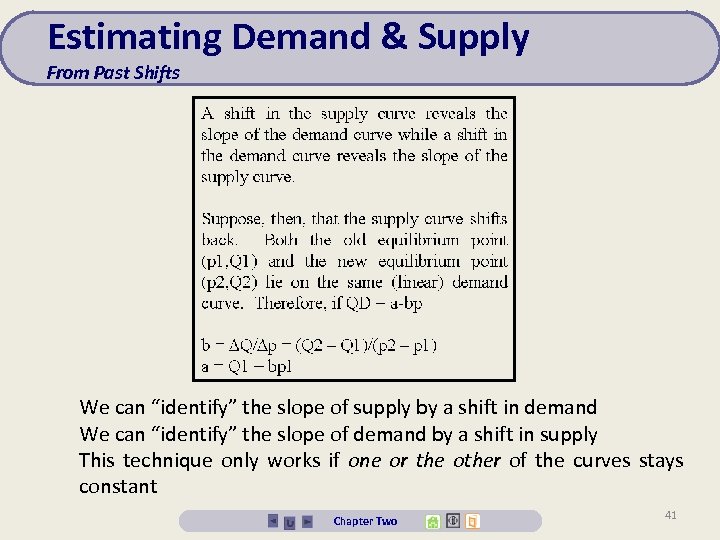 Estimating Demand & Supply From Past Shifts We can “identify” the slope of supply by a shift in demand We can “identify” the slope of demand by a shift in supply This technique only works if one or the other of the curves stays constant Chapter Two 41
 Chapter Two Main Points • Market Demand Function and Curve • Market Supply Function and Curve • Equilibrium • Measures of Elasticity • Back-of-the-Envelope Calculations Chapter Two 42