


 Скачать презентацию CHAPTER 2 DATA LINK NETWORKS The simplest network
078e7b7fec35b4f8d0fd9db100e9cd23.ppt
- Количество слайдов: 111
 CHAPTER 2 DATA LINK NETWORKS The simplest network possible is one in which all the hosts are directly connected by some physical medium. This may be a wire or a fiber, and it may cover a small area (e. g. , an office building) or a wide area (e. g. , transcontinental). Connecting two or more nodes with a suitable medium is only the first step, However. there are five additional problems that must be addressed before the nodes can successfully exchange packets. 1
 The first is encoding bits onto the wire or fiber so that they can be understood by a receiving host. Second is the matter of delineating the sequence of bits transmitted over the link into complete messages that can be delivered to the end node. This is called the framing problem. Third, because frames are sometimes corrupted during transmission, it is necessary to detect these errors and take the appropriate action; this is the error detection problem. 2
 The fourth issue is making a link appear reliable in spite of the fact that it corrupts frames from time to time. Finally, in those cases where the link is shared by multiple hosts—as opposed to a simple point-to-point link—it is necessary to mediate access to this link. This is the media access control problem. 3
 Hardware Building Blocks 1. Nodes are often general-purpose computers, like a desktop workstation, a multiprocessor, or a PC which serve as a host that users run application programs on, it might be used inside the network as a switch that forwards messages from one link to another, a network node—most commonly a switch or router inside the network, rather than a host—is implemented by special-purpose hardware. 4
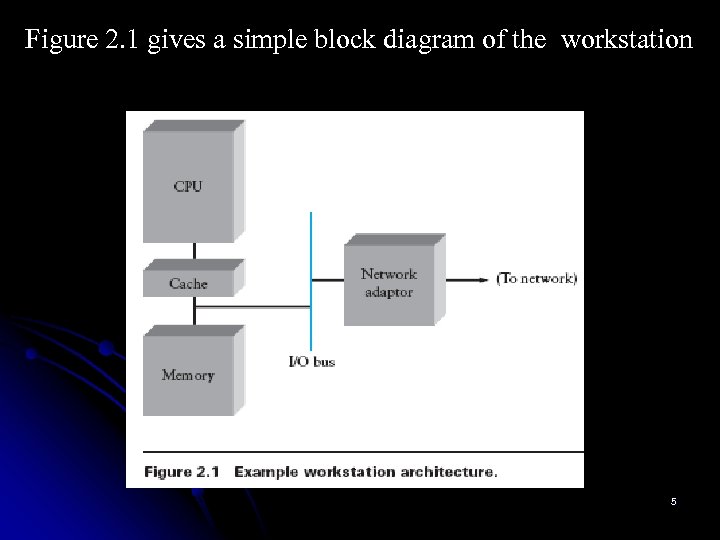 Figure 2. 1 gives a simple block diagram of the workstation 5
 There are three key features of this figure that are worth noting. First, the memory on any given machine is finite. Memory is a scarce resource because on a node that serves as a switch or router, packets must be buffered in memory while waiting their turn to be transmitted over an outgoing link. Second, each node connects to the network via a network adaptor(NIC). This adaptor generally sits on the system’s I/O bus and delivers data between the workstation’s memory and the network link. Finally, while CPUs are becoming faster at an unbelievable pace, the same is not true of memory. Recent performance trends show processor speeds doubling every 18 months, but memory latency improving at a rate of only 7%each year. 6
 Links Network links are implemented on a variety of different physical media, including twisted pair (the wire that your phone connects to), coaxial cable (the wire that your TV connects to), optical fiber (the medium most commonly used for high-bandwidth, long-distance links), and space (the stuff that radio waves, microwaves, and infrared beams propagate through). Physical medium, is used to propagate signals. These signals are actually electromagnetic waves traveling at the speed of Light. 7
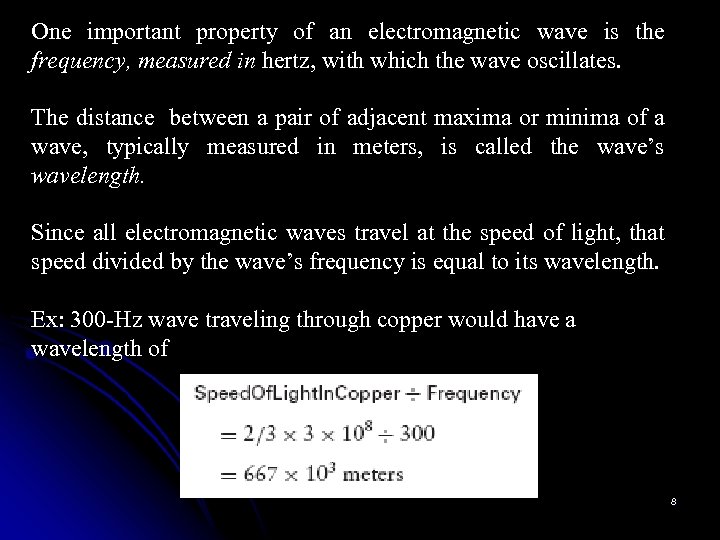 One important property of an electromagnetic wave is the frequency, measured in hertz, with which the wave oscillates. The distance between a pair of adjacent maxima or minima of a wave, typically measured in meters, is called the wave’s wavelength. Since all electromagnetic waves travel at the speed of light, that speed divided by the wave’s frequency is equal to its wavelength. Ex: 300 -Hz wave traveling through copper would have a wavelength of 8
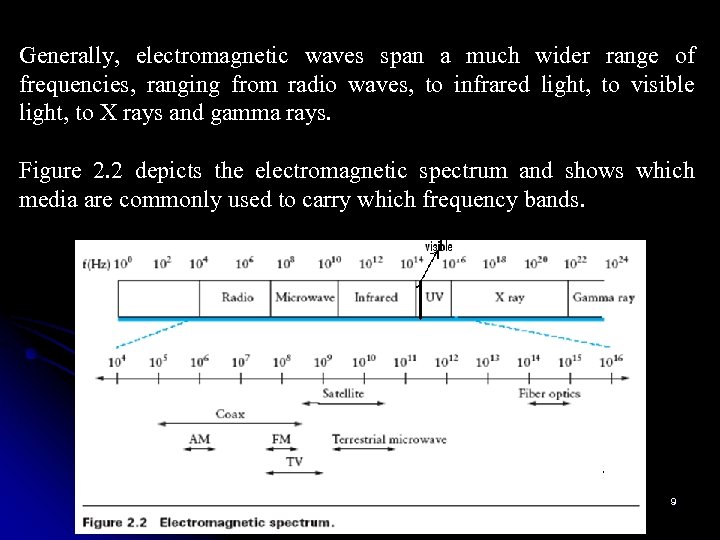 Generally, electromagnetic waves span a much wider range of frequencies, ranging from radio waves, to infrared light, to visible light, to X rays and gamma rays. Figure 2. 2 depicts the electromagnetic spectrum and shows which media are commonly used to carry which frequency bands. 9
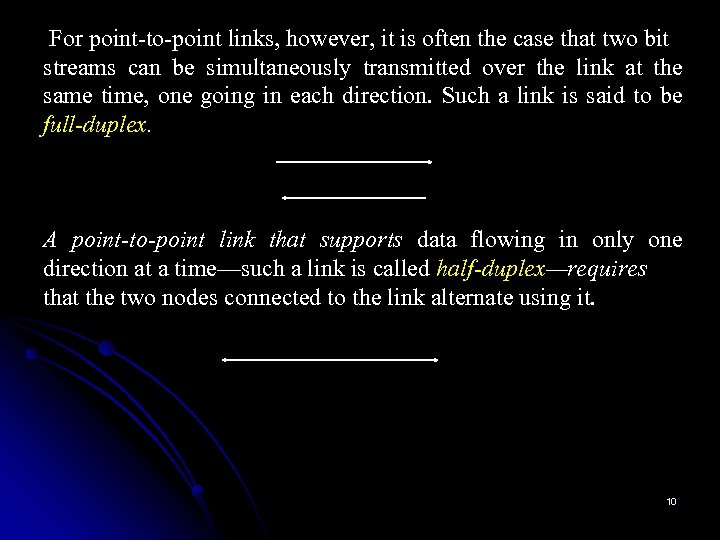 For point-to-point links, however, it is often the case that two bit streams can be simultaneously transmitted over the link at the same time, one going in each direction. Such a link is said to be full-duplex. A point-to-point link that supports data flowing in only one direction at a time—such a link is called half-duplex—requires that the two nodes connected to the link alternate using it. 10
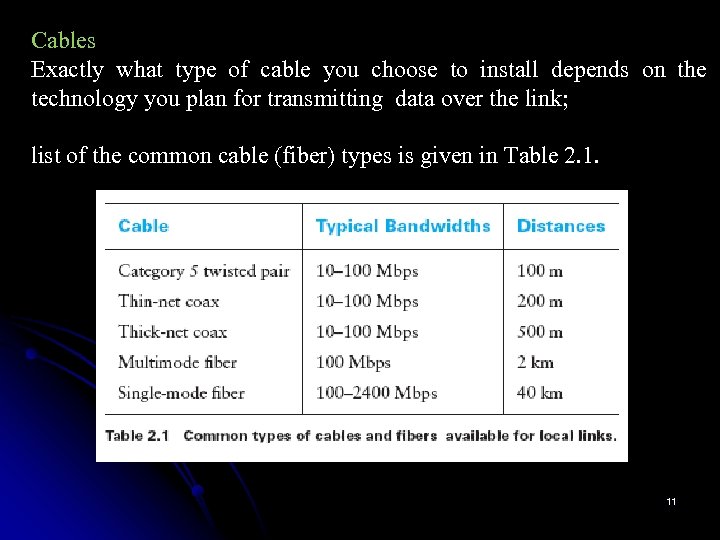 Cables Exactly what type of cable you choose to install depends on the technology you plan for transmitting data over the link; list of the common cable (fiber) types is given in Table 2. 1. 11
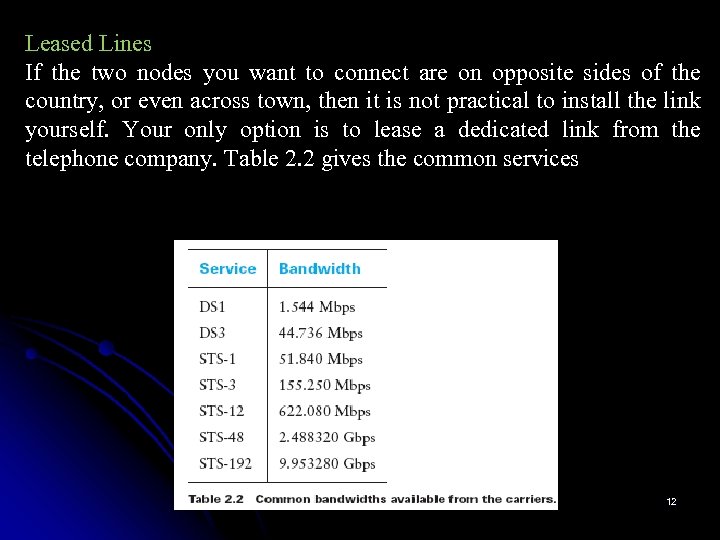 Leased Lines If the two nodes you want to connect are on opposite sides of the country, or even across town, then it is not practical to install the link yourself. Your only option is to lease a dedicated link from the telephone company. Table 2. 2 gives the common services 12
 All the STS-N links are for optical fiber (STS stands for Synchronous Transport Signal). STS-1 is the base link speed, and each STS-N has N times the bandwidth of STS-1. An STS-N link is also sometimes called an OC-N link (OC stands for optical carrier). The difference between STS and OC is subtle: The former refers to the electrical transmission on the devices connected to the link, and the latter refers to the actual optical signal that is propagated over the fiber. 13
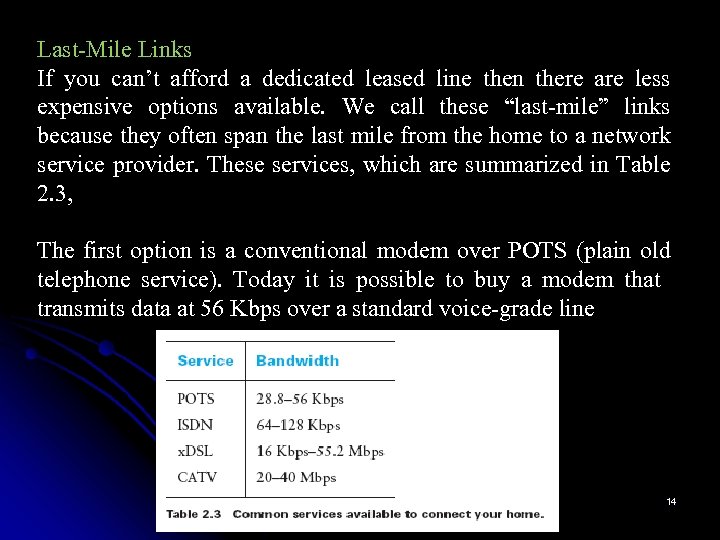 Last-Mile Links If you can’t afford a dedicated leased line then there are less expensive options available. We call these “last-mile” links because they often span the last mile from the home to a network service provider. These services, which are summarized in Table 2. 3, The first option is a conventional modem over POTS (plain old telephone service). Today it is possible to buy a modem that transmits data at 56 Kbps over a standard voice-grade line 14
 Second option: ISDN (Integrated Services Digital Network). An ISDN connection includes two 64 -Kbps channels, one that can be used to transmit data and another that can be used for digitized voice. (A device that encodes analog voice into a digital ISDN link is called a CODEC, for coder/decoder. ) When the voice channel is not in use, it can be combined with the data channel to support up to 128 Kbps of data bandwidth. x. DSL (digital subscriber line) and cable modems. are able to transmit data at high speeds over the standard twisted pair lines 15
 The one in most widespread use today is ADSL (asymmetric digital subscriber line). As its name implies, ADSL provides a different bandwidth from the subscriber to the telephone company’s central office (upstream) than it does from the central office to the subscriber (downstream). Cable modems are an alternative to the various types of DSL. As the name suggests, this technology uses the cable TV (CATV) infrastructure, which currently reaches 95% of the households 16
 Wireless Links l Wireless links transmit electromagnetic signals l l Wireless links all share the same “wire” l l l Radio, microwave, infrared The challenge is to share it efficiently without unduly interfering with each other Most of this sharing is accomplished by dividing the “wire” along the dimensions of frequency and space Exclusive use of a particular frequency in a particular geographic area may be allocated to an individual entity such as a corporation 17
 Wireless Links l These allocations are determined by government agencies such as FCC (Federal Communications Commission) in USA l Specific bands (frequency) ranges are allocated to certain uses. l l Some bands are reserved for government use Other bands are reserved for uses such as AM radio, FM radio, televisions, satellite communications, and cell phones Specific frequencies within these bands are then allocated to individual organizations for use within certain geographical areas. Finally, there are several frequency bands set aside for “license exempt” usage l Bands in which a license is not needed (Ex: Cordless phones) 18
 Wireless Links l Devices that use license-exempt frequencies are still subject to certain restrictions l The first is a limit on transmission power l This limits the range of signal, making it less likely to interfere with another signal l For example, a cordless phone might have a range of about 100 feet. 19
 Wireless Links l The second restriction requires the use of Spread Spectrum technique l Idea is to spread the signal over a wider frequency band l l l So as to minimize the impact of interference from other devices Originally designed for military use Frequency hopping l Transmitting signal over a random sequence of frequencies -First transmitting at one frequency, then a second, then a third… -The sequence of frequencies is not truly random, instead computed algorithmically by a pseudorandom number generator -The receiver uses the same algorithm as the sender, initializes it with the same seed, and is Able to hop frequencies in sync with the transmitter to correctly receive the frame 20
 Wireless Links l A second spread spectrum technique called Direct sequence l l Represents each bit in the frame by multiple bits in the transmitted signal. For each bit the sender wants to transmit l l the exclusive OR of that bit and n random bits The sequence of random bits is generated by a pseudorandom number generator known to both the sender and the receiver. 21
 Wireless Links l Wireless technologies differ in a variety of dimensions l l l How much bandwidth they provide How far apart the communication nodes can be Four prominent wireless technologies l l Bluetooth Wi-Fi (more formally known as 802. 11)(mobility) Wi. MAX (802. 16) (wireless & nomobility) 3 G cellular wireless(Mobility) 22
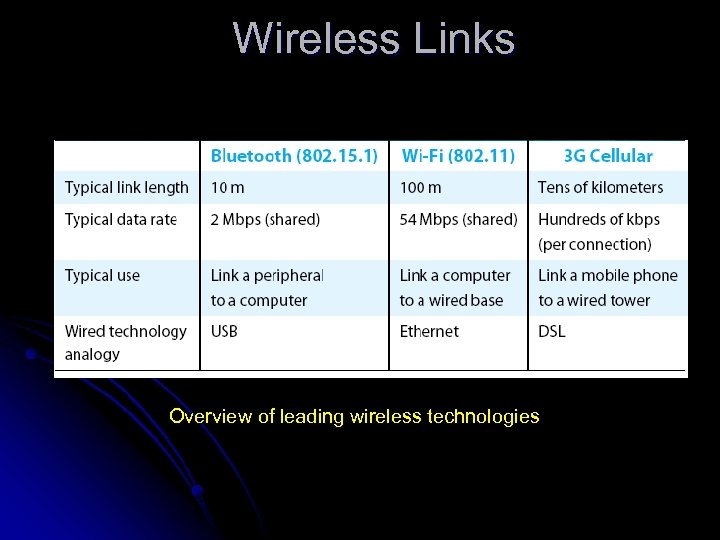 Wireless Links Overview of leading wireless technologies
 Wireless Links l Mostly widely used wireless links today are usually asymmetric l Two end-points are usually different kinds of nodes l One end-point usually has no mobility, but has wired connection to the Internet (known as base station) l The node at the other end of the link is often mobile 24
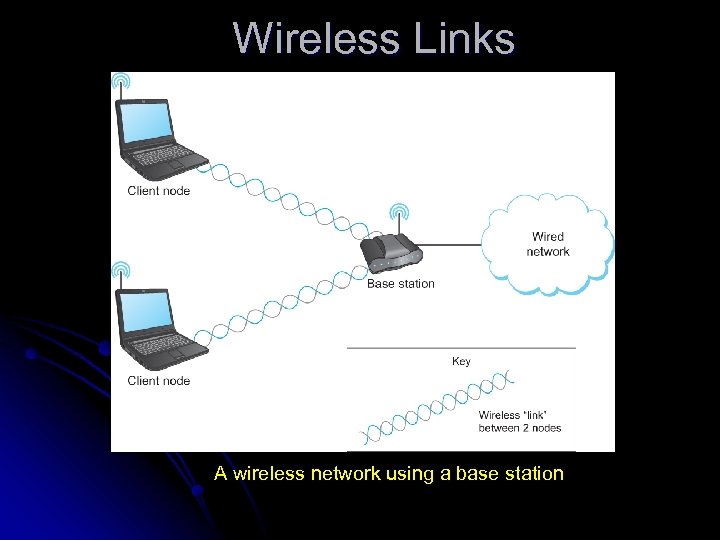 Wireless Links A wireless network using a base station
 Wireless Links l l l Wireless communication supports point-to-multipoint communication Communication between non-base (client) nodes is routed via the base station Three levels of mobility for clients l l l No mobility: the receiver must be in a fix location to receive a directional transmission from the base station (initial version of Wi. MAX) Mobility is within the range of a base (Bluetooth) Mobility between bases (Cell phones and Wi-Fi) 26
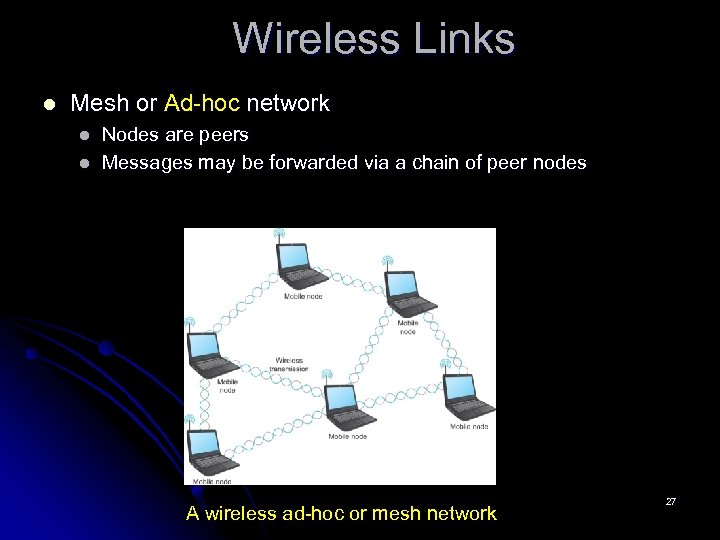 Wireless Links l Mesh or Ad-hoc network l l Nodes are peers Messages may be forwarded via a chain of peer nodes A wireless ad-hoc or mesh network 27
 Encoding (NRZ, NRZI, Manchester, 4 B/5 B) encode the binary data that the source node wants to send into the signals that the links are able to carry, and then to decode the signal back into the corresponding binary data at the receiving node. The network adaptor contains a signalling component that actually encodes bits into signals at the sending node and decodes signals into bits at the receiving node. 28
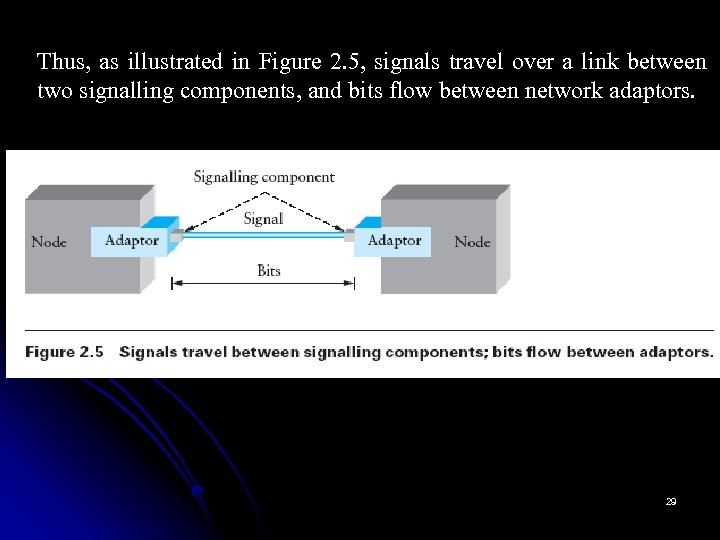 Thus, as illustrated in Figure 2. 5, signals travel over a link between two signalling components, and bits flow between network adaptors. 29
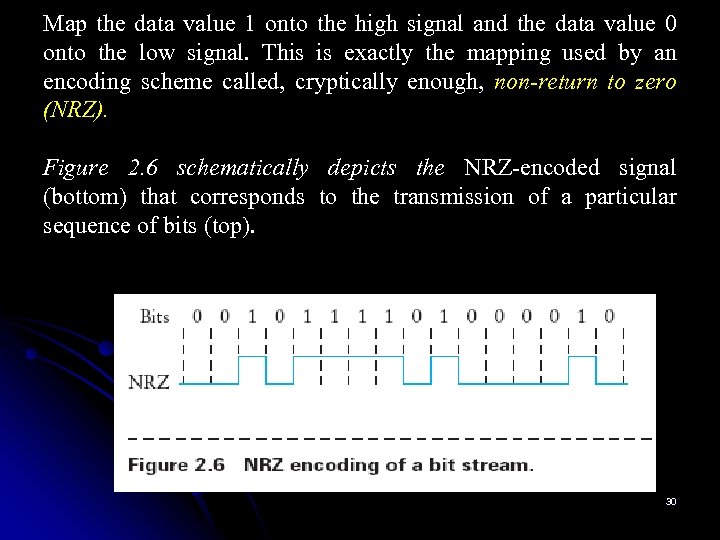 Map the data value 1 onto the high signal and the data value 0 onto the low signal. This is exactly the mapping used by an encoding scheme called, cryptically enough, non-return to zero (NRZ). Figure 2. 6 schematically depicts the NRZ-encoded signal (bottom) that corresponds to the transmission of a particular sequence of bits (top). 30
 The sender’s and the receiver’s clocks have to be precisely synchronized in order for the receiver to recover the same bits the sender transmits. If the receiver’s clock is even slightly faster or slower than the sender’s clock, then it does not correctly decode the signal. Thus, clock recovery depends on having lots of transitions in the signal, no matter what data is being sent. 31
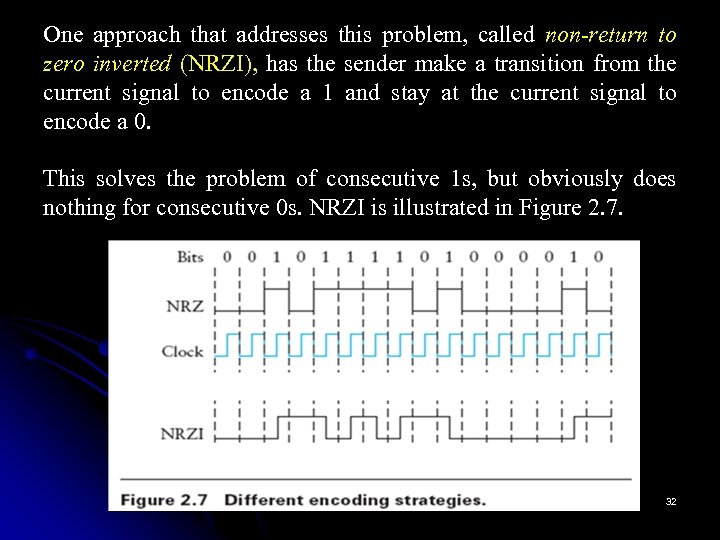 One approach that addresses this problem, called non-return to zero inverted (NRZI), has the sender make a transition from the current signal to encode a 1 and stay at the current signal to encode a 0. This solves the problem of consecutive 1 s, but obviously does nothing for consecutive 0 s. NRZI is illustrated in Figure 2. 7. 32
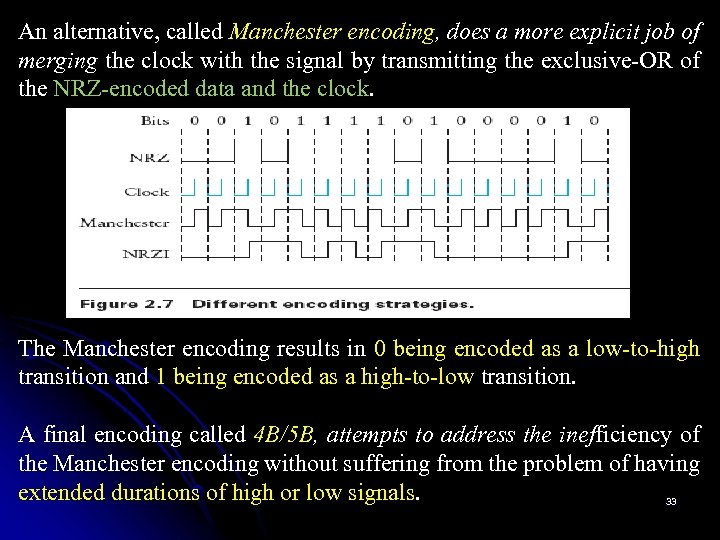 An alternative, called Manchester encoding, does a more explicit job of merging the clock with the signal by transmitting the exclusive-OR of the NRZ-encoded data and the clock. The Manchester encoding results in 0 being encoded as a low-to-high transition and 1 being encoded as a high-to-low transition. A final encoding called 4 B/5 B, attempts to address the inefficiency of the Manchester encoding without suffering from the problem of having extended durations of high or low signals. 33
 The idea of 4 B/5 B is to insert extra bits into the bit stream so as to break up long sequences of 0 s or 1 s. Specifically, every 4 bits of actual data are encoded in a 5 -bit code that is then transmitted to the receiver; hence the name 4 B/5 B. The 5 -bit codes are selected in such a way that each one has no more than one leading 0 and no more than two trailing 0 s. 34
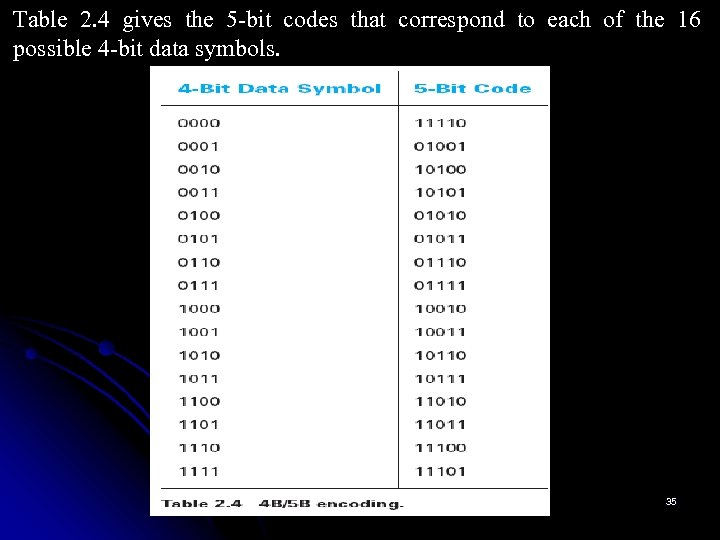 Table 2. 4 gives the 5 -bit codes that correspond to each of the 16 possible 4 -bit data symbols. 35
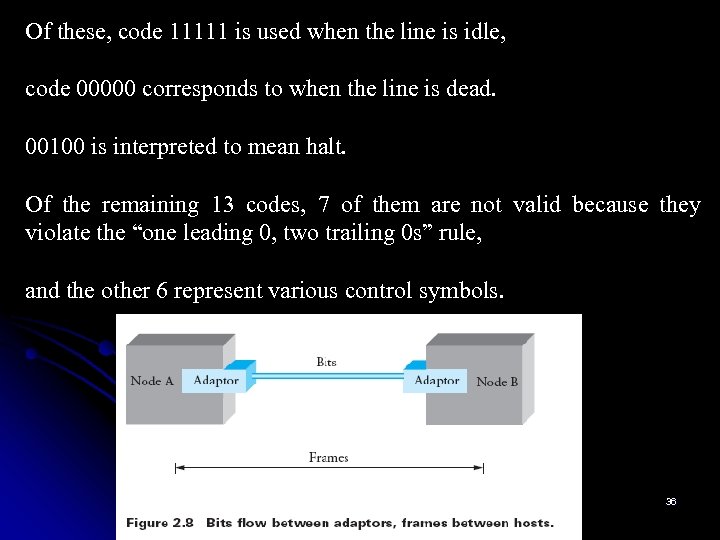 Of these, code 11111 is used when the line is idle, code 00000 corresponds to when the line is dead. 00100 is interpreted to mean halt. Of the remaining 13 codes, 7 of them are not valid because they violate the “one leading 0, two trailing 0 s” rule, and the other 6 represent various control symbols. 36
 FRAMING Blocks of data (called frames at this level), not bit streams, are exchanged between nodes. It is the network adaptor that enables the nodes to exchange frames. Recognizing exactly what set of bits constitutes a frame—that is, determining where the frame begins and ends—is the central challenge faced by the adaptor. There are several ways to address the framing problem. This section uses several different protocols to illustrate the various points in the design space. 37
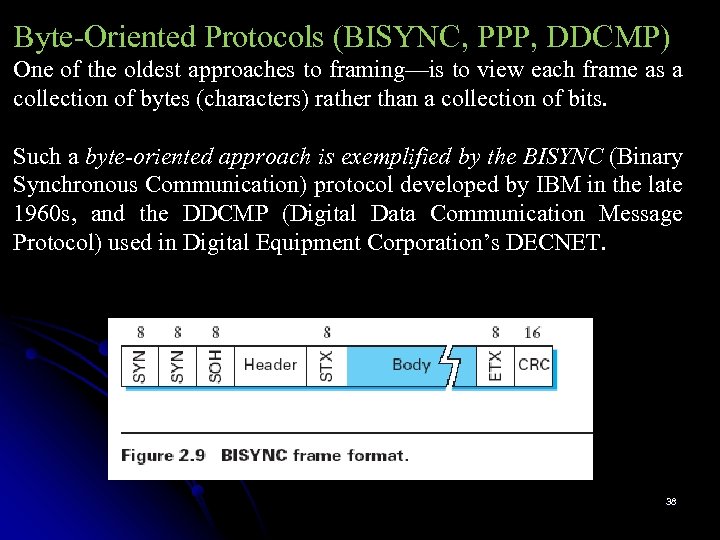 Byte-Oriented Protocols (BISYNC, PPP, DDCMP) One of the oldest approaches to framing—is to view each frame as a collection of bytes (characters) rather than a collection of bits. Such a byte-oriented approach is exemplified by the BISYNC (Binary Synchronous Communication) protocol developed by IBM in the late 1960 s, and the DDCMP (Digital Data Communication Message Protocol) used in Digital Equipment Corporation’s DECNET. 38
 The beginning of a frame is denoted by sending a special SYN (synchronization) character. The data portion of the frame is then contained between special sentinel characters: STX (start of text) and ETX (end of text). The SOH (start of header) field serves much the same purpose as the STX field. The problem with the sentinel approach is that the ETX character might appear in the data portion of the frame. BISYNC overcomes this problem by “escaping” the ETX character by preceding it with a DLE (data-link-escape) character whenever it appears in the body of a frame; the DLE character is also escaped (by preceding it with an extra DLE) in the frame body. 39
 The frame format also includes a field labeled CRC (cyclic redundancy check) that is used to detect transmission errors; various algorithms for error detection. The more recent Point-to-Point Protocol (PPP), which is commonly run over dialup modem links, is similar to BISYNC in that it uses character stuffing. 40
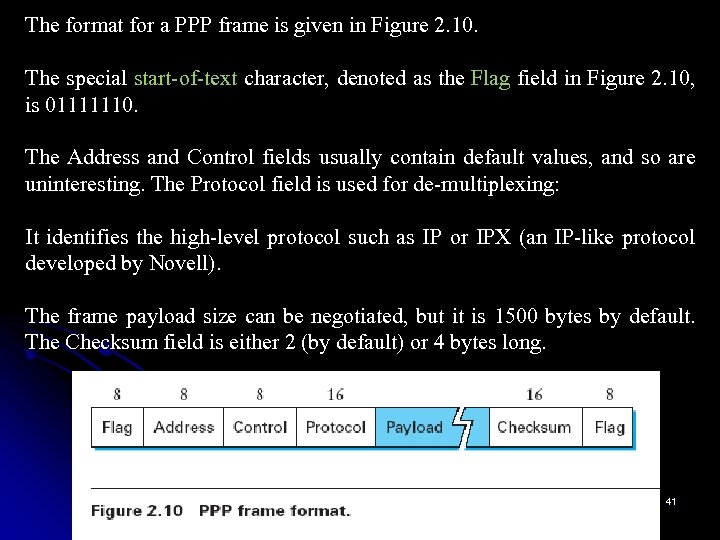 The format for a PPP frame is given in Figure 2. 10. The special start-of-text character, denoted as the Flag field in Figure 2. 10, is 01111110. The Address and Control fields usually contain default values, and so are uninteresting. The Protocol field is used for de-multiplexing: It identifies the high-level protocol such as IP or IPX (an IP-like protocol developed by Novell). The frame payload size can be negotiated, but it is 1500 bytes by default. The Checksum field is either 2 (by default) or 4 bytes long. 41
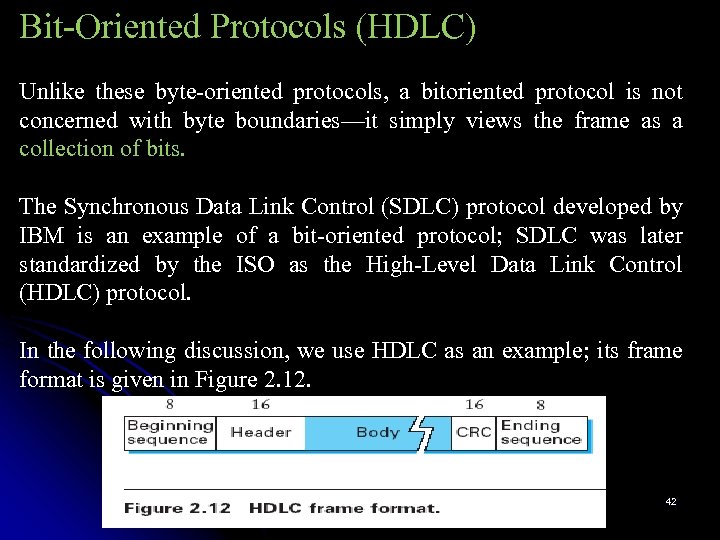 Bit-Oriented Protocols (HDLC) Unlike these byte-oriented protocols, a bitoriented protocol is not concerned with byte boundaries—it simply views the frame as a collection of bits. The Synchronous Data Link Control (SDLC) protocol developed by IBM is an example of a bit-oriented protocol; SDLC was later standardized by the ISO as the High-Level Data Link Control (HDLC) protocol. In the following discussion, we use HDLC as an example; its frame format is given in Figure 2. 12. 42
 HDLC denotes both the beginning and the end of a frame with the distinguished bit sequence 01111110. This sequence is also transmitted during any times that the link is idle so that the sender and receiver can keep their clocks synchronized. In this way, both protocols essentially use the sentinel approach. Because this sequence might appear anywhere in the body of the frame—in fact, the bits 01111110 might cross byte boundaries—bitoriented protocols use the analog of the DLE character, a technique known as bit stuffing. 43
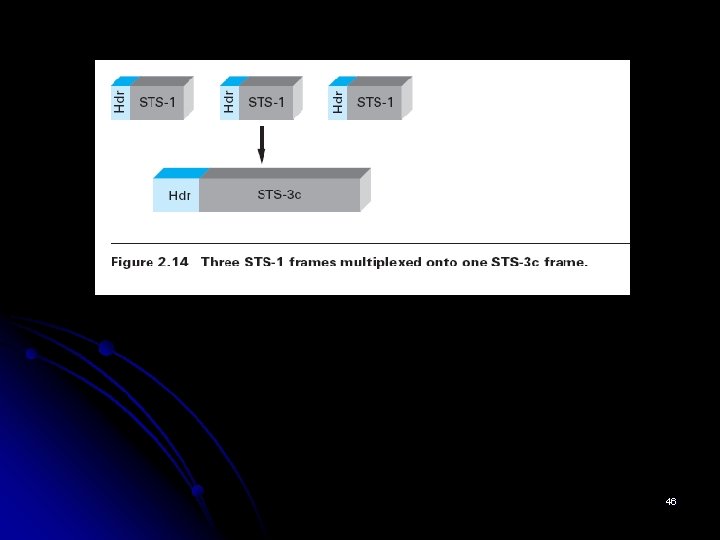
 Clock-Based Framing (SONET) A third approach to framing is Synchronous Optical Network (SONET) standard. This approach simply as clock-based framing. SONET is that it is the dominant standard for long-distance transmission of data over optical networks. SONET addresses both the framing problem and the encoding problem. It also addresses a problem that is very important for phone companies—the multiplexing of several low-speed links onto one high-speed link. lowest-speed SONET link, which is known as STS-1 and runs at 51. 84 Mbps. An STS-1 frame is shown in Figure 2. 13. It is arranged as nine rows of 90 bytes each, and the first 3 bytes of each row are overhead, with the rest being available for data that is being 44 transmitted over the link.
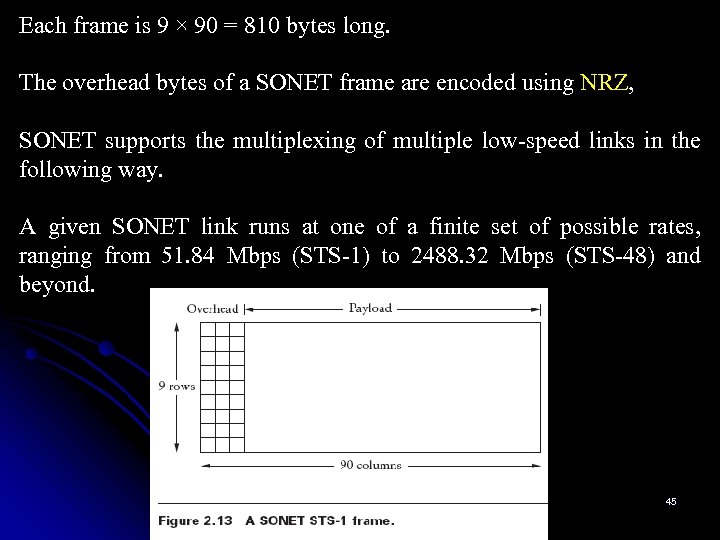 Each frame is 9 × 90 = 810 bytes long. The overhead bytes of a SONET frame are encoded using NRZ, SONET supports the multiplexing of multiple low-speed links in the following way. A given SONET link runs at one of a finite set of possible rates, ranging from 51. 84 Mbps (STS-1) to 2488. 32 Mbps (STS-48) and beyond. 45
 46
46
 Error Detection Bit errors are sometimes introduced into frames. This happens, for example, because of electrical interference or thermal noise. Although errors are rare, especially on optical links, some mechanism is needed to detect these errors so that corrective action can be taken. Detecting errors is only one part of the problem. The other part is correcting errors once detected. There are two basic approaches that can be taken when the recipient of a message detects an error. One is to notify the sender that the message was corrupted so that the sender can retransmit a 47 copy of the message.
 Alternatively, there are some types of error detection algorithms that allow the recipient to reconstruct the correct message even after it has been corrupted; such algorithms rely on error-correcting codes One of the most common techniques for detecting transmission errors is a technique known as the cyclic redundancy check (CRC). It is used in nearly all the link-level protocols discussed in the previous section—for example, HDLC, DDCMP—as well as in the CSMA and token ring protocols. The basic idea behind any error detection scheme is to add redundant information to a frame that can be used to determine if errors have been introduced. 48
 In general, we can provide quite strong error detection capability while sending only k redundant bits for an n-bit message, where k ≪ n. for example, a frame carrying up to 12, 000 bits (1500 bytes) of data requires only a 32 -bit CRC code, or as it is commonly expressed, as CRC-32. Such a code will catch the overwhelming majority of errors, We say that the extra bits we send are redundant because they add no new information to the message. Instead, they are derived directly from the original message using some well-defined algorithm. Both the sender and the receiver know exactly what that algorithm is. 49
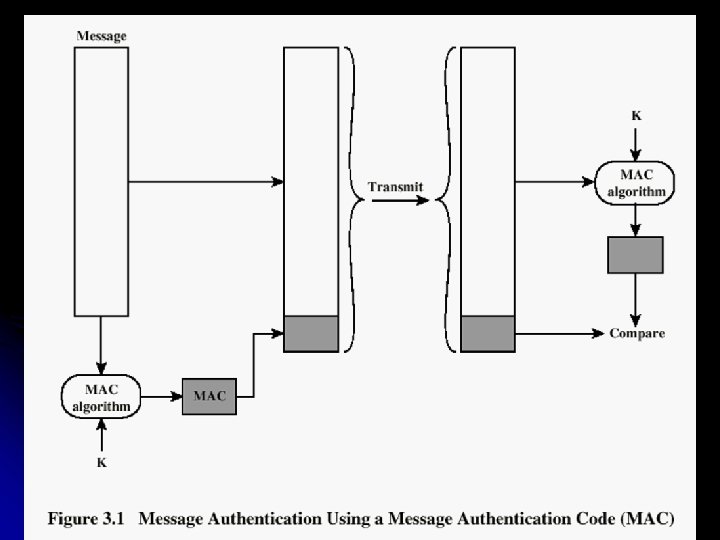
 The sender applies the algorithm to the message to generate the redundant bits. It then transmits both the message and those few extra bits. When the receiver applies the same algorithm to the received message, it should (in the absence of errors) come up with the same result as the sender. It compares the result with the one sent to it by the sender. If they match, it can conclude (with high likelihood) that no errors were introduced in the message during transmission. If they do not match, it can be sure that either the message or the redundant bits were corrupted, and it must take appropriate action, that is, discarding the message, or correcting it if that is possible. 50
 18/03/2018 51 Dr. Ajit Danti
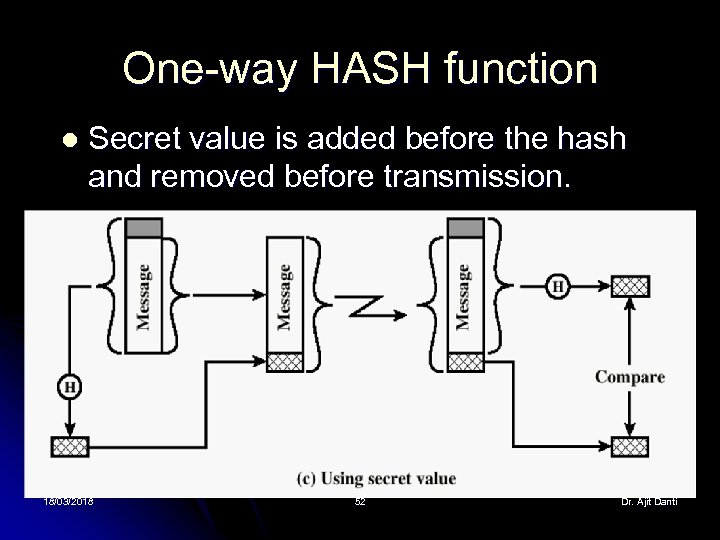 One-way HASH function l Secret value is added before the hash and removed before transmission. 18/03/2018 52 Dr. Ajit Danti
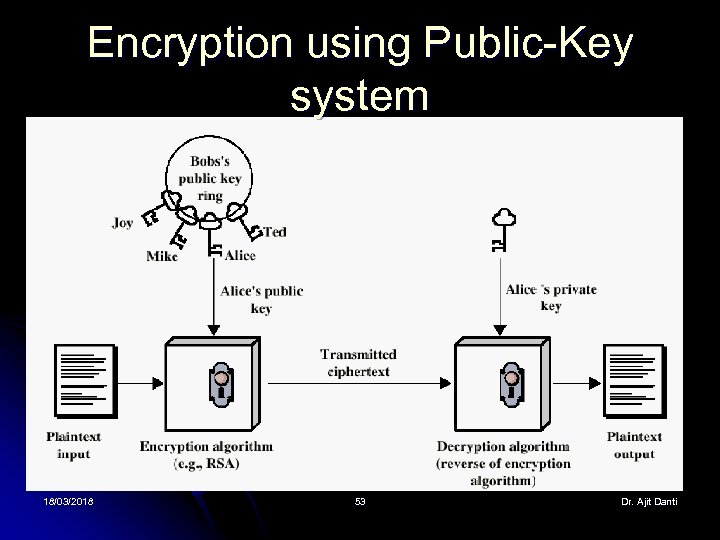 Encryption using Public-Key system 18/03/2018 53 Dr. Ajit Danti
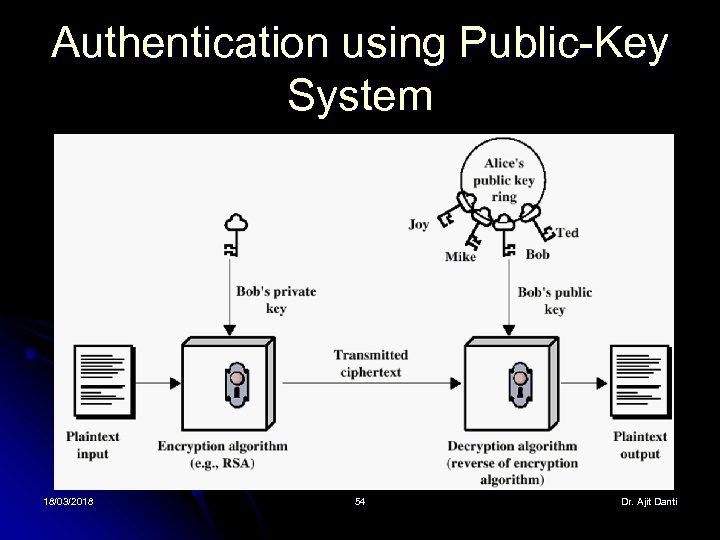 Authentication using Public-Key System 18/03/2018 54 Dr. Ajit Danti
 These extra bits. In general, they are referred to as error-detecting codes. In specific cases, when the algorithm to create the code is based on addition, they may be called a checksum It is an error check that uses a summing algorithm. 55
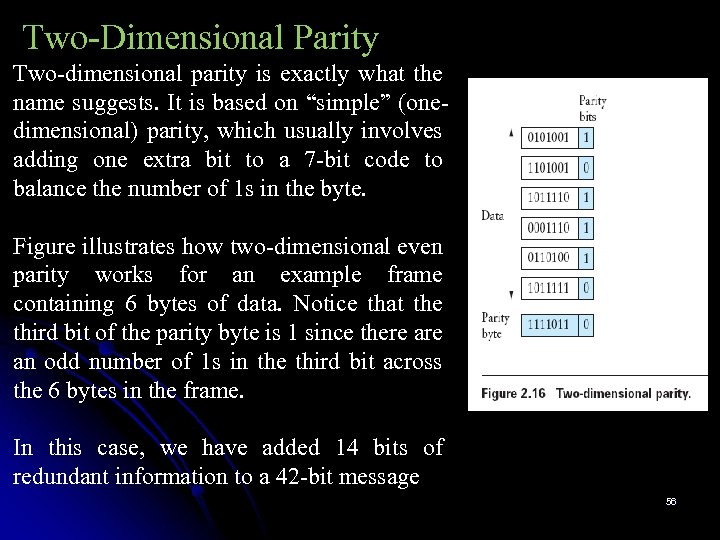 Two-Dimensional Parity Two-dimensional parity is exactly what the name suggests. It is based on “simple” (onedimensional) parity, which usually involves adding one extra bit to a 7 -bit code to balance the number of 1 s in the byte. Figure illustrates how two-dimensional even parity works for an example frame containing 6 bytes of data. Notice that the third bit of the parity byte is 1 since there an odd number of 1 s in the third bit across the 6 bytes in the frame. In this case, we have added 14 bits of redundant information to a 42 -bit message 56
 Internet Checksum Algorithm A second approach to error detection is exemplified by the Internet checksum. The idea behind the Internet checksum is very simple—you add up all the words that are transmitted and then transmit the result of that sum. The result is called the checksum. The receiver performs the same calculation on the received data and compares the result with the received checksum. If any transmitted data, including the checksum itself, is corrupted, then the results will not match, so the receiver knows that an error occurred. 57
 In ones complement arithmetic, a negative integer −x is represented as the complement of x; that is, each bit of x is inverted. When adding numbers in ones complement arithmetic, a carryout from the most significant bit needs to be added to the result. Consider, for example, the addition of − 5 and − 3 in ones complement arithmetic on 4 -bit integers. +5 is 0101, so − 5 is 1010; +3 is 0011, so − 3 is 1100. If we add 1010 and 1100 ignoring the carry, we get 0110. In ones complement arithmetic, the fact that this operation caused a carry from the most significant bit causes us to increment the result, giving 0111, which is the ones complement representation of − 8 (obtained by inverting the bits in 1000), as we would expect. 58
 Cyclic Redundancy Check It should be clear by now that a major goal in designing error detection algorithms is to maximize the probability of detecting errors using only a small number of redundant bits. a 32 -bit CRC gives strong protection against common bit errors in messages that are thousands of bytes long. To start, think of an (n+1)-bit message as being represented by a polynomial of degree n, that is, a polynomial whose highest-order term is xn. 59
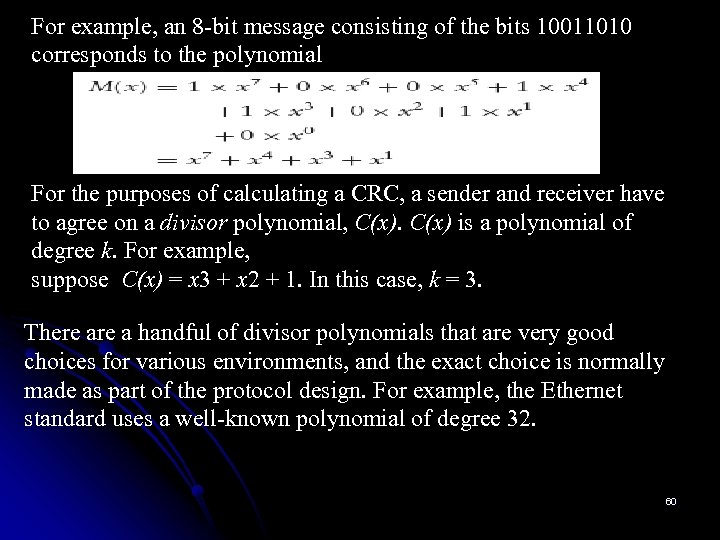 For example, an 8 -bit message consisting of the bits 10011010 corresponds to the polynomial For the purposes of calculating a CRC, a sender and receiver have to agree on a divisor polynomial, C(x) is a polynomial of degree k. For example, suppose C(x) = x 3 + x 2 + 1. In this case, k = 3. There a handful of divisor polynomials that are very good choices for various environments, and the exact choice is normally made as part of the protocol design. For example, the Ethernet standard uses a well-known polynomial of degree 32. 60
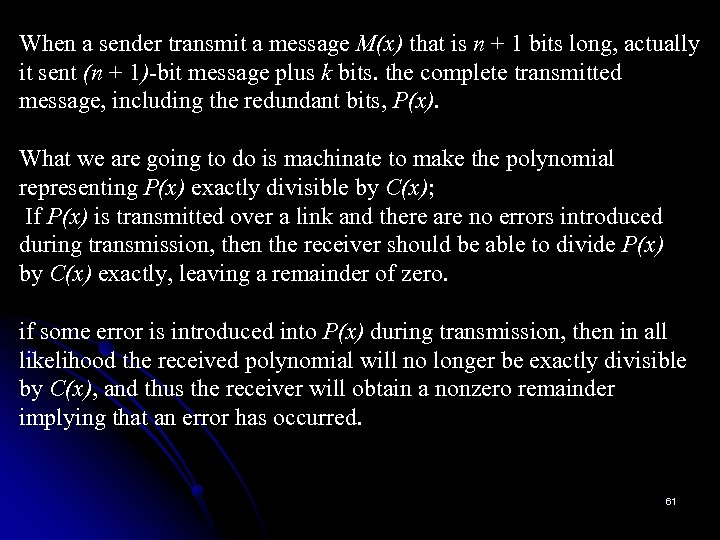 When a sender transmit a message M(x) that is n + 1 bits long, actually it sent (n + 1)-bit message plus k bits. the complete transmitted message, including the redundant bits, P(x). What we are going to do is machinate to make the polynomial representing P(x) exactly divisible by C(x); If P(x) is transmitted over a link and there are no errors introduced during transmission, then the receiver should be able to divide P(x) by C(x) exactly, leaving a remainder of zero. if some error is introduced into P(x) during transmission, then in all likelihood the received polynomial will no longer be exactly divisible by C(x), and thus the receiver will obtain a nonzero remainder implying that an error has occurred. 61
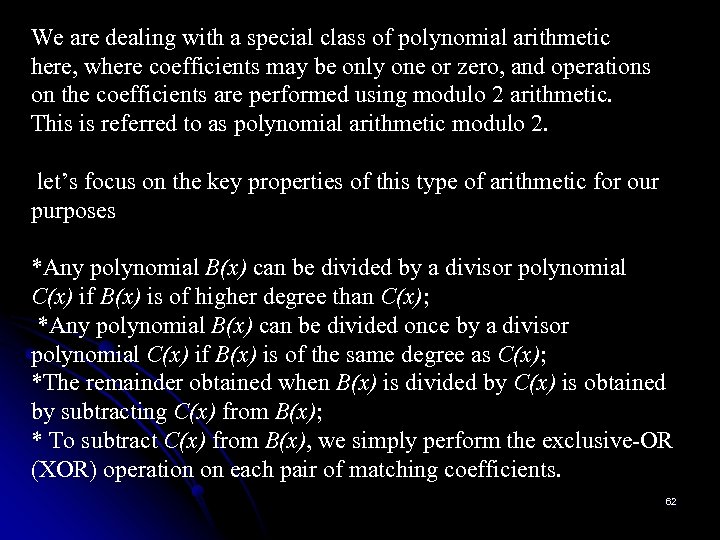 We are dealing with a special class of polynomial arithmetic here, where coefficients may be only one or zero, and operations on the coefficients are performed using modulo 2 arithmetic. This is referred to as polynomial arithmetic modulo 2. let’s focus on the key properties of this type of arithmetic for our purposes *Any polynomial B(x) can be divided by a divisor polynomial C(x) if B(x) is of higher degree than C(x); *Any polynomial B(x) can be divided once by a divisor polynomial C(x) if B(x) is of the same degree as C(x); *The remainder obtained when B(x) is divided by C(x) is obtained by subtracting C(x) from B(x); * To subtract C(x) from B(x), we simply perform the exclusive-OR (XOR) operation on each pair of matching coefficients. 62
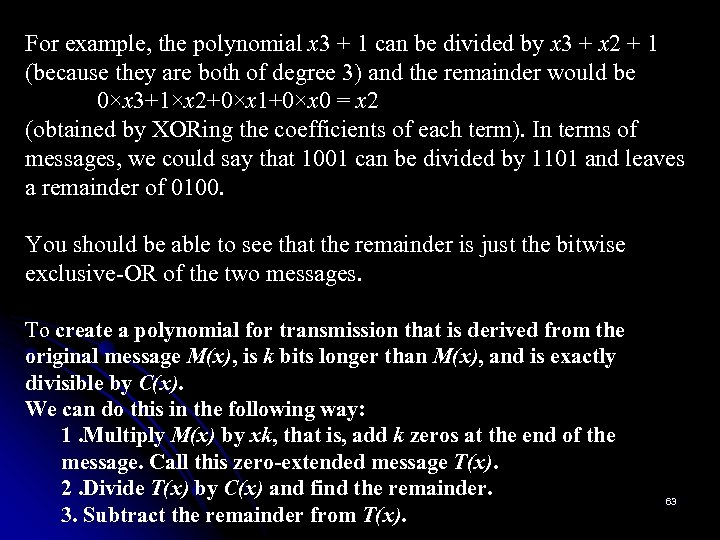 For example, the polynomial x 3 + 1 can be divided by x 3 + x 2 + 1 (because they are both of degree 3) and the remainder would be 0×x 3+1×x 2+0×x 1+0×x 0 = x 2 (obtained by XORing the coefficients of each term). In terms of messages, we could say that 1001 can be divided by 1101 and leaves a remainder of 0100. You should be able to see that the remainder is just the bitwise exclusive-OR of the two messages. To create a polynomial for transmission that is derived from the original message M(x), is k bits longer than M(x), and is exactly divisible by C(x). We can do this in the following way: 1. Multiply M(x) by xk, that is, add k zeros at the end of the message. Call this zero-extended message T(x). 2. Divide T(x) by C(x) and find the remainder. 3. Subtract the remainder from T(x). 63
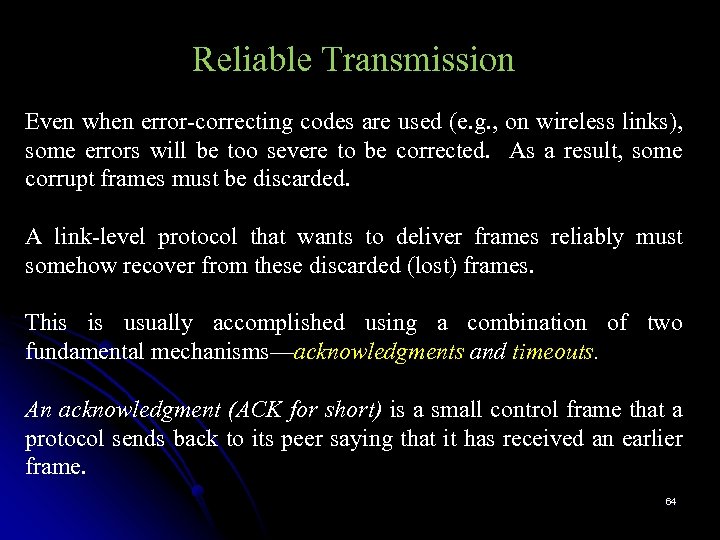 Reliable Transmission Even when error-correcting codes are used (e. g. , on wireless links), some errors will be too severe to be corrected. As a result, some corrupt frames must be discarded. A link-level protocol that wants to deliver frames reliably must somehow recover from these discarded (lost) frames. This is usually accomplished using a combination of two fundamental mechanisms—acknowledgments and timeouts. An acknowledgment (ACK for short) is a small control frame that a protocol sends back to its peer saying that it has received an earlier frame. 64
 By control frame (header) without any data, although a protocol can piggyback an ACK on a data frame it just happens to be sending in the opposite direction. The receipt of an acknowledgment indicates to the sender of the original frame that its frame was successfully delivered. If the sender does not receive an acknowledgment after a reasonable amount of time, then it retransmits the original frame. This action of waiting a reasonable amount of time is called a timeout. The general strategy of using acknowledgments and timeouts to implement reliable delivery is sometimes called automatic repeat request (abbreviated as ARQ). This section describes three different ARQ algorithms using generic language; 65 65
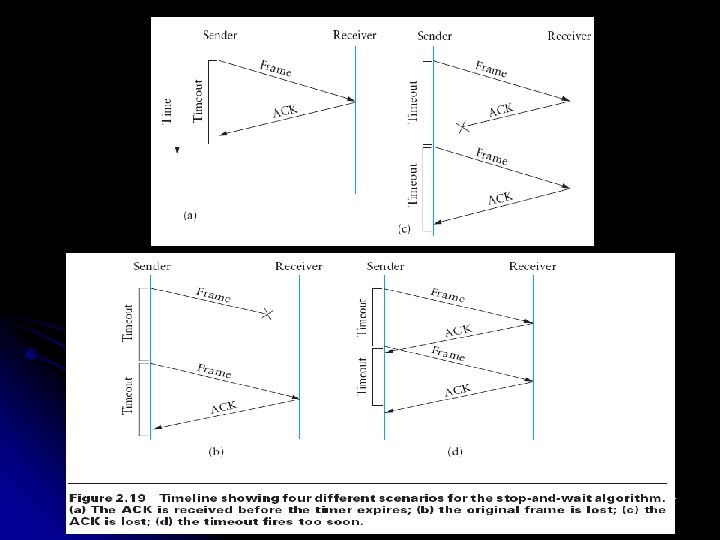
 Stop-and-Wait The simplest ARQ scheme is the stop-and- wait algorithm. The idea of stop-and-wait is straightforward: After transmitting one frame, the sender waits for an acknowledgment before transmitting the next frame. If the acknowledgment does not arrive after a certain period of time, the sender times out and retransmits the original frame. Figure 2. 19 illustrates four different scenarios that result from this basic algorithm. 66
 67
67
 Figure 2. 19(a) shows the situation in which the ACK is received before the timer expires, (b) and (c) show the situation in which the original frame and the ACK, respectively, are lost, and (d) shows the situation in which the timeout fires too soon. Recall that by “lost” we mean that the frame was corrupted while in transit, that this corruption was detected by an error code on the receiver, and that the frame was subsequently discarded. (c) and (d) of Figure 2. 19. In both cases, the sender times out and retransmits the original frame, but the receiver will think that it is the next frame, since it correctly received and acknowledged the first frame. This has the potential to cause duplicate copies of a frame to be delivered. 68
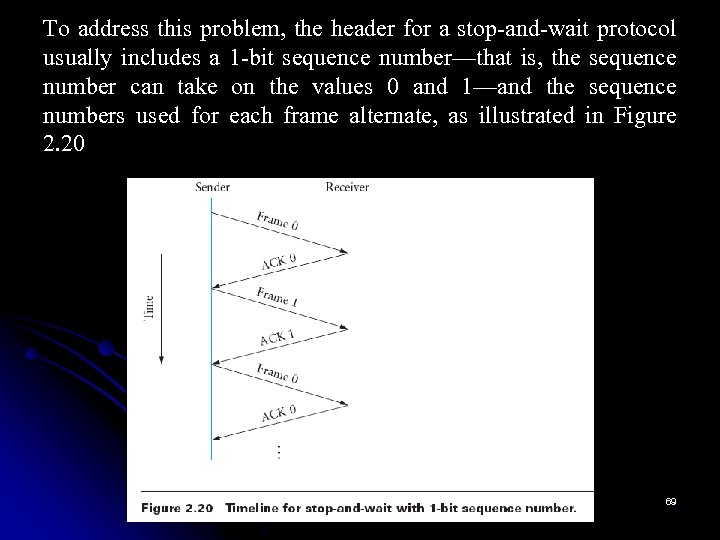 To address this problem, the header for a stop-and-wait protocol usually includes a 1 -bit sequence number—that is, the sequence number can take on the values 0 and 1—and the sequence numbers used for each frame alternate, as illustrated in Figure 2. 20 69
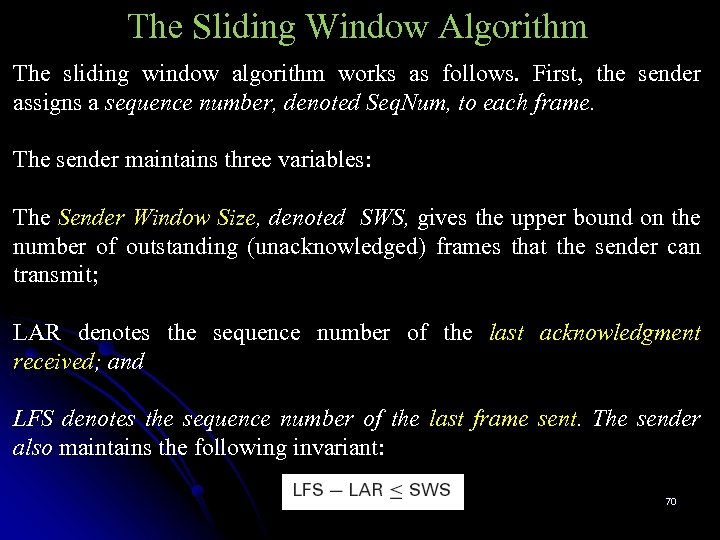 The Sliding Window Algorithm The sliding window algorithm works as follows. First, the sender assigns a sequence number, denoted Seq. Num, to each frame. The sender maintains three variables: The Sender Window Size, denoted SWS, gives the upper bound on the number of outstanding (unacknowledged) frames that the sender can transmit; LAR denotes the sequence number of the last acknowledgment received; and LFS denotes the sequence number of the last frame sent. The sender also maintains the following invariant: 70
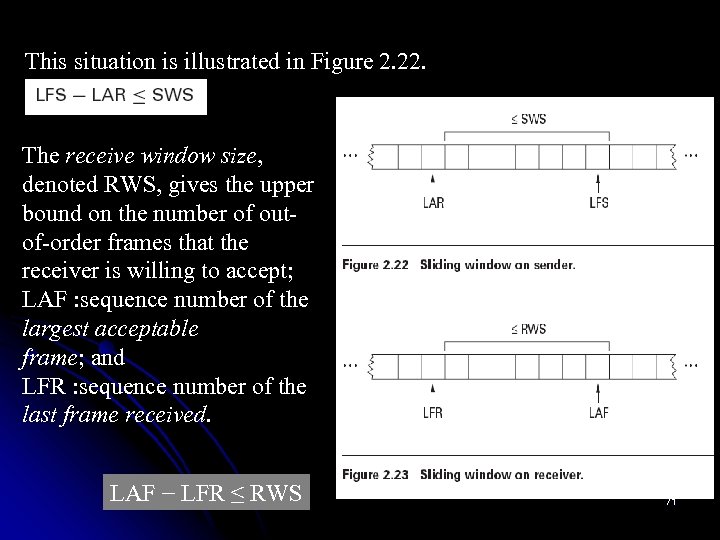 This situation is illustrated in Figure 2. 22. The receive window size, denoted RWS, gives the upper bound on the number of outof-order frames that the receiver is willing to accept; LAF : sequence number of the largest acceptable frame; and LFR : sequence number of the last frame received. LAF − LFR ≤ RWS 71
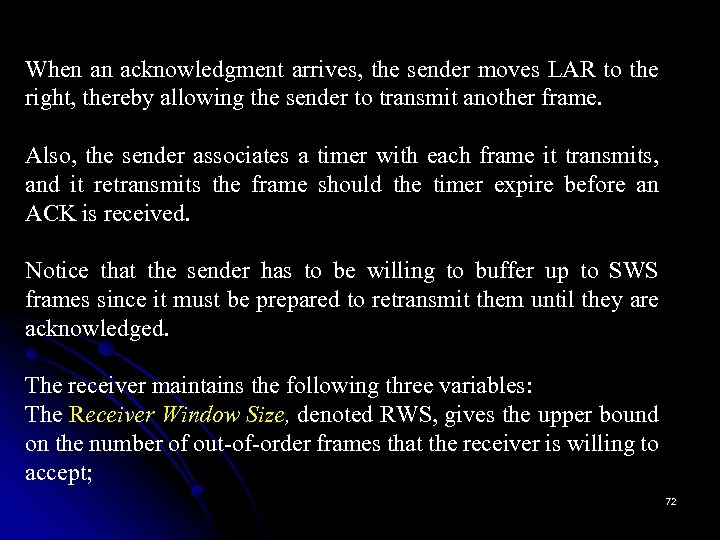 When an acknowledgment arrives, the sender moves LAR to the right, thereby allowing the sender to transmit another frame. Also, the sender associates a timer with each frame it transmits, and it retransmits the frame should the timer expire before an ACK is received. Notice that the sender has to be willing to buffer up to SWS frames since it must be prepared to retransmit them until they are acknowledged. The receiver maintains the following three variables: The Receiver Window Size, denoted RWS, gives the upper bound on the number of out-of-order frames that the receiver is willing to accept; 72
 LAF denotes the sequence number of the largest acceptable frame; and LFR denotes the sequence number of the last frame received. The receiver also maintains the following invariant: LAF − LFR ≤ RWS This situation is illustrated in Figure 2. 23. When a frame with sequence number Seq. Num arrives, the receiver takes the following action. If Seq. Num ≤ LFR or Seq. Num > LAF, then the frame is outside the receiver’s window and it is discarded. If LFR < Seq. Num ≤ LAF, then the frame is within the receiver’s window and it is accepted. Now the receiver needs to decide whether or not to send an ACK. 73
 Let Seq. Num. To. Ack denote the largest sequence number not yet acknowledged, such that all frames with sequence numbers less than or equal to Seq. Num. To. Ack have been received. The receiver acknowledges the receipt of Seq. Num. To. Ack, even if higher-numbered packets have been received. This acknowledgment is said to be cumulative. It then sets LFR = Seq. Num. To. Ack and adjusts LAF = LFR + RWS. 74
 Ethernet (802. 3) Ethernet is a working example of the more general Carrier Sense Multiple Access with Collision Detect (CSMA/CD) local area network technology. the Ethernet is a multiple-access network, meaning that a set of nodes send and receive frames over a shared link. You can, therefore, think of an Ethernet as being like a bus that has multiple stations plugged into it. 75
 The “carrier sense” in CSMA/CD means that all the nodes can distinguish between an idle and a busy link, and “collision detect” means that a node listens as it transmits and can therefore detect when a frame it is transmitting has interfered (collided) with a frame transmitted by another node. Digital Equipment Corporation and Intel Corporation joined Xerox to define a 10 -Mbps Ethernet standard in 1978. This standard then formed the basis for IEEE standard 802. 3. a 100 -Mbps version called Fast Ethernet and a 1000 -Mbps version called Gigabit Ethernet. 76
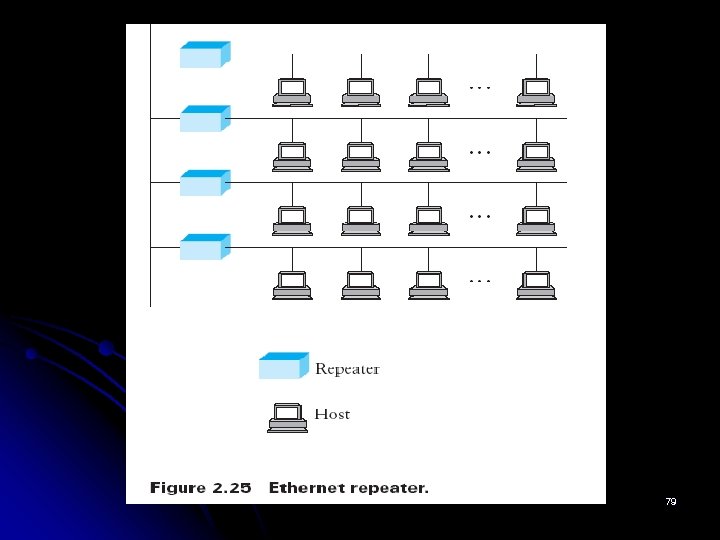
 Physical Properties Hosts connect to an Ethernet segment by tapping into it; taps must be at least 2. 5 m apart. A transceiver—a small device directly attached to the tap—detects when the line is idle and drives the signal when the host is transmitting. It also receives incoming signals. The transceiver is, in turn, connected to an Ethernet adaptor, which is plugged into the host. Multiple Ethernet segments can be joined together by repeaters. A repeater is a device that forwards digital signals, much like an amplifier forwards analog signals. 77
 However, no more than four repeaters may be positioned between any pair of hosts, meaning that an Ethernet has a total reach of only 2500 m. an Ethernet is limited to supporting a maximum of 1024 hosts. Any signal placed on the Ethernet by a host is broadcast over the entire network; that is, the signal is propagated in both directions, and repeaters forward the signal on all outgoing segments. Terminators attached to the end of each segment absorb the signal and keep it from bouncing back and interfering with trailing signals. 78
 79
79
 Access Protocol An algorithm that controls access to the shared Ethernet link. This algorithm is commonly called the Ethernet’s media access control (MAC). It is typically implemented in hardware on the network adaptor. Frame Format Each Ethernet frame is defined by the format given in Figure 2. 27. The 64 -bit preamble allows the receiver to synchronize with the signal; it is a sequence of alternating 0 s and 1 s. Both the source and destination hosts are identified with a 48 -bit 80 address.
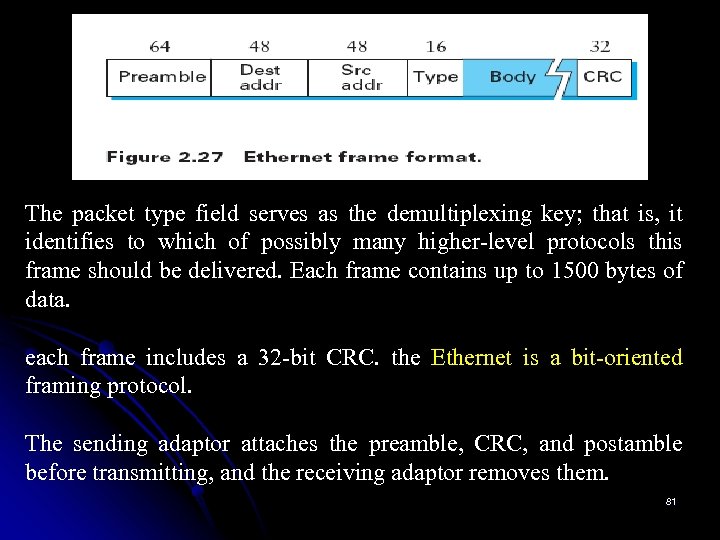 The packet type field serves as the demultiplexing key; that is, it identifies to which of possibly many higher-level protocols this frame should be delivered. Each frame contains up to 1500 bytes of data. each frame includes a 32 -bit CRC. the Ethernet is a bit-oriented framing protocol. The sending adaptor attaches the preamble, CRC, and postamble before transmitting, and the receiving adaptor removes them. 81
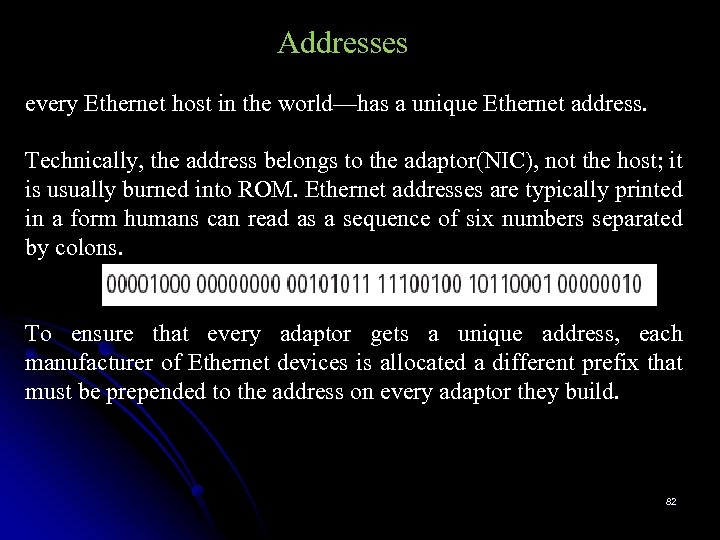 Addresses every Ethernet host in the world—has a unique Ethernet address. Technically, the address belongs to the adaptor(NIC), not the host; it is usually burned into ROM. Ethernet addresses are typically printed in a form humans can read as a sequence of six numbers separated by colons. To ensure that every adaptor gets a unique address, each manufacturer of Ethernet devices is allocated a different prefix that must be prepended to the address on every adaptor they build. 82
 Each frame transmitted on an Ethernet is received by every adaptor connected to that Ethernet. Each adaptor recognizes those frames addressed to its address and passes only those frames on to the host. To summarize, an Ethernet adaptor receives all frames but accepts ■ frames addressed to its own address ■ frames addressed to the broadcast address ■ frames addressed to a multicast address, if it has been instructed to listen to that address ■ all frames, if it has been placed in promiscuous mode It passes to the host only the frames that it accepts. 83
 Transmitter Algorithms The transmitter algorithm is defined as follows. When the adaptor has a frame to send and the line is idle, it transmits the frame immediately; there is no negotiation with the other adaptors. When an adaptor has a frame to send and the line is busy, it waits for the line to go idle and then transmits immediately. The Ethernet is said to be a 1 -persistent protocol because an adaptor with a frame to send transmits with probability 1 whenever a busy line goes idle. In general, a p-persistent (At wish) algorithm transmits with probability 0≤p≤ 1 after a line becomes idle, and defers with probability q = 1− p 84
 To complete the story about p-persistent protocols for the case when p < 1, you might wonder how long a sender that loses the coin flip (i. e. , decides to defer) has to wait before it can transmit. Whenever a node has a frame to send and it senses an empty (idle) slot, it transmits with probability p and defers until the next slot with probability q = 1− p. If that next slot is also empty, the node again decides to transmit or defer, with probabilities p and q, respectively. If that next slot is not empty—that is, some other station has decided to transmit—then the node simply waits for the next idle slot and the algorithm repeats. 85
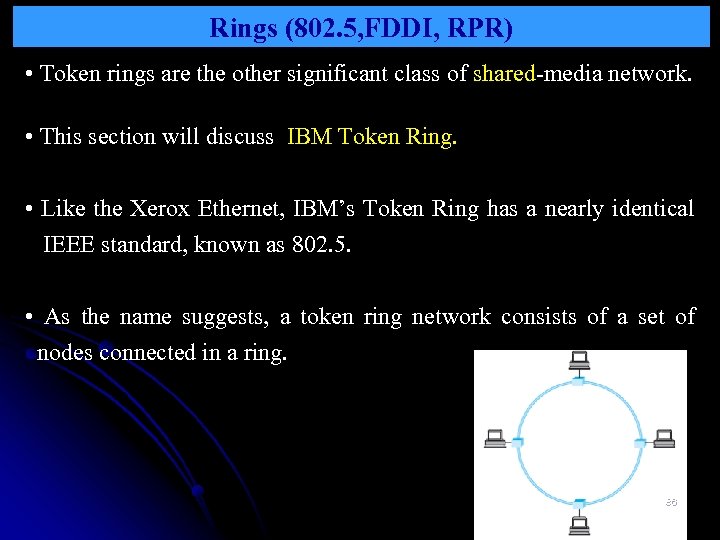 Rings (802. 5, FDDI, RPR) • Token rings are the other significant class of shared-media network. • This section will discuss IBM Token Ring. • Like the Xerox Ethernet, IBM’s Token Ring has a nearly identical IEEE standard, known as 802. 5. • As the name suggests, a token ring network consists of a set of nodes connected in a ring. 86
 • Data always flows in a particular direction around the ring, where each node receives frames from its upstream neighbor and then forwards them to its downstream neighbor. This ring-based topology is in contrast to the Ethernet’s bus topology. Like the Ethernet, however, the ring is viewed as a single shared medium; 87
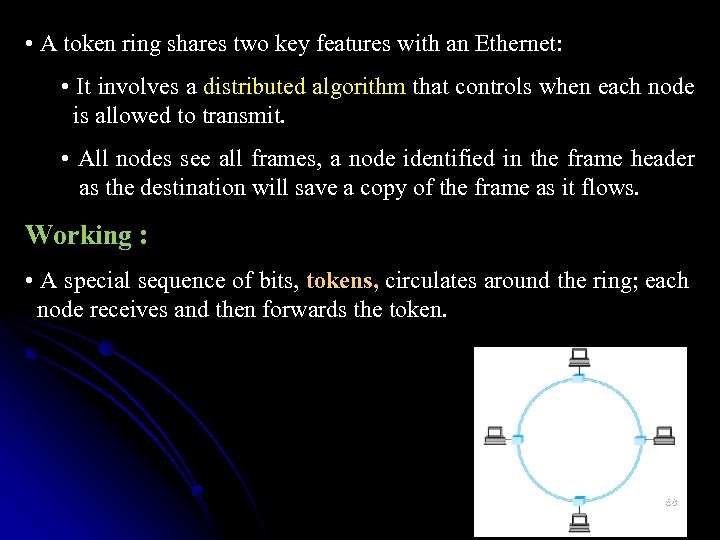 • A token ring shares two key features with an Ethernet: • It involves a distributed algorithm that controls when each node is allowed to transmit. • All nodes see all frames, a node identified in the frame header as the destination will save a copy of the frame as it flows. Working : • A special sequence of bits, tokens, circulates around the ring; each node receives and then forwards the token. 88
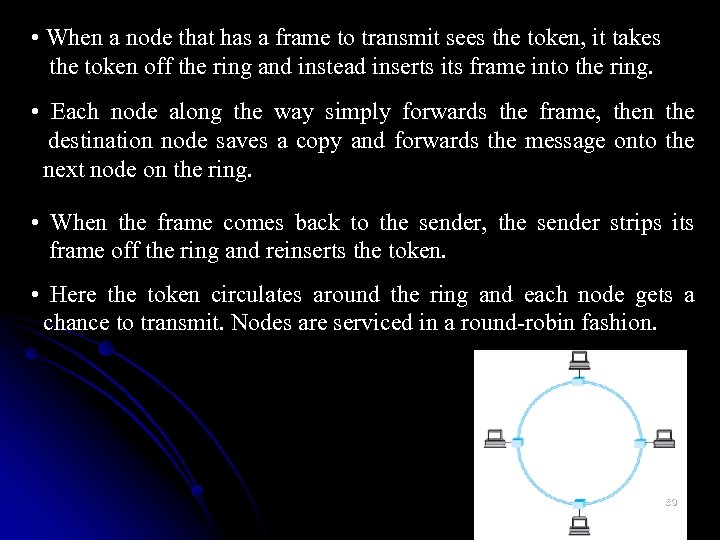 • When a node that has a frame to transmit sees the token, it takes the token off the ring and instead inserts its frame into the ring. • Each node along the way simply forwards the frame, then the destination node saves a copy and forwards the message onto the next node on the ring. • When the frame comes back to the sender, the sender strips its frame off the ring and reinserts the token. • Here the token circulates around the ring and each node gets a chance to transmit. Nodes are serviced in a round-robin fashion. 89
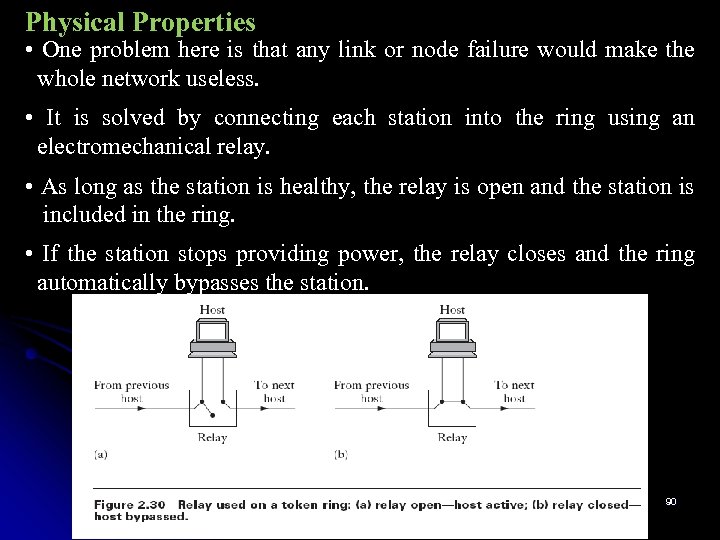 Physical Properties • One problem here is that any link or node failure would make the whole network useless. • It is solved by connecting each station into the ring using an electromechanical relay. • As long as the station is healthy, the relay is open and the station is included in the ring. • If the station stops providing power, the relay closes and the ring automatically bypasses the station. 90
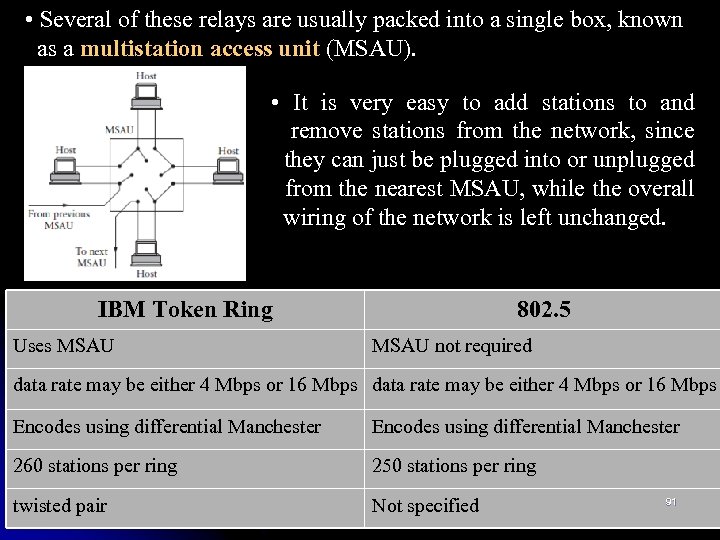 • Several of these relays are usually packed into a single box, known as a multistation access unit (MSAU). • It is very easy to add stations to and remove stations from the network, since they can just be plugged into or unplugged from the nearest MSAU, while the overall wiring of the network is left unchanged. IBM Token Ring Uses MSAU 802. 5 MSAU not required data rate may be either 4 Mbps or 16 Mbps Encodes using differential Manchester 260 stations per ring 250 stations per ring twisted pair Not specified 91
 Token Ring Media Access Control • The network adaptor for a token ring contains a receiver, a transmitter, and one or more bits of data storage between them. • When none of the stations connected to the ring has nothing to send, the token circulates around the ring. • As the token circulates around the ring, any station that has data to send may “seize” the token and begins sending data. • Once a station has the token, it is allowed to send one or more packets. • Each transmitted packet contains the destination address of the intended receiver; it may also contain a multicast or broadcast address if it is intended to reach more than one receivers. • As the packet flows past each node on the ring, each node looks inside the packet to see if it is the intended recipient. 92
 • If so, it copies the packet into a buffer as it flows through the network adaptor, but it does not remove the packet from the ring. • The sending station has the responsibility of removing the packet from the ring. • How long a given node is allowed to hold the token? This is called as the token holding time (THT). • If any of the node in the ring has no data to send, then the node that has token can transmit as much data as it has before passing the token on to the next node, means setting THT to infinity. • The danger is that a single station could hold the token for long time. • We can set the THT to significantly more than the time to send one packet. 93
 • By doing so, a node sends more bytes and hence better utilization of the ring is achieved. • But this does not work well when multiple nodes have data to send. • This is solved by using priority bits. • 94
 PRIORITY BITS • The token contains a 3 -bit priority field, and have a certain priority ‘ n’ at any time. • Each device having a packet, assigns a priority to that packet and the device can only seize the token to transmit a packet if the packet’s priority is greater than the token’s priority. • The priority of the token changes over time. • Here low-priority packets may not be released to the ring if there is lot of high-priority packets. 95
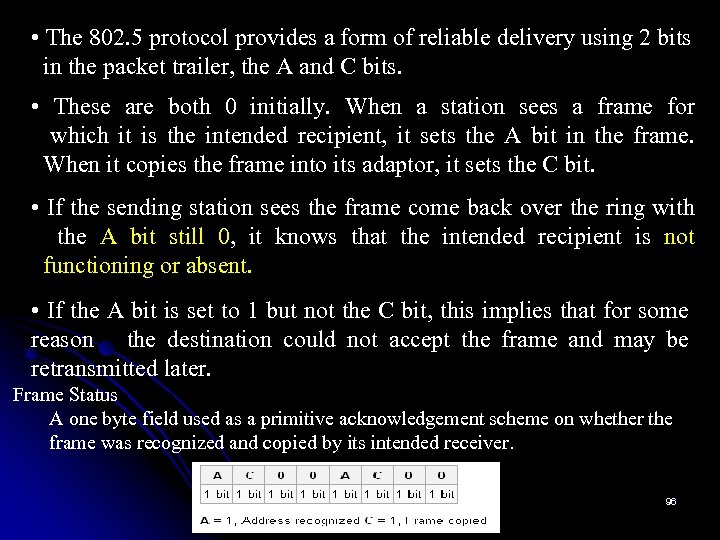 • The 802. 5 protocol provides a form of reliable delivery using 2 bits in the packet trailer, the A and C bits. • These are both 0 initially. When a station sees a frame for which it is the intended recipient, it sets the A bit in the frame. When it copies the frame into its adaptor, it sets the C bit. • If the sending station sees the frame come back over the ring with the A bit still 0, it knows that the intended recipient is not functioning or absent. • If the A bit is set to 1 but not the C bit, this implies that for some reason the destination could not accept the frame and may be retransmitted later. Frame Status A one byte field used as a primitive acknowledgement scheme on whether the frame was recognized and copied by its intended receiver. 96
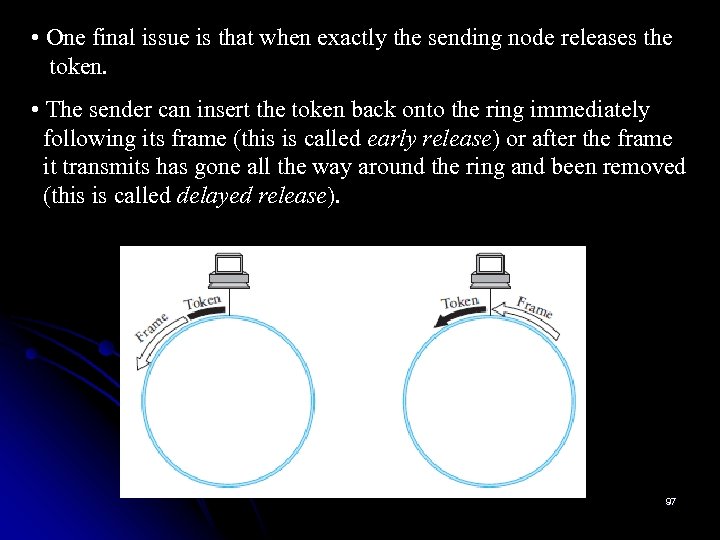 • One final issue is that when exactly the sending node releases the token. • The sender can insert the token back onto the ring immediately following its frame (this is called early release) or after the frame it transmits has gone all the way around the ring and been removed (this is called delayed release). 97
 Token Ring Maintenance • Each 802. 5 token ring has one station designated as a monitor. • The monitor’s job is to ensure the health of the ring. • Any station on the ring can become the monitor, and there are defined procedures by which the monitor is elected when the ring is first connected or on the failure of the current monitor. • A healthy monitor periodically announces its presence with a special control message; if a station fails to see such a message for some period of time, it will assume that the monitor has failed and will try to become the monitor. • When a station decides that a new monitor is needed, it transmits a “claim token” frame, announcing its intent to become the new monitor. If that token circulates back to the sender, it can assume that it is OK for it to become the monitor. (Unanimous) 98
 • If some other station is also trying to become the monitor at the same instant, the sender might see a claim token message from that other station first. • In this case, the tie using some well- defined rule like “highest address wins. ” the MAC address • One responsibility of the monitor is to make sure that there is always a token in the ring (circulating or held by station). • A token may be vanished by a bit error or due to a crash on the station holding the token. • To detect a missing token, the monitor watches for a passing token and maintains a timer equal to the maximum possible token rotation time. 99
 • This interval equals Num. Stations X THT + Ring. Latency THT: Time Holding Time - where Num. Stations is the number of stations on the ring, and Ring. Latency is the total propagation delay of the ring • If the timer expires without the monitor seeing a token, it creates a new one. • The monitor also checks for corrupted or orphaned frames. • The monitor drains corrupted frames off the ring before reinserting the token. • An orphaned frame is one that was transmitted correctly onto the ring but the sending station went down before it could remove the frame from the ring. 100
 • These are detected using another header bit, the “monitor” bit. • This is 0 on transmission and set to 1 the first time the packet passes the monitor. • If the monitor sees a packet with this bit set, it knows the packet is going by for the second time and it drains the packet off the ring. • One additional ring maintenance function is the detection of dead stations. • The relays in the MSAU can automatically bypass a station that has been disconnected or powered down, but may not detect more subtle failures. • If any station suspects a failure on the ring, it can send a beacon(signal) frame to the suspect destination. 101
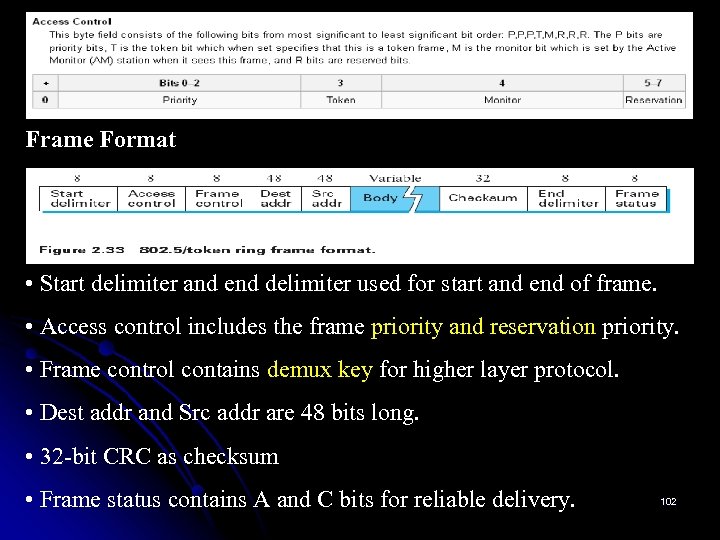 Frame Format • Start delimiter and end delimiter used for start and end of frame. • Access control includes the frame priority and reservation priority. • Frame control contains demux key for higher layer protocol. • Dest addr and Src addr are 48 bits long. • 32 -bit CRC as checksum • Frame status contains A and C bits for reliable delivery. 102
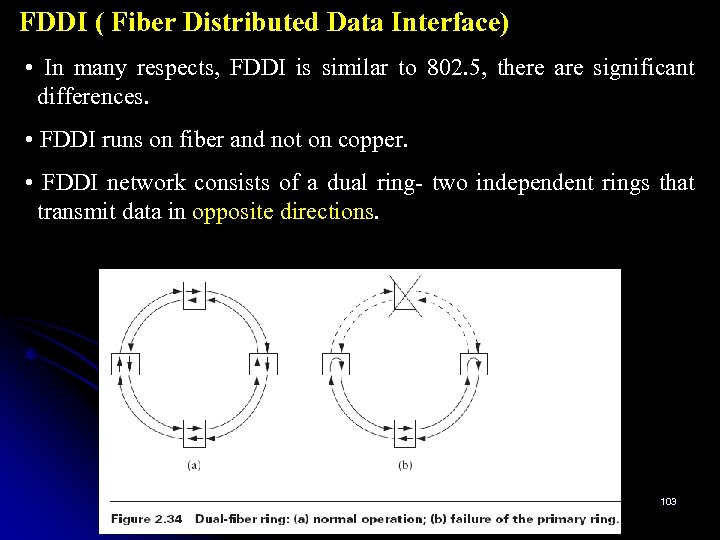 FDDI ( Fiber Distributed Data Interface) • In many respects, FDDI is similar to 802. 5, there are significant differences. • FDDI runs on fiber and not on copper. • FDDI network consists of a dual ring- two independent rings that transmit data in opposite directions. 103
 • The second ring is not used during normal operation and used only if the primary ring fails. • FDDI network is able to tolerate a single break in the cable or the failure of one station. • Here all the nodes participate in maintaining the FDDI ring and no monitor is appointed. • Each node maintains an estimate of the token rotation time (TRT). • A node measures the time between successive arrivals of the token. • If too much time elapses, token may be lost and the node transmits a claim frame. • The claim frame serves two functions: 104
 • First, the claim frame is a vote for a particular value of TRT. • Any node that wants to vote for a shorter TRT will replace that claim frame with its own claim frame, else accept the new time and forward the claim frame. • Second, the claim frame is a request for authorization to regenerate the token. • If a claim frame comes back to the original sender, then that nodes TRT is accepted and also has rights to regenerate the token. • When a token arrives to a node early, then the node can transmit data else the node cannot transmit data. • The drawback of this scheme is that it cannot guarantee any particular node the chance to transmit regularly, because an upstream node could consume all the available time. 105
 • It is solved using Synchronous traffic: when a node receives a token, it is always allowed to send synchronous data whether token is early or late. • Asynchronous traffic : Here a node can send asynchronous traffic only when the token is early. 106
 Resilient(Flexible) Packet Ring(802. 17) • A recent technology standardized by IEEE as 802. 17 • Resiliency-the ability to recover quickly from a link or node failure. • Other design goal included bandwidth efficiency and quality of service (Qo. S) support. • RPR consists of two counter-rotating optical fiber rings. • It uses both the rings during normal operation. • An RPR frame is removed from the ring by the receiving node instead of sender node and is called spatial reuse. • RPR does not use tokens, instead RPR uses technique called buffer insertion. • In a buffer insertion ring, a node can transmit its own frames 107 whenever it has no other frames to forward.
 • If a frame arrives while the node is transmitting its own frame, then the node temporarily buffers that frame. • RPR supports three Qo. S classes : • Class A : provides low latency and low jitter (phone calls) • Class B : provides predictable latency and jitter (prerecorded multimedia) • Class C : provides a best-effort transport. • RPR uses two mechanisms to recover from link or node failure. • First, wrapping similar to FDDI. • Second, steering, nodes adjacent to the failure nodes, which will direct packets in correct direction. 108
 FAQ 1. Draw a block diagram of a typical network adopter. Explain 2. What are the different types of network links? Explain briefly. 3. What are different encoding techniques used? Explain any one. 4. Explain NRZ encoding of a bit stream. 5. What is 4 B/5 B encoding schemes? Explain its significance? 6. What is framing? Explain the significance of byte oriented protocols? 7. How do you distinguish between BISYNC and PPP frame formats? 8. Explain Significance of bit oriented protocol. Draw HDLC frame format. 9. Write a short note on SONET. 10. What is error detection? Explain any one error detection method. 109
 11. How does Two dimensional parity is used in error detection. 12. Explain internet check sum algorithm. 13. Write a note on CRC. 14. What is reliable transmission? Explain Stop and Wait algorithm. 15. Explain working of sliding window algorithm. 16. Explain IEEE 802. 3 frame format. 17. What are transmitter algorithms? 18. How do you distinguish between 1 -persistent and Ppersistent algorithm. 19. How IEEE 802. 5 does works? 20. Write Short note on FDDI. 21. What is resilient packet ring (IEEE 802. 17)? Explain. 110
 End of Chapter 111