 Скачать презентацию Chapter 2 Computer-Based System Engineering Ian Sommerville 2000
d786d217725df30d95c72b1891c0c085.ppt
- Количество слайдов: 41



Chapter 2 Computer-Based System Engineering ©Ian Sommerville 2000 Software Engineering, 6 th edition. Chapter 2 Slide 1
Systems Engineering l Specifying, designing, implementing, validating, deploying and maintaining systems which include hardware, software and people ©Ian Sommerville 2000 Software Engineering, 6 th edition. Chapter 2 Slide 2
Objectives l l To explain why system software is affected by broader system engineering issues To introduce the concept of emergent system properties such as reliability and security To explain why the systems environment must be considered in the system design process To explain system engineering and system procurement processes ©Ian Sommerville 2000 Software Engineering, 6 th edition. Chapter 2 Slide 3
Topics covered l l l Emergent system properties Systems and their environment System modeling The system engineering process System procurement ©Ian Sommerville 2000 Software Engineering, 6 th edition. Chapter 2 Slide 4
What is a system? l l A purposeful collection of inter-related components working together towards some common objective. A big system may include software, mechanical, electrical and electronic hardware and be operated by people. The properties and behaviour of system components are inter-mingled System components are dependent on other system components ©Ian Sommerville 2000 Software Engineering, 6 th edition. Chapter 2 Slide 5
Problems of systems engineering l l Large systems include lots of sub-systems and are usually designed to solve wicked' problems Systems engineering requires a great deal of co-ordination across disciplines • • l Almost infinite possibilities for design trade-offs across components Mutual distrust and lack of understanding across engineering disciplines Systems must be designed to last many years in a changing environment ©Ian Sommerville 2000 Software Engineering, 6 th edition. Chapter 2 Slide 6
Software and systems engineering l l l The proportion of software in systems is increasing. Software-driven general purpose electronics is replacing special-purpose systems Problems of systems engineering are similar to problems of software engineering Software is (unfortunately) seen as a problem in systems engineering. Many large system projects have been delayed because of software problems ©Ian Sommerville 2000 Software Engineering, 6 th edition. Chapter 2 Slide 7
Emergent properties l l l Properties of the system as a whole rather than properties that can be derived from the properties of components of a system Emergent properties are a consequence of the relationships between system components They can therefore only be assessed and measured once the components have been integrated into a system ©Ian Sommerville 2000 Software Engineering, 6 th edition. Chapter 2 Slide 8
Examples of emergent properties l The overall weight of the system • l The reliability of the system • l This is an example of an emergent property that can be computed from individual component properties. This depends on the reliability of system components and the relationships between the components. The usability of a system • This is a complex property which is not simply dependent on the system hardware and software but also depends on the system operators and the environment where it is used. ©Ian Sommerville 2000 Software Engineering, 6 th edition. Chapter 2 Slide 9
Types of emergent property l Functional properties • l These appear when all the parts of a system work together to achieve some objective. For example, a car has the functional property of being a transportation device once it has been assembled from its components. Non-functional emergent properties • Examples are reliability, performance, safety, and security. These relate to the behaviour of the system in its operational environment. They are often critical for computer-based systems as failure to achieve some minimal defined level in these properties may make the system unusable. ©Ian Sommerville 2000 Software Engineering, 6 th edition. Chapter 2 Slide 10
System reliability engineering l l Because of component inter-dependencies, faults can be propagated through the system System failures often occur because of unforeseen inter-relationships between components It is probably impossible to anticipate all possible component relationships Software reliability measures may give a false picture of the system reliability ©Ian Sommerville 2000 Software Engineering, 6 th edition. Chapter 2 Slide 11
Influences on reliability l Hardware reliability • l Software reliability • l What is the probability of a hardware component failing and how long does it take to repair that component? How likely is it that a software component will produce an incorrect output. Software failure is usually distinct from hardware failure in that software does not wear out. Operator reliability • How likely is it that the operator of a system will make an error? ©Ian Sommerville 2000 Software Engineering, 6 th edition. Chapter 2 Slide 12
Reliability relationships l l l Hardware failure can generate false signals that are outside the range of inputs expected by the software Software errors can cause alarms to be activated which cause operator stress and lead to operator errors The environment in which a system is installed can affect its reliability ©Ian Sommerville 2000 Software Engineering, 6 th edition. Chapter 2 Slide 13
The ‘shall-not’ properties l l Properties such as performance and reliability can be measured However, some properties are properties that the system should not exhibit • • l Safety - the system should not behave in an unsafe way Security - the system should not permit unauthorised use Measuring or assessing these properties is very hard ©Ian Sommerville 2000 Software Engineering, 6 th edition. Chapter 2 Slide 14
Systems and their environment l l Systems are not independent but exist in an environment System’s function may be to change its environment Environment affects the functioning of the system e. g. system may require electrical supply from its environment The organizational as well as the physical environment may be important ©Ian Sommerville 2000 Software Engineering, 6 th edition. Chapter 2 Slide 15
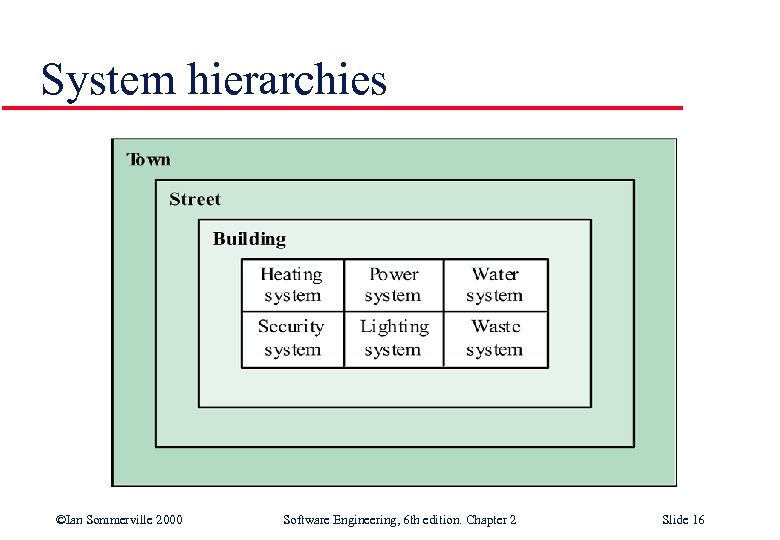
System hierarchies ©Ian Sommerville 2000 Software Engineering, 6 th edition. Chapter 2 Slide 16
Human and organizational factors Organizational factors: Policies and Procedures. l Process changes • l Job changes • l Does the system require changes to the work processes in the environment? Does the system de-skill the users in an environment or cause them to change the way they work? Organizational changes • Does the system change the political power structure in an organization? ©Ian Sommerville 2000 Software Engineering, 6 th edition. Chapter 2 Slide 17
System architecture modeling l l An architectural model presents an abstract view of the sub-systems making up a system May include major information flows between subsystems Usually presented as a block diagram May identify different types of functional component in the model ©Ian Sommerville 2000 Software Engineering, 6 th edition. Chapter 2 Slide 18
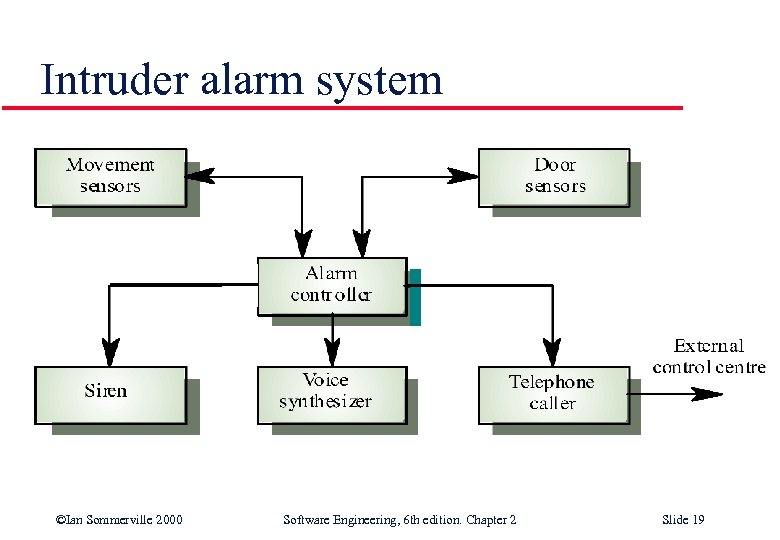
Intruder alarm system ©Ian Sommerville 2000 Software Engineering, 6 th edition. Chapter 2 Slide 19
Functional system components l Sensor components • l Actuator components • l Collect information from the system’s environment e. g. radars in an air traffic control system Cause some change in the system’s environment e. g. valves in a process control system which increase or decrease material flow in a pipe Computation components • Carry out some computations on an input to produce an output e. g. a floating point processor in a computer system ©Ian Sommerville 2000 Software Engineering, 6 th edition. Chapter 2 Slide 20
Functional system components l Communication components • l Co-ordinate the interactions of other system components e. g. scheduler in a real-time system Interface components • l Allow system components to communicate with each other e. g. network linking distributed computers Facilitate the interactions of other system components e. g. operator interface All components are now usually software controlled ©Ian Sommerville 2000 Software Engineering, 6 th edition. Chapter 2 Slide 21
The system engineering process l Usually follows a ‘waterfall’ model because of the need for parallel development of different parts of the system • l Little scope for iteration between phases because hardware changes are very expensive. Software may have to compensate for hardware problems Inevitably involves engineers from different disciplines who must work together • Much scope for misunderstanding here. Different disciplines use a different vocabulary and much negotiation is required. Engineers may have personal agendas to fulfil ©Ian Sommerville 2000 Software Engineering, 6 th edition. Chapter 2 Slide 22
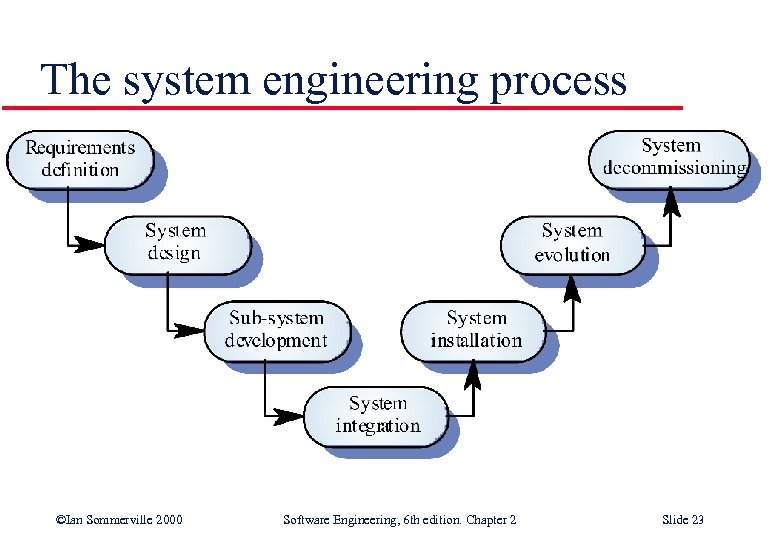
The system engineering process ©Ian Sommerville 2000 Software Engineering, 6 th edition. Chapter 2 Slide 23
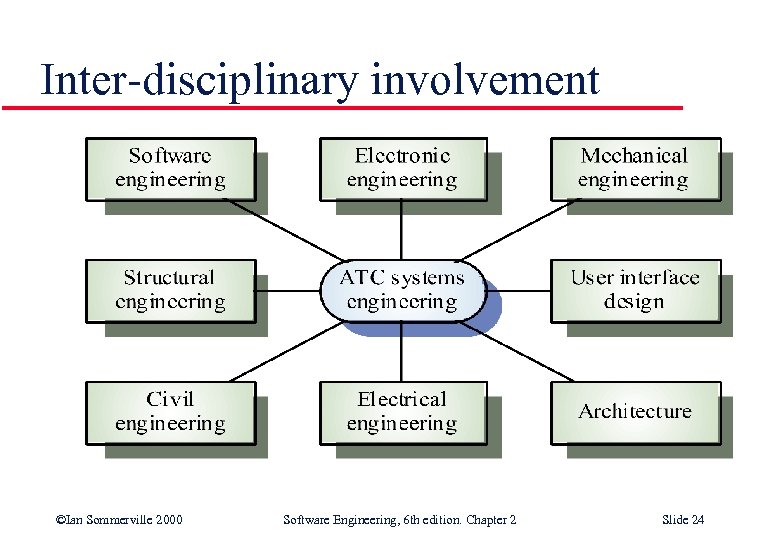
Inter-disciplinary involvement ©Ian Sommerville 2000 Software Engineering, 6 th edition. Chapter 2 Slide 24
System requirements definition l l Define overall organizational objectives for the system Three types of requirement defined at this stage • • • Abstract functional requirements. System functions are defined in an abstract way System properties. Non-functional requirements for the system in general are defined Undesirable characteristics. Unacceptable system behaviour is specified ©Ian Sommerville 2000 Software Engineering, 6 th edition. Chapter 2 Slide 25
System objectives l Organizational objectives • l To ensure that the normal functioning of work carried out in the building is not seriously disrupted by events such as fire and unauthorized intrusion Functional objectives • To provide a fire and intruder alarm system for the building which will provide internal and external warning of fire or unauthorized intrusion ©Ian Sommerville 2000 Software Engineering, 6 th edition. Chapter 2 Slide 26
The system design process l Partition requirements • l Identify sub-systems • l l Identify a set of sub-systems which collectively can meet the system requirements Assign requirements to sub-systems • l Organise requirements into related groups Causes particular problems when COTS are integrated Specify sub-system functionality Define sub-system interfaces • Critical activity for parallel sub-system development ©Ian Sommerville 2000 Software Engineering, 6 th edition. Chapter 2 Slide 27
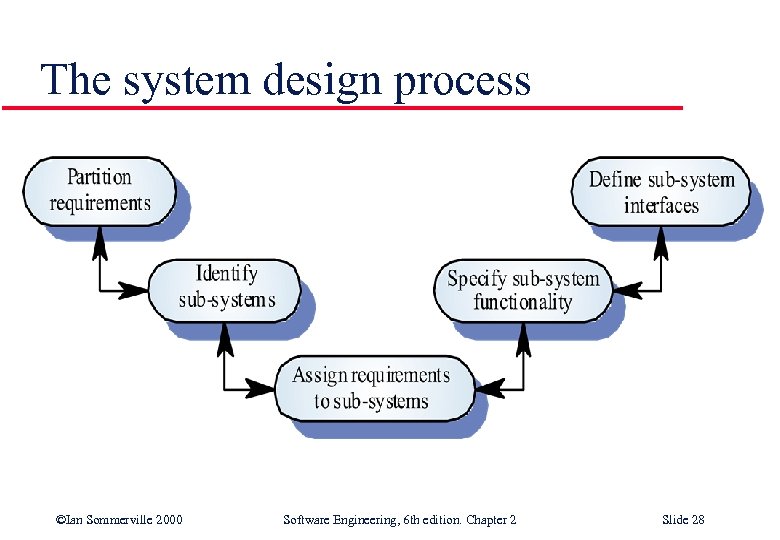
The system design process ©Ian Sommerville 2000 Software Engineering, 6 th edition. Chapter 2 Slide 28
Sub-system development l l l Typically parallel projects developing the hardware, software and communications May involve some COTS (Commercial Off-the. Shelf) systems procurement Lack of communication across implementation teams ©Ian Sommerville 2000 Software Engineering, 6 th edition. Chapter 2 Slide 29
System integration l l The process of putting hardware, software and people together to make a system Should be tackled incrementally so that sub-systems are integrated one at a time Interface problems between sub-systems are usually found at this stage May be problems with uncoordinated deliveries of system components ©Ian Sommerville 2000 Software Engineering, 6 th edition. Chapter 2 Slide 30
System installation l l l Environmental assumptions may be incorrect May be human resistance to the introduction of a new system System may have to coexist with alternative systems for some time May be physical installation problems (e. g. cabling problems) Operator training has to be identified ©Ian Sommerville 2000 Software Engineering, 6 th edition. Chapter 2 Slide 31
System operation l l l Will bring unforeseen requirements to light Users may use the system in a way which is not anticipated by system designers May reveal problems in the interaction with other systems • • • Physical problems of incompatibility Data conversion problems Increased operator error rate because of inconsistent interfaces ©Ian Sommerville 2000 Software Engineering, 6 th edition. Chapter 2 Slide 32
System evolution l l l Large systems have a long lifetime. They must evolve to meet changing requirements Existing systems which must be maintained are sometimes called legacy systems Evolution is inherently expensive • • Changes must be analyzed from a technical and business perspective Sub-systems are not independent so that changing one may affect the others There is rarely a rationale for original design decisions System structure is corrupted as changes are made ©Ian Sommerville 2000 Software Engineering, 6 th edition. Chapter 2 Slide 33
System decommissioning l l Taking the system out of service after its useful lifetime May require removal of materials (e. g. dangerous chemicals which pollute the environment) • l Should be planned for in the system design by encapsulation May require data to be restructured and converted to be used in some other system ©Ian Sommerville 2000 Software Engineering, 6 th edition. Chapter 2 Slide 34
System procurement l l Acquiring a system for an organization to meet some need Some system specification and architectural design is usually necessary before procurement • • You need a specification to let a contract for system development The specification may allow you to buy a commercial off-theshelf (COTS) system. Almost always cheaper than developing a system from scratch ©Ian Sommerville 2000 Software Engineering, 6 th edition. Chapter 2 Slide 35
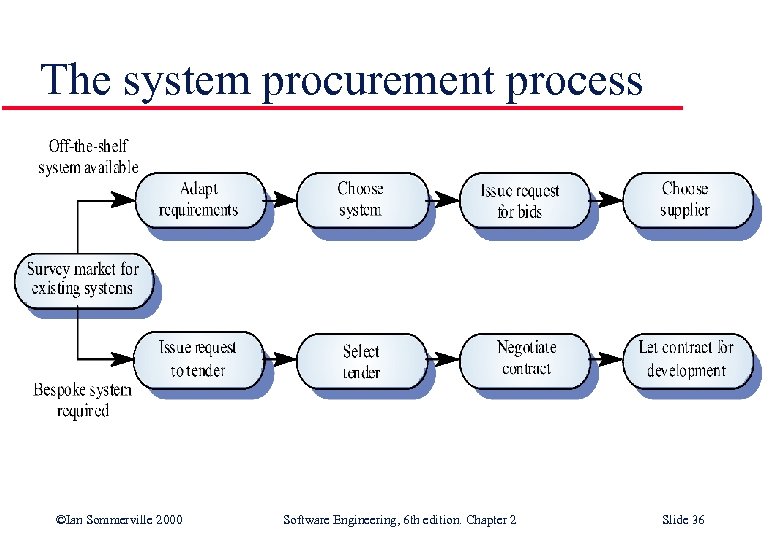
The system procurement process ©Ian Sommerville 2000 Software Engineering, 6 th edition. Chapter 2 Slide 36
Procurement issues l l l Requirements may have to be modified to match the capabilities of off-the-shelf components The requirements specification may be part of the contract for the development of the system There is usually a contract negotiation period to agree changes after the contractor to build a system has been selected ©Ian Sommerville 2000 Software Engineering, 6 th edition. Chapter 2 Slide 37
Contractors and sub-contractors l l l The procurement of large hardware/software systems is usually based around some principal contractor Sub-contracts are issued to other suppliers to supply parts of the system Customer liases with the principal contractor and does not deal directly with sub-contractors ©Ian Sommerville 2000 Software Engineering, 6 th edition. Chapter 2 Slide 38
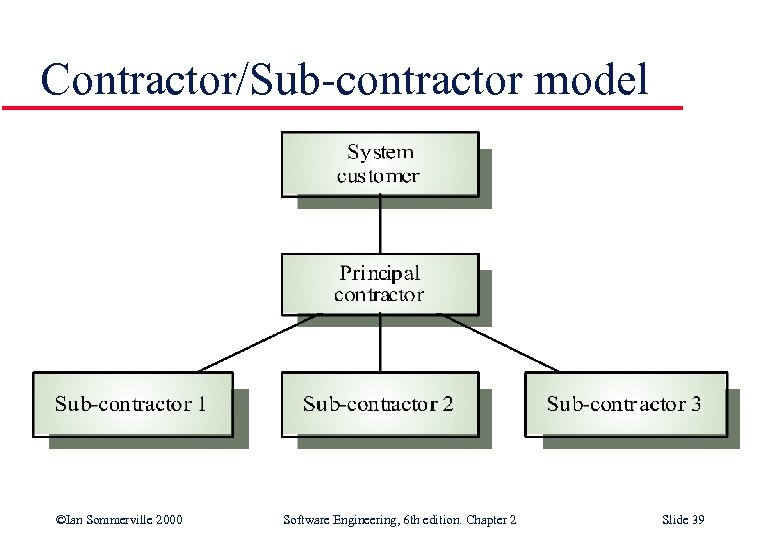
Contractor/Sub-contractor model ©Ian Sommerville 2000 Software Engineering, 6 th edition. Chapter 2 Slide 39
Key points l l l System engineering involves input from a range of disciplines Emergent properties are properties that are characteristic of the system as a whole and not its component parts System architectural models show major subsystems and inter-connections. They are usually described using block diagrams ©Ian Sommerville 2000 Software Engineering, 6 th edition. Chapter 2 Slide 40
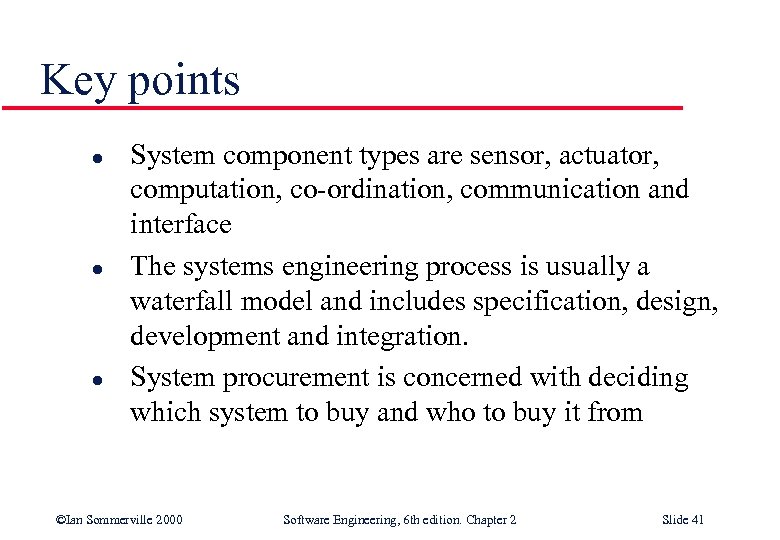
Key points l l l System component types are sensor, actuator, computation, co-ordination, communication and interface The systems engineering process is usually a waterfall model and includes specification, design, development and integration. System procurement is concerned with deciding which system to buy and who to buy it from ©Ian Sommerville 2000 Software Engineering, 6 th edition. Chapter 2 Slide 41
Скачать презентацию Chapter 2 Computer-Based System Engineering Ian Sommerville 2000
d786d217725df30d95c72b1891c0c085.ppt