 Скачать презентацию Chapter 2 Comparative Advantage The Basis of Exchange
941c0a653c79fb89b01ea3c28086fe81.ppt
- Количество слайдов: 37



Chapter 2 Comparative Advantage: The Basis of Exchange
Economics: Redefined Economics is the subject that studies how decision-making entities allocate and utilize the limited resources to produce goods and services that best satisfy the various, unlimited, competing human desires.
Economics: Macro vs. Micro n Macroeconomics: – How does the economic system work? – When and why economic system does not work? – When do people become counterproductive? – Why are there ups and downs in the economy? – Why is the long run mainly a story of ups? => National economy, GDP, inflation, unemployment, international trade, exchange rate, etc.
Economics: Macro vs. Micro n Microeconomics: – – The housing market in Shanghai The price of Honda Accord in Guangzhou The production quantity of peaches in Nanhui The number of people hired producing milk powder at Mengniu – The number of T-shirts I buy at Hang-Ten => Individual decisions and interactions, individual consumer behaviors, individual producer decisions on production and input requirements, single product market, single market structure, etc.
Microeconomics n Individual decisions about what to do and what not to do. n Decisions about production and consumption made by individual firms and consumers (market economy) n How individuals’ pursuit of self interest can lead to good results as a whole (the invisible hand)
Also in Microeconomics n Society’s goal: efficiency and equity n Market usually leads to efficiency, but not necessarily equity. n There are times for market failures. n When market fails, it calls for government interventions. n Proper “incentives” offered by government interventions may help reach society’s goals.
Economics: a way of thinking and an analysis tool Economics is not the body of concrete truth, but an engine for the discovery of concrete truth.
Economic Analysis n Positive analysis : – objective descriptions about what things are (facts) n Normative analysis: – value judgments on what things be (opinions) should
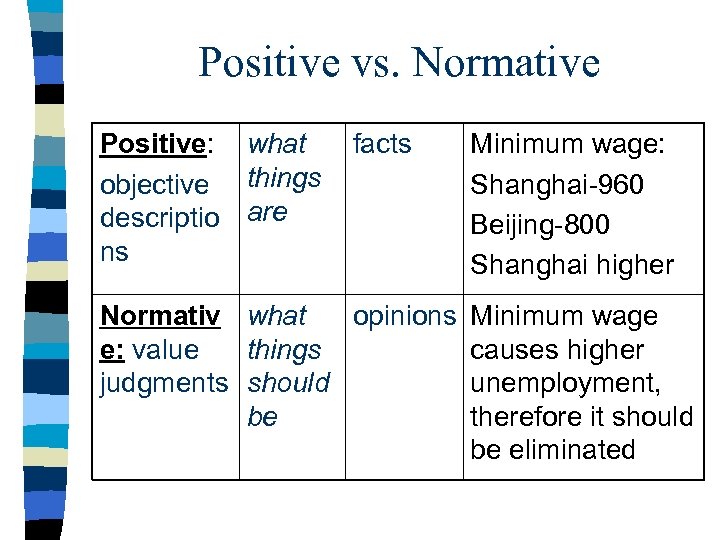
Positive vs. Normative Positive: what objective things descriptio are ns facts Minimum wage: Shanghai-960 Beijing-800 Shanghai higher Normativ what opinions Minimum wage e: value things causes higher judgments should unemployment, be therefore it should be eliminated
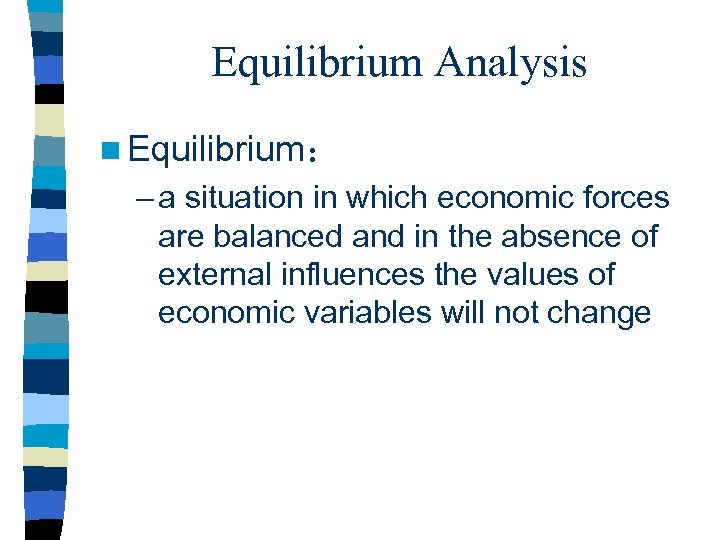
Equilibrium Analysis n Equilibrium: – a situation in which economic forces are balanced and in the absence of external influences the values of economic variables will not change
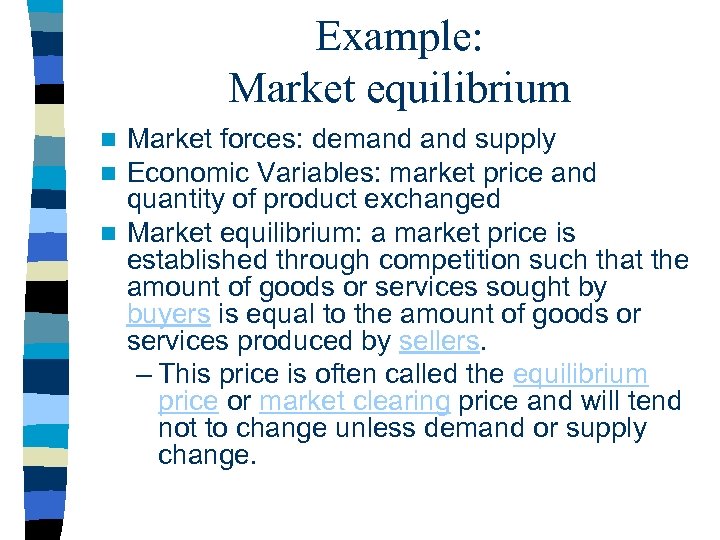
Example: Market equilibrium Market forces: demand supply Economic Variables: market price and quantity of product exchanged n Market equilibrium: a market price is established through competition such that the amount of goods or services sought by buyers is equal to the amount of goods or services produced by sellers. – This price is often called the equilibrium price or market clearing price and will tend not to change unless demand or supply change. n n
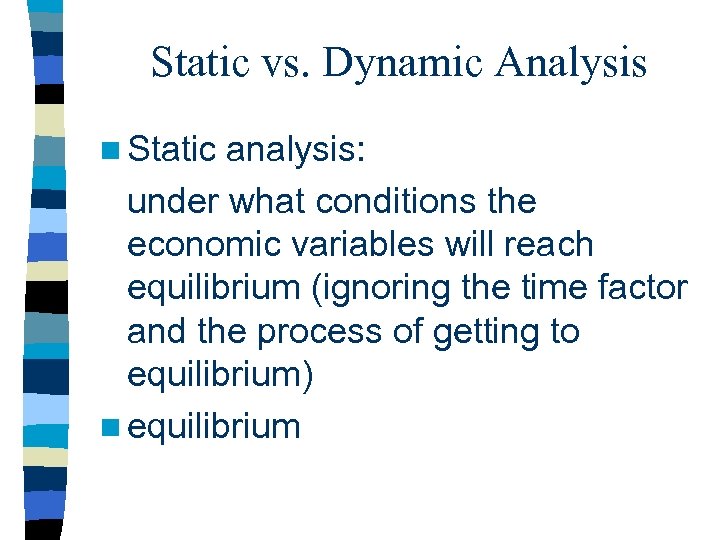
Static vs. Dynamic Analysis n Static analysis: under what conditions the economic variables will reach equilibrium (ignoring the time factor and the process of getting to equilibrium) n equilibrium

Static vs. Dynamic Analysis n Comparative static analysis: what happens to the equilibrium and the values of the economic variables if some of the conditions change n Equilibrium price under D 1 vs. equilibrium price under D 2 2018/3/19 14
Static vs. Dynamic Analysis n Dynamic analysis: – the process analysis; – the interactive process and relationships among all economic variables n Equilibrium price P 1 – US companies bankrupt US income lowers US consumption of Chinese products lowers Chinese exports decreases Chinese income lowers Chinese comsumption decreases Chinese companies investments decrease Chinese domestic D lower equilibrium price lower 2018/3/19 15
Economic Models A model is a simplified representation of a real situation that is used to better understand real-life situations. 2018/3/19 16
Economic model n Using functions to describe the inter relationships among economic variables n Word description, mathematics, graphs n Abstract: skip some of the non-vital factors and variables (assumptions) n Focus on certain relationships only (hypothesis) 2018/3/19 17
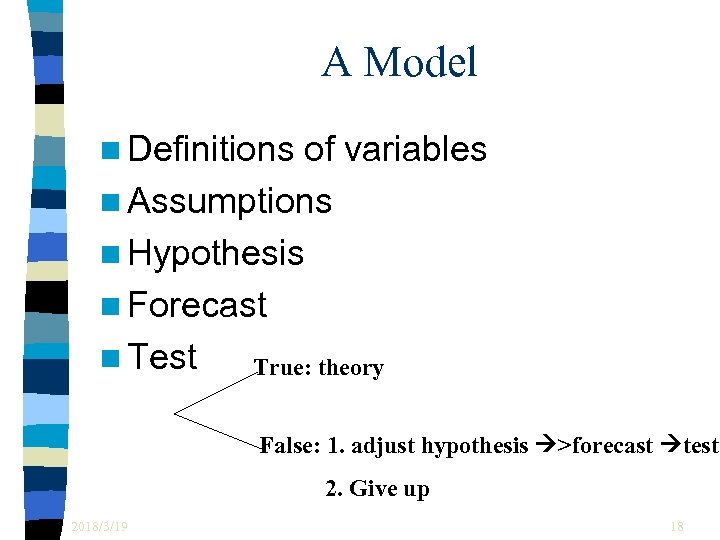
A Model n Definitions of variables n Assumptions n Hypothesis n Forecast n Test True: theory False: 1. adjust hypothesis >forecast test 2. Give up 2018/3/19 18
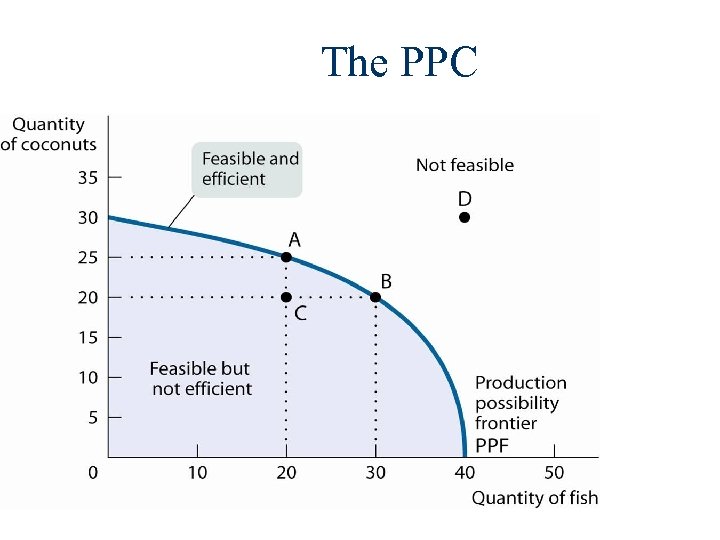
Model Example: PPC The production possibility curve the trade-offs facing an economy that produces only two goods. 2018/3/19 19
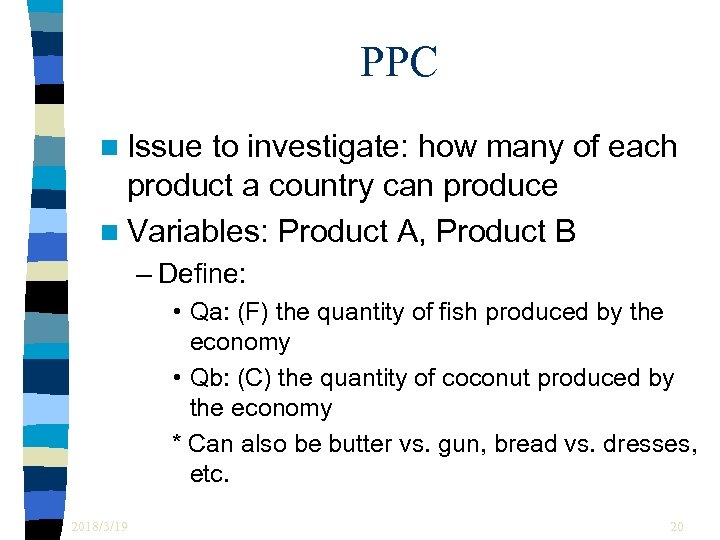
PPC n Issue to investigate: how many of each product a country can produce n Variables: Product A, Product B – Define: • Qa: (F) the quantity of fish produced by the economy • Qb: (C) the quantity of coconut produced by the economy * Can also be butter vs. gun, bread vs. dresses, etc. 2018/3/19 20
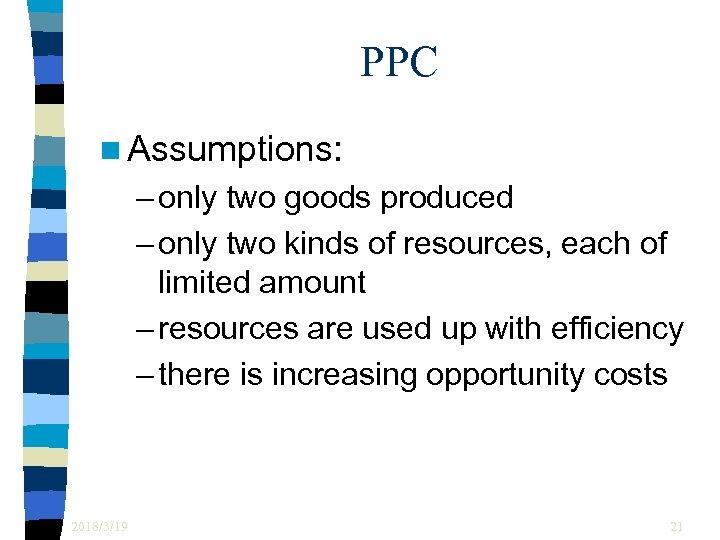
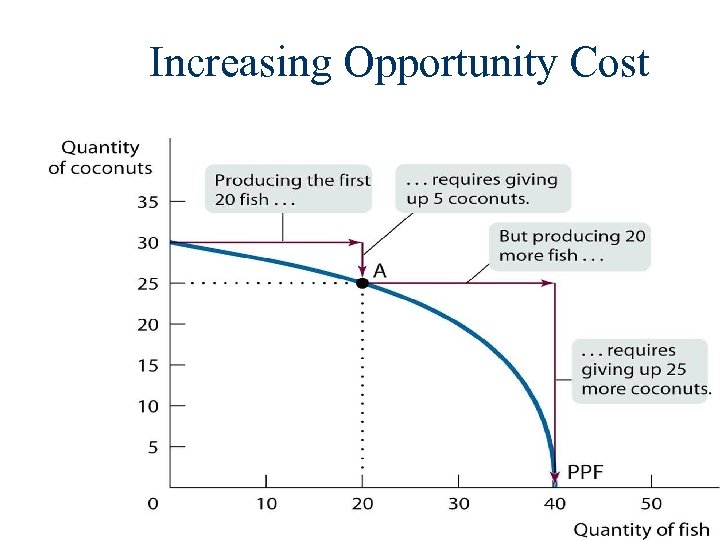
PPC n Assumptions: – only two goods produced – only two kinds of resources, each of limited amount – resources are used up with efficiency – there is increasing opportunity costs 2018/3/19 21
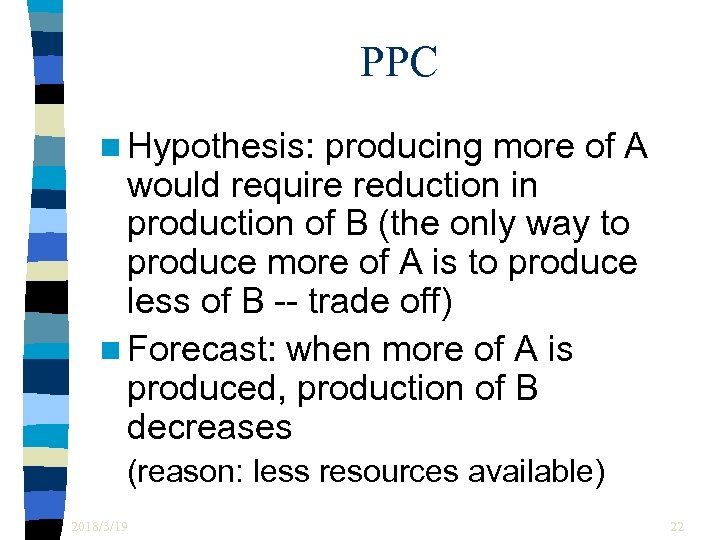
PPC n Hypothesis: producing more of A would require reduction in production of B (the only way to produce more of A is to produce less of B -- trade off) n Forecast: when more of A is produced, production of B decreases (reason: less resources available) 2018/3/19 22
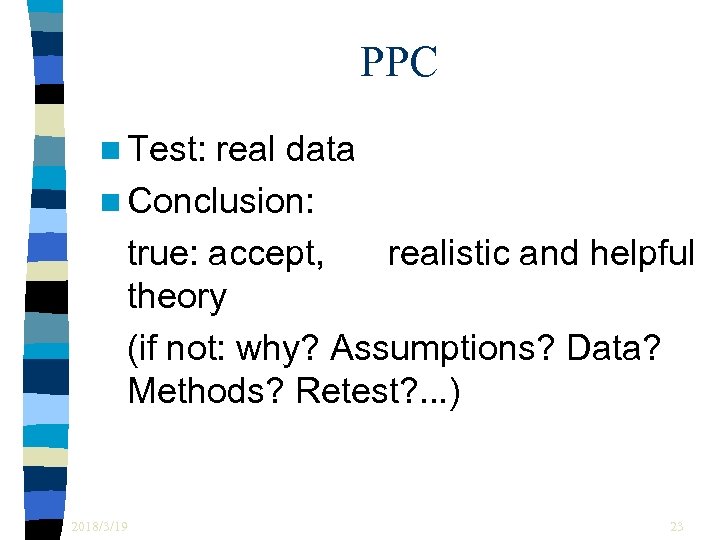
PPC n Test: real data n Conclusion: true: accept, realistic and helpful theory (if not: why? Assumptions? Data? Methods? Retest? . . . ) 2018/3/19 23
The PPC
Increasing Opportunity Cost
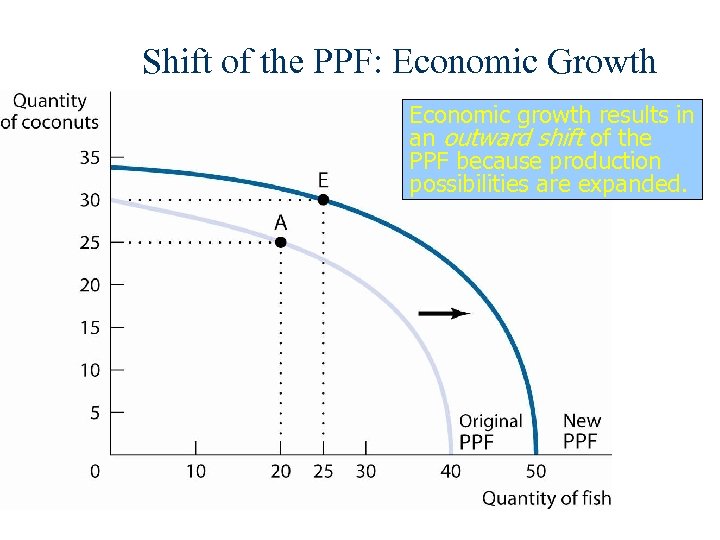
Shift of the PPF: Economic Growth Economic growth results in an outward shift of the PPF because production possibilities are expanded.
PPC: Key Points n Intersections with X-axis and Y- axis n Points inside, on, outside the curve n The bowed-out shape n Shift of the curve 2018/3/19 27
Marginal Analysis n Trade off situations: How much decisions (as vs. either-or) n marginal analysis: comparing marginal benefit to marginal cost n Marginal Benefit: additional benefit related to one more unit change Marginal Cost: additional cost related to the same one more unit change 2018/3/19 28
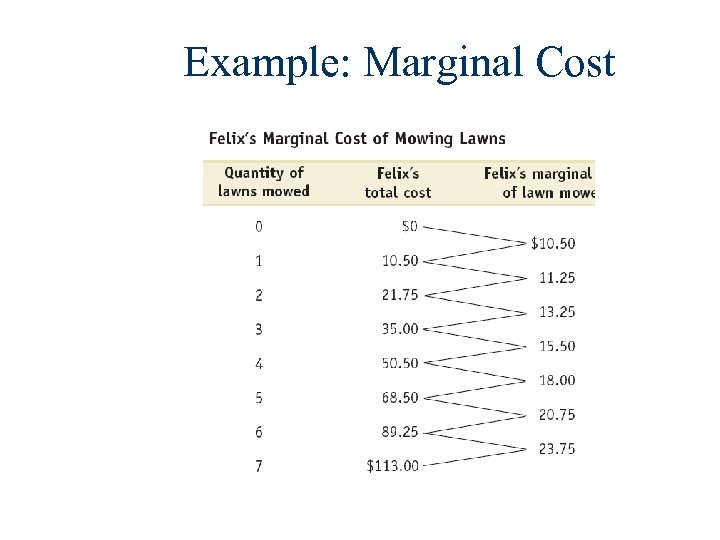
Example: Marginal Cost
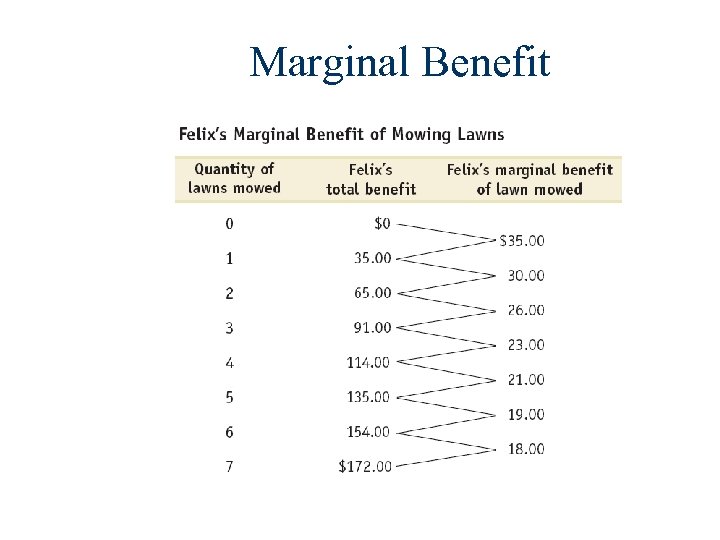
Marginal Benefit
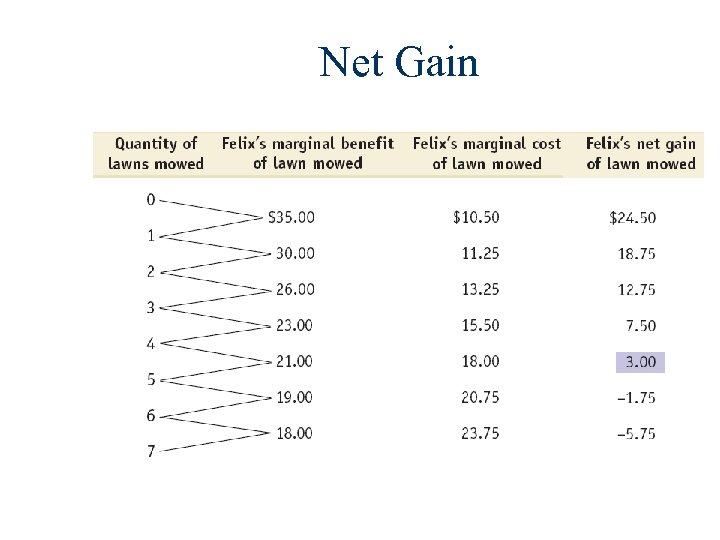
Net Gain
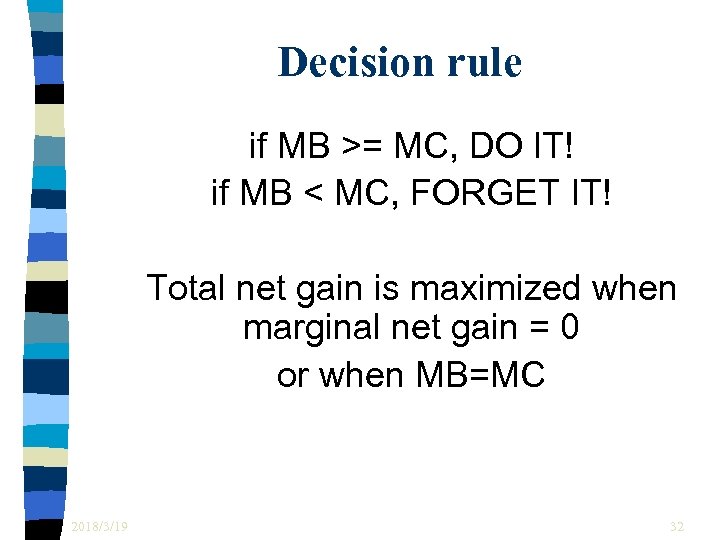
Decision rule if MB >= MC, DO IT! if MB < MC, FORGET IT! Total net gain is maximized when marginal net gain = 0 or when MB=MC 2018/3/19 32
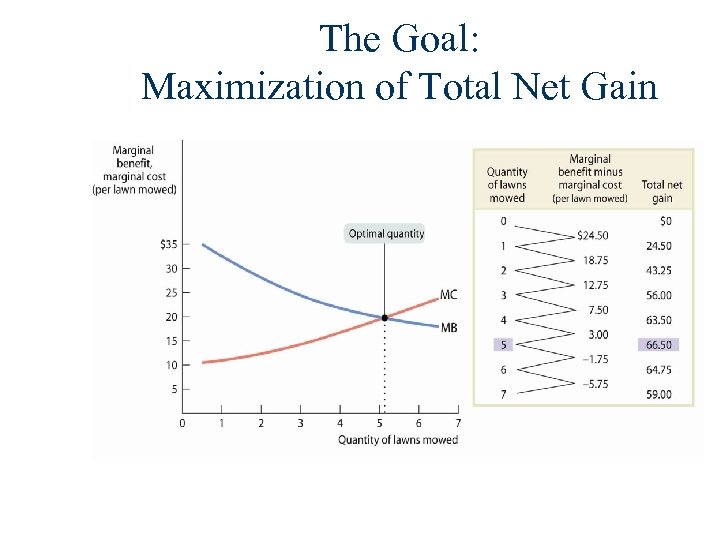
The Goal: Maximization of Total Net Gain
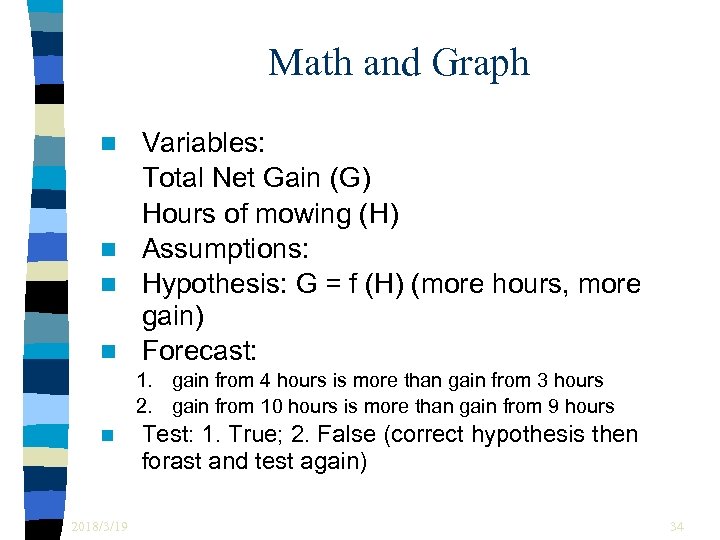
Math and Graph Variables: Total Net Gain (G) Hours of mowing (H) n Assumptions: n Hypothesis: G = f (H) (more hours, more gain) n Forecast: n 1. gain from 4 hours is more than gain from 3 hours 2. gain from 10 hours is more than gain from 9 hours n 2018/3/19 Test: 1. True; 2. False (correct hypothesis then forast and test again) 34
Graph n Plotting: origin, X-axis, Y-axis, n Variables: independent, dependent n Relationships: positive, negative; linear, nonlinear; 2018/3/19 35
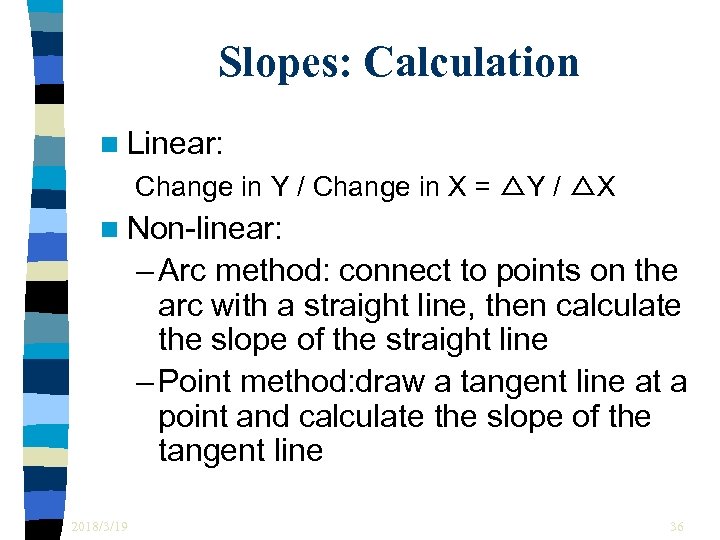
Slopes: Calculation n Linear: Change in Y / Change in X = △Y / △X n Non-linear: – Arc method: connect to points on the arc with a straight line, then calculate the slope of the straight line – Point method: draw a tangent line at a point and calculate the slope of the tangent line 2018/3/19 36
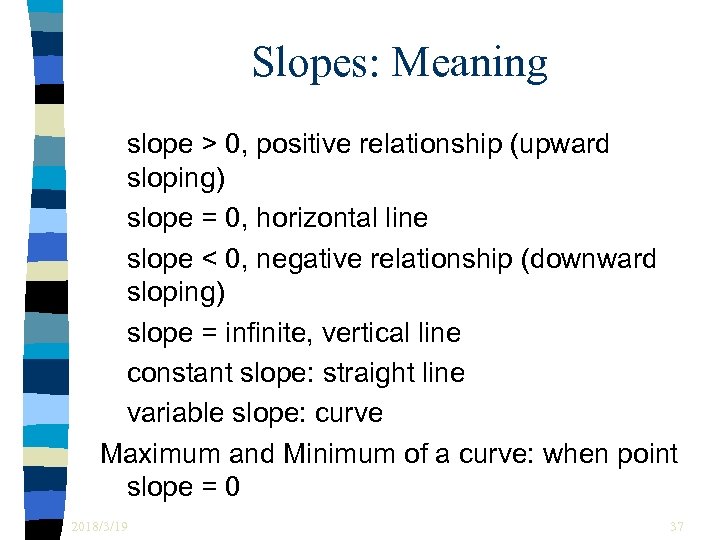
Slopes: Meaning slope > 0, positive relationship (upward sloping) slope = 0, horizontal line slope < 0, negative relationship (downward sloping) slope = infinite, vertical line constant slope: straight line variable slope: curve Maximum and Minimum of a curve: when point slope = 0 2018/3/19 37
Скачать презентацию Chapter 2 Comparative Advantage The Basis of Exchange
941c0a653c79fb89b01ea3c28086fe81.ppt