 Скачать презентацию Chapter 2 6 Critical Section Problem Mutual
1460acad16c73a30ae1ad268d925377a.ppt
- Количество слайдов: 14



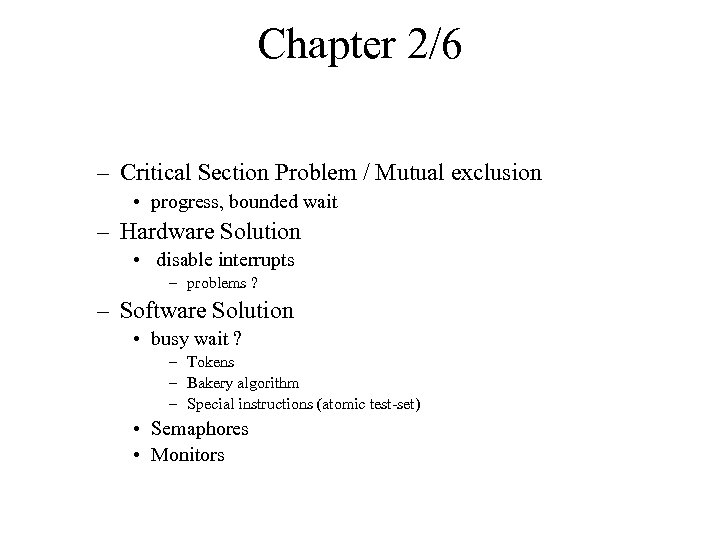
Chapter 2/6 – Critical Section Problem / Mutual exclusion • progress, bounded wait – Hardware Solution • disable interrupts – problems ? – Software Solution • busy wait ? – Tokens – Bakery algorithm – Special instructions (atomic test-set) • Semaphores • Monitors
Other Synchrnization Problems • Dining Philosophers • Producer Consumer • Readers Writers – reader’s priority, writer’s priority
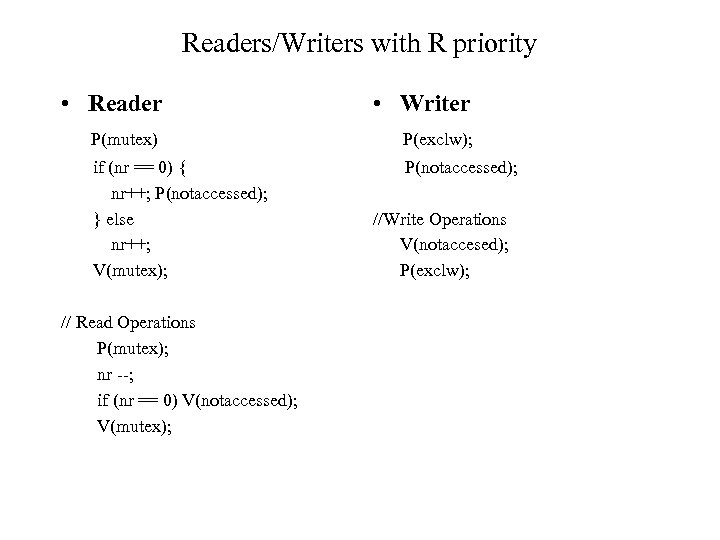
Readers/Writers with R priority • Reader • Writer P(mutex) P(exclw); if (nr == 0) { nr++; P(notaccessed); } else nr++; V(mutex); P(notaccessed); // Read Operations P(mutex); nr --; if (nr == 0) V(notaccessed); V(mutex); //Write Operations V(notaccesed); P(exclw);
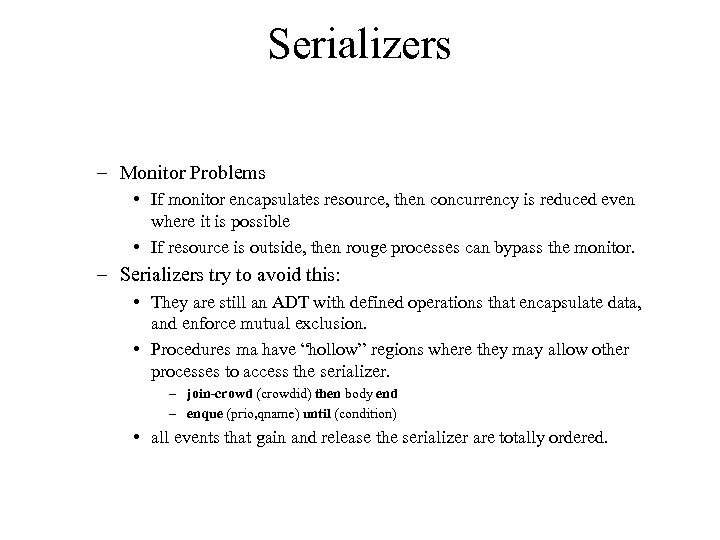
Serializers – Monitor Problems • If monitor encapsulates resource, then concurrency is reduced even where it is possible • If resource is outside, then rouge processes can bypass the monitor. – Serializers try to avoid this: • They are still an ADT with defined operations that encapsulate data, and enforce mutual exclusion. • Procedures ma have “hollow” regions where they may allow other processes to access the serializer. – join-crowd (crowdid) then body end – enque (prio, qname) until (condition) • all events that gain and release the serializer are totally ordered.
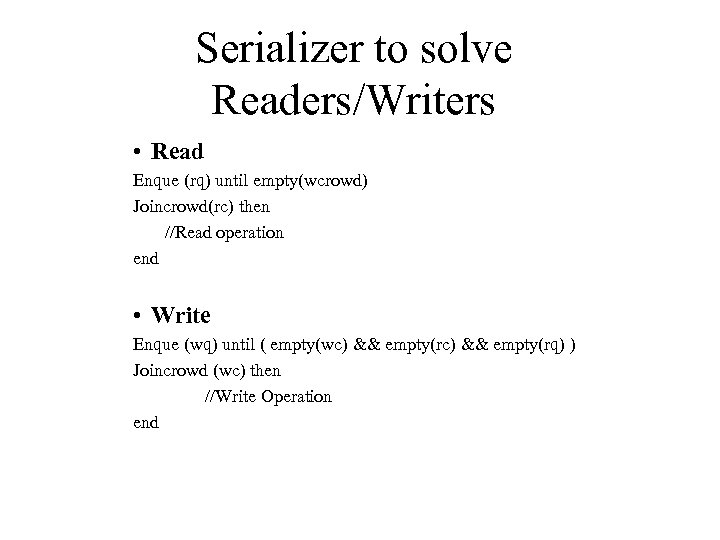
Serializer to solve Readers/Writers • Read Enque (rq) until empty(wcrowd) Joincrowd(rc) then //Read operation end • Write Enque (wq) until ( empty(wc) && empty(rq) ) Joincrowd (wc) then //Write Operation end
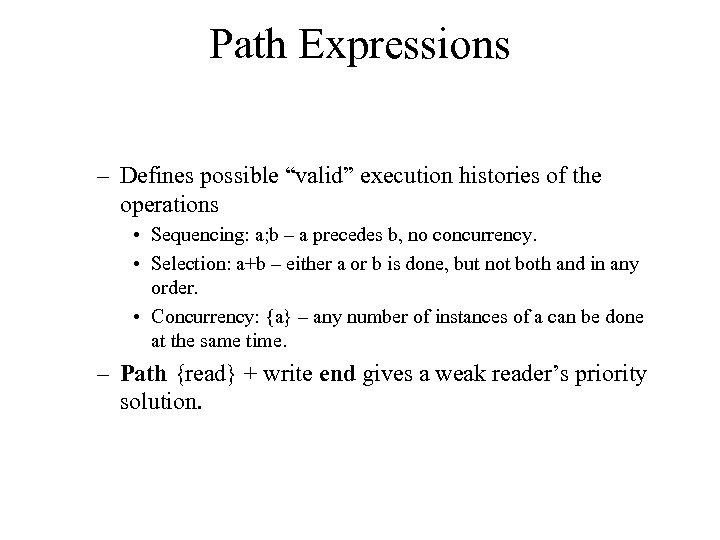
Path Expressions – Defines possible “valid” execution histories of the operations • Sequencing: a; b – a precedes b, no concurrency. • Selection: a+b – either a or b is done, but not both and in any order. • Concurrency: {a} – any number of instances of a can be done at the same time. – Path {read} + write end gives a weak reader’s priority solution.
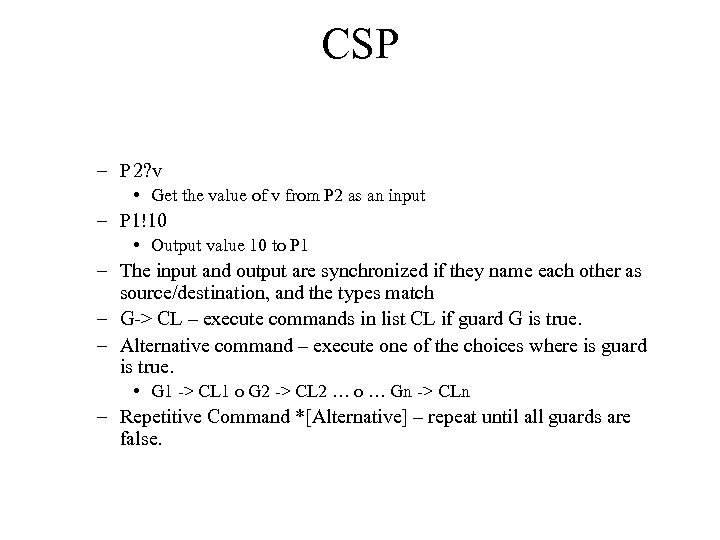
CSP – P 2? v • Get the value of v from P 2 as an input – P 1!10 • Output value 10 to P 1 – The input and output are synchronized if they name each other as source/destination, and the types match – G-> CL – execute commands in list CL if guard G is true. – Alternative command – execute one of the choices where is guard is true. • G 1 -> CL 1 o G 2 -> CL 2 … o … Gn -> CLn – Repetitive Command *[Alternative] – repeat until all guards are false.
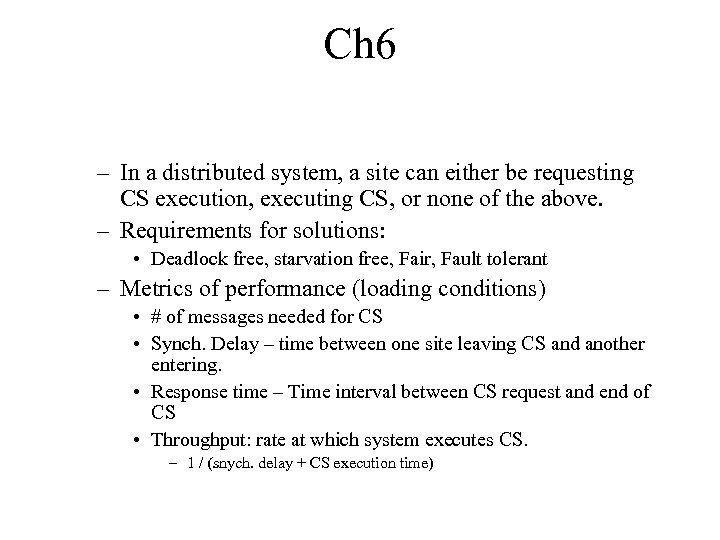
Ch 6 – In a distributed system, a site can either be requesting CS execution, executing CS, or none of the above. – Requirements for solutions: • Deadlock free, starvation free, Fair, Fault tolerant – Metrics of performance (loading conditions) • # of messages needed for CS • Synch. Delay – time between one site leaving CS and another entering. • Response time – Time interval between CS request and end of CS • Throughput: rate at which system executes CS. – 1 / (snych. delay + CS execution time)
Solutions – Centralized approach: Make a single site responsible for permissions. • Needs only 3 messages / CS (which 3 ? ) • Single point of failure, load on central site, 2 T synch. Delay – Lamports algorithm (non token based, FIFO delivery) • When Si needs CS, it sends REQ(tsi, i) to all sites in its request set. , and places it in its request queue. A site Sj which receives this places it in its own queue, and sends a timestamped REPLY message • Si can enter CS when – Its request is as the top of the queue – It has a reply from all sites it sent a message to with timestamp > timestamp of request • Upon exiting CS, removes its request, and sends a release message to all sites. Each receiving site dequeues the request as well
Does it work ? – Can Prove by contradiction • Basically this means that a process entered CS even though a request from another process with lower timestamp was in its queue. – Requires 3(n-1) messages / CS, sd is T – Improvement – Ricart-Agrawala Algorithm • A request is sent just as in Lamport’s algo. • On receiving a request, a reply is sent if this site is neither executing its CS nor requesting it. Otherwise, timestamps are compared and a reply sent if the received tstamp is lower than the local tstamp. Otherwise defer. • Enter CS when reply received from all. • Upon exiting CS, send replies to defered sites. – Note that once I have clearance to go into CS, I can do so many times as long as I don’t send back reply.
Maekawa’s Algo. – Each site’s request set is constructed so that • • Intersection of request set for any pair of sites is not null Each site is in its own request set The request set size is K for any site. Each site is contained in K sets (K = sqrt(N)) – To request • Site Si sends REQ(i) to all sites in its request set. • On receiving the request, Sj will send REPLY(j) if it hasn’t sent a reply to anyone since it got the last release. Otherwise hold. – To Execute CS • When you get all Replies – To Release CS • Send Release(i) to all sites in request set. • When Sj gets release message, it sends reply to next waiting request.
– Need 3*sqrt(N) messages, 2*T synch. delay. – Problem – deadlock can occur • Imagine a situation with three sites each requesting CS. – Solution – prioritize request using timestamps and do some extra processing. • Basically, eliminate circular wait. Site will send a failure message if it can’t honor your request. • If a site is locked, but receives a request from a site with higher priority, it “inquires” from the locking site to see if the lock can be released. • Message traffic now 5*sqrt(N)
Token Based – Suzuki Kasami Broadcast Algorithm: • Basically, need a token to get into CS. Site possesing the token can get into CS repeatedly. RN is an array of integers denoting the largest number in request sequence from a site. The token itself has an array LN containing sequence number of most recently executed request and a queue Q of requesting sites. – Request • If requesting site does not have token, it increments RNi[i] and sends REQ(i, RNi[i]) to everyone else. When Sj receives this, it updates RNj[i]. If it has idle token it sends it to Si – CS is executed when token is received – Release • Set LN[i] to RNi[i]. If RNi[j] = LN[j]+1, then Sj is appended to token Q • If token queue is nonempty, delete top entry and send token to that site. This makes it “non-symmetric” – Messages is 0 or N, Snych. delay is 0 or T.
Raymond’s Tree Based Algo. – The site with the token is the root of a tree. Each node has a variable called holder pointing to parent. Each node also has a r-q that contains requests for tokens from children. – Request • To request, send request to parent if your r_q is empty and add yourself to the r_q • When you get a request, add to r_q and forward to parent if you have not sent a previous request. • When root site gets request, it sends token to requesting site and sets holder to point to that site. • When site gets a token, it deletes top entry from r_q, sends token and points holder. If r_q is nonempty, it sends request to holder. – Execute • When get the token and your request at top of r_q – Release • If r_q is nonempty, delete top entry , send token, point holder. If r_q still nonempty, send request to holder. – Message complexity is O(log. N), Synch. Delay is (T log N) /2 • Do Section 6. 14
Скачать презентацию Chapter 2 6 Critical Section Problem Mutual
1460acad16c73a30ae1ad268d925377a.ppt