


 Скачать презентацию Chapter 19 A Macroeconomic Theory of the Open
9d388db59051c3b09b17792d674b722b.ppt
- Количество слайдов: 27
 Chapter 19 A Macroeconomic Theory of the Open Economy
 Supply and Demand for Loanable Funds • The market for loanable funds – In an open economy • S = I + NCO • Saving = Domestic investment + Net capital outflow – Supply of loanable funds • From national saving (S) – Demand for loanable funds • From domestic investment (I) • And net capital outflow (NCO) 2
 Supply and Demand for Loanable Funds • The market for loanable funds • Loanable funds - interpreted as – Domestically generated flow of resources available for capital accumulation • Purchase of a capital asset – Adds to the demand for loanable funds • Asset – located at home: I • Asset – located abroad: NCO – If NCO > 0, net outflow of capital - adds to demand – If NCO < 0, net inflow of capital - reduce the demand 3
 Supply and Demand for Loanable Funds • The market for loanable funds • Higher real interest rate • Encourages people to save – Increases quantity of loanable funds supplied • Discourages investment – Decreases quantity of loanable funds demanded • Discourages Americans from buying foreign assets – Reduces U. S. net capital outflow • Encourages foreigners to buy U. S. assets – Reduces U. S. net capital outflow 4
 Supply and Demand for Loanable Funds • The market for loanable funds • Supply of loanable funds – Slopes upward • Demand of loanable funds – Slopes downward • At equilibrium interest rate – Amount that people want to save – Exactly balances the desired quantities of domestic investment and net capital outflow 5
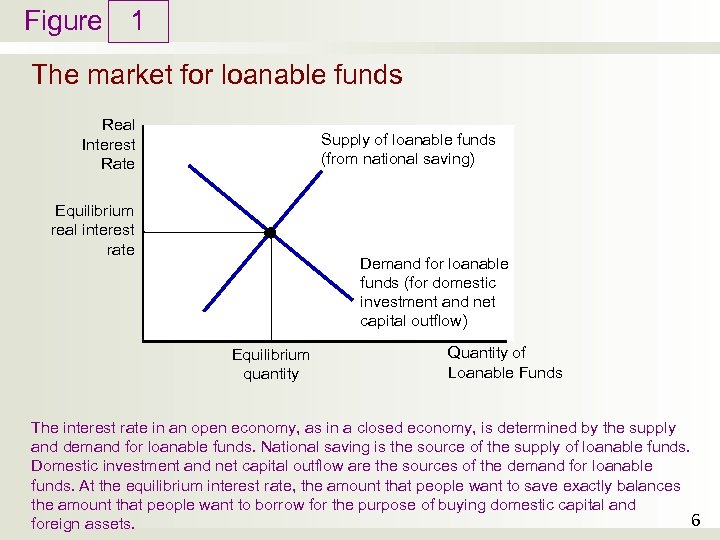 Figure 1 The market for loanable funds Real Interest Rate Supply of loanable funds (from national saving) Equilibrium real interest rate Demand for loanable funds (for domestic investment and net capital outflow) Equilibrium quantity Quantity of Loanable Funds The interest rate in an open economy, as in a closed economy, is determined by the supply and demand for loanable funds. National saving is the source of the supply of loanable funds. Domestic investment and net capital outflow are the sources of the demand for loanable funds. At the equilibrium interest rate, the amount that people want to save exactly balances the amount that people want to borrow for the purpose of buying domestic capital and 6 foreign assets.
 Market for Foreign-Currency Exchange • The market foreign-currency exchange – Identity: NCO = NX – Net capital outflow = Net exports • If trade surplus, NX > 0 – Foreigners - buy more U. S. goods & services • Than Americans - buy foreign goods & services – Americans – use foreign currency • Buy foreign assets – Capital is flowing abroad, NCO > 0 7
 Market for Foreign-Currency Exchange • The market foreign-currency exchange • If trade deficit, NX < 0 – Americans - buy more foreign goods & services • Than foreigners - buy U. S. goods & services – Some of this spending • Financed by selling American assets abroad – Foreign capital is flowing into U. S. – NCO < 0 8
 Market for Foreign-Currency Exchange • The market foreign-currency exchange • Supply of foreign-currency exchange – Net capital outflow – Quantity of dollars supplied - buy foreign assets – Supply curve – vertical • Quantity of dollars supplied for net capital outflow • Does not depend on the real exchange rate 9
 Market for Foreign-Currency Exchange • The market foreign-currency exchange • Demand foreign-currency exchange – Net exports – Quantity of dollars demanded – buy U. S. net exports of goods and services – Demand curve - downward sloping • A higher real exchange rate – Makes U. S. goods more expensive – Reduces the quantity of dollars demanded to buy those goods 10
 Market for Foreign-Currency Exchange • The market foreign-currency exchange • Equilibrium real exchange rate – Demand for dollars • By foreigners • Arising from U. S. net exports of goods & services – Exactly balances supply of dollars • From Americans • Arising from U. S. net capital outflow 11
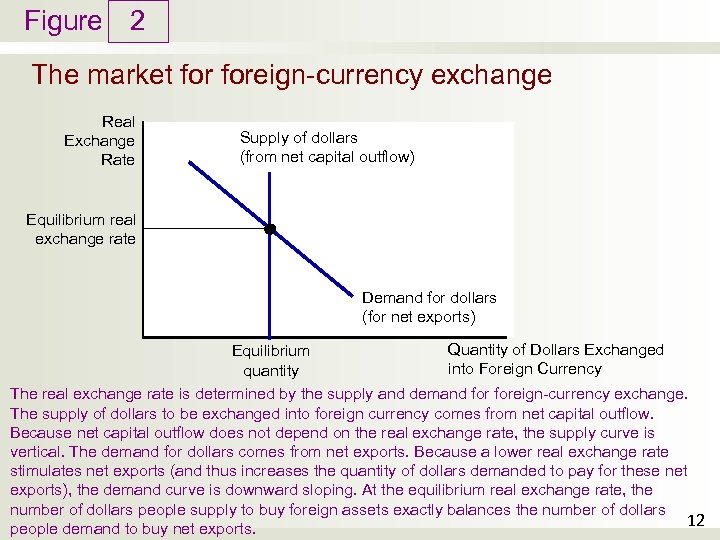 Figure 2 The market foreign-currency exchange Real Exchange Rate Supply of dollars (from net capital outflow) Equilibrium real exchange rate Demand for dollars (for net exports) Quantity of Dollars Exchanged Equilibrium into Foreign Currency quantity The real exchange rate is determined by the supply and demand foreign-currency exchange. The supply of dollars to be exchanged into foreign currency comes from net capital outflow. Because net capital outflow does not depend on the real exchange rate, the supply curve is vertical. The demand for dollars comes from net exports. Because a lower real exchange rate stimulates net exports (and thus increases the quantity of dollars demanded to pay for these net exports), the demand curve is downward sloping. At the equilibrium real exchange rate, the number of dollars people supply to buy foreign assets exactly balances the number of dollars 12 people demand to buy net exports.
 Equilibrium in the Open Economy • Net capital outflow: link between the two markets • Identities – Market for loanable funds: S = I + NCO – Market foreign-currency exchange: NCO=NX • Net-capital-outflow curve – Link between • Market for loanable funds • Market foreign-currency exchange 13
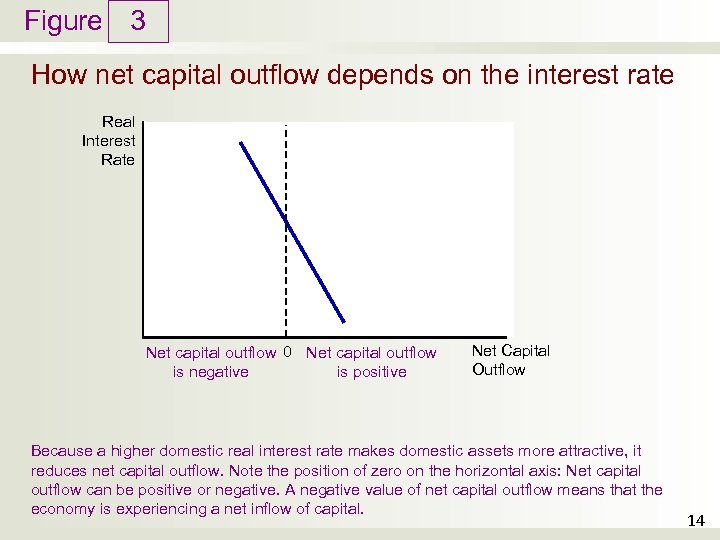 Figure 3 How net capital outflow depends on the interest rate Real Interest Rate Net capital outflow 0 Net capital outflow is negative is positive Net Capital Outflow Because a higher domestic real interest rate makes domestic assets more attractive, it reduces net capital outflow. Note the position of zero on the horizontal axis: Net capital outflow can be positive or negative. A negative value of net capital outflow means that the economy is experiencing a net inflow of capital. 14
 Equilibrium in the Open Economy • Simultaneous equilibrium in two markets – Market for loanable funds • Supply: national saving • Demand: domestic investment & net capital outflow • Equilibrium real interest rate, r – Net capital outflow • Slopes downward • Equilibrium interest rate, r 15
 Equilibrium in the Open Economy • Simultaneous equilibrium in two markets – Market foreign-currency exchange • Supply: net capital outflow • Demand: net exports • Equilibrium real exchange rate, E – Equilibrium real interest rate, r • Price of goods and services in the present – Relative to goods and services in the future – Equilibrium real exchange rate, E • Price of domestic goods and services – Relative to foreign goods and services 16
 Equilibrium in the Open Economy • Simultaneous equilibrium in two markets • E and r - adjust simultaneously – To balance supply and demand • In both markets – Loanable funds – Foreign-currency exchange – Determine • National saving • Domestic investment • Net capital outflow • Net exports 17
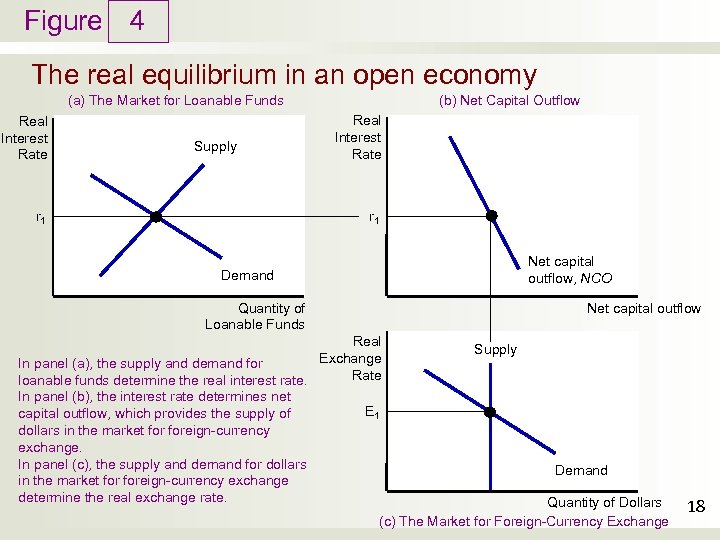 Figure 4 The real equilibrium in an open economy (b) Net Capital Outflow (a) The Market for Loanable Funds Real Interest Rate Supply Real Interest Rate r 1 Net capital outflow, NCO Demand Quantity of Loanable Funds Net capital outflow Real Exchange In panel (a), the supply and demand for Rate loanable funds determine the real interest rate. In panel (b), the interest rate determines net E 1 capital outflow, which provides the supply of dollars in the market foreign-currency exchange. In panel (c), the supply and demand for dollars in the market foreign-currency exchange determine the real exchange rate. Supply Demand Quantity of Dollars (c) The Market for Foreign-Currency Exchange 18
 How Policies & Events Affect an Open Economy • Government budget deficits • Negative public saving • Reduces national saving • Reduces supply of loanable funds • Increase in interest rate • Reduces net capital outflow • Crowd-out domestic investment • Decrease in supply of foreign-currency exchange • Exchange rate appreciates • Net exports fall • Push the trade balance toward deficit 19
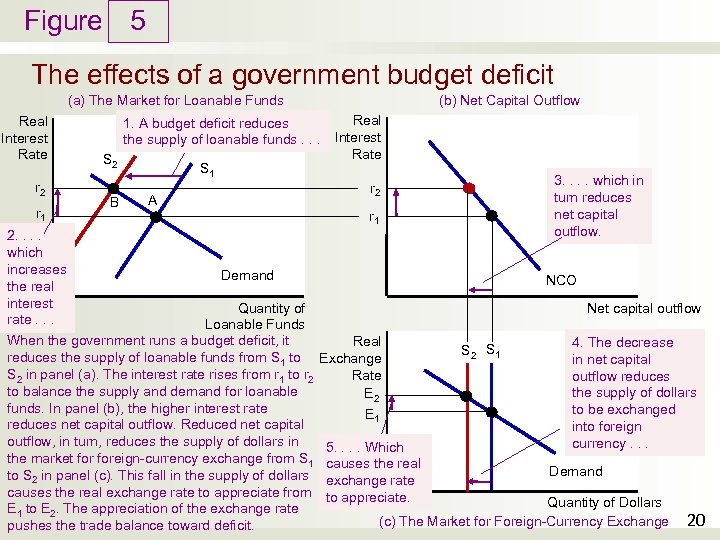 Figure 5 The effects of a government budget deficit (b) Net Capital Outflow (a) The Market for Loanable Funds Real Interest Rate r 2 r 1 2. . which increases the real interest rate. . . 1. A budget deficit reduces the supply of loanable funds. . . S 2 B S 1 Real Interest Rate 3. . which in turn reduces net capital outflow. r 2 A r 1 Demand Quantity of Loanable Funds When the government runs a budget deficit, it reduces the supply of loanable funds from S 1 to S 2 in panel (a). The interest rate rises from r 1 to r 2 to balance the supply and demand for loanable funds. In panel (b), the higher interest rate reduces net capital outflow. Reduced net capital outflow, in turn, reduces the supply of dollars in the market foreign-currency exchange from S 1 to S 2 in panel (c). This fall in the supply of dollars causes the real exchange rate to appreciate from E 1 to E 2. The appreciation of the exchange rate pushes the trade balance toward deficit. NCO Net capital outflow Real Exchange Rate E 2 E 1 5. . Which causes the real exchange rate to appreciate. S 2 S 1 4. The decrease in net capital outflow reduces the supply of dollars to be exchanged into foreign currency. . . Demand Quantity of Dollars (c) The Market for Foreign-Currency Exchange 20
 How Policies & Events Affect an Open Economy • Trade policy – Government policy – Directly influences the quantity of goods and services • That a country imports or exports – Tariff • Tax on imports – Import quota • Limit on quantity of imports 21
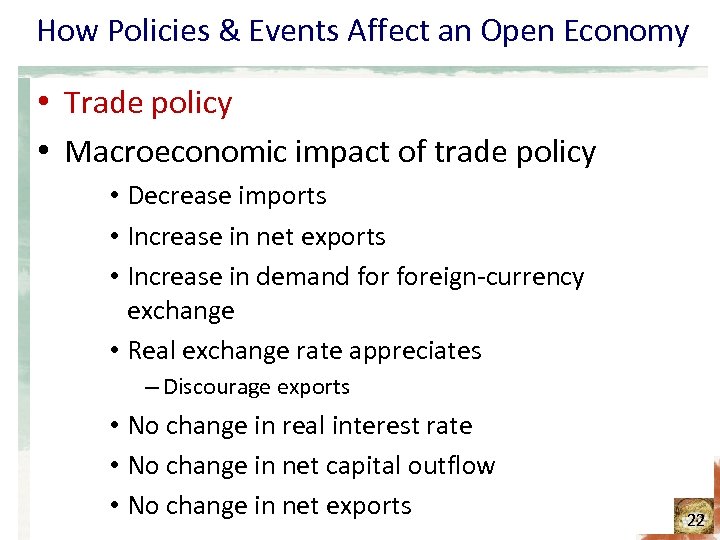 How Policies & Events Affect an Open Economy • Trade policy • Macroeconomic impact of trade policy • Decrease imports • Increase in net exports • Increase in demand foreign-currency exchange • Real exchange rate appreciates – Discourage exports • No change in real interest rate • No change in net capital outflow • No change in net exports 22
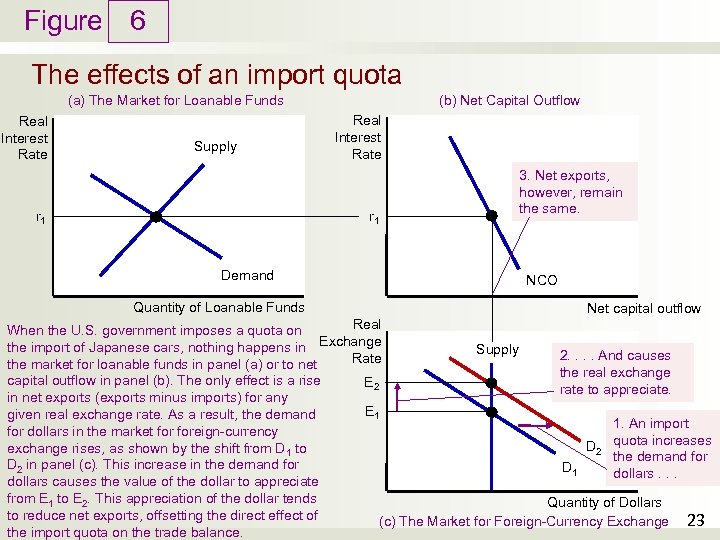 Figure 6 The effects of an import quota (b) Net Capital Outflow (a) The Market for Loanable Funds Real Interest Rate Supply Real Interest Rate r 1 Demand Quantity of Loanable Funds 3. Net exports, however, remain the same. NCO Net capital outflow Real When the U. S. government imposes a quota on the import of Japanese cars, nothing happens in Exchange Supply 2. . And causes Rate the market for loanable funds in panel (a) or to net the real exchange capital outflow in panel (b). The only effect is a rise E 2 rate to appreciate. in net exports (exports minus imports) for any E 1 given real exchange rate. As a result, the demand 1. An import for dollars in the market foreign-currency D 2 quota increases exchange rises, as shown by the shift from D 1 to the demand for D 2 in panel (c). This increase in the demand for D 1 dollars. . . dollars causes the value of the dollar to appreciate from E 1 to E 2. This appreciation of the dollar tends Quantity of Dollars to reduce net exports, offsetting the direct effect of (c) The Market for Foreign-Currency Exchange 23 the import quota on the trade balance.
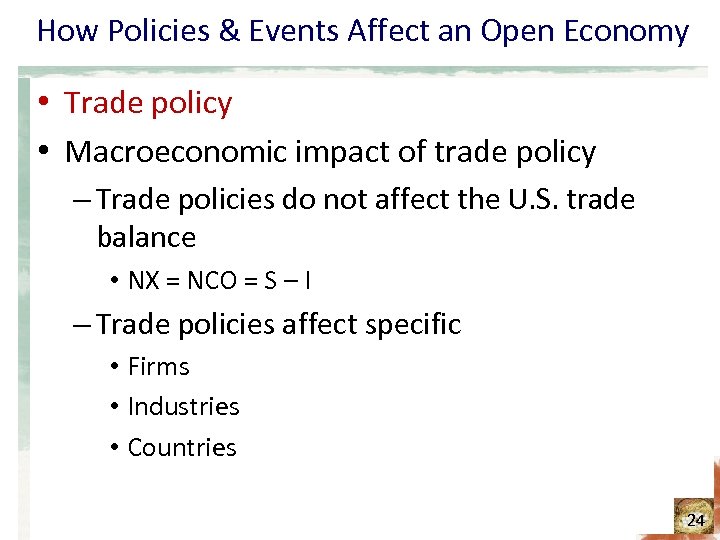 How Policies & Events Affect an Open Economy • Trade policy • Macroeconomic impact of trade policy – Trade policies do not affect the U. S. trade balance • NX = NCO = S – I – Trade policies affect specific • Firms • Industries • Countries 24
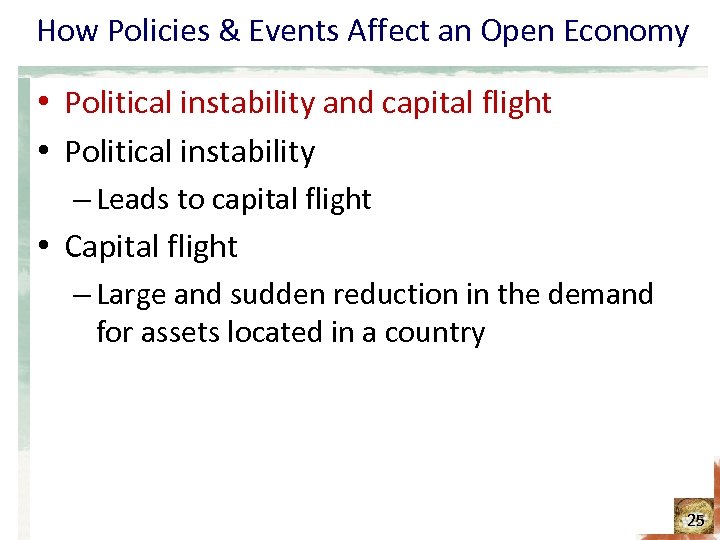 How Policies & Events Affect an Open Economy • Political instability and capital flight • Political instability – Leads to capital flight • Capital flight – Large and sudden reduction in the demand for assets located in a country 25
 How Policies & Events Affect an Open Economy • Mexico - capital flight affects both markets – Investors • Sell Mexican assets & Buy U. S. assets – Net-capital-outflow curve – increases • Supply of pesos in the market foreigncurrency exchange – increases – Demand curve in the market for loanable funds – increases – Interest rate – increases – The peso – depreciates 26
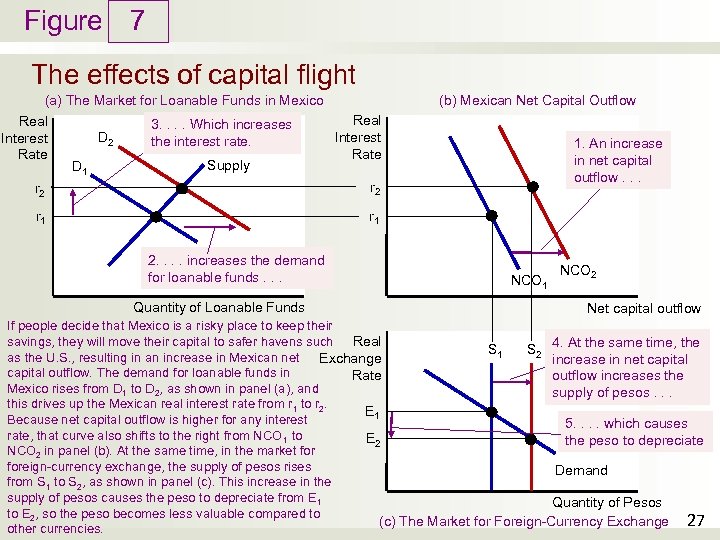 Figure 7 The effects of capital flight (a) The Market for Loanable Funds in Mexico Real 3. . Which increases D 2 Interest the interest rate. Rate Supply D 1 r 2 1. An increase in net capital outflow. . . r 2 r 1 (b) Mexican Net Capital Outflow r 1 2. . increases the demand for loanable funds. . . Quantity of Loanable Funds NCO 1 NCO 2 Net capital outflow If people decide that Mexico is a risky place to keep their savings, they will move their capital to safer havens such Real 4. At the same time, the S 1 S 2 as the U. S. , resulting in an increase in Mexican net Exchange increase in net capital outflow. The demand for loanable funds in Rate outflow increases the Mexico rises from D 1 to D 2, as shown in panel (a), and supply of pesos. . . this drives up the Mexican real interest rate from r 1 to r 2. E 1 Because net capital outflow is higher for any interest 5. . which causes rate, that curve also shifts to the right from NCO 1 to E 2 the peso to depreciate NCO 2 in panel (b). At the same time, in the market foreign-currency exchange, the supply of pesos rises Demand from S 1 to S 2, as shown in panel (c). This increase in the supply of pesos causes the peso to depreciate from E 1 Quantity of Pesos to E 2, so the peso becomes less valuable compared to (c) The Market for Foreign-Currency Exchange 27 other currencies.