 Скачать презентацию Chapter 18 Human Threats to Biodiversity Human
77a092ddaf36eb852fd474cefc4b03dc.ppt
- Количество слайдов: 18



Chapter 18 Human Threats to Biodiversity
Human Threats to Biodiversity: Introduction • the number of species is unknown: estimates range from 10 million to 100 million • ~1. 4 million species have been catalogued, many of them are beetles! • rates of speciation and extinction are also unknown, although estimates exist • it is widely believed that significant species loss is occurring, but it is easier to catalogue habitat loss than species loss • estimates of habitat loss can lead to estimates of species loss, but that is complicated because certain species are more important than other species to their ecosystems: keystone species
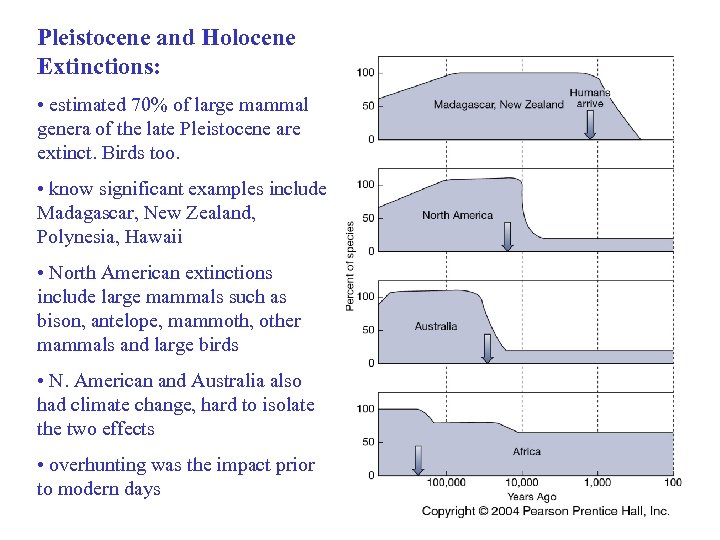
Pleistocene and Holocene Extinctions: • estimated 70% of large mammal genera of the late Pleistocene are extinct. Birds too. • know significant examples include Madagascar, New Zealand, Polynesia, Hawaii • North American extinctions include large mammals such as bison, antelope, mammoth, other mammals and large birds • N. American and Australia also had climate change, hard to isolate the two effects • overhunting was the impact prior to modern days
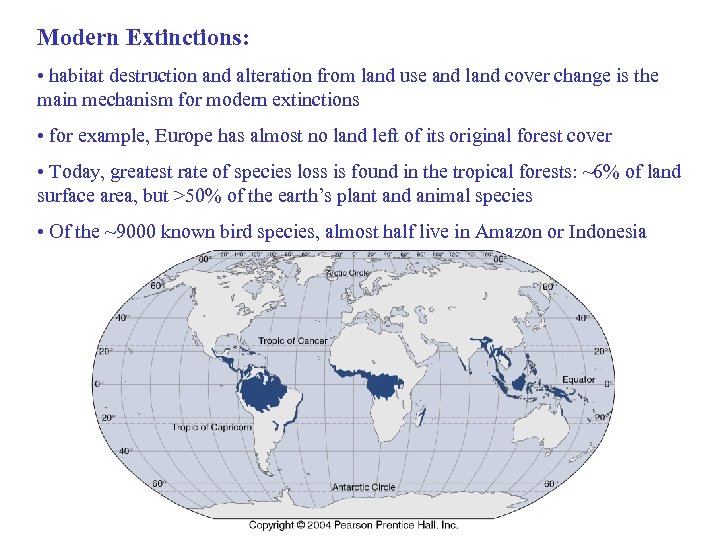
Modern Extinctions: • habitat destruction and alteration from land use and land cover change is the main mechanism for modern extinctions • for example, Europe has almost no land left of its original forest cover • Today, greatest rate of species loss is found in the tropical forests: ~6% of land surface area, but >50% of the earth’s plant and animal species • Of the ~9000 known bird species, almost half live in Amazon or Indonesia
Tropical Deforestation: • for every 10 x increase in the area of tropical forest, it is believed that the number of species doubles • E. O. Wilson concludes that ~27000 species are lost each year from tropical deforestation. This is believed to be perhaps thousands of times greater than the average natural rate of extinction • Tropical forests hold much of the nutrients in the biomass, not in the soil, and so when trees are removed few nutrients remain • soils are acidic, and tree seeds are less tolerant to the stressful environmental conditions, so forests do not grow back easily, or with the same species • many species live in relatively small geographic areas, and can get wiped out
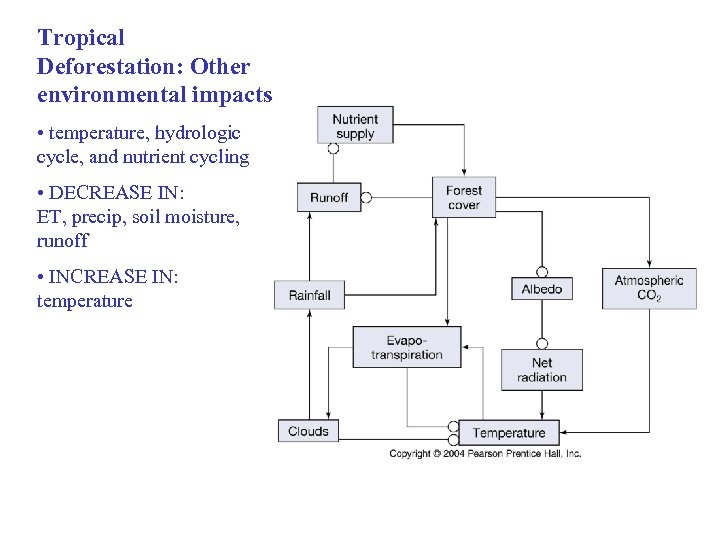
Tropical Deforestation: Other environmental impacts • temperature, hydrologic cycle, and nutrient cycling • DECREASE IN: ET, precip, soil moisture, runoff • INCREASE IN: temperature
Tropical Deforestation: how? • logging for agriculture, ranching, hydroelectric projects, mining, human settlement • 80, 000 km 2 per year cleared for agriculture • slash and burn leaves nutrients in the soil. Buth, they are depleted within a few years. If given enough regeneration time, this works. Otherwise, problems with soil fertility, crop yields, and degradation results • 50, 000 km 2 per year cleared for wood products (particularly Asia and West Africa) • 20, 000 km 2 per year in latin america cleared for cattle ranching. Usually results in soil that can not be regenerated due to compaction
Tropical Deforestation: why? • population growth • uneven property ownership – many landless, poor people forced to move into previously uninhabited areas • government sponsored resettlement programs: Brazil • cash crops or mineral extraction for export
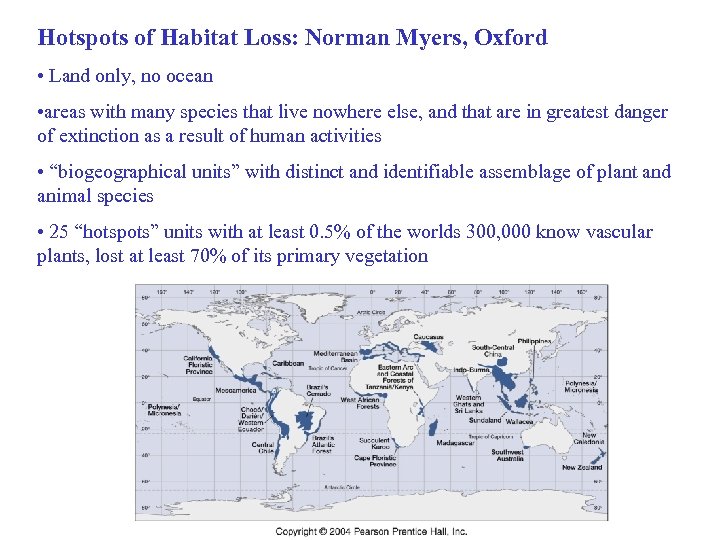
Hotspots of Habitat Loss: Norman Myers, Oxford • Land only, no ocean • areas with many species that live nowhere else, and that are in greatest danger of extinction as a result of human activities • “biogeographical units” with distinct and identifiable assemblage of plant and animal species • 25 “hotspots” units with at least 0. 5% of the worlds 300, 000 know vascular plants, lost at least 70% of its primary vegetation
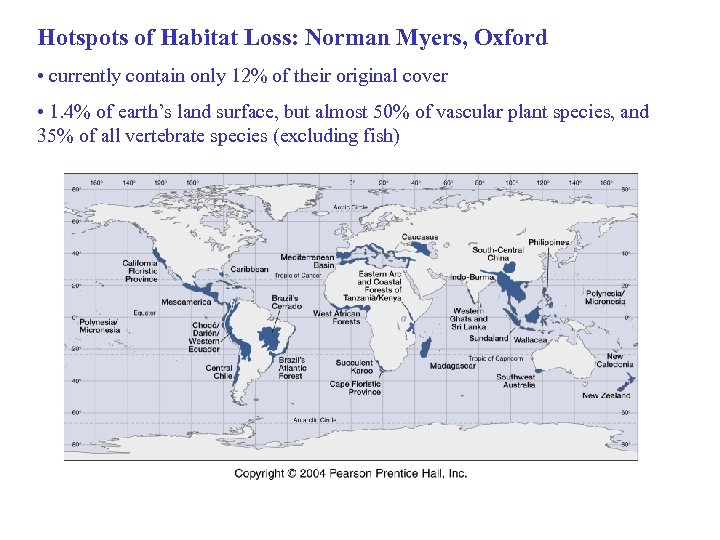
Hotspots of Habitat Loss: Norman Myers, Oxford • currently contain only 12% of their original cover • 1. 4% of earth’s land surface, but almost 50% of vascular plant species, and 35% of all vertebrate species (excluding fish)
Why should we care about biodiversity? Environmental Ethics • instrumental value how does one species benefit another (usually humans) • intrinsic value something has value for its own sake, regardless of how it benefits us • rights do animals, plants, rocks have rights? • biodiversity and food supply, ecosystem stability
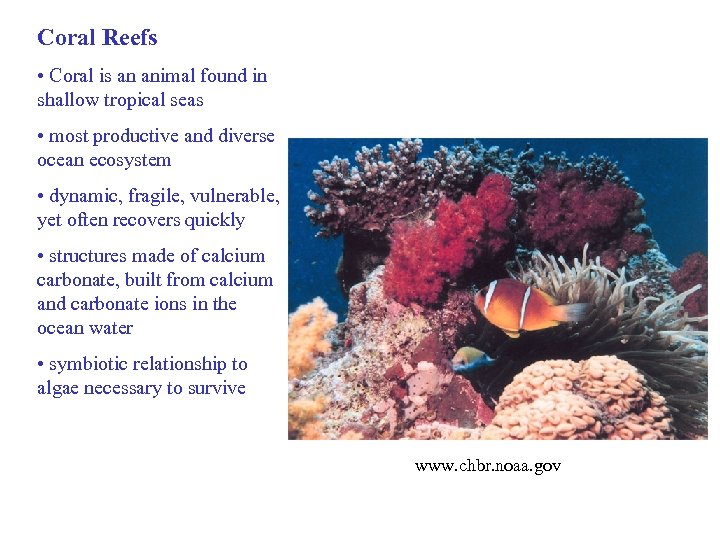
Coral Reefs • Coral is an animal found in shallow tropical seas • most productive and diverse ocean ecosystem • dynamic, fragile, vulnerable, yet often recovers quickly • structures made of calcium carbonate, built from calcium and carbonate ions in the ocean water • symbiotic relationship to algae necessary to survive www. chbr. noaa. gov
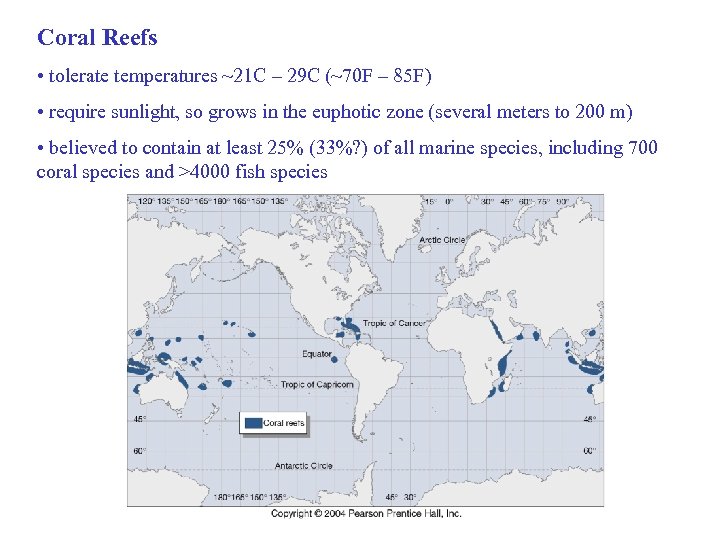
Coral Reefs • tolerate temperatures ~21 C – 29 C (~70 F – 85 F) • require sunlight, so grows in the euphotic zone (several meters to 200 m) • believed to contain at least 25% (33%? ) of all marine species, including 700 coral species and >4000 fish species
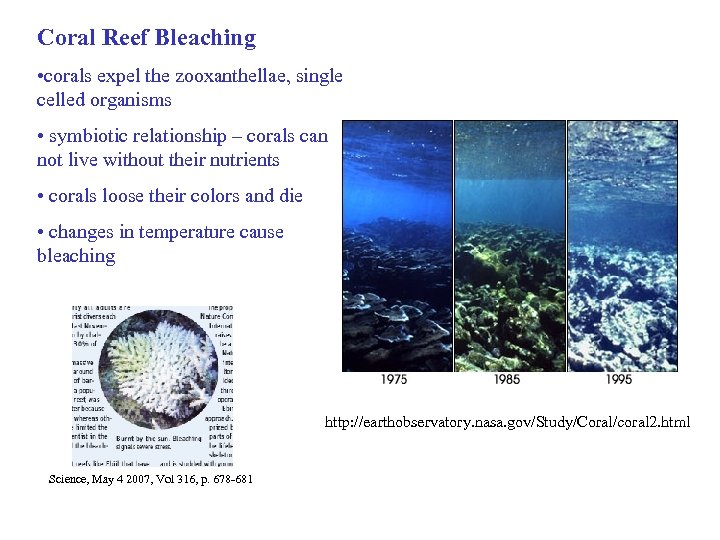
Coral Reef Bleaching • corals expel the zooxanthellae, single celled organisms • symbiotic relationship – corals can not live without their nutrients • corals loose their colors and die • changes in temperature cause bleaching http: //earthobservatory. nasa. gov/Study/Coral/coral 2. html Science, May 4 2007, Vol 316, p. 678 -681
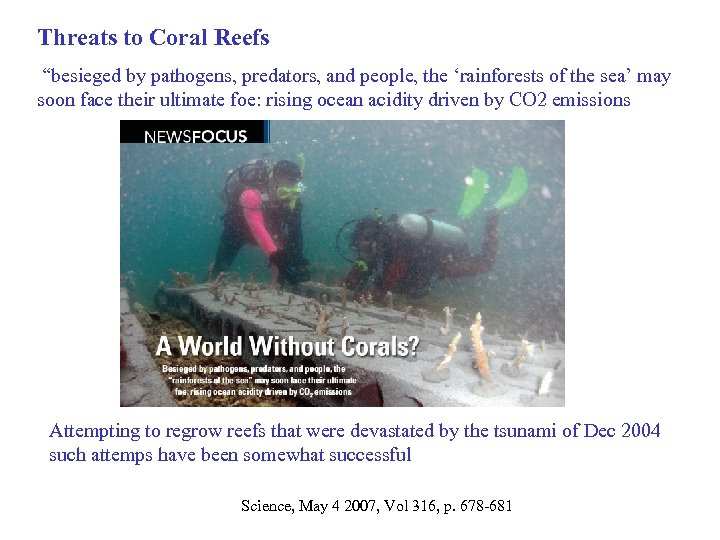
Threats to Coral Reefs “besieged by pathogens, predators, and people, the ‘rainforests of the sea’ may soon face their ultimate foe: rising ocean acidity driven by CO 2 emissions Attempting to regrow reefs that were devastated by the tsunami of Dec 2004 such attemps have been somewhat successful Science, May 4 2007, Vol 316, p. 678 -681
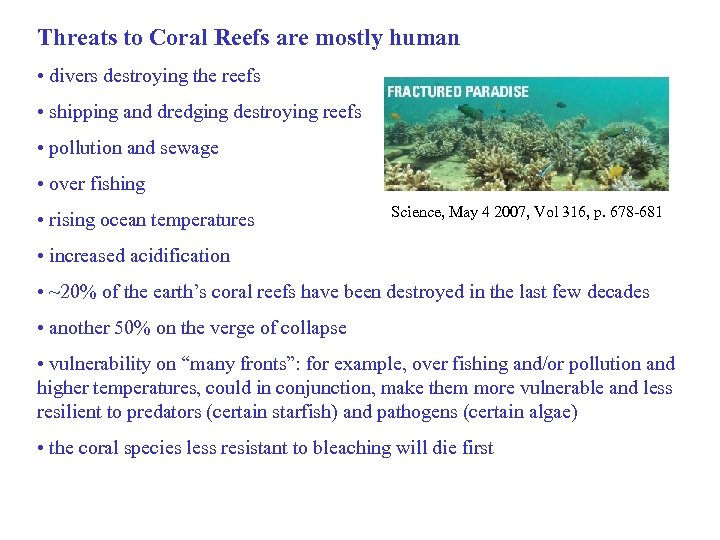
Threats to Coral Reefs are mostly human • divers destroying the reefs • shipping and dredging destroying reefs • pollution and sewage • over fishing • rising ocean temperatures Science, May 4 2007, Vol 316, p. 678 -681 • increased acidification • ~20% of the earth’s coral reefs have been destroyed in the last few decades • another 50% on the verge of collapse • vulnerability on “many fronts”: for example, over fishing and/or pollution and higher temperatures, could in conjunction, make them more vulnerable and less resilient to predators (certain starfish) and pathogens (certain algae) • the coral species less resistant to bleaching will die first
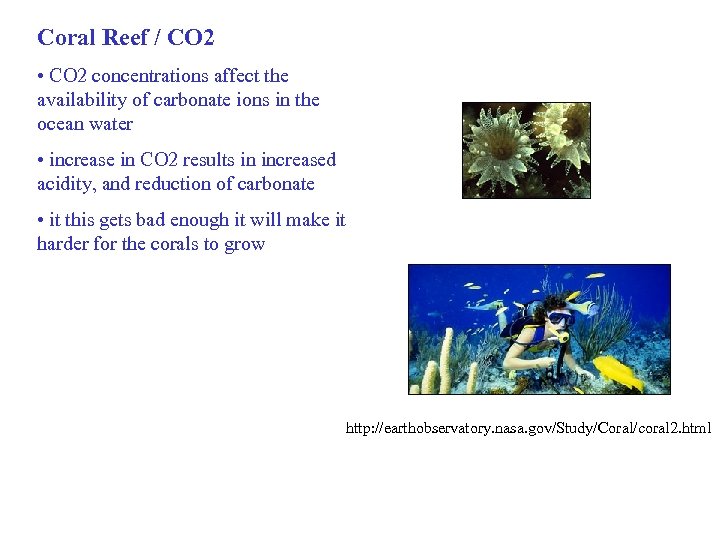
Coral Reef / CO 2 • CO 2 concentrations affect the availability of carbonate ions in the ocean water • increase in CO 2 results in increased acidity, and reduction of carbonate • it this gets bad enough it will make it harder for the corals to grow http: //earthobservatory. nasa. gov/Study/Coral/coral 2. html
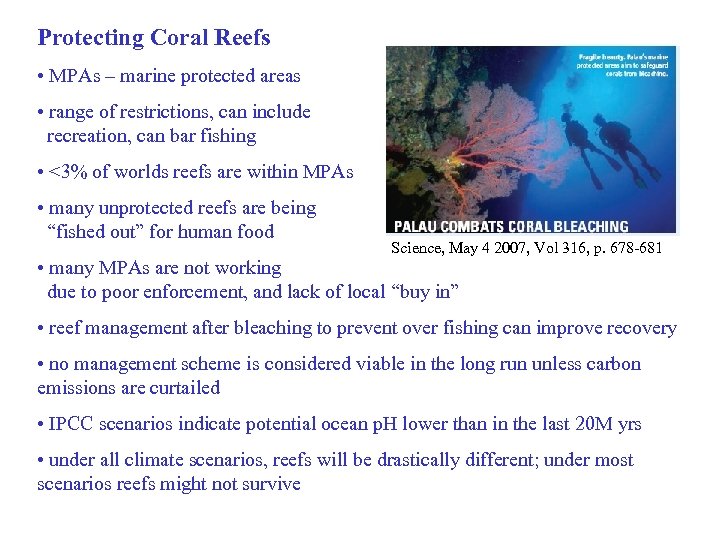
Protecting Coral Reefs • MPAs – marine protected areas • range of restrictions, can include recreation, can bar fishing • <3% of worlds reefs are within MPAs • many unprotected reefs are being “fished out” for human food Science, May 4 2007, Vol 316, p. 678 -681 • many MPAs are not working due to poor enforcement, and lack of local “buy in” • reef management after bleaching to prevent over fishing can improve recovery • no management scheme is considered viable in the long run unless carbon emissions are curtailed • IPCC scenarios indicate potential ocean p. H lower than in the last 20 M yrs • under all climate scenarios, reefs will be drastically different; under most scenarios reefs might not survive
Скачать презентацию Chapter 18 Human Threats to Biodiversity Human
77a092ddaf36eb852fd474cefc4b03dc.ppt