 Скачать презентацию Chapter 18 Externalities and Public Goods Chapter 18
6339254714a18bbd36473e3de92c6791.ppt
- Количество слайдов: 62



Chapter 18 Externalities and Public Goods Chapter 18 1

Topics to be Discussed n Externalities n Ways of Correcting Market Failure n Externalities and Property Rights n Common Property Resources Chapter 18 2
Topics to be Discussed n Public Goods n Private Preferences for Public Goods Chapter 18 3
Externalities n Negative l n Action by one party imposes a cost on another party Positive l Chapter 18 Action by one party benefits another party 4
External Cost n Scenario l Steel plant dumping waste in a river l The entire steel market effluent can be reduced by lowering output (fixed proportions production function) Chapter 18 5
External Cost n Scenario l Marginal External Cost (MEC) is the cost imposed on others for each level of production. l Marginal Social Cost (MSC) is MC plus MEC. Chapter 18 6
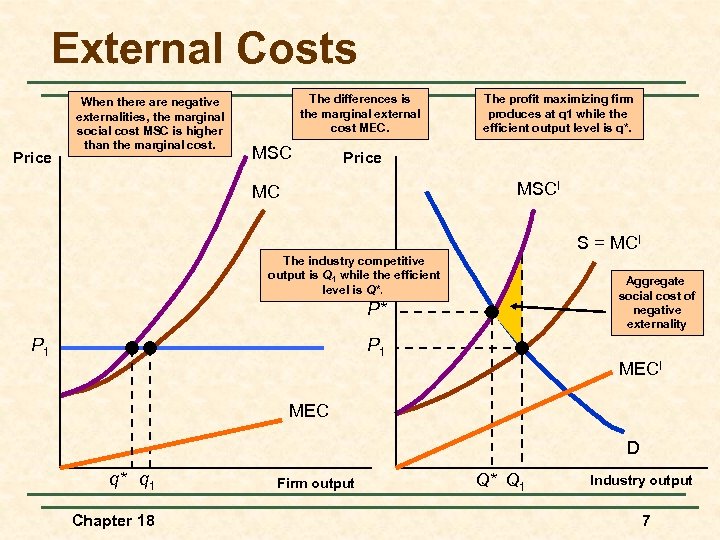
External Costs Price When there are negative externalities, the marginal social cost MSC is higher than the marginal cost. The differences is the marginal external cost MEC. MSC The profit maximizing firm produces at q 1 while the efficient output level is q*. Price MSCI MC S = MCI The industry competitive output is Q 1 while the efficient level is Q*. Aggregate social cost of negative externality P* P 1 MECI MEC D q* q 1 Chapter 18 Firm output Q* Q 1 Industry output 7
External Cost n Negative Externalities encourage inefficient firms to remain in the industry and create excessive production in the long run. Chapter 18 8
Externalities n Positive Externalities and Inefficiency l Chapter 18 Externalities can also result in too little production, as can be shown in an example of home repair and landscaping. 9
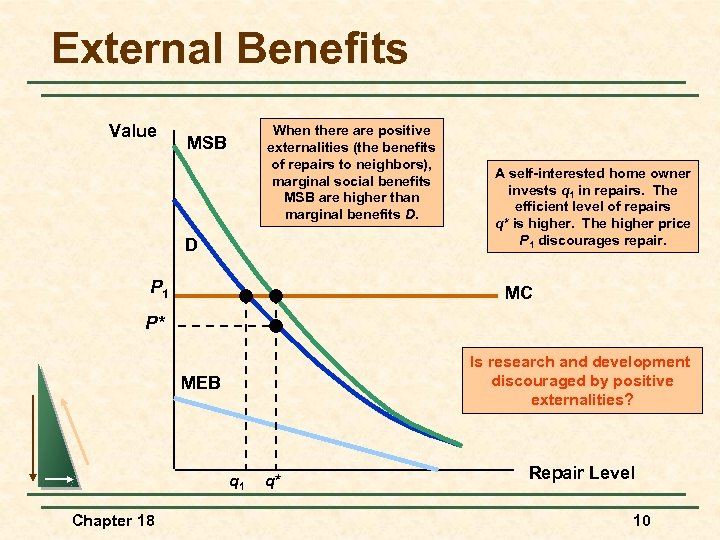
External Benefits Value When there are positive externalities (the benefits of repairs to neighbors), marginal social benefits MSB are higher than marginal benefits D. MSB D P 1 A self-interested home owner invests q 1 in repairs. The efficient level of repairs q* is higher. The higher price P 1 discourages repair. MC P* Is research and development discouraged by positive externalities? MEB q 1 Chapter 18 q* Repair Level 10
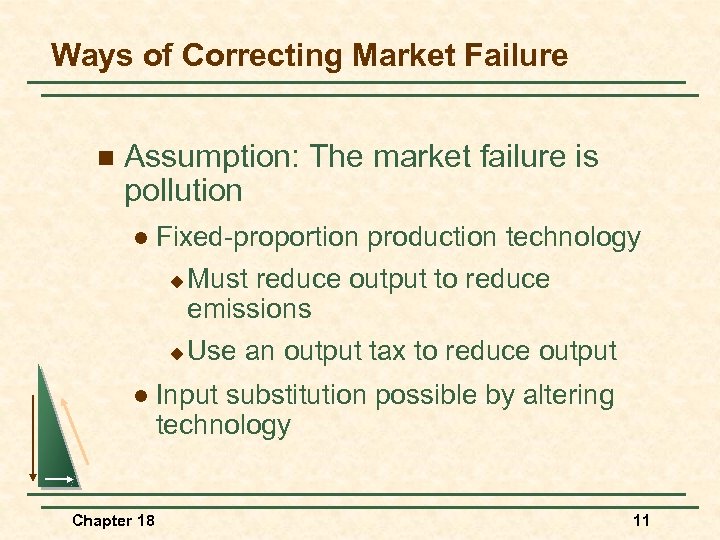
Ways of Correcting Market Failure n Assumption: The market failure is pollution l Fixed-proportion production technology u Must reduce output to reduce emissions u Use an output tax to reduce output l Input substitution possible by altering technology Chapter 18 11
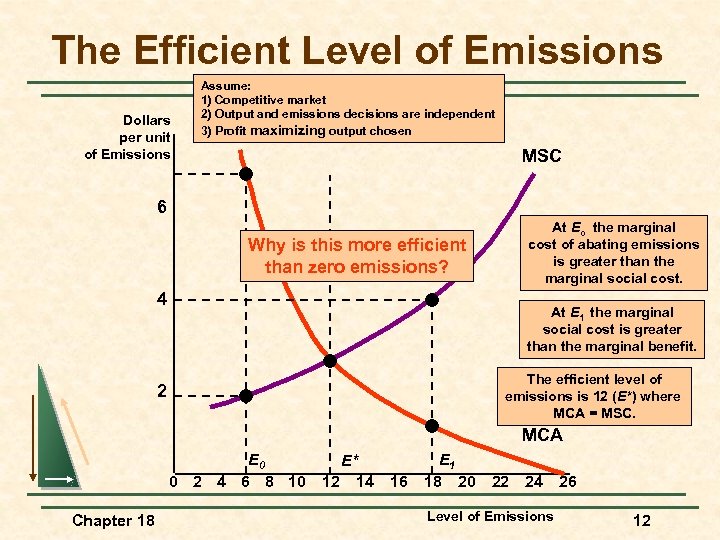
The Efficient Level of Emissions Dollars per unit of Emissions Assume: 1) Competitive market 2) Output and emissions decisions are independent 3) Profit maximizing output chosen MSC 6 At Eo the marginal cost of abating emissions is greater than the marginal social cost. Why is this more efficient than zero emissions? 4 At E 1 the marginal social cost is greater than the marginal benefit. The efficient level of emissions is 12 (E*) where MCA = MSC. 2 MCA E 0 0 2 4 6 8 10 Chapter 18 E* 12 14 E 1 16 18 20 22 24 26 Level of Emissions 12
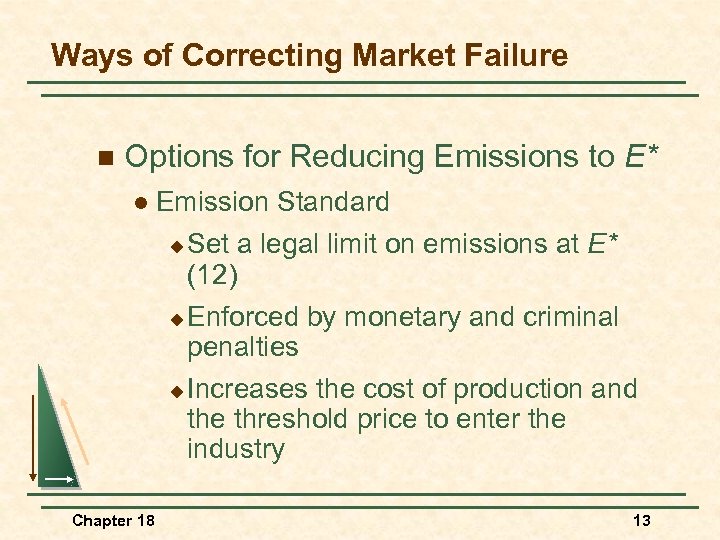
Ways of Correcting Market Failure n Options for Reducing Emissions to E* l Emission Standard Set a legal limit on emissions at E* (12) u Enforced by monetary and criminal penalties u u Chapter 18 Increases the cost of production and the threshold price to enter the industry 13
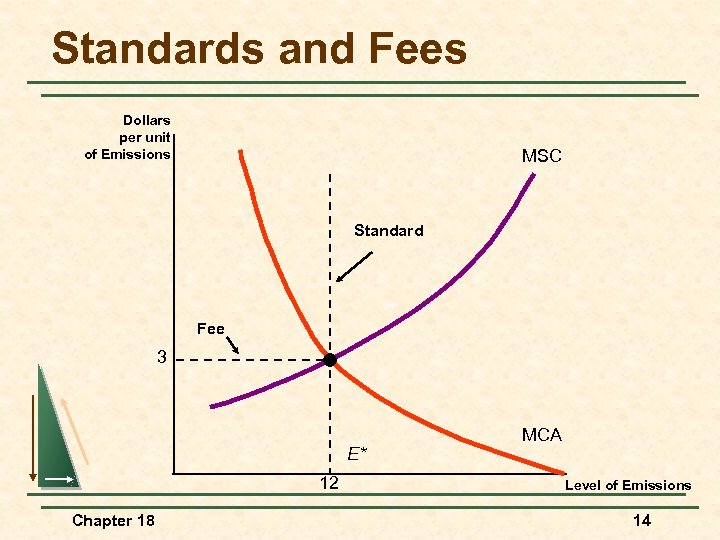
Standards and Fees Dollars per unit of Emissions MSC Standard Fee 3 E* 12 Chapter 18 MCA Level of Emissions 14
Ways of Correcting Market Failure n Options for Reducing Emissions to E* l Emissions Fee u Chapter 18 Charge levied on each unit of emission 15
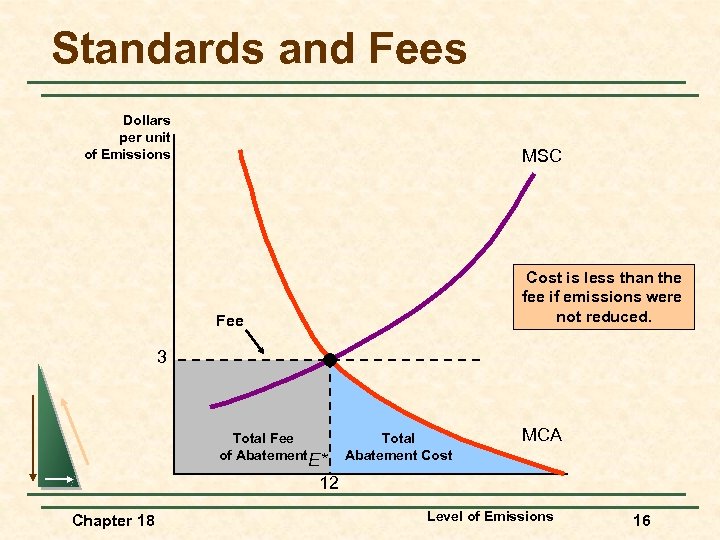
Standards and Fees Dollars per unit of Emissions MSC Cost is less than the fee if emissions were not reduced. Fee 3 Total Fee of Abatement. E* Total Abatement Cost MCA 12 Chapter 18 Level of Emissions 16
Ways of Correcting Market Failure n Standards Versus Fees l Assumptions u u Chapter 18 Policymakers have asymmetric information Administrative costs require the same fee or standard for all firms 17
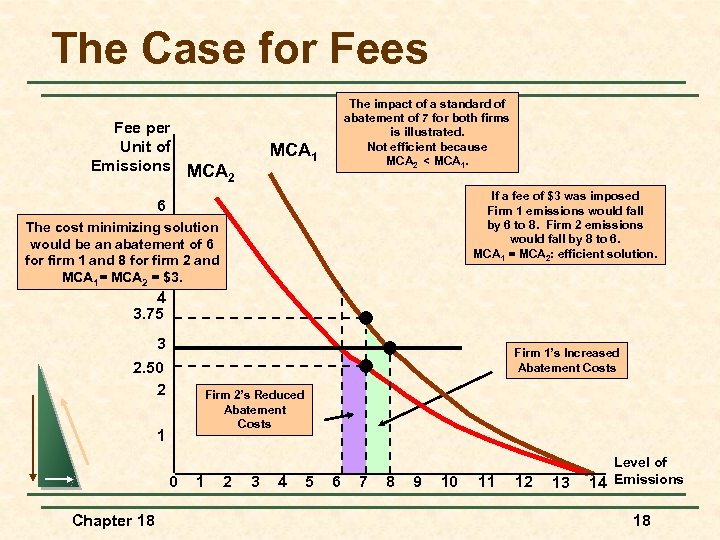
The Case for Fees Fee per Unit of Emissions The impact of a standard of abatement of 7 for both firms is illustrated. Not efficient because MCA 2 < MCA 1 MCA 2 If a fee of $3 was imposed Firm 1 emissions would fall by 6 to 8. Firm 2 emissions would fall by 8 to 6. MCA 1 = MCA 2: efficient solution. 6 The cost minimizing solution would be an abatement of 6 5 for firm 1 and 8 for firm 2 and MCA 1= MCA 2 = $3. 4 3. 75 3 2. 50 2 Firm 1’s Increased Abatement Costs Firm 2’s Reduced Abatement Costs 1 0 Chapter 18 1 2 3 4 5 6 7 8 9 10 11 12 13 Level of 14 Emissions 18
Ways of Correcting Market Failure n Advantages of Fees l When equal standards must be used, fees achieve the same emission abatement at lower cost. l Fees create an incentive to install equipment that would reduce emissions further. Chapter 18 19
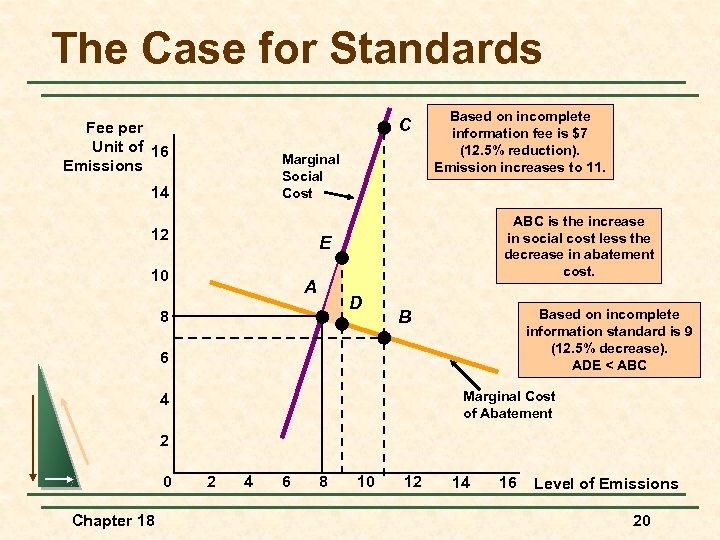
The Case for Standards C Fee per Unit of 16 Emissions Marginal Social Cost 14 12 Based on incomplete information fee is $7 (12. 5% reduction). Emission increases to 11. ABC is the increase in social cost less the decrease in abatement cost. E 10 A D 8 Based on incomplete information standard is 9 (12. 5% decrease). ADE < ABC B 6 Marginal Cost of Abatement 4 2 0 Chapter 18 2 4 6 8 10 12 14 16 Level of Emissions 20
Ways of Correcting Market Failure n Summary: Fees vs. Standards l Standards are preferred when MSC is steep and MCA is flat. l Standards (incomplete information) yield more certainty on emission levels and less certainty on the cost of abatement. Chapter 18 21
Ways of Correcting Market Failure n Summary: Fees vs. Standards l Fees have certainty on cost and uncertainty on emissions. l Preferred policy depends on the nature of uncertainty and the slopes of the cost curves. Chapter 18 22
Ways of Correcting Market Failure n Transferable Emissions Permits l Permits help develop a competitive market for externalities. u u u Chapter 18 Agency determines the level of emissions and number of permits Permits are marketable High cost firm will purchase permits from low cost firms 23
Externalities and Property Rights n Property Rights l Legal rules describing what people or firms may do with their property l For example u Chapter 18 If residents downstream owned the river (clean water) they control upstream emissions. 24
Externalities and Property Rights n Bargaining and Economic Efficiency l Chapter 18 Economic efficiency can be achieved without government intervention when the externality affects relatively few parties and when property rights are well specified. 25
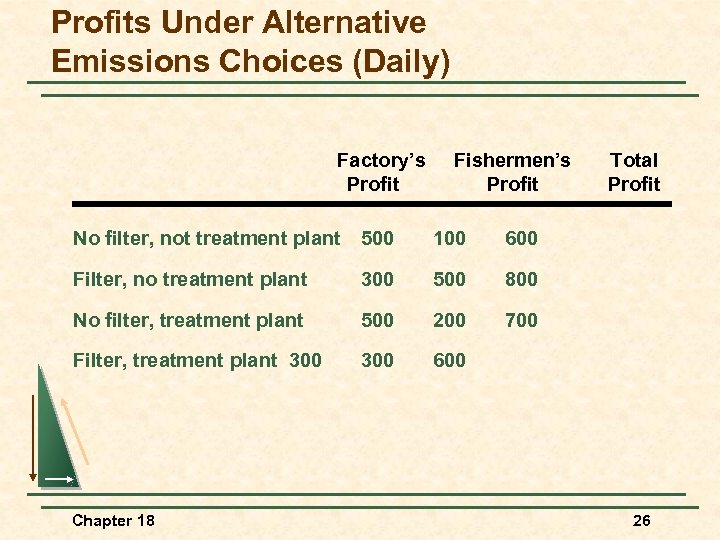
Profits Under Alternative Emissions Choices (Daily) Factory’s Profit Fishermen’s Profit No filter, not treatment plant 500 100 600 Filter, no treatment plant 300 500 800 No filter, treatment plant 500 200 700 Filter, treatment plant 300 Total Profit 600 Chapter 18 26
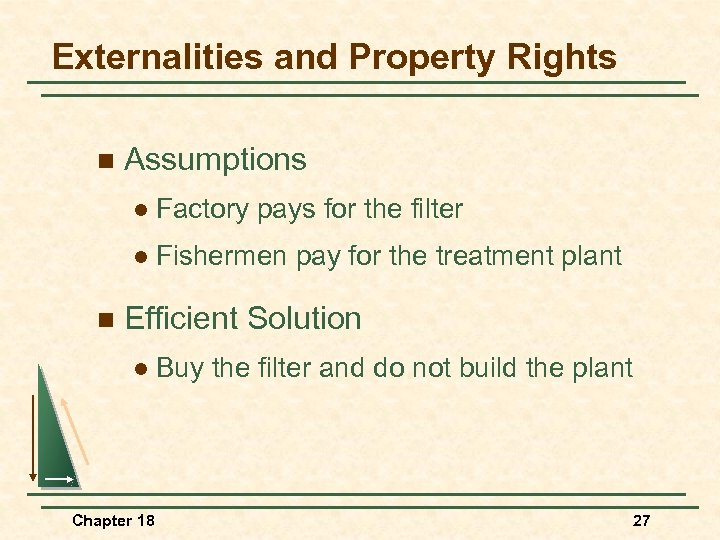
Externalities and Property Rights n Assumptions l l n Factory pays for the filter Fishermen pay for the treatment plant Efficient Solution l Chapter 18 Buy the filter and do not build the plant 27
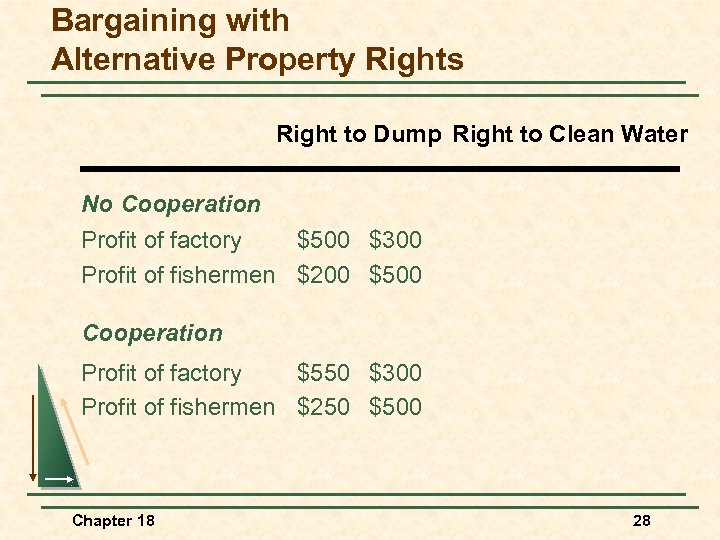
Bargaining with Alternative Property Rights Right to Dump Right to Clean Water No Cooperation Profit of factory $500 $300 Profit of fishermen $200 $500 Cooperation Profit of factory $550 $300 Profit of fishermen $250 $500 Chapter 18 28
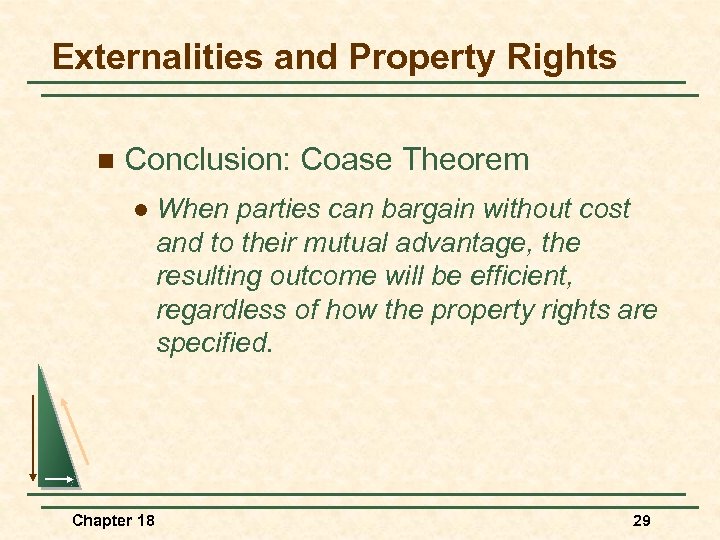
Externalities and Property Rights n Conclusion: Coase Theorem l Chapter 18 When parties can bargain without cost and to their mutual advantage, the resulting outcome will be efficient, regardless of how the property rights are specified. 29
Externalities and Property Rights n Costly Bargaining --- The Role of Strategic Behavior l Chapter 18 Bargaining requires clearly defined rules and property rights. 30
Externalities and Property Rights n A Legal Solution --- Suing for Damages l Fishermen have the right to clean water l Factory has two options u No filter, pay damages l u Profit = $100 ($500 - $400) Filter, no damages l Profit Chapter 18 = $300 ($500 - $200) 31
Externalities and Property Rights n A Legal Solution --- Suing for Damages l Factory has the right to emit effluent l Fishermen have three options u. Put l in treatment plant Profit = $200 u. Filter l u. No l Chapter 18 and pay damages Profit = $300 ($500 - $200) plant, no filter Profit = $100 32
Externalities and Property Rights n Conclusion l n A suit for damages results in an efficient outcome. Question l Chapter 18 How would imperfect information impact the outcome? 33
The Coase Theorem at Work n Negotiating an Efficient Solution l 1987 --- New York garbage spill (200 tons) littered the New Jersey beaches u. The potential cost of litigation resulted in a solution that was mutually beneficial to both parties. Chapter 18 34
Common Property Resources n Common Property Resource l Everyone has free access. l Likely to be overutilized l Examples u u Fish and animal populations u Chapter 18 Air and water Minerals 35
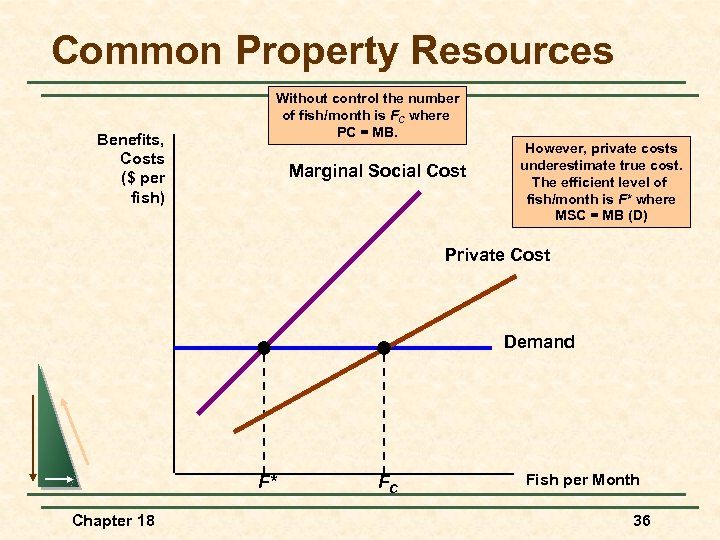
Common Property Resources Benefits, Costs ($ per fish) Without control the number of fish/month is FC where PC = MB. Marginal Social Cost However, private costs underestimate true cost. The efficient level of fish/month is F* where MSC = MB (D) Private Cost Demand F* Chapter 18 FC Fish per Month 36
Common Property Resources n Solution l n Private ownership Question l Chapter 18 When would private ownership be impractical? 37
Crawfish Fishing in Lousiana n Finding the Efficient Crawfish Catch l. F = crawfish catch in millions of pounds/yr l. C Chapter 18 = cost in dollars/pound 38
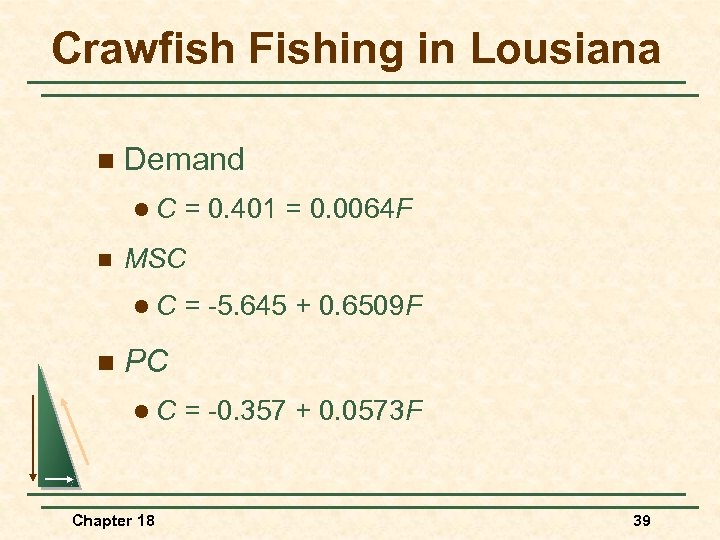
Crawfish Fishing in Lousiana n Demand l. C n MSC l. C n = 0. 401 = 0. 0064 F = -5. 645 + 0. 6509 F PC l. C Chapter 18 = -0. 357 + 0. 0573 F 39
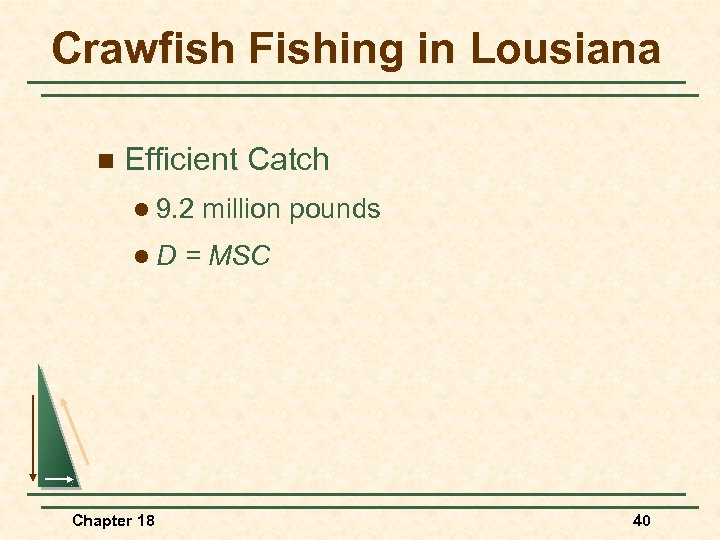
Crawfish Fishing in Lousiana n Efficient Catch l 9. 2 l. D Chapter 18 million pounds = MSC 40
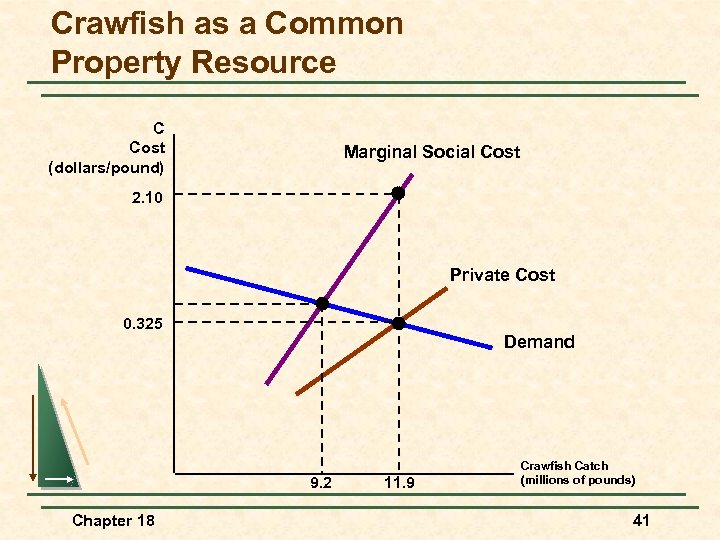
Crawfish as a Common Property Resource C Cost (dollars/pound) Marginal Social Cost 2. 10 Private Cost 0. 325 Demand 9. 2 Chapter 18 11. 9 Crawfish Catch (millions of pounds) 41
Public Goods n Question l Chapter 18 When should government replace firms as the producer of goods and services? 42
Public Goods n Public Good Characteristics l Nonrival u l Nonexclusive u Chapter 18 For any given level of production the marginal cost of providing it to an additional consumer is zero. People cannot be excluded from consuming the good. 43
Public Goods n Not all government produced goods are public goods l Some are rival and nonexclusive u u Chapter 18 Education Parks 44
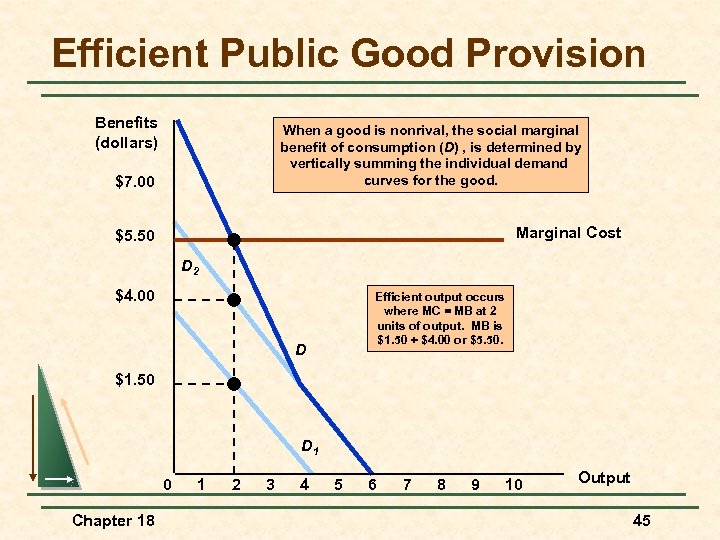
Efficient Public Good Provision Benefits (dollars) When a good is nonrival, the social marginal benefit of consumption (D) , is determined by vertically summing the individual demand curves for the good. $7. 00 Marginal Cost $5. 50 D 2 $4. 00 Efficient output occurs where MC = MB at 2 units of output. MB is $1. 50 + $4. 00 or $5. 50. D $1. 50 D 1 0 Chapter 18 1 2 3 4 5 6 7 8 9 10 Output 45
Public Goods n Public Goods and Market Failure l Chapter 18 How much national defense did you consume last week? 46
Public Goods n Free Riders l There is no way to provide some goods and services without benefiting everyone. l Households do not have the incentive to pay what the item is worth to them. l Free riders understate the value of a good or service so that they can enjoy its benefit without paying for it. Chapter 18 47
Public Goods n Establishing a mosquito abatement company l How do you measure output? l Who do you charge? l A mosquito meter? Chapter 18 48
The Demand for Clean Air n Clean Air is a public good l n Nonexclusive and nonrival What is the price of clean air? Chapter 18 49
The Demand for Clean Air n Choosing where to live l Chapter 18 Study in Boston correlates housing prices with the quality of air and other characteristics of the houses and their neighborhoods. 50
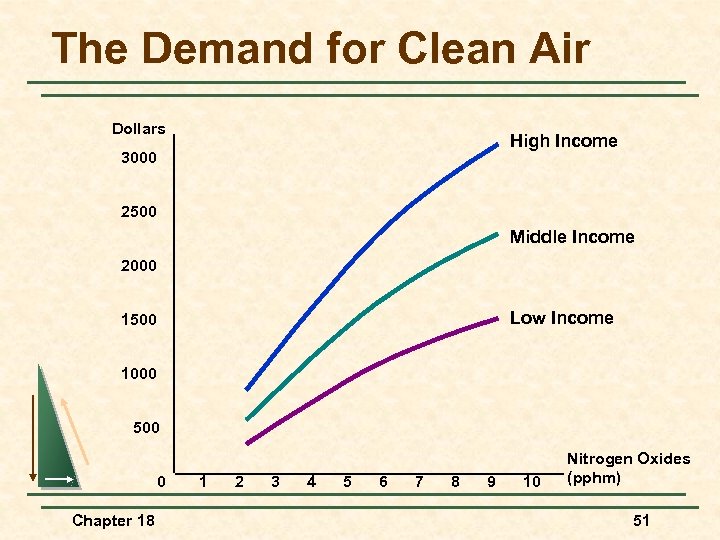
The Demand for Clean Air Dollars High Income 3000 2500 Middle Income 2000 Low Income 1500 1000 500 0 Chapter 18 1 2 3 4 5 6 7 8 9 10 Nitrogen Oxides (pphm) 51
The Demand for Clean Air n Findings l Amount people are willing to pay for clean air increases substantially as pollution increases. l Higher income earners are willing to pay more (the gap between the demand curves widen) l National Academy of Sciences found that a 10% reduction in auto emissions yielded a benefit of $2 billion---somewhat greater than the cost. Chapter 18 52
Private Preferences for Public Goods n Government production of a public good is advantageous because the government can assess taxes or fees to pay for it. n Determining how much of a public good to provide when free riders exist is difficult. Chapter 18 53
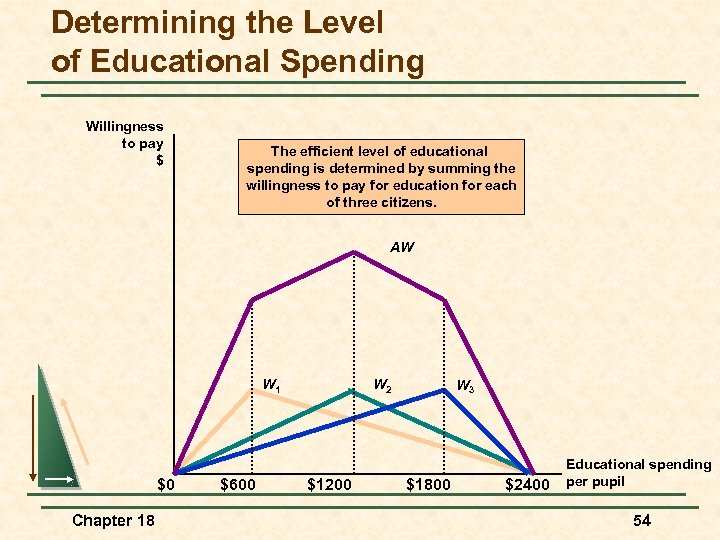
Determining the Level of Educational Spending Willingness to pay $ The efficient level of educational spending is determined by summing the willingness to pay for education for each of three citizens. AW W 1 $0 Chapter 18 $600 W 2 $1200 W 3 $1800 $2400 Educational spending per pupil 54
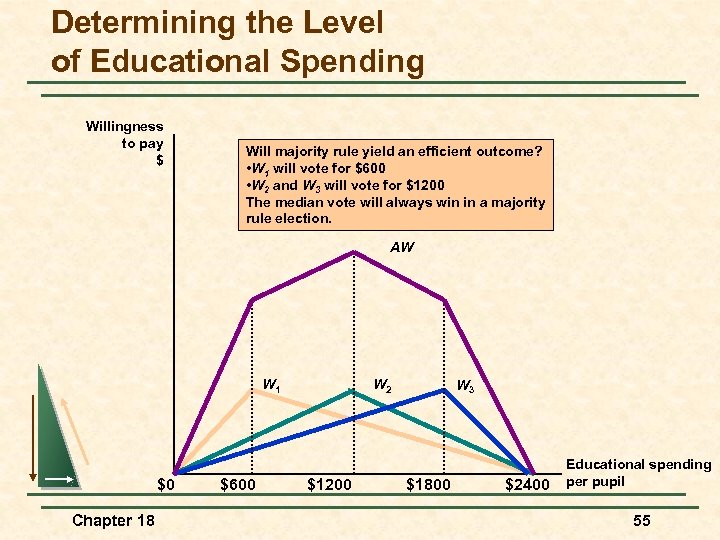
Determining the Level of Educational Spending Willingness to pay $ Will majority rule yield an efficient outcome? • W 1 will vote for $600 • W 2 and W 3 will vote for $1200 The median vote will always win in a majority rule election. AW W 1 $0 Chapter 18 $600 W 2 $1200 W 3 $1800 $2400 Educational spending per pupil 55
Private Preferences for Public Goods n Question l n Will the median voter selection always be efficient? Answer l If two of the three preferred $1200 there would be overinvestment. l If two of the three preferred $600 there would be underinvestment. Chapter 18 56
Private Preferences for Public Goods n Majority rule is inefficient because it weighs each citizen’s preference equally---the efficient outcome weighs each citizen’s vote by his or her strength of preference. Chapter 18 57
Summary n There is an externality when a producer or a consumer affects the production or consumption activities of others in a manner that is not directly reflected in the market. n Pollution can be corrected by emission standards, emissions fees, marketable emissions permits, or by encouraging recycling. Chapter 18 58
Summary n Inefficiencies due to market failure may be eliminated through private bargaining among the affected parties. n Common property resources are not controlled by a single person and can be used without a price being paid. Chapter 18 59
Summary n Goods that private markets are not likely to produce efficiently are either nonrival or nonexclusive. Public goods are both. n A public good is provided efficiently when the vertical sum of the individual demands for the public good is equal to the marginal cost of producing it. Chapter 18 60
Summary n Under majority rule voting, the level of spending provided will be that preferred by the median voter---this need not be the efficient outcome. Chapter 18 61
End of Chapter 18 Externalities and Public Goods Chapter 18 62
Скачать презентацию Chapter 18 Externalities and Public Goods Chapter 18
6339254714a18bbd36473e3de92c6791.ppt