


 Скачать презентацию CHAPTER 18 AMERICAN FOREIGN POLICY CHAPTER 18
fb15e4a08eea0e2fa560290a317c8fdf.ppt
- Количество слайдов: 63
 CHAPTER 18 AMERICAN FOREIGN POLICY
 CHAPTER 18: LEARNING OBJECTIVES v. Discuss the formal powers of Congress and the president to conduct foreign policy under the Constitution v. Trace the history of U. S. foreign policy from independence to the present v. Compare different approaches to foreign policy including isolationism, pacifism, and expansionism Copyright © 2012 Cengage Learning
 CHAPTER 18: LEARNING OBJECTIVES v. Understand the role of manifest destiny and America’s shift to internationalism in the twentieth century v. Consider America’s approach to the Cold War, including theories of containment v. Explain how foreign and military policy is conducted by the executive branch Copyright © 2012 Cengage Learning
 CHAPTER 18: LEARNING OBJECTIVES v. Describe current foreign policy in the Middle East, including the ongoing war on terrorism v. Describe the bureaucratic structures that implement foreign policy, including the State Department, the National Security Council, and various intelligence agencies Copyright © 2012 Cengage Learning
 CHAPTER 18: LEARNING OBJECTIVES v Explain how members of Congress and interest groups influence foreign policy v. Understand how public opinion shapes foreign policy, especially since 9/11 v. Appreciate how the preemption doctrine is used to justify aggressive military actions in the Middle East Copyright © 2012 Cengage Learning
 CHAPTER 18: LEARNING OBJECTIVES v Learn about the state of Russian-U. S. relations, the nature of U. S. foreign aid, and the role of the United Nations Copyright © 2012 Cengage Learning
 A DOMESTIC FOCUS YIELDS TO INTERNATIONAL REALITIES: NOW & THEN v. During his presidential campaign, he repeatedly criticized previous foreign policy initiatives that overextended America’s military abroad v. Questioned sending troops where U. S. immediate interests weren’t threatened Copyright © 2012 Cengage Learning
 …NOW & THEN v. Yet once elected, dramatic events quickly tipped the political scales in favor of increased U. S. involvement abroad v. As president, he went before Congress to demand immediate military action v. Ironically, his primary legacy would be as commander-in-chief and attempts to spread democracy Copyright © 2012 Cengage Learning
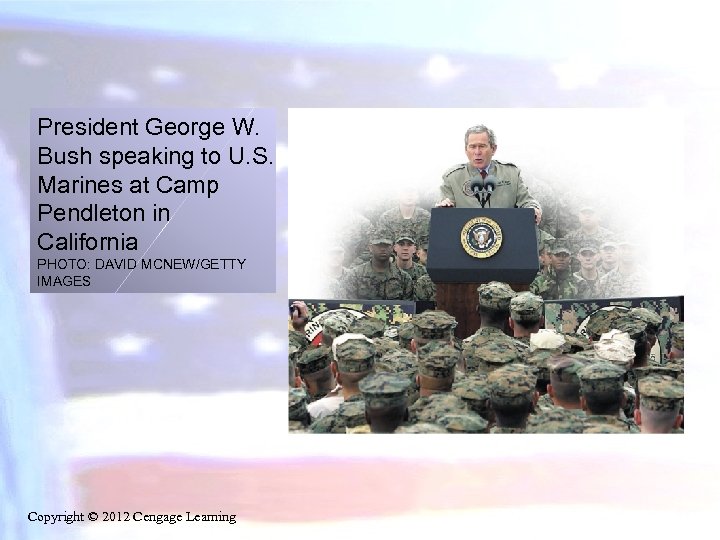 President George W. Bush speaking to U. S. Marines at Camp Pendleton in California PHOTO: DAVID MCNEW/GETTY IMAGES Copyright © 2012 Cengage Learning
 NOW… PRESIDENT GEORGE W. BUSH v. Viewed his father’s failed re-election bid as a warning that Americans wanted the emphasis to be on domestic issues v. But September 11, 2001 changed this v. Less than 2 years after criticizing the U. S. role as international policeman v. Bush readily flexed U. S. military power Copyright © 2012 Cengage Learning
 THEN… PRESIDENT WOODROW WILSON v. Ran for president twice as the candidate most closely associated with progressive domestic reforms v. Wilson won reelection on the slogan: “He kept us out of the war, ” but v. After German subs sank three U. S. ships in early 1917, he urged Americans to fight to make the world “safe for democracy” Copyright © 2012 Cengage Learning
 …NOW & THEN v. Both Bush and Wilson faced similar dilemmas v. Foreign policy seems to sit on the back burner, until the U. S. is attacked v. Then, even leaders who were elected on a platform of noninterventionism— v. Lead the charge for military solutions Copyright © 2012 Cengage Learning
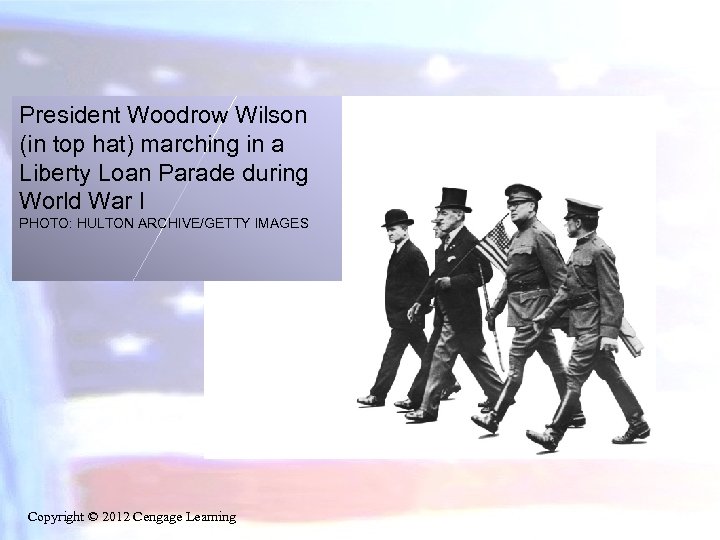 President Woodrow Wilson (in top hat) marching in a Liberty Loan Parade during World War I PHOTO: HULTON ARCHIVE/GETTY IMAGES Copyright © 2012 Cengage Learning
 THE CONSTITUTIONAL FRAMEWORK OF AMERICAN FOREIGN POLICY v. Foreign policy: all activities directed at conducting relations with other countries, including military operations and diplomatic activities v. The most basic elements of foreign policy during the 18 th and 19 th centuries were U. S. treaties with foreign nations Copyright © 2012 Cengage Learning
 THE CONSTITUTIONAL FRAMEWORK OF AMERICAN FOREIGN POLICY v. Within the next two centuries, control shifted from Congress to the president v. U. S. ascendancy to superpower status in the early 20 th century led to U. S. involvement in world affairs v. The presidency was well-suited to respond to these new demands Copyright © 2012 Cengage Learning
 AMERICAN GOVERNMENT… IN HISTORICAL PERSPECTIVE v. Presidential Dominance of the Warmaking Power v. Congress alone has the authority to declare war v. The president’s role as commander-inchief is theoretically limited to strategic decisions about how to wage war Copyright © 2012 Cengage Learning
 AMERICAN GOVERNMENT… IN HISTORICAL PERSPECTIVE v. The president has come to dominate the declaration and exercise of war making power in everything but name v 1861: Lincoln waged “war” for almost three months against the Confederacy without even calling Congress into session v. Critics complained he exceeded his constitutional authority Copyright © 2012 Cengage Learning
 AMERICAN GOVERNMENT… IN HISTORICAL PERSPECTIVE v 1964: Johnson secured consent from Congress for the Gulf of Tonkin Resolution v. Authorized the President to use armed military force to protect U. S. soldiers in South Vietnam and v. To deter further aggression from North Vietnam Copyright © 2012 Cengage Learning
 AMERICAN GOVERNMENT… IN HISTORICAL PERSPECTIVE v 2003: G. W. Bush ordered U. S. military forces (joined by troops from Great Britain, Australia and Poland) v. To “disarm Iraq of weapons of mass destruction, to end Saddam Hussein's support for terrorism, and v. To free the Iraqi people” Copyright © 2012 Cengage Learning
 WAR POWERS RESOLUTION v 1973: requires the president to report to Congress whenever U. S. forces enter into hostilities, and attain congressional permission to remain over sixty days v. Every president since has either evaded or ignored the Resolution, arguing it unconstitutionally infringes on the president’s war powers Copyright © 2012 Cengage Learning
 THE ROOTS OF AMERICAN FOREIGN POLICY v. The Isolationist Tradition and the Monroe Doctrine v. Under Washington’s leadership, the newly formed U. S. set aside the alliance with France and v. Declared neutrality when England revolutionary France went to war in 1793 Copyright © 2012 Cengage Learning
 THE ROOTS OF AMERICAN FOREIGN POLICY v. During the nation’s early years, the U. S. maintained a foreign policy marked by isolationism: opposition to both 1. Interventions in distant wars (outside the Western hemisphere) and 2. Involvement in permanent military alliances Copyright © 2012 Cengage Learning
 THE ROOTS OF AMERICAN FOREIGN POLICY v. Military isolationism never applied to the Western hemisphere v. Monroe Doctrine: U. S. would consider any new colonization efforts on its side of the Atlantic Ocean as an act of war v 1895: U. S. intervened between Great Britain and Venezuela over boundaries Copyright © 2012 Cengage Learning
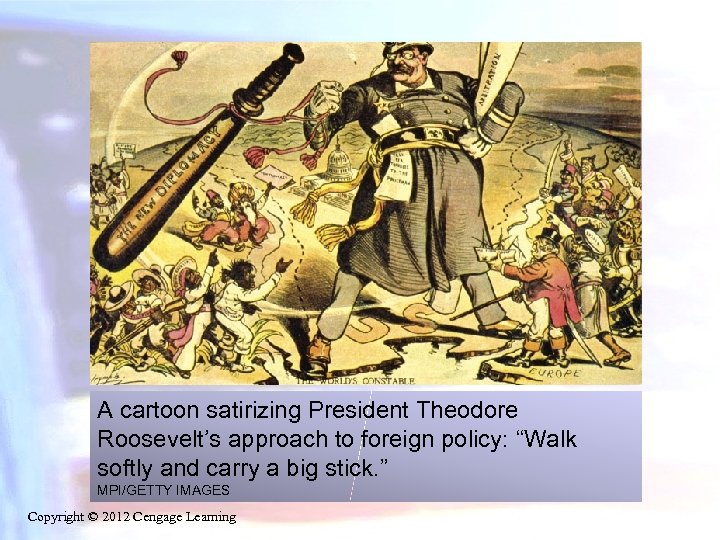 A cartoon satirizing President Theodore Roosevelt’s approach to foreign policy: “Walk softly and carry a big stick. ” MPI/GETTY IMAGES Copyright © 2012 Cengage Learning
 EXPANSIONISM AND THE BIRTH OF A SUPERPOWER v. Expansionism: doctrine of expanding territory or economic influence v. Began as a systematic pursuit of what many viewed as the nation’s defining ideology: v. Its manifest destiny to acquire and occupy the entire continent Copyright © 2012 Cengage Learning
 EXPANSIONISM AND THE BIRTH OF A SUPERPOWER v 1803: Louisiana Territory purchased from the French v 1817– 1819: Annexed Florida after conquering Spanish holdings there v 1840 s: Established the northeastern boundary of Maine and of the Oregon territory Copyright © 2012 Cengage Learning
 EXPANSIONISM AND THE BIRTH OF A SUPERPOWER v 1845: Annexed the Republic of Texas v 1846– 48: After the war against Mexico, gained all of California, Nevada, and Utah and parts of Arizona, New Mexico, Colorado, and Wyoming v 1890 s: Annexed Hawaii v 1898– 1902: Philippine Islands acquired Copyright © 2012 Cengage Learning
 EXPANSIONISM AND THE BIRTH OF A SUPERPOWER v 1917: After Germany relentlessly attacked U. S. vessels, we entered WWI v. By the end of WWI, the Allies owed over $11 billion to the U. S. v. Treaty of Versailles: established a system of reparations and called for the creation of a League of Nations Copyright © 2012 Cengage Learning
 EXPANSIONISM AND THE BIRTH OF A SUPERPOWER v. WWII: FDR first utilized a lend-lease program with Britain v. Supplied them with arms at little or no cost, and later, increased economic pressures on the Japanese v. The Japanese attack on Pearl Harbor propelled the U. S. into the war Copyright © 2012 Cengage Learning
 EXPANSIONISM AND THE BIRTH OF A SUPERPOWER v. After the war, European victors looked to the U. S. again to help keep peace v 1945: U. S. joined the newly created United Nations (UN) v. International organization formed to promote and maintain international security and peace Copyright © 2012 Cengage Learning
 EXPANSIONISM AND THE BIRTH OF A SUPERPOWER v. Marshall Plan: $13 billion in loans to Western European countries ravaged by WWII v. Some countries used it to combat inflation or retire state debts v. Others used the assistance to buy food Copyright © 2012 Cengage Learning
 FOREIGN POLICY DURING THE COLD WAR v. Cold War: conflict over ideological differences—U. S. democracy vs. Soviet Union communism v. Lasted from 1945 until the dissolution of the Soviet Union in 1991 v. Carried on by: economic warfare, arms buildups, and tense diplomacy Copyright © 2012 Cengage Learning
 FOREIGN POLICY DURING THE COLD WAR v 1949: North Atlantic Treaty Organization (NATO) v. Bound the U. S. to the military defense of Western Europe v. The Soviet Union dominated its Eastern European neighbors, including Poland Romania—the Warsaw Pact Copyright © 2012 Cengage Learning
 FOREIGN POLICY DURING THE COLD WAR v. Truman Doctrine: provided resources to assist non-Communist governments v. Containment: resisting any efforts to expand Communist influence v. Domino theory: Communist takeovers of Southeast Asian countries would cause takeovers of other nations as well Copyright © 2012 Cengage Learning
 FOREIGN POLICY DURING THE COLD WAR v. President Reagan denounced the Soviet Union as an evil empire v. Proposed the controversial Strategic Defense Initiative (SDI) v. An antimissile system using lasers and particle beams to shoot down Soviet nuclear missiles in outer space Copyright © 2012 Cengage Learning
 FOREIGN POLICY DURING THE COLD WAR v. Tensions eased with the leadership of reform-minded Mikhail Gorbachev v 1991: amid extremely difficult economic times, the former Soviet-bloc countries and 10 former Soviet republics, including Russia, declared their independence v Formally ended the Cold War Copyright © 2012 Cengage Learning
 YOUR PERSPECTIVE. . . ON AMERICAN GOVERNMENT v. Is the U. S. Draft a Thing of the Past? v. Do you believe America’s selective service system is unfair? v. Should it apply only to male U. S. citizens? v. Given the advanced state of military technology, can conscription still be justified? Copyright © 2012 Cengage Learning
 NEW WORLD ORDER AND NEW WORLD DISORDER v 1991: State of the Union speech, G. H. W. Bush spoke of a new world order v. Nations working together for peace, security, freedom, and the rule of law v. Maintaining this has been a challenge for American political leaders ever since Copyright © 2012 Cengage Learning
 NEW WORLD ORDER AND NEW WORLD DISORDER v. Further complicating the landscape is the looming presence of China v. Communist China is a crucial market for U. S. goods and products and contains 1/5 th of the world’s population v. Also, the U. S. economy is increasingly intertwined with the global economy Copyright © 2012 Cengage Learning
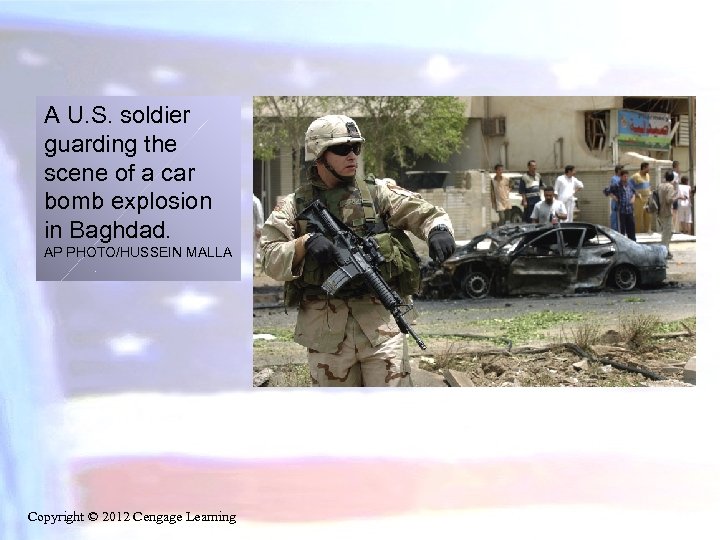 A U. S. soldier guarding the scene of a car bomb explosion in Baghdad. AP PHOTO/HUSSEIN MALLA Copyright © 2012 Cengage Learning
 THE U. S. GOVERNMENT CONFRONTS THE MIDDLE EAST v. Greatest threats to U. S. security during the 21 st century are in the Middle East and North Korea v. U. S. support for Israel has intensified distrust of many Middle East countries v. Exacerbated by U. S. military bases in Saudi Arabia and Kuwait Copyright © 2012 Cengage Learning
 THE U. S. GOVERNMENT CONFRONTS THE MIDDLE EAST v 1990: Iraq President Saddam Hussein invaded Kuwait v. Spurring the first Bush administration to militarily expel his army in early 1991 v. September 11, 2001 refocused U. S. foreign policy toward a global war on terrorism Copyright © 2012 Cengage Learning
 NAVIGATING THE NEW WORLD ORDER AFTER THE SEPTEMBER 11 ATTACKS v. After a short-lived war in Afghanistan that purportedly expelled Al Qaeda v. Attention turned back to Saddam Hussein’s government in Iraq v. After less than six weeks of fighting, American military forces liberated Iraq during the spring of 2003 Copyright © 2012 Cengage Learning
 NAVIGATING THE NEW WORLD ORDER AFTER THE SEPTEMBER 11 ATTACKS v. The aftermath of the Iraq war has proved highly problematic v. In 2009, President Obama announced an 18 -month withdrawal window v. Leaving 50, 000 troops after 2011 to advise and train Iraqi forces and provide intelligence and surveillance Copyright © 2012 Cengage Learning
 AMERICAN GOVERNMENT. . . IN GLOBAL PERSPECTIVE v. A Perspective on Obama’s Afghan Strategy. . . from the Other Side of the World v. President Obama’s military timetable was viewed as follows by Dr. Shanthie Mariet D'Souza of the Institute for Defence Studies and Analyses, New Delhi, India, in December 2009: Copyright © 2012 Cengage Learning
![AMERICAN GOVERNMENT. . . IN GLOBAL PERSPECTIVE v“…[I]t runs the danger of working to](https://present5.com/presentation/fb15e4a08eea0e2fa560290a317c8fdf/image-46.jpg "AMERICAN GOVERNMENT. . . IN GLOBAL PERSPECTIVE v“…[I]t runs the danger of working to") AMERICAN GOVERNMENT. . . IN GLOBAL PERSPECTIVE v“…[I]t runs the danger of working to the advantage [in propaganda] of the insurgents and their sponsors…” v“. . . [A]lthough the setting of a date for draw down of forces after 18 months ends a lot of speculation. . . it has sent a wrong message to the ‘friends and foes’ in the region. . . ” Copyright © 2012 Cengage Learning
AMERICAN GOVERNMENT. . . IN GLOBAL PERSPECTIVE v“…[I]t runs the danger of working to the advantage [in propaganda] of the insurgents and their sponsors…” v“. . . [A]lthough the setting of a date for draw down of forces after 18 months ends a lot of speculation. . . it has sent a wrong message to the ‘friends and foes’ in the region. . . ” Copyright © 2012 Cengage Learning
 NAVIGATING THE NEW WORLD ORDER AFTER THE SEPTEMBER 11 ATTACKS v. North Korea has now emerged as a potential nuclear threat v. Has the end of the Cold War ushered in a “new world disorder”— v. Ever-shifting alliances and grave terrorist threats from entities not formally associated with any specific nation? Copyright © 2012 Cengage Learning
 THE STRUCTURE OF AMERICAN FOREIGN POLICY MAKING v. The Role of the Executive Branch v. Presidential dominance of foreign policy allows the U. S. government to act immediately and decisively, however v. The more controversial foreign policy forays might have been avoided if so much power wasn’t vested in one individual Copyright © 2012 Cengage Learning
 THE STRUCTURE OF AMERICAN FOREIGN POLICY MAKING v. Other executive branch departments and agencies help formulate and implement foreign policy v. Department of State: headed by the secretary of state v. Maintains primary responsibility for many foreign policy programs Copyright © 2012 Cengage Learning
 THE STRUCTURE OF AMERICAN FOREIGN POLICY MAKING v. Department of Defense: plays a critical role in helping formulate and implement U. S. foreign policy by managing the nation’s military v. Joint Chiefs of Staff (JCS): chief officers of the army, navy, air force, and marines, and JCS chair and vice chair Copyright © 2012 Cengage Learning
 THE STRUCTURE OF AMERICAN FOREIGN POLICY MAKING v. National Security Council (NSC): presidential advisory body v. Coordinates information about foreign, military, and economic policies that affect national security, includes: v. President, VP, secretaries of state and defense, and a national security adviser Copyright © 2012 Cengage Learning
 DEPARTMENT OF HOMELAND SECURITY (DHS) v. Governmental divisions responsible for U. S. border and transportation security, and infrastructure protection, i. e. , v. U. S. Coast Guard, Secret Service, Federal Emergency Management Agency (FEMA), and the Bureau of Citizenship and Immigration Services Copyright © 2012 Cengage Learning
 CENTRAL INTELLIGENCE AGENCY (CIA) v. Correlates, evaluates, and disseminates intelligence information from throughout the world that affects national security v. Also disseminates propaganda— performs public relations functions on behalf of the U. S. , and v. Engages in overt or covert activities at the direction of the president Copyright © 2012 Cengage Learning
 AMERICAN GOVERNMENT. . . IN POPULAR PERSPECTIVE v“Jaywalking” and Americans’ Lack of Knowledge of World Affairs v. The common person’s ignorance has become a form of entertainment v“Jaywalking” videos can be found at The Tonight Show Web site, http: //www. nbc. com/the-tonight-show/ Copyright © 2012 Cengage Learning
 AMERICAN GOVERNMENT. . . IN POPULAR PERSPECTIVE v. How important is it for citizens to have general knowledge about other countries in general, and U. S. foreign relations in particular? v. Should standardized tests focus on social studies and civics, in addition to math and reading skills which are already tested? Copyright © 2012 Cengage Learning
 AMERICAN GOVERNMENT. . . IN POPULAR PERSPECTIVE v. In your opinion, are sources of news on the Internet, such as Google news and Yahoo news, as effective at conveying information as more traditional media sources such as newspapers and magazines? Copyright © 2012 Cengage Learning
 OTHER FOREIGN POLICY ACTORS AND INTERESTS v. Congressional approval of military actions can help rally public support and provide some political cover if they fail v. Legislators on the Senate and House Foreign Relations committees may initiate investigations v. House and Senate Armed Services committees oversee defense issues Copyright © 2012 Cengage Learning
 OTHER FOREIGN POLICY ACTORS AND INTERESTS v. Groups of legislators frequently tour other nations v. Private-sector interest groups have been active in general trade policy v. Military-industrial complex: network of U. S. defense industries; maintains a keen interest in foreign policy Copyright © 2012 Cengage Learning
 FOREIGN POLICY DILEMMAS FOR THE TWENTY-FIRST CENTURY 1. Is the Preemption Doctrine Justifiable? 2. Cultivating Relations with the New Russian Federation 3. What Role Does Foreign Aid Play in the New International Order? 4. Does the United Nations Still Serve an Important Function? Copyright © 2012 Cengage Learning
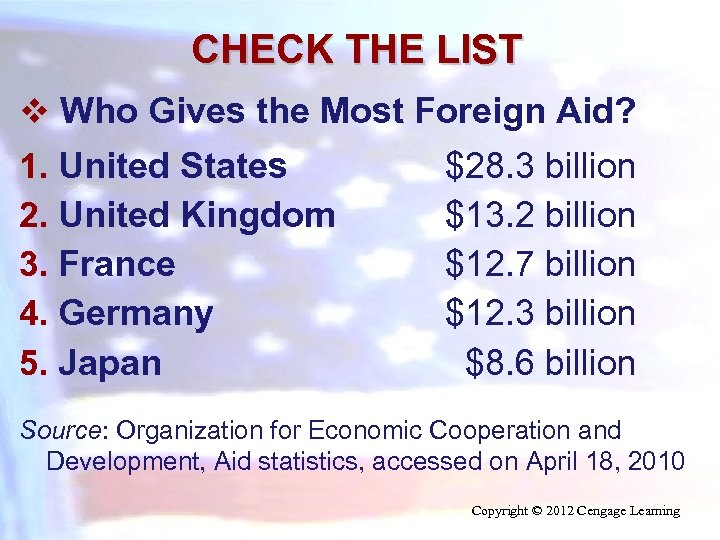 CHECK THE LIST v Who Gives the Most Foreign Aid? 1. United States 2. United Kingdom 3. France 4. Germany 5. Japan $28. 3 billion $13. 2 billion $12. 7 billion $12. 3 billion $8. 6 billion Source: Organization for Economic Cooperation and Development, Aid statistics, accessed on April 18, 2010 Copyright © 2012 Cengage Learning
 NOW & THEN: MAKING THE CONNECTION v. Unforeseen crises have a way of scuttling carefully laid presidential plans and bringing new priorities to the table v. Wilson’s second term was occupied with World War I and its aftermath v 9/11 launched Bush’s administration into the war on terrorism Copyright © 2012 Cengage Learning
 POLITICS INTERACTIVE! v A Growing Threat from Iran? v Iran’s warlike gestures may ultimately force the U. S. to again exercise its military power vwww. cengage. com/dautrich/america ngovernment/2 e v Find the link for the latest details on Iran, and how the current administration is reacting to these threats Copyright © 2012 Cengage Learning
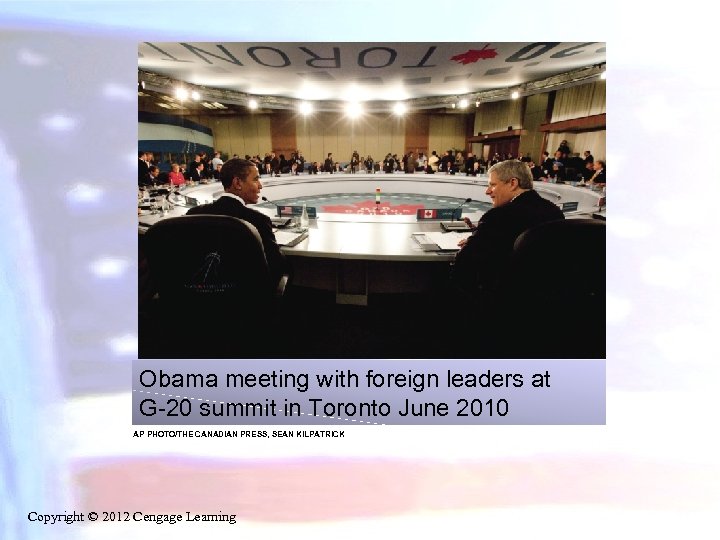 Obama meeting with foreign leaders at G-20 summit in Toronto June 2010 AP PHOTO/THE CANADIAN PRESS, SEAN KILPATRICK Copyright © 2012 Cengage Learning