


 Скачать презентацию Chapter 17 Legal Ethical and Social Impacts of
09a64f73b2121f89af2c59004146dc61.ppt
- Количество слайдов: 30
 Chapter 17 Legal, Ethical, and Social Impacts of EC Electronic Commerce Prentice Hall © 2006
 Learning Objectives 1. Describe the differences between legal and ethical issues in EC. 2. Understand the difficulties of protecting privacy in EC. 3. Discuss issues of intellectual property rights in EC. 4. Describe unsolicited ad problems and remedies. Electronic Commerce Prentice Hall © 2006 2
 Learning Objectives 5. Describe major legal issues in EC. 1. Describe the types of fraud on the Internet and how to protect against them. 2. Describe representative societal issues in EC. Electronic Commerce Prentice Hall © 2006 3
 Legal Issues Versus Ethical Issues ethics The branch of philosophy that deals with what is considered to be right and wrong Electronic Commerce Prentice Hall © 2006 4
 Legal Issues Versus Ethical Issues • The Major Ethical and Legal Issues Discussed in this Chapter – – – -- Privacy Intellectual property rights and online piracy Unsolicited electronic ads and spamming Consumer and merchant protection against fraud Electronic Commerce Prentice Hall © 2006 5
 Legal Issues Versus Ethical Issues • EC Ethical Issues – Non-Work-Related Use of the Internet • • • Employees are tempted to use e-mail and the Web for non -work-related purposes In some companies, this use is tremendously out of proportion with its work-related use The utility of monitoring employee usage can be considered “one of the most controversial EC issues” Electronic Commerce Prentice Hall © 2006 6
 Legal Issues Versus Ethical Issues – Codes of Ethics: Useful guidelines for a corporate Web policy: • • Issue written policy guidelines about employee use of the Internet Make it clear to employees that they cannot use copyrighted trademarked material without permission Post disclaimers concerning content, such as sample code, that the company does not support Post disclaimers of responsibility concerning content of online forums and chat sessions Electronic Commerce Prentice Hall © 2006 7
 Legal Issues Versus Ethical Issues • Codes of Ethics: Useful guidelines for a corporate Web policy: – – – Make sure that Web content and activity comply with the laws in other countries Make sure that the company’s Web content policy is consistent with other company policies Appoint someone to monitor Internet legal and liability issues. Have attorneys review Web content to make sure that there is nothing unethical, or illegal, on the company’s Web site Electronic Commerce Prentice Hall © 2006 8
 Privacy • privacy The right to be left alone and the right to be free of unreasonable personal intrusions Collecting Information about Individuals – – – Web Site Registration Cookies Spyware and Similar Methods RFID’s Threat to Privacy of Employees Privacy of Patients Electronic Commerce Prentice Hall © 2006 9
 • Protection of Privacy – Notice/awareness – Choice/consent opt-out clause Agreement that requires computer users to take specific steps to prevent the collection of personal information opt-in clause Agreement that requires computer users to take specific steps to allow the collection of personal information Electronic Commerce Prentice Hall © 2006 10
 Privacy • Protection of Privacy – – – Access/participation Integrity/security Enforcement/redress Electronic Commerce Prentice Hall © 2006 11
 Privacy • The USA Patriot Act – – – E-mail and Internet searches Nationwide roving wiretaps Requirement that ISPs hand over more user information Expanded scope of surveillance based on new definitions of terrorism Government spying on suspected computer trespassers with no need for court order Wiretaps for suspected violations of the Computer Fraud and Abuse Act Electronic Commerce Prentice Hall © 2006 12
 Privacy • The USA Patriot Act – – Dramatic increases in the scope and penalties of the Computer Fraud and Abuse Act General expansion of Foreign Intelligence Surveillance Act (FISA) authority Increased information sharing between domestic law enforcement and intelligence FISA detours around federal domestic surveillance limitations; domestic surveillance detours around FISA limitations Electronic Commerce Prentice Hall © 2006 13
 Privacy • Privacy Protection in Other Countries – – In 1998, the European Union passed a privacy directive (EU Data Protection Directive) reaffirming the principles of personal data protection in the Internet age The directive aims to regulate the activities of any person or company that controls the collection, storage, processing, or use of personal data on the Internet Electronic Commerce Prentice Hall © 2006 14
 Intellectual Property Rights intellectual property Creations of the mind, such as inventions, literary and artistic works, and symbols, names, images, and designs, used in commerce Electronic Commerce Prentice Hall © 2006 15
 Intellectual Property Rights copyright An exclusive grant from the government that allows the owner to reproduce a work, in whole or in part, and to distribute, perform, or display it to the public in any form or manner, including over Internet • • • Literary works Musical works Dramatic works Artistic works Sound recordings, films, broadcasts, cable programs Electronic Commerce Prentice Hall © 2006 16
 Intellectual Property Rights • Copyrights – – – Piracy of Software, Music, and Other Digitizable Material Copyright Protection Approaches digital watermarks Unique identifiers embedded in digital content that make it possible to identify pirated works Digital Rights Management Electronic Commerce Prentice Hall © 2006 17
 Intellectual Property Rights trademark A symbol used by businesses to identify their goods and services; government registration of the trademark confers exclusive legal right to its use – Domain Name Disputes and Resolutions cybersquatting The practice of registering domain names in order to sell them later at a higher price Electronic Commerce Prentice Hall © 2006 18
 Intellectual Property Rights • patent A document that grants the holder exclusive rights to an invention for a fixed number of years Fan and Hate Sites cyberbashing The registration of a domain name that criticizes an organization or person Electronic Commerce Prentice Hall © 2006 19
 Unsolicited Electronic Ads: Problems and Solutions • E-Mail Spamming – unsolicited commercial e-mail (UCE) The use of e-mail to send unwanted ads or correspondence What Drives UCE? Many spammers are just trying to get people’s financial information Electronic Commerce Prentice Hall © 2006 20
 Unsolicited Electronic Ads: Problems and Solutions – Why It Is Difficult to Control Spamming • • – Spammers send millions of e-mails, shifting Internet accounts to avoid detection Spammers use different methods to find their victims Solutions to Spamming • • • Junk-mail filters Automatic junk-mail deleters Blocking certain URLs and e-mail addresses Electronic Commerce Prentice Hall © 2006 21
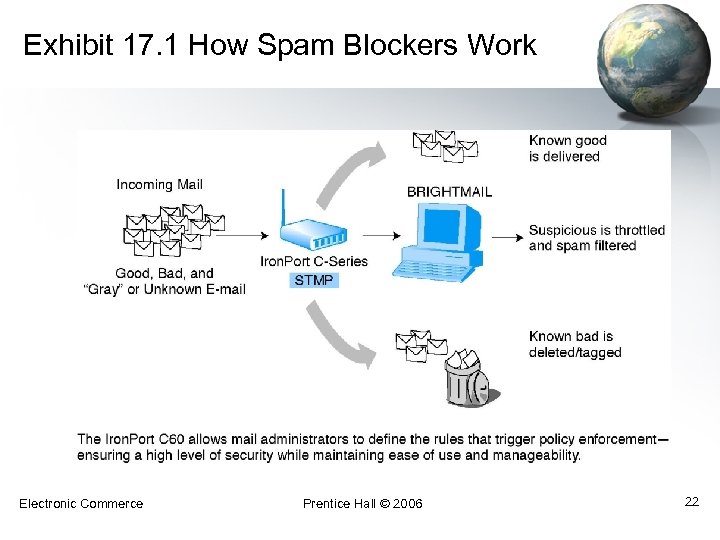 Exhibit 17. 1 How Spam Blockers Work Electronic Commerce Prentice Hall © 2006 22
 Unsolicited Electronic Ads: Problems and Solutions • E-Mail Spamming – Anti-spam Legislation • Do-not-spam lists • Protecting employees Electronic Commerce Prentice Hall © 2006 23
 Unsolicited Electronic Ads: Problems and Solutions • Protecting against Pop-Up Ads – • Pop-Up stoppers Concluding Remarks – The spam situation has not yet been resolved. However, it seems that both e-mail spamming and pop-ups are not increasing, and they may even be declining Electronic Commerce Prentice Hall © 2006 24
 EC Fraud and Consumer and Seller Protection • Fraud on the Internet – – – Online Auction Fraud Internet Stock Fraud Other Financial Fraud Electronic Commerce Prentice Hall © 2006 25
 EC Fraud and Consumer and Seller Protection • Fraud on the Internet – Identity Theft and Phishing identity theft A criminal act in which someone presents himself (herself) as another person and uses that person’s social security number, bank account numbers, and so on, to obtain loans, purchase items, make obligations, sell stocks, etc. Electronic Commerce Prentice Hall © 2006 26
 EC Fraud and Consumer and Seller Protection • Consumer Protection – Third-Party Assurance Services • TRUSTe’s “Trustmark” • Better Business Bureau • WHICHonline • Web Trust Seal and Others • Online Privacy Alliance • Evaluation by Consumers – Authentication and Biometric Controls Electronic Commerce Prentice Hall © 2006 27
 EC Fraud and Consumer and Seller Protection • Seller Protection – – – Customers who deny that they placed an order Customers who download copyrighted software and/or knowledge and sell it to others Customers who give false payment (credit card or bad checks) information in payment for products and services provided Use of their name by others Use of their unique words and phrases, names, and slogans and their Web addresses by others Electronic Commerce Prentice Hall © 2006 28
 EC Fraud and Consumer and Seller Protection • What can Sellers Do? – – – Use intelligent software to identify possibly questionable customers Identify warning signals for possibly fraudulent transactions Ask customers whose billing address is different from the shipping address to call their bank and have the alternate address added to their bank account Electronic Commerce Prentice Hall © 2006 29
 Societal Issues • digital divide The gap between those who have and those who do not have the ability to access electronic technology in general, and the Internet and EC in particular Other Societal Issues – – – Education Public safety, criminal justice, and homeland security Health aspects Electronic Commerce Prentice Hall © 2006 30