


 Скачать презентацию Chapter 16 Structures Unions and Enumerations Chapter 16
85412ee5ec44167717519c168f5eb404.ppt
- Количество слайдов: 101
 Chapter 16: Structures, Unions, and Enumerations Chapter 16 Structures, Unions, and Enumerations 1 Copyright © 2008 W. W. Norton & Company. All rights reserved.
 Chapter 16: Structures, Unions, and Enumerations Structure Variables • The properties of a structure are different from those of an array. – The elements of a structure (its members) aren’t required to have the same type. – The members of a structure have names; to select a particular member, we specify its name, not its position. • In some languages, structures are called records, and members are known as fields. 2 Copyright © 2008 W. W. Norton & Company. All rights reserved.
 Chapter 16: Structures, Unions, and Enumerations Declaring Structure Variables • A structure is a logical choice for storing a collection of related data items. • A declaration of two structure variables that store information about parts in a warehouse: struct { int number; char name[NAME_LEN+1]; int on_hand; } part 1, part 2; 3 Copyright © 2008 W. W. Norton & Company. All rights reserved.
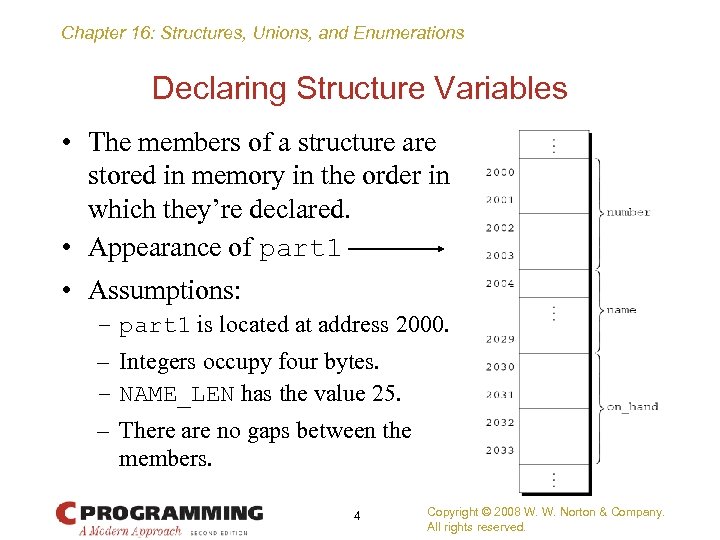 Chapter 16: Structures, Unions, and Enumerations Declaring Structure Variables • The members of a structure are stored in memory in the order in which they’re declared. • Appearance of part 1 • Assumptions: – – part 1 is located at address 2000. Integers occupy four bytes. NAME_LEN has the value 25. There are no gaps between the members. 4 Copyright © 2008 W. W. Norton & Company. All rights reserved.
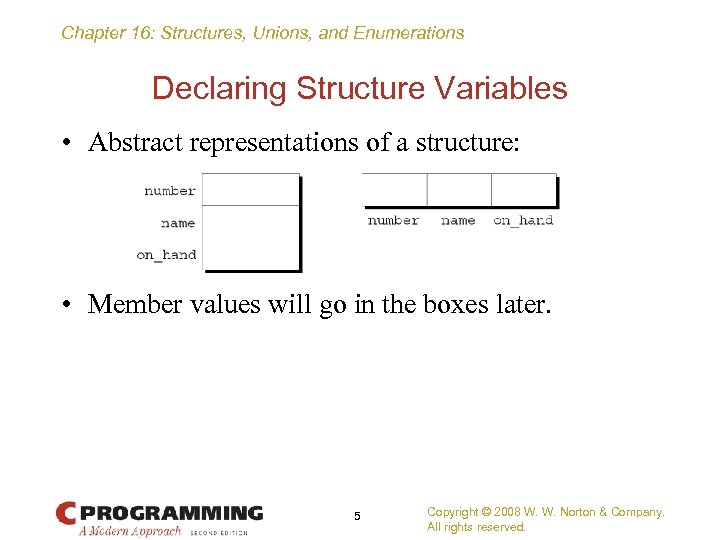 Chapter 16: Structures, Unions, and Enumerations Declaring Structure Variables • Abstract representations of a structure: • Member values will go in the boxes later. 5 Copyright © 2008 W. W. Norton & Company. All rights reserved.
 Chapter 16: Structures, Unions, and Enumerations Declaring Structure Variables • Each structure represents a new scope. • Any names declared in that scope won’t conflict with other names in a program. • In C terminology, each structure has a separate name space for its members. 6 Copyright © 2008 W. W. Norton & Company. All rights reserved.
 Chapter 16: Structures, Unions, and Enumerations Declaring Structure Variables • For example, the following declarations can appear in the same program: struct { int number; char name[NAME_LEN+1]; int on_hand; } part 1, part 2; struct { char name[NAME_LEN+1]; int number; char sex; } employee 1, employee 2; 7 Copyright © 2008 W. W. Norton & Company. All rights reserved.
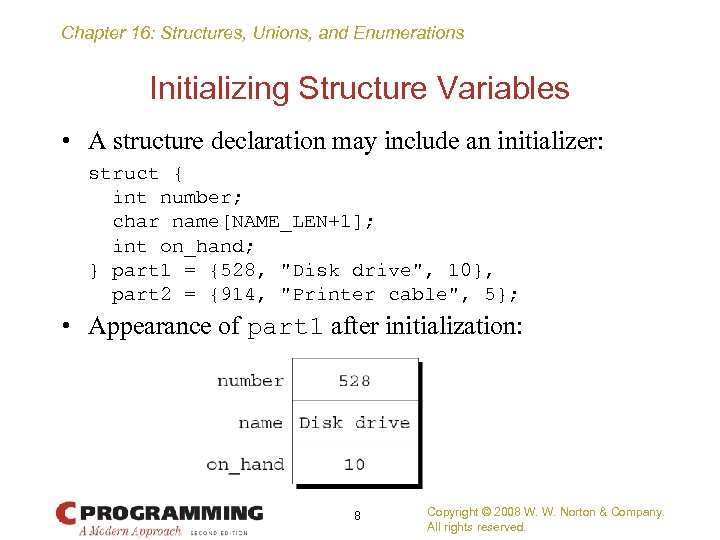 Chapter 16: Structures, Unions, and Enumerations Initializing Structure Variables • A structure declaration may include an initializer: struct { int number; char name[NAME_LEN+1]; int on_hand; } part 1 = {528, "Disk drive", 10}, part 2 = {914, "Printer cable", 5}; • Appearance of part 1 after initialization: 8 Copyright © 2008 W. W. Norton & Company. All rights reserved.
 Chapter 16: Structures, Unions, and Enumerations Initializing Structure Variables • Structure initializers follow rules similar to those for array initializers. • Expressions used in a structure initializer must be constant. (This restriction is relaxed in C 99. ) • An initializer can have fewer members than the structure it’s initializing. • Any “leftover” members are given 0 as their initial value. 9 Copyright © 2008 W. W. Norton & Company. All rights reserved.
 Chapter 16: Structures, Unions, and Enumerations Designated Initializers (C 99) • C 99’s designated initializers can be used with structures. • The initializer for part 1 shown in the previous example: {528, "Disk drive", 10} • In a designated initializer, each value would be labeled by the name of the member that it initializes: {. number = 528, . name = "Disk drive", . on_hand = 10} • The combination of the period and the member name is called a designator. 10 Copyright © 2008 W. W. Norton & Company. All rights reserved.
 Chapter 16: Structures, Unions, and Enumerations Designated Initializers (C 99) • Designated initializers are easier to read and check for correctness. • Also, values in a designated initializer don’t have to be placed in the same order that the members are listed in the structure. – The programmer doesn’t have to remember the order in which the members were originally declared. – The order of the members can be changed in the future without affecting designated initializers. 11 Copyright © 2008 W. W. Norton & Company. All rights reserved.
 Chapter 16: Structures, Unions, and Enumerations Designated Initializers (C 99) • Not all values listed in a designated initializer need be prefixed by a designator. • Example: {. number = 528, "Disk drive", . on_hand = 10} The compiler assumes that "Disk drive" initializes the member that follows number in the structure. • Any members that the initializer fails to account for are set to zero. 12 Copyright © 2008 W. W. Norton & Company. All rights reserved.
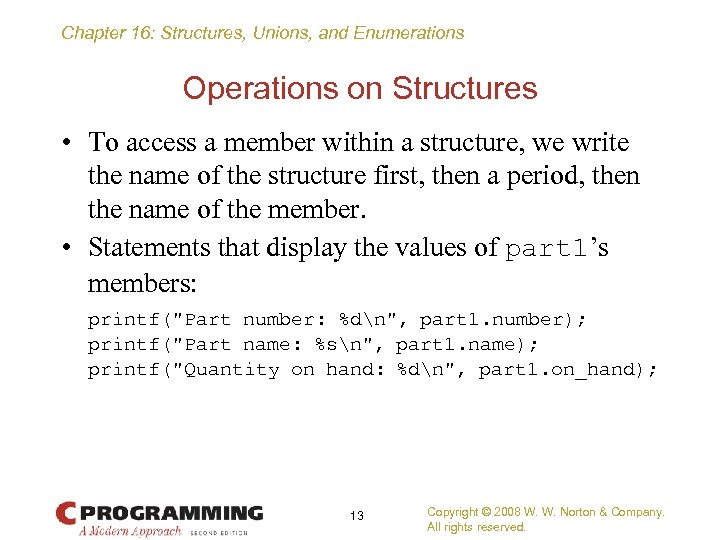 Chapter 16: Structures, Unions, and Enumerations Operations on Structures • To access a member within a structure, we write the name of the structure first, then a period, then the name of the member. • Statements that display the values of part 1’s members: printf("Part number: %dn", part 1. number); printf("Part name: %sn", part 1. name); printf("Quantity on hand: %dn", part 1. on_hand); 13 Copyright © 2008 W. W. Norton & Company. All rights reserved.
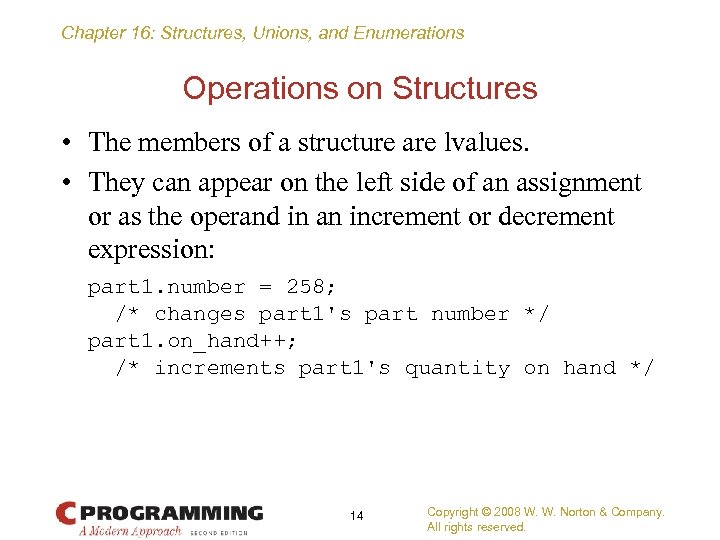 Chapter 16: Structures, Unions, and Enumerations Operations on Structures • The members of a structure are lvalues. • They can appear on the left side of an assignment or as the operand in an increment or decrement expression: part 1. number = 258; /* changes part 1's part number */ part 1. on_hand++; /* increments part 1's quantity on hand */ 14 Copyright © 2008 W. W. Norton & Company. All rights reserved.
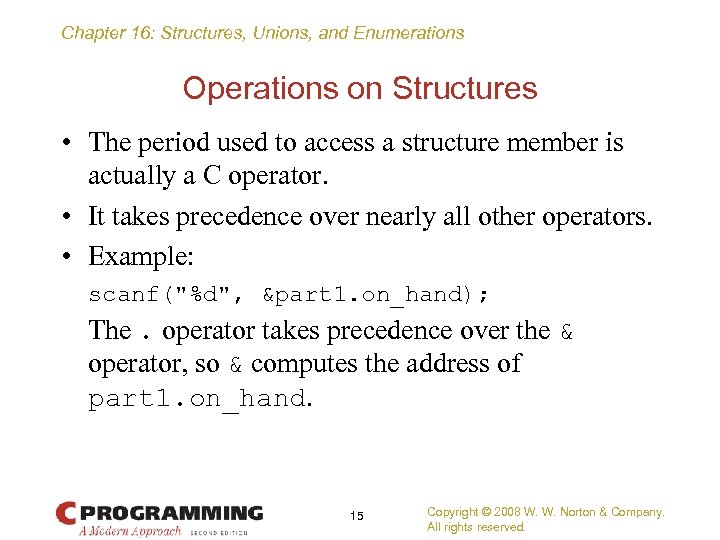 Chapter 16: Structures, Unions, and Enumerations Operations on Structures • The period used to access a structure member is actually a C operator. • It takes precedence over nearly all other operators. • Example: scanf("%d", &part 1. on_hand); The. operator takes precedence over the & operator, so & computes the address of part 1. on_hand. 15 Copyright © 2008 W. W. Norton & Company. All rights reserved.
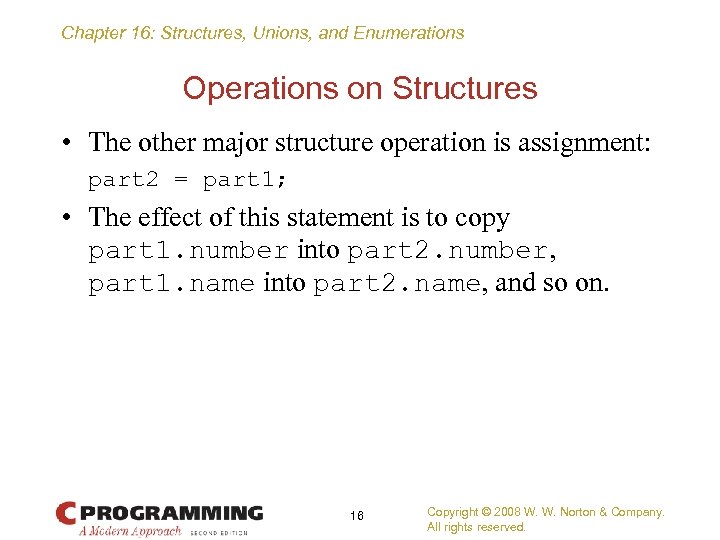 Chapter 16: Structures, Unions, and Enumerations Operations on Structures • The other major structure operation is assignment: part 2 = part 1; • The effect of this statement is to copy part 1. number into part 2. number, part 1. name into part 2. name, and so on. 16 Copyright © 2008 W. W. Norton & Company. All rights reserved.
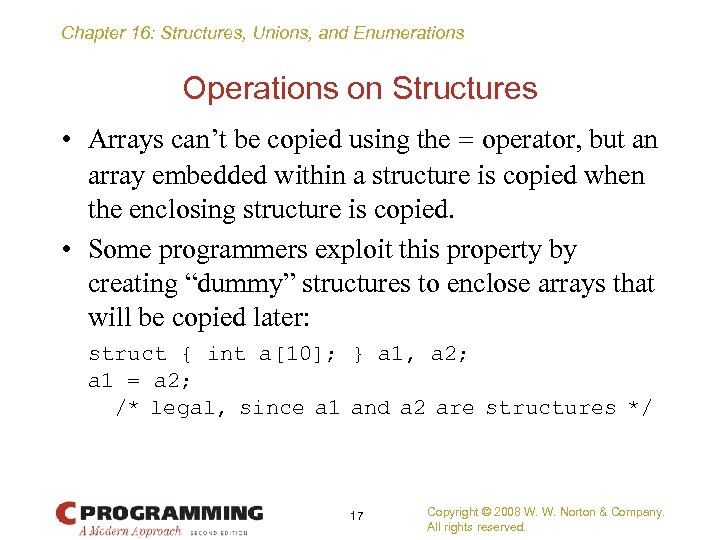 Chapter 16: Structures, Unions, and Enumerations Operations on Structures • Arrays can’t be copied using the = operator, but an array embedded within a structure is copied when the enclosing structure is copied. • Some programmers exploit this property by creating “dummy” structures to enclose arrays that will be copied later: struct { int a[10]; } a 1, a 2; a 1 = a 2; /* legal, since a 1 and a 2 are structures */ 17 Copyright © 2008 W. W. Norton & Company. All rights reserved.
 Chapter 16: Structures, Unions, and Enumerations Operations on Structures • The = operator can be used only with structures of compatible types. • Two structures declared at the same time (as part 1 and part 2 were) are compatible. • Structures declared using the same “structure tag” or the same type name are also compatible. • Other than assignment, C provides no operations on entire structures. • In particular, the == and != operators can’t be used with structures. 18 Copyright © 2008 W. W. Norton & Company. All rights reserved.
 Chapter 16: Structures, Unions, and Enumerations Structure Types • Suppose that a program needs to declare several structure variables with identical members. • We need a name that represents a type of structure, not a particular structure variable. • Ways to name a structure: – Declare a “structure tag” – Use typedef to define a type name 19 Copyright © 2008 W. W. Norton & Company. All rights reserved.
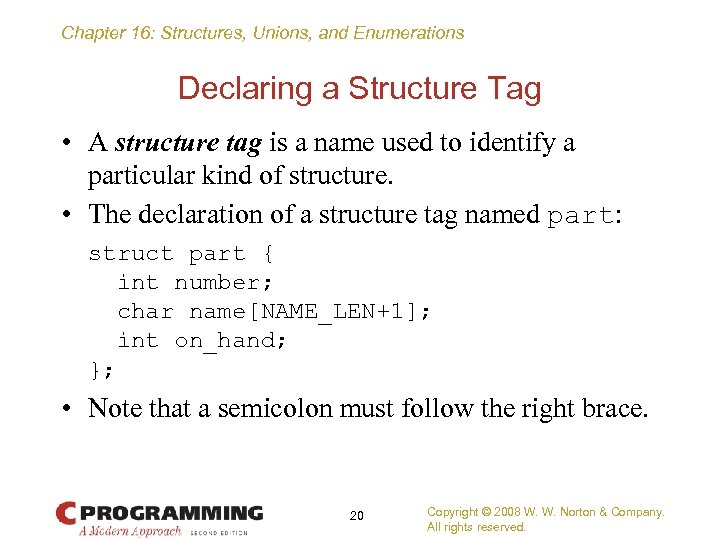 Chapter 16: Structures, Unions, and Enumerations Declaring a Structure Tag • A structure tag is a name used to identify a particular kind of structure. • The declaration of a structure tag named part: struct part { int number; char name[NAME_LEN+1]; int on_hand; }; • Note that a semicolon must follow the right brace. 20 Copyright © 2008 W. W. Norton & Company. All rights reserved.
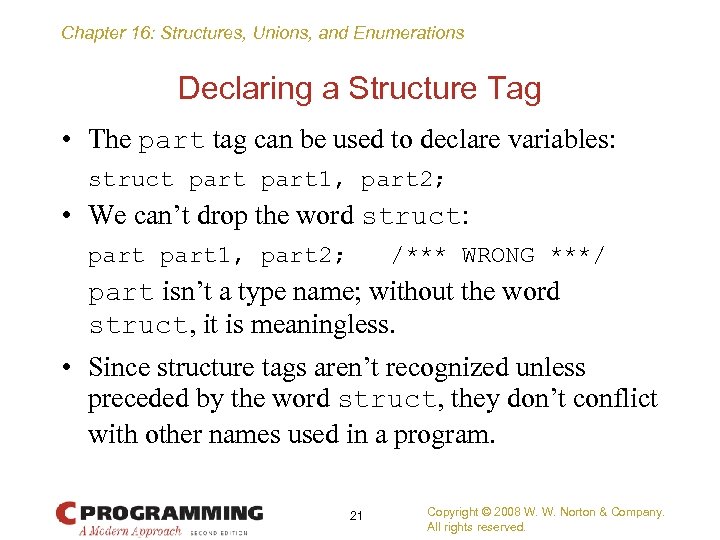 Chapter 16: Structures, Unions, and Enumerations Declaring a Structure Tag • The part tag can be used to declare variables: struct part 1, part 2; • We can’t drop the word struct: part 1, part 2; /*** WRONG ***/ part isn’t a type name; without the word struct, it is meaningless. • Since structure tags aren’t recognized unless preceded by the word struct, they don’t conflict with other names used in a program. 21 Copyright © 2008 W. W. Norton & Company. All rights reserved.
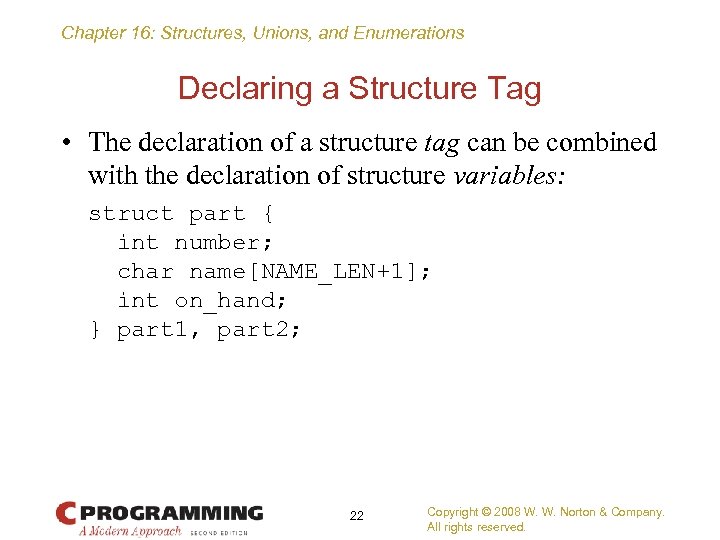 Chapter 16: Structures, Unions, and Enumerations Declaring a Structure Tag • The declaration of a structure tag can be combined with the declaration of structure variables: struct part { int number; char name[NAME_LEN+1]; int on_hand; } part 1, part 2; 22 Copyright © 2008 W. W. Norton & Company. All rights reserved.
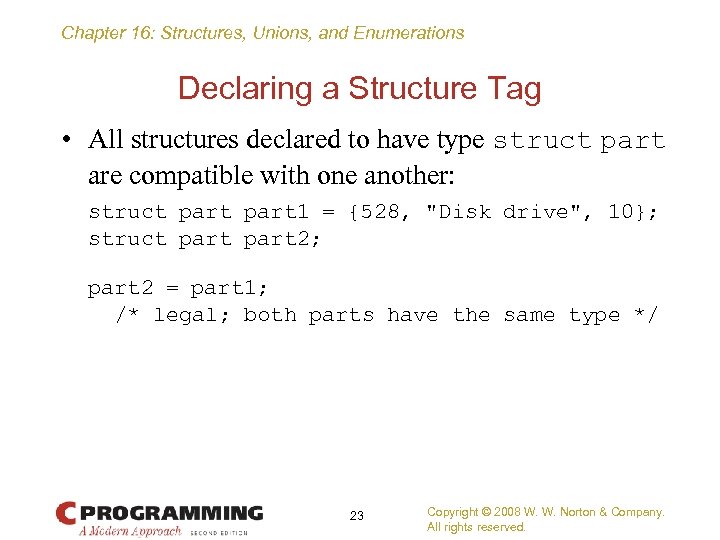 Chapter 16: Structures, Unions, and Enumerations Declaring a Structure Tag • All structures declared to have type struct part are compatible with one another: struct part 1 = {528, "Disk drive", 10}; struct part 2; part 2 = part 1; /* legal; both parts have the same type */ 23 Copyright © 2008 W. W. Norton & Company. All rights reserved.
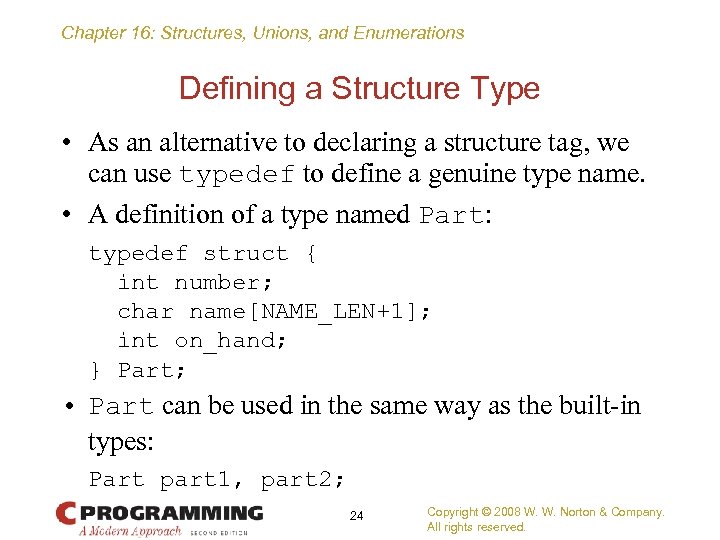 Chapter 16: Structures, Unions, and Enumerations Defining a Structure Type • As an alternative to declaring a structure tag, we can use typedef to define a genuine type name. • A definition of a type named Part: typedef struct { int number; char name[NAME_LEN+1]; int on_hand; } Part; • Part can be used in the same way as the built-in types: Part part 1, part 2; 24 Copyright © 2008 W. W. Norton & Company. All rights reserved.
 Chapter 16: Structures, Unions, and Enumerations Defining a Structure Type • When it comes time to name a structure, we can usually choose either to declare a structure tag or to use typedef. • However, declaring a structure tag is mandatory when the structure is to be used in a linked list (Chapter 17). 25 Copyright © 2008 W. W. Norton & Company. All rights reserved.
 Chapter 16: Structures, Unions, and Enumerations Structures as Arguments and Return Values • Functions may have structures as arguments and return values. • A function with a structure argument: void print_part(struct part p) { printf("Part number: %dn", p. number); printf("Part name: %sn", p. name); printf("Quantity on hand: %dn", p. on_hand); } • A call of print_part: print_part(part 1); 26 Copyright © 2008 W. W. Norton & Company. All rights reserved.
 Chapter 16: Structures, Unions, and Enumerations Structures as Arguments and Return Values • A function that returns a part structure: struct part build_part(int number, const char *name, int on_hand) { struct part p; p. number = number; strcpy(p. name, name); p. on_hand = on_hand; return p; } • A call of build_part: part 1 = build_part(528, "Disk drive", 10); 27 Copyright © 2008 W. W. Norton & Company. All rights reserved.
 Chapter 16: Structures, Unions, and Enumerations Structures as Arguments and Return Values • Passing a structure to a function and returning a structure from a function both require making a copy of all members in the structure. • To avoid this overhead, it’s sometimes advisable to pass a pointer to a structure or return a pointer to a structure. • Chapter 17 gives examples of functions that have a pointer to a structure as an argument and/or return a pointer to a structure. 28 Copyright © 2008 W. W. Norton & Company. All rights reserved.
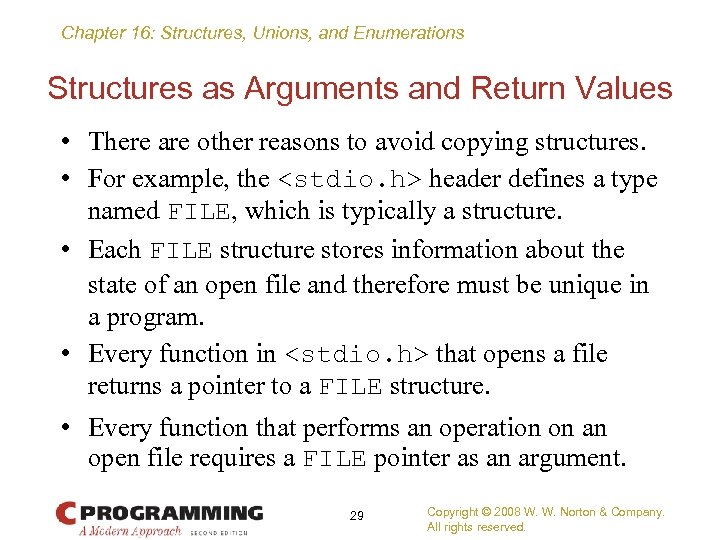 Chapter 16: Structures, Unions, and Enumerations Structures as Arguments and Return Values • There are other reasons to avoid copying structures. • For example, the
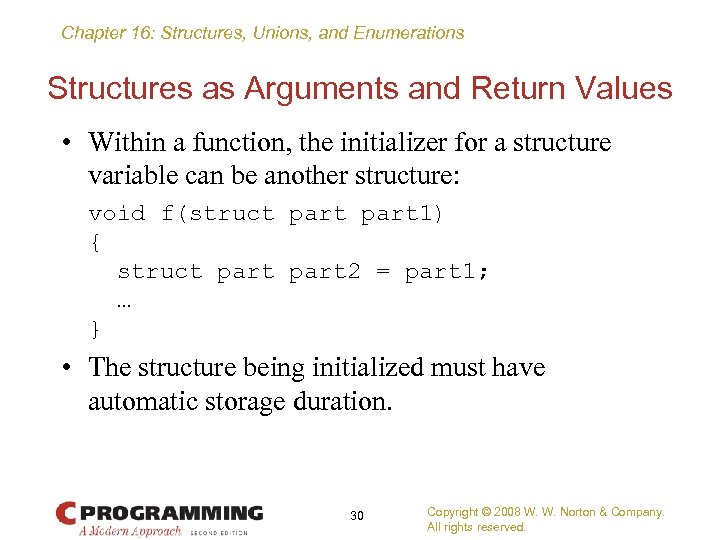 Chapter 16: Structures, Unions, and Enumerations Structures as Arguments and Return Values • Within a function, the initializer for a structure variable can be another structure: void f(struct part 1) { struct part 2 = part 1; … } • The structure being initialized must have automatic storage duration. 30 Copyright © 2008 W. W. Norton & Company. All rights reserved.
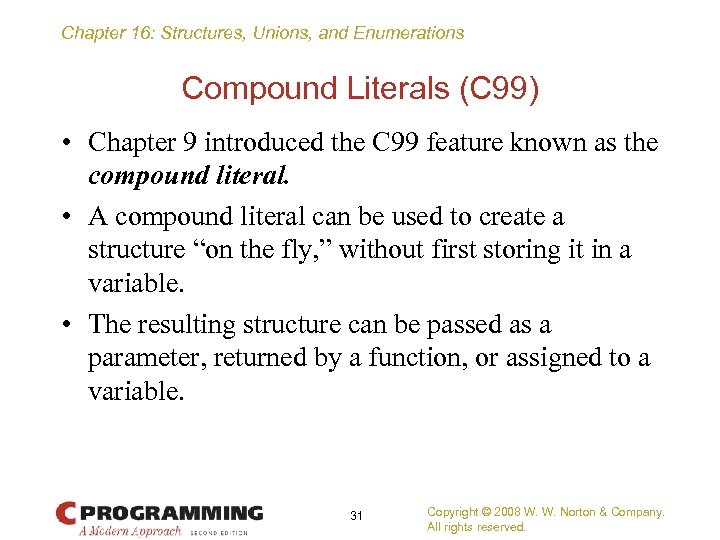 Chapter 16: Structures, Unions, and Enumerations Compound Literals (C 99) • Chapter 9 introduced the C 99 feature known as the compound literal. • A compound literal can be used to create a structure “on the fly, ” without first storing it in a variable. • The resulting structure can be passed as a parameter, returned by a function, or assigned to a variable. 31 Copyright © 2008 W. W. Norton & Company. All rights reserved.
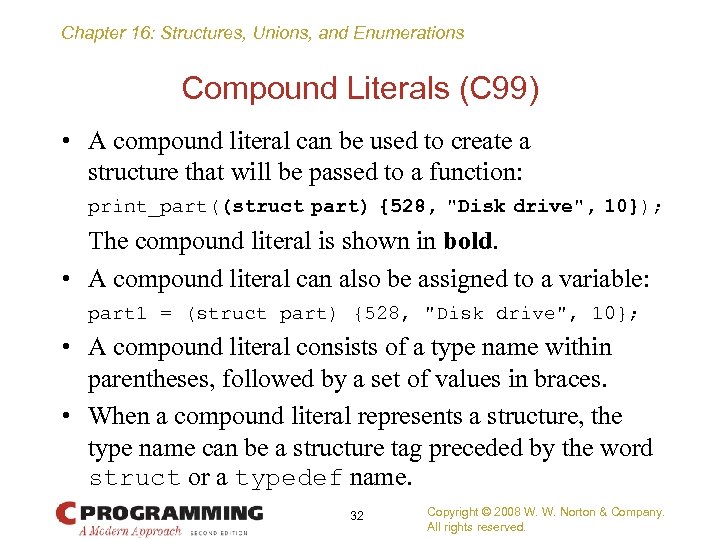 Chapter 16: Structures, Unions, and Enumerations Compound Literals (C 99) • A compound literal can be used to create a structure that will be passed to a function: print_part((struct part) {528, "Disk drive", 10}); The compound literal is shown in bold. • A compound literal can also be assigned to a variable: part 1 = (struct part) {528, "Disk drive", 10}; • A compound literal consists of a type name within parentheses, followed by a set of values in braces. • When a compound literal represents a structure, the type name can be a structure tag preceded by the word struct or a typedef name. 32 Copyright © 2008 W. W. Norton & Company. All rights reserved.
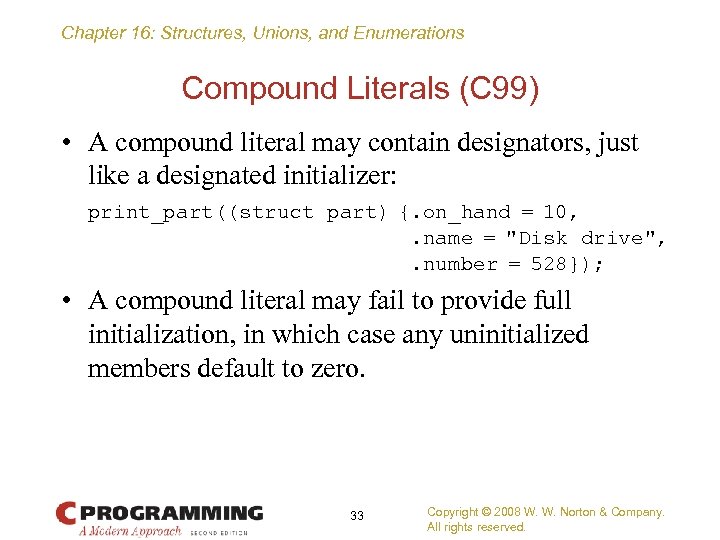 Chapter 16: Structures, Unions, and Enumerations Compound Literals (C 99) • A compound literal may contain designators, just like a designated initializer: print_part((struct part) {. on_hand = 10, . name = "Disk drive", . number = 528}); • A compound literal may fail to provide full initialization, in which case any uninitialized members default to zero. 33 Copyright © 2008 W. W. Norton & Company. All rights reserved.
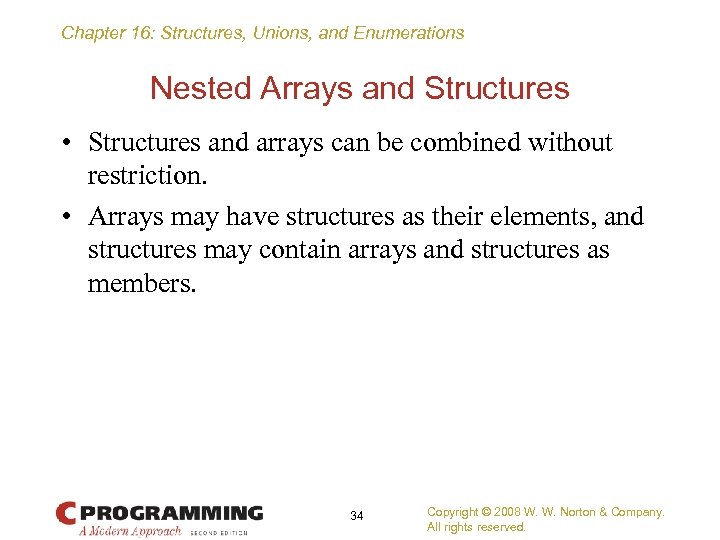 Chapter 16: Structures, Unions, and Enumerations Nested Arrays and Structures • Structures and arrays can be combined without restriction. • Arrays may have structures as their elements, and structures may contain arrays and structures as members. 34 Copyright © 2008 W. W. Norton & Company. All rights reserved.
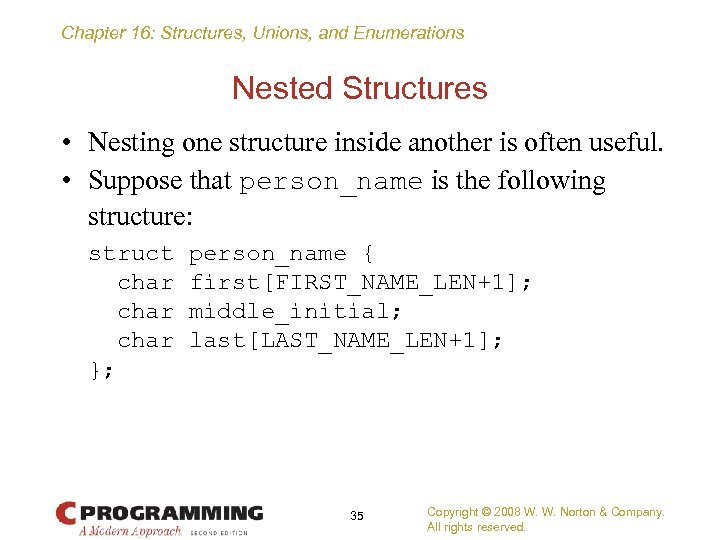 Chapter 16: Structures, Unions, and Enumerations Nested Structures • Nesting one structure inside another is often useful. • Suppose that person_name is the following structure: struct person_name { char first[FIRST_NAME_LEN+1]; char middle_initial; char last[LAST_NAME_LEN+1]; }; 35 Copyright © 2008 W. W. Norton & Company. All rights reserved.
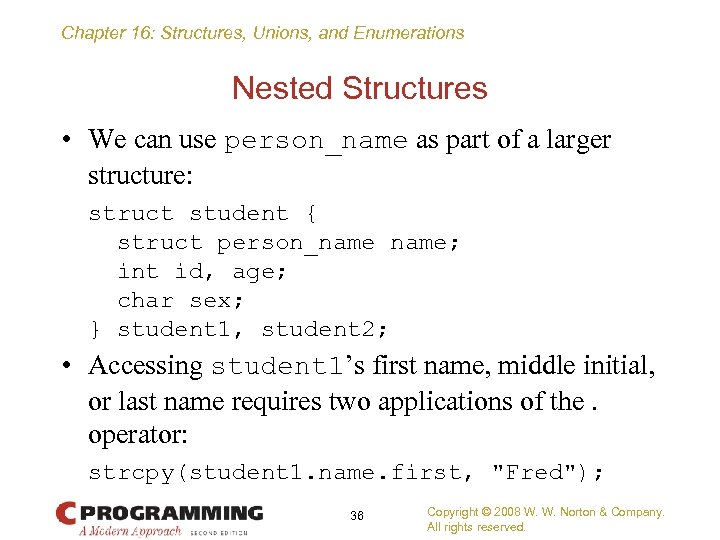 Chapter 16: Structures, Unions, and Enumerations Nested Structures • We can use person_name as part of a larger structure: struct student { struct person_name; int id, age; char sex; } student 1, student 2; • Accessing student 1’s first name, middle initial, or last name requires two applications of the. operator: strcpy(student 1. name. first, "Fred"); 36 Copyright © 2008 W. W. Norton & Company. All rights reserved.
 Chapter 16: Structures, Unions, and Enumerations Nested Structures • Having name be a structure makes it easier to treat names as units of data. • A function that displays a name could be passed one person_name argument instead of three arguments: display_name(student 1. name); • Copying the information from a person_name structure to the name member of a student structure would take one assignment instead of three: struct person_name new_name; … student 1. name = new_name; 37 Copyright © 2008 W. W. Norton & Company. All rights reserved.
 Chapter 16: Structures, Unions, and Enumerations Arrays of Structures • One of the most common combinations of arrays and structures is an array whose elements are structures. • This kind of array can serve as a simple database. • An array of part structures capable of storing information about 100 parts: struct part inventory[100]; 38 Copyright © 2008 W. W. Norton & Company. All rights reserved.
 Chapter 16: Structures, Unions, and Enumerations Arrays of Structures • Accessing a part in the array is done by using subscripting: print_part(inventory[i]); • Accessing a member within a part structure requires a combination of subscripting and member selection: inventory[i]. number = 883; • Accessing a single character in a part name requires subscripting, followed by selection, followed by subscripting: inventory[i]. name[0] = ''; 39 Copyright © 2008 W. W. Norton & Company. All rights reserved.
 Chapter 16: Structures, Unions, and Enumerations Initializing an Array of Structures • Initializing an array of structures is done in much the same way as initializing a multidimensional array. • Each structure has its own brace-enclosed initializer; the array initializer wraps another set of braces around the structure initializers. 40 Copyright © 2008 W. W. Norton & Company. All rights reserved.
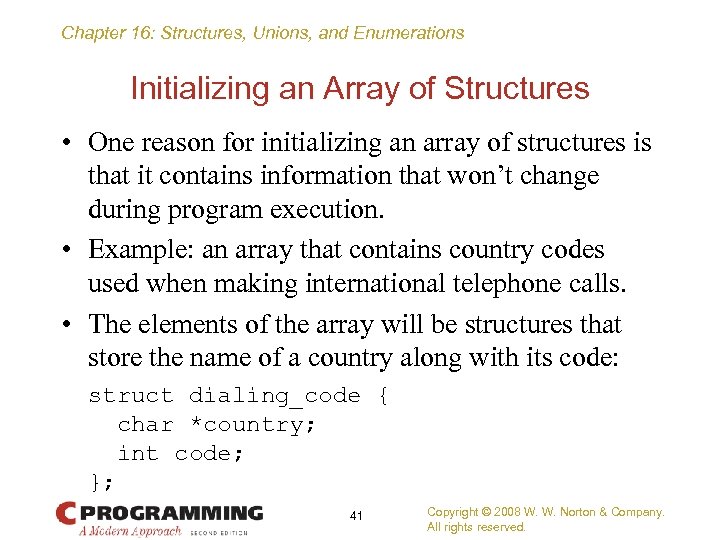 Chapter 16: Structures, Unions, and Enumerations Initializing an Array of Structures • One reason for initializing an array of structures is that it contains information that won’t change during program execution. • Example: an array that contains country codes used when making international telephone calls. • The elements of the array will be structures that store the name of a country along with its code: struct dialing_code { char *country; int code; }; 41 Copyright © 2008 W. W. Norton & Company. All rights reserved.
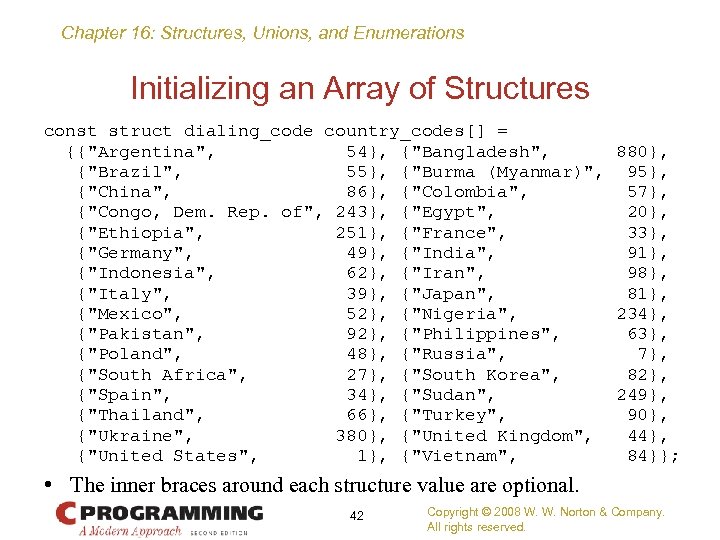 Chapter 16: Structures, Unions, and Enumerations Initializing an Array of Structures const struct dialing_code country_codes[] = {{"Argentina", 54}, {"Bangladesh", 880}, {"Brazil", 55}, {"Burma (Myanmar)", 95}, {"China", 86}, {"Colombia", 57}, {"Congo, Dem. Rep. of", 243}, {"Egypt", 20}, {"Ethiopia", 251}, {"France", 33}, {"Germany", 49}, {"India", 91}, {"Indonesia", 62}, {"Iran", 98}, {"Italy", 39}, {"Japan", 81}, {"Mexico", 52}, {"Nigeria", 234}, {"Pakistan", 92}, {"Philippines", 63}, {"Poland", 48}, {"Russia", 7}, {"South Africa", 27}, {"South Korea", 82}, {"Spain", 34}, {"Sudan", 249}, {"Thailand", 66}, {"Turkey", 90}, {"Ukraine", 380}, {"United Kingdom", 44}, {"United States", 1}, {"Vietnam", 84}}; • The inner braces around each structure value are optional. 42 Copyright © 2008 W. W. Norton & Company. All rights reserved.
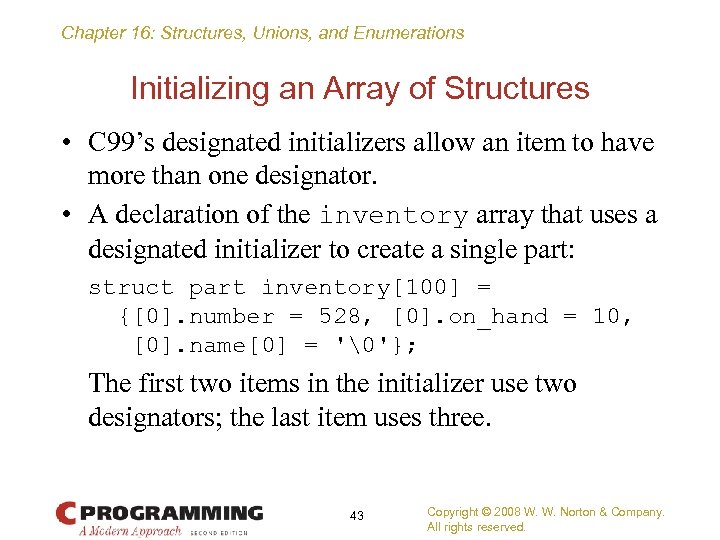 Chapter 16: Structures, Unions, and Enumerations Initializing an Array of Structures • C 99’s designated initializers allow an item to have more than one designator. • A declaration of the inventory array that uses a designated initializer to create a single part: struct part inventory[100] = {[0]. number = 528, [0]. on_hand = 10, [0]. name[0] = ''}; The first two items in the initializer use two designators; the last item uses three. 43 Copyright © 2008 W. W. Norton & Company. All rights reserved.
 Chapter 16: Structures, Unions, and Enumerations Program: Maintaining a Parts Database • The inventory. c program illustrates how nested arrays and structures are used in practice. • The program tracks parts stored in a warehouse. • Information about the parts is stored in an array of structures. • Contents of each structure: – Part number – Name – Quantity 44 Copyright © 2008 W. W. Norton & Company. All rights reserved.
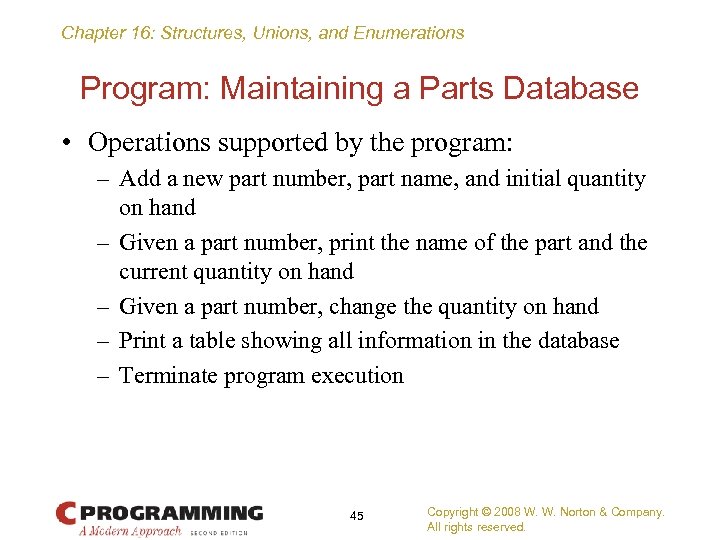 Chapter 16: Structures, Unions, and Enumerations Program: Maintaining a Parts Database • Operations supported by the program: – Add a new part number, part name, and initial quantity on hand – Given a part number, print the name of the part and the current quantity on hand – Given a part number, change the quantity on hand – Print a table showing all information in the database – Terminate program execution 45 Copyright © 2008 W. W. Norton & Company. All rights reserved.
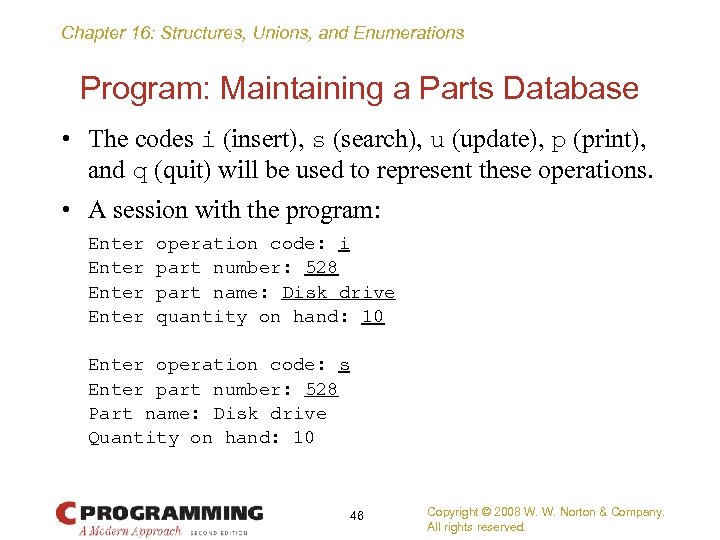 Chapter 16: Structures, Unions, and Enumerations Program: Maintaining a Parts Database • The codes i (insert), s (search), u (update), p (print), and q (quit) will be used to represent these operations. • A session with the program: Enter operation code: i Enter part number: 528 Enter part name: Disk drive Enter quantity on hand: 10 Enter operation code: s Enter part number: 528 Part name: Disk drive Quantity on hand: 10 46 Copyright © 2008 W. W. Norton & Company. All rights reserved.
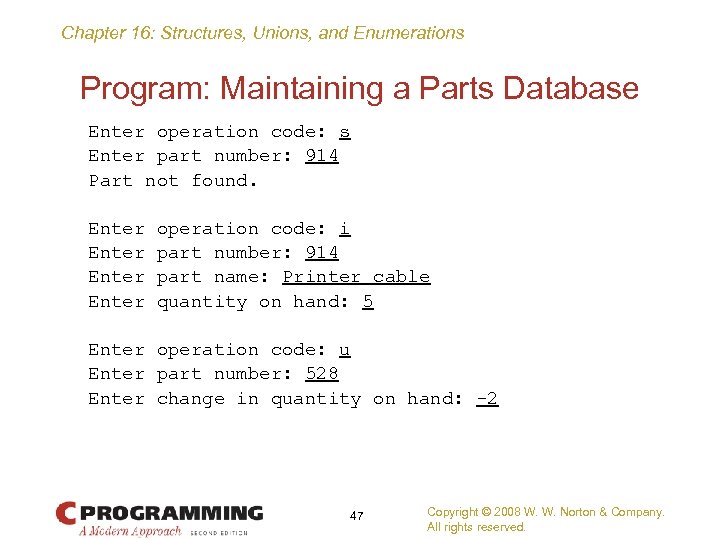 Chapter 16: Structures, Unions, and Enumerations Program: Maintaining a Parts Database Enter operation code: s Enter part number: 914 Part not found. Enter operation code: i Enter part number: 914 Enter part name: Printer cable Enter quantity on hand: 5 Enter operation code: u Enter part number: 528 Enter change in quantity on hand: -2 47 Copyright © 2008 W. W. Norton & Company. All rights reserved.
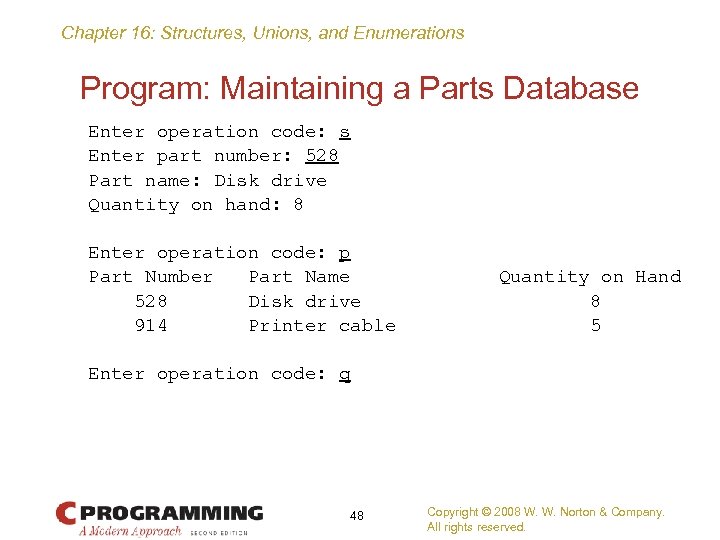 Chapter 16: Structures, Unions, and Enumerations Program: Maintaining a Parts Database Enter operation code: s Enter part number: 528 Part name: Disk drive Quantity on hand: 8 Enter operation code: p Part Number Part Name Quantity on Hand 528 Disk drive 8 914 Printer cable 5 Enter operation code: q 48 Copyright © 2008 W. W. Norton & Company. All rights reserved.
 Chapter 16: Structures, Unions, and Enumerations Program: Maintaining a Parts Database • The program will store information about each part in a structure. • The structures will be stored in an array named inventory. • A variable named num_parts will keep track of the number of parts currently stored in the array. 49 Copyright © 2008 W. W. Norton & Company. All rights reserved.
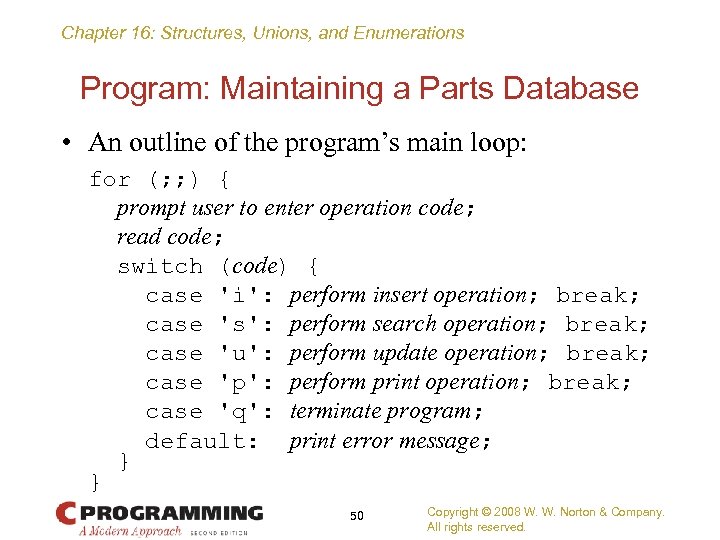 Chapter 16: Structures, Unions, and Enumerations Program: Maintaining a Parts Database • An outline of the program’s main loop: for (; ; ) { prompt user to enter operation code; read code; switch (code) { case 'i': perform insert operation; break; case 's': perform search operation; break; case 'u': perform update operation; break; case 'p': perform print operation; break; case 'q': terminate program; default: print error message; } } 50 Copyright © 2008 W. W. Norton & Company. All rights reserved.
 Chapter 16: Structures, Unions, and Enumerations Program: Maintaining a Parts Database • Separate functions will perform the insert, search, update, and print operations. • Since the functions will all need access to inventory and num_parts, these variables will be external. • The program is split into three files: – inventory. c (the bulk of the program) – readline. h (contains the prototype for the read_line function) – readline. c (contains the definition of read_line) 51 Copyright © 2008 W. W. Norton & Company. All rights reserved.
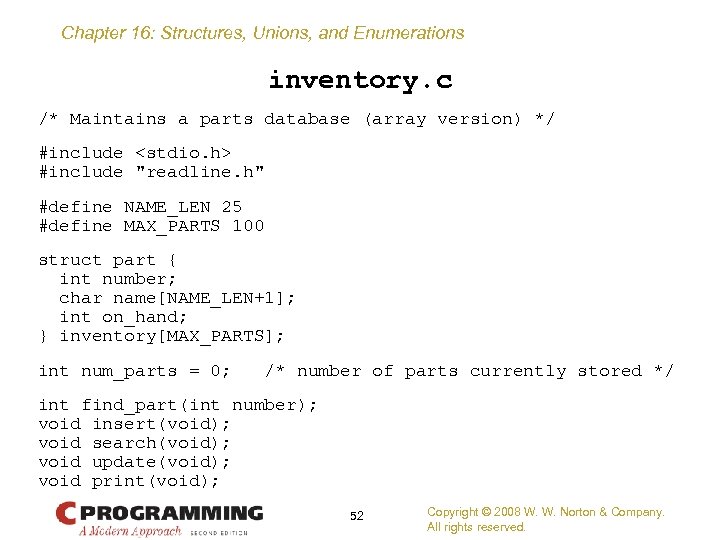 Chapter 16: Structures, Unions, and Enumerations inventory. c /* Maintains a parts database (array version) */ #include
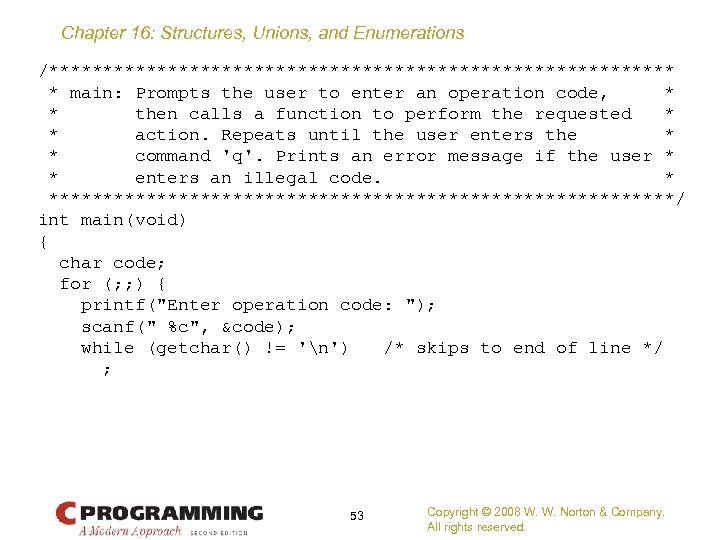 Chapter 16: Structures, Unions, and Enumerations /***************************** * main: Prompts the user to enter an operation code, * * then calls a function to perform the requested * * action. Repeats until the user enters the * * command 'q'. Prints an error message if the user * * enters an illegal code. * *****************************/ int main(void) { char code; for (; ; ) { printf("Enter operation code: "); scanf(" %c", &code); while (getchar() != 'n') /* skips to end of line */ ; 53 Copyright © 2008 W. W. Norton & Company. All rights reserved.
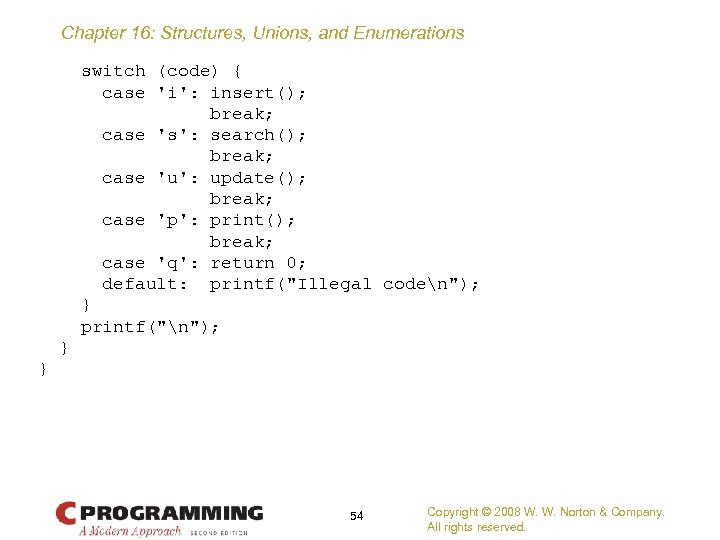 Chapter 16: Structures, Unions, and Enumerations switch (code) { case 'i': insert(); break; case 's': search(); break; case 'u': update(); break; case 'p': print(); break; case 'q': return 0; default: printf("Illegal coden"); } printf("n"); } } 54 Copyright © 2008 W. W. Norton & Company. All rights reserved.
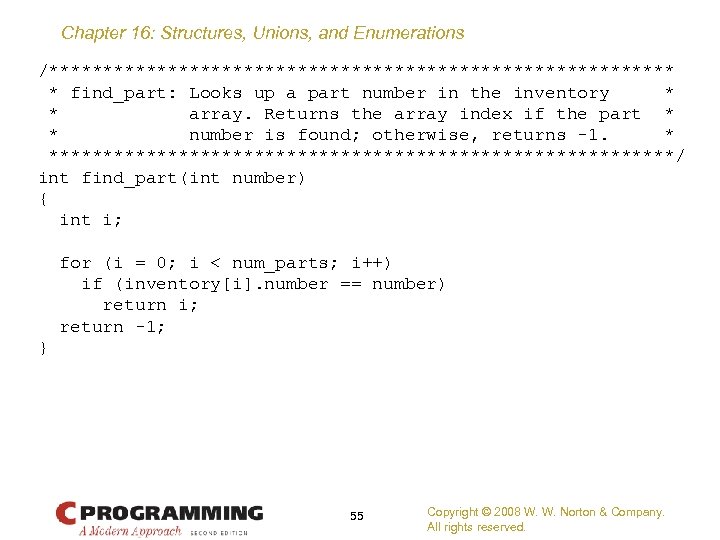 Chapter 16: Structures, Unions, and Enumerations /***************************** * find_part: Looks up a part number in the inventory * * array. Returns the array index if the part * * number is found; otherwise, returns -1. * *****************************/ int find_part(int number) { int i; for (i = 0; i < num_parts; i++) if (inventory[i]. number == number) return i; return -1; } 55 Copyright © 2008 W. W. Norton & Company. All rights reserved.
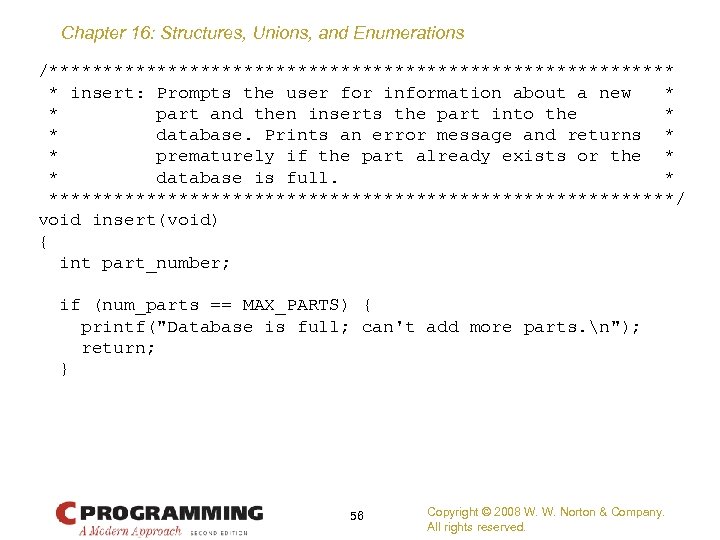 Chapter 16: Structures, Unions, and Enumerations /***************************** * insert: Prompts the user for information about a new * * part and then inserts the part into the * * database. Prints an error message and returns * * prematurely if the part already exists or the * * database is full. * *****************************/ void insert(void) { int part_number; if (num_parts == MAX_PARTS) { printf("Database is full; can't add more parts. n"); return; } 56 Copyright © 2008 W. W. Norton & Company. All rights reserved.
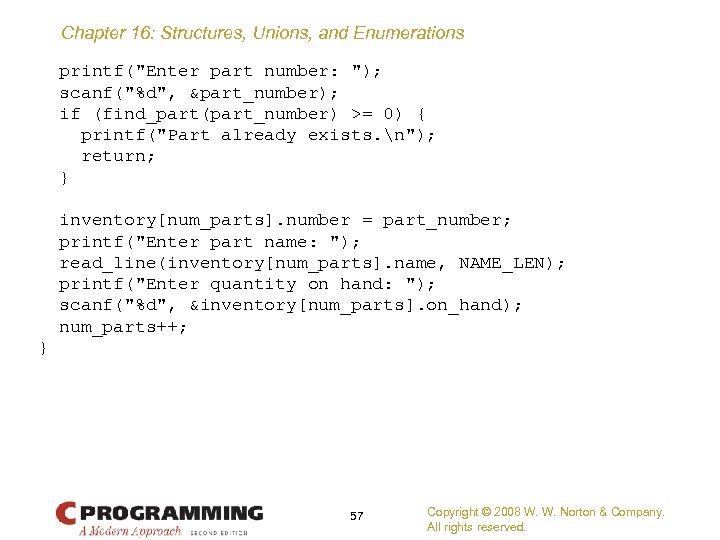 Chapter 16: Structures, Unions, and Enumerations printf("Enter part number: "); scanf("%d", &part_number); if (find_part(part_number) >= 0) { printf("Part already exists. n"); return; } inventory[num_parts]. number = part_number; printf("Enter part name: "); read_line(inventory[num_parts]. name, NAME_LEN); printf("Enter quantity on hand: "); scanf("%d", &inventory[num_parts]. on_hand); num_parts++; } 57 Copyright © 2008 W. W. Norton & Company. All rights reserved.
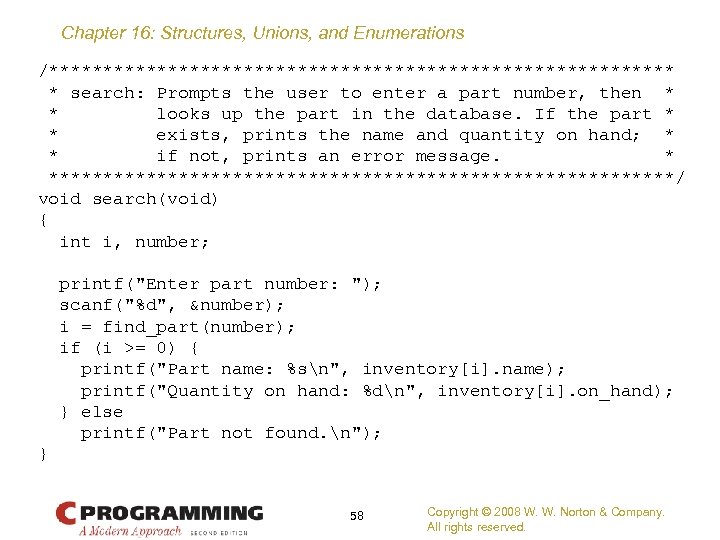 Chapter 16: Structures, Unions, and Enumerations /***************************** * search: Prompts the user to enter a part number, then * * looks up the part in the database. If the part * * exists, prints the name and quantity on hand; * * if not, prints an error message. * *****************************/ void search(void) { int i, number; printf("Enter part number: "); scanf("%d", &number); i = find_part(number); if (i >= 0) { printf("Part name: %sn", inventory[i]. name); printf("Quantity on hand: %dn", inventory[i]. on_hand); } else printf("Part not found. n"); } 58 Copyright © 2008 W. W. Norton & Company. All rights reserved.
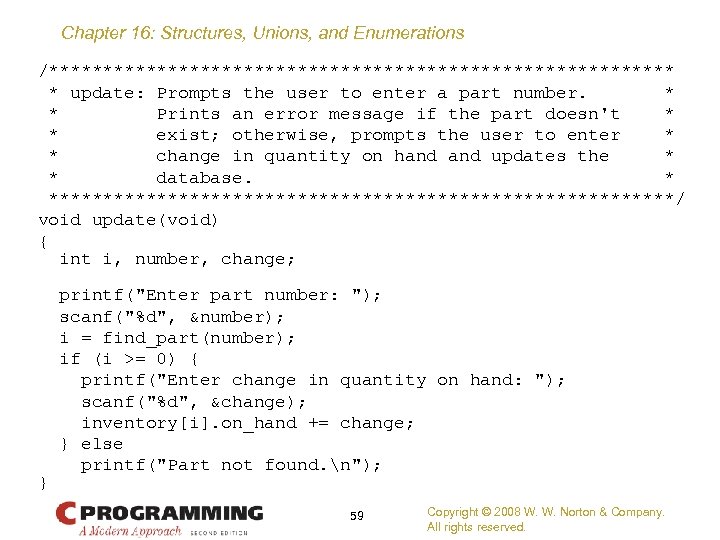 Chapter 16: Structures, Unions, and Enumerations /***************************** * update: Prompts the user to enter a part number. * * Prints an error message if the part doesn't * * exist; otherwise, prompts the user to enter * * change in quantity on hand updates the * * database. * *****************************/ void update(void) { int i, number, change; printf("Enter part number: "); scanf("%d", &number); i = find_part(number); if (i >= 0) { printf("Enter change in quantity on hand: "); scanf("%d", &change); inventory[i]. on_hand += change; } else printf("Part not found. n"); } 59 Copyright © 2008 W. W. Norton & Company. All rights reserved.
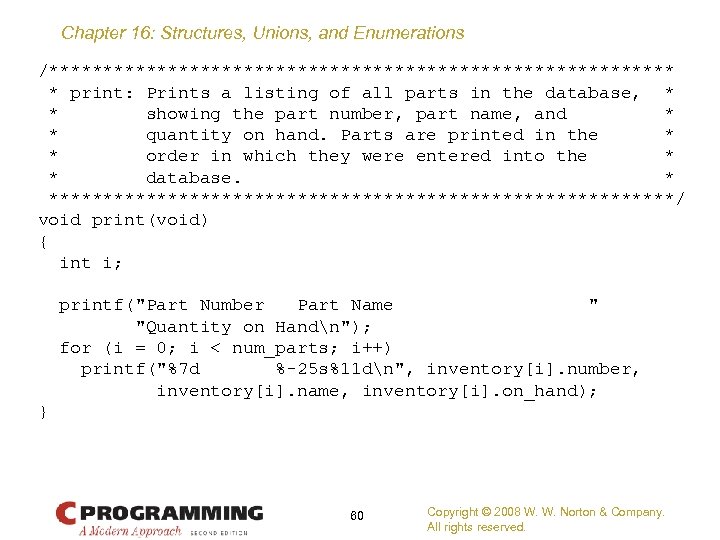 Chapter 16: Structures, Unions, and Enumerations /***************************** * print: Prints a listing of all parts in the database, * * showing the part number, part name, and * * quantity on hand. Parts are printed in the * * order in which they were entered into the * * database. * *****************************/ void print(void) { int i; printf("Part Number Part Name "Quantity on Handn"); for (i = 0; i < num_parts; i++) printf("%7 d %-25 s%11 dn", inventory[i]. number, inventory[i]. name, inventory[i]. on_hand); } 60 Copyright © 2008 W. W. Norton & Company. All rights reserved.
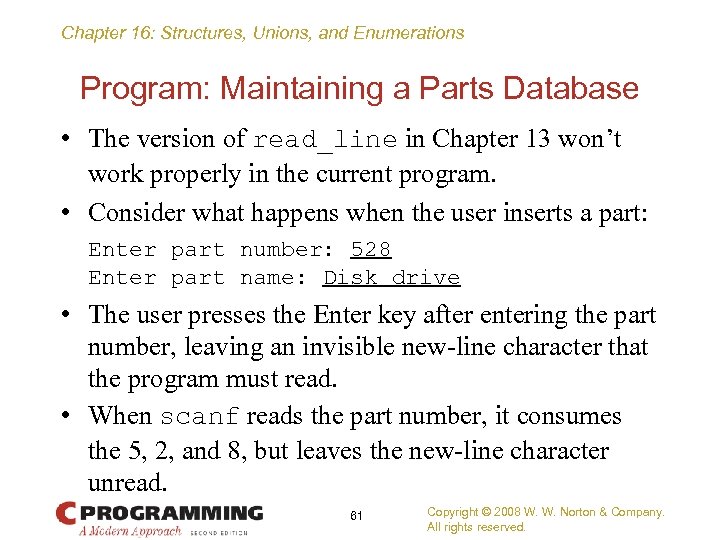 Chapter 16: Structures, Unions, and Enumerations Program: Maintaining a Parts Database • The version of read_line in Chapter 13 won’t work properly in the current program. • Consider what happens when the user inserts a part: Enter part number: 528 Enter part name: Disk drive • The user presses the Enter key after entering the part number, leaving an invisible new-line character that the program must read. • When scanf reads the part number, it consumes the 5, 2, and 8, but leaves the new-line character unread. 61 Copyright © 2008 W. W. Norton & Company. All rights reserved.
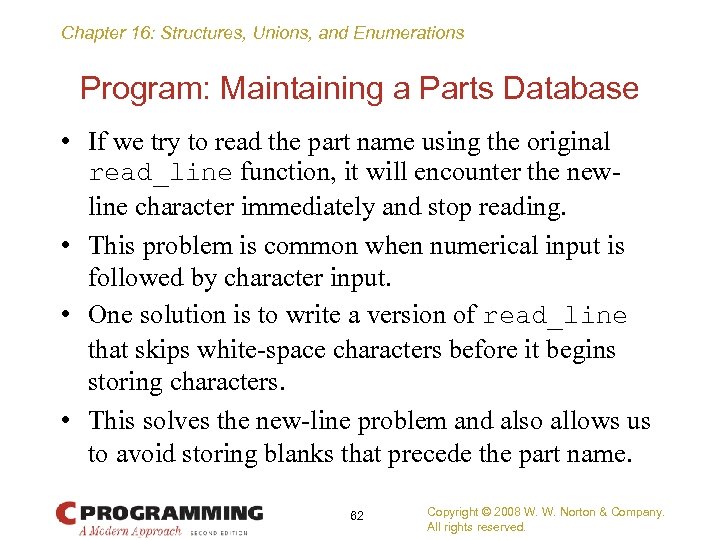 Chapter 16: Structures, Unions, and Enumerations Program: Maintaining a Parts Database • If we try to read the part name using the original read_line function, it will encounter the newline character immediately and stop reading. • This problem is common when numerical input is followed by character input. • One solution is to write a version of read_line that skips white-space characters before it begins storing characters. • This solves the new-line problem and also allows us to avoid storing blanks that precede the part name. 62 Copyright © 2008 W. W. Norton & Company. All rights reserved.
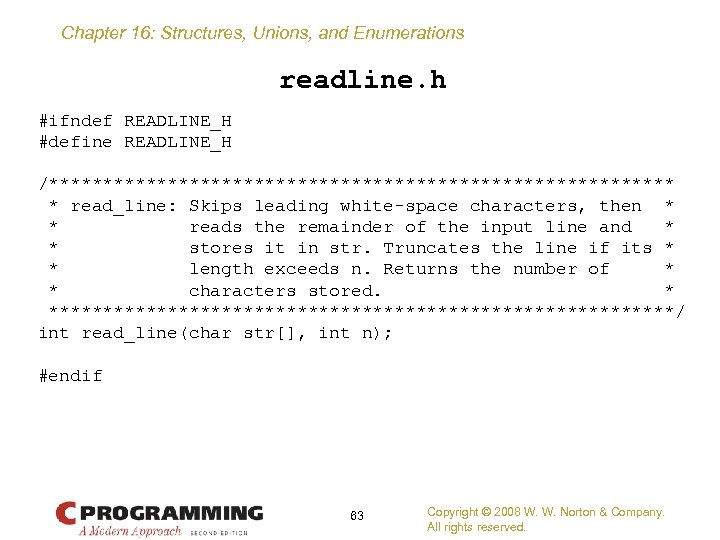 Chapter 16: Structures, Unions, and Enumerations readline. h #ifndef READLINE_H #define READLINE_H /***************************** * read_line: Skips leading white-space characters, then * * reads the remainder of the input line and * * stores it in str. Truncates the line if its * * length exceeds n. Returns the number of * * characters stored. * *****************************/ int read_line(char str[], int n); #endif 63 Copyright © 2008 W. W. Norton & Company. All rights reserved.
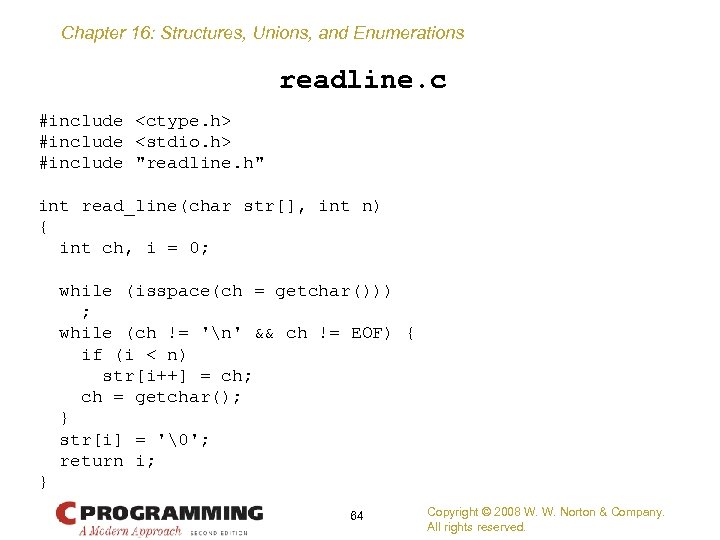 Chapter 16: Structures, Unions, and Enumerations readline. c #include
 Chapter 16: Structures, Unions, and Enumerations Unions • A union, like a structure, consists of one or more members, possibly of different types. • The compiler allocates only enough space for the largest of the members, which overlay each other within this space. • Assigning a new value to one member alters the values of the other members as well. 65 Copyright © 2008 W. W. Norton & Company. All rights reserved.
 Chapter 16: Structures, Unions, and Enumerations Unions • An example of a union variable: union { int i; double d; } u; • The declaration of a union closely resembles a structure declaration: struct { int i; double d; } s; 66 Copyright © 2008 W. W. Norton & Company. All rights reserved.
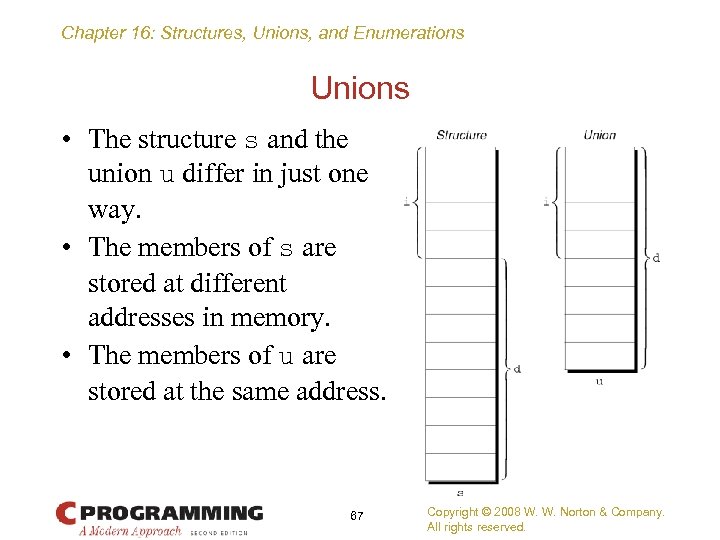 Chapter 16: Structures, Unions, and Enumerations Unions • The structure s and the union u differ in just one way. • The members of s are stored at different addresses in memory. • The members of u are stored at the same address. 67 Copyright © 2008 W. W. Norton & Company. All rights reserved.
 Chapter 16: Structures, Unions, and Enumerations Unions • Members of a union are accessed in the same way as members of a structure: u. i = 82; u. d = 74. 8; • Changing one member of a union alters any value previously stored in any of the other members. – Storing a value in u. d causes any value previously stored in u. i to be lost. – Changing u. i corrupts u. d. 68 Copyright © 2008 W. W. Norton & Company. All rights reserved.
 Chapter 16: Structures, Unions, and Enumerations Unions • The properties of unions are almost identical to the properties of structures. • We can declare union tags and union types in the same way we declare structure tags and types. • Like structures, unions can be copied using the = operator, passed to functions, and returned by functions. 69 Copyright © 2008 W. W. Norton & Company. All rights reserved.
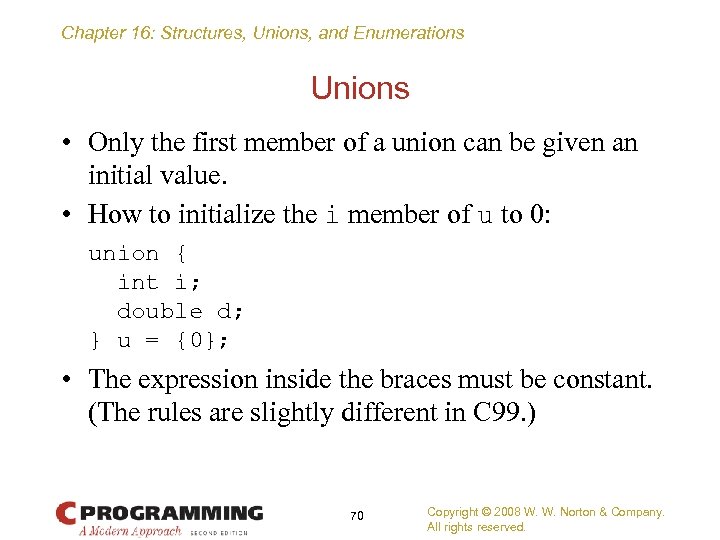 Chapter 16: Structures, Unions, and Enumerations Unions • Only the first member of a union can be given an initial value. • How to initialize the i member of u to 0: union { int i; double d; } u = {0}; • The expression inside the braces must be constant. (The rules are slightly different in C 99. ) 70 Copyright © 2008 W. W. Norton & Company. All rights reserved.
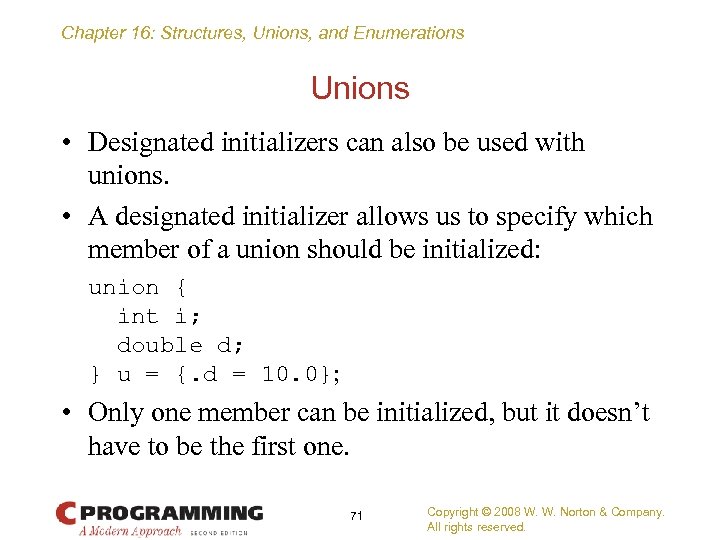 Chapter 16: Structures, Unions, and Enumerations Unions • Designated initializers can also be used with unions. • A designated initializer allows us to specify which member of a union should be initialized: union { int i; double d; } u = {. d = 10. 0}; • Only one member can be initialized, but it doesn’t have to be the first one. 71 Copyright © 2008 W. W. Norton & Company. All rights reserved.
 Chapter 16: Structures, Unions, and Enumerations Unions • Applications for unions: – Saving space – Building mixed data structures 72 Copyright © 2008 W. W. Norton & Company. All rights reserved.
 Chapter 16: Structures, Unions, and Enumerations Using Unions to Save Space • Unions can be used to save space in structures. • Suppose that we’re designing a structure that will contain information about an item that’s sold through a gift catalog. • Each item has a stock number and a price, as well as other information that depends on the type of the item: Books: Title, author, number of pages Mugs: Design Shirts: Design, colors available, sizes available 73 Copyright © 2008 W. W. Norton & Company. All rights reserved.
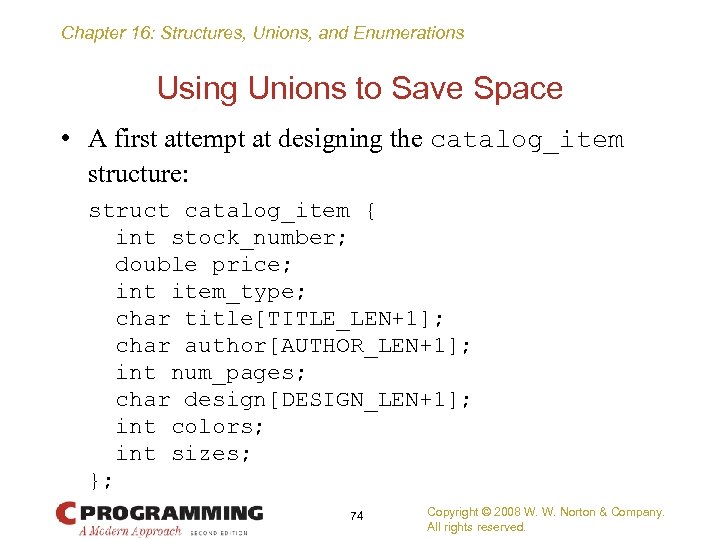 Chapter 16: Structures, Unions, and Enumerations Using Unions to Save Space • A first attempt at designing the catalog_item structure: struct catalog_item { int stock_number; double price; int item_type; char title[TITLE_LEN+1]; char author[AUTHOR_LEN+1]; int num_pages; char design[DESIGN_LEN+1]; int colors; int sizes; }; 74 Copyright © 2008 W. W. Norton & Company. All rights reserved.
 Chapter 16: Structures, Unions, and Enumerations Using Unions to Save Space • The item_type member would have one of the values BOOK, MUG, or SHIRT. • The colors and sizes members would store encoded combinations of colors and sizes. • This structure wastes space, since only part of the information in the structure is common to all items in the catalog. • By putting a union inside the catalog_item structure, we can reduce the space required by the structure. 75 Copyright © 2008 W. W. Norton & Company. All rights reserved.
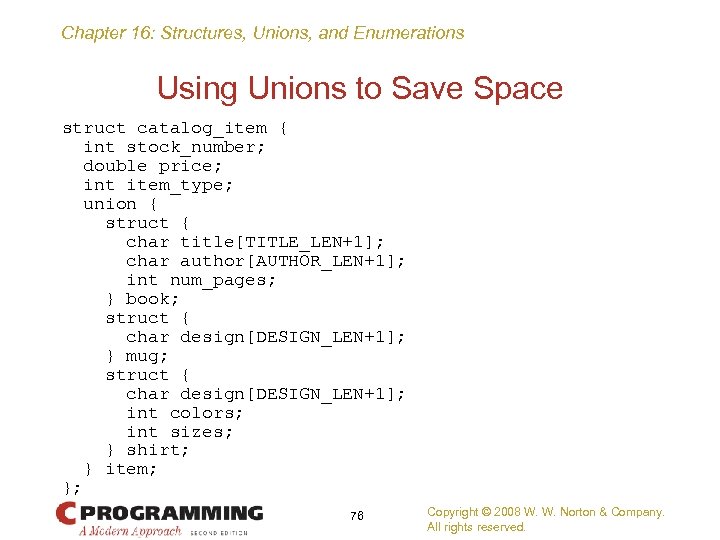 Chapter 16: Structures, Unions, and Enumerations Using Unions to Save Space struct catalog_item { int stock_number; double price; int item_type; union { struct { char title[TITLE_LEN+1]; char author[AUTHOR_LEN+1]; int num_pages; } book; struct { char design[DESIGN_LEN+1]; } mug; struct { char design[DESIGN_LEN+1]; int colors; int sizes; } shirt; } item; }; 76 Copyright © 2008 W. W. Norton & Company. All rights reserved.
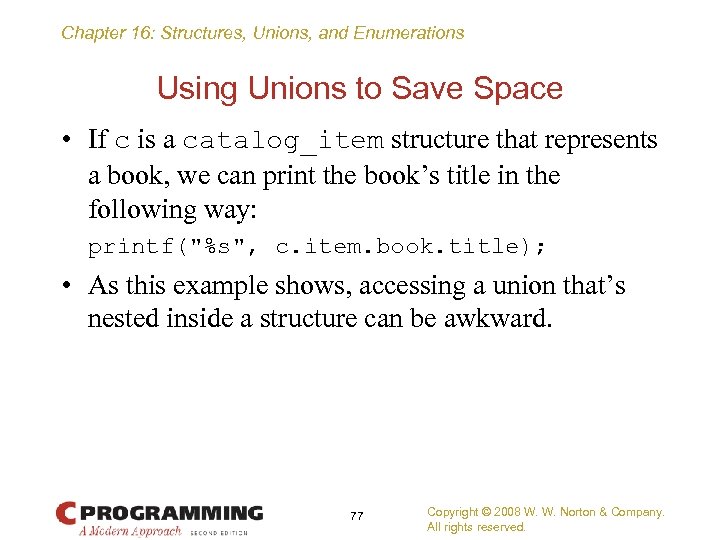 Chapter 16: Structures, Unions, and Enumerations Using Unions to Save Space • If c is a catalog_item structure that represents a book, we can print the book’s title in the following way: printf("%s", c. item. book. title); • As this example shows, accessing a union that’s nested inside a structure can be awkward. 77 Copyright © 2008 W. W. Norton & Company. All rights reserved.
 Chapter 16: Structures, Unions, and Enumerations Using Unions to Save Space • The catalog_item structure can be used to illustrate an interesting aspect of unions. • Normally, it’s not a good idea to store a value into one member of a union and then access the data through a different member. • However, there is a special case: two or more of the members of the union are structures, and the structures begin with one or more matching members. • If one of the structures is currently valid, then the matching members in the other structures will also be valid. 78 Copyright © 2008 W. W. Norton & Company. All rights reserved.
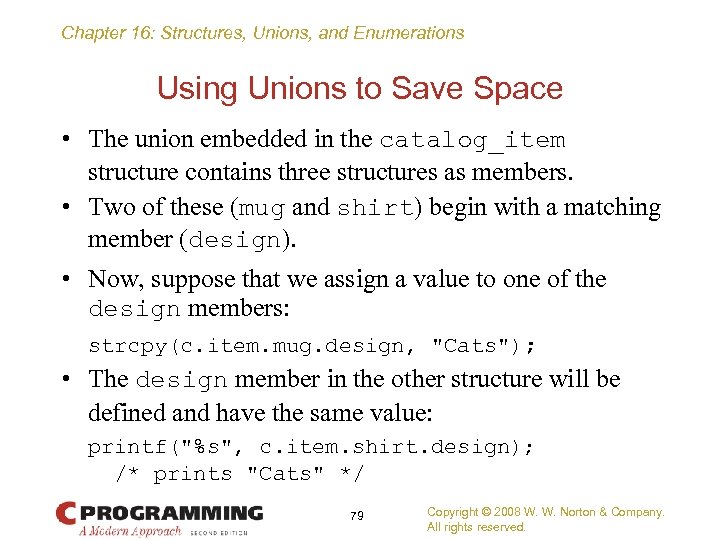 Chapter 16: Structures, Unions, and Enumerations Using Unions to Save Space • The union embedded in the catalog_item structure contains three structures as members. • Two of these (mug and shirt) begin with a matching member (design). • Now, suppose that we assign a value to one of the design members: strcpy(c. item. mug. design, "Cats"); • The design member in the other structure will be defined and have the same value: printf("%s", c. item. shirt. design); /* prints "Cats" */ 79 Copyright © 2008 W. W. Norton & Company. All rights reserved.
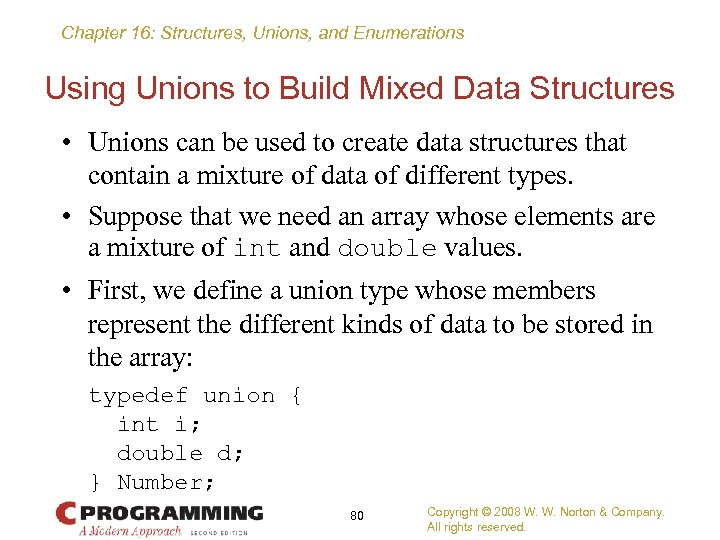 Chapter 16: Structures, Unions, and Enumerations Using Unions to Build Mixed Data Structures • Unions can be used to create data structures that contain a mixture of data of different types. • Suppose that we need an array whose elements are a mixture of int and double values. • First, we define a union type whose members represent the different kinds of data to be stored in the array: typedef union { int i; double d; } Number; 80 Copyright © 2008 W. W. Norton & Company. All rights reserved.
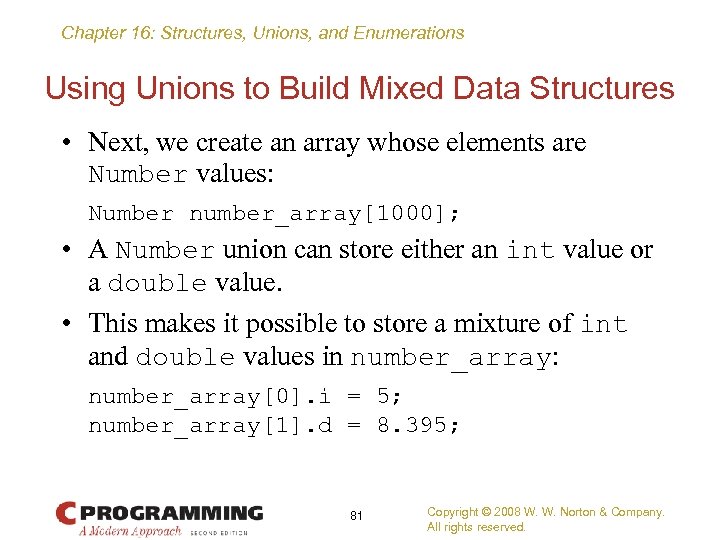 Chapter 16: Structures, Unions, and Enumerations Using Unions to Build Mixed Data Structures • Next, we create an array whose elements are Number values: Number number_array[1000]; • A Number union can store either an int value or a double value. • This makes it possible to store a mixture of int and double values in number_array: number_array[0]. i = 5; number_array[1]. d = 8. 395; 81 Copyright © 2008 W. W. Norton & Company. All rights reserved.
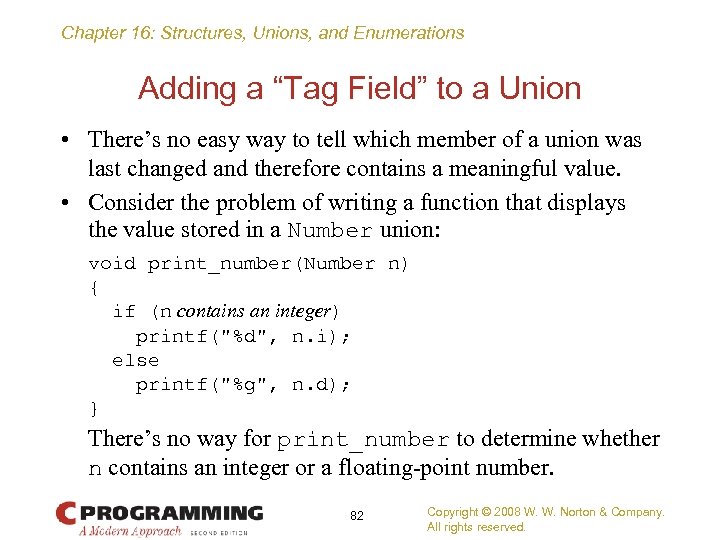 Chapter 16: Structures, Unions, and Enumerations Adding a “Tag Field” to a Union • There’s no easy way to tell which member of a union was last changed and therefore contains a meaningful value. • Consider the problem of writing a function that displays the value stored in a Number union: void print_number(Number n) { if (n contains an integer) printf("%d", n. i); else printf("%g", n. d); } There’s no way for print_number to determine whether n contains an integer or a floating-point number. 82 Copyright © 2008 W. W. Norton & Company. All rights reserved.
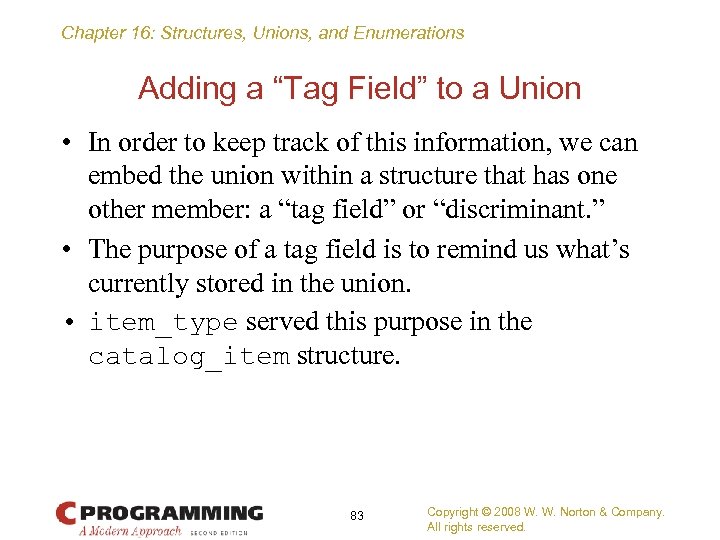 Chapter 16: Structures, Unions, and Enumerations Adding a “Tag Field” to a Union • In order to keep track of this information, we can embed the union within a structure that has one other member: a “tag field” or “discriminant. ” • The purpose of a tag field is to remind us what’s currently stored in the union. • item_type served this purpose in the catalog_item structure. 83 Copyright © 2008 W. W. Norton & Company. All rights reserved.
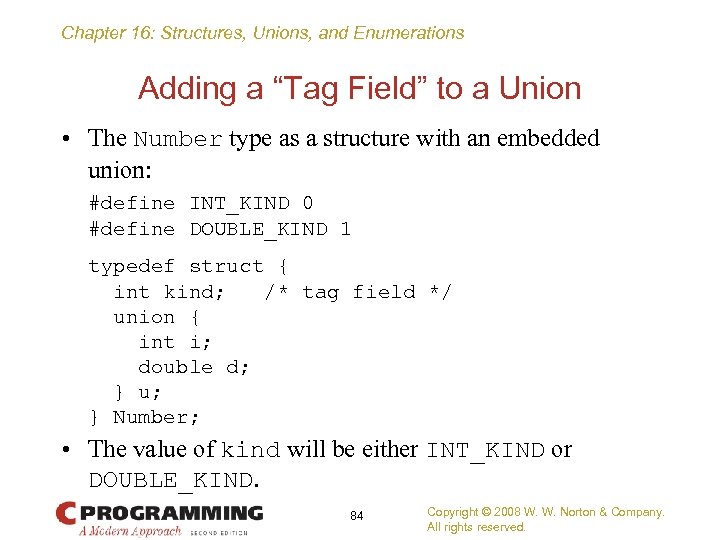 Chapter 16: Structures, Unions, and Enumerations Adding a “Tag Field” to a Union • The Number type as a structure with an embedded union: #define INT_KIND 0 #define DOUBLE_KIND 1 typedef struct { int kind; /* tag field */ union { int i; double d; } u; } Number; • The value of kind will be either INT_KIND or DOUBLE_KIND. 84 Copyright © 2008 W. W. Norton & Company. All rights reserved.
 Chapter 16: Structures, Unions, and Enumerations Adding a “Tag Field” to a Union • Each time we assign a value to a member of u, we’ll also change kind to remind us which member of u we modified. • An example that assigns a value to the i member of u: n. kind = INT_KIND; n. u. i = 82; n is assumed to be a Number variable. 85 Copyright © 2008 W. W. Norton & Company. All rights reserved.
 Chapter 16: Structures, Unions, and Enumerations Adding a “Tag Field” to a Union • When the number stored in a Number variable is retrieved, kind will tell us which member of the union was the last to be assigned a value. • A function that takes advantage of this capability: void print_number(Number n) { if (n. kind == INT_KIND) printf("%d", n. u. i); else printf("%g", n. u. d); } 86 Copyright © 2008 W. W. Norton & Company. All rights reserved.
 Chapter 16: Structures, Unions, and Enumerations • In many programs, we’ll need variables that have only a small set of meaningful values. • A variable that stores the suit of a playing card should have only four potential values: “clubs, ” “diamonds, ” “hearts, ” and “spades. ” 87 Copyright © 2008 W. W. Norton & Company. All rights reserved.
 Chapter 16: Structures, Unions, and Enumerations • A “suit” variable can be declared as an integer, with a set of codes that represent the possible values of the variable: int s; /* s will store a suit */ … s = 2; /* 2 represents "hearts" */ • Problems with this technique: – We can’t tell that s has only four possible values. – The significance of 2 isn’t apparent. 88 Copyright © 2008 W. W. Norton & Company. All rights reserved.
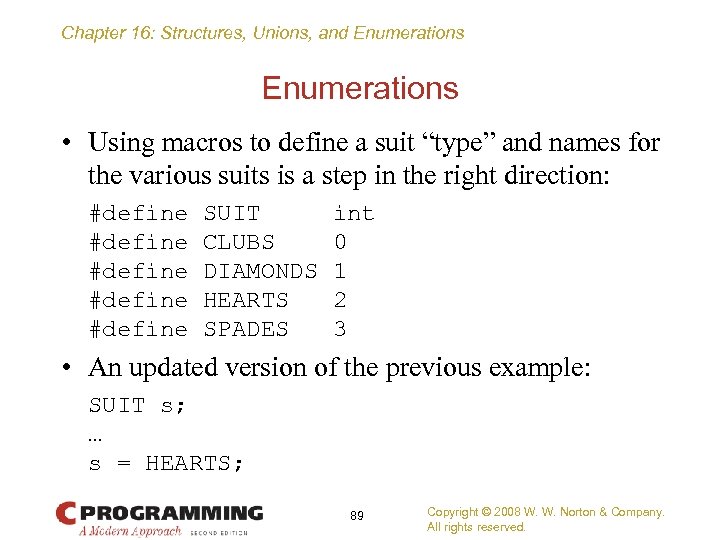 Chapter 16: Structures, Unions, and Enumerations • Using macros to define a suit “type” and names for the various suits is a step in the right direction: #define SUIT int #define CLUBS 0 #define DIAMONDS 1 #define HEARTS 2 #define SPADES 3 • An updated version of the previous example: SUIT s; … s = HEARTS; 89 Copyright © 2008 W. W. Norton & Company. All rights reserved.
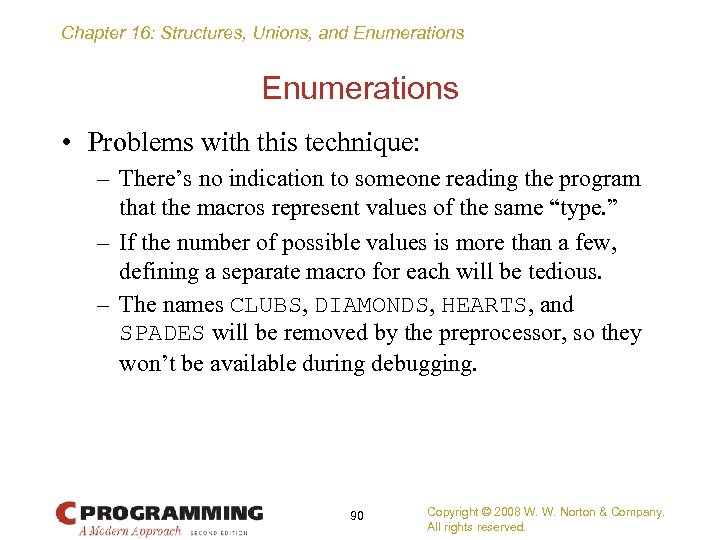 Chapter 16: Structures, Unions, and Enumerations • Problems with this technique: – There’s no indication to someone reading the program that the macros represent values of the same “type. ” – If the number of possible values is more than a few, defining a separate macro for each will be tedious. – The names CLUBS, DIAMONDS, HEARTS, and SPADES will be removed by the preprocessor, so they won’t be available during debugging. 90 Copyright © 2008 W. W. Norton & Company. All rights reserved.
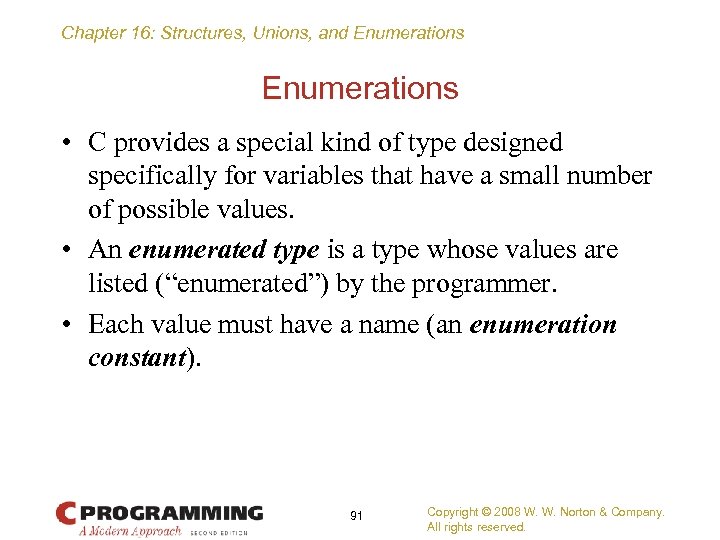 Chapter 16: Structures, Unions, and Enumerations • C provides a special kind of type designed specifically for variables that have a small number of possible values. • An enumerated type is a type whose values are listed (“enumerated”) by the programmer. • Each value must have a name (an enumeration constant). 91 Copyright © 2008 W. W. Norton & Company. All rights reserved.
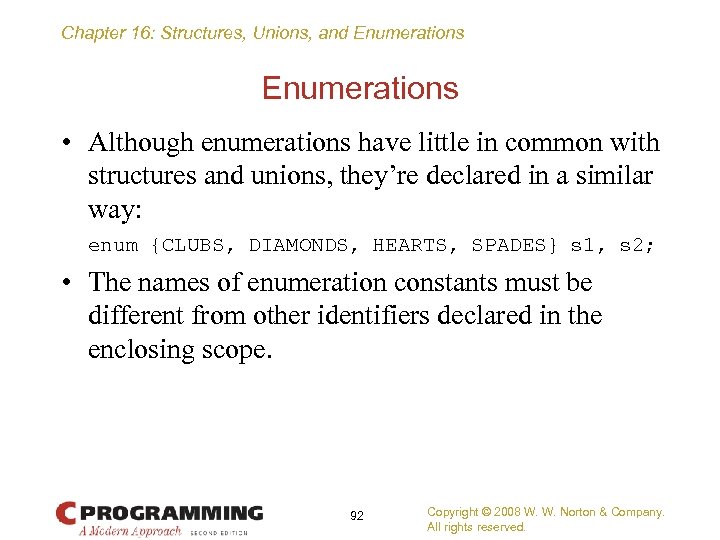 Chapter 16: Structures, Unions, and Enumerations • Although enumerations have little in common with structures and unions, they’re declared in a similar way: enum {CLUBS, DIAMONDS, HEARTS, SPADES} s 1, s 2; • The names of enumeration constants must be different from other identifiers declared in the enclosing scope. 92 Copyright © 2008 W. W. Norton & Company. All rights reserved.
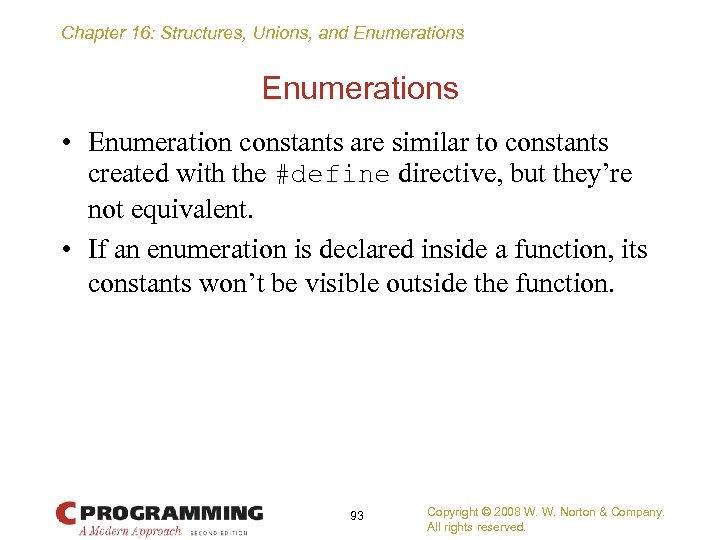 Chapter 16: Structures, Unions, and Enumerations • Enumeration constants are similar to constants created with the #define directive, but they’re not equivalent. • If an enumeration is declared inside a function, its constants won’t be visible outside the function. 93 Copyright © 2008 W. W. Norton & Company. All rights reserved.
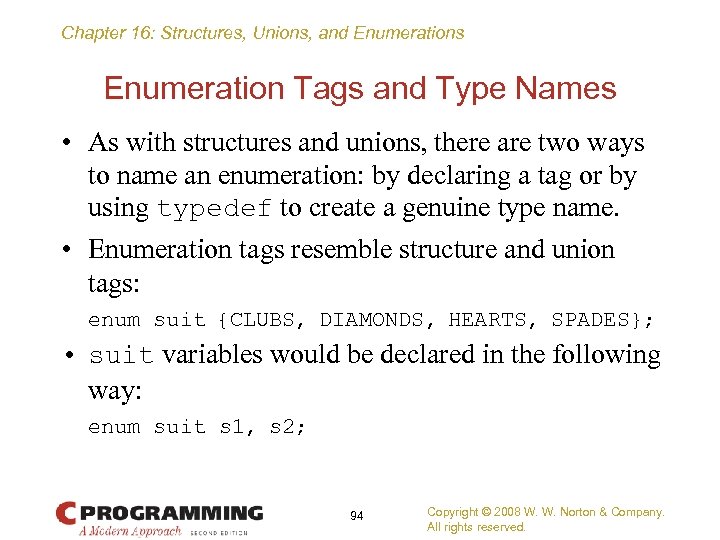 Chapter 16: Structures, Unions, and Enumerations Enumeration Tags and Type Names • As with structures and unions, there are two ways to name an enumeration: by declaring a tag or by using typedef to create a genuine type name. • Enumeration tags resemble structure and union tags: enum suit {CLUBS, DIAMONDS, HEARTS, SPADES}; • suit variables would be declared in the following way: enum suit s 1, s 2; 94 Copyright © 2008 W. W. Norton & Company. All rights reserved.
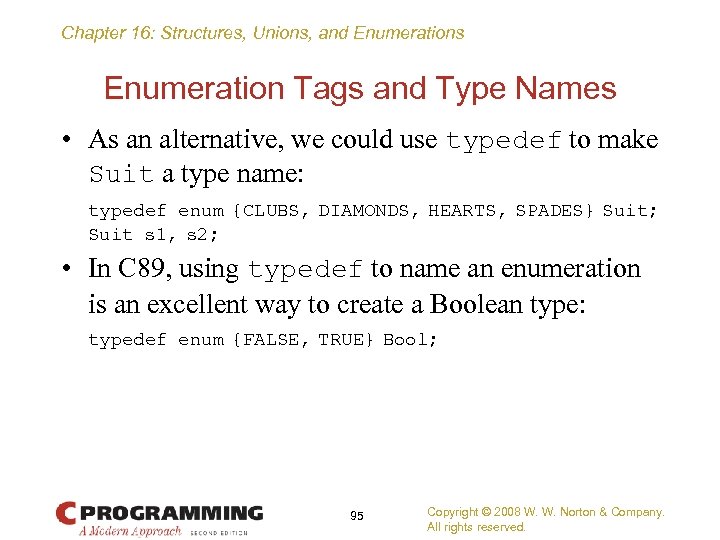 Chapter 16: Structures, Unions, and Enumerations Enumeration Tags and Type Names • As an alternative, we could use typedef to make Suit a type name: typedef enum {CLUBS, DIAMONDS, HEARTS, SPADES} Suit; Suit s 1, s 2; • In C 89, using typedef to name an enumeration is an excellent way to create a Boolean type: typedef enum {FALSE, TRUE} Bool; 95 Copyright © 2008 W. W. Norton & Company. All rights reserved.
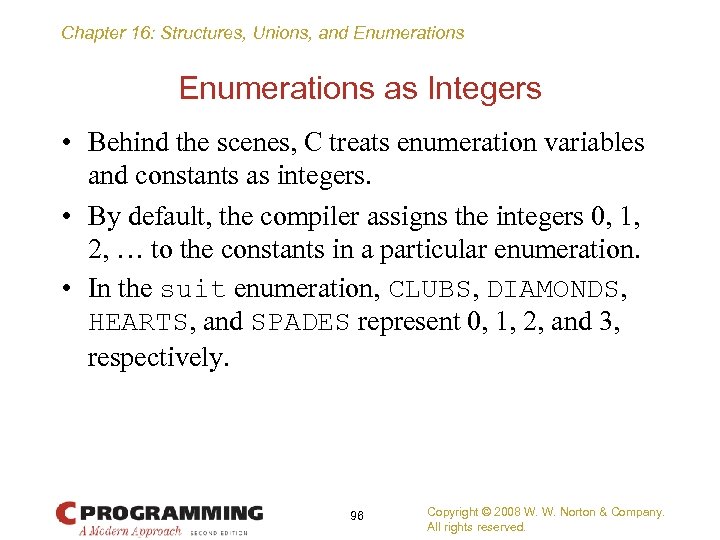 Chapter 16: Structures, Unions, and Enumerations as Integers • Behind the scenes, C treats enumeration variables and constants as integers. • By default, the compiler assigns the integers 0, 1, 2, … to the constants in a particular enumeration. • In the suit enumeration, CLUBS, DIAMONDS, HEARTS, and SPADES represent 0, 1, 2, and 3, respectively. 96 Copyright © 2008 W. W. Norton & Company. All rights reserved.
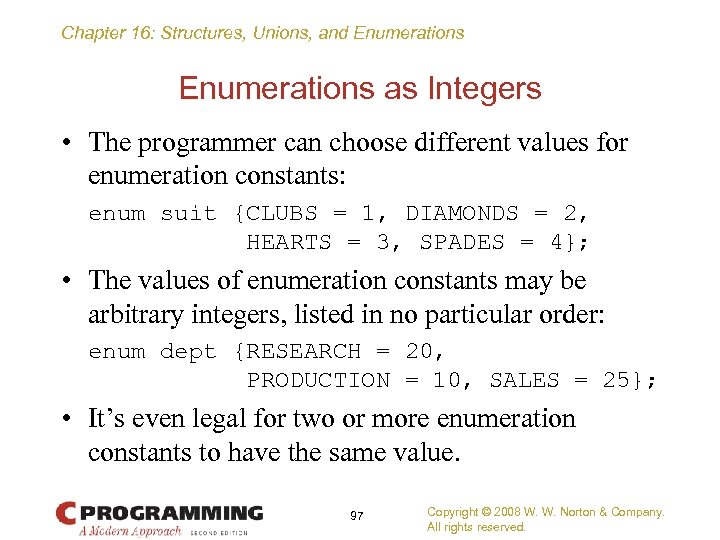 Chapter 16: Structures, Unions, and Enumerations as Integers • The programmer can choose different values for enumeration constants: enum suit {CLUBS = 1, DIAMONDS = 2, HEARTS = 3, SPADES = 4}; • The values of enumeration constants may be arbitrary integers, listed in no particular order: enum dept {RESEARCH = 20, PRODUCTION = 10, SALES = 25}; • It’s even legal for two or more enumeration constants to have the same value. 97 Copyright © 2008 W. W. Norton & Company. All rights reserved.
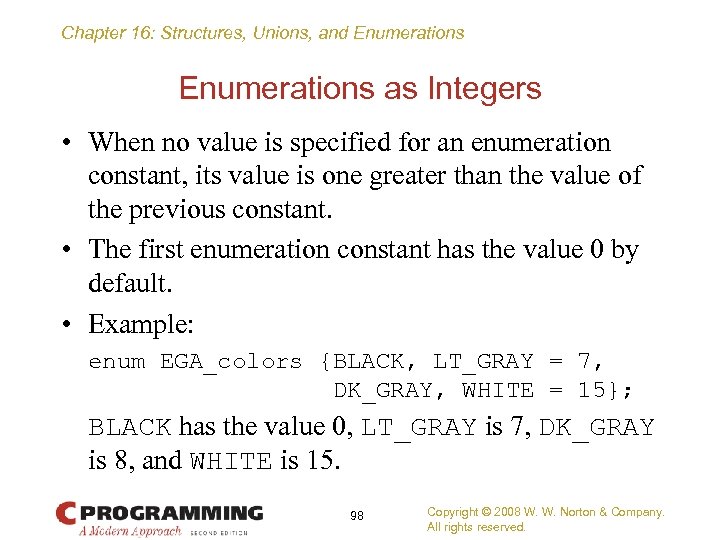 Chapter 16: Structures, Unions, and Enumerations as Integers • When no value is specified for an enumeration constant, its value is one greater than the value of the previous constant. • The first enumeration constant has the value 0 by default. • Example: enum EGA_colors {BLACK, LT_GRAY = 7, DK_GRAY, WHITE = 15}; BLACK has the value 0, LT_GRAY is 7, DK_GRAY is 8, and WHITE is 15. 98 Copyright © 2008 W. W. Norton & Company. All rights reserved.
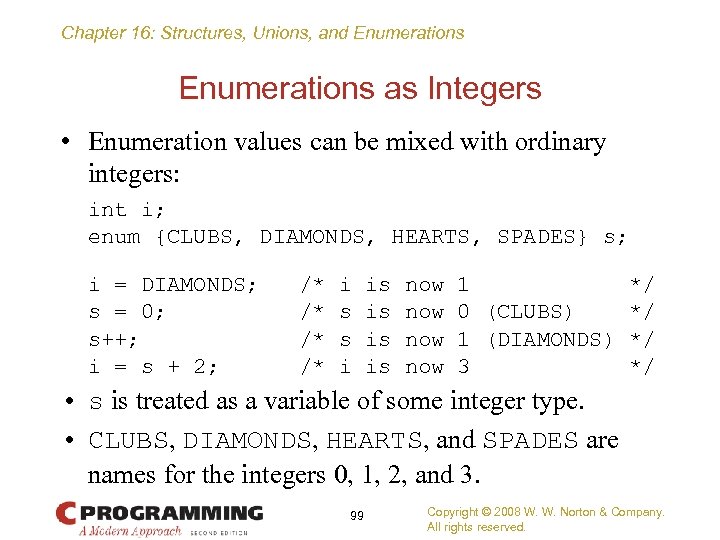 Chapter 16: Structures, Unions, and Enumerations as Integers • Enumeration values can be mixed with ordinary integers: int i; enum {CLUBS, DIAMONDS, HEARTS, SPADES} s; i = DIAMONDS; /* i is now 1 */ s = 0; /* s is now 0 (CLUBS) */ s++; /* s is now 1 (DIAMONDS) */ i = s + 2; /* i is now 3 */ • s is treated as a variable of some integer type. • CLUBS, DIAMONDS, HEARTS, and SPADES are names for the integers 0, 1, 2, and 3. 99 Copyright © 2008 W. W. Norton & Company. All rights reserved.
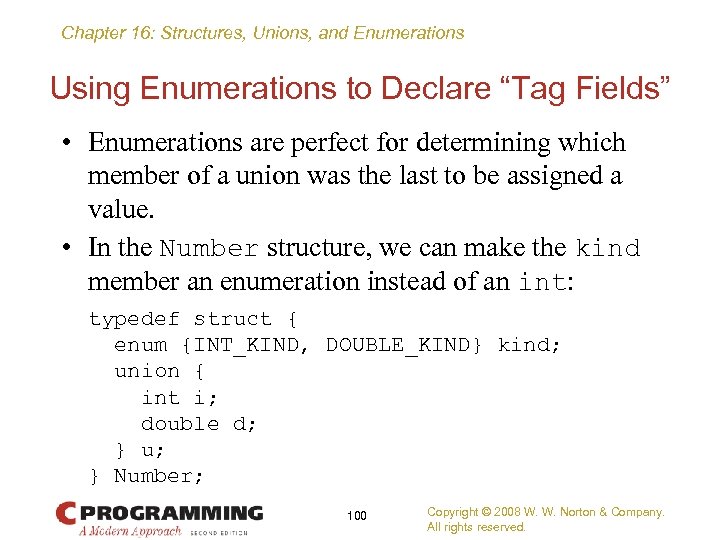 Chapter 16: Structures, Unions, and Enumerations Using Enumerations to Declare “Tag Fields” • Enumerations are perfect for determining which member of a union was the last to be assigned a value. • In the Number structure, we can make the kind member an enumeration instead of an int: typedef struct { enum {INT_KIND, DOUBLE_KIND} kind; union { int i; double d; } u; } Number; 100 Copyright © 2008 W. W. Norton & Company. All rights reserved.
 Chapter 16: Structures, Unions, and Enumerations Using Enumerations to Declare “Tag Fields” • The new structure is used in exactly the same way as the old one. • Advantages of the new structure: – Does away with the INT_KIND and DOUBLE_KIND macros – Makes it obvious that kind has only two possible values: INT_KIND and DOUBLE_KIND 101 Copyright © 2008 W. W. Norton & Company. All rights reserved.