 Скачать презентацию Chapter 16 Social Behavior Table of Contents
9ab03cf30d82845cb8d4ee65debc9b89.ppt
- Количество слайдов: 62



Chapter 16 Social Behavior Table of Contents
“ We cannot live for ourselves alone. ” Herman Melville Table of Contents 2
Social Psychology n Social psychology – studies how we think about, influence and relate to each other n Social cognition – mental processes one uses to perceive and react to others Table of Contents 3
Social thinking involves thinking about others, especially when they engage in doing things that are unexpected. Table of Contents 4
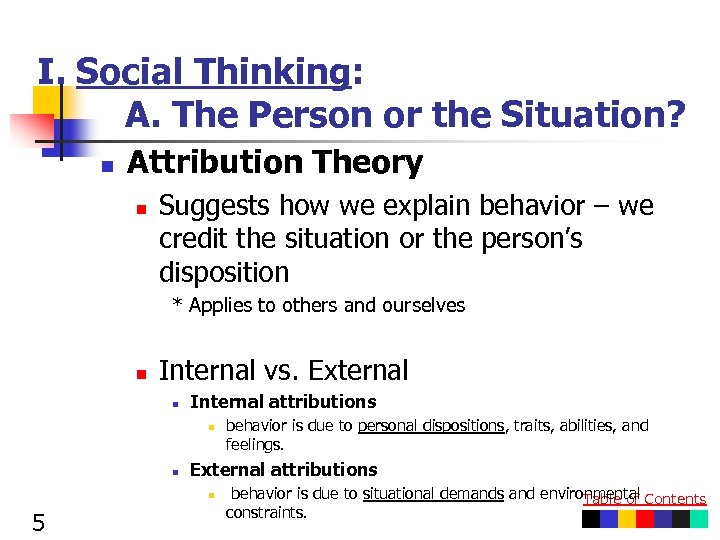
I. Social Thinking: A. The Person or the Situation? n Attribution Theory n Suggests how we explain behavior – we credit the situation or the person’s disposition * Applies to others and ourselves n Internal vs. External n Internal attributions n n External attributions n 5 behavior is due to personal dispositions, traits, abilities, and feelings. behavior is due to situational demands and environmental Contents Table of constraints.
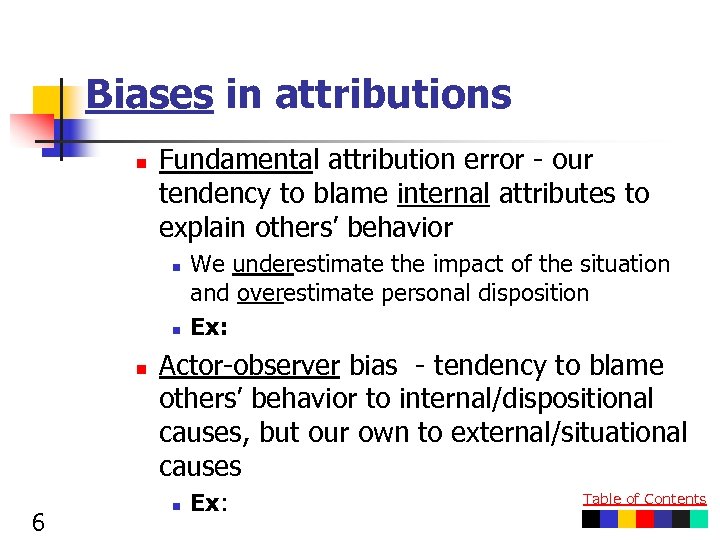
Biases in attributions n Fundamental attribution error - our tendency to blame internal attributes to explain others’ behavior n n n 6 We underestimate the impact of the situation and overestimate personal disposition Ex: Actor-observer bias - tendency to blame others’ behavior to internal/dispositional causes, but our own to external/situational causes n Ex: Table of Contents
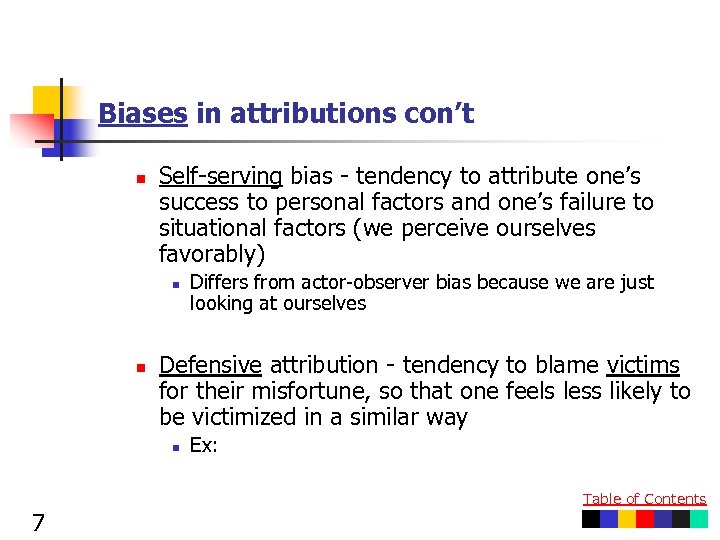
Biases in attributions con’t n Self-serving bias - tendency to attribute one’s success to personal factors and one’s failure to situational factors (we perceive ourselves favorably) n n Differs from actor-observer bias because we are just looking at ourselves Defensive attribution - tendency to blame victims for their misfortune, so that one feels less likely to be victimized in a similar way n Ex: Table of Contents 7
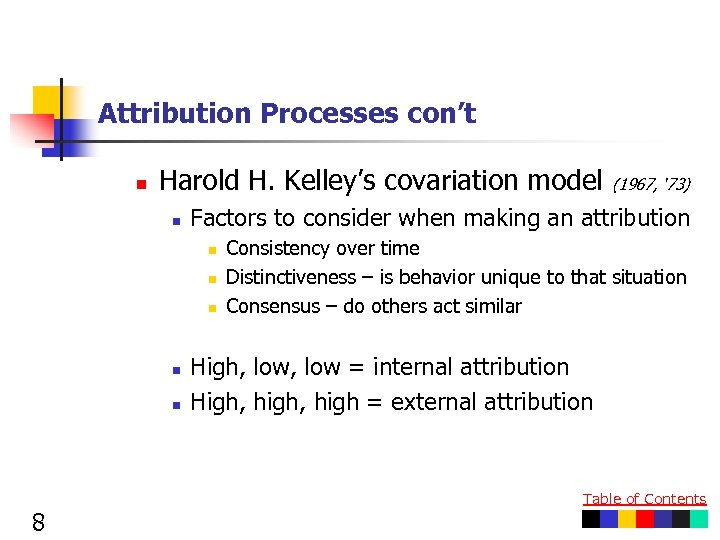
Attribution Processes con’t n Harold H. Kelley’s covariation model n Factors to consider when making an attribution n n (1967, ‘ 73) Consistency over time Distinctiveness – is behavior unique to that situation Consensus – do others act similar High, low = internal attribution High, high = external attribution Table of Contents 8
Attribution Processes con’t n Cultural influences n individualistic emphasis in Western cultures promotes the fundamental attribution error and the self-serving bias. Table of Contents 9
B. Attitudes & Actions 1. Attitudes n Attitudes - our feelings, based on our beliefs, that predispose our actions to objects, people and events *Our tendency to respond to a particular object in a certain way n Attitude Components: n n n Cognitive – a belief Emotional – a judgment, like or dislike Behavioral – a way of acting * Ex: 10 Table of Contents
Attitudes con’t n a. Attitudes can affect actions when… n n n Other influences are minimal Attitude is specific to the behavior We are keenly aware of our attitude (not wishy-washy) Table of Contents 11
n b. Actions can affect attitudes when people… n 1. comply to a small action which makes them more likely to comply to a larger action later (foot-in-thedoor phenomenon) n Ex: Table of Contents 12
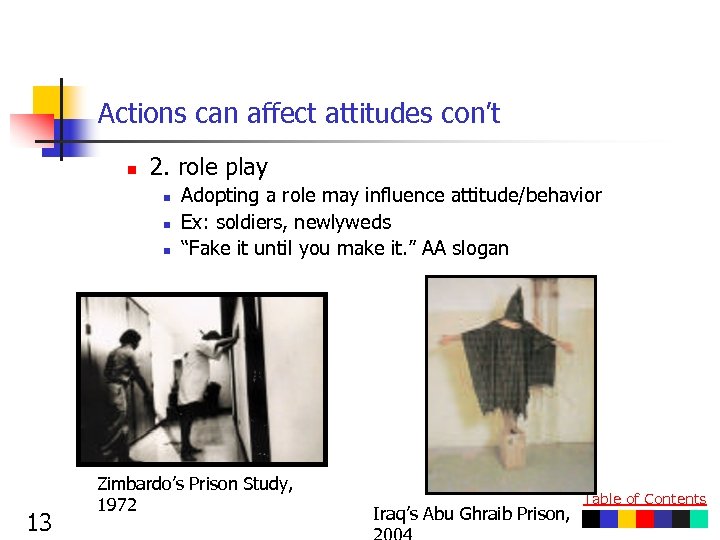
Actions can affect attitudes con’t n 2. role play n n n 13 Adopting a role may influence attitude/behavior Ex: soldiers, newlyweds “Fake it until you make it. ” AA slogan Zimbardo’s Prison Study, 1972 Iraq’s Abu Ghraib Prison, Table of Contents
Actions can affect attitudes con’t n 3. relieve cognitive dissonance (tension) by changing their attitude n Cognitive Dissonance theory (Festinger) n n inconsistent/conflicting attitudes cause tension, people alter their attitudes to reduce cognitive dissonance n * the change reduces the tension *see next slide Ex: Table of Contents 14
2. Factors Influencing Attitude Change n Roads to Persuasion n Central vs. Peripheral route to persuasion n n Central – logical arguments/cues Peripheral – superficial cues (e. g. speakers appearance) *central route attitude changes tend to last longer Table of Contents 15
Factors Influencing Attitude Change con’t n “Consider the source” n 1. Source n 2. Message n (credible, expert, trustworthy, likable, physically attractive) 3. Receiver (two-sided, sticks to strong points only, repetitive and fear arousing) (persuasion is harder if receiver was forewarned, has prior knowledge or a strong opinion on the topic) Table of Contents 16
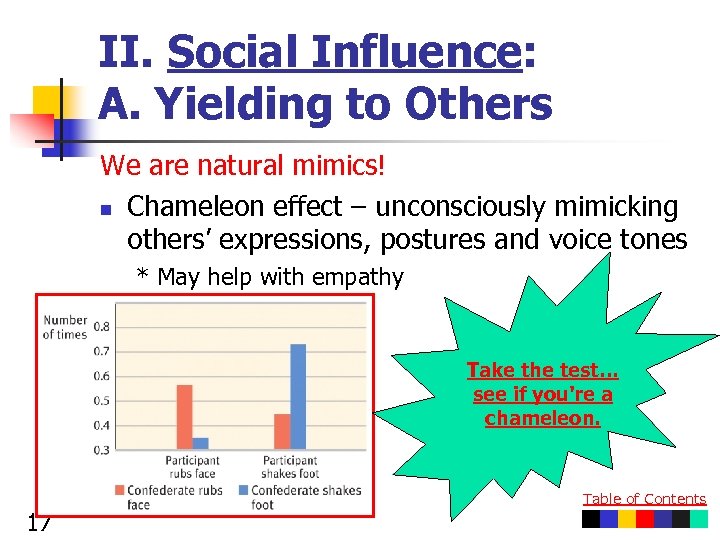
II. Social Influence: A. Yielding to Others We are natural mimics! n Chameleon effect – unconsciously mimicking others’ expressions, postures and voice tones * May help with empathy Take the test… see if you're a chameleon. Table of Contents 17
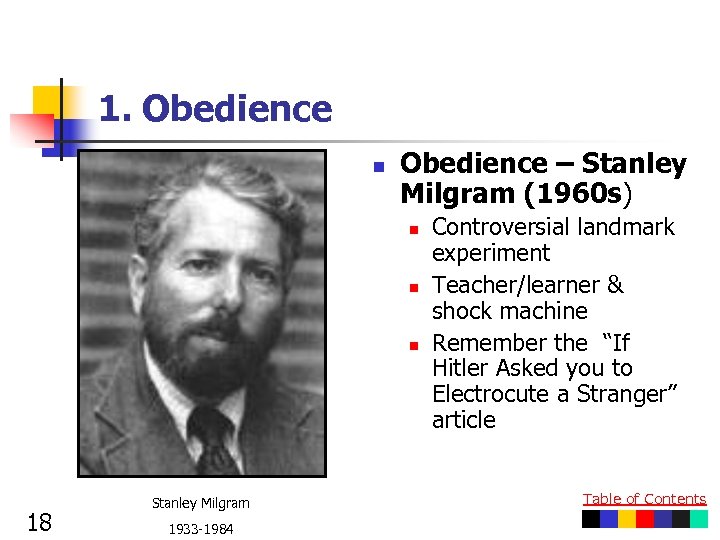
1. Obedience n Obedience – Stanley Milgram (1960 s) n n n 18 Stanley Milgram 1933 -1984 Controversial landmark experiment Teacher/learner & shock machine Remember the “If Hitler Asked you to Electrocute a Stranger” article Table of Contents
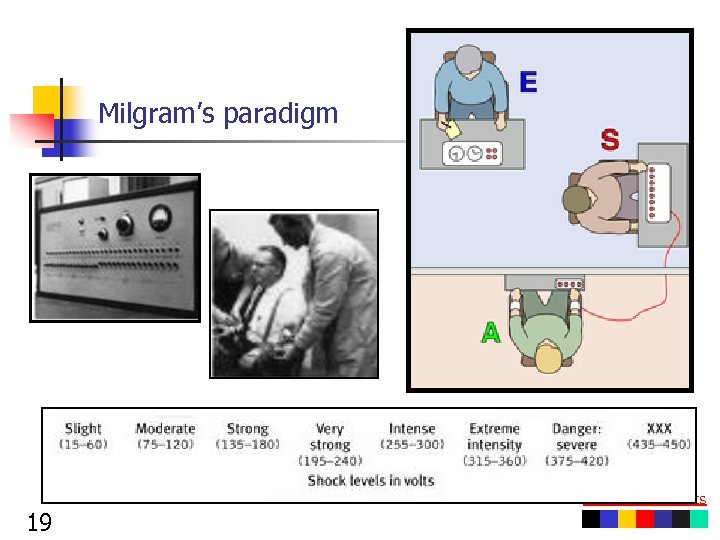
Milgram’s paradigm Table of Contents 19
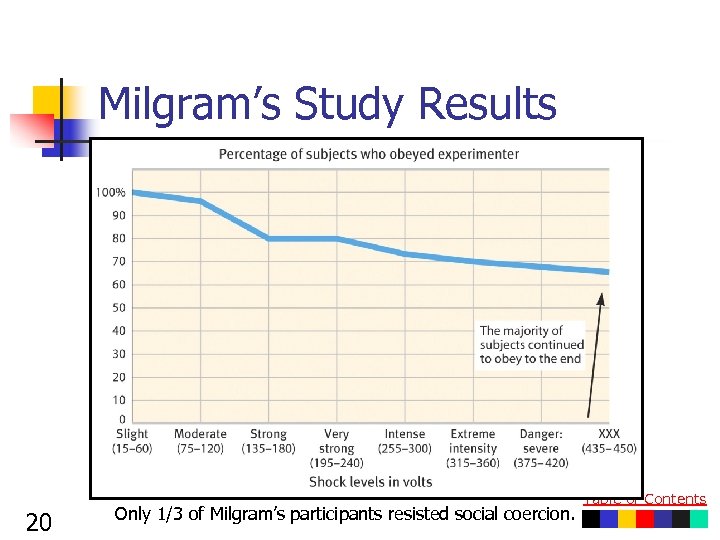
Milgram’s Study Results 20 Only 1/3 of Milgram’s participants resisted social coercion. Table of Contents
Yielding to Others: obedience con’t n Obedience was highest when… n the person giving orders was close and was perceived to be a legitimate authority figure n authority figure was supported by a prestigious institution n victim was depersonalized or at a distance n there were no role model for defiance (other participants were not seen disobeying) Table of Contents 21
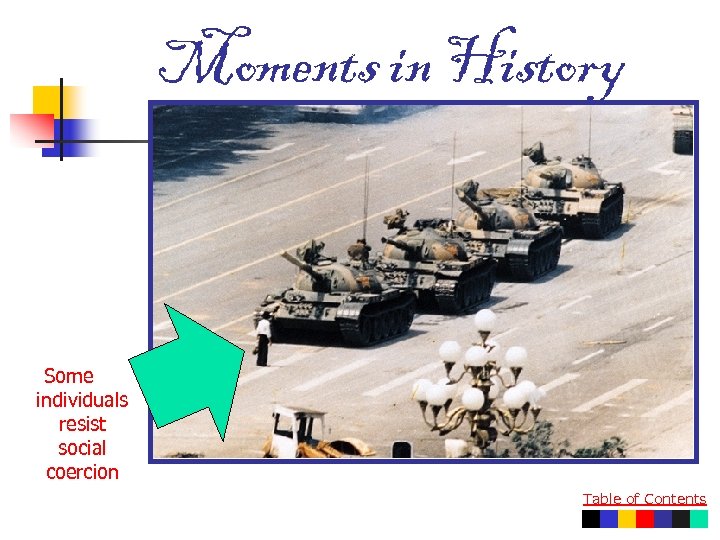
Moments in History Some individuals resist social coercion Table of Contents
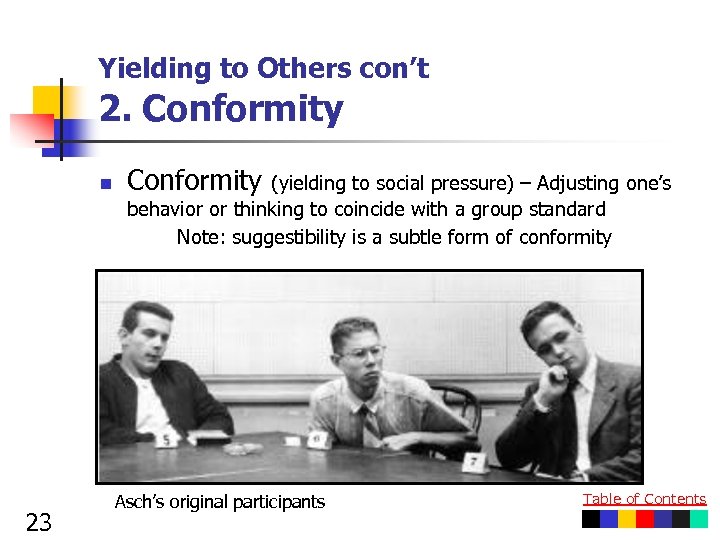
Yielding to Others con’t 2. Conformity n 23 Conformity (yielding to social pressure) – Adjusting one’s behavior or thinking to coincide with a group standard Note: suggestibility is a subtle form of conformity Asch’s original participants Table of Contents
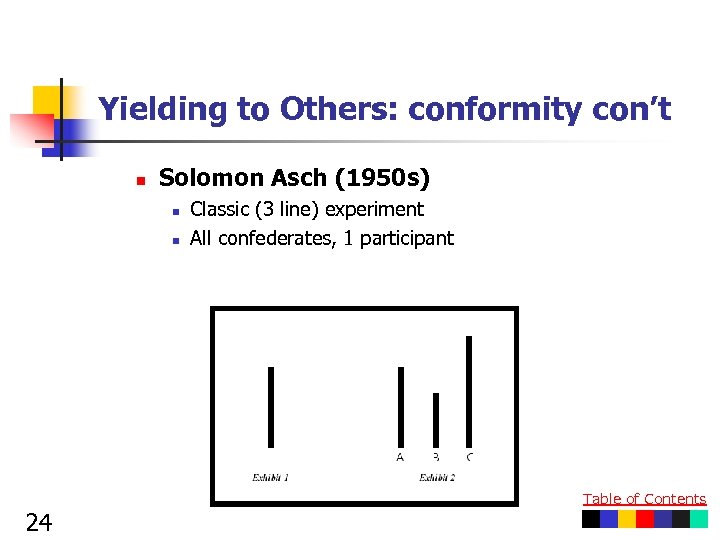
Yielding to Others: conformity con’t n Solomon Asch (1950 s) n n Classic (3 line) experiment All confederates, 1 participant Table of Contents 24
Yielding to Others: conformity con’t n Conditions Strengthening Conformity n n One is made to feel incompetent Group size – has at least 3 people n n Group is unanimous n n n conformity increases as group size does… to a point (24 members) if one dissents, subject is less likely to conform One admires group’s status/attractiveness No prior commitment to a response Group members observe one’s behavior One’s culture strongly encourages respect for social standards Table of Contents 25
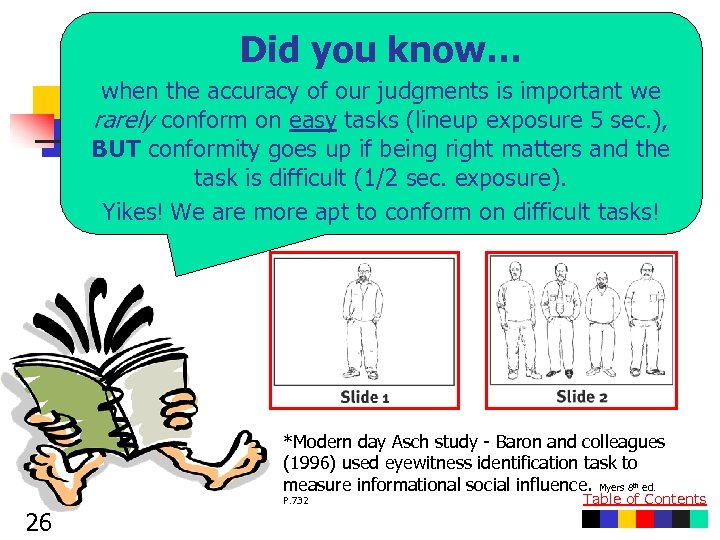
Did you know… when the accuracy of our judgments is important we rarely conform on easy tasks (lineup exposure 5 sec. ), BUT conformity goes up if being right matters and the task is difficult (1/2 sec. exposure). Yikes! We are more apt to conform on difficult tasks! *Modern day Asch study - Baron and colleagues (1996) used eyewitness identification task to measure informational social influence. Myers 8 ed. th P. 732 26 Table of Contents
Yielding to Others: conformity con’t n Reasons for Conformity n Normative social influence n n influence resulting from a person’s desire to gain approval or avoid rejection Informative social influence n influence resulting from one’s willingness to accept other’s opinion about reality * stubborn people typically won’t listen Table of Contents 27

“You Try” Quasi –Research on Conformity Next time you are with three or four friends, stop and gaze upward as if you are looking at something interesting. Watch to see if people passing by do the same. Table of Contents 28
II. Social Influence con’t B. Group Influence n How do groups affect our behavior? 1. Behavior in the Presence of Others n Social facilitation – improved performance in the presence of others n Ex: n n Ex: Table of Contents 29
Group Influence con’t 2. Behavior in Groups n a. Group productivity & Social loafing n productivity decreases as group size increases n 2 factors: n n loss of efficiency from loss of coordination of effort social loafing - reduction in effort when working in groups n 30 Ex: Table of Contents
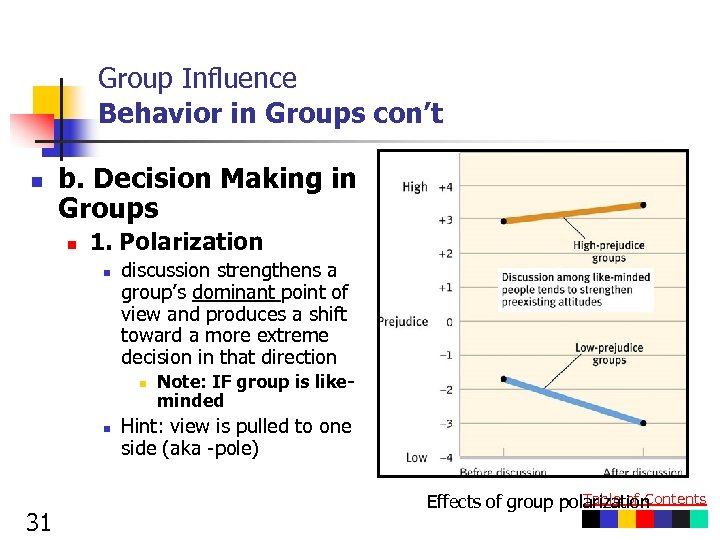
Group Influence Behavior in Groups con’t n b. Decision Making in Groups n 1. Polarization n discussion strengthens a group’s dominant point of view and produces a shift toward a more extreme decision in that direction n n 31 Note: IF group is likeminded Hint: view is pulled to one side (aka -pole) Table of Contents Effects of group polarization
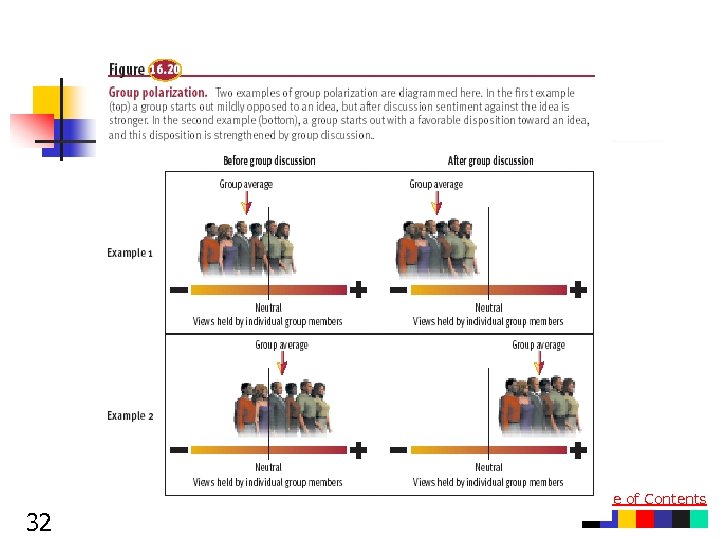
Table of Contents 32
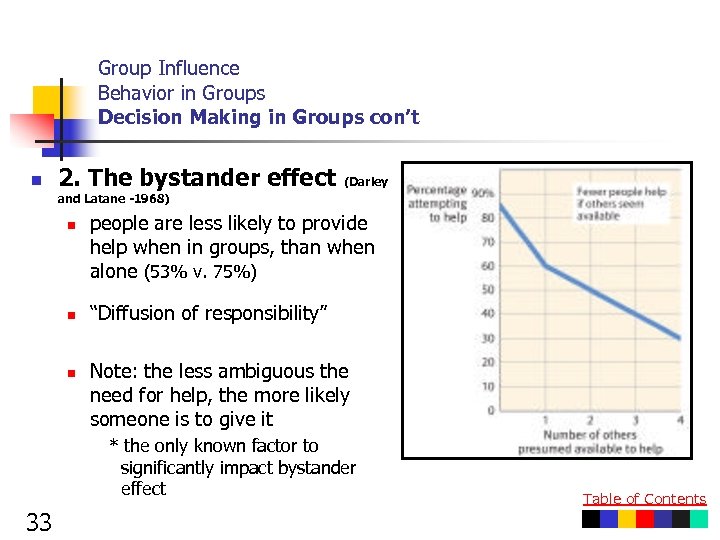
Group Influence Behavior in Groups Decision Making in Groups con’t n 2. The bystander effect (Darley and Latane -1968) n n n people are less likely to provide help when in groups, than when alone (53% v. 75%) “Diffusion of responsibility” Note: the less ambiguous the need for help, the more likely someone is to give it * the only known factor to significantly impact bystander effect 33 Table of Contents
Behavior in Groups con’t n 3. Groupthink n n members of a group agree at the expense of critical thinking Influencing factors n n Desire for harmony Cohesiveness of the group Group lacks an impartial leader Stressors (ex: time crunch) Table of Contents 34
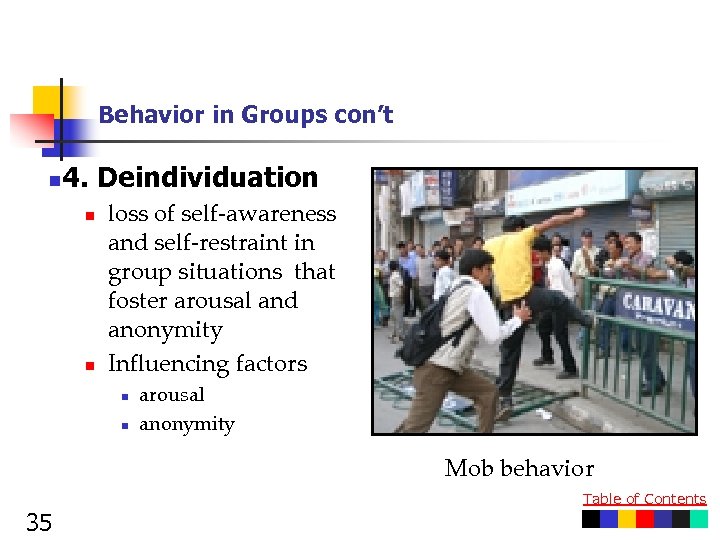
Behavior in Groups con’t n 4. Deindividuation n n loss of self-awareness and self-restraint in group situations that foster arousal and anonymity Influencing factors n n arousal anonymity Mob behavior Table of Contents 35
III. Social Relations: A. Person Perception: Forming Impressions n Effects of physical appearance n n “good looking” people – viewed as sociable, warm & competent “Baby-faced” people – are view as more honest Table of Contents 36
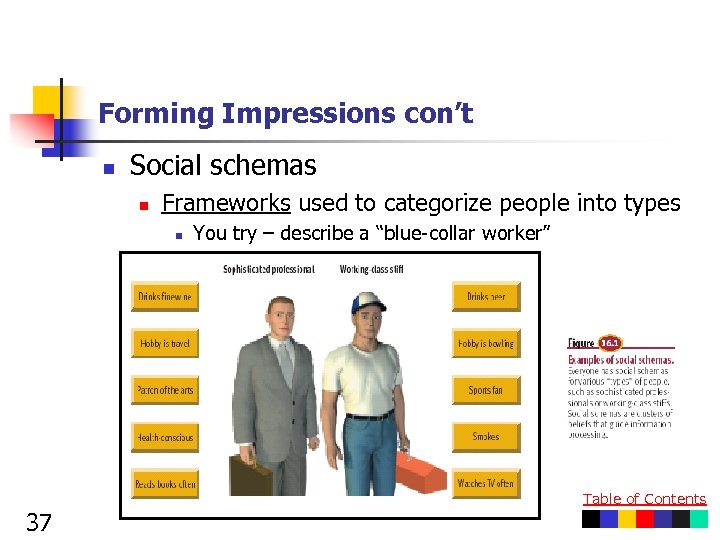
Forming Impressions con’t n Social schemas n Frameworks used to categorize people into types n You try – describe a “blue-collar worker” Table of Contents 37
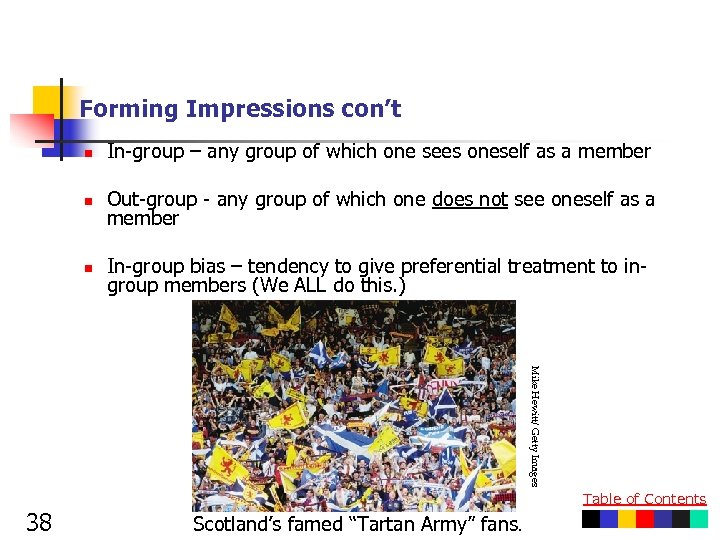
Forming Impressions con’t n In-group – any group of which one sees oneself as a member n Out-group - any group of which one does not see oneself as a member n In-group bias – tendency to give preferential treatment to ingroup members (We ALL do this. ) Mike Hewitt/ Getty Images Table of Contents 38 Scotland’s famed “Tartan Army” fans.
Forming Impressions con’t n Stereotypes - social schemas leading people to expect certain characteristic due to group membership What else might you call a stereotype? Can you list four of the most common stereotypes? Table of Contents 39
Can you list four of the most common stereotypes? n Common types: 1. n 2. n 3. n 4. n Table of Contents 40
What’s the difference between prejudice and discrimination? Table of Contents 41
Forming Impressions con’t Prejudice IS “prejudgment” n n a prejudice is an unjustifiable (usually negative) attitude toward a group and its members. • • typically directed towards different cultural, ethnic, or gender groups. works at the conscious and [more at] the unconscious level, tends to be more like a knee-jerk response than a conscious decision. Table of Contents 42
STOP & Reflect!!! Do you selfhandicap or self sabotage? Click & see. Table of Contents 43
Forming Impressions Roots of Prejudice n Components/Roots of Prejudice • (see slide) Cognitive/Beliefs (stereotypes) • • n n we simplify our world to categorize. vivid cases feed stereotypes or prejudices tendency of people to believe the world is just, and people get what they deserve and deserve what they get (the just world phenomenon) the tendency to believe that we could have predicted the outcome of an event beforehand (hindsight bias ) may contribute to blaming the victim and forming a prejudice against them Table of Contents 44
Forming Impressions Roots of Prejudice con’t • Emotional Roots • • Social Roots • • provides an outlet for hostility, envy, fear [emotion] by providing someone to blame Social Inequalities Social Divisions Emotional Scapegoating Predisposition to act (to discriminate) Table of Contents 45
Forming Impressions Roots of Prejudice con’t n Additional Factors Influencing Prejudice n Cognitive & Environmental n n Subjectivity in person perception n n Cognitive factors – it’s mentally economical Memory biases lean toward confirmation (confirmation bias) Transmission across generations (observational learning, strengthened through operant conditioning) people tend to see what they expect to see and to overestimate how often they see it (illusory correlation). Evolutionary perspectives n biases were adaptive in our ancestral past (separate friend from foe) Table of Contents 46
You can not stop an ignorant person from being prejudice, but you can prevent yourself from self-sabotaging. Table of Contents 47
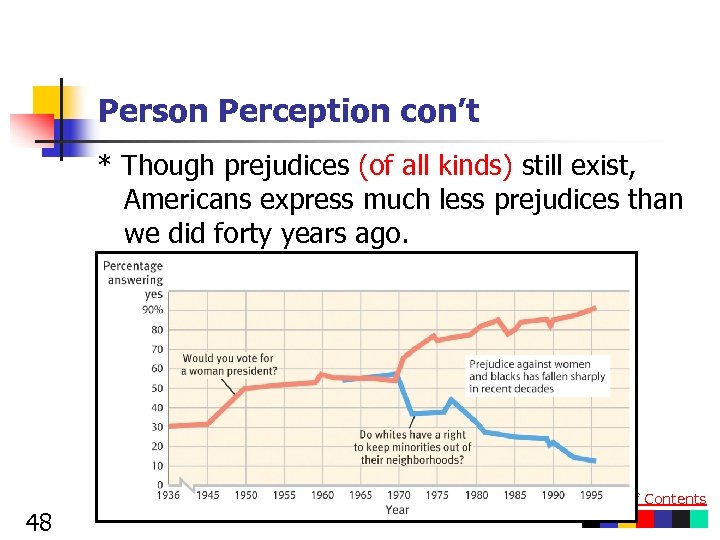
Person Perception con’t * Though prejudices (of all kinds) still exist, Americans express much less prejudices than we did forty years ago. Table of Contents 48
Close Relationships: Liking and Loving n A. Factors in attraction n 1. Proximity: Geographic nearness – it breeds friendship n n 2. Physical Attractiveness: after proximity, the next most important thing in attraction. n Matching hypothesis n 49 Repeated exposure to novel stimuli increases their attraction (mere exposure effect). proposes males and females of equal attractiveness select Table of Contents each other as partners
Liking and Loving con’t n 3. Similarity n n n (age, race, religion, social class, etc. ) Byrne’s: suggests similarity causes attraction Davis and Rusbult (2001): attraction fosters similarity, with partners experiencing attitude alignment 4. Reciprocity n liking those who show they like you Table of Contents 50
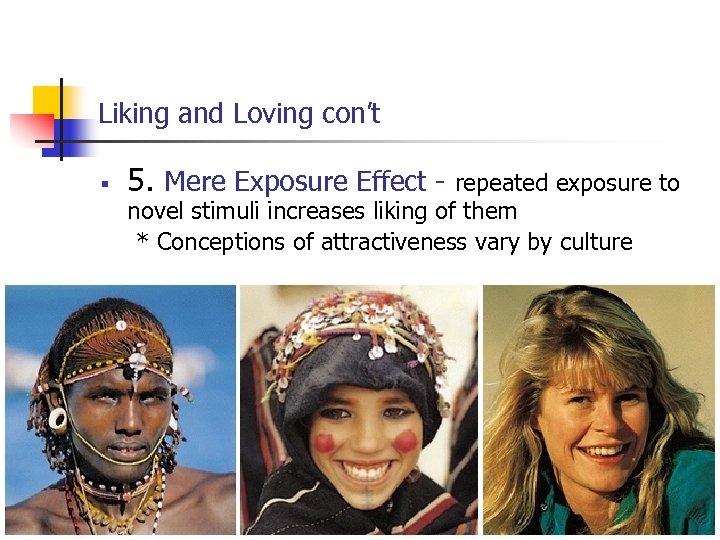
Liking and Loving con’t § 5. Mere Exposure Effect - repeated exposure to novel stimuli increases liking of them * Conceptions of attractiveness vary by culture Table of Contents 51
Liking and Loving con’t n B. Perspectives on Love n Hatfield & Berscheid n Passionate vs. Companionate love n n Passionate - an aroused state of intense positive absorption in another, usually present in the beginning Companionate Love: a deep, affectionate attachment we feel for those with whom our lives are intertwined Table of Contents 52
Liking and Loving con’t n Sternberg Triangular theory n n n Suggest love relationships mimic attachment styles of infancy Evolutionary perspectives n 53 *the later two are part of companionate love Hazen & Shaver n n Passion, intimacy (warmth, closeness, and sharing) and commitment (the intent to stay) Mating priorities (look in text) Table of Contents
Did you know… fatuous love is based on passion and is usually short lived? Consummate love has high levels of Sternberg’s three – passion, commitment and intimacy. It’s difficult to attain and sustain. Table of Contents 54 http: //www. psywww. com
IV. Competition, Conflict & Cooperation n A. Conflict n n incompatibility of actions, goals, or ideas btw. individuals Social trap n a situation in which the conflicting parties, by each rationally pursuing their self-interest, become caught in mutually destructive behavior Table of Contents 55
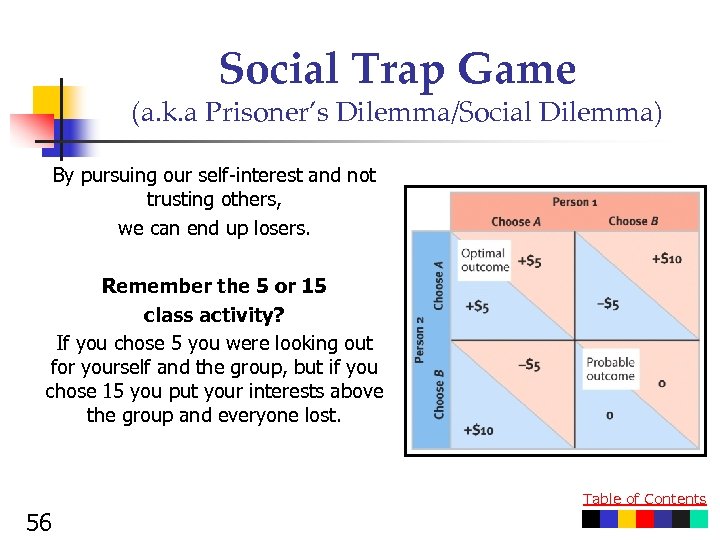
Social Trap Game (a. k. a Prisoner’s Dilemma/Social Dilemma) By pursuing our self-interest and not trusting others, we can end up losers. Remember the 5 or 15 class activity? If you chose 5 you were looking out for yourself and the group, but if you chose 15 you put your interests above the group and everyone lost. Table of Contents 56
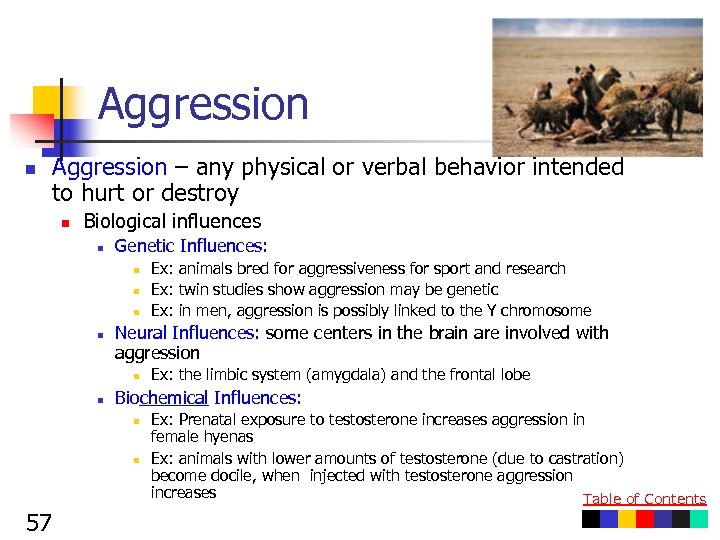
Aggression n Aggression – any physical or verbal behavior intended to hurt or destroy n Biological influences n Genetic Influences: n n Neural Influences: some centers in the brain are involved with aggression n n Ex: the limbic system (amygdala) and the frontal lobe Biochemical Influences: n n 57 Ex: animals bred for aggressiveness for sport and research Ex: twin studies show aggression may be genetic Ex: in men, aggression is possibly linked to the Y chromosome Ex: Prenatal exposure to testosterone increases aggression in female hyenas Ex: animals with lower amounts of testosterone (due to castration) become docile, when injected with testosterone aggression increases Table of Contents
Aggression con’t n Psychological influences on aggression n n Dealing with aversive events Learning aggression is rewarding Observing models of aggression Acquiring social scripts Frustration-Aggression Principle - principle which states frustration (caused by the blocking of an attempt to achieve a desired goal) creates anger, which can generate aggression Table of Contents 58
Aggression con’t Table of Contents 59
Did you know… people in conflict often form diabolic images of one another? It’s a “mirror-image perception”. Example, George Bush and Saddam Hussein described each other in the same way. Saddam Hussein is a “wicked Pharaoh”* George Bush is “evil”* Table of Contents 60 * Actual quotes
Competition, Conflict & Cooperation con’t n B. Cooperation: Helping Others § Altruism - an unselfish regard for the welfare of others § Pro-social behavior - positive, helpful behavior (opposite of antisocial behavior) § Social Exchange theory states our social behavior is an exchange process, the aim is to maximize benefits and minimize costs § Reciprocity Norm - the expectation that we should return help and not harm those who have helped us § Social–Responsibility Norm - norm that states help others when needed even if we may not be repaid * typically a learned behavior Table of Contents 61
THE END! n Study “Beyond Recognition” Note cards are due n Mini -test n n n 25 minute free response multiple choice Table of Contents 62
Скачать презентацию Chapter 16 Social Behavior Table of Contents
9ab03cf30d82845cb8d4ee65debc9b89.ppt